119
연구노트
©The Korean Society of Food Science and Technology
누룩원료를 달리하여 제조한 쌀약주의 관능적 특성
이승주*·안병학1
세종대학교 외식경영학과, 1한국식품연구원 우리술연구센터
Sensory Profiling of Rice Wines Made with Nuruks Using
Different Ingredients
Seung-Joo Lee* and Byung-Hak Ahn1
Department of Food Service Management, Sejong University
1Brewing Research Center, Korea FoodResearch Institute
Abstract The quantitative sensory profiles of rice wines made with nuruks using eight different cereal ingredients were
developed using sensory descriptive analysis. Two appearances, eight aromas, eight flavors and tastes, and two mouthfeel related sensory attributes were evaluated by a panel of 10 judges. The sample made of black rice nuruk had the highest intensity in red color, while the other samples had similar ranges in yellow color. The mean sensory intensities of the samples prepared with black rice and glutinous rice nuruks were high in ‘sweet’, ‘fruit taste’, ‘pungent’, and ‘sour’, while those samples prepared using non-glutinous rice, buckwheat, hull-less barley, unpolished rice nuruks had overall high intensities in ‘grain’, ‘fermented aroma’, ‘bitter’, and ‘astringent’ attributes. Based on the principal component analysis of the descriptive data, samples were primarily separated along the first principal component, which accounted for 53% of the total variance between the rice wines with high intensities of ‘red color’, ‘sweet’, and ‘fruit taste’ versus ‘bitter’, ‘astringent’, and ‘yellow color’.
Key words: Korean rice wine, Nuruk, fermentation, sensory analysis, descriptive analysis
서 론 우리나라의전통주는삼한시대와삼국시대를거쳐고려시대다 양한양조법이정착되어약주와탁주, 소주등여러형태의술로 발전하였다(1). 우리의전통주에는다양한곡류(보리, 밀, 녹두, 옥 수수등)를이용한누룩과또한 다양한곡류(보리, 옥수수, 수수, 녹두, 조, 메밀, 팥등) 및약재가사용되었고, 조선시대에는양조 기술이 고급화되고술의 제조 및판매가 자유로워져 360여종의 다양한술이름을남기는전성기를맞이하였다(2). 그러나일제강 점기를거치면서대부분이러한양조기술이단절되고해방후에 도양곡정책등으로인하여쌀을이용한술의제조가엄격히규 제되어민속주들은명맥이단절되었다. 그러나 '88서울올림픽개 최를계기로우리나라전통문화의계승에의필요성이제기되고이 를계기로관련법조항을개정하여현재탁주, 약주, 리큐르, 일반 증류주, 증류식소주, 기타주류등의다양한제품이시판되고있다. 전통탁·약주는위에서기술한 바와같이다양한곡물원료 와가향약재를사용하고자연중에존재하는미생물을이용한누 룩을사용하여발효를 하는특징이있다(2,3). 전통누룩사용시 곡류의당화 및발효에작용하는 미생물의 분포가다양하고 이 들의복합적인당화과정과발효과정이 동시다발적으로이루어져 균일화된 주질의제품생산에어려움이있다. 따라서일제강점 기를 거치며 현재까지 일본술 제조에 이용되는 Aspergillus 속 곰팡이와 효모가주로 사용되고 있으며원재료 또한쌀에한정 되어서 기존의전통주의 다양성이상실되었고, 소비자또한 천편 일률적인제품에식상하여약주시장은침체기를맞이하게되었 다(3,4). 과학적으로 선별된 미생물을 사용하는 경우 술 제조에 안정성은 있으나, 다양한균류조성에의해양조된전통주의 풍 부한향미와맛을재현시키지는 못하는실정이다(2). 누룩에관한 연구로는주로 전통누룩에 유래하는유용곰팡 이및효모의분리와동정에관한 연구(5-8)와각종균주를적용 한개량누룩과전통누룩을이용한양조주의품질및이화학적특 성에관한연구가수행되었다(9-15). 그러나이러한연구는전반 적으로균주의당화력과알코올생성능에초점을맞추어만들어 진술의 관능적특성에 대한체계적이고 정량적인 분석은부족 한실정이다. 따라서 본연구에서는 점차획일화되어가는 약주의 원료 및균주 다양화를위한기초자료를확보하기위해, 국내에서 생산되는다양한곡물원료(멥쌀, 찹쌀, 메밀, 쌀보리, 찹쌀흑미, 현 미, 흑미, 현미찹쌀)를이용하여 전통누룩을제조하고 이를이용 하여 만든 쌀약주 8종의 관능특성을 일반적인 묘사분석 방법
(generic descriptive analysis method)으로분석하였다.
재료 및 방법
재료
전국적으로생산되는다양한곡류 19종을수집하여누룩을제
*Corresponding author: Seung-Joo Lee, Department of Food Service Management, Sejong University, Seoul 143-147, Korea
Tel: 82-2-3408-3187 Fax: 82-2-3408-4313 E-mail: [email protected]
Received November 14, 2009; revised December 3, 2009; accepted December 4, 2009
조한후당화력 검사를통해 상대적으로 높은당화력을 나타낸
8종의 곡류를 선발하여 실험의 재료로 사용하였다. 멥쌀
(non-glutinous rice, NGR)은경북청도, 찹쌀(glutinous rice, GR)과메 밀(buckwheat, BW)은경북영양군, 현미(unpolished rice, UPR)는 경북성주, 쌀보리(hull-less barley, HLB)는 전북남원, 찹쌀흑미
(waxy black rice, WBR)는경북하양, 현미찹쌀(unpolished
gluti-nous rice, UGR)과흑미(black rice, BR)는경북현풍에서구입하 여사용하였다. 주모제조용효모는 Saccharomyces cerevisiae
(Fer-mivin No.7013, Inra, Narbonne, Servian, France)를사용하였다. 8종 곡물을 이용한 전통누룩 제조 각곡물을파쇄한후급수율 40%로하여사각성형누룩(20×14 cm, 두께 2 cm)을제조하고이를 25oC에서 2주간배양, 40oC에서 2일간건조한후 cold room에보관하면서사용하였다. 각 곡물누룩을 이용한 쌀약주 제조 시험양조는이양법으로 시행하였다. 일반멥쌀을 평량하고수 세한후 4시간 침지하여 1시간가량 물빼기를 한후광목에싸 서스팀증자기에넣고스팀이나온 후부터약 30분간 증자하여 실온으로 냉각시킨 후 사용하였다. 1단 담금(증자미 14%, 물 16.2%, 각곡물누룩 0.5%, 효모 0.07%)하여 25oC에서 1일간발 효한후 2단담금(쌀 31.4%, 각곡물누룩 0.6%, 물 36.8%)을하 여 20oC에서 16일간발효하여쌀약주를제조하였다. 묘사분석 묘사분석을 위한검사원은 한국식품연구원 24-37세남성 4명, 여성 6명으로총 10명이 참여하였고기존의전통주관련묘사분 석경험이있는연구원으로이루어졌다. 묘사분석운영은 Lee 등 (16)의방법을참조하여일부변형하여실시하였다. 총 6회에걸 쳐패널 훈련을실시하였고 첫세션에서는 검사원에 대한간단 한패널설문이있고이어서각자검사원이 5종의시료를시음하 고묘사용어를도출한후패널간토의가이루어졌다. 두번째 세 션에서는 전세션에 도출된향특성에 대해서 스탠다드를제시 하고 선정된 용어와 비교하여 수정하는 과정을 가졌다. 세번째 세션에서는맛특성에대해스탠다드를제시하고선정된용어와 비교하였으며, 네번째세션에서는시료의묘사특성과스탠다드에 대한 검토와 패널 간의 토의로 이루어 졌고 5번째 세션에서는 matching test를 통해 패널요원의 묘사특성 이해 정도 파악하고 최종적으로 시료의묘사용어를 패널간합의를 통해결정하였다. 마지막훈련세션에서는본실험을위해채점표와척도에대해 배 우고 척도사용에익숙하도록 한후실제훈련세션을 통해 3개 의시료를예비평가하였다. 각훈련세션은 약 40-60분정도 소요 되었다. 묘사분석 결과도출된관능평가용어는 Table 1과같다. 본 실험에서는 시료를 세자리 난수표로 표기하여 와인글라스에 18-21oC의 온도로 제시되었으며, 제시된 시료는 Williams' latin square법(17)에 의해 랜덤화되어 순서상의 오차를 최소화하였고 실험은 각각의 부스로 분리된 관능검사실에서이루어져 검사의 Table 1. Sensory attributes, definitions and physical standards
Attribute Code Written definition Physical standards
Appearance attributes
Yellowness yellow Intensity of yellow color No physical standards Redness red Intensity of red color No physical standards
Aroma attributes
Sweet sweet The smell associated with grain syrup Grain syrup 15 g/150 mL distilled water Ripe fruit fruit The smell associated with ripe fruits similar to pears Crushed pear 15 g/100 mL distilled water
Grain grain The smell associated with crushed barley and other grains Crushd unpolished rice and barley 4 g/20 mL distilled water Pungent pungent Pungent olfactory sense 0.2 mL vinegar/100 mL distilled water
Alcohol alcohol The smell associated with alcohol 25%(w/v) Ethanol solvent solvent Tthe smell associated with solvent thinner Paint
moldy moldy The smell associated with mold growth or mildew 2-Ethyl-1-hexanol 0.1%(w/v)
Fermented ferment The smell associated with activated yeast Fermented sugar solution (20%) for 24 hr by 1.5 g yeast
Flavor/taste attributes
Sweet sweet_T Basic taste descriptor characterized by a solution of sucrose Sucrose 6% (w/v)
Fruity flavor fruit_T flavor similar to pears Crushed pear 15 g/100 mL distilled water
Grain flavor Grain_T flavor similar to Crushed barley and other grains Crushd unpolished rice and barley 4 g/20 mL distilled water Sour sour Basic taste descriptor characterized by a solution of organic acid Citric acid 0.25%(w/v)
Alcohol flavor alcohol-T Alcohol 25%(w/v) Ethanol
Bitter bitter Basic taste characterized by a solution of caffeine, qui-nine and certain alkaloids Anhydride caffeine 0.1%(w/v)
fermented flavor ferment_T Yeasty Yeast0.1% in 10% warm sugar solution overnight
Mouthfeel/after taste attributes
Astringent astrin Mouthfeel of dryness Aluminium sulfate 0.1%(w/v) full-body body full- bodyness while tasting No physical standards
방해를최소한으로하였다. 각시료에 대해 2회반복으로평가가 이루어졌고 10점척도(0: 없음, 9: 대단히강함)를사용하여평가 하였다.
통계처리
묘사분석결과의통계분석을위하여분산분석(analysis of
vari-ance), 상관분석(correlation analysis)과주성분분석(principal
com-ponent analysis)을 Statistical Analysis Systems(SAS, Cary, NC,
USA) for Windows 7.2 또는 XLSTAT ver. 2007.1(Addinsoft,
NewYork, NY, USA)을 이용하여 실시하였다. 분산분석은 시료
(sample), 검사자(judge), 반복실험(rep)을 주요인으로 하고 시료* 검사자, 시료*반복실험, 검사자*반복실험 간의 교호작용을 파악 하였다. 결과 및 고찰 8종의원료곡물을달리한전통누룩(멥쌀, 찹쌀, 메밀, 쌀보리, 찹쌀흑미, 현미, 흑미, 현미찹쌀)을이용하여제조한쌀약주에대 한묘사분석을 실시하였다. 묘사분석 결과의삼원분산분석(three
way analysis of variance) 결과, 각 시료(sample)간에는 구수한맛
(grain taste)과알코올맛(alcohol taste)을제외한모든 항목에서유 의적차이가나타났다(p<0.05). 검사자와시료간의교호작용(Judge
* sample)에서적색도(redness), 과일향(fruit), 알코올향(alcohol), 구 수한맛(grain taste), 신맛(sour), 알코올맛(alcohol taste), 누룩맛
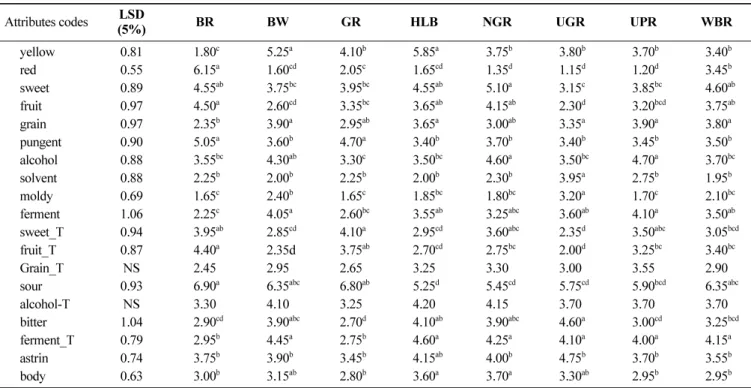
(fer-mented taste), 떫은맛(astringent), 바디감(full-body) 항목에서유의 적차이가 나타나지않아 검사자가일관되게 시료를 평가한것 으로나타났다. 그외의항목에서는 낮은수준의 유의적교호작 용이나타나시료간의평가가검사자간에다른방식으로이루어 졌으나시료간의유의적차이가나타나이러한검사자간의평가 방식의차이에도불구하고시료간의차이가있음을확인할수있 었다. 그외반복실험(rep)의경우일관된평가를수행한것으로 나타났다. 8개의약주 시료의묘사분석결과, 10명검사원의 2회반복 측 정한 결과의 평균점과 Fisher Least Significant Difference (LSD) 는 Table 2와 같다. 외관 특성에서는 메밀(BW)과 쌀보리(HLB) 누룩을 사용한경우노란색(yellow) 정도가진하게나타났다. 반 면 대부분의 경우 노란색이 일반적인 약주 색상을 나타냈으나, 흑미(BR) 누룩을사용한 경우는붉은빛(red)을띠는것으로 나 타났다. 누룩의 재료인 흑미의 색상이 반영된 것으로 찹쌀흑미 (WBR) 누룩을사용한경우도흑미(BR)에비해진하기는약하였 으나 다른시료에비해 적색을나타내었다. 향특성분석 결과를 살펴보면전반적으로시료의향특성이 5점이하의낮은수준으 로 나타났는데, 이는 가향약재를 사용하지 않고 멥쌀을 원료로 누룩 제조원료만을달리하여 만든시료의 특성으로여겨진다. 8 종시료중에서는멥쌀(NGR) 누룩을사용한경우단향(sweet)이 가장높은 것으로나타났고현미찹쌀(UGR) 누룩의경우단향 강 도가 가장낮았다. 과일향(fruit)의경우관련원료를사용하지 않 았으므로순전히발효과정에서생성된에스터성분에기인하는 것으로 여겨지며(18), 흑미(BR)와멥쌀(NGR) 누룩을 사용한 경 우가장높게나타났다. 구수한향(grain)의경우시료간의차이가 크지않았고흑미(BR) 누룩을사용한 경우가장낮게나타났다. 시큼한 향(pungent)은찹쌀(GR)과흑미(BR) 누룩을사용한경우 다른 시료에 비해 유의적으로 높은 수준을 나타냈다. 유기용매 냄새(solvent), 곰팡이냄새(moldy)와같이기호성에 나쁜영향을 주는관능특성의경우전반적으로모든시료에서낮은수준으로 나타났으나 현미찹쌀(UGR) 누룩을사용한경우가장높게나타
Table 2. Mean sensory attribute intensity ratingsa,b for eight rice wine samples determined by descriptive analysis from a panel of ten
judges over duplicate replications (BR: black rice, BW: buckwheat, GR: glutinous rice, HLB: hull-less barley, NGR: non-glutinous rice, UGR: unpolished glutinous rice, UPR: unpolished rice, WBR: waxy black rice). Attribute codes are defined in Table 1
Attributes codes (5%)LSD BR BW GR HLB NGR UGR UPR WBR
yellow 0.81 1.80c 5.25a 4.10b 5.85a 3.75b 3.80b 3.70b 3.40b red 0.55 6.15a 1.60cd 2.05c 1.65cd 1.35d 1.15d 1.20d 3.45b sweet 0.89 4.55ab 3.75bc 3.95bc 4.55ab 5.10a 3.15c 3.85bc 4.60ab fruit 0.97 4.50a 2.60cd 3.35bc 3.65ab 4.15ab 2.30d 3.20bcd 3.75ab grain 0.97 2.35b 3.90a 2.95ab 3.65a 3.00ab 3.35a 3.90a 3.80a pungent 0.90 5.05a 3.60b 4.70a 3.40b 3.70b 3.40b 3.45b 3.50b alcohol 0.88 3.55bc 4.30ab 3.30c 3.50bc 4.60a 3.50bc 4.70a 3.70bc solvent 0.88 2.25b 2.00b 2.25b 2.00b 2.30b 3.95a 2.75b 1.95b moldy 0.69 1.65c 2.40b 1.65c 1.85bc 1.80bc 3.20a 1.70c 2.10bc ferment 1.06 2.25c 4.05a 2.60bc 3.55ab 3.25abc 3.60ab 4.10a 3.50ab sweet_T 0.94 3.95ab 2.85cd 4.10a 2.95cd 3.60abc 2.35d 3.50abc 3.05bcd fruit_T 0.87 4.40a 2.35d 3.75ab 2.70cd 2.75bc 2.00d 3.25bc 3.40bc Grain_T NS 2.45 2.95 2.65 3.25 3.30 3.00 3.55 2.90 sour 0.93 6.90a 6.35abc 6.80ab 5.25d 5.45cd 5.75cd 5.90bcd 6.35abc alcohol-T NS 3.30 4.10 3.25 4.20 4.15 3.70 3.70 3.70 bitter 1.04 2.90cd 3.90abc 2.70d 4.10ab 3.90abc 4.60a 3.00cd 3.25bcd ferment_T 0.79 2.95b 4.45a 2.75b 4.60a 4.25a 4.10a 4.00a 4.15a astrin 0.74 3.75b 3.90b 3.45b 4.15ab 4.00b 4.75b 3.70b 3.55b body 0.63 3.00b 3.15ab 2.80b 3.60a 3.70a 3.30ab 2.95b 2.95b
aScale ranging from 0 to 9.
bMeans with the same letter in a row are not significantly different at α=0.05 by Fisher’s least significant difference (LSD) tests, NS denotes no significant difference.
났다. 누룩향(ferment)의경우현미(UPR)와메밀(BW) 누룩을사 용한경우가장높게 나타났고흑미(BR)를사용한경우가장낮 았다. 맛 특성을 살펴보면 모든시료에서 다른 맛특성에 비해 신맛(sour)이강하게나타나이에대한조절이필요한것으로여 겨진다. 단맛(sweet_T)의 경우 전반적으로 낮은 수준으로 찹쌀 (GR)과흑미(BR)를사용한경우다른시료에비해 높았고현미 찹쌀(UGR)을사용한경우 가장낮게나타났다. 신맛(sour)의경 우흑미(BR), 찹쌀(GR)을사용한경우가장높게나타났고쌀보 리(HLB)를 사용한경우 가장 낮았다. 현미찹쌀(UGR)을 사용한 경우 쓴맛(bitter)과 떫은맛(astrin)에서 높은 수준을 나타내 향후 이를제품생산에적용시에기호도에대한점검이필요할것으 로 여겨진다. 찹쌀(GR) 누룩 사용 시에는 쓴맛(bitter), 누룩맛 (ferment_T), 떫은맛(astrin)이가장 낮은수준으로 나타나기호도 에긍정적으로 적용할 것으로여겨지나 신맛부분에 대한조정 이 필요하리라 여겨진다. 단향과 과일향이 강한 찹쌀누룩 사용 쌀약주의관능특성은발효제가아닌원료로서찹쌀을사용한약 주의관능특성과도 유사한것으로나타났다(19).
묘사분석 결과의주성분분석(principal component analysis) 결 과는 Fig. 1과같았다(분산분석결과유의적차이를나타내지않 았던 특성은제외하였다). Fig. 1a)의 경우관능특성을 벡타선으 로제시하였고 Fig. 1b)의경우시료의분포를나타내었다. 분석 결과는 그림에서보여지는바와같이 첫번째, 두번째주성분(PC) 은전체테이타 편차의 53%와 18%를각각 대표하고있다. 관능 특성항목의분포를보면 PC1의오른편으로적색정도(red), 신맛
Fig. 1. Principal component analysis (PCA) loadings for (a) sensory attributes and (b) the eight rice wine samples (BR: black rice, BW: buckwheat, GR: glutinous rice, HLB: hull-less barley, NGR: non-glutinous rice, UGR: unpolished glutinous rice, UPR: unpolished rice, WBR: waxy black rice). Attribute (vector) codes are defined in Table 1.
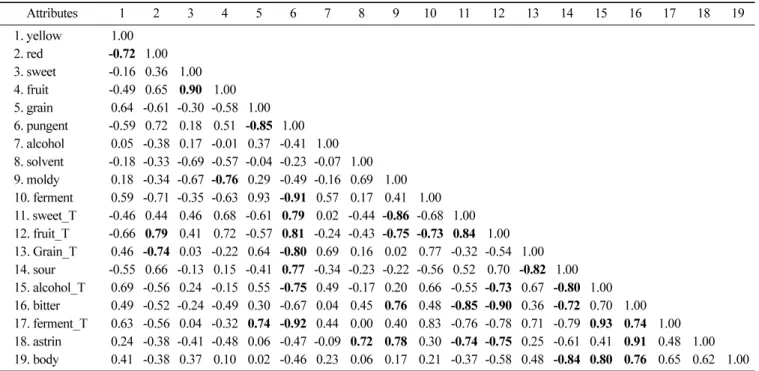
Table 3. Matrix of correlations for sensory attributes of rice wines profiled by descriptive analysis (n=10 judges X 2 replications)
Attributes 1 2 3 4 5 6 7 8 9 10 11 12 13 14 15 16 17 18 19 1. yellow 1.00 2. red -0.72 1.00 3. sweet -0.16 0.36 1.00 4. fruit -0.49 0.65 0.90 1.00 5. grain 0.64 -0.61 -0.30 -0.58 1.00 6. pungent -0.59 0.72 0.18 0.51 -0.85 1.00 7. alcohol 0.05 -0.38 0.17 -0.01 0.37 -0.41 1.00 8. solvent -0.18 -0.33 -0.69 -0.57 -0.04 -0.23 -0.07 1.00 9. moldy 0.18 -0.34 -0.67 -0.76 0.29 -0.49 -0.16 0.69 1.00 10. ferment 0.59 -0.71 -0.35 -0.63 0.93 -0.91 0.57 0.17 0.41 1.00 11. sweet_T -0.46 0.44 0.46 0.68 -0.61 0.79 0.02 -0.44 -0.86 -0.68 1.00 12. fruit_T -0.66 0.79 0.41 0.72 -0.57 0.81 -0.24 -0.43 -0.75 -0.73 0.84 1.00 13. Grain_T 0.46 -0.74 0.03 -0.22 0.64 -0.80 0.69 0.16 0.02 0.77 -0.32 -0.54 1.00 14. sour -0.55 0.66 -0.13 0.15 -0.41 0.77 -0.34 -0.23 -0.22 -0.56 0.52 0.70 -0.82 1.00 15. alcohol_T 0.69 -0.56 0.24 -0.15 0.55 -0.75 0.49 -0.17 0.20 0.66 -0.55 -0.73 0.67 -0.80 1.00 16. bitter 0.49 -0.52 -0.24 -0.49 0.30 -0.67 0.04 0.45 0.76 0.48 -0.85 -0.90 0.36 -0.72 0.70 1.00 17. ferment_T 0.63 -0.56 0.04 -0.32 0.74 -0.92 0.44 0.00 0.40 0.83 -0.76 -0.78 0.71 -0.79 0.93 0.74 1.00 18. astrin 0.24 -0.38 -0.41 -0.48 0.06 -0.47 -0.09 0.72 0.78 0.30 -0.74 -0.75 0.25 -0.61 0.41 0.91 0.48 1.00 19. body 0.41 -0.38 0.37 0.10 0.02 -0.46 0.23 0.06 0.17 0.21 -0.37 -0.58 0.48 -0.84 0.80 0.76 0.65 0.62 1.00
(sour), 시큼한향(pungent), 과일맛(fruit_T), 단맛(sweet_T)이나타났 고반대편으로 쓴맛(bitter), 누룩향(ferment), 구수한향(grain), 노란 정도(yellow)가분포하여대비를나타냈고서로가까이분포하여 상관관계가높은것으로여겨진다. PC2 상으로는대각선방향으 로 아래쪽에 곰팡이냄새(moldy), 유기용매 냄새(solvent), 떫은맛
(astrin)이나타났고 반대면으로 과일향(fruit), 단맛(sweet)이 자리 잡아관능특성간의 강한대비를나타내었다. 이러한 주성분분석 결과는묘사분석 항목간의 상관분석 결과에서도확인할 수있 다(Table 3). PC1 상에강한대비를 나타낸노란색 정도와적색 정도는서로유의적인음의상관관계(r=−0.72)를나타냈다(p<0.05). 또한 PC1 상의양의방향으로가깝게자리잡은과일향(fruit), 시 큼한향(pungent), 단맛(sweet_T), 과일맛(fruit_T), 신맛(sour)은서로 높은양의상관관계를 나타내었고(p<0.05), 이러한과일/단맛관 련 향미특성은 반대로 PC1상의 음의 방향에 자리잡은 누룩향
(ferment), 구수한향(grain), 누룩맛(ferment_T)과는 전반적으로 음 의상관관계를 나타내었다. 특히떫은맛은기호도에 부정적인영 향을주는것으로여겨지는쓴맛(r=0.91), 곰팡이냄새(r=0.78), 유 기용매냄새(r=0.72)와높은양의상관관계를나타내었다(p<0.05). 시료의분포를살펴보면 PC1의가장오른편으로흑미(BR)가나 타났는데이시료는신맛(sour), 시큼한향(pungent)이가장강하고 과일향(fruit), 단맛(sweet), 과일맛(fruit_T)에서도 높은 수준을 나 타났다. 또한 구수한향(grain), 누룩향(ferment)은가장 낮은수준 을보였다. 흑미(BR) 가까이 자라잡은찹쌀(GR)의경우도 흑미 와유사한관능특성을보이나 적색정도와신맛, 시큼한향에서흑 미에 비해낮은 수준을 나타냈다. 3사분면에 위치한 메밀(BW), 현미(UPR), 쌀보리(HLB), 멥쌀(NGR)을이용한 누룩으로제조한 쌀약주의경우유사한관능특성을나타냈는데구수한향(grain), 누 룩향(ferment), 누룩맛(ferment_T)이전반적으로높게 나타났고반 면시큼한향(pungent), 신맛(sour)은낮게 나타났다. 4개 시료간 에는좀더 PC2 방향으로위로분포한쌀보리(HLB)와멥쌀(NGR) 이단향(sweet)과과일향(fruit)이높은수준으로 나타났다. 4사분 면에위치한현미찹쌀(UGR)의경우기호도에나쁜영향을주는 것으로알려진(20) 쓴맛(bitter), 떫은맛(astrin), 곰팡이냄새(moldy), 유기용매 냄새(solvent)의강도는 시료중 가장 높고 반면 과일 및단향미특성은가장 낮게나타나향후제품개발에서 사용 여부를고려하여야할것으로여겨진다. 요 약 쌀을주원료로누룩원료만을교체하여제조한약주의경우도 시료별다양한 관능특성을 나타내어 누룩원료사용 변화를통 한관능특성 다양화가 가능한 것으로 나타났다. 선행연구(20)에 서떫은맛, 쓴맛, 곰팡이냄새, 유기용매 냄새는기호도 저해요인 으로나타났고 누룩향미에대해서는상반된의견이 나타났다. 따 라서본묘사분석 결과바람직한 관능특성을 나타낸 누룩의원 료로찹쌀, 찹쌀흑미, 멥쌀, 쌀보리, 메밀, 현미를 선정하고흑미 의경우신맛은 높았으나 전반적인패널의견에서 가장 높은기 호도를나타내어선정에 포함하였다. 향후선정된 7종의곡물을 바탕으로미생물분리및동정을통해우수균주를선발하고이 를통해누룩원료및미생물다양화에기여하고자 한다. 감사의 글 본연구는농림수산식품부농림기술개발사업(GA073303) 연구 결과의일부로서연구비지원에감사드립니다. 문 헌
1. Lee SR. Hankuk eui Balhyo Sikpum (Fermented Foods of Korea). Ewha Press, Seoul, Korea. pp. 142-155 (1986)
2. Lee MK, Lee SW, Yoon TH. The bibliographical study on nuruk. J. East Asian Soc. Dietary Life 4: 19-29 (1994)
3. Lee SS, Kim KS, Eom AH, Sung CK, Hong IP. Production of Korean traditional rice wines made from cultures of the single fungal isolates under laboratory conditions. Korean J. Mycol. 30: 61-65 (2002)
4. Chung HK. Characteristics and present status of Korean tradi-tional alcoholic beverage. Korean J. Diet. Culture 4: 311-318 (1989)
5. Jo GY, Lee CW. Isolation and identification of the fungi from
nuruk. J. Korean Soc. Food Sci. Nutr. 26: 759-766 (1997)
6. Kim HS, Hyun JS, Kim J, Ha HP, Yu TS. Characteristics of use-ful fungi isolated from traditional Korean nuruk. J. Korean Soc. Food Sci. Nutr. 26: 767-774 (1997)
7. Lee JH, Yu TS. Identification and characteristics of lactic acid bacteria isolated from nuruk. Korean J. Biotechnol. Bioeng. 15: 359-365 (2000)
8. Lee SH, Jung HJ, Yeo SH, Kim HS, Yu TS. Characteristics of á-Amylase of, a new species, Aspergillus coreanus NR 15-1. Korean J. Biotechnol. Bioeng. 19: 301-307 (2004)
9. Lee MK, Lee SW, Yoon TH. Quality assessment of yakju brewed with conventional nuruk. J. Korean Soc. Food Sci. Nutr. 23: 78-89 (1994)
10. Lee MK, Lee SW, Bae SM. The quality of yakju brewed from many kind of nuruk. J. East Asian Soc. Dietary Life 1: 99-111 (1991)
11. Lee TS, Choi JS. Volatile flavor components in mash of takju prepared by using Aspergillus kawachii nuruks. Korean J. Food Sci. Technol. 37: 944-950 (2005)
12. Park CS, Lee TS. Quality characteristics of takju prepared by wheat flour nuruks. Korean J. Food Sci. Technol. 34: 296-302 (2002)
13. Jung HK, Park CS, Park HH, Lee GD, Lee IS, Hong JH. Manu-facturing and characteristics of Korean traditional liquor, hahy-angju prepared by Saccharomyces cerevisiae HA3 isolated from traditional nuruk. Korean J. Food Sci. Technol. 38: 659-667 (2006)
14. Han H, Lee TS, Noh BS, Lee DS. Quality characteristics in mash of takju by using different nuruk during fermentation. Korean J. Food Sci. Technol. 29: 555-562 (1997)
15. Lee TS, Han EH. Volatile flavor components in mash of takju
prepared by using Rhizopus japonicus nuruks. Korean J. Food Sci. Technol. 32: 691-698 (2000)
16. Lee SJ, Kwon YH, Kim HR, Ahn BH. Chemical and sensory characterization of Korean commercial yakju. Food Sci. Biotech-nol. 16: 374-380 (2007)
17. Schlich P. Uses of change-over designs and repeated measure-ments in sensory and consumer studies. Food Qual. Prefer. 4: 223-235 (1993)
18. Blandino A, Al-Aseeri ME, Pandiella SS, Cantero D, Webb C. Cereal-based fermented foods and beverages. Food Res. Int. 36: 527-543 (2003)
19. Kim HR, Jo SJ, Lee SJ, Ahn BH. Physicochemical and sensory characterization of a Korean traditional rice wine prepared from different ingredients. Korean J. Food Sci. Technol. 40: 551-557 (2008)
20. Lee SJ, Lee KG. Understanding consumer preferences for rice wines using sensory data. J. Sci. Food Agric. 88: 690-698 (2008)