© 2013 The Korean Academy of Medical Sciences.
This is an Open Access article distributed under the terms of the Creative Commons Attribution Non-Commercial License (http://creativecommons.org/licenses/by-nc/3.0) which permits unrestricted non-commercial use, distribution, and reproduction in any medium, provided the original work is properly cited.
pISSN 1011-8934 eISSN 1598-6357
Percutaneous Renal Sympathetic Denervation for the Treatment of Resistant Hypertension with Heart Failure: First Experience in Korea
Percutaneous catheter-based therapy has recently been introduced to decrease blood pressure by ablation of efferent and afferent sympathetic renal nerves. The patient described here had a seven-year history of hypertension and presented with poorly controlled blood pressure despite antihypertensive therapy with four different drugs. A 44-yr-old man underwent percutaneous renal denervation under local anesthesia using an ablation catheter. After six months of follow-up his blood pressure had dropped 49/37 mmHg with a decrease in 24-hr ambulatory BP of 20/18 mmHg. Renal Doppler ultrasound showed no significant stenosis in either renal artery. This is the first case of successful percutaneous renal denervation, which has recently become available in Korea.
Key Words: Resistant Hypertension; Renal Sympathetic Denervation Jeong Hoon Yang, Seung-Hyuk Choi,
and Hyeon-Cheol Gwon
Division of Cardiology, Department of Medicine, Cardiac and Vascular Center, Samsung Medical Center, Sungkyunkwan University School of Medicine, Seoul, Korea
Received: 18 October 2012 Accepted: 15 February 2013 Address for Correspondence:
Seung-Hyuk Choi, MD
Cardiac and Vascular Center, Samsung Medical Center, Sungkyunkwan University School of Medicine, 81 Irwon-ro, Gangnam-gu, Seoul 135-710, Korea
Tel: +82.2-3410-3419, Fax: +82.2-3410-3849 E-mail: [email protected]
http://dx.doi.org/10.3346/jkms.2013.28.6.951 • J Korean Med Sci 2013; 28: 951-954
CASE REPORT
Cardiovascular Disorders
INTRODUCTION
The renal sympathetic nervous system has been identified as a major contributor to the complex pathophysiology of hyperten- sion and states of volume overload such as heart failure in hu- mans (1, 2). Recently, catheter-based renal sympathetic dener- vation (RDN) has been introduced as a new technique to re- duce blood pressure (BP) by denervation of efferent and affer- ent renal sympathetic nerve fibers using radiofrequency abla- tion (3, 4). Here we describe the first of these procedures per- formed in Korea on a 44-yr old male with resistant hyperten- sion complicated by heart failure. He successfully underwent percutaneous RDN with a significant reduction in BP after six months of follow-up.
CASE DESCRIPTION
Optimal BP could not be achieved in a 44-yr-old man with a seven-year history of hypertension despite antihypertensive therapy with four different drugs. He had a 30-pack-year smok- ing history with a body mass index of 33.4 kg/m2, no history of diabetes, and a family history of early coronary artery disease.
The patient first visited to our hospital with chronic headache on september 1, 2008. His antihypertensive medications con- sisted of hydrochlorothiazide 12.5 mg and felodipine 5 mg once a day, and carvedilol 25 mg and valsartan 160 mg twice a day.
His average office BP was 170/115 mmHg and his 24 hr-ambu- latory BP was 167/113 mmHg with a non-dipping profile (Fig.
1A).
The patient underwent the established clinical and laborato- ry evaluation to identify essential hypertension, and he did not have any secondary causes of hypertension (5). A physical ex- amination revealed no abnormal findings. Resting electrocar- diography revealed a normal sinus rhythm with left ventricular hypertrophy diagnosed using voltage criteria. N-terminal pro- brain natriuretic peptide, renin activity, aldosterone were 47.8 pg/mL (normal < 88 pg/mL), 0.5 ng/mL/hr (0.15 to 3.95 ng/mL/
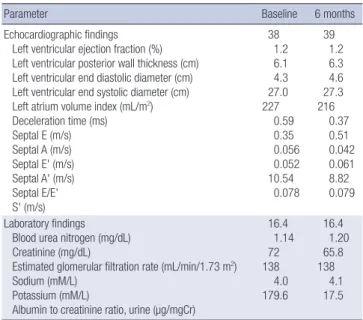
hr) and aldosterone was 4.0 ng/dL (1.0 to 27.3 ng/dL), respec- tively. In addition, other laboratory and his transthoracic echo- cardiographic findings were shown in Table 1. Computed to- mography showed bilateral renal artery length > 20 mm, lumen diameter > 4 mm, and no significant atherosclerotic plaques.
He underwent percutaneous RDN under local anesthesia with midazolam and fentanyl. First, a 6 French sheath was in- serted into the right femoral artery and 5000 units of heparin were injected intravenously. Renal angiography was performed through a 5 French pigtail catheter (Cordis, Miami Lakes, FL, USA). Then, a 6 French renal double curve guide catheter (Cor- dis, Miami Lakes, FL, USA) was inserted to engage the left renal artery. Using an ablation catheter (Symplicity, Ardian, Medtron- ic), five radiofrequency ablations (Fig. 2B) were delivered to the left renal artery and six (Fig. 2E) were delivered to the right renal
Yang JH, et al. • Renal Denervation in Resistant Hypertension
952 http://jkms.org http://dx.doi.org/10.3346/jkms.2013.28.6.951
Fig. 1. Monitoring of 24-hr ambulatory blood pressure (BP). (A) At baseline showing poorly controlled BP (average systolic/diastolic BP = 167/113 mm Hg). (B) After 6 months of follow-up showing suboptimally-controlled BP (average systolic/diastolic BP = 147/95 mmHg).
12:00 18:00 00:00 06:00
300 250 200 150 100 50
0 A
12:00 18:00 00:00 06:00
300 250 200 150 100 50
0 B
Table 1. Transthoracic echocardiographic and laboratory findings
Parameter Baseline 6 months
Echocardiographic findings Left ventricular ejection fraction (%) Left ventricular posterior wall thickness (cm) Left ventricular end diastolic diameter (cm) Left ventricular end systolic diameter (cm) Left atrium volume index (mL/m2) Deceleration time (ms) Septal E (m/s) Septal A (m/s) Septal E' (m/s) Septal A' (m/s) Septal E/E' S' (m/s)
38 1.2 6.1 4.3 27.0 227
0.59 0.35 0.056 0.052 10.54
0.078 39
1.2 6.3 4.6 27.3 216
0.37 0.51 0.042 0.061 8.82 0.079 Laboratory findings
Blood urea nitrogen (mg/dL) Creatinine (mg/dL)
Estimated glomerular filtration rate (mL/min/1.73 m2) Sodium (mM/L)
Potassium (mM/L)
Albumin to creatinine ratio, urine (µg/mgCr)
16.4 1.14 72 138 4.0 179.6
16.4 1.20 65.8 138
4.1 17.5
artery. Final angiographic findings were acceptable, and did not experience any complications such as significant stenosis, dis- section, or spasm (Fig. 2C, F).
After four weeks of follow-up, his average office BP was 144/90 mmHg and his 24 hr-ambulatory BP was 145/94 mmHg. Six months post-procedure, an average office BP of 121/78 mmHg and 24-hr ambulatory BP of 147/95 mmHg were noted (Fig. 1B).
Moreover, the patient did not complain of chronic headaches anymore and his microalbuminuria was decreased with an al- bumin to creatinine ratio of 17.5 µg/mgCr. Renal Doppler ultra- sound showed no significant stenosis in either renal artery, but there was no change in his left ventricular ejection fraction, dia- stolic function and right ventricular systolic function (Table 1).
DISCUSSION
This case is the first successful percutaneous RDN performed for the treatment of a hypertensive patient with congestive heart failure in Korea. Hyperactivation of the sympathetic nerve sys-
Yang JH, et al. • Renal Denervation in Resistant Hypertension
http://jkms.org 953
http://dx.doi.org/10.3346/jkms.2013.28.6.951
tem plays a major role in initiating and maintaining hyperten- sion, and enhanced nerve activity in hypertensive patients may contribute to subsequent target organ damage such as left ven- tricular hypertrophy, congestive heart failure, and progressive renal damage (1, 2, 6-8). Surgical renal denervation has been performed to lower blood pressure in patients with hyperten- sion, but the invasive nature of this approach is associated with a high incidence of complications (3). However, a percutane- ous catheter-based device using radiofrequency ablation has recently been introduced to interrupt both efferent and afferent renal nerves located in the adventitia of the renal artery (9). The key clinical study supporting this technique, Symplicity HTN-2, was a multicenter, prospective, randomized controlled trial in patients aged 18-85 yr with a systolic blood pressure of 160 mm Hg or more ( ≥ 150 mm Hg in patients with type 2 diabetes), despite compliance with three or more antihypertensive drugs, showing a significant decrease in office BP of 32/12 mmHg af- ter six months of follow-up in 49 patients who underwent RDN.
Measurements of 24-hr ambulatory BP recordings were avail- able for 20 patients in the RDN group in that study, showing a mean decrease of 11/7 mmHg at six months (10). In our case,
the drop in office BP was 49/37 mmHg with a decrease in 24-hr ambulatory BP of 20/18 mmHg after six months of follow-up.
Considering data obtained from Western populations (3, 10, 11), our results suggest that percutaneous RDN could also be an effective and safe strategy for the treatment of resistant hy- pertension in Asian populations. Furthermore, in hypertensive patients with heart failure and left ventricular systolic dysfunc- tion like our patient, the beneficial effects of this procedure might extend beyond a decrease in BP and involve the repair of end organ damage because conditions such as hypertension, heart failure, and kidney injury are commonly associated with sodium retention or systemic sympathetic hyperactivity albeit by different mechanisms (3). Our patient’s microalbuminuria was improved although there was no change in his left ventric- ular systolic function. Further research is needed to investigate the benefit of this procedure for the treatment of various condi- tions such as heart failure and hypertension.
In summary, we reported the first successful experience with percutaneous RDN as a new technique for the treatment of hy- pertension. Our findings indicate that percutaneous RDN might be an effective and safe therapeutic tool in Asian populations Fig. 2. Renal angiographies baseline image showing no significant stenosis in the left (A) or right renal artery (D). While the catheter was withdrawn proximally, five radiofre- quency ablations were delivered to the left renal artery (B) while six were delivered to the right renal artery (E). Final angiographic findings were acceptable and did not show any complications in the left (C) or right renal artery (F).
A
D
B
E
C
F 1
2 3 4 5
1 2 3 4 5 6
Yang JH, et al. • Renal Denervation in Resistant Hypertension
954 http://jkms.org http://dx.doi.org/10.3346/jkms.2013.28.6.951
with resistant hypertension.
REFERENCES
1. Schlaich MP, Sobotka PA, Krum H, Whitbourn R, Walton A, Esler MD.
Renal denervation as a therapeutic approach for hypertension: novel implications for an old concept. Hypertension 2009; 54: 1195-201.
2. DiBona GF. The sympathetic nervous system and hypertension: recent developments. Hypertension 2004; 43: 147-50.
3. Krum H, Schlaich M, Whitbourn R, Sobotka PA, Sadowski J, Bartus K, Kapelak B, Walton A, Sievert H, Thambar S, et al. Catheter-based renal sympathetic denervation for resistant hypertension: a multicentre safety and proof-of-principle cohort study. Lancet 2009; 373: 1275-81.
4. Mahfoud F, Cremers B, Janker J, Link B, Vonend O, Ukena C, Linz D, Schmieder R, Rump LC, Kindermann I, et al. Renal hemodynamics and renal function after catheter-based renal sympathetic denervation in pa- tients with resistant hypertension. Hypertension 2012; 60: 419-24.
5. Mancia G, De Backer G, Dominiczak A, Cifkova R, Fagard R, Germano G, Grassi G, Heagerty AM, Kjeldsen SE, Laurent S, et al. 2007 ESH-ESC practice guidelines for the management of arterial hypertension: ESH- ESC task force on the management of arterial hypertension. J Hypertens
2007; 25: 1751-62.
6. Thomas G, Shishehbor MH, Bravo EL, Nally JV. Renal denervation to treat resistant hypertension: guarded optimism. Cleve Clin J Med 2012;
79: 501-10.
7. Mancia G, Grassi G, Giannattasio C, Seravalle G. Sympathetic activa- tion in the pathogenesis of hypertension and progression of organ dam- age. Hypertension 1999; 34: 724-8.
8. Davies JE, Manisty CH, Petraco R, Barron AJ, Unsworth B, Mayet J, Ha- mady M, Hughes AD, Sever PS, Sobotka PA, et al. First-in-man safety evaluation of renal denervation for chronic systolic heart failure: prima- ry outcome from REACH-Pilot Study. Int J Cardiol 2013; 162: 189-92.
9. Sobotka PA, Krum H, Böhm M, Francis DP, Schlaich MP. The role of re- nal denervation in the treatment of heart failure. Curr Cardiol Rep 2012;
14: 285-92.
10. Symplicity HTN-2 Investigators, Esler MD, Krum H, Sobotka PA, Schla- ich MP, Schmieder RE, Böhm M. Renal sympathetic denervation in pa- tients with treatment-resistant hypertension (The Symplicity HTN-2 Tri- al): a randomised controlled trial. Lancet 2010; 376: 1903-9.
11. Voskuil M, Verloop WL, Blankestijn PJ, Agostoni P, Stella PR, Doeven- dans PA. Percutaneous renal denervation for the treatment of resistant essential hypertension; the first Dutch experience. Neth Heart J 2011; 19:
319-23.