News Portrayal of Cancer: Content Analysis of Threat and Efficacy by Cancer Type and Comparison with Incidence and Mortality in Korea
How the news media cover cancer may have profound significance for cancer prevention and control; however, little is known about the actual content of cancer news coverage in Korea. This research thus aimed to examine news portrayal of specific cancer types with respect to threat and efficacy, and to investigate whether news portrayal corresponds to actual cancer statistics. A content analysis of 1,138 cancer news stories was conducted, using a representative sample from 23 news outlets (television, newspapers, and other news media) in Korea over a 5-year period from 2008 to 2012. Cancer incidence and mortality rates were obtained from the Korean Statistical Information Service. Results suggest that threat was most prominent in news stories on pancreatic cancer (with 87% of the articles containing threat information with specific details), followed by liver (80%) and lung cancers (70%), and least in stomach cancer (41%). Efficacy information with details was conveyed most often in articles on colorectal (54%), skin (54%), and liver (50%) cancers, and least in thyroid cancer (17%). In terms of discrepancies between news portrayal and actual statistics, the threat of pancreatic and liver cancers was overreported, whereas the threat of stomach and prostate cancers was underreported. Efficacy
information regarding cervical and colorectal cancers was overrepresented in the news relative to cancer statistics; efficacy of lung and thyroid cancers was underreported.
Findings provide important implications for medical professionals to understand news information about particular cancers as a basis for public (mis)perception, and to communicate effectively about cancer risk with the public and patients.
Keywords: Incidence; Mortality; Risk; Newspapers; Television; Internet; Korea Minsun Shim,1 Yong-Chan Kim,2
Su Yeon Kye,3 and Keeho Park4
1Department of Communication & Information, Inha University, Incheon, Korea; 2College of Communication, Yonsei University, Seoul, Korea;
3Cancer Information and Education Branch, National Cancer Control Institute, National Cancer Center, Goyang, Korea; 4Cancer Policy Branch, National Cancer Control Institute, National Cancer Center, Goyang, Korea
Received: 11 January 2016 Accepted: 29 April 2016 Address for Correspondence:
Keeho Park, MD
Cancer Policy Branch, National Cancer Control Institute, National Cancer Center, 323 Ilsan-ro, Ilsandong-gu, Goyang 10408, Korea
E-mail: [email protected]
Funding: This research was supported by National Cancer Center (Grant No. 1310260).
http://dx.doi.org/10.3346/jkms.2016.31.8.1231 • J Korean Med Sci 2016; 31: 1231-1238
INTRODUCTION
How the news media cover cancer may bear significant impli- cations for cancer prevention and control. Past studies suggest that the amount of news coverage of specific cancers does not correspond to the actual incidence or mortality rates (1-6) and that public perception of cancer risk is significantly related to distorted depictions in cancer news coverage (7,8). For exam- ple, Jenson and colleagues found that in comparison to cancer incidence rates in the United States, certain cancers (e.g., breast, lung, blood/Leukemia, pancreatic, and skin) were overreported in newspapers, whereas other cancers (e.g., male reproductive, female reproductive, kidney, and thyroid) were underreported (3). Also in Korea, research reported an incongruence between the amount of news coverage and the actual incidence and mor- tality – with breast, cervical, prostate, and skin cancer being over- represented and lung, thyroid, liver, and stomach cancer being underrepresented (5). Distorted depictions in cancer news may in turn shape public misperception of cancer risk; for example,
the American public showed a tendency to overestimate the in- cidence rates of cancers which are overrepresented in the news and underestimate the incidence of underrepresented cancers, and such distorted perceptions were more prominent among heavy news consumers (8). Widespread discrepancies between individual perceptions of cancer incidence and survival rates and actual epidemiological data were also observed among Korean adults (9), meriting thorough investigation of news por- trayal of specific cancers in Korea.
Extending past research on the incongruity between the “amo- unt” of news coverage of specific cancers and actual cancer sta- tistics, the present research aimed to examine the “content” of news stories by cancer type and its relation to cancer statistics.
It is important to investigate not only “whether” particular can- cer types are over- or under-represented in news coverage but also specifically “how” they are represented in the news. The latter is particularly significant because individuals’ exposure to cancer news may lead to either desirable outcomes, such as, in- creased knowledge and healthy lifestyles (10,11) or detrimental
consequences including fatalistic beliefs about cancer preven- tion (12), depending on the actual content of cancer news sto- ries (13). Pertinent to specific cancers, more research is needed to examine how the content of cancer news differs by cancer type, as compared to the real world incidence and mortality rates. Understanding the representation of specific cancers in the news media—one of the primary sources for cancer risk in- formation among the lay public—will help physicians and med- ical professionals to better apprehend public knowledge and perception of different cancers.
Considering the role of cancer news in shaping—and often distorting—cancer risk perception, the present research focused on two particular elements of the content of cancer news: threat and efficacy. These two elements are emphasized in theoretical frameworks for health risk messages, including the Extended Parallel Process Model (EPPM). The EPPM posits that messages about risk issues can grab attention if strong threat information is contained but that it is critical for threat to be accompanied by efficacy information in order to lead people to take proper actions to cope with the threat (14,15). The EPPM has been used to examine the mechanism of fear appeals (16), to guide cam- paign message design (17), and to evaluate the effectiveness of communication campaigns (18). The EPPM has also been appli- ed in research concerning health risk messages in which threat and efficacy information is not included on purpose but may nonetheless be present, such as news articles (19,20), in line with the present research.
The purpose of this research was two-fold. First, we aimed to examine how the news portrayal of cancer may differ by cancer type in Korea, focusing on threat and efficacy information in the news. In particular, this study examined the ways in which news stories contain threat information about the severity of the harm expected from getting cancer and efficacy informa- tion about the ways of lowering cancer risk. Second, we aimed to investigate how such news portrayal of cancer is related to cancer statistics in the real world. We were interested in wheth- er there were discrepancies between portrayed threat/efficacy and actual statistics (including the overall incidence and mor- tality rates, and yearly incidence trends). If news stories depict certain cancers as more (or less) severe than what they actually are, or describe certain cancers with less (or more) reference to efficacious means to cope with them, then news coverage may further distort lay individuals’ perception of cancer incidence or mortality pertaining to those particular cancers.
MATERIALS AND METHODS Data
Two data sets were used in this study: 1) news data for portrayed threat and efficacy in cancer news and 2) government data for cancer incidence and mortality statistics. More information on
data can be found in a study previously published by the rese- arch team (5).
Cancer news data included 1,138 news stories about cancer risks—a representative sample of TV, newspapers, and other news media in Korea over a 5-year period from January 1, 2008 to December 31, 2012. News stories were obtained from four different types of news media, counting a total of 23 news out- lets, including 16 general newspapers (e.g., Chosun- Ilbo, Joon- gang-Ilb, Dong A-Ilbo, Hankyorae-Sinmun, Kyonghyang-Sin- mun, Hankuk-Ilbo), 3 major television news (KBS, MBC, SBS), 3 medical newspapers (Dailymedi, Medical Times, Yeihyub-Sin- mun), and 1 news agency (Yonhap News). The Eyesurfer (ver 3.0.) was used to gather news stories, which is an online data- base news scrap service system in Korea. Search terms were en- tered with a combination of a primary keyword, “cancer,” with sub-keywords including “cause,” “occurrence,” “carcinogene- sis,” and “engenderment.” A total of 13,583 news stories were re- trieved at first, and of them 1,438 stories were selected through systematic stratified sampling considering the quota of ratio by the amount of news articles in each media outlet. The final sam- ple size was 1,138 after excluding articles irrelevant to cancer risks.
Cancer statistics data were obtained from the Korean Statisti- cal Information Service. Specifically, this study examined three types of cancer statistics: cancer incidence rates, morality rates, and temporal changes in cancer incidence (i.e., annual percent- age change or APC). For the period corresponding to that of news data (2008-2012), we calculated the rank and proportion of incidence by cancer type, using the Korean Cancer Registry data (21). Those of cancer mortality were obtained with infor- mation on the Cause of Death statistics in Korea for the same period (22). Temporal changes in cancer incidence were assess- ed with the APC from when the government cancer data were available (1999-2012). For the APC, we used age-standardized incidence rates based on the WHO world standard population (21), and calculated 100(Exp(b)-1) where b is the slope coeffi- cient of the regression of log age-standardized rates on years (23).
Coding procedure and measures
A content analysis of cancer news data was conducted, with re- spect to the primary cancer type, threat, and efficacy informa- tion. The unit of analysis was the entire news article. Six gradu- ate student coders participated in coding. Pilot coding was con- ducted with one hundred articles (not included in the final sam- ple) for training and refinement of the coding scheme. Coding disagreements were resolved by discussion, and the resolution was noted for future coding. Then, another set of one hundred articles were double-coded to establish intercoder reliability, with Krippendorff’s alphas ranging from 0.88 to 0.95. The re- mainder of the sample was divided between the coders and coded independently.
As for the cancer type, coders first read the title and the lead of each news article to identify whether any specific cancer types were mentioned. If coders were unsure, they continued to read the entire story. When two or more cancer types were addressed in one news story, the most primary one was coded. The types of cancer sites coded included general cancer (i.e., not mention- ing any specific cancer types), thyroid, stomach, colorectal, lung, liver, breast, prostate, pancreas, cervical, skin, and others (i.e., those not covered within top 10 ranks, including mouth, larynx, mesothelioma, kidney, bladder, tonsil, brain, ovary, gallbladder, esophagus, testis, and corpus uteri cancer).
Threat was operationally defined as any reference to the se- verity or magnitude of the harm expected from getting cancers (19,20). Each news story was coded to indicate whether any ref- erence was explicitly made to threat, e.g., the cancer caused by cellphone radiation is lethal. In addition, if such threat informa- tion was present, we additionally coded whether specific details accompanied the reference, such as detailed depictions of death, hospitalization, and serious symptoms of illness. The coding categories were: 1 = no presence of threat, 2 = presence of threat at a general level, 3 = presence of threat with specific details.
Efficacy was assessed by looking at whether news stories ex- plicitly referenced any ways to reduce cancer risk (13,19,20). We coded whether each news story mentioned any actions to re- duce one’s risk of getting cancer, such as physical activities. And if so, we coded whether specific details about recommended actions were offered, e.g., guidelines on the specific frequencies or intensity levels of physical activities, and strategies to reduce one’s exposure to cellphone radiation. The coding categories were: 1 = no presence of efficacy, 2 = presence of efficacy at a general level, 3 = presence of efficacy with specific details.
Statistical analysis
To examine the content of cancer news (threat and efficacy) by specific cancer types, we ran cross-tabulations, and conducted analysis of variance (ANOVA) for the mean differences in the degree of portrayed threat and efficacy by cancer type. To com- pare news portrayal (threat and efficacy) with cancer statistics (overall incidence, mortality, and APC in incidence), we exam-
ined the differences between their respective rank scores, a wide- ly used method in past research (3). We additionally investigat- ed Kendall rank correlations (τ) between them. We conducted all analyses using SPSS 21.0, with significance accepted for P <
0.05 except where stated otherwise.
RESULTS
Threat and efficacy by cancer type in news coverage The first goal of this research was to investigate how news por- trayal of cancer may differ by cancer type in Korea. Table 1 pres- ents the cross-tabulations on news portrayal of threat and effi- cacy by cancer type over a 5-year period from 2008 to 2012. Over- all, the findings reveal that cancer news coverage emphasized the threat of getting cancer over efficacy to alleviate cancer risk.
With respect to threat, about 18 percent of cancer news stories did not mention any threat component, 28% included threat information at a general level, and 54% contained threat infor- mation with specific details. By contrast, about 52% of news stories contained no efficacy information, 15% mentioned effi- cacy at a general level, and only 33% of news stories included efficacy with specific details. In particular, comparing across different cancer types, threat information with specific details was most commonly included in news stories on pancreatic cancer (87%) and liver cancer (80%), followed by lung cancer (70%) and breast cancer (60%), whereas it was least present in news on stomach cancer (41%). Efficacy information with spe- cific details was included most often in news articles on colorec- tal cancer (54%), skin cancer (54%), and liver cancer (50%), and least often in articles on thyroid cancer (17%).
In a related vein, we examined the mean differences in the degree of portrayed threat and efficacy by specific cancer types, and conducted one-way ANOVA to see whether the mean dif- ferences were statistically significant. Table 2 presents the top 10-most covered cancers in news stories in a period from 2008- 2012, and in the column entitled “News coverage,” their rank is reported in terms of the percentages of the amount of news cov- erage each cancer received (with a lower score indicating a larg- er amount of coverage). The next two columns, entitled “News
Table 1. Cross tabulations of news portrayal of threat and efficacy by cancer type N ews
content coding
Cancer type General
(n = 673)
Thyroid (n = 23)
Stomach (n = 17)
Colorectal (n = 79)
Lung (n = 33)
Liver (n = 20)
Breast (n = 80)
Prostate (n = 42)
Pancreatic (n = 15)
Cervical (n = 67)
Skin (n = 24)
Others (n = 65)
Total (n = 1,138) Threat 1
2 3
18.9 26.6 54.5
17.4 30.4 52.2
29.4 29.4 41.2
11.4 35.4 53.2
12.1 18.2 69.7
10.0 10.0 80.0
15.0 25.0 60.0
26.2 31.0 42.9
0.0 13.3 86.7
20.9 34.3 44.8
12.5 33.3 54.2
20.0 33.8 46.2
17.9 27.7 54.4 Efficacy 1
2 3
59.0 14.1 26.9
69.6 13.0 17.4
35.3 23.5 41.2
31.6 13.9 54.4
45.5 12.1 42.4
35.0 15.0 50.0
46.3 18.8 35.0
42.9 9.5 47.6
46.7 26.7 26.7
29.9 25.4 44.8
45.8 0.0 54.2
44.6 15.4 40.0
51.7 14.9 33.4 Values are column percentages for each cancer type, with respect to either portrayed threat or efficacy in the news. News content coding categories were: 1 = no presence, 2 = presence at a general level, 3 = presence with specific details.
threat” and “News efficacy,” report the mean scores of threat and efficacy contained in news articles by each cancer, and the corresponding rank. Threat severity was prominent in news stories in the order of pancreatic, liver, lung, breast, colorectal, skin, thyroid, cervical, and stomach cancers. The mean differ- ences in portrayed threat across cancers were statistically sig- nificant, F(df = 9) = 2.40, P = 0.012. Efficacy information was prominent in cancer news in the order of colorectal, liver, cervi- cal, skin, stomach, prostate, lung, breast, pancreatic, and thy- roid cancers, and their mean differences were borderline sig- nificant, F(df = 9) = 1.89, P = 0.052.
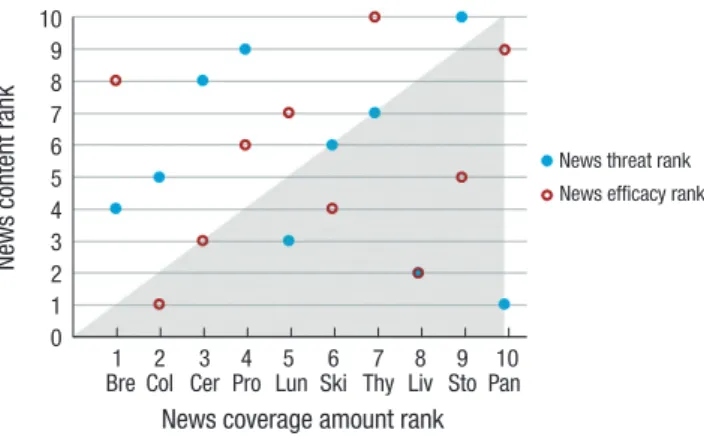
For better interpretation of the aforementioned results, Fig. 1 depicts the rank scores of news content on each cancer type, rel- ative to the rank of the amount of news coverage. Cancers mark- ed in the gray space indicate those having higher rank scores in
news portrayal of threat/efficacy, in comparison to the rank in news coverage amount. For example, liver cancer, which was ranked the 8th in terms of news amount, ranked much higher on both news depiction of threat (2nd) and efficacy (2nd).
Comparison of news portrayal of threat and efficacy with actual cancer statistics
The second objective of this research was to examine whether or not news content of cancer is congruent with actual cancer statistics in Korea. Table 3 presents five different types of rank scores: news threat, news efficacy, cancer incidence (2008-2012), cancer mortality (2008-2012), and incidence changes (APC, 1999-2012). Cancer statistic rates are also reported in Table 3.
The last six columns indicate the rank difference between news portrayal and reality—that is, the cancer statistics rank minus
Table 3. Comparison of threat and efficacy in news with cancer statistics, for top 10 most-covered cancers in the news
Cancer type
News
threat News
efficacy Incidence Mortality Incidence change
(APC) Rank difference
Rank Rank Rank % Rank % Rank Δ% I-TH M-TH C-TH I-EF M-EF C-EF
Breast 4 8 6 7.2 6 2.7 4 6.0 +2 +2 0 -2 -2 -4
Colorectal 5 1 3 12.9 4 10.5 5 5.3 -2 -1 0 +2 +3 +4
Cervical 8 3 9 1.9 8 1.3 10 -4.2 +1 0 +2 +6 +5 +7
Prostate 9 6 7 3.9 7 1.8 2 13.0 -2 -2 -7 +1 +1 -4
Lung 3 7 4 10.2 1 21.8 7 0.0 +1 -2 +4 -3 -6 0
Skin 6 4 10 1.9 9 0.6 3 6.5 +4 +3 -3 +6 +5 -1
Thyroid 7 10 1 17.6 10 0.5 1 22.3 -6 +3 -6 -9 0 -9
Liver 2 2 5 7.9 2 15.7 9 -1.9 +3 0 +7 +3 0 +7
Stomach 10 5 2 14.7 3 13.9 8 -0.3 -8 -7 -2 -3 -2 +3
Pancreatic 1 9 8 2.3 5 6.0 6 1.5 +7 +4 +5 -1 -4 -3
Number of news stories = 465. Rank is a hierarchical score among each category, from the highest (1) to the lowest (10). Rank difference was calculated by subtracting news rank from actual cancer statistics rank. For example, a positive score means that threat of getting a particular cancer was over-emphasized in the news in comparison to its ac- tual incidence, morality, or APC.
I, incidence; M, mortality; C, incidence change (APC); TH, threat; EF, efficacy.
News content rank
Bre Col Cer Pro Lun Ski Thy Liv Sto Pan News coverage amount rank 1 2 3 4 5 6 7 8 9 10 10
9 8 7 6 5 4 3 2 1 0
News threat rank News efficacy rank
Fig. 1. The rank of news content on each cancer type, in comparison to the rank of the amount of news coverage.
X-axis indicates the rank of the amount of news coverage on each cancer type: 1, breast; 2, colon; 3, cervical; 4, prostate; 5, lung; 6, skin; 7, thyroid; 8, liver; 9, stom- ach; 10, pancreatic cancer. Y-axis indicates the rank of the content of cancer news, respectively for threat and efficacy.
Table 2. Means and ranks of news portrayal of threat and efficacy, for top 10 most- covered cancers in the news
Cancer type News coverage News threat News efficacy
Rank % Rank Mean (SD) Rank Mean (SD)
Breast 1 17.2 4 2.45 (0.74) 8 1.89 (0.90)
Colorectal 2 17.0 5 2.42 (0.69) 1 2.23 (0.91) Cervical 3 14.4 8 2.24 (0.78) 3 2.15 (0.86)
Prostate 4 9.0 9 2.17 (0.82) 6 2.05 (0.96)
Lung 5 7.1 3 2.58 (0.71) 7 1.97 (0.95)
Skin 6 5.2 6 2.42 (0.72) 4 2.09 (1.02)
Thyroid 7 4.9 7 2.35 (0.78) 10 1.48 (0.79)
Liver 8 4.3 2 2.70 (0.66) 2 2.15 (0.93)
Stomach 9 3.7 10 2.12 (0.86) 5 2.06 (0.90)
Pancreatic 10 3.2 1 2.87 (0.35) 9 1.80 (0.86) Number of news stories = 465 (excluding stories on general cancer without specify- ing a cancer type). Cancers coded as “others” are omitted in the Table, which account for the remaining 14.0% of news coverage. Rank is a hierarchical score among each category, from the highest to the lowest. Percentage (%) indicates column percent- ages.
SD, standard deviation.
it was not so compared to the APC (-3). Results on thyroid can- cer were mixed: its threat was underrepresented relative to inci- dence and APC (-6, -6) but overrepresented relative to mortality (+3).
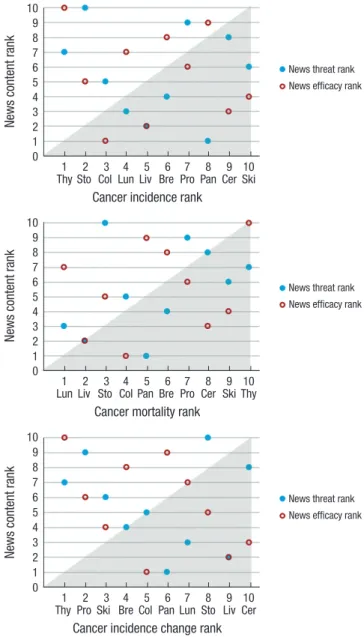
Efficacy information on how to alleviate the risk of getting cancers was contained relatively more in news stories on cervi- cal cancer (+6, +5, +7) and colorectal cancer (+2, +3. +4) relative to epidemiological data. Efficacy to cope with skin cancer risk was overreported relative to incidence and mortality (+6, +5), but not so relative to APC (-1). By contrast, efficacy was relative- ly less included in news articles on lung cancer (-3, -6, 0) and thyroid cancer (-9, 0, -9). Taken together, the comparisons show- ed numerous discrepancies between the news portrayal of can- cer and the realities of the disease in Korea. These disparities between news reports and cancer statistics are visualized in Fig. 2.
We further examined Kendall rank correlations between the news and cancer statistic variables, supporting the discrepan- cies between the two. The rank of threat in the news had no sig- nificant associations with the ranks of incidence (τ = -0.16, ns, not significant), mortality (τ = 0.24, ns), and APC (τ = -0.20, ns), respectively. The rank of news efficacy was also not statistically associated with any of the cancer statistics: incidence (τ = -0.07, ns), mortality (τ = 0.16, ns), and APC (τ = -0.38, ns).
DISCUSSION
The aims of the present research were to examine the content of cancer news coverage by cancer type and to explore its rela- tionships with incidence and mortality of the diseases in Korea.
Several patterns were found, with the potential to shape illness representations of cancer. To summarize, our findings indicate:
1) cancer news stories contained more threat than efficacy in- formation; 2) threat was most prominent in news stories on pancreatic cancer, followed by liver, lung, and breast cancers, and least in stories on stomach cancer; 3) efficacy was convey- ed most often in articles on colorectal, skin, and liver cancers, and least in thyroid cancer; 4) there were numerous disparities between cancer news content and realities; 5) threat about pan- creatic cancer and liver cancers was overreported relative to cancer statistics, whereas threat of stomach and prostate can- cers was underreported; 6) efficacy information regarding cer- vical and colorectal cancers was overrepresented in the news relative to cancer statistics, whereas that regarding lung and thy- roid cancers was underreported.
This research has several important implications. First, we applied the EPPM (14,15) to a context of news articles, which are not intentionally crafted for the purpose of persuasive cam- paigns, and examined the degree to which cancer news stories contained threat and efficacy elements. Overall findings reveal that threat was more prevalent in the cancer news coverage than was efficacy. While more than 8 in 10 news articles conveyed
News threat rank News efficacy rank
News threat rank News efficacy rank
News threat rank News efficacy rank
Fig. 2. The rank of news content on each cancer, relative to the rank of cancer statis- tics (incidence rates, morality rates, and yearly incidence change).
X-axis indicates the rank of cancer statistics, and the name of cancer sites was short- ened: thy, thyroid; sto, stomach; col, colon; lun, lung; liv, liver; bre, breast; pro, pros- tate; pan, pancreatic; cer, cervical; ski, skin. Y-axis indicates the rank of the content of cancer news, respectively for threat and efficacy.
News content rank
Thy Sto Col Lun Liv Bre Pro Pan Cer Ski Cancer incidence rank
1 2 3 4 5 6 7 8 9 10 10
9 8 7 6 5 4 3 2 1 0
News content rank
Lun Liv Sto Col Pan Bre Pro Cer Ski Thy Cancer mortality rank
1 2 3 4 5 6 7 8 9 10 10
9 8 7 6 5 4 3 2 1 0
News content rank
Thy Pro Ski Bre Col Pan Lun Sto Liv Cer Cancer incidence change rank 1 2 3 4 5 6 7 8 9 10 10
9 8 7 6 5 4 3 2 1 0
the news portrayal rank. This rank difference score reflects the degree of distortion between news portrayal and actual cancer statistics; a positive score indicates that threat or efficacy was over-represented in the cancer news in comparison to the reality.
Specifically, threat severity of getting cancers was depicted more frequently in news stories of pancreatic cancer (+7, +4, +5) and liver cancer (+3, +0, +7), as compared with the cancer epidemiological data, whereas threat of getting stomach cancer (-8, -7, -2) and prostate cancer (-2, -2, -7) was relatively under- reported in the news. Threat of getting skin cancer seemed to be overreported based on incidence and mortality (+4, +3), but
threat information (either general or specific), less than 50%
contained efficacy information, and those containing specific details on efficacy accounted for only one third of news stories.
Our findings are consistent with past research on news cover- age of other health risks, such as the H1N1 virus in the USA (19) and a medication contamination crisis in Panama (20). Simi- larly, past research found that cancer news coverage focuses more on cancer treatment and conveys relatively little informa- tion on prevention, detection, or coping (3,6,24). The findings imply that the news is successful at communicating the threat of getting various cancers, and perhaps evoking fear, but may be less successful at informing people of doable actions to alle- viate their risks. It may be sensible that news articles contain threat information relatively more than efficacy because threat may reflect newly reported medical findings and thus be more newsworthy; however, it should be noted that exposure to news stories focusing primarily on threat is likely to cultivate fatalistic beliefs about cancer prevention and coping among lay people and patients. This possibility raises a caution for health journal- ists in writing cancer news stories, and suggests increasingly important roles of physicians and medical professionals in con- veying efficacy information simultaneously in communicating about cancer risk with patients.
Second, this research extends past findings on the amount of news coverage by cancer type (1-6) by examining how the spe- cific content of news coverage may vary across cancer type. One notable finding concerns the pattern of news stories of pancre- atic and liver cancers. These cancers had similarities in terms of the amount and threat-related content of the news coverage.
Both cancers showed a relatively small amount of news cover- age, but once they were reported in the news, threat informa- tion was very likely to be included. Every article on pancreatic cancer conveyed threat, and almost 9 in 10 stories on liver can- cer contained threat, which may be attributable to low survival rates. The coverage of efficacy regarding the two cancers was different, such that news stories on liver cancer highly covered efficacy, whereas news stories on pancreatic cancer did not.
Therefore, news reports on pancreatic cancer may be particu- larly problematic given the coverage of high threat and low effi- cacy, possibly enhancing fatalism about pancreatic cancer. On the other hand, there is a possibility that the problem may not be that serious because the absolute amount of the news on pancreatic cancer was not high. Future research is needed to see how the quantity of news coverage and the specific content of news (the presence or absence of threat and efficacy) may jointly determine risk perception about particular cancers.
Another interesting finding concerns news stories of breast cancer. Breast cancer has been consistently found to be the most covered cancer site in both the U.S. and Korea (3,4,25). In this study, breast cancer was ranked 4 out of 10 in the degree of threat in the news (with 85% of stories conveying either general or spe-
cific-level threat information), and ranked 8 in terms of efficacy conveyed in the news. The disproportionately high amount of coverage of breast cancer, coupled with the relatively strong portrayal of threat, can also be problematic, especially if effica- cy information is not offered together. Researchers have attrib- uted the large amount of breast cancer news coverage to suc- cessful advocacy efforts for breast cancer (3,5,6), and it seems that the breast cancer community now needs to focus not only on increasing the awareness of breast cancer but also on lead- ing people to take doable actions for prevention and early de- tection.
Efficacy information was more prevalent in news stories of colorectal, liver, and cervical cancers than other cancer news, which may be explained by their higher preventive potential.
Efficacy was the least mentioned in news of thyroid cancer, and this finding may be due to the issue of over-diagnosis in Korea, which could have been the primary focus of news articles, there- by rarely covering efficacious methods of reducing the risk. The association between individual perception of different cancers and portrayed efficacy in the news coverage is also worth inves- tigation, awaiting future research.
Most notably, we examined the possible discrepancies be- tween news portrayal of specific cancers and actual incidence or mortality in the real world. It is meaningful that we compar- ed cancer news coverage not only with the overall incidence and mortality rates but also with the changes in incidence over the years. Our findings suggest that news coverage of threat and efficacy on cancers, more often than not, does not accurately mirror the statistics for these cancers. Overrepresentation of threat in the news is problematic, as shown with pancreatic and liver cancer, but underrepresentation of threat is also undesir- able. For example, in news stories of stomach cancer, threat in- formation was underreported, relative to all three cancer statis- tics. The 5-year relative survival rate for stomach cancer was 71.5% in Korea in 2012, which was lower than the rates of colorec- tal, cervical, and breast cancers, and stomach cancer was more common in Korea than other countries, implying an urgent need to include threat information in the news in Korea. Additional- ly, despite well-identified risk factors for stomach cancer, we saw a relatively weak emphasis on specific preventive actions to cope with stomach cancer in the news. Regarding efficacy content, news coverage of lung cancer showed a similar pat- tern; although smoking cessation is the undoubted solution for prevention of lung cancer and various programs for cessation are being implemented, more than half of the articles did not suggest any concrete strategy. On the contrary, for skin cancer, both threat and efficacy were over-reported relative to incidence and mortality, although such news report may not be sufficient to reflect its high increase in the incidence over the years.
Our findings on the discrepancies between news portrayal and realities are consistent with past studies regarding the amo-
unt of news coverage by cancer type (3-6,24,25). Indeed, por- trayed threat and efficacy did not have significant rank-order correlations with any of the cancer statistics used in this research.
Taking together our findings and past research findings, it seems that the amount of cancer news coverage does not correspond properly to the realities, and furthermore, the specific threat or efficacy elements conveyed in cancer news do not also reflect these realities accurately. Cancers that were more frequent and more deadly were not always depicted as involving a correspond- ing degree of threat in news stories. Similarly, cancers that need- ed more efficacy information on how to reduce the risk were not always covered in news as needed. Overall, the patterns of cancer news coverage in Korea with the potential to cultivate misrepresentations of illness (8) raise concerns, and it is neces- sary to identify ways to convey cancer news in ways that avoid distortion in terms of both the volume and content of news cov- erage.
This study has several limitations that need to be acknowl- edged. First, the time period of data collection was limited to the period from 2008 to 2012, and does not include an assess- ment of more recent news coverage or longer range trends since 1999 when a nation-wide cancer control policy started in Ko- rea. Secondly, the coding categories of threat and efficacy were somewhat simple having only three levels, thereby possibly miss- ing more nuanced tones and implications embedded in news stories. Lastly, this study included news data only on cancer risk. Any varying trends in news portrayal of threat and efficacy across the cancer control continuum await future research.
In conclusion, this research sheds lights on the way particu- lar cancer types are portrayed in news coverage relative to can- cer incidence and mortality in Korea. The findings offer impor- tant implications for health journalists to convey cancer risk in the news media. The content of cancer news in Korea needs to be improved, to better mirror the reality and to strike a balance between threat and efficacy information in news stories. The findings also provide implications for physicians and medical professionals to understand the content of cancer risk informa- tion in the news widely available to lay people and patients, and to utilize it for the education and consultation for them. Build- ing on the present research offering a snapshot of cancer news coverage in Korea, future research is warranted to examine the possible effects of cancer coverage patterns on lay individuals’
perceptions, efficacy, and behaviors.
ACKNOWLEDGMENT
The authors thank Jee Hyun Kim (College of Communication, Yonsei University) and Jeong Hyun Kwon (Cancer Policy Branch, National Cancer Control Institute, National Cancer Center) for their significant contribution to data collection and coding.
DISCLOSURE
The authors have no potential conflicts of interest to disclose.
AUTHOR CONTRIBUTION
Study concept and design: Shim M, Kim YC, Park K. Acquisi- tion, analysis, or interpretation of data: Shim M, Kim YC, Kye SY, Park K. Drafting of the manuscript: Shim M. Revision of the manuscript: Shim M, Kim YC, Kye SY, Park K. Administrative or technical support: Kye SY, Park K. Manuscript approval: all au- thors.
ORCID
Minsun Shim http://orcid.org/0000-0003-4248-7120 Yong-Chan Kim http://orcid.org/0000-0003-4045-1028 Su Yeon Kye http://orcid.org/0000-0003-2535-3518 Keeho Park http://orcid.org/0000-0002-0186-4172 REFERENCES
1. Cohen EL, Caburnay CA, Luke DA, Rodgers S, Cameron GT, Kreuter MW.
Cancer coverage in general-audience and black newspapers. Health Com- mun 2008; 23: 427-35.
2. Freimuth VS, Greenberg RH, DeWitt J, Romano RM. Covering cancer:
newspapers and the public interest. J Commun 1984; 34: 62-73.
3. Jensen JD, Moriarty CM, Hurley RJ, Stryker JE. Making sense of cancer news coverage trends: a comparison of three comprehensive content analyses. J Health Commun 2010; 15: 136-51.
4. Ju Y, Jeong DE, You M. The representation of cancer risk by Korean health journalism: comparing the crude rates of 10 cancers to the amount of cancer news in the three major newspapers (1990-2010). J Korean Soc Health Educ Promot 2013; 12: 201-10.
5. Kye SY, Kwon JH, Kim YC, Shim M, Kim JH, Cho H, Jung KW, Park K. Can- cer risk factors in Korean news media: a content analysis. Asian Pac J Cancer Prev 2015; 16: 731-6.
6. Slater MD, Long M, Bettinghaus EP, Reineke JB. News coverage of cancer in the United States: a national sample of newspapers, television, and magazines. J Health Commun 2008; 13: 523-37.
7. Jensen JD, Scherr CL, Brown N, Jones C, Christy K. Public perception of cancer survival rankings. Health Educ Behav 2013; 40: 721-9.
8. Jensen JD, Scherr CL, Brown N, Jones C, Christy K, Hurley RJ. Public esti- mates of cancer frequency: cancer incidence perceptions mirror distort- ed media depictions. J Health Commun 2014; 19: 609-24.
9. Kim S, Shin DW, Yang HK, Kim SY, Ko YJ, Cho B, Lee YS, Lee D, Park K, Park JH. Public perceptions on cancer incidence and survival: a nation- wide survey in Korea. Cancer Res Treat 2016; 48: 775-88.
10. Kelly B, Hornik R, Romantan A, Schwartz JS, Armstrong K, DeMichele A, Fishbein M, Gray S, Hull S, Kim A, et al. Cancer information scanning and seeking in the general population. J Health Commun 2010; 15: 734-53.
11. Shim M, Kelly B, Hornik R. Cancer information scanning and seeking be- havior is associated with knowledge, lifestyle choices, and screening. J
Health Commun 2006; 11 Suppl 1: 157-72.
12. Niederdeppe J, Fowler EF, Goldstein K, Pribble J. Does local television news coverage cultivate fatalistic beliefs about cancer prevention? J Commun 2010; 60: 230-53.
13. Niederdeppe J, Lee T, Robbins R, Kim HK, Kresovich A, Kirshenblat D, Standridge K, Clarke CE, Jensen J, Fowler EF. Content and effects of news stories about uncertain cancer causes and preventive behaviors. Health Commun 2014; 29: 332-46.
14. Witte K. Putting the fear back into fear appeals: the extended parallel pro- cess model. Commun Monogr 1992; 59: 329-49.
15. Witte K. Fear control and danger control: a test of the extended parallel process model (EPPM). Commun Monogr 1994; 61: 113-34.
16. Roskos‐Ewoldsen DR, Yu JH, Rhodes N. Fear appeal messages affect ac- cessibility of attitudes toward the threat and adaptive behaviors. Com- mun Monogr 2004; 71: 49-69.
17. Cho H, Witte K. Managing fear in public health campaigns: a theory-based formative evaluation process. Health Promot Pract 2005; 6: 482-90.
18. Cohen EL, Shumate MD, Gold A. Original: anti-smoking media campaign messages: theory and practice. Health Commun 2007; 22: 91-102.
19. Goodall C, Sabo J, Cline R, Egbert N. Threat, efficacy, and uncertainty in
the first 5 months of national print and electronic news coverage of the H1N1 virus. J Health Commun 2012; 17: 338-55.
20. Turner MM, Boudewyns V, Kirby-Straker R, Telfer J. A double dose of fear:
a theory-based content analysis of news articles surrounding the 2006 cough syrup contamination crisis in Panama. Risk Manag 2013; 15: 79- 99.
21. Statistics Korea. Cancer registration statistics [Internet]. Available at http:
//kosis.kr/statisticsList/statisticsList_01List.jsp?vwcd=MT_ZTITLE&
parentId=D#SubCont [accessed on 30 August 2015].
22. Statistics Korea. Cause of death statistics [Internet]. Available at http://ko- sis.kr/statisticsList/statisticsList_01List.jsp?vwcd=MT_ZTITLE&parentId
=D#SubCont [accessed on 30 August 2015].
23. Jung KW, Won YJ, Kong HJ, Oh CM, Cho H, Lee DH, Lee KH. Cancer sta- tistics in Korea: incidence, mortality, survival, and prevalence in 2012.
Cancer Res Treat 2015; 47: 127-41.
24. Stryker JE, Emmons KM, Viswanath K. Uncovering differences across the cancer control continuum: a comparison of ethnic and mainstream can- cer newspaper stories. Prev Med 2007; 44: 20-5.
25. Clarke JN, Everest MM. Cancer in the mass print media: fear, uncertainty and the medical model. Soc Sci Med 2006; 62: 2591-600.