Association between Circulating Irisin and C-Reactive Protein Levels: A Systematic Review and Meta-Analysis
Elham Eslampour1, Farzad Ebrahimzadeh2, Amir Abbasnezhad1, Mohammad Zeinali Khosroshahi1, Razieh Choghakhori3, Omid Asbaghi1
1Nutritional Health Research Center, 2Department of Biostatistics and Epidemiology, Nutritional Health Research Center, 3Razi Herbal Medicines Research Center, Lorestan University of Medical Sciences, Khorramabad, Iran
Background: Although previous studies have demonstrated that irisin plays an anti-inflammatory role in the body, conflicting re- sults have been reported regarding the correlation between serum levels of irisin and C-reactive protein (CRP). The present meta- analysis was conducted to further investigate the correlation between irisin and CRP levels.
Methods: We systematically searched PubMed, the Cochrane Library, Web of Science, Embase, SCOPUS, and Ovid to retrieve studies assessing the correlation between irisin and CRP levels. Meta-analyses were performed using a random-effects model, and the I2 index was used to evaluate heterogeneity.
Results: Of the 428 studies that were initially found, 14 studies with 2,530 participants met the inclusion criteria for the meta-analy- sis. The pooled effect size was calculated as 0.052 (95% confidence interval, −0.047 to 0.152; P=0.302). Subgroup analyses identi- fied s ignificant, positive, but weak correlations between CRP and irisin levels in cohort studies, studies conducted among healthy participants, studies in which the male-to-female ratio was less than 1, in overweight or obese subjects, and in studies with a sample size of at least 100 participants.
Conclusion: The present meta-analysis found no overall significant correlation between irisin and CRP levels, although a significant positive correlation was found in overweight or obese subjects. Well-designed studies are needed to verify the results of the present meta-analysis.
Keywords: C-reactive protein; Irisin; FNDC5 protein; Systematic review; Meta-analysis
INTRODUCTION
Irisin, a novel peptidic myokine, was discovered by Bostrom et al. [1] in 2012. It is secreted from skeletal muscle tissue through the cleavage of fibronectin type III domain containing 5 (FNDC5), and is regulated by peroxisome proliferator-activated receptor (PPAR)-coactivator-1α (PGC-1α) [1]. Irisin stimulates thermogenesis via browning of white adipose tissue, and subse-
quently increases energy expenditure, improves glucose homeo- stasis, and regulates energy metabolism [2]. In addition to its regulatory role in metabolism, a limited number of studies have demonstrated that it plays a role in immunity, and most of those studies found that irisin has anti-inflammatory properties [3]. In light of its function in metabolism and immunity, irisin has been considered as a new therapeutic target for metabolic disorders [4-6].
Received: 15 December 2018, Revised: 12 February 2019, Accepted: 11 March 2019
Corresponding author: Amir Abbasnezhad
Department of Nutrition, Nutritional Health Research Center, Lorestan University of Medical Sciences, Goledasht Blvd, Khorramabad 6813833946, Iran
Tel: +98-9128980693, Fax: +98-6633300661, E-mail: [email protected]
Copyright © 2019 Korean Endocrine Society
This is an Open Access article distributed under the terms of the Creative Com- mons Attribution Non-Commercial License (http://creativecommons.org/
licenses/by-nc/4.0/) which permits unrestricted non-commercial use, distribu- tion, and reproduction in any medium, provided the original work is properly cited.
C-reactive protein (CRP), a common acute-phase reactant, is a sensitive serum parameter for diagnosing systemic inflamma- tion [7-9]. It has been well documented that pro-inflammatory cytokines, such as tumor necrosis factor-α (TNF-α), interleu- kin-6 (IL-6), and IL-1β, can regulate the production and secre- tion of CRP [10]. In response to any inflammatory stimulus, se- rum levels of CRP increase and then decrease very rapidly [10].
Moreover, it has been shown that serum levels of CRP and other inflammatory biomarkers are influenced by muscle contraction, as well as by serum irisin levels [11]. This finding implies a re- lationship between serum concentrations of irisin and CRP. The possible association between irisin and CRP has been assessed in several studies. Hou et al. [12] reported that circulating irisin was significantly and negatively correlated with high-sensitivity CRP. However, another study found a significant positive corre- lation between irisin and high-sensitivity CRP levels in the gen- eral population [13]. In another study conducted by Jameel et al.
[14], no significant correlation was seen between serum levels of irisin and high-sensitivity CRP in healthy adults. Due to the inconsistent results of previous studies, we carried out a system- atic review and meta-analysis of extant observational studies to assess the correlation between circulating irisin levels and se- rum levels of CRP.
METHODS
Data sources and search strategies
A comprehensive literature search of six databases, including PubMed, the Cochrane Library, Web of Science, Embase, SCO- PUS, and Ovid, was conducted using the keywords “C reactive protein,” “C-reactive protein,” “high-sensitivity CRP,” “hs- CRP,” “high sensitivity CRP,” “hscrp,” and “CRP” in combina- tion with the keywords “irisin” and “FNDC5” for studies in all languages published up to March 28, 2018. The complete search strategy is presented in Supplemental File S1.
Study selection
All the potentially relevant studies obtained from the databases were reviewed by two investigators (E.E. and M.Z.K.). The titles and abstracts of retrieved publications were initially screened for potentially eligible studies, which were subsequently evaluated by full-text review. Studies were included if the study popula- tion was adults (mean age ≥18 years) and if they presented re- sults on the relationship between circulating irisin and CRP lev- els (measured in plasma or serum). All types of studies except animal-based studies, reviews, posters, and letters to the editor
were included. Studies were excluded if the participants were lactating or pregnant woman and if complete data were unavail- able. The initial search was supplemented by checking the refer- ence lists of the retrieved articles to identify missed studies.
Disagreements about the eligibility of any article were solved by discussing with a third author (A.A.). This study was ex- empted from the requirement for a consent form.
Data extraction and quality assessment
Data from eligible studies were extracted by two investigators (E.E. and O.A.) using an Excel form. The following data were extracted from each eligible study: first author, publication year, study location, study population, study design, sample size, type of blood sample, circulating irisin and CRP levels, age, body mass index (BMI), sex ratio, measures of association, and brief results together with the adjusted covariates. When the data were insufficient for a meta-analysis, we contacted the authors directly to obtain the data. Study quality was assessed by the Newcastle-Ottawa Scale (NOS) [15].
Data synthesis and analysis
Meta-analysis was carried out using Stata version 12.0 (Stata Corp., College Station, TX, USA). A fixed-effects model was used for the assessment of the pooled effect size. When hetero- geneity was present, a random-effects model was used. Hetero- geneity was tested using the I2 statistic, and an I2 value ≥50%
with a level of significance of P<0.05 by the Cochran Q-test was interpreted as evidence of substantial heterogeneity. Publi- cation bias was assessed by a funnel plot analysis, the Begg ad- justed rank correlation test, and the Egger regression asymmetry test. Subgroup analyses were carried out based on the quality of the studies, disease status of the participants, sex ratio (men vs.
women), study design (cross-sectional vs. case-control vs. co- hort), sample size, and BMI of the participants. The trim-and- fill method was used to explore the number and outcomes of potential missing studies. Additionally, the metaninf test was used to assess the effect of individual studies by estimating the r values obtained when each study was omitted.
RESULTS
The first step of the search yielded 24, 9, 30, 52, 214, and 97 ci- tations in PubMed, Cochrane Library, Web of Science, Embase, SCOPUS, and Ovid, respectively (Fig. 1). Two additional stud- ies were found while searching the reference lists [16,17]. Of these, 141 articles were excluded due to duplication. The titles
and abstracts of 287 articles were reviewed. Forty-two studies were identified for full-text review. Of these, 28 studies were excluded for the following reasons: three studies were posters, data were not available for six studies, and 19 studies did not re- port the association between irisin and CRP levels. Ultimately, 14 articles were included in the meta-analysis [12-14,16-26].
Study characteristics
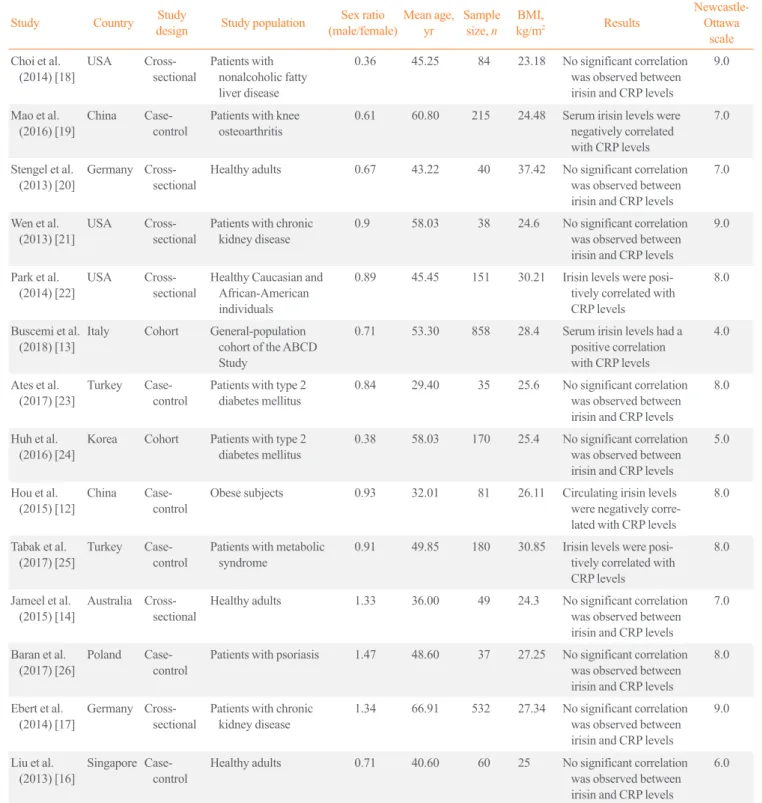
The selected studies were published between 2012 and 2017 (Table 1), with a total sample size of 2,530. The mean age of the participants ranged from 29 to 66.9 years, and the mean BMI ranged from 23.18 to 37.42 kg/m2. All studies included both sexes, and the ratio of male to female participants ranged from
0.36 to 1.47. Three studies were from the USA, and others were from China, Germany, Italy, Turkey, Korea, Australia, Poland, and Singapore. Six studies were cross-sectional studies, six were case-control studies, and two were cohort studies. Two of the studies included type 2 diabetes mellitus patients, five stud- ies included healthy individuals or the general population, two studies included patients with chronic kidney disease, one study included patients with psoriasis, one study included patients with metabolic syndrome, one study included obese subjects, one study included nonalcoholic fatty liver disease patients, and one study included patients with knee osteoarthritis. Seven stud- ies had sample sizes of 100 to 1,000 patients, while the remain- ing seven studies had a sample size under 100 patients. Four Fig. 1. Flow diagram of the literature search. CRP, C-reactive protein.
426 Articles identified in total through database search 24 PubMed
9 the Cochrane Library 30 Web of Science 52 Embase 214 SCOPUS
97 Ovid 2 Additional articles identified through other sources
428 Articles identified in all the database
287 Articles screened on titles/abstracts
42 Articles identified for full-text review
14 Articles included in the meta-analysis
141 Duplicate removed
245 Articles excluded 109 Reviews/meta-analyses 14 Not on human beings 105 Studies not related
11 Studies on subjects ≤18-year-old 6 Studies on pregnant or lactating women
28 Articles further excluded 3 Posters
6 No available data
19 Not reporting of the association between irisin and CRP
studies used the enzyme-linked immunosorbent assay (ELISA) method to determine the circulating levels of CRP, and seven studies used other methods, such as immunoturbidimetric as-
says. All studies used the ELISA method to evaluate circulating levels of irisin.
Table 1. Characteristics of the Selected Studies Included in This Meta-Analysis
Study Country Study
design Study population Sex ratio
(male/female) Mean age, yr Sample
size, n BMI,
kg/m2 Results Newcastle-
Ottawa scale Choi et al.
(2014) [18] USA Cross-
sectional Patients with nonalcoholic fatty liver disease
0.36 45.25 84 23.18 No significant correlation was observed between irisin and CRP levels
9.0
Mao et al.
(2016) [19] China Case-
control Patients with knee
osteoarthritis 0.61 60.80 215 24.48 Serum irisin levels were negatively correlated with CRP levels
7.0
Stengel et al.
(2013) [20] Germany Cross-
sectional Healthy adults 0.67 43.22 40 37.42 No significant correlation was observed between irisin and CRP levels
7.0
Wen et al.
(2013) [21] USA Cross-
sectional Patients with chronic
kidney disease 0.9 58.03 38 24.6 No significant correlation
was observed between irisin and CRP levels
9.0
Park et al.
(2014) [22] USA Cross-
sectional Healthy Caucasian and African-American individuals
0.89 45.45 151 30.21 Irisin levels were posi- tively correlated with CRP levels
8.0
Buscemi et al.
(2018) [13] Italy Cohort General-population cohort of the ABCD Study
0.71 53.30 858 28.4 Serum irisin levels had a positive correlation with CRP levels
4.0
Ates et al.
(2017) [23] Turkey Case-
control Patients with type 2
diabetes mellitus 0.84 29.40 35 25.6 No significant correlation was observed between irisin and CRP levels
8.0
Huh et al.
(2016) [24] Korea Cohort Patients with type 2
diabetes mellitus 0.38 58.03 170 25.4 No significant correlation was observed between irisin and CRP levels
5.0
Hou et al.
(2015) [12] China Case-
control Obese subjects 0.93 32.01 81 26.11 Circulating irisin levels were negatively corre- lated with CRP levels
8.0
Tabak et al.
(2017) [25] Turkey Case-
control Patients with metabolic
syndrome 0.91 49.85 180 30.85 Irisin levels were posi-
tively correlated with CRP levels
8.0
Jameel et al.
(2015) [14] Australia Cross-
sectional Healthy adults 1.33 36.00 49 24.3 No significant correlation was observed between irisin and CRP levels
7.0
Baran et al.
(2017) [26] Poland Case-
control Patients with psoriasis 1.47 48.60 37 27.25 No significant correlation was observed between irisin and CRP levels
8.0
Ebert et al.
(2014) [17] Germany Cross-
sectional Patients with chronic
kidney disease 1.34 66.91 532 27.34 No significant correlation was observed between irisin and CRP levels
9.0
Liu et al.
(2013) [16] Singapore Case-
control Healthy adults 0.71 40.60 60 25 No significant correlation
was observed between irisin and CRP levels
6.0
BMI, body mass index; CRP, C-reactive protein; ABCD, Alimentazione, Benessere Cardiovascolare e Diabete.
Meta-analysis
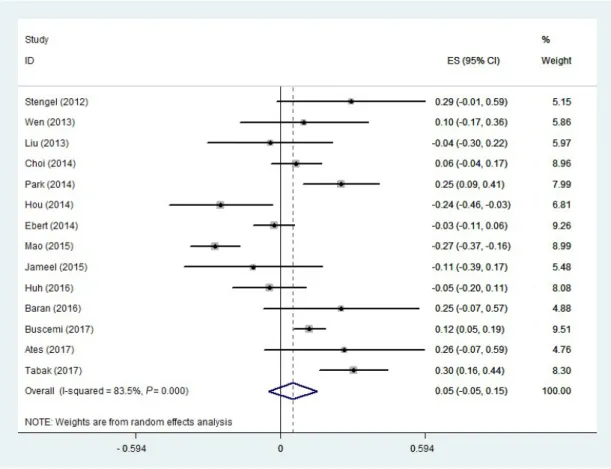
Of the 14 studies selected for the meta-analysis, nine reported no correlation between circulating irisin and CRP levels, three reported a positive correlation, and two reported a negative cor- relation. A random-effects model was used to estimate the over- all correlation between irisin and CRP levels. The pooled effect size was calculated at 0.052 (95% confidence interval [CI],
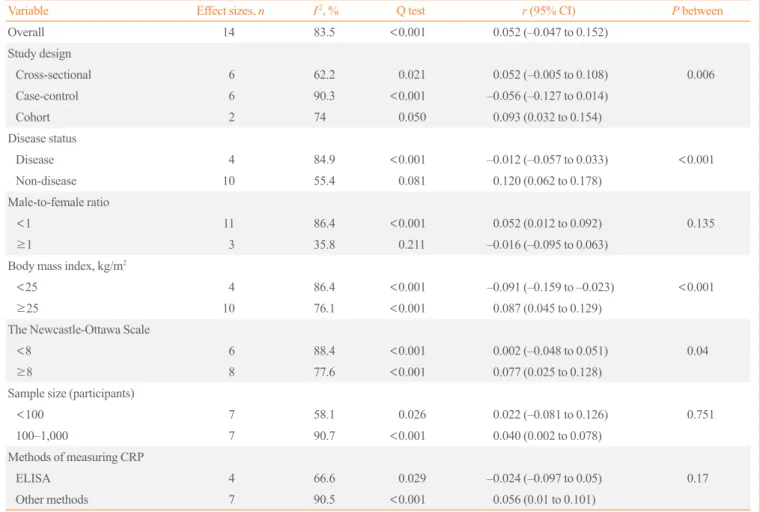
−0.047 to 0.152; P=0.302) (Fig. 2). There was a moderate-to- high level of heterogeneity (I2=83.5%, P<0.001) among the in- cluded studies. Therefore, to identify the sources of heterogene- ity, we performed subgroup analyses. The subgroup analysis by study design indicated that heterogeneity was lower in both cross-sectional and cohort studies (I2=62.2%, P=0.021;
I2=74.0%, P=0.050; respectively) (Table 2), and the correlation was only significant in cohort studies. The subgroup analysis by disease status demonstrated that disease status of the partici- pants was a source of heterogeneity (Table 2). In the subgroup of healthy people and the general population, the heterogeneity was not significant (I2=55.4%, P=0.081) (Table 2). As shown in Table 2, a significant positive correlation between CRP and
Fig. 2. Forest plot of the random-effects meta-analysis of the correlation between C-reactive protein and irisin levels. ES, effect size; CI, confidence interval.
irisin levels was found in the subgroup of healthy people and the general population (r=0.12; 95% CI, 0.062 to 0.178). An- other source of heterogeneity was the male-to-female ratio. As Table 2 indicates, heterogeneity was lower in studies in which the male-to-female ratio was 1 or higher (I2=35.8%, P=0.211).
In addition, there was a significant direct correlation between CRP and irisin levels in studies where the male-to-female ratio was lower than 1 (Table 2). The subgroup analysis according to BMI indicated that a significant positive correlation was present in participants with a BMI ≥25 kg/m2 (Table 2). Moreover, as shown in Table 2, a significant but weak positive correlation was found between CRP and irisin levels in high-quality studies (NOS ≥8) (r=0.077; 95% CI, 0.025 to 0.128). We likewise found a significant but weak positive correlation (r=0.040; 95%
CI, 0.002 to 0.078) in studies with a sample size of more than 100 participants (Table 2). Furthermore, the subgroup analysis according to the methods of measuring CRP indicated that there was no significant correlation in studies that used ELISA, whereas a significant positive correlation was found in studies that used other methods (Supplemental Fig. S1).
Publication bias, trim-and-fill analysis, and sensitivity analysis
The evaluation of publication bias using funnel plots demon- strated no evidence of publication bias within the studies (Fig.
3). Furthermore, both the Egger test and the Begg test showed no evidence of publication bias (P=0.897 and P=0.584, respec- tively). The trim-and-fill analysis explored the potential theoret- ical existence of two hypothetical studies that were not pub- lished due to publication bias; however, the results obtained by considering those two hypothetical studies demonstrated no sig- nificant correlation (pooled effect size, 0.015; 95% CI, −0.083 to 0.114), which was highly similar to the results without these studies. In the metaninf analysis, one study [19] seemed to in- fluence the results (Supplemental Fig. S2). By omitting this study, the direction of the correlation between irisin and CRP did not change; however, it became significant (pooled effect size, 0.082; 95% CI, 0.001 to 0.164).
Table 2. Subgroup Analysis Based on Fixed-Effects Models for the Correlation between Irisin and CRP Levels
Variable Effect sizes, n I2, % Q test r (95% CI) P between
Overall 14 83.5 <0.001 0.052 (–0.047 to 0.152)
Study design
Cross-sectional 6 62.2 0.021 0.052 (–0.005 to 0.108) 0.006
Case-control 6 90.3 <0.001 –0.056 (–0.127 to 0.014)
Cohort 2 74 0.050 0.093 (0.032 to 0.154)
Disease status
Disease 4 84.9 <0.001 –0.012 (–0.057 to 0.033) <0.001
Non-disease 10 55.4 0.081 0.120 (0.062 to 0.178)
Male-to-female ratio
<1 11 86.4 <0.001 0.052 (0.012 to 0.092) 0.135
≥1 3 35.8 0.211 –0.016 (–0.095 to 0.063)
Body mass index, kg/m2
<25 4 86.4 <0.001 –0.091 (–0.159 to –0.023) <0.001
≥25 10 76.1 <0.001 0.087 (0.045 to 0.129)
The Newcastle-Ottawa Scale
<8 6 88.4 <0.001 0.002 (–0.048 to 0.051) 0.04
≥8 8 77.6 <0.001 0.077 (0.025 to 0.128)
Sample size (participants)
<100 7 58.1 0.026 0.022 (–0.081 to 0.126) 0.751
100–1,000 7 90.7 <0.001 0.040 (0.002 to 0.078)
Methods of measuring CRP
ELISA 4 66.6 0.029 –0.024 (–0.097 to 0.05) 0.17
Other methods 7 90.5 <0.001 0.056 (0.01 to 0.101)
CRP, C-reactive protein; CI, confidence interval; ELISA, enzyme-linked immunosorbent assay.
0 0.05 0.10 0.15 0.20
Standard error of r
r
Funnel plot with pseudo 95% confidence limits
–0.4 –0.2 0 0.2 0.4 Fig. 3. Funnel plot of the included studies.
DISCUSSION
To our best knowledge, this is the first meta-analysis to assess the correlation between circulating irisin and CRP levels. In the overall results of the present meta-analysis, the circulating con- centration of irisin had no correlation with that of CRP. Due to the significant heterogeneity among the studies, subgroup anal- yses were performed, finding that the study design, disease sta- tus of participants, sample size, and the male-to-female ratio were the main sources of heterogeneity. The results of the sub- group analyses indicated that there were significant, positive, but weak correlations between CRP and irisin levels in cohort studies, studies conducted among healthy participants, studies with a male-to-female ratio less than 1, participants with a BMI
≥25 kg/m2, high-quality studies, and studies with a sample size of at least 100 participants.
Irisin is a peptide that has been reported to play beneficial and protective roles for a wide range of disorders, such as insulin re- sistance, obesity, and metabolic disorders [27,28]. Although nu- merous studies have been conducted on irisin and its role in me- tabolism, the literature contains scant data regarding its impact on inflammatory processes. Identifying the detailed characteris- tics of irisin in inflammatory processes is an important step to- wards the development of therapeutic strategies, especially for low-grade inflammation generated by immune cells in adipose tissues [3]. Most studies assessing the role of irisin in immunity have reported it to show anti-inflammatory properties. Irisin has been reported to reduce the expression and secretion of pro-in- flammatory cytokines, such as TNF-α and IL-6 [29]. The pre- cise anti-inflammatory mechanism of irisin is unclear; however, recent studies demonstrated that irisin can inhibit the activation of the Toll-like receptor 4 (TLR4) and nuclear factor-κB path- ways, which are the most important pathways for activation of the innate immune system [3].
CRP is a classical acute-phase protein that is synthesized in the liver [30]. IL-6 and IL-1 are the main stimuli of CRP synthe- sis, although other agents, such as corticosteroids, can also in- fluence its synthesis [10]. In general, serum CRP concentrations are correlated with those of other inflammatory markers, such as IL-6 [31]. Its serum level rises and falls more rapidly than other inflammatory markers, making it a useful marker to fol- low the clinical course of a disease and response to a specific treatment [10]. In human blood, circulating CRP binds to white blood cells through Fc receptors, specially the FcγRIIa receptor, which increases the production of cytokines [32]. Previous in- vestigations revealed that CRP can increase the production of
both pro- and anti-inflammatory cytokines [10]. Tilg et al. [33]
suggested that the net effect of CRP is anti-inflammatory through its role in stimulating IL-10 and IL-1RA.
The overall results of the present meta-analysis demonstrated no significant correlation between circulating CRP and irisin levels. Of note, the results of the metaninf analysis indicated that by omitting the study of Mao et al. [19], the correlation be- tween irisin and CRP became significant, albeit weak. Further- more, it should be noted that after omitting this study, there was still a direct correlation between irisin and CRP. The study of Mao et al. [19] was conducted among patients with knee osteo- arthritis, and demonstrated that serum levels of irisin were lower in these patients. A possible reason for lower levels of irisin in this group of patients could be lower levels of physical activity due to pain related to osteoarthritis. It has been thoroughly doc- umented that irisin is a muscle-derived peptide that is secreted from contracting skeletal muscles, and lower levels of physical activity have therefore been associated with lower serum irisin levels [34,35]. In contrast, in osteoarthritis patients, the serum level of CRP increases due to the inflammatory nature of the disease [36]. These considerations could jointly explain the sig- nificant negative correlation between irisin and CRP levels that was found by Mao et al. [19]. Therefore, it could be speculated that the serum concentration of irisin is influenced more by physical activity than by inflammation, although further studies are needed to confirm this hypothesis.
Previous investigations have demonstrated that exercise pro- vokes elevated levels of cytokines [37]. Those studies reported that skeletal muscles can express and produce different kinds of cytokines, such as IL-6, IL-8, and IL-15 [37]. Thus, IL-6 has been labeled as a contraction-regulated myokine, similar to iri- sin, which is known to be a muscle-derived protein [37]. An ele- vation in the serum level of IL-6 is the earliest cytokine re- sponse to muscle contraction and exercise [37]. Increased serum levels of IL-6 can stimulate the production and secretion of CRP from the liver, increasing the serum concentration of CRP by as much as 100-fold [38]. Therefore, it can be speculated that dur- ing muscle contractions, the serum levels of both CRP and irisin increase.
It is notable that most of the studies analyzed herein did not find a significant correlation between irisin and CRP levels. As discussed above, the serum level of irisin is more strongly influ- enced by physical activity than by inflammation, meaning that physical activity should be considered as an important con- founder of the results of studies assessing serum levels of irisin.
Almost all the studies that assessed the correlation between iri-
sin and CRP levels were limited by not evaluating the physical activity of participants. Furthermore, the health status of the population studied (healthy or having a specific disease) is an important factor that might have affected the results. As the re- sults of the subgroup analyses indicated, there was a significant positive correlation between irisin and CRP levels in the sub- group of healthy participants, but there was no significant corre- lation in the subgroup of participants with a disease. Of note, the comorbidities in the disease group were very diverse, in- cluding type 2 diabetes mellitus, chronic kidney disease, psoria- sis, nonalcoholic fatty liver disease, and osteoarthritis; the dif- ferent origins of these diseases may have influenced the possible correlation between CRP and irisin levels. Therefore, our results should not be considered conclusive, and further studies are needed.
A positive correlation was found between CRP and irisin lev- els in overweight or obese participants. Circulating levels of both CRP and irisin are highly dependent on body fat mass. It has been reported that plasma irisin levels were positively cor- related with body fat mass [20]. In addition, body fat can influ- ence the serum levels of CRP [39]. IL-6 and TNF-α are secreted by subcutaneous adipose tissue, which are the main stimuli of CRP synthesis [10]. The subgroup analysis also indicated a pos- itive correlation between CRP and irisin in studies with a male- to-female ratio less than 1. Previous investigations reported that females have a higher amount of body fat mass than males [40].
In addition, it has been found that irisin and CRP levels were higher in females than males [41,42]. It is also important to note that high-quality studies, cohort studies, and studies with a larg- er sample size demonstrated a significant positive correlation between CRP and irisin levels. A well-designed cohort study with a large sample size can provide powerful results. Because the exposure is identified before the outcome, cohort studies have an appropriate temporal framework for evaluating causali- ty, and therefore have the potential to provide the strongest sci- entific evidence. Moreover, the results of the subgroup analysis indicated that there was no significant correlation between CRP and irisin levels in subgroup of studies that used the ELISA method to assess CRP, whereas a significant positive correlation was found in studies that used other methods. Although the ELISA method has advantages, several weaknesses of this method have been recognized. The results obtained from this method are largely dependent on the operator’s skill and experi- ence, antibody quality, and the kit manufacturer [43]. Therefore, these shortcomings can limit the ability of ELISA to obtain ac- curate results.
This study has limitations. First, we did not limit the system- atic search to a particular disease or condition, which led to an increase in heterogeneity. However, the subgroup analysis found lower levels of heterogeneity in some of the subgroups.
Second, the small sample size of the individual studies limits the strength of the conclusions of the present meta-analysis, al- though we nonetheless hope that this study will be helpful for future research.
In conclusion, the results of the present meta-analysis indicat- ed that there was no significant correlation between irisin and CRP levels. However, the subgroup analyses found significant, positive, but weak correlations between CRP and irisin levels in cohort studies, studies conducted among healthy participants, and studies with a male-to-female ratio less than 1. Further- more, we found that there was a significant positive correlation between irisin and CRP in overweight or obese subjects, al- though it should be noted that there was a moderate-to-high lev- el of heterogeneity between the studies in this subgroup. Despite the incremental impact of muscle contraction on the serum lev- els of both irisin and CRP, most of the studies included in this analysis did not assess the physical activity of the participants, which is an important limitation of those studies. Therefore, fur- ther well-designed studies are needed to confirm the results of the present meta-analysis.
CONFLICTS OF INTEREST
No potential conflict of interest relevant to this article was re- ported.
AUTHOR CONTRIBUTIONS
Conception or design: E.E., A.A., M.Z.K. Acquisition, analysis, or interpretation of data: E.E., F.E., A.A., O.A. Drafting the work or revising: A.A., R.C. Final approval of the manuscript:
E.E., F.E., A.A., M.Z.K., R.C., O.A.
ORCID
Amir Abbasnezhad https://orcid.org/0000-0002-9436-7334
REFERENCES
1. Bostrom P, Wu J, Jedrychowski MP, Korde A, Ye L, Lo JC, et al. A PGC1-α-dependent myokine that drives brown-fat- like development of white fat and thermogenesis. Nature
2012;481:463-8.
2. Chen JQ, Huang YY, Gusdon AM, Qu S. Irisin: a new mo- lecular marker and target in metabolic disorder. Lipids Health Dis 2015;14:2.
3. Mazur-Bialy AI, Pochec E, Zarawski M. Anti-inflammatory properties of irisin, mediator of physical activity, are con- nected with TLR4/MyD88 signaling pathway activation. Int J Mol Sci 2017;18:E701.
4. Raschke S, Eckardt K, Bjorklund Holven K, Jensen J, Eckel J. Identification and validation of novel contraction-regulat- ed myokines released from primary human skeletal muscle cells. PLoS One 2013;8:e62008.
5. Xiang L, Xiang G, Yue L, Zhang J, Zhao L. Circulating iri- sin levels are positively associated with endothelium-depen- dent vasodilation in newly diagnosed type 2 diabetic pa- tients without clinical angiopathy. Atherosclerosis 2014;235:
328-33.
6. Polyzos SA, Anastasilakis AD, Efstathiadou ZA, Makras P, Perakakis N, Kountouras J, et al. Irisin in metabolic diseas- es. Endocrine 2018;59:260-74.
7. Dantzer R, O’Connor JC, Freund GG, Johnson RW, Kelley KW. From inflammation to sickness and depression: when the immune system subjugates the brain. Nat Rev Neurosci 2008;9:46-56.
8. Calder PC. n-3 Polyunsaturated fatty acids, inflammation, and inflammatory diseases. Am J Clin Nutr 2006;83(6 Sup- pl):1505S-19S.
9. Li W, Luo X, Liu Z, Chen Y, Li Z. Prognostic value of C-re- active protein levels in patients with bone neoplasms: a me- ta-analysis. PLoS One 2018;13:e0195769.
10. Du Clos TW, Mold C. C-reactive protein: an activator of in- nate immunity and a modulator of adaptive immunity. Im- munol Res 2004;30:261-77.
11. Kasapis C, Thompson PD. The effects of physical activity on serum C-reactive protein and inflammatory markers: a systematic review. J Am Coll Cardiol 2005;45:1563-9.
12. Hou N, Han F, Sun X. The relationship between circulating irisin levels and endothelial function in lean and obese sub- jects. Clin Endocrinol (Oxf) 2015;83:339-43.
13. Buscemi S, Corleo D, Vasto S, Buscemi C, Massenti MF, Nuzzo D, et al. Factors associated with circulating concen- trations of irisin in the general population cohort of the ABCD study. Int J Obes (Lond) 2018;42:398-404.
14. Jameel F, Thota RN, Wood LG, Plunkett B, Garg ML. Sex- dependent association between circulating irisin levels and insulin resistance in healthy adults. J Nutr Intermed Metab
2015;2:86-92.
15. Wells GA, Shea B, O’Connell D, Peterson J, Welch V, Lo- sos M, et al. The Newcastle-Ottawa Scale (NOS) for assess- ing the quality of nonrandomised studies in meta-analyses [Internet]. Ottawa: Ottawa Hospital Research Institute;
c2019 [cited 2019 Mar 28]. Available from: http://www.
ohri.ca/programs/clinical_epidemiology/oxford.asp.
16. Liu JJ, Wong MD, Toy WC, Tan CS, Liu S, Ng XW, et al.
Lower circulating irisin is associated with type 2 diabetes mellitus. J Diabetes Complications 2013;27:365-9.
17. Ebert T, Focke D, Petroff D, Wurst U, Richter J, Bachmann A, et al. Serum levels of the myokine irisin in relation to metabolic and renal function. Eur J Endocrinol 2014;170:
501-6.
18. Choi ES, Kim MK, Song MK, Kim JM, Kim ES, Chung
WJ, et al. Association between serum irisin levels and non- alcoholic fatty liver disease in health screen examinees.
PLoS One 2014;9:e110680.
19. Mao Y, Xu W, Xie Z, Dong Q. Association of irisin and CRP levels with the radiographic severity of knee osteoarthritis.
Genet Test Mol Biomarkers 2016;20:86-9.
20. Stengel A, Hofmann T, Goebel-Stengel M, Elbelt U, Kobelt P, Klapp BF. Circulating levels of irisin in patients with an- orexia nervosa and different stages of obesity: correlation with body mass index. Peptides 2013;39:125-30.
21. Wen MS, Wang CY, Lin SL, Hung KC. Decrease in irisin in patients with chronic kidney disease. PLoS One 2013;8:
e64025.
22. Park KH, Zaichenko L, Peter P, Davis CR, Crowell JA, Mantzoros CS. Diet quality is associated with circulating C- reactive protein but not irisin levels in humans. Metabolism 2014;63:233-41.
23. Ates I, Arikan MF, Erdogan K, Kaplan M, Yuksel M, Topc- uoglu C, et al. Factors associated with increased irisin levels in the type 1 diabetes mellitus. Endocr Regul 2017;51:1-7.
24. Huh JH, Ahn SV, Choi JH, Koh SB, Chung CH. High serum irisin level as an independent predictor of diabetes mellitus:
a longitudinal population-based study. Medicine (Baltimore) 2016;95:e3742.
25. Tabak O, Simsek G, Erdenen F, Sozer V, Hasoglu T, Gelis- gen R, et al. The relationship between circulating irisin, reti- nol binding protein-4, adiponectin and inflammatory media- tors in patients with metabolic syndrome. Arch Endocrinol Metab 2017;61:515-23.
26. Baran A, Mysliwiec H, Kiluk P, Swiderska M, Flisiak I. Se- rum irisin levels in patients with psoriasis. J Dermatolog
Treat 2017;28:304-8.
27. Perakakis N, Triantafyllou GA, Fernandez-Real JM, Huh JY, Park KH, Seufert J, et al. Physiology and role of irisin in glucose homeostasis. Nat Rev Endocrinol 2017;13:324-37.
28. Ebert T, Kralisch S, Wurst U, Scholz M, Stumvoll M, Kovacs P, et al. Association of metabolic parameters and rs726344 in FNDC5 with serum irisin concentrations. Int J Obes (Lond) 2016;40:260-5.
29. Mazur-Bialy AI, Bilski J, Pochec E, Brzozowski T. New in- sight into the direct anti-inflammatory activity of a myokine irisin against proinflammatory activation of adipocytes. Im- plication for exercise in obesity. J Physiol Pharmacol 2017;
68:243-51.
30. Hurlimann J, Thorbecke GJ, Hochwald GM. The liver as the site of C-reactive protein formation. J Exp Med 1966;123:
365-78.
31. Ballou SP, Lozanski G. Induction of inflammatory cytokine release from cultured human monocytes by C-reactive pro- tein. Cytokine 1992;4:361-8.
32. Chi M, Tridandapani S, Zhong W, Coggeshall KM, Mortensen RF. C-reactive protein induces signaling through Fc gamma RIIa on HL-60 granulocytes. J Immunol 2002;168:1413-8.
33. Tilg H, Vannier E, Vachino G, Dinarello CA, Mier JW. Anti- inflammatory properties of hepatic acute phase proteins:
preferential induction of interleukin 1 (IL-1) receptor antag- onist over IL-1 beta synthesis by human peripheral blood mononuclear cells. J Exp Med 1993;178:1629-36.
34. Chen N, Li Q, Liu J, Jia S. Irisin, an exercise-induced myo- kine as a metabolic regulator: an updated narrative review.
Diabetes Metab Res Rev 2016;32:51-9.
35. Biniaminov N, Bandt S, Roth A, Haertel S, Neumann R, Bub A. Irisin, physical activity and fitness status in healthy hu- mans: no association under resting conditions in a cross-sec- tional study. PLoS One 2018;13:e0189254.
36. Sokolove J, Lepus CM. Role of inflammation in the patho- genesis of osteoarthritis: latest findings and interpretations.
Ther Adv Musculoskelet Dis 2013;5:77-94.
37. Pedersen BK, Akerstrom TC, Nielsen AR, Fischer CP. Role of myokines in exercise and metabolism. J Appl Physiol (1985) 2007;103:1093-8.
38. Ostrowski K, Rohde T, Zacho M, Asp S, Pedersen BK. Evi- dence that interleukin-6 is produced in human skeletal mus- cle during prolonged running. J Physiol 1998;508(Pt 3):949- 53.
39. Yudkin JS, Stehouwer CD, Emeis JJ, Coppack SW. C-reac- tive protein in healthy subjects: associations with obesity, insulin resistance, and endothelial dysfunction: a potential role for cytokines originating from adipose tissue? Arterio- scler Thromb Vasc Biol 1999;19:972-8.
40. Jackson AS, Stanforth PR, Gagnon J, Rankinen T, Leon AS, Rao DC, et al. The effect of sex, age and race on estimating percentage body fat from body mass index: the Heritage Family Study. Int J Obes Relat Metab Disord 2002;26:789- 96.
41. MacKenzie KE, Wiltshire EJ, Pena AS, Gent R, Hirte C, Pi- otto L, et al. Hs-CRP is associated with weight, BMI, and female sex but not with endothelial function in children with type 1 diabetes. Pediatr Diabetes 2009;10:44-51.
42. Anastasilakis AD, Polyzos SA, Saridakis ZG, Kynigopoulos G, Skouvaklidou EC, Molyvas D, et al. Circulating irisin in healthy, young individuals: day-night rhythm, effects of food intake and exercise, and associations with gender, physical activity, diet, and body composition. J Clin Endo- crinol Metab 2014;99:3247-55.
43. Leng SX, McElhaney JE, Walston JD, Xie D, Fedarko NS, Kuchel GA. ELISA and multiplex technologies for cytokine measurement in inflammation and aging research. J Geron- tol A Biol Sci Med Sci 2008;63:879-84.