대한고관절학회지 제1 4권 제2호 Vol. 14, No. 2, June, 2002
대퇴 전자간 골절 후
내고정 실패에서의 인공관절 치환술
최원식・안재훈・최근종
을지의과대학 정형외과학교실
목 적 : 대퇴골 전자간 골절후 발생한 내고정의 실패에 대하여 인공 관절 치환술을 시행하고 그 결과를 임상적 및 방사선학적으로 분석하고자 하였다.
대상 및 방법 : 본원에서 인공 관절 치환술로 치료한 내고정 실패 27예 중 24개월 이상 추시가 가능하였 던 16예를 대상으로 하였다. 방사선학적으로 골절의 Evans 분류, 대퇴골의 골밀도 및 정복의 만족도 등 을 측정하였고, 임상적으로 수술시간, 실혈량 및 술후 Harris hip score (HHS)등을 조사하였다. 치환 술후 추시 사진상 비구쪽에서는 컵의 경사도와 수직 및 수평이동을, 대퇴쪽에서는 수직 침강, 정열의 변 화, 골용해 등을 측정하여 그 안정성을 평가하였다.
결 과 : 내고정은 압박 고 나사 14예, Ender정 1예, gamma정 1예가 각각 사용되었으며, 고정 실패까 지의 기간은 평균 8.5개월이었다. 골절은 모두 불안정 골절이었으며, Singh index는 11예(68.7%)가 3등급 이하였다. 내고정술 후 정복의 만족도는 12예(75%)에서 0.6이하로서 불량하였다. HHS는 치환 술 전 평균 36.1점에서 최종 추시시 평균 73.4점으로 증가하였다. 수술중 대퇴골의 골절이나 천공은 발 생하지 않았다. 추시 방사선 사진상 stem은 전예에서 안정성이 유지되었다. 비구컵의 안정성은 해리로 진단된 경우는 없었으나 양극성 반치환술을 실시한 1예에서 인공 골두의 수직 이동이 관찰되었다.
결 론 : 대퇴 전자간 골절후 내고정의 실패에 대해 인공 관절 치환술을 시행하여 비교적 만족할 만한 결 과를 얻을 수 있었다.
색인 단어 : 대퇴골 전자간 골절, 고정 실패, 고관절 치환술
— 90 —
서 론
대퇴골 전자간 골절은 고령층에서 호발하며 장기 간의 침상안정으로 인한 합병증에 의해 유병율 및
사망률이 상당히 높은 질환으로1 7 ), 합병증 방지를 위 해서는 견고한 고정과 조기 거동이 강조되고 있다.
그러나 고령으로 인한 골다공증과 분쇄된 골절 양상 으로 인해 견고한 내고정과 안정 정복이 힘든 경우 가 많으며, 압박 고 나사의 골두 천공이나 고정 소실 등 내고정의 실패가 술후 3~15% 정도에서 발생하 는 것으로 알려져 있다4 , 7 , 1 1 , 1 8 , 2 1 , 2 3 , 2 5 ). 이러한 내고정의 실패에 대해 유합을 재시도하거나 인공 관절 치환술 이 시행될 수 있으나 관절 치환술로의 전환은 기술 적으로 어려울 뿐만 아니라 사망률이 높은 관계로 국내외적으로 문헌보고가 드문 상태이다2 , 3 , 2 0 ). 저자들 은 대퇴골 전자간 골절후 발생한 내고정의 실패에 대하여 인공 관절 치환술을 시행하고 그 결과를 임 상적 및 방사선학적으로 분석함으로써 수술시 및 술
※ 통신저자: 안 재 훈
대전광역시 중구 목동 2 4 - 1 4 을지의과대학병원 정형외과학교실 T e l: 8 2 - 4 2 - 2 5 9 - 1 2 8 6 Fax : 82-42-252-5498
E-mail : [email protected]
*본 논문의 요지는 2 0 0 1년 제 4 5차 대한정형외과학회 추 계학술대회에서 구연되었음.
내고정술 후 정복의 만족도는 1 2예( 7 5 % )에서 0 . 6이 하로서 불량하였다.
관절 치환술후 H H S는 술전 평균 3 6 . 1점에서 최 종 추시상 평균 7 3 . 4점으로 증가하였다. 술후 동통 은 1 6예중 9예( 5 6 . 2 % )에서 호소하였으며, 4예 ( 2 5 % )는 경미(slight), 4예( 2 5 % )는 경도(mild) 그 리고 1예( 6 . 2 % )는 중등도( m o d e r a t e )의 동통이었다. 파 행은 1 6예중 1 0예( 6 2 . 5 % )에서 관찰되었으며 5예 ( 3 1 . 2 % )는 경미, 4예( 2 5 % )는 중등도 그리고 1예 ( 6 . 2 % )는 심하였고, 16예중 1 1예( 6 8 . 7 % )에서 단 장을 이용한 독립 보행이상의 활동이 가능하였다.
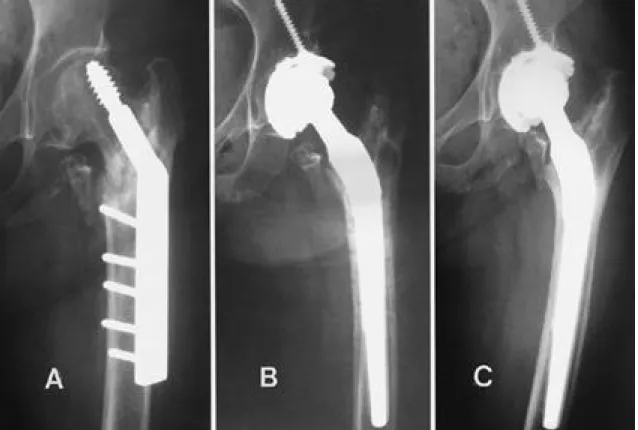
치환술후 추시 방사선 사진상 대퇴 삽입물의 정열은 전예에서 변화가 없었다(Fig. 1). 수직침강은 1년 추시상 3예( 1 8 . 8 % )에서 2 mm이상의 변화가 관찰 되 었으나 이후 진행되지 않아 전예에서 안정성이
유지되었다. 그 외 골용해가 1예( 6 . 2 % )에서 술후 2 년에 1 및 7 구역에서 관찰되었으나 진행하지 않았 고 골내막 신생골 형성은 9예( 5 6 . 3 % )에서 주로 1 및 7 구역에서 관찰되었다. 또한 골시멘트를 사용한 2예에서 방사선 투과 선이나 골시멘트의 골절 등 삽 입물의 해리를 시사하는 소견은 관찰되지 않았다.
비구컵의 안정성은 경사도가 유의하게 변화하여 해 리로 진단된 경우는 없었으나 양극성 반치환술을 실 시한 1예에서 컵의 과도한 수직 이동이 관찰되어 컵 의 전치환술을 시행하였다.
합병증으로는 고관절 탈구 1예 및 연부 조직 감염 2예가 발생하였으며, 탈구 1예는 도수정복 후 보조 기를 이용하여 치료하였고, 감염은 보존적으로 치료 하였다. 이극성 컵의 수직 이동에 대하여 전치환술 을 실시한 1예에 대해서는 추시 관찰 중에 있다.
— 92 — 최원식・안재훈・최근종
Fig. 1. A 81 year old female patient with unstable intertrochanteric fracture was fixed with compression hip screw(CHS). At postoperative 1 year 2 months, lateral cut-out of screw occurred.
Fig. 1. B THR was performed.
Fig. 1. C At postoperative 4 years, the radiograph showed stable fixation of both components.
시멘트 대퇴 삽입물을 사용하는 경우 m e t a p h y s e a l fit and fill이 불충분할 수 있으며, 이 경우 d i a- physeal fixation용의 삽입물을 사용함으로써 근위 부의 변형을 극복할 수 있다고 하였다. 한편 고령 환 자에서의 무시멘트 인공관절 치환술에 대해서는 임 상적으로 양호한 결과와 함께 티타늄 대퇴 삽입물 주위의 신생골 형성이 여러 사후 retrieval 연구1 6 , 2 8 )
를 통해 확인된 바 있다.
결 론
전자간 골절의 내고정 실패에 대해 관절 치환술은 신뢰할만한 해결책의 하나로서, 각 증예에 따라 적 절한 대퇴 삽입물의 선택 및 대퇴 근위부 변형에 대 한 세심한 주의를 통하여 최선의 결과를 얻을 수 있 을 것으로 사료된다.
REFERENCES
01) Berry DJ : Total hip arthroplasty in patients with proximal femoral deformity. Clin Orthop, 369: 262- 272, 1999.
02) Bogoch ER, Ouellette G and Hastings DE : Failure of internal fixation of displaced femoral neck fractures in rheumatoid patients. J Bone Joint Surg, 73-B: 7-10, 1991.
03) Bogoch ER, Ouellette G and Hastings DE : Intertrochanteric fractures of the femur on rheuma - toid arthritis patients. Clin Orthop, 294: 181-186, 1993.
04) Choi CU, Kim YH, Song JM and Kim HS : Clinical study for the complications of unstable intertrochanteric femoral fracture. J of Korean Orthop Assoc, 28: 683-693, 1993.
05) Davis TRC, Sher JL, Harsman A, Simpson M, Panter BB and Checke HSRG : I n t e r t r o c h a n t e r i c femoral fracture. Mechanical failure after internal fixation. J Bone Joint Surg, 72-B: 26-31, 1990.
06) Evans EM : The treatment of trochanteric fracture of the femur. J Bone Joint Surg, 31-B: 190-203, 1949.
07) Evans EM : Trochanteric fractures. A review of 110 cases treatment by nail plate fixation. J Bone Joint Surg, 33-B: 192-204, 1951.
08) Frankel VH : Mechanical fixation of unstable frac -
tures about the proximal end of the femur. Bull Hosp Jt Dis Orthop Inst, 24: 75-84, 1963.
09) Gruen TA, Mc Neice GM and Amstutz HC :
“Modes of failure”of cemented stem type femoral components. A radiographic analysis of loosening.
Clin Orthop, 141: 17-27, 1979.
10) Gundle R, Gargan MF and Simpson AHRW : How to minimize failures of fixation of unstable intertrochanteric fractures. Injury, 29: 611-614, 1995.
11) Hardy DCR, Descamps PY, Krallis, P et al : Use of an intramedullary hip-screw compared with a plate for intertrochanteric femoral fractures. A prospective randomized study of one hundred patients. J Bone Joint Surg, 80-A: 618-630, 1998.
12) Harris HW : Traumatic arthritis of the hip after dis - location and acetabular fractures: treatment by mold arthroplasty. An end-result study using a new method of result evaluation. J Bone Joint Surg, 51- A: 737-755, 1969.
13) Johnsson R : Comparison between hemiarthroplas - ty and total hip replacement following failure of nailed femoral neck fractures focused on disloca - tions. Arch Orthop Trauma Surg, 102: 187-190, 1984.
14) Keating JF, Robinson CM, Court-Broun CM, McQueen MM and Christie J : The effect of com - plication after hip fracture on rehabilitation. J Bone Joint Surg, 75-B: 976, 1993.
15) Kim HJ, Kim YM, Lee SH, Lee JH and Kang SB:
Treatment of intertrochanteric fracture with com - pression hip screw. A clinical analysis of causative factors in loss of fixation. J of Korean Trauma Society, 4: 57-68, 1991.
16) Lester DK : Cross-section radiographic analysis of 10 retrieved titanium alloy press-fit femoral endo - prosthesis. J Arthroplasty, 12: 930-937, 1997.
17) Lewinnek GE. Kelsey J, White AA III and Kriegger NJ : Comparative analysis of the epidemi - ology of hip fractures. Clin Orthop, 152: 35-42, 1980.
18) Mainds CC and Newman RJ : Implant failures in patients with proximal fractures of the femur treated with a sliding screw device. Injury: British J of Accident Surg, 20: 98-100, 1989.
19) Mariani EM and Rand JA : Nonunion of intertro- chanteric fractures of the femur following open reduction and internal fixation. Clin Orthop, 218:
— 94 — 최원식・안재훈・최근종
— 96 — 최원식・안재훈・최근종
ABSTRACT
Hip Replacement following Failed Internal Fixation of Intertrochanteric Fracture of Femur
Won-Sik Choy, M.D., Jae Hoon Ahn, M.D. and Keun Jong Choy, M.D.
Department of Orthopaedic Surgery, Eulji medical college, Taejon, Korea
Purpose : To analyze the clinical and radiological results of hip arthroplasty following failed inter- nal fixation of intertrochanteric fracture of the femur.
Materials and Methods : Sixteen patients of hip arthroplasty after failed internal fixation of intertrochanteric fracture were followed for more than 24 months postoperatively. Fractures were classified by Evans type and Singh index. The adequacy of reduction after internal fixation was ana- lyzed. Clinically, the amount of blood loss and Harris hip score (HHS) were measured. The stability of the cup and stem after arthroplasty was assessed using various radiological indices.
Results : Fractures were fixed with 14 compression hip screws in 14 hips, with Ender nail in 1 hip and with gamma nail in 1. The fixation failed after a mean duration of 8.5 months. All fractures were unstable. Singh index was less than grade 3 in 11 cases (68.7%). The reduction was inadequate in 12 cases (75%). At the latest follow-up, mean HHS was increased from preoperative 36.1 points to 73.4 points. There was no incidence of femoral fracture or perforation during operation. All stems were stable at the latest follow-up. There was no cup loosening except 1 case of vertical migration of bipo- lar head.
C o n c l u s i o n : Satisfactory results were obtained with salvage arthroplasty for failed intertrochanteric fixation.
Key Words : Intertrochanteric fracture of femur, Failure of fixation, Hip arthroplasty.