© 2017 Korean Breast Cancer Society. All rights reserved. http://ejbc.kr | pISSN 1738-6756
INTRODUCTION
A family history of breast cancer is a well-established, strong risk factor for breast cancer [1]. Previous studies sug- gest that a family history of breast cancer also increases the risk of breast cancer recurrence and the risk of the second pri- mary breast cancer [2-5]. A majority of these studies have in- vestigated the associations between mutations in BRCA1 and BRCA2 genes and the risk of breast cancer recurrence and contralateral breast cancer [5]. However, mutations in BRCA1 and BRCA2 are found only in about 6% to 23% of patients with breast cancer with a family history, suggesting that other
genetic factors may contribute to a family history of breast cancer [6,7]. Among these factors, other DNA repair genes have received increased attention [8]. Impaired DNA repair capacity in individuals with certain genetic variations in DNA repair genes results in slower rates of DNA damage repair caused by endogenous and exogenous influences, thus in- creasing cancer risk [8].
Among the risk factors that induce DNA damage, ionizing radiation has been long recognized as a breast cancer risk fac- tor [9]. Some studies also suggest that the association between ionizing radiation and breast cancer risk is stronger in women with a family history of breast cancer as compared to women without a family history [10,11]. On the other hand, because of the sensitivity of malignant breast tissue to the effects of ionizing radiation, radiotherapy has been widely used for the treatment of patients with breast cancer. Some concerns have been raised regarding the potential damaging effects of radia- tion therapy on the surrounding normal tissue and the tissue in unaffected breast. Recognizing this concern, previous stud- ies have been conducted to investigate the association of radi- ation therapy with the risk of local (ipsilateral) recurrence and
Interactions of Family History of Breast Cancer with Radiotherapy in Relation to the Risk of Breast Cancer Recurrence
Danmeng Li, Volker Mai, Travis Gerke, Susan Mengel Pinney1, Lusine Yaghjyan
Department of Epidemiology, College of Public Health and Health Professions and College of Medicine, University of Florida, Gainesville; 1Department of Environmental Health, University of Cincinnati, Cincinnati, USA
ORIGINAL ARTICLE
Purpose: We examined associations between a family history of breast cancer and the risk of breast cancer recurrence in women who received or did not receive radiotherapy. Methods: Our study included 2,440 women enrolled in the Breast Cancer Reg- istry of Greater Cincinnati. Information on breast cancer risk fac- tors, including detailed family history of breast cancer, character- istics of the primary tumor, treatment received, and recurrence status was collected at baseline and via updates. Associations between a family history of breast cancer and the risk of breast cancer recurrence were examined separately in women treated with and without radiotherapy using survival analysis. Results:
Over an average follow-up time of 8.78 years, we found no as- sociations between a family history of breast cancer and the risk of breast cancer recurrence among women with a history of ra-
diotherapy (hazard ratio [HR], 0.96; 95% confidence interval [CI], 0.75–1.23). Among women who did not receive radiotherapy, the total number of relatives with breast cancer was positively asso- ciated with the risk of breast cancer recurrence (HR, 1.21; 95%
CI, 1.00–1.47). We found no interactions of radiotherapy with family history (p-interaction >0.05). Conclusion: Radiotherapy for a primary breast cancer in women with a family history of breast cancer does not increase risk of breast cancer recurrence. If these findings are replicated in future studies, the results may translate into an important health message for breast cancer survivors with a family history of breast cancer.
Key Words: Breast neoplasms, Radiotherapy, Recurrence
Correspondence to: Lusine Yaghjyan
Department of Epidemiology, College of Public Health and Health Professions and College of Medicine, University of Florida, 2004 Mowry Rd., Gainesville, FL 32610, USA
Tel: +1-352-294-5940, Fax: +1-352-273-5365 E-mail: [email protected]
The Breast Cancer Registry of Greater Cincinnati (BCRGC) is supported by funding from NIEHS (grant number: P30-ES006096).
Received: October 18, 2017 Accepted: December 7, 2017
Cancer
the risk of contralateral breast cancer. While radiotherapy has been reported to decrease the risk of local recurrence [5,12, 13], the risk of contralateral breast cancer has been found to increase after radiotherapy, especially in younger women [5,12,14-16]. To date, only one study examined the impact of a family history of breast cancer on the relationship between radiotherapy and the risk of contralateral breast cancer [14].
This study found a significant additive interaction between ra- diotherapy and a positive family history of breast cancer in re- lation to the risk of contralateral breast cancer [14]. Two stud- ies also examined the association between a family history of breast cancer and the risk of local recurrence in women treat- ed with radiotherapy. These studies had relatively small sam- ples, and did not find significant associations [17,18]. The purpose of the current study was to examine the association between a family history of breast cancer and the risk of breast cancer recurrence in women who received or did not receive radiotherapy in an established breast cancer registry.
METHODS
Study population and data collection
The Breast Cancer Registry of Greater Cincinnati (BCRGC) was established by the University of Cincinnati, Department of Environmental Health in 2003. The registry aims to collect information on incident and prevalent breast cancer cases in the Greater Cincinnati area and to explore the risk factors for breast cancer in this population. Women and men living in the Greater Cincinnati area and diagnosed with breast cancer are recruited through local oncology practices, media, and community outreach events. The women in the registry rep- resent a volunteer convenience sample. Demographic infor- mation, clinical characteristics of the tumor (except tumor size and stage), treatment history, reproductive history, and detailed family history of cancer are collected via the baseline self-administered questionnaire. The data in the registry are available for analyses conducted by approved investigators at the following link: http://eh.uc.edu/breastcancerregistry/
researchers/index.html.
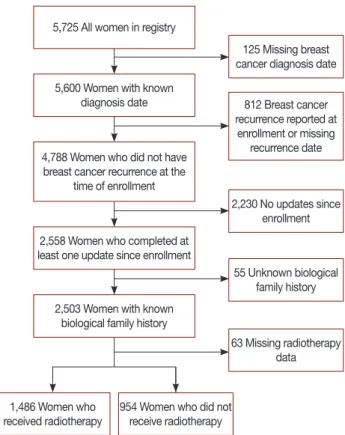
The data on recurrence of the tumor and updated informa- tion on breast cancer risk factors used in this analysis were collected in 2006, 2011, and 2013. Out of 5,725 women in the BCRGC, we excluded women with missing diagnosis date (n=125) and women with a prior history of breast cancer re- currence or missing recurrence date at enrollment (n=812).
To be eligible for the study, women were required to have at least one update completed during the follow-up and to have knowledge of their biological family history (n=2,503). We further excluded women with missing radiotherapy history
information (n=63). The final study sample included 2,440 women (42.6% of all participants in the BCRGC), of which 1,486 had a history of receiving radiotherapy and 954 women did not receive radiotherapy (Figure 1). Of these women, 41.3% were incident breast cancer cases and 58.7% were preva- lent cases. Characteristics of women in the study sample were similar to characteristics of all women in the registry. The av- erage follow-up time between the initial and the first available update questionnaire, and between the initial and the last available update questionnaire, were 2 years (range, <1–8 years) and 4 years (range, <1–10 years), respectively. This study was approved by the University of Florida and Universi- ty of Cincinnati Institutional Review Boards (protocol num- bers 201400996 and 20123745, respectively). All women pro- vided written informed consent.
Radiotherapy and family history of breast cancer
Information about radiotherapy for the initial breast cancer diagnosis was collected at baseline. Detailed information on a family history of breast cancer in first- (mother, sister, and daughter) and second-degree relatives (paternal and maternal grandmothers and aunts) was collected at baseline and updat- ed at each follow-up cycle. As inherited genetic susceptibility may not have fully manifested at the time of entry into the
5,725 All women in registry
125 Missing breast cancer diagnosis date
2,230 No updates since enrollment
55 Unknown biological family history
63 Missing radiotherapy data 812 Breast cancer recurrence reported at
enrollment or missing recurrence date 5,600 Women with known
diagnosis date
4,788 Women who did not have breast cancer recurrence at the
time of enrollment
2,558 Women who completed at least one update since enrollment
2,503 Women with known biological family history
1,486 Women who
received radiotherapy 954 Women who did not receive radiotherapy
Figure 1. Participant selection diagram.
study, we supplemented data on family history from baseline with the updates to fully capture this information. For these analyses, a family history of breast cancer was defined in sev- eral ways: (1) having any first-degree relative with breast can- cer diagnosis (any or none); (2) total number of first-degree relatives with breast cancer; (3) total number of relatives with breast cancer; and (4) a total family history score that was cal- culated as the sum of the number of first-degree relatives with breast cancer and half the number of second-degree relatives with breast cancer.
Covariates
Information on potential confounders was collected at baseline and updated throughout the follow-up period. These confounders included age (years) and body mass index (BMI, kg/m2) at the time of diagnosis, menopausal status and post- menopausal hormone use (premenopausal, postmenopausal who never used hormones, postmenopausal with hormone use history, and postmenopausal with unknown hormone use status), a history of benign breast biopsies (yes/no), parity and the age at first birth (nulliparous, any children with age at first birth <25 years, and any children with age at first birth of
≥25 years), a history of alcohol consumption (any/none), and smoking (yes/no). We further examined the following factors related to breast cancer diagnosis and treatment: receptor sta- tus (positive or negative for estrogen receptor [ER], progester- one receptor, and human epidermal growth factor receptor 2), nodal involvement (positive/negative), and a history of sur- gery (yes/no), chemotherapy (yes/no), and adjuvant hormone therapy (yes/no).
Statistical analysis
Distributions of baseline characteristics in women with and without a history of radiotherapy were compared using the t- test (for continuous variables) and chi-square test (for cate- gorical variables). To compare characteristics of women in the study sample and all women in the registry, we first created a new indicator variable explaining whether the population represents that of the entire registry or of the study sample in respective data sets. Next, two data sets (entire registry and study sample) were combined into one and the distribution of variables by the indicator variable described above was com- pared using the t-test or chi-square test.
Cox proportional hazards models with time since diagnosis in months as the underlying time variable were used to calcu- late hazard ratios (HRs) and the corresponding 95% confi- dence intervals (CIs). The primary endpoint, breast cancer re- currence, was defined as an episode of recurrence self-report- ed on any of the update questionnaires. For individuals with
breast cancer recurrence, follow-up began at the time of breast cancer diagnosis and ended on the date of breast cancer re- currence. If the exact date of recurrence was not specified, the mid-point between the previous contact and the date of the update when the recurrence was reported was used as the es- timated date of recurrence (n=10). For women without breast cancer recurrence, follow-up began at the time of diagnosis and ended at the time of the last contact or at the end of the study (December 31, 2014), whichever occurred first. As age and BMI have shown significant associations with breast can- cer-free survival in previous studies [2,19], both of these vari- ables were forced into the survival models. The best fitting model was selected using step-wise model selection approach and only covariates that met statistical significance at 0.05 level were kept in the final models. The survival models were run separately for each of the family history variables in women who received and did not receive radiotherapy.
The proportional hazards assumption was tested for the survival models within each of the radiotherapy strata. The results suggested no assumption violations (among women with radiotherapy, proportionality test p-values ranged 0.730–
0.915; among women with no radiotherapy, proportionality test p-values ranged 0.206–0.569). The differences in the asso- ciations between each of the family history variables and the risk of breast cancer recurrence in women who received and did not receive radiotherapy were tested by including an inter- action term in the survival model for the entire study sample.
In a secondary analysis, to examine the potential influence of immortality bias, we defined the start of the follow-up time for women with prevalent breast cancer as the date of recruit- ment rather than breast cancer diagnosis. In additional analy- sis, we also excluded 10 women with unknown exact dates of recurrence during the follow-up. Finally, to determine if the type of surgery might influence our findings, we explored the influence of the type of surgery in the analysis (modeled as mastectomy, breast-conserving surgery, or no surgery). The findings with this modeling approach were very similar to those obtained with binary history of surgery variable. As the binary modeling approach provided better data balance, the history of surgery was modeled as yes versus no in all the analyses. All the tests were two-sided and significance of the effects was assessed at the 0.05 level. All analyses were per- formed using SAS statistical software version 9.4 (SAS Insti- tute Inc., Cary, USA).
RESULTS
This study included 2,440 women with breast cancer (1,486 who received radiotherapy and 954 who did not receive ra-
diotherapy). The average follow-up time was 8.42 years for women with radiotherapy (median, 7.27; interquartile range [IQR], 3.91–11.50) and 9.51 years for women without radio- therapy (median, 7.90; IQR, 4.23–13.29). During the follow- up, there were 109 reported recurrences (69 in women with radiotherapy and 40 in women without radiotherapy). The distribution of selected characteristics among study partici- pants by the status of radiotherapy is presented in the Table 1.
Compared to the participants without radiotherapy, women who received radiotherapy were older (55.93 years vs. 54.10 years, p<0.001), had greater BMI (27.36 kg/m2 vs. 26.30 kg/m2, p<0.001) at the time of breast cancer diagnosis, had a smaller total number of first-degree relatives with breast cancer (0.27 vs. 0.32, p=0.028), were less likely to have any first-degree rel- ative with breast cancer (23.0% vs. 26.8%, p=0.032), and were less likely to have a history of chemotherapy (51.5% vs. 61.7%, p<0.001). There was also a significant difference in women’s
menopausal status and postmenopausal hormone use be- tween the two groups; women who received radiotherapy were more likely to be postmenopausal and to have a history of postmenopausal hormone use (p<0.001). The distribu- tions of other characteristics were similar in women with and without radiotherapy.
In univariate analysis of the associations of age, BMI, tumor characteristics and clinical variables with the risk of recurrence in women with and without radiotherapy, BMI and surgery were the only variables that were significantly associated with the risk of recurrence in both strata (BMI ≥25 to <30 kg/m2 vs.
<25 kg/m2 [HR, 2.84; 95% CI, 1.47–5.50] and BMI ≥30 kg/m2 vs. <20 kg/m2 [HR, 4.03; 95% CI, 2.10–7.74] for women with radiotherapy; BMI ≥25 to <30 kg/m2 vs. <25 kg/m2 [HR, 2.21; 95% CI, 1.01–4.85] and BMI ≥30 kg/m2 vs. <20 kg/m2 [HR, 2.62; 95% CI, 1.05–6.52] for women without radiother- apy; surgery yes vs. no [HR, 0.12; 95% CI, 0.07–0.19] for Table 1. Characteristics of study participants by radiotherapy history
Characteristic Women with radiotherapy
(n=1,486)
Women without radiotherapy
(n=954) p-value
Age at diagnosis (yr) 55.93±10.94 54.10±11.49 <0.001
Time between breast cancer diagnosis and enrollment (yr) 3.63±4.57 4.71±6.13 <0.001
Length of follow-up (mo) 100.98±70.48 114.07±83.40 <0.001
Body mass index at diagnosis (kg/m2) 27.36±6.31 26.30±5.56 <0.001
Family history of BC*
Total no. of first-degree relatives with BC 0.27±0.53 0.32±0.59 0.028
Total no. of relatives with BC 0.65±0.93 0.78±1.11 0.003
Total family history score 0.46±0.67 0.55±0.77 0.003
Alcohol use (ever) 1,019 (69.9) 627 (67.4) 0.195
Smoking status (ever) 689 (46.6) 421 (44.5) 0.316
Parity and age at first child’s birth
Nulliparous 234 (15.8) 133 (13.9) 0.410
First birth <25 yr 703 (47.3) 451 (47.3)
First birth ≥25 yr 549 (36.9) 370 (38.8)
Menopausal status/PMH history
Premenopausal 112 (7.5) 135 (14.2) <0.001
Postmenopausal, no PMH 696 (46.8) 459 (48.1)
Postmenopausal, with PMH 639 (43.0) 338 (35.4)
Postmenopausal, PMH unknown 32 (2.2) 18 (1.9)
Family history of BC, any first-degree relative with BC (yes) 342 (23.0) 256 (26.8) 0.032
Benign breast biopsies (yes) 393 (27.1) 269 (29.1) 0.293
Primary BC diagnosis-related
Nodal involvement (positive) 440 (29.6) 306 (32.1) 0.316
Estrogen receptor status (positive)† 828 (82.1) 487 (75.5) 0.001
Progesterone receptor status (positive)† 257 (56.5) 168 (51.4) 0.157
HER2 receptor status (positive)† 47 (29.0) 49 (35.0) 0.265
Breast surgery (yes) 1,399 (94.3) 886 (93.2) 0.240
Chemotherapy (yes) 764 (51.5) 589 (61.7) <0.001
Adjuvant therapy (yes) 1,059 (71.3) 564 (59.1) <0.001
Data are presented as mean±SD or number (%). Percentages calculated from non-missing data.
BC=breast cancer; PMH=postmenopausal hormone use; HER2=human epidermal growth factor receptor 2.
*Information on family history was retrieved from both baseline and update questionnaires; †Percentages calculated for women with non-missing data on receptor status.
women with radiotherapy; surgery yes vs. no [HR, 0.11; 95%
CI, 0.06–0.22] for women without radiotherapy). Among women with radiotherapy, ER negative status was also associ- ated with an increased risk of recurrence (ER– vs. ER+: HR, 2.20; 95% CI, 1.22–3.97), but this association was no longer significant after adjustment for other covariates in the full model.
The results of the survival analysis in women with and without a history of radiotherapy are summarized in Table 2.
Among women with a history of radiotherapy, breast cancer recurrence was not associated with any of the variables for the family history of breast cancer after adjustment for age and BMI at diagnosis and a history of surgery (any first-degree relative with breast cancer: HR, 0.98; 95% CI, 0.58–1.68; total first-degree relatives with breast cancer: HR, 0.89; 95% CI, 0.57–1.39; total number of relatives with breast cancer: HR, 0.96; 95% CI, 0.75–1.23; total family history score: HR, 0.92;
95% CI, 0.65–1.32).
Among women without a history of radiotherapy, the total number of relatives with breast cancer was positively associat- ed with breast cancer recurrence, with approximately a 21%
increase in the risk of recurrence per any additional family member with breast cancer (HR, 1.21; 95% CI, 1.00–1.47).
None of the other family history variables were associated with the risk of breast cancer recurrence in women without radiotherapy. The risk estimates for any of the family history variables did not differ significantly across the radiotherapy strata (p-interaction >0.05 for all).
In a secondary analysis with the start of the follow-up de- fined as the enrollment date for women with prevalent breast cancer, the results remained unchanged (data not shown).
Similarly, the results did not change after exclusion of 10 women with unknown exact date of recurrence (data not shown).
DISCUSSION
We examined the interactions between radiotherapy and a family history of breast cancer in relation to the risk of breast cancer recurrence in an established prospective breast cancer registry. Our findings suggest no difference in the associations of the family history of breast cancer with the risk of breast cancer recurrence by the status of radiotherapy.
Consistent with previous reports, we found no association between a family history of breast cancer and the risk of breast cancer recurrence among women who received radiotherapy [17,18]. Chabner et al. [17] found no association between a family history of breast cancer in first-degree relatives and the risk of local recurrence among 201 women diagnosed with stage I or II invasive breast cancer and receiving radiotherapy.
Similarly, a case-control study in women with early-stage breast cancer receiving breast-conserving surgery and radio- therapy did not find any association between a family history of breast cancer and breast cancer recurrence among 52 wom- en with a local recurrence and 52 matched controls [18].
We found a significant association between the total num- ber of relatives with breast cancer and the risk of breast cancer recurrence among women who did not receive radiotherapy.
The results from previous studies on a family history of breast cancer and the risk of recurrence are inconsistent [20-24]. A retrospective study by Turkoz et al. [24] reported an increased recurrence risk among family history-positive breast cancer cases with young age or triple negative breast cancer (HR=
1.62 and 1.82, respectively). Similarly, Jobsen et al. [23] found a positive association between a family history of breast can- cer and the risk of local recurrence among young breast can- cer patients (age ≤40 years old). However, three cohort stud- ies found no association between the family history of breast cancer and/or ovarian cancer and the risk of breast cancer re- currence [20-22].
Table 2. Associations of the family history of breast cancer with the risk of breast cancer recurrence by radiotherapy status Family history of BC
Women with radiotherapy (n=1,486), HR (95% CI) Women without radiotherapy (n=954), HR (95% CI)
p-value‡ Univariate Full* Parsimonious
model† Univariate Full* Parsimonious
model†
Any first-degree relative with BC 1.17 (0.69–1.98) 1.22 (0.70–2.12) 0.98 (0.58–1.68) 1.10 (0.55–2.20) 0.92 (0.45–1.90) 0.86 (0.42–1.73) 0.855 Total first-degree relatives with BC§ 1.00 (0.65–1.53) 1.03 (0.66–1.61) 0.89 (0.57–1.39) 1.22 (0.78–1.90) 1.11 (0.69–1.80) 1.05 (0.66–1.68) 0.535 Total number of relatives with BCII 1.06 (0.83–1.34) 1.00 (0.78–1.27) 0.96 (0.75–1.23) 1.27 (1.05–1.55) 1.23 (1.01–1.49) 1.21 (1.00–1.47) 0.252 Total family history score¶ 1.05 (0.75–1.47) 1.01 (0.71–1.43) 0.92 (0.65–1.32) 1.36 (1.00–1.83) 1.30 (0.95–1.77) 1.26 (0.92–1.73) 0.272 HR=hazard ratio; CI=confidence interval; BC=breast cancer.
*Adjusted for age and body mass index at diagnosis, tumor characteristics (nodal involvement, estrogen, progesterone, and human epidermal growth factor receptor 2 status) and a history of treatment (surgery, adjuvant hormone therapy, and chemotherapy); †Adjusted for age and body mass index at diagnosis and a history of surgery; ‡p-value for two-way interaction between radiotherapy and family history of BC; §The risk estimates reflect the change in risk per any additional first degree relative with BC; IIThe risk estimates reflect the change in risk per any additional relative with BC; ¶The risk estimates reflect the change in risk per one unit change in the family history score (which reflects either one additional first-degree relative with BC or two second-degree relatives with BC).
Our study utilized an established prospective cohort with more than 12 years of follow-up. Women included in the analysis were representative of all women in the registry with respect to important characteristics. In addition, characteris- tics of women in the registry and in the analysis were similar to those from previous studies [25]. Unlike previous studies, we defined a family history of breast cancer using various ap- proaches, which allowed us to separately examine the effects of the family history in first-degree relatives, family history in both first and second-degree relatives, as well as a total score that accounted for the nature of these familial relationships. It is possible, however, that some of the effects were not detected due to the relatively small number of recurrences in this co- hort. Information on breast cancer risk factors, tumor charac- teristics, treatment history, and breast cancer recurrence status was self-reported and misclassification of the recurrence sta- tus cannot be excluded completely. However, previous studies suggest high accuracy of self-reported cancer history, history of breast cancer recurrence, and treatment [26,27]. A previous study reported high agreement between self-reported data (recall time, 1.6–9.0 years; mean, 3.2 years) and data in medi- cal records; the agreement between the two data sources was 99% for a history of radiotherapy and 97% for breast cancer recurrence status [27]. The prospective data collection in our study also minimizes the possibility of misclassification. We could not, however, separately examine the associations for contralateral versus ipsilateral recurrence as this information was not available.
Our study population appears to be representative of breast cancer cases reported by the Surveillance, Epidemiology, and End Results Program with respect to the distribution of recep- tor statuses [28]. However, the registry did not collect infor- mation on breast cancer stage and tumor size. As treatment regimens are based on these tumor features and as we exam- ined the effect of treatment history in our analysis (surgery, adjuvant hormone therapy, and chemotherapy), it is very un- likely that the absence of information on tumor stage influ- enced our findings. Even though information on the age at breast cancer diagnosis for first- and second-degree relatives was collected at enrollment, a substantial proportion of par- ticipants had missing data on these variables. Thus, we could not consider a younger age at diagnosis in modeling the fami- ly history in our analysis. Finally, as the follow-up time starts on the date of diagnosis rather than on the date of enrollment in the registry, the immortal bias is possible. However, as the average time between diagnosis and enrollment date was 4.0 years (median, 2.0; IQR, 0.6–5.2), which falls within the ex- pected time window for observing recurrences, it is unlikely that the results were influenced by this bias. This is further
supported by similar findings of the secondary analysis, in which the start of the follow-up for prevalent cases was set to the date of enrollment.
Some previous studies suggest that breast cancer patients with a positive family history of breast cancer tend to undergo cancer screening more frequently and from a younger age [29]. Higher dose and early age at exposure to ionizing radia- tion have been linked to breast cancer risk in previous studies [30]. Mammography represents a source of medical ionizing radiation in women and it is possible that the cumulative ex- posure to this radiation in women with a family history of breast cancer might contribute to a higher risk of breast can- cer recurrence. Information on the number of prior mammo- grams, however, was not collected by the registry and could not be controlled for in this analysis. Similarly, the informa- tion on radiotherapy dose was also unavailable. Future studies would benefit from inclusion of this important information in the analysis, which would allow to account for a woman’s total cumulative exposure to ionizing radiation.
In conclusion, our findings do not support the hypothesis that radiotherapy in breast cancer cases with a family history of breast cancer might increase the risk of breast cancer recur- rence. Future studies are warranted to further examine these associations in larger population-based studies with complete information on ionizing radiation from prior mammography screening. If these findings are replicated by future studies, the results could be translated into an important health message to breast cancer survivors with a family history of breast can- cer explaining that they are not at an increased risk of breast cancer recurrence due to the radiation exposure from their treatment as compared to women with no family history of breast cancer.
CONFLICT OF INTEREST
The authors declare that they have no competing interests.
ACKNOWLEDGMENTS
We thank the many members of the BCRGC for providing the data used in this analysis.
REFERENCES
1. Collaborative Group on Hormonal Factors in Breast Cancer. Familial breast cancer: collaborative reanalysis of individual data from 52 epide- miological studies including 58,209 women with breast cancer and 101,986 women without the disease. Lancet 2001;358:1389-99.
2. Fowble B, Hanlon A, Freedman G, Nicolaou N, Anderson P. Second
cancers after conservative surgery and radiation for stages I-II breast cancer: identifying a subset of women at increased risk. Int J Radiat Oncol Biol Phys 2001;51:679-90.
3. Reiner AS, John EM, Brooks JD, Lynch CF, Bernstein L, Mellemkjær L, et al. Risk of asynchronous contralateral breast cancer in noncarriers of BRCA1 and BRCA2 mutations with a family history of breast cancer: a report from the Women’s Environmental Cancer and Radiation Epide- miology study. J Clin Oncol 2013;31:433-9.
4. Bouchardy C, Benhamou S, Fioretta G, Verkooijen HM, Chappuis PO, Neyroud-Caspar I, et al. Risk of second breast cancer according to estrogen receptor status and family history. Breast Cancer Res Treat 2011;127:233-41.
5. Drooger JC, Hooning MJ, Seynaeve CM, Baaijens MH, Obdeijn IM, Sleijfer S, et al. Diagnostic and therapeutic ionizing radiation and the risk of a first and second primary breast cancer, with special attention for BRCA1 and BRCA2 mutation carriers: a critical review of the litera- ture. Cancer Treat Rev 2015;41:187-96.
6. Hall MJ, Reid JE, Wenstrup RJ. Prevalence of BRCA1 and BRCA2 mutations in women with breast carcinoma In Situ and referred for genetic testing. Cancer Prev Res (Phila) 2010;3:1579-85.
7. Donenberg T, Lunn J, Curling D, Turnquest T, Krill-Jackson E, Royer R, et al. A high prevalence of BRCA1 mutations among breast cancer patients from the Bahamas. Breast Cancer Res Treat 2011;125:591-6.
8. Goode EL, Ulrich CM, Potter JD. Polymorphisms in DNA repair genes and associations with cancer risk. Cancer Epidemiol Biomarkers Prev 2002;11:1513-30.
9. Carmichael A, Sami AS, Dixon JM. Breast cancer risk among the survivors of atomic bomb and patients exposed to therapeutic ionising radiation.
Eur J Surg Oncol 2003;29:475-9.
10. Hill DA, Preston-Martin S, Ross RK, Bernstein L. Medical radiation, family history of cancer, and benign breast disease in relation to breast cancer risk in young women, USA. Cancer Causes Control 2002;13:
711-8.
11. Hiramatsu H, Bornstein BA, Recht A, Schnitt SJ, Baum JK, Connolly JL, et al. Local recurrence after conservative surgery and radiation ther- apy for ductal carcinoma in situ: possible importance of family history.
Cancer J Sci Am 1995;1:55-61.
12. Clarke M, Collins R, Darby S, Davies C, Elphinstone P, Evans V, et al.
Effects of radiotherapy and of differences in the extent of surgery for early breast cancer on local recurrence and 15-year survival: an over- view of the randomised trials. Lancet 2005;366:2087-106.
13. Vinh-Hung V, Verschraegen C. Breast-conserving surgery with or without radiotherapy: pooled-analysis for risks of ipsilateral breast tumor recurrence and mortality. J Natl Cancer Inst 2004;96:115-21.
14. Hooning MJ, Aleman BM, Hauptmann M, Baaijens MH, Klijn JG, Noyon R, et al. Roles of radiotherapy and chemotherapy in the develop- ment of contralateral breast cancer. J Clin Oncol 2008;26:5561-8.
15. Stovall M, Smith SA, Langholz BM, Boice JD Jr, Shore RE, Andersson M, et al. Dose to the contralateral breast from radiotherapy and risk of second primary breast cancer in the WECARE study. Int J Radiat Oncol Biol Phys 2008;72:1021-30.
16. Gao X, Fisher SG, Emami B. Risk of second primary cancer in the contralateral breast in women treated for early-stage breast cancer: a
population-based study. Int J Radiat Oncol Biol Phys 2003;56:1038-45.
17. Chabner E, Nixon A, Gelman R, Hetelekidis S, Recht A, Bornstein B, et al. Family history and treatment outcome in young women after breast- conserving surgery and radiation therapy for early-stage breast cancer. J Clin Oncol 1998;16:2045-51.
18. Harrold EV, Turner BC, Matloff ET, Pathare P, Beinfield M, McKhann C, et al. Local recurrence in the conservatively treated breast cancer patient: a correlation with age and family history. Cancer J Sci Am 1998;4:302-7.
19. Kroenke CH, Chen WY, Rosner B, Holmes MD. Weight, weight gain, and survival after breast cancer diagnosis. J Clin Oncol 2005;23:1370-8.
20. Buist DS, Abraham LA, Barlow WE, Krishnaraj A, Holdridge RC, Sickles EA, et al. Diagnosis of second breast cancer events after initial diagnosis of early stage breast cancer. Breast Cancer Res Treat 2010;124:
863-73.
21. Figueiredo JC, Ennis M, Knight JA, McLaughlin JR, Hood N, O’Malley F, et al. Influence of young age at diagnosis and family history of breast or ovarian cancer on breast cancer outcomes in a population-based cohort study. Breast Cancer Res Treat 2007;105:69-80.
22. Harris EE, Schultz DJ, Peters CA, Solin LJ. Relationship of family history and outcome after breast conservation therapy in women with ductal carcinoma in situ of the breast. Int J Radiat Oncol Biol Phys 2000;48:
933-41.
23. Jobsen JJ, Meerwaldt JH, van der Palen J. Family history in breast cancer is not a prognostic factor? Breast 2000;9:83-7.
24. Turkoz FP, Solak M, Aksoy S, Petekkaya I, Keskin O, Kertmen N, et al.
Association between family history and clinicopathologic characteristics in 1987 breast cancer patients: single institution experience from Turkey.
J BUON 2012;17:649-57.
25. Gierach GL, Ichikawa L, Kerlikowske K, Brinton LA, Farhat GN, Vacek PM, et al. Relationship between mammographic density and breast cancer death in the Breast Cancer Surveillance consortium. J Natl Can- cer Inst 2012;104:1218-27.
26. Barisic A, Glendon G, Weerasooriya N, Andrulis IL, Knight JA. Accuracy of self-reported breast cancer information among women from the Ontario site of the breast cancer family registry. J Cancer Epidemiol 2012;2012:310804.
27. Phillips KA, Milne RL, Buys S, Friedlander ML, Ward JH, McCredie MR, et al. Agreement between self-reported breast cancer treatment and medical records in a population-based Breast Cancer Family Reg- istry. J Clin Oncol 2005;23:4679-86.
28. Li CI, Malone KE, Daling JR. Differences in breast cancer hormone receptor status and histology by race and ethnicity among women 50 years of age and older. Cancer Epidemiol Biomarkers Prev 2002;11:601- 7.
29. Broeks A, Braaf LM, Huseinovic A, Nooijen A, Urbanus J, Hogervorst FB, et al. Identification of women with an increased risk of developing radiation-induced breast cancer: a case only study. Breast Cancer Res 2007;9:R26.
30. John EM, Phipps AI, Knight JA, Milne RL, Dite GS, Hopper JL, et al.
Medical radiation exposure and breast cancer risk: findings from the Breast Cancer Family Registry. Int J Cancer 2007;121:386-94.