• 검색 결과가 없습니다.

Pumpless extracorporeal interventional lung assist for bronchiolitis obliterans after allogenic peripheral blood stem cell transplantation for acute lymphocytic leukemia

N/A
N/A
Protected

Academic year: 2021

Share "Pumpless extracorporeal interventional lung assist for bronchiolitis obliterans after allogenic peripheral blood stem cell transplantation for acute lymphocytic leukemia"

Copied!
4
0
0

로드 중.... (전체 텍스트 보기)

전체 글

(1)

CASE REPORT eISSN 2384-0293 http://dx.doi.org/10.12701/yujm.2015.32.2.98 Yeungnam Univ J Med 2015;32(2):98-101

98 YUJM VOLUME 32, NUMBER 2, DECEMBER 2015

Pumpless extracorporeal interventional lung assist for bronchiolitis obliterans after allogenic peripheral blood stem cell transplantation for

acute lymphocytic leukemia

Yeon-Hee Park, Chae-Uk Chung, Jae-Woo Choi, Sang-Ok Jung, Sung-Soo Jung, Jeong-Eun Lee, Ju-Ock Kim, Jae-Young Moon

Department of Internal Medicine, Chungnam National University School of Medicine, Daejeon, Korea

Bronchiolitis obliterans (BO), which is associated with graft-versus-host disease after allogenic hemato- poietic stem cell transplantation, is a major obstacle to survival after bone marrow transplantation due to its gradual progress, eventually leading to respiratory failure. Pumpless extracorporeal interventional lung assist (iLA) is effective in treatment of reversible hypercapnic respiratory failure. In this paper, we present a 23- year-old female patient who underwent allogeneic peripheral blood stem cell transplantation (PBSCT) for acute lymphocytic leukemia. After 6 months, she complained of shortness of breath and was diagnosed with BO.

Five months later, she developed an upper respiratory tract infection that worsened her BO and caused life-threatening hypercapnia. Since mechanical ventilation failed to eliminate CO

2

effectively, iLA was applied as rescue therapy. Her hypercapnia and respiratory acidosis showed significant improvement within a few hours, and she was successfully weaned off iLA after 12 days. This is the first case report of iLA application for temporarily aggravated hypercapnia of PBSCT-associated BO followed by successful weaning. This rescue therapy should be considered in ventilator-refractory reversible hypercapnia in BO patients.

Keywords: Bronchiolitis obliterans; Graft vs host disease; Pumpless extracorporeal interventional lung assist;

Hypercapnia

Received: June 30, 2014, Revised: July 31, 2014, Accepted: August 4, 2014

Corresponding Author: Jae Young Moon, Division of Pulmonary and Critical Care Medicine, Department of Internal Medicine, Chungnam National University School of Medicine, 282 Munhwa-ro, Jung-gu, Daejeon 35015, Korea Tel: +82-42-280-7142, Fax: +82-42-257-5753

E-mail: [email protected]

INTRODUCTION

Bronchiolitis obliterans (BO) is characterized by the pro- gression of fixed small-airway obstruction and is associated with chronic graft-versus-host disease (GVHD) after alloge- neic hematopoietic stem cell transplantation (HSCT) [1]. Bio- psy specimens usually show bronchiolitis involving the small airways and fibrinous obliteration of the lumens of the respira- tory bronchioles. The overall prevalence of BO is 5.5%, while prevalence in patients who survived at least 1 year after HSCT is 10% and 16% in all patients with chronic GVHD. The

prognosis of BO is poor, with an overall survival rate of 44%

at 2 years and 13% at 5 years [2]. Consequently, BO is one of the major obstacles to post-HSCT survival.

In the progression of BO, many risk factors, including respi- ratory tract infection and drug side effects can aggravate venti- lation and cause respiratory failure [2]. Overcoming acute exa- cerbation of BO is crucial to improving its long-term prognosis.

Pumpless extracorporeal interventional lung assist (iLA) is useful for supporting the pulmonary function in patients with severe hypercapnia and moderate hypoxia [3-6]. Here, we re- port on a patient with hypercapnic respiratory failure of BO after allogeneic peripheral blood stem cell transplantation (PBSCT) that was successfully overcome with iLA for the first time.

CASE

A 23-year-old female was diagnosed with acute lympho-

(2)

iLA for bronchiolitis obliterans after PBSCT

YUJM VOLUME 32, NUMBER 2, DECEMBER 2015 99

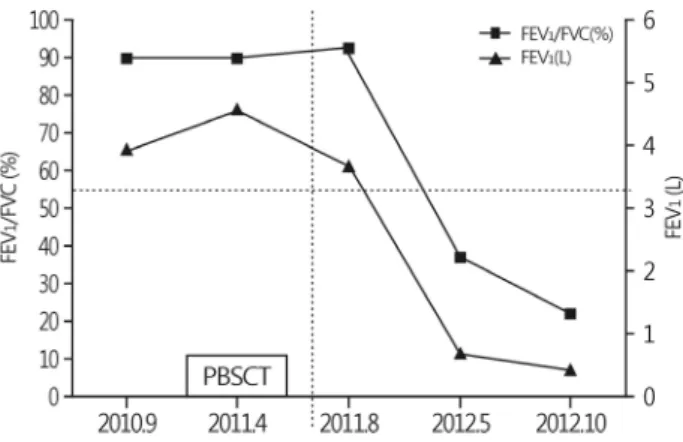
Fig. 1. Twelve months after allogeneic PBSCT, the patient’s pul- monary function test showed a severe obstructive pattern. The FEV

1

was 20% of the expected normal level while the FEV

1

/FVC ratio was 37%. PBSCT, peripheral blood stem cell transplanta- tion; FEV

1

, forced expiratory volume in 1 second; FVC, forced vital capacity.

Fig. 2. Chest CT upon diagnosis of BO. (A) Air trapping or persis- tent lucency of lung parenchyma during expiration of both lungs.

(B) Bronchial wall thickening and bronchiectasis were apparent in all the visible lobes on chest CT. CT, computed tomography;

BO, bronchiolitis obliterans.

Fig. 3. The patient was successfully weaned off iLA after 12 days.

Subsequently, her PaCO

2

and pH remained stable via HFNC. iLA, interventional lung assist; HFNC, high-flow nasal cannula.

cytic leukemia (ALL) and underwent allogenic PBSCT after high-dose chemotherapy on 20 April 2011. Six months later, she developed an erythematous maculopapular skin rash, and a biopsy confirmed cutaneous GVHD. She also developed watery diarrhea with elevated serum liver enzymes, which suggested GVHD in the gastrointestinal tract and liver. After steroid pulse therapy, her symptoms and signs improved and she was kept on oral systemic steroid medication.

Twelve months after allogeneic PBSCT, she was admitted to the authors’ hospital with progressive shortness of breath and cough. A pulmonary function test revealed a severe ob- structive pattern, with forced expiratory volume in one second (FEV

1

) of 0.7 L, 20% of the predicted values, and a forced vital capacity (FVC) of 1.91 L, 43% of the predicted values.

The FEV

1

/FVC ratio was 37% (Fig. 1). Diffuse air trapping in both lungs and bronchial wall thickening and bronchiec- tasis observed on her chest computed tomography (CT) were compatible with BO (Fig. 2). Immune suppressants, including corticosteroid, were administered and her symptoms showed gradual improvement.

Five months later, she complained of severe dyspnea and fever, and there was expiratory wheezing throughout her lungs. A paranasal sinus X-ray showed right maxillary sinusi- tis, while a chest X-ray showed minimal peribronchial in- filtration in the right lower lung field. She was treated with broad-spectrum antibiotics and bronchodilators without much improvement. Her dyspnea worsened, and an arterial blood gas analysis (ABGA) showed a pH of 7.19, PaCO

2

of 120

mmHg, PaO

2

of 169 mmHg. She was transferred to the Inten- sive Care Unit, and non-invasive ventilation was initially ad- ministered. However, her CO

2

retention worsened and she became stuporous. She was intubated immediately and placed on mechanical ventilation. Despite use of optimized ventila- tor care and neuromuscular blockade, her hypercapnia and respiratory acidosis worsened rapidly, and the peak airway pressure became elevated. Eventually, ABGA showed a pH of 7.12, PaCO

2

of 143 mmHg, PaO

2

of 139 mmHg. For im- mediate removal of CO

2

, iLA was applied as rescue therapy.

One hour after the iLA application, her hypercapnia showed

a dramatic decrease. Six hours later, PaCO

2

had decreased

to 85 mmHg while the pH increased to 7.38 (Fig. 3). A few

hours later, the patient was extubated and supplied with oxy-

gen via a high-flow nasal cannula. Her respiratory infection

showed gradual improvement. She was successfully weaned

(3)

Yeon-Hee Park et al.

100 YUJM VOLUME 32, NUMBER 2, DECEMBER 2015

off the iLA after 12 days. Without the iLA, the patient’s PaCO

2

and the pH remained stable (Fig. 3). She was trans- ferred to a general ward the next day and was placed under hospice care.

DISCUSSION

BO is the most common late non-infectious pulmonary complication of allogeneic HSCT. The National Institutes of Health and other reviewers have published the clinical cri- teria for the diagnosis of BO. The criteria include (1) the absence of active infection in the respiratory tract, (2) a FEV

1

<75% of the predicted normal, (3) a FEV

1

/FVC ratio <0.7 and a residual volume >120% of the predicted normal, and (4) evidence of air trapping, small airway thickening, or bron- chiectasis on a high-resolution CT or pathologic confirmation of constrictive bronchiolitis. If a pathological diagnosis is not made, another manifestation of chronic GVHD is needed [7,8]. In the case presented, the patient met the criteria for the clinical diagnosis of BO even without a biopsy. Patients with BO often develop hypercapnia through an imbalance of the delicate respiratory dynamic state due to events such as infection or progression of the BO itself.

Despite the many clinical studies on treatment strategies for BO after HSCT, there is still no definitive treatment.

Treatment of BO consists of corticosteroid and immunosu- ppressive drugs such as cyclosporine A or tacrolimus [9]. When the conventional immunosuppressive treatment is ineffective, the 2-year survival rate is 20% [10]. A few papers have re- cently reported on lung transplantation (LT) for BO compli- cated by HSCT, and suggested LT as an effective therapy for respiratory failure secondary to BO[9]. However, LT leads to high post-operative risk of rejection and infection, and finding a suitable lung donor is difficult. Despite these diffi- culties, LT is a feasible treatment option for refractory lung diseases such as BO [3]. In this case, however, the patient and her family preferred hospice care to LT.

Currently, iLA is an effective bridge to LT in patients with ventilation-refractory hypercapnia [3,4], and is widely used to rescue the patient from reversible hypercapnic respiratory failure, including asthma [5]. The iLA uses an arterio-venous approach without a pump and with an artificial membrane for CO

2

elimination, thus there is a limit to its application for treatment of severe hypoxemic and hemodynamically un-

stable patients. Nevertheless, iLA implantation is easier to perform and has significantly fewer side effects such as he- molysis, infection, renal insufficiency, and bleeding than ex- tracorporeal membrane oxygenation (ECMO).

One case report demonstrated the usefulness of ECMO in overcoming hypercapnia in a BO patient [6]. Here, we report our experience with iLA for treatment of temporarily aggra- vated hypercapnia of BO after allogeneic PBSCT for ALL for the first time.

In conclusion, we successfully used iLA in a BO patient with life-threatening hypercapnia and respiratory acidosis.

We emphasize that iLA is a highly effective therapeutic moda- lity for overcoming reversible hypercapnic respiratory failure, including BO.

CONFLICT OF INTEREST

The authors have no financial conflicts of interest.

REFERENCES

1. Ditschkowski M, Elmaagacli AH, Koldehoff M, Gromke T, Trenschel R, Beelen DW. Bronchiolitis obliterans after alloge- neic hematopoietic SCT: further insight--new perspectives?

Bone Marrow Transplant 2013;48:1224-9.

2. Chien JW, Duncan S, Williams KM, Pavletic SZ. Bronchiolitis obliterans syndrome after allogeneic hematopoietic stem cell transplantation-an increasingly recognized manifestation of chronic graft-versus-host disease. Biol Blood Marrow Trans- plant 2010;16(1 Suppl):S106-14.

3. Bartosik W, Egan JJ, Wood AE. The Novalung interventional lung assist as bridge to lung transplantation for self-ventilating patients-initial experience. Interact Cardiovasc Thorac Surg 2011;13:198-200.

4. Fischer S, Simon AR, Welte T, Hoeper MM, Meyer A, Tessmann R, et al. Bridge to lung transplantation with the novel pumpless interventional lung assist device NovaLung.

J Thorac Cardiovasc Surg 2006;131:719-23.

5. Lee YS, Joo H, Moon JY, Huh JW, Oh YM, Lim CM, et al.

A case of iLA application in a patient with refractory asthma who is nonresponsive to conventional mechanical ventilation:

a case report. Korean J Crit Care Med 2012;27:108-10. Korean.

6. Waseda K, Tanimoto Y, Ichiba S, Miyahara N, Murakami T, Ochi N, et al. Successful extracorporeal life support for life-threatening hypercapnia with bronchiolitis obliterans after allogeneic hematopoietic stem cell transplantation. Acta Med Okayama 2011;65:403-6.

7. Filipovich AH, Weisdorf D, Pavletic S, Socie G, Wingard JR,

Lee SJ, et al. National Institutes of Health consensus deve-

lopment project on criteria for clinical trials in chronic graft-

(4)

iLA for bronchiolitis obliterans after PBSCT

YUJM VOLUME 32, NUMBER 2, DECEMBER 2015 101

versus-host disease: I. diagnosis and staging working group report. Biol Blood Marrow Transplant 2005;11:945-56.

8. Williams KM, Chien JW, Gladwin MT, Pavletic SZ. Bron- chiolitis obliterans after allogeneic hematopoietic stem cell transplantation. JAMA 2009;302:306-14.

9. Kim YR, Haam SJ, Park YG, Lim BJ, Park YM, Paik HC.

Lung transplantation for bronchiolitis obliterans after alloge-

neic hematopoietic stem cell transplantation. Yonsei Med J 2012;53:1054-7.

10. Dudek AZ, Mahaseth H, DeFor TE, Weisdorf DJ. Bronchi-

olitis obliterans in chronic graft-versus-host disease: analysis

of risk factors and treatment outcomes. Biol Blood Marrow

Transplant 2003;9:657-66.

수치

Fig. 3. The patient was successfully weaned off iLA after 12 days.

참조

관련 문서