Yonsei Med J http://www.eymj.org Volume 53 Number 5 September 2012 1054
Case Report
http://dx.doi.org/10.3349/ymj.2012.53.5.1054pISSN: 0513-5796, eISSN: 1976-2437 Yonsei Med J 53(5):1054-1057, 2012
Lung Transplantation for Bronchiolitis Obliterans after Allogeneic Hematopoietic Stem Cell Transplantation
Yu Ri Kim,
1Seok Jin Haam,
2Yoon Ghil Park,
3Beom Jin Lim,
4Yoo Mi Park,
1and Hyo Chae Paik
2Departments of 1Internal Medicine, 2Thoracic and Cardiovascular Surgery,
3Rehabilitation Medicine and Rehabilitation Institute of Muscular Disease, and
4Pathology, Gangnam Severance Hospital, Yonsei University College of Medicine, Seoul, Korea.
Received: August 1, 2011 Revised: September 15, 2011 Accepted: September 26, 2011 Corresponding author: Dr. Hyo Chae Paik, Department of Thoracic and Cardiovascular Surgery, Gangnam Severance Hospital, Yonsei University College of Medicine, 211 Eonju-ro, Gangnam-gu, Seoul 135-720, Korea.
Tel: 82-2-2019-3380, Fax: 82-2-3461-8282 E-mail: [email protected]
∙ The authors have no financial conflicts of interest.
© Copyright:
Yonsei University College of Medicine 2012 This is an Open Access article distributed under the terms of the Creative Commons Attribution Non- Commercial License (http://creativecommons.org/
licenses/by-nc/3.0) which permits unrestricted non- commercial use, distribution, and reproduction in any medium, provided the original work is properly cited.
Bronchiolitis obliterans (BO) is a late onset complication of allogeneic hematopoi- etic stem cell transplantation (HSCT), and treatment outcome is dismal if it does not respond to immunosuppressive therapy. A 21-year-old male diagnosed with acute myeloid leukemia received an allogeneic HSCT from human leukocyte anti- gen-identical sibling donor. Twenty one months after transplantation, he developed progressive dyspnea and was diagnosed BO. Despite standard immunosuppressive therapy, the patient rapidly progressed to respiratory failure and Novalung® inter- ventional lung-assist membrane ventilator was applied in the intensive care unit.
Three months after the diagnosis of BO, the patient underwent bilateral lung trans- plantation (LT) and was eventually able to wean from the ventilator and the No- valung®. Since the LT, the patient has been under a strict rehabilitation program in order to overcome a severe lower extremity weakness and muscle atrophy. Histo- logic findings of the explanted lungs confirmed the diagnosis of BO. Nine months after the LT, the patient showed no signs of rejection or infectious complications, but still required rehabilitation treatment. This is the first LT performed in a patient with BO after allogeneic HSCT in Korea. LT can be an effective therapy in terms of survival for patients with respiratory failure secondary to development of BO following HSCT.
Key Words: Lung transplantation, bronchiolitis obliterans, chronic graft versus host disease
INTRODUCTION
Allogeneic hematopoietic stem cell transplantation (HSCT) is a curative treatment for many hematologic malignancies including acute myeloid leukemia (AML).1 However, chronic graft-versus-host disease (GVHD) is a major complication and a main cause of late mortality following allogeneic HSCT.2-4 Bronchiolitis obliter- ans (BO) is a late onset noninfectious pulmonary complication occurring in 10%
to 15% of patients with extensive chronic GVHD.3 The mortality rate of BO after HSCT is very high, although BO is treated with high-dose systemic corticosteroid and immunosuppressive agents as in chronic GVHD. Furthermore, to our best
Lung Transplantation after HSCT
Yonsei Med J http://www.eymj.org Volume 53 Number 5 September 2012 1055
Staphylococcus aureus (methicillin-resistant Staphylococcus aureus). Pulmonary function test showed evidence of BO with reduction in forced expiratory volume in one second (25% of expected) and diffusion capacity (48% of expect- ed). Despite standard immunosuppressive therapy consist- ing of steroid, FK-506, and mycophenolate mofetil, the symptoms aggravated, and rapidly progressed to respiratory failure and became completely dependent on oxygen supply via mechanical ventilator. Hypercapnea could not be man- aged even with mechanical ventilator support, and therefore, Novalung® interventional lung-assist membrane was applied.
There was no other therapeutic option except lung trans- plantation (LT) in order to treat end-stage BO, therefore, he was transferred to our hospital. Three months after the on- set of BO and one month after the Novalung® application, he underwent bilateral LT from unrelated donor. Post-trans- plant course for LT was uneventful, and the patient was able to wean from the Novalung® on postoperative day (POD) 1 day and from the ventilator on POD 16 days. His- tologic examination of the explanted lung showed obliterat- ed bronchiole, patch interstitial fibrosis and intra-alveolar knowledge, there are no controlled trials regarding the
treatment of BO. The role of immunosuppressive agents is marginal in BO and many other therapeutic strategies have been reported. There are a few reports of lung transplanta- tion (LT) in BO with encouraging results,5 and we report a first successful case of LT for BO following allogeneic HSCT in Korea.
CASE REPORT
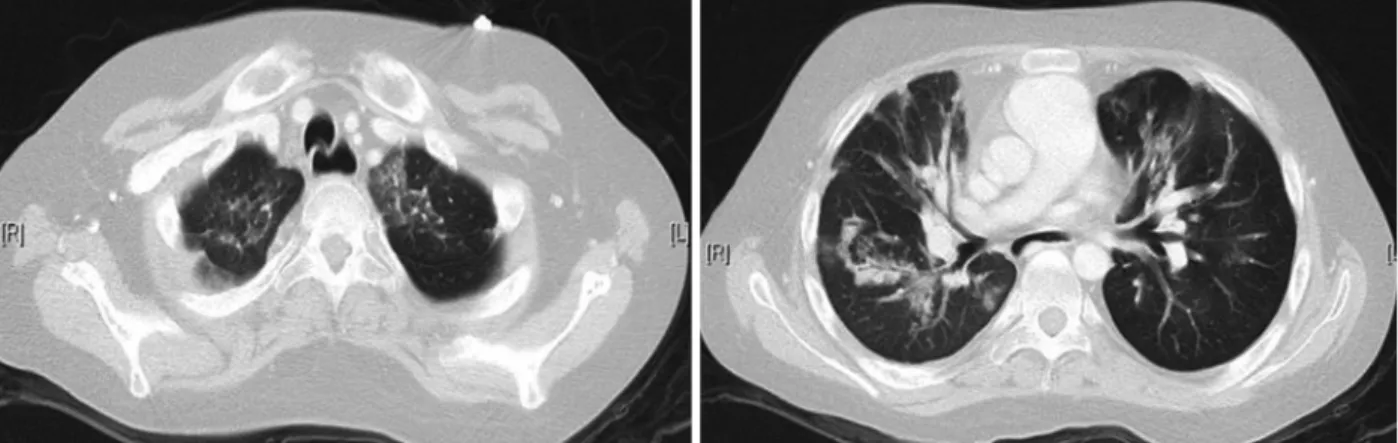
A 21-year-old male diagnosed as AML received an alloge- neic HSCT from his human leukocyte antigen-identical sib- ling donor. Twenty one months after the transplantation, the patient was admitted due to progressive dyspnea, and com- puterized tomography examination of the chest showed dif- fuse bronchiectasis and air-trapping in both lungs with peri- bronchial ground glass opacity (Fig. 1), which was compatible with BO combined with pneumonia. Sputum culture showed the growth of pseudomonas aeruginosa, while bronchial washing culture showed the growth of
Fig. 1. Chest computed tomography. Diffuse bronchiectasis and airtrapping in both lungs with peribronchial graund glass opacity more predominantly in both upper lobe. It is consistent with underlying bronchiolitis obliterans combined with pneumonia.
Fig. 2. Microscopic findings of the lung. The biopsy showed the obliterated bronchiole and patchy interstitial fibrosis and intraalveolar collection of histio- cytes (A: H&E stain ×100, B: H&E stain ×200).
A B
Yu Ri Kim, et al.
Yonsei Med J http://www.eymj.org Volume 53 Number 5 September 2012 1056
treated with single LT following HSCT.3,13-15 Recently, Os- hima, et al.16 reported a living-donor lobar lung transplanta- tion for therapy-resistant BO after allogenetic HSCT from the same donor of bone marrow. In general, the donor of LT is different from hematopoietic stem cell donor. Therefore, there is high risk of rejection and may develop BO event in the transplanted lung. It has been reported that allogeneic HSCT would increase the risk of rejection after LT because of the amount of immunocompetent leukocytes present in the donor lung. However, most of LT do not experience graft rejection because long term immunosuppresion prior to LT might have induced a down-regulation of alloreactiv- ity.5,13,17 In our case, the patient did not experience graft re- jection.
Herein, we report the first case of LT for BO after alloge- neic HSCT in Korea. Prior to LT, the patient was complete- ly dependent on mechanical ventilator and rapidly pro- gressed to respiratory failure. After LT, the patient underwent rehabilitation without any sign of respiratory failure or graft rejection, and needed special attention regarding the infec- tious complications or post transplant lymphoproliferative disorders. LT could be an effective therapy in terms of quali- ty of life and survival for patients with respiratory failure secondary to the development of BO after allogeneic HSCT.
REFERENCES
1. Armitage JO. Bone marrow transplantation. N Engl J Med 1994;330:827-38.
2. Filipovich AH, Weisdorf D, Pavletic S, Socie G, Wingard JR, Lee SJ, et al. National Institutes of Health consensus development project on criteria for clinical trials in chronic graft-versus-host disease: I. Diagnosis and staging working group report. Biol Blood Marrow Transplant 2005;11:945-56.
3. Redel-Montero J, Bujalance-Cabrera C, Vaquero-Barrios JM, Santos-Luna F, Arenas-De Larriva M, Moreno-Casado P, et al.
Lung transplantation for bronchiolitis obliterans after allogenic bone marrow transplantation. Transplant Proc 2010;42:3023-5.
4. Lee JW, Lee DH, Jang PS, Yi MS, Chung NG, Cho B, et al. Prog- nostic implications of the NIH consensus criteria in children with chronic graft-versus-host disease. Yonsei Med J 2011;52:779-86.
5. Calhoon JH, Levine S, Anzueto A, Bryan CL, Trinkle JK. Lung transplantation in a patient with a prior bone marrow transplant.
Chest 1992;102:948.
6. Santo Tomas LH, Loberiza FR Jr, Klein JP, Layde PM, Lipchik RJ, Rizzo JD, et al. Risk factors for bronchiolitis obliterans in al- logeneic hematopoietic stem-cell transplantation for leukemia.
Chest 2005;128:153-61.
7. Chien JW, Martin PJ, Gooley TA, Flowers ME, Heckbert SR, Nichols WG, et al. Airflow obstruction after myeloablative alloge- neic hematopoietic stem cell transplantation. Am J Respir Crit
collection of histiocytes, which was compatible with BO (Fig. 2). He recovered from pulmonary edema and pneu- monia, and was transferred to general ward on POD 20 days without necessitating oxygen support. Since the lung transplantation, the patient has been taking immunosup- pressive agents including FK-506, mycophenolate mofetil and corticosteroids adjusted according to trough levels.
Postoperative antimicrobial prophylaxis consisted of broad- spectrum antibacterial agents, gancyclovir and itraconazole.
Currently, at 38 months after allogeneic HSCT and 10 months after LT, the patient still maintains complete chime- rism without sign of respiratory failure or graft rejection.
DISCUSSION
The incidence of BO following HSCT is reported as 1.7- 32%.6,7 It is a progressive, insidious lung disease occurring in patients after allogeneic HSCT, although the pathogene- sis of BO following allogeneic HSCT remains not well de- fined. The standard diagnosis is the pathologic confirmation through lung biopsy. However, due to its invasiveness for the patients with chronic GVHD and BO, the National In- stitutes of Health provided that BO can be clinically diag- nosed via pulmonary function test, radiologic testing in the absence of respiratory tract infection.2 International Bone Marrow Transplant Registry data suggest peripheral blood stem cell source, long duration to transplant, female donor to male recipient, prior episode of interstitial pneumonitis in addition to acute GVHD, and busulfan-based conditioning regimen as risk factors.6 However, there is no consistent risk factor except the presence of chronic GVHD.7
There is no standard treatment for BO. In general, the management of BO consists of immunosuppressive agents such as high dose corticosteroid, or calcineurin inhibitor such as cyclosporine A or tacrolimus. If a patient does not respond to conventional immunosuppressive treatment, the 2-year and 5-year survival rates are 20% and 13%, respec- tively.8 Recently, other therapeutic approach such as ima- tinib mesylate, antithymocyte globulins, anti-tumor necro- sis factor-α and extracorporeal photodynamic therapy have been tried for treatment of BO.9-12 However, the efficacy and long-term results of adding such methods to the treat- ment for BO following HSCT is not yet known. There are a few reports of LT for BO following HSCT since Calhoon, et al.5 first reported a case in a 25 year old woman with acute lymphoblastic leukemia and restrictive lung disease
Lung Transplantation after HSCT
Yonsei Med J http://www.eymj.org Volume 53 Number 5 September 2012 1057 host disease. Blood 2001;98:1622-5.
13. Rabitsch W, Deviatko E, Keil F, Herold C, Dekan G, Greinix HT, et al. Successful lung transplantation for bronchiolitis obliterans after allogeneic marrow transplantation. Transplantation 2001;71:
1341-3.
14. Gascoigne A, Corris P. Lung transplants in patients with prior bone marrow transplants. Chest 1994;105:327.
15. Svendsen UG, Aggestrup S, Heilmann C, Jacobsen N, Koch C, Larsen B, et al. Transplantation of a lobe of lung from mother to child following previous transplantation with maternal bone mar- row. Eur Respir J 1995;8:334-7.
16. Oshima K, Kikuchi A, Mochizuki S, Yamane M, Date H, Hanada R. Living-donor single lobe lung transplantation for bronchiolitis obliterans from mother to child following previous allogeneic he- matopoietic stem cell transplantation from the same donor. Int J Hematol 2009;90:540-2.
17. Svendsen UG, Aggestrup S, Heilmann C, Jacobsen N, Koch C, Larsen B, et al. Transplantation of a lobe of lung from mother to child following previous transplantation with maternal bone mar- row. J Heart Lung Transplant 1999;18:388-90.
Care Med 2003;168:208-14.
8. Dudek AZ, Mahaseth H, DeFor TE, Weisdorf DJ. Bronchiolitis obliterans in chronic graft-versus-host disease: analysis of risk fac- tors and treatment outcomes. Biol Blood Marrow Transplant 2003;9:657-66.
9. Majhail NS, Schiffer CA, Weisdorf DJ. Improvement of pulmo- nary function with imatinib mesylate in bronchiolitis obliterans following allogeneic hematopoietic cell transplantation. Biol Blood Marrow Transplant 2006;12:789-91.
10. Fullmer JJ, Fan LL, Dishop MK, Rodgers C, Krance R. Success- ful treatment of bronchiolitis obliterans in a bone marrow trans- plant patient with tumor necrosis factor-alpha blockade. Pediatrics 2005;116:767-70.
11. Smith EP, Sniecinski I, Dagis AC, Parker PM, Snyder DS, Stein AS, et al. Extracorporeal photochemotherapy for treatment of drug-resistant graft-vs.-host disease. Biol Blood Marrow Trans- plant 1998;4:27-37.
12. Alcindor T, Gorgun G, Miller KB, Roberts TF, Sprague K, Schen- kein DP, et al. Immunomodulatory effects of extracorporeal pho- tochemotherapy in patients with extensive chronic graft-versus-