557
R
Reessuusscciittaattiioonn
Does the placement of automated external defibrillators affect first responders’
willingness to perform cardiopulmonary resuscitation in high-rise residential buildings?
Dong Eun Lee1, Hyun Wook Ryoo1, Jae Yun Ahn1, Sungbae Moon1, Jong Kun Kim1, Yun Jeong Kim1, Jung Bae Park1, Jung Ho Kim2, Kyung Woo Lee3, Sang Chan Jin4
1Department of Emergency Medicine, School of Medicine, Kyungpook National University, Daegu, 2Department of Emergency Medicine, Yeungnam University College of Medicine, Daegu, 3Department of Emergency Medicine, Catholic University of Daegu School of Medicine, Daegu, 4Department of Emergency Medicine, Keimyung University Dongsan
Medical Center, Keimyung University School of Medicine, Daegu, Korea
Objective: The increasing number of people living in high-rise apartments may result in a delayed response from emer- gency medical technicians called out for an out-of-hospital cardiac arrest, making the role of apartment managers as the first responders extremely important. This study investigated whether automated external defibrillator (AED) placement influences the willingness of apartment managers to perform cardiopulmonary resuscitation (CPR) and use an AED.
Methods: A cross-sectional target population-based survey was conducted in Daegu, July 2016. Questionnaires were sent to apartment managers working in apartments with more than 500 households. The general characteristics of the respondents, status of CPR education, and knowledge about and willingness to perform CPR and use an AED were investigated.
Results: Of the 1,445 respondents, 758 (52.5%) worked in apartments with AEDs, of which 77.8% and 70.8% were will- ing to perform CPR and use an AED, respectively, compared with 68.1% and 60.0% of respondents who worked in apartments without AEDs. After adjusting for potential confounders, AED placement was associated with the willingness to perform CPR (odds ratio [OR], 1.33; 95% confidence interval [CI], 1.04-1.71) and use an AED (OR, 1.39; 95% CI, 1.10-1.75). Prior CPR training and accurate knowledge of CPR skills were also associated with the willingness to perform CPR and use an AED.
Conclusion: Placing AEDs in high-rise apartment buildings and providing refresher CPR education for maintaining CPR skills will be necessary to support apartment managers in their role as first responders.
Keywords: Cardiopulmonary resuscitation; Defibrillator; Emergency responders; Survey and questionnaires
책임저자: 류 현 욱
대구광역시 중구 국채보상로 680 경북대학교 의과대학 응급의학교실
Tel: 053-200-6400, Fax: 053-428-2820, E-mail: [email protected]
접수일: 2018년 3월 12일, 1차 교정일: 2018년 7월 30일, 게재승인일: 2018년 10월 10일
INTRODUCTION
In Korea, the incidence rate of non-traumatic sudden out-of-hospital cardiac arrest (OHCA) is 45.1 per 100,000 people. The survival-to-discharge rate is 4.8%, which is lower than that in most developed countries.1 Immediate bystander cardiopulmonary resuscitation (CPR) and early defibrillation are important in improv-
ing the survival rate of OHCA patients.2Previous studies have shown that the increase in the distribution of auto- mated external defibrillators (AEDs) and the implemen- tation of public access defibrillation (PAD) programs in the community are associated with the increased survival rate of OHCA patients.3,4 After the Emergency Medical Service Act of 2008 required the installation of AEDs in apartments with 500 or more households as well as pub- licly used facilities such as airports, railway stations,
trains, ships, and public offices, the distribution of AEDs has been consistently increasing in Korea.5According to the 2015 Emergency Medicine Statistical Annual Report from the National Emergency Medical Center of Korea, 24,407 AEDs have been distributed nationwide, which is equivalent to 47 AEDs per 100,000 people. However, contrary to the increasing number of AEDs, the actual public use of AEDs before the arrival of emergency medical services (EMS) is minimal in Korea. Studies conducted in the United States, Canada, the United Kingdom, and Denmark also revealed that the rate of defibrillation use before EMS arrival is below 3%.4,6,7
In Korea, 54.2% of cardiac arrests occur every day, with the house as the major place of occurrence (53.8%).1South Korea is a nation with a high rate of living in apartments.
According to Korean statistics, 48.1% of the residents in Korea live in apartments. A Canadian study reported that EMS response for patients who experienced cardiac arrest on or above the third floor of buildings was slower than that for patients who live below the third floors. The reported survival rate of those who live on or above the third floor was 2.6%, which is significantly different from the reported survival rate of 4.2% for those who live below the third floor.8Therefore, considering the importance of AEDs, which are important in improving the survival rate
of cardiac arrest patients, a plan of action regarding the placement of AEDs and their active use in high-rise build- ings is needed. In addition, to effectively use AEDs that are available in apartment buildings, the role of apartment managers as the first responders, whose main task is to transport AEDs installed in the apartment entrance to the household of the cardiac arrest patient, is crucial.
In 2016, the AED Program Implementation Project was conducted in Daegu Metropolitan City (DMC), which targeted apartments with 500 or more households as part of the plan to enhance the chain of survival in the city. A system was established to inform the apartment managers of the location of the cardiac arrest patients along with the nearby AED locations via a short message service (SMS) sent to the manager’s mobile phone after an OHCA from an apartment was called by a 119 dis- patcher. This preliminary research aimed to evaluate the baseline status of CPR knowledge and education, along with the apartment managers’ willingness to perform CPR and use an AED according to AED placement.
METHODS 1. Study design and participants
We analyzed data from a cross-sectional target popula- tion-based survey in Daegu in July 2016. The study pop- ulation consisted of apartment managers and security guards working in apartments with more than 500 house- holds. The population in DMC was 2,487,829 in 2015.
According to the official report, 336 apartment buildings contained more than 500 households in 2016, with an average of 18.9 employees in each apartment building.
The survey was performed via mailing a structured ques- tionnaire that evaluated the awareness, experience, and attitude toward CPR and AED. The official cooperation documents of the Public Health Division of Daegu were included to reduce the selection bias and improve the quality of the questionnaire response. The survey response rate was 22.7%. After excluding 72 question- naires that were insufficiently answered, a total of 1,445 questionnaires were analysed. This study was approved by the Institutional Review Board of Kyungpook National University Hospital (KNUH 2016-06-006), and a signed informed consent was obtained from all partici- pants via mail.
Capsule Summary
What is already known in the previous study The increasing number of people living in high-rise apartments may result in a delayed response from emergency medical technicians called out for an out-of- hospital cardiac arrest, making the role of apartment managers as the first responders extremely important.
What is new in the current study
The present study identified the potential of apartment managers to act as first responders. Along with the acti- vation system of the first responder from the dispatch center, automated external defibrillator (AED) dissemi- nation in high-rise residential buildings and refresher cardiopulmonary resuscitation (CPR) education for maintaining accurate knowledge of CPR skills will be necessary to promote the efficient use of AEDs and sup- port the role of apartment managers as first responders.
2. Questionnaire and variables
The questionnaire was designed to obtain the follow- ing data: (1) demographic data (i.e., sex and age of the manager); (2) data regarding awareness, attitude, and willingness to perform CPR (five questions); (3) data regarding CPR skills (three questions) and awareness of dispatcher-assisted CPR (DA-CPR) and the Good Samaritan Law (two questions); (4) data regarding prior CPR training experience (i.e., training type, last training time, and number of training sessions attended) (five questions); and (5) data regarding awareness and will- ingness to use an AED (five questions) (Appendix 1).
The outcome variables of interest were willingness to perform CPR and use AEDs. Questions related to the awareness of CPR methods and confidence in perform- ing CPR were assessed using a five-point scale (1, not at all; 5, very likely). Results were divided into two cate- gories for analysis: ≤3 points and ≥4 points. When a respondent correctly answered three questions about chest compression, then he/she was considered to have correct knowledge of CPR skills.
3. Statistical analyses
Apartment managers and security guards working in apartments with more than 500 households were divided into two groups (AED placement and AED non-place- ment groups) according to whether an AED was installed in their workplace. Pearson’s chi-square and extended Mantel-Haenszel chi-square for linear trend tests were carried out to assess the significance of the differences between the two groups. To examine the association of AED placement and outcomes, logistic regression analy- sis was used. In general characteristics, the distribution of sex and age is different between the two groups according to AED placement. Confidence in performing CPR, awareness of the Good Samaritan Law and DA- CPR, and knowledge of AED use are factors influenced by CPR training experience. The status of CPR training has been confounded with correct knowledge of CPR skills and prior CPR training, so we have controlled these variables as representative variables related to CPR training experience. We included potential confounding variables such as age, sex, correct knowledge of CPR skills and prior CPR training. The results are expressed as odds ratios (ORs) and 95% confidence intervals (CIs).
All statistical tests were conducted using IBM SPSS Statistics for Windows ver. 22.0 (IBM Corp., Armonk, NY, USA), and P-values of <0.05 were considered sta- tistically significant.
RESULTS
1. Comparison of respondent characteristics and their awareness and willingness to perform CPR and use AEDs in apartment buildings with and without AEDs
Among the respondents who were classified under the AED placement and non-placement groups, 87.5%
(663/758) and 81.2% (558/687), respectively, were men.
No difference was observed in the distributions of age between the two groups. A higher number of respon- dents knew how to perform CPR in the AED placement group compared to the AED non-placement group.
Among the respondents with AED placement in their workplace, 47.4% (359/758) and 60.7% (460/758) were aware of the Good Samaritan Law and DA-CPR. In the AED non-placement group, 33.3% (229/687) and 44.5%
(306/687) were knowledgeable about the Good Samaritan Law and DA-CPR, respectively. The propor- tion of respondents who felt confident in performing CPR and those who had CPR training was higher in the AED placement group. Significant differences were observed between the two groups in terms of the willing- ness to perform CPR and use AEDs (Table 1).
2. Comparison of prior CPR training and AED placement
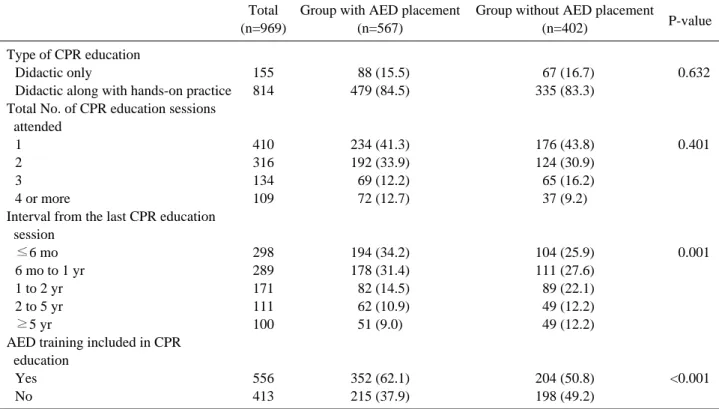
A total of 969 respondents had attended CPR educa- tion sessions at least once. Of these, 84% (814/969) indi- cated that they had also attended practical education ses- sions. Significant differences were observed between the AED placement and non-placement groups in terms of interval from the last CPR training and AED training.
The proportion of respondents who had CPR training within 1 year was higher in the AED placement group.
Among the respondents in the AED placement group and non-placement group, 62.1% (352/567) and 50.8%
(204/402), respectively, reported that AED training was included in their CPR education (Table 2).
3. Subgroup analyses according to prior CPR training
Fig. 1 shows the results of subgroup analyses accord- ing to prior CPR training. Differences were observed in the percentages of persons who were willing to perform CPR and use an AED according to the status of AED placement in the prior CPR training group. The positive response rates of willingness to perform CPR and to use an AED were 83.8% (480/573) and 77.8% (446/573), respectively among those who had CPR training along with AED placement. Moreover, 77.4% (312/403) and 70.2% (283/403) of the respondents living in apartments
without an AED in the prior CPR training group were willing to perform CPR and use an AED, respectively.
4. Factors associated with performing CPR and AED use
AED placement was associated with the willingness to perform CPR (OR, 1.64; 95% CI, 1.30-2.08) and to use an AED (OR, 1.86; 95% CI, 1.32-2.64). After adjust- ment for potential confounders, AED placement was still associated with the willingness to perform CPR (OR, 1.33; 95% CI, 1.04-1.71) and to use an AED (OR, 1.39;
Table 1. General characteristics and differences according to AED placement
Characteristic Total Group with AED placement Group without AED placement
P-value
(n=1,445) (n=758) (n=687)
Sex
Male 1,221 663 (87.5) 558 (81.2) <0.001
Female 1,224 095 (12.5) 129 (18.8)
Age (yr)
<60 1,775 394 (52.0) 381 (55.5) <0.185
≥60 1,670 364 (48.0) 306 (44.5)
Awareness of how to perform CPR
Yes 1,725 403 (53.2) 322 (46.9) <0.017
No 1,720 355 (46.8) 365 (53.1)
Awareness of the Good Samaritan Law
Yes 1,588 359 (47.4) 229 (33.3) <0.001
No 1,857 399 (52.6) 458 (66.7)
Awareness of DA-CPR
Yes 1,766 460 (60.7) 306 (44.5) <0.001
No 1,679 298 (39.3) 381 (55.5)
Confidence in performing CPR
Yes 1,264 164 (21.6) 100 (14.6) <0.001
No 1,181 594 (78.4) 587 (85.4)
Correct knowledge of CPR
Yes 1,268 153 (20.2) 115 (16.7) <0.092
No 1,177 605 (79.8) 572 (83.3)
Knowledge of AED use
Yes 1,481 376 (49.6) 105 (15.3) <0.001
No 1,964 382 (50.4) 582 (84.7)
Prior CPR training
Yes 1,969 567 (74.8) 402 (58.5) <0.001
No 1,476 191 (25.2) 285 (41.5)
Willingness to perform CPR
Yes 1,058 590 (77.8) 468 (68.1) <0.001
No 1,387 168 (22.2) 219 (31.9)
Willingness to use an AED
Yes 1,949 537 (70.8) 412 (60.0) <0.001
No 1,496 221 (29.2) 275 (40.0)
Values are presented as number (%).
AED, automated external defibrillator; CPR, cardiopulmonary resuscitation; DA-CPR, dispatcher-assisted cardiopulmonary resuscitation.
95% CI, 1.10-1.75) (Table 3). Prior CPR training and accurate knowledge of CPR skills were also associated with the willingness to perform CPR and use an AED.
DISCUSSION
In this study, 73.2% of respondents (1,058/1,445) were willing to perform CPR. Our results indicate that AED placement was associated with apartment managers’
willingness to perform CPR and use AEDs. Prior CPR training was also an important factor related to willing- ness to perform CPR and use AEDs. Previous studies have assessed data from nationwide community surveys, regional community surveys, and surveys on CPR recog- nition and attitude among students and teachers.9-12 However, to the best of our knowledge, no studies or
surveys have included apartment managers. Thus, the present study identified the potential of apartment man- agers to act as first responders. Furthermore, their will- ingness to perform CPR and use AEDs according to AED placement was assessed.
Early defibrillation is a key factor in the chain of sur- vival of patients who experience cardiac arrest. In addi- tion, minimizing the time-to-shock interval is a crucial step in improving survival rates.13 The public use of AEDs has been permitted in Japan since 2004. Since then, the number of AEDs used has significantly increased to more than 500,000 nationwide in 2013.14 Furthermore, the time of the administration of the first shock was reduced by the nationwide dissemination of PAD, which in turn improved the OHCA survival rate.3
The deployment of CPR-and-AED-educated volun- teers and CPR-only-educated volunteers in public facili-
Fig. 1. Association of willingness to perform cardiopulmonary resuscitation (CPR) (A) and use an automated external defibril- lator (AED) (B) according to AED placement and prior CPR training. Apartment managers and security guards work- ing in apartments with more than 500 households were divided into two groups (with or without AED) according to whether or not an AED was installed in their workplace.
A
B
ties, such as shopping malls, recreational centres, hotels, and apartment complexes, resulted in a significant improvement in the survival-to-hospital-discharge rates.15This result showed the importance of AED place- ment and PAD program implementation, which may improve the survival-to-hospital-discharge rates.
Previous studies have suggested the efficacy not only of the widespread placement of AEDs but also their strate- gic placement along with its linkage to a dispatch center.3,16-18Moreover, the bystander CPR and survival discharge rates of OHCA patients increased due to the
use of an EMS system-linked text message notification system by the volunteers.19,20
Since 2007, efforts have been made to improve the public recognition of CPR and AEDs in Korea. Public CPR education is conducted on a large scale, and those subjected to mandatory education by the Emergency Medical Service Act were required to receive CPR edu- cation. In 2008, the Good Samaritan Law was legislated to improve bystander rates and to increase the distribu- tion of AEDs. AED installation was required not only in public facilities but also in apartments with 500 or more
Table 3. Factors related to the willingness regarding CPR and AED use
Willingness to perform CPR Willingness to use an AED
Predictor Crude OR Adjusted ORa) Crude OR Adjusted ORa)
(95% CI) (95% CI) (95% CI) (95% CI)
AED placement 1.64 (1.30-2.08) 1.33 (1.04-1.71) 1.86 (1.32-2.64) 1.39 (1.10-1.75)
Male sex 1.92 (1.38-2.67) 1.30 (0.94-1.81)
Age (<60 yr) 0.86 (0.66-1.12) 1.78 (1.39-2.27)
Correct knowledge of CPR skills 2.13 (1.47-3.09) 1.60 (1.15-2.22)
Prior CPR training 2.78 (2.16-3.59) 2.90 (2.28-3.69)
CPR, cardiopulmonary resuscitation; AED, automated external defibrillator; OR, odds ratio; CI, confidence interval.
a)Adjusted for AED placement, sex, age, correct knowledge of CPR skills, prior CPR training.
Table 2. Differences in CPR training experience of the study participants
Total Group with AED placement Group without AED placement
P-value
(n=969) (n=567) (n=402)
Type of CPR education
Didactic only 155 088 (15.5) 067 (16.7) <0.632
Didactic along with hands-on practice 814 479 (84.5) 335 (83.3) Total No. of CPR education sessions
attended
1 410 234 (41.3) 176 (43.8) <0.401
2 316 192 (33.9) 124 (30.9)
3 134 069 (12.2) 065 (16.2)
4 or more 109 072 (12.7) 37 (9.2)
Interval from the last CPR education session
≤6 mo 298 194 (34.2) 104 (25.9) <0.001
6 mo to 1 yr 289 178 (31.4) 111 (27.6)
1 to 2 yr 171 082 (14.5) 089 (22.1)
2 to 5 yr 111 062 (10.9) 049 (12.2)
≥5 yr 100 51 (9.0) 049 (12.2)
AED training included in CPR education
Yes 556 352 (62.1) 204 (50.8) <0.001
No 413 215 (37.9) 198 (49.2)
Values are presented as number (%).
CPR, cardiopulmonary resuscitation; AED, automated external defibrillator.
households.5The role of apartment managers is impera- tive for the (1) efficient use of AEDs placed in apart- ments through the AED Program Implementation Project and (2) the successful application of the 119 dispatch center-linked SMS notification system, which informs apartment managers of the location of the individual and AEDs in the event of a reported OHCA in an apartment.
In this study, significant differences were observed between the AED placement and non-placement groups in terms of CPR confidence and prior training experi- ence. In a previous study, the confidence of a layperson in performing CPR is influenced by awareness of the neighborhood AED location, having prior CPR training, and having performed CPR.21Similarly, this study shows a higher confidence for performing CPR in the AED placement group. Furthermore, significant differences were observed between the AED placement and non- placement groups regarding awareness of the Good Samaritan Law and DA-CPR. The difference in aware- ness of the Good Samaritan Law and DA-CPR seemed to be influenced by prior CPR training experience. The proportion of AED training included in CPR education was higher in the AED placement group. It is possible that the AED installation company provided instruction on how to use an AED during its installation.
In the 2012 survey of the general population of Daegu citizens, 57.3% of the respondents were willing to per- form CPR, which differs from the 77.8% of the AED placement group found in this study.22Kuramoto et al.12 noted that the recognition of AED placement in public places is not directly associated with a willingness to perform CPR but influences the CPR training experience of a layperson. Similar findings were observed in the present study of the specific population group that could act as first responders in cases of OHCA. The AED placement group had the latest CPR training.
Furthermore, AED placement was associated with the willingness to perform CPR and use an AED based on the multivariable analysis. A previous study concluded that CPR training affects the willingness to perform CPR.23 However, in the 2015 survey conducted in a nationwide general population, there was no association between willingness to perform CPR for strangers and prior CPR training experience.24 In the present study, prior CPR training was associated with a willingness to perform CPR and use an AED. Moreover, accurate
knowledge of CPR skills also affected the willingness to perform CPR and use an AED. Differences in the base- line characteristics of the general population and apart- ment managers and prior CPR training experience may have affected these results. In this study, age under 60 years was associated with a willingness to use an AED.
This seems to be the result of younger people learning to use the device more easily and having more confidence in using newer devices than older people.
Surprisingly, among the employees of apartments with AED placement, only 70.9% were aware of the AED locations. Therefore, for apartment managers who will act as the first responders, the importance of AED should be emphasized during CPR training to increase their interest and willingness to use an AED. Previous studies involving laypersons report that it is difficult to maintain CPR skills for more than 1 year.25,26Based on the results of the present study, consistent CPR education of apart- ment managers should be conducted to maintain ade- quate CPR knowledge along with their willingness to use an AED. The efficient use of AEDs will require the establishment of a linkage system with the local EMS (i.e., SMS alert system or DA-CPR) and the inclusion of DA-CPR in CPR education programs.
This study has several limitations. First, the retrieval rate was approximately 22.7%. Selection bias may be present owing to the limited number of respondents who were not aware or interested in CPR. In addition, the pre- sent study involved a specific population, and it does not represent the whole community population. Therefore, the results of this survey may be difficult to generalize to the community population. Nevertheless, the feasibility of the apartment managers’ role as first responders dur- ing OHCA must be confirmed. Second, the actual com- petence and performance of CPR and willingness to use an AED in the event of real cardiac arrest situations may differ from the survey responses. Third, the time since the most recent CPR training, the number of CPR train- ing sessions, and the CPR training methods depended on the respondents’ memory and may be subject to recall bias, which may have affected the results. Fourth, the apartment manager did not distinguish whether he or she had undergone firefighting safety education in the ques- tionnaire. Also, the questionnaire did not include the impact of the AED installation on prior CPR training.
These differences cannot be reflected in this study.
Although the retrieval rate was only 22.7%, 73.2% of the respondents (1,058/1,445) were willing to perform CPR. Therefore, we identified the potential of apartment managers to act as first responders. AED placement was associated with the willingness to perform CPR and use an AED among the apartment managers in this study.
Furthermore, prior CPR training and accurate knowledge of CPR skills were associated with the willingness to perform CPR and use an AED. Therefore, along with the activation system of first responders from the dispatch center, AED dissemination in high-rise residential build- ings and refresher CPR education for maintaining accu- rate knowledge of CPR skills are necessary to promote the efficient use of AEDs and support the role of apart- ment managers as first responders.
ORCID
Dong Eun Lee (https://orcid.org/0000-0002-2057-5261) Hyun Wook Ryoo (https://orcid.org/0000-0002-1361-9887) Jae Yun Ahn (https://orcid.org/0000-0002-1050-8575) Sungbae Moon (https://orcid.org/0000-0001-6928-8573) Jong Kun Kim (https://orcid.org/0000-0002-0583-4368) Yun Jeong Kim (https://orcid.org/0000-0002-7906-9734) Jung Bae Park (https://orcid.org/0000-0003-4104-5857) Jung Ho Kim (https://orcid.org/0000-0002-3215-4640) Kyung Woo Lee (https://orcid.org/0000-0002-2502-7993) Sang Chan Jin (https://orcid.org/0000-0002-4347-0171)
CONFLICT OF INTEREST
No potential conflict of interest relevant to this article was reported.
ACKNOWLEDGMENTS
We are grateful to the apartment managers and securi- ty guards who participated in the survey. Special thanks to Yeon Sin Kim, Mi Kyung Kim, and Hong Joon Kim who were affiliated with the Public Health Division of DMC and helped in contacting the apartment managers.
REFERENCES
01. Number of acute cardiac arrest incidents [Internet].
Cheongju: Korea Centers for Disease Control and Prevention; 2015 [cited 2017 Mar 31]. Available from:
http://www.cdc.go.kr/CDC/contents/CdcKrContentView.j s p ? c i d = 6 6 3 8 6 & m e n u I d s = H O M E 0 0 1 - M N U 1 1 3 0 - MNU1110-MNU2383-MNU2387.
02. Hansen CM, Kragholm K, Granger CB, et al. The role of bystanders, first responders, and emergency medical ser- vice providers in timely defibrillation and related out- comes after out-of-hospital cardiac arrest: results from a statewide registry. Resuscitation 2015;96:303-9.
03. Kitamura T, Iwami T, Kawamura T, et al. Nationwide public-access defibrillation in Japan. N Engl J Med 2010;
362:994-1004.
04. Weisfeldt ML, Sitlani CM, Ornato JP, et al. Survival after application of automatic external defibrillators before arrival of the emergency medical system: evaluation in the resuscitation outcomes consortium population of 21 mil- lion. J Am Coll Cardiol 2010;55:1713-20.
05. Emergency Medical Services Act [Internet]. Sejong:
National Law Information Center; 2016 [cited 2017 Mar 31]. Available from: http://www.law.go.kr/lsInfoP.do?
lsiSeq=188094&efYd=20161202#0000.
06. Deakin CD, Shewry E, Gray HH. Public access defibrilla- tion remains out of reach for most victims of out-of-hospi- tal sudden cardiac arrest. Heart 2014;100:619-23.
07. Wissenberg M, Lippert FK, Folke F, et al. Association of national initiatives to improve cardiac arrest management with rates of bystander intervention and patient survival after out-of-hospital cardiac arrest. JAMA 2013;310:1377- 84.
08. Drennan IR, Strum RP, Byers A, et al. Out-of-hospital car- diac arrest in high-rise buildings: delays to patient care and effect on survival. CMAJ 2016;188:413-9.
09. Ro YS, Shin SD, Song KJ, Hong SO, Kim YT, Cho SI.
Bystander cardiopulmonary resuscitation training experi- ence and self-efficacy of age and gender group: a nation- wide community survey. Am J Emerg Med 2016;34:1331- 7.
10. Mpotos N, Vekeman E, Monsieurs K, Derese A, Valcke M. Knowledge and willingness to teach cardiopulmonary resuscitation: a survey amongst 4273 teachers. Resuscitation 2013;84:496-500.
11. Kanstad BK, Nilsen SA, Fredriksen K. CPR knowledge and attitude to performing bystander CPR among sec- ondary school students in Norway. Resuscitation 2011;82:
1053-9.
12. Kuramoto N, Morimoto T, Kubota Y, et al. Public percep-
tion of and willingness to perform bystander CPR in Japan. Resuscitation 2008;79:475-81.
13. Schober P, van Dehn FB, Bierens JJ, Loer SA, Schwarte LA. Public access defibrillation: time to access the public.
Ann Emerg Med 2011;58:240-7.
14. Kiyohara K, Kitamura T, Sakai T, et al. Public-access AED pad application and outcomes for out-of-hospital cardiac arrests in Osaka, Japan. Resuscitation 2016;106:
70-5.
15. Hallstrom AP, Ornato JP, Weisfeldt M, et al. Public- access defibrillation and survival after out-of-hospital car- diac arrest. N Engl J Med 2004;351:637-46.
16. Caffrey SL, Willoughby PJ, Pepe PE, Becker LB. Public use of automated external defibrillators. N Engl J Med 2002;347:1242-7.
17. Folke F, Lippert FK, Nielsen SL, et al. Location of cardiac arrest in a city center: strategic placement of automated external defibrillators in public locations. Circulation 2009;120:510-7.
18. Rea T, Blackwood J, Damon S, Phelps R, Eisenberg M. A link between emergency dispatch and public access AEDs:
potential implications for early defibrillation. Resuscitation 2011;82:995-8.
19. Pijls RW, Nelemans PJ, Rahel BM, Gorgels AP. A text message alert system for trained volunteers improves out- of-hospital cardiac arrest survival. Resuscitation 2016;
105:182-7.
20. Ringh M, Rosenqvist M, Hollenberg J, et al. Mobile- phone dispatch of laypersons for CPR in out-of-hospital cardiac arrest. N Engl J Med 2015;372:2316-25.
21. Sasaki M, Ishikawa H, Kiuchi T, Sakamoto T, Marukawa S. Factors affecting layperson confidence in performing resuscitation of out-of-hospital cardiac arrest patients in Japan. Acute Med Surg 2015;2:183-9.
22. Son JW, Ryoo HW, Moon S, et al. Association between public cardiopulmonary resuscitation education and the willingness to perform bystander cardiopulmonary resus- citation: a metropolitan citywide survey. Clin Exp Emerg Med 2017;4:80-7.
23. Hamasu S, Morimoto T, Kuramoto N, et al. Effects of BLS training on factors associated with attitude toward CPR in college students. Resuscitation 2009;80:359-64.
24. Seo HI, Park YS, Lee MJ, et al. Willingness variability of bystander cardiopulmonary resuscitation in special situa- tion. J Korean Soc Emerg Med 2017;28:287-93.
25. Woollard M, Whitfeild R, Smith A, et al. Skill acquisition and retention in automated external defibrillator (AED) use and CPR by lay responders: a prospective study.
Resuscitation 2004;60:17-28.
26. Woollard M, Whitfield R, Newcombe RG, Colquhoun M, Vetter N, Chamberlain D. Optimal refresher training inter- vals for AED and CPR skills: a randomised controlled trial. Resuscitation 2006;71:237-47.
Appendix 1. Questionnaires
Sex:
Age:
1. Do you know what CPR is?
(a) Yes (b) No
2. Do you know how to perform CPR?
(a) Do not know at all (b) Know little (c) So-so (d) Well (e) Very well
3. Do you have confidence in performing CPR?
(a) Do not have at all (b) Have little confidence (c) So-so
(d) Have some confidence (e) Very confident
4. Where is the correct site of the chest compression?
(a)-(e) (shown in picture) (f) Have no idea
5. What is the correct chest compression rate per minute during CPR?
(a) 60-70 (b) 70-80 (c) 80-90 (d) 90-100 (e) 100-120 (f) Have no idea.
6. What is the correct chest compression depth during CPR in adult?
(a) About 2 cm (b) About 3 cm (c) About 4 cm (d) About 5 cm (e) Over 6 cm (f) Have no idea
7. Do you know the Good Samaritan Law?
(a) Yes (b) No
8. Do you know about “dispatcher-assisted CPR,”in which you can call 119 when a cardiac arrest occurs?
(a) Yes (b) No
9. Will you be able to recognize if a sudden cardiac arrest occurs in the apartment in which you are employed?
(a) Yes (b) No
10. Are you willing to perform CPR for cardiac arrest patients in your workplace?
(a) Yes (b) No
11. Is an AED installed in your working apartment?
(a) Yes (Proceed to question 12) (b) No (Proceed to question 13)
(c) Have no idea (Proceed to question 13)
12. Do you know where the AEDs are placed?
(a) Yes (b) No
13. How much do you know about AEDs?
(a) Know the name and how to use them
(b) Know only the name but not how to use them (c) Do not know at all
14. Do you know AED installation is required by law for apartments over 500 households?
(a) Yes (b) No
15. Are you willing to use AEDs for cardiac arrest patients?
(a) Yes (b) No
16. Have you ever been trained in CPR?
(a) Yes (Proceed to question 17) (b) No (End)
17-1. Did your CPR training include hands-on training?
(a) Yes (b) No
17-2. How many times have you received CPR training?
(a) Once (b) Twice (c) Three times (d) Four times or more
17-3. When was the last time you attended CPR training?
(a) Within 6 months (b) 6 months-1 year (c) 1-2 years (d) 2-5 years (e) Over 5 years
17-4. Did you use AEDs in the CPR training course?
(a) Yes (b) No