Is Prophylactic Irradiation to Para-aortic Lymph Nodes in Locally Advanced Cervical Cancer Necessary?
Purpose
This study evaluated the efficacy of extended field irradiation (EFI) in patients with locally advanced cervical cancer without para-aortic nodal involvement.
Materials and Methods
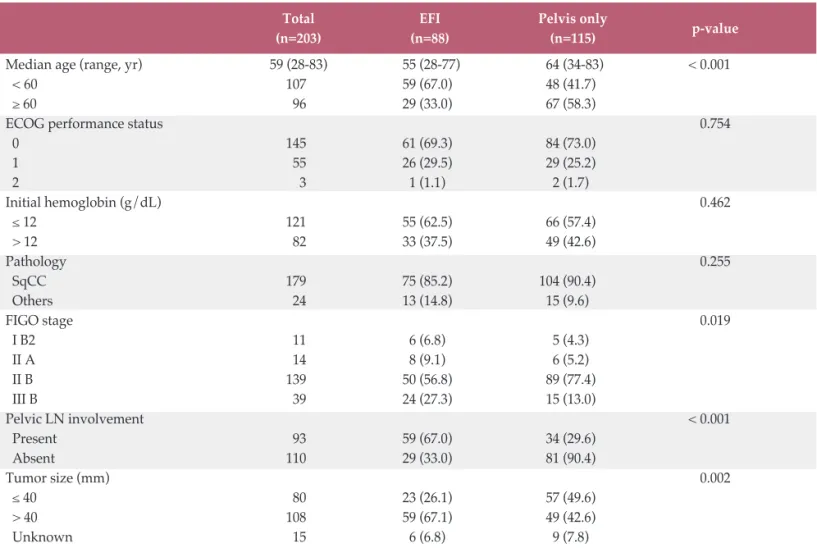
A total of 203 patients with locally advanced cervical cancer (International Federation of Gynecology and Obstetrics [FIGO] stage, IB2-IIIB) treated with radiotherapy at Keimyung University Dongsan Medical Center from 1996 to 2010 were retrospectively analyzed. The median patient age was 59 years (range, 29 to 83 years). None of the patients had para-aortic node metastases. Of the 203 patients, 88 underwent EFI and 115 underwent irradiation of the pelvis only. Concurrent chemoradiotherapy (CCRT) was administered to 133 patients. EFI field was used for treatment of 26 patients who received radiotherapy alone and 62 who received CCRT.
Results
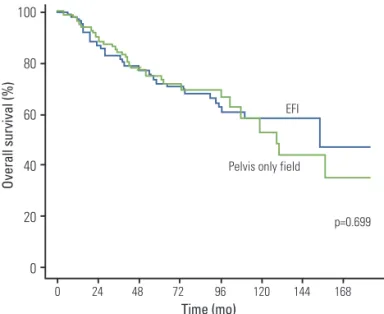
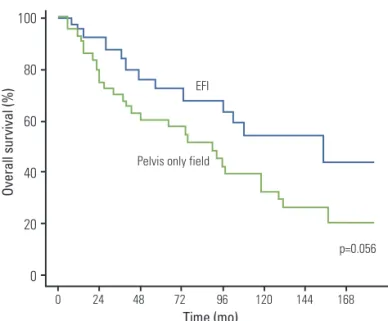
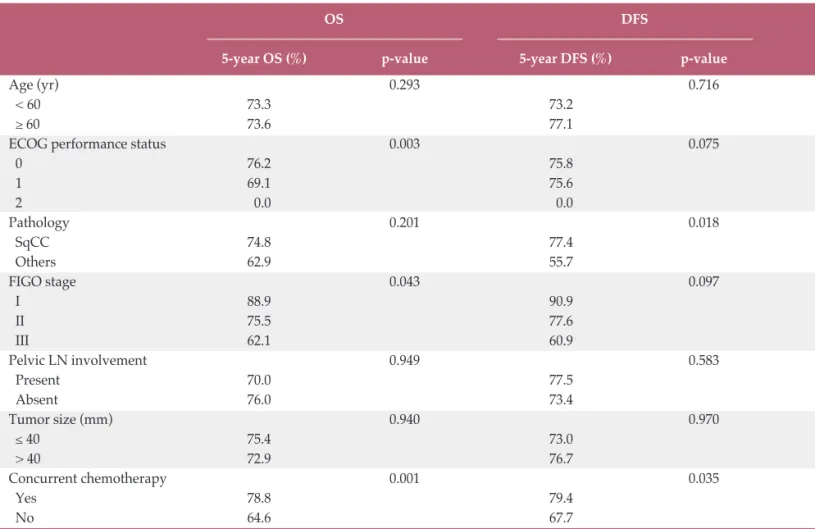
The median follow-up period was 60 months. The 2- and 5-year overall survival (OS) rates were 87.8% and 73.5%, respectively, and the 2- and 5-year disease-free survival rates were 81.7% and 75.0%, respectively, however, no survival differences were observed between the two treatment field groups. EFI tended to increase OS in the radiotherapy alone group, but not in the CCRT group.
Conclusion
These findings suggest that EFI does not have a significant effect in patients with locally advanced cervical cancer, especially in patients receiving CCRT. Conduct of additional studies will be required in order to confirm these findings.
Key words
Uterine cervical neoplasms, Radiotherapy, Survival rate, Lymph nodes, Neoplasm metastasis
Introduction
The spread of cervical cancer usually exhibits stepwise progression, from regional pelvic lymph nodes to para-aortic lymph nodes (PAN), followed by distant metastases with the prevalence of PAN metastases increasing progressively with stage [1,2]. Extended field irradiation (EFI) has therefore been utilized for treatment of occult PAN metastases in patients with advanced cervical cancer [2-7]. One randomized trial
found that EFI had no effect on locoregional tumor control, but showed an association with increased overall survival (OS) rate [3], whereas a second randomized trial found that EFI did not affect locoregional control or survival, but reduced the rates of PAN and distant metastases without pelvic failure [4]. In both studies, the decision to treat PAN was difficult, because of significant late complications.
The use of concurrent chemoradiotherapy (CCRT) has complicated findings regarding the efficacy and safety of EFI [7-10]. In a comparison between EFI without chemotherapy + + + + + + + + + + + + + + + + + + + +
+ + + + + + + + + + + + + + + + + + + + + + + + + + + + + + + + + + + + + + + + + + + + + + + + + + + + + + + + + + + + + + + + + + + + + + + + + + + + + + + + + + + + + + + + + + + + + + + + + + + + + + + + + + + + + + + + + + + + + + + + + + + + + + + + + + + + + + + + + + + + + + + + + + + + + + + + + + + + + + + + + + + + + + + + + + + + + + + + + + + + + + + + + + + + + + + + + + + + + + + + + + + + + + + + + + + + + + + + + + + + + + + + + + + + + + + + + + + + + + + + + + + + + + + + + + + + + + + + + + + +
Correspondence: Jin Hee Kim, MD, PhD Department of Radiation Oncology,
Keimyung University Dongsan Medical Center, Keimyung University School of Medicine, 56 Dalseong-ro, Jung-gu, Daegu 700-712, Korea Tel: 82-53-250-7665
Fax: 82-53-250-7984 E-mail: [email protected]
Received May 28, 2013 Accepted October 31, 2013
Seung Gyu Park, MD
1Jin Hee Kim, MD, PhD
1Young Kee Oh, PhD
1Sang Jun Byun, MD
1Mi Young Kim, MD
1Sang Hoon Kwon, MD, PhD
2Ok Bae Kim, MD, PhD
1Departments of
1Radiation Oncology and
2