INTRODUCTION
Concomitant cisplatin-based chemoradiotherapy is the standard care for patients with locally advanced cervical car- cinoma (LACC) [1]. The use of a neoadjuvant chemotherapy (NACT) approach followed by surgery may offer some specific
advantages over chemoradiotherapy such as better potential activity against micrometastatic disease and a debulking effect that may improve subsequent surgical outcome.
NACT followed by radical surgery could be an alternative to chemoradiotherapy in the treatment of LACC based on sev- eral studies showing a 5-year overall survival (OS) rate ranging from 45% to 83% [2-9]. A direct comparison of NACT followed by surgery versus concurrent chemoradiotherapy is still lacking and is being addressed by the ongoing EORTC-55994/
NCT00193739 trial.
The Studio Neo-Adjuvante Portio 02 Italian collaborative study confirmed the superiority of a three-drug induction
Efficacy and tolerability of paclitaxel, ifosfamide, and cisplatin as a neoadjuvant chemotherapy in locally advanced cervical carcinoma
Giuseppa Scandurra1, Giuseppe Scibilia1, Giuseppe Luigi Banna1, Gabriella D’Agate1, Helga Lipari1, Stefania Gieri2, Paolo Scollo1
1Division of Gynecological and Medical Oncology, Department of Maternal and Child, Cannizzaro Hospital, Catania; 2IBFM-CNR, Cefalù, Italy
Objective: To evaluate the efficacy and tolerability of a neoadjuvant paclitaxel, ifosfamide, and cisplatin chemotherapy in patients with locally advanced cervical carcinoma.
Methods: Patients with histologically confirmed locally advanced cervical carcinoma, aged ≥18 years, were treated with intravenous ifosfamide 5,000 mg/m2 and mesna 5,000 mg/m2, on day 1; intravenous paclitaxel 175 mg/m2 and cisplatin 75 mg/
m2, on day 2; every 3 weeks for three cycles. Following chemotherapy, operable patients underwent radical hysterectomy and pelvic lymphadenectomy, and, if necessary, adjuvant radiotherapy.
Results: One hundred fifty-two patients with median age 53 years (range, 24 to 79 years), FIGO stage IIB in 126 (89%), were treated with chemotherapy for median 3 cycles (range, 1 to 3). Treatment was delayed or withdrawn in 23 patients (15%). One hundred thirty-nine patients (91%) underwent surgery. Postchemotherapy pathological complete response rate was 18% (25 patients). Postoperative radiotherapy was administered in 100 patients (72%). The 5-year overall survival and progression-free survival were 87.3% (95% confidence interval [CI], 84.5 to 90.3) and 76.4% (95% CI, 73.5 to 79.5), respectively.
Conclusion: Neoadjuvant paclitaxel, ifosfamide, and cisplatin chemotherapy was feasible and effective in the treatment of locally advanced cervical carcinoma patients with older age and more advanced disease stage than reported in previous studies.
Hematological and renal toxicity could be carefully prevented.
Keywords: Antineoplastic Combined Chemotherapy Protocols; Disease-Free Survival; Retrospective Studies; Uterine Cervical Neoplasms
Copyright © 2015. Asian Society of Gynecologic Oncology, Korean Society of Gynecologic Oncology pISSN 2005-0380 · eISSN 2005-0399
Received Oct 14, 2014, Revised Jan 27, 2015, Accepted Jan 27, 2015 Correspondence to Giuseppa Scandurra
Division of Gynecological and Medical Oncology, Department of Maternal and Child, Cannizzaro Hospital, Via Messina 829, Catania 95126, Italy. E-mail:
chemotherapy with paclitaxel, ifosfamide, and cisplatin (TIP) compared to a two-drug combination of cisplatin and paclitaxel (TP), in terms of response rate. However, TIP was associated with significantly higher rates of grade 3 or 4 hematological toxicity than the TP schedule (78% vs. 29%, p<0.0001) and more drug-related serious adverse events that required hospitalization [10].
We explored the efficacy and tolerability of a TIP NACT performed in a real-life setting of LACC patients.
MATERIALS AND METHODS 1. Patient eligibility
Women aged 18 years or more, with a histological diag- nosis of LACC were consecutively treated at the Division of Gynecological and Medical Oncology, Maternal and Child Department of the Cannizzaro Hospital, Sicily, Italy, from July 1997 to November 2013. Patient data on histology and disease stage, treatment response and toxicity, and survival were retrospectively evaluated.
Pretreatment evaluation included history, physical examina- tion, tumor biopsy, and complete blood analysis. Tumor extension was assessed clinically and by abdominal magnetic resonance imaging (MRI), three-dimensional (3D) ultrasound, and, where necessary, 18F-fluorodeoxyglucose-positron emission tomography (18F-FDG-PET), at baseline. Patients with International Federation of Gynecology and Obstetrics (FIGO) [11] stages IB2 to IVA cervical carcinoma were treated.
Further eligibility criteria included: World Health Organization performance status of ≤2; adequate bone marrow reserve (i.e., absolute granulocyte count ≥2.0×10³/L, platelet count
≥100×103/L, hemoglobin ≥8.0 g/dL); adequate renal, hepatic, and cardiac function. Informed consent was obtained from all patients.
2. Chemotherapy and supportive therapy
TIP regimen included: 24-hour continuous intravenous infu- sion of ifosfamide 5,000 mg/m2 and mesna intravenous 5,000 mg/m2, each in one liter of saline solution, on day 1; 3-hour intravenous paclitaxel 175 mg/m2 and 1-hour intravenous cisplatin 75 mg/m2, each in 500 mL of saline solution, on day 2;
every 3 weeks for 3 cycles.
Premedication included: intravenous 8 mg ondansetron and intravenous 50 mg ranitidine, 30 minutes before the administration of ifosfamide, on day 1; intravenous 250 mg methylprednisolone 60 minutes before, intravenous 8 mg ondansetron and intravenous 50 mg ranitidine 30 minutes before the administration of paclitaxel, on day 2. Two and a
half liters of saline solution, with the addition of 10 mEq/L of potassium chloride and 10 mEq/L of MgSO4, were intravenous administered over 6 hours, on day 2. On day 3, supportive therapy included: 1 L of saline solution with the addition of 8 mg ondansetron, 50 mg ranitidine, and 4 mg dexamethasone, in a 2-hour intravenous infusion.
Since 2003, granulocyte-colony stimulating factor (G- CSF) prophylaxis, administration of erythropoietin with iron implementation in those patients with hemoglobin values below 10 g/dL, and accurate urological evaluation for possible nephrostomy or ureteral stenting, along with the assessment of creatinine clearance before the start of each chemotherapy cycle have been implemented for all patients.
The administration of each TIP cycle was based on the evalu- ation of blood cell count, renal and hepatic function. Treat- ment was administered if absolute granulocyte count was
≥1.5×10³/L and platelet count was ≥100×103/L. Treatment was delayed for a maximum of 2 weeks; thereafter, it was withdrawn. Treatment was discontinued in cases of: grade 4 toxicity, or not resolved grade 2 to 3 toxicity [12].
3. Feasibility and chemotherapy response evaluation All patients who had received at least one cycle of TIP NACT were assessed for feasibility, which was defined by the follow- ing parameters: the median number of cycles of TIP delivered, the number of patients who had to delay or withdraw TIP, the toxicity that determined the delay or withdrawal of TIP (i.e., treatment-related limiting toxicity).
Tumor extension was re-evaluated clinically and by abdomi- nal MRI, 3D ultrasound, and possible 18F-FDG-PET after the three cycles of TIP. Clinical objective tumor responses were assessed according to the Response Evaluation Criteria in Solid Tumors (RECIST) criteria [13].
4. Treatment following chemotherapy and follow-up All patients underwent surgical evaluation for radical hysterectomy and pelvic lymphadenectomy within 4 weeks following the administration of the third cycle. The surgery was performed according to Piver, Rutledge, and Smith clas- sification; radical hysterectomy and pelvic lymphadenectomy was done via laparotomy, laparoscopy was never done. Pa- tients with inoperable tumors because of progressive disease (PD) were offered radiotherapy.
Based on the histopathology report of the surgical specimen, pathological response to chemotherapy was classified as:
pathologic complete response (pCR), if no tumor was found in the cervix and/or in the lymph nodes; pathological partial response-1 (pPR1), in cases of residual tumor infiltrating less than 3 mm (microinvasion); pathological partial response-2
(pPR2), in patients with response, but persistent residual disease infiltrating more than 3 mm; and stable disease (SD), if tumor size was unchanged.
Postoperative adjuvant radiation was considered in high- risk patients with positive surgical margins, metastatic lymph nodes, or parametria involvement. The volume of external beam radiation therapy (EBRT) included parametria, uterosacral ligaments, vaginal margin from the gross disease (3 cm), presacral nodes, and other nodal volumes at risk. For patients with negative nodes the radiation volume included the entirety of the external iliac, internal iliac, and obturator nodal basins. For patients with confirmed nodes confined to the lesser pelvis the radiation volume was increased to cover the common iliac nodes. In those patients with common iliac and/or para-aortic nodal involvement, extended field pelvic and para-aortic radiotherapy up to the level of renal vessels was delivered. An EBRT dose of approximately 50 Gy (in conventional fractionation of 1.8 to 2.0 Gy daily), and highly conformal boost of an additional 10 to 15 Gy were considered for limited volume of gross unresected adenopathy. In the last 5 years, intensity-modulated radiation therapy has been used to minimize the dose to the bowel and other clinical structures and to treat the para-aortic nodes, when necessary.
Brachytherapy was not performed.
Disease assessment was performed 1 month after comple- tion of treatment, every 3 months for the first year and every 6 months for 5 years thereafter. Follow-up included pelvic examination and vaginal cytology, pelvis and abdomen MRI or computed tomography scan and chest X-ray at each follow- up examination.
5. Statistical analysis
The primary end point was pCR and the sum of pCR and pPR1. Secondary endpoints included: pPR2, surgical resection
rate, clinical response rate (according to the RECIST criteria), OS and progression-free survival (PFS), and toxicities (accord- ing to the common toxicity criteria ver. 2.0) [12].
The responses rates were reported as relative proportions to the total number of patients. Percentages were approximated to the nearest unit. Continuous variables were expressed as medians with related value ranges. The PFS was calculated from the date of diagnosis until the date of PD, or death from any cause. The OS was calculated from the date of diagnosis until death, or last date of follow-up. Patients who had not died or progressed at the time of the final analysis were censored at the date of last contact. The PFS and OS were estimated using the Kaplan-Meier method [14]. All analyses were performed according to the intention to treat. In order to study the possible influence of prognostic or predictive factors, the log-rank test was used to assess survival differ- ences between groups by univariate analysis. The multivariate Cox proportional hazards regression modeling was used to identify the prognostic clinical-pathological features from univariate analysis and independently associated with OS and PFS [15].
RESULTS
1. Patient characteristics
Between July 1997 and November 2013, 152 women were
Table 1. Patient characteristics (n=152)
Characteristic No. (%)
Age (yr), median (range) 53 (24–79)
Histological subtype
Squamous cell carcinoma 147 (97)
Adenocarcinoma 5 (3)
FIGO stage
IB2 2 (1)
IIB 126 (89)
III 12 (8)
IVA 2 (1)
Missing 10 (7)
FIGO, International Federation of Gynecology and Obstetrics.
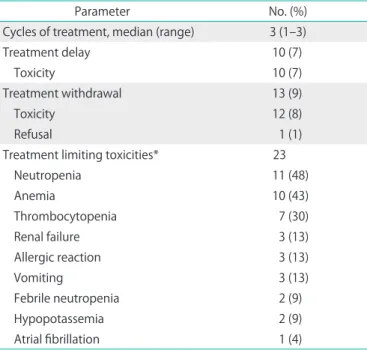
Table 2. Feasibility of paclitaxel, ifosfamide, and cisplatin (n=152)
Parameter No. (%)
Cycles of treatment, median (range) 3 (1–3)
Treatment delay 10 (7)
Toxicity 10 (7)
Treatment withdrawal 13 (9)
Toxicity 12 (8)
Refusal 1 (1)
Treatment limiting toxicities* 23
Neutropenia 11 (48)
Anemia 10 (43)
Thrombocytopenia 7 (30)
Renal failure 3 (13)
Allergic reaction 3 (13)
Vomiting 3 (13)
Febrile neutropenia 2 (9)
Hypopotassemia 2 (9)
Atrial fibrillation 1 (4)
*Toxicities requiring treatment delay or withdrawal.
treated with TIP NACT and were assessable for response.
Patient characteristics are reported in Table 1. Median age was 53 years (range, 24 to 79 years). The majority of patients (89%) had FIGO stage IIB disease.
2. Treatment feasibility
Feasibility data are summarized in Table 2. Median numbers of delivered cycles of TIP was 3 (range, 1 to 3). Treatment was delayed in 10 patients (7%) and withdrawn in 13 patients (9%). In all cases treatment was delayed due to toxicity; in all cases except one it was withdrawn due to toxicity. The most frequent treatment-related limiting toxicity included: hema- tological toxicity such as neutropenia, anemia and thrombo- cytopenia in 48%, 43% and 30% of patients, respectively; renal failure in 13% of patients; allergic reaction in 13% of patients;
vomiting in 13% of patients; febrile neutropenia in 9% of
patients; and hypokalemia in 9% of patients. No treatment- related deaths occurred. Fifteen of these treatment-related limiting toxicities (63%) occurred in the first 50 patients. In the subsequent 102 patients, it was observed in only eight of them (36%).
3. Treatment efficacy
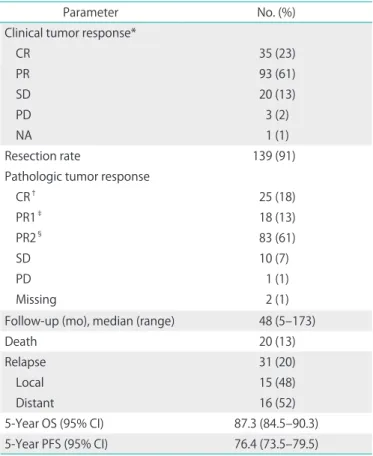
Efficacy data are reported in Tables 3, 4. Following NACT, 35 patients (23%) had clinical CR, and 93 patients (62%) a clinical PR; clinical SD was observed in 20 patients (13%); only three patients (2%) had a clinical PD.
Resection rate was 91%. The median time from the initiation of TIP to surgery was 3 months (range, 2 to 4 months). Thir- teen patients did not undergo surgery; this was due to clinical SD in 10 patients and PD in three patients. The mean duration of surgery was approximately 150 minutes. Lymphadenec- tomy was performed in 121 patients (87%). A median number of 20 lymph nodes were removed (range, 4 to 64). Ninety-one patients (75%) were pN0, 30 patients were pN1 (25%) (Table 4).
Perioperative and postoperative complications included: the need for blood transfusions in 13 patients (9%); three cases (2%) of bladder denervation requiring suprapubic catheteriza- tion; four cases (3%) of rectovaginal fistulas all occurred in patients who subsequently received radiotherapy. During surgery, the mean blood loss was 300 mL.
Postchemotherapy pathological response in 137 assessable patients was: pCR in 25 patients (18%), pPR1 in 18 patients (13%), pPR2 in 83 patients (61%), SD in 10 patients (7%), and PD in one patient (1%). Overall, 43 patients (31%) had a pCR Table 3. Treatment efficacy (n=152)
Parameter No. (%)
Clinical tumor response*
CR 35 (23)
PR 93 (61)
SD 20 (13)
PD 3 (2)
NA 1 (1)
Resection rate 139 (91)
Pathologic tumor response
CR† 25 (18)
PR1‡ 18 (13)
PR2§ 83 (61)
SD 10 (7)
PD 1 (1)
Missing 2 (1)
Follow-up (mo), median (range) 48 (5–173)
Death 20 (13)
Relapse 31 (20)
Local 15 (48)
Distant 16 (52)
5-Year OS (95% CI) 87.3 (84.5–90.3)
5-Year PFS (95% CI) 76.4 (73.5–79.5)
CI, confidence interval; CR, complete response; NA, not available;
OS, overall survival; PD, disease progression; PFS, progression-free survival; PR, partial response; SD, stable disease.
*As assessed by magnetic resonance imaging or transvaginal ultra- sonography on all 152 patients according to Response Evaluation Criteria in Solid Tumors criteria. †Pathological CR, defined by pT0.
‡Pathological PR1, defined by residual disease with ≤3 mm stromal invasion including pTis. §Pathological PR2, defined by persistent residual disease with >3 mm stromal invasion on surgical specimen.
Table 4. Postchemotherapy pathological TNM stage* (n=139)
Parameter No. (%)
T stage
ypT0 26 (21)
ypTis 7 (6)
ypT1a1–2 11 (9)
ypT1b1–2 45 (36)
ypT2a1–2 16 (13)
ypT2b 19 (15)
ypT3b 1 (1)
ypT4 1 (1)
Missing 13 (10)
N stage
ypN0 91 (75)
ypN1 30 (25)
*According to tumor, node, and metastasis (TNM) classification.
Prefix p indicates stage given by pathologic examination of a surgical specimen; y indicates stage assessed after neoadjuvant therapy.
or pPR1 following TIP and surgery. Following chemotherapy, disease downstaging was observed in 105 patients (of the 138 with an initial clinical stage more than IB2, 86%), including:
27% of all operated patients with ypT0/pTis stage, 9% with ypT1a, 36% with ypT1b, and 13% with ypT2a (Table 4).
Postoperative radiotherapy was administered in 100 patients (72%). With a median follow-up of 48 months (range 5 to 173 months), 132 patients (87%) are alive and 121 patients (80%) are alive and disease-free. Among the 31 patients with relapse 15 patients (10% of all patients) had pelvic recurrences and the remaining 16 patients (11%) had distant metastases.
The probability of 5-year OS and PFS were 87.3% (95%
confidence interval [CI], 84.5 to 90.3) and 76.4% (95% CI, 73.5 to 79.5), respectively (Fig. 1). None of the clinicopathological features studied resulted prognostic factors by univariate analysis (Table 5).
DISCUSSION
With a 5-year OS of 87.3% and PFS of 76.4%, this study confirms the efficacy and tolerability of NACT with TIP in a large series of 152 patients with LACC homogenously treated in a real-life setting with older age and more advanced FIGO disease stage than reported in previous studies [10,16,17].
In comparison with the two Italian randomized clinical trials that used TIP as NACT [10,16], the observed OS and PFS were slightly higher. One possible reason for these unexpected results may lie in the high proportion of patients (72%) who underwent adjuvant radiotherapy at the completion of surgery. In fact, this treatment could have contributed as consolidation or salvage therapy for these patients. Indirect evidence supporting this hypothesis could be the low occur-
rence of pelvic relapse, reported in only 15 of the 31 patients with PD. Moreover, though NACT followed by radical surgery have been used to reduce the long-lasting adverse effects of radiotherapy [17], the role of adjuvant radiotherapy following NACT and radical surgery is still not clear. Another factor that should be taken into account is the role of surgery following NACT, since the efficacy of NACT still remains suboptimal as is evident from the high proportion of SD, PR2 or even disease progression. For this reason, the expertise and surgical aggres- siveness of a single well-experienced surgical team and the meticulous sharp dissection performed to achieve excellent clearance despite the presence of postchemotherapy fibrosis, may contribute to improve the outcome of patients.
As shown in Table 5 the absence of a significant difference of survival outcomes could depend on the large number of patients who received postoperative adjuvant radiotherapy.
These patients underwent adjuvant radiotherapy because of advanced FIGO stage at the diagnosis or postchemotherapy pathological response after radical surgery, except for microle- sions, T0 or Tis TNM stage. So, the selection of most patients for this treatment probably over-rides the significant differ- ence of survival outcomes between FIGO stages and between negative and positive parametrium. In addition, the reason of better survival in patients with positive parametria could be related to NACT or sequence of the three treatments.
No prognostic factors for PFS and OS were identified in our series. In particular, response to NACT was not associated with PFS or OS, similarly to the results of a Korean case series of 112 patients with FIGO stage IB-IIB cervical carcinoma that were treated with cisplatin/etoposide NACT [18]. However, the ob- served overall response rate of 92% (including 18% pCR, 13%
pPR1, and 61% pPR2 rates) is in agreement with the range of response rates (between 70% and 90%) reported in other Fig. 1. (A) Probability of overall survival. (B) Probability of progression-free survival.
Overallsurvival
0
12 24 36 48 60
Months 1.0
0.8
0.6
0.4
0.2
0
Progression-freesurvival
0
12 24 36 48 60
Months 1.0
0.8
0.6
0.4
0.2
0
A B
(n=15 )2 (n=15 )2
trials [4,9,10,16]. A plausible explanation for that may lie in the administration of adjuvant radiotherapy discussed above, and its possible positive effect on the outcome of patients.
Feasibility of TIP in this study was acceptable, with 85% of patients completing the planned 3 cycles of chemotherapy.
However, the high toxicity profile of TIP was confirmed as a relevant issue, with hematological, renal, gastrointestinal toxicity, and allergic reaction being the more frequent causes of treatment delay or withdrawal. It should be noted that 63%
of treatment-related limiting toxicities occurred in the first 50 patients, suggesting the relevance of adequate management of TIP side effects. In the subsequent 102 patients, a treatment limiting toxicity was reported in only eight patients (36%), due to the introduction of routine G-CSF prophylaxis, as well as the administration of erythropoietin with iron implementation in those patients with hemoglobin values below 10 g/dL, and accurate urological evaluation for possible nephrostomy
or ureteral stenting, along with the assessment of creatinine clearance before the start of each chemotherapy cycle. These measures may have significantly contributed to the reduction of severe hematological and renal toxicity.
The question of whether NACT or chemoradiotherapy is a more effective treatment for patients with LACC (FIGO stage IB2-IIB) remains unanswered [17]. The results of the ongoing EORTC RCT (EORTC-55994, NCT00193739), comparing these two strategies in patients with LACC, are expected to reveal the most effective treatment protocol. TIP NACT demonstrated a significant advantage in terms of optimal disease response when compared with a two-drug regimen with ifosfamide and cisplatin (IP) or TP, though it was associated with significantly higher rates of grade 3 or 4 hematological toxicity than the TP schedule [10,16]. Based on the efficacy and tolerability of TIP, which were confirmed in this large series of LACC patients, efforts should be addressed to tailor chemotherapy using pre- Table 5. Univariate analyses for prognostic factors
Variable At risk Progression-free survival Overall survival
No. of events 5-Year survival (%) p-value No. of events 5-Year survival (%) p-value
FIGO stage
IB2 2 0 100 0.45 0 100 0.27
IIB 133 25 78 18 88
III–IVA 16 6 62 2 80
NACT withdrawal
Yes 17 6 59 0.11 4 86 0.86
No 135 25 79 16 88
Response to NACT
pCR+pPR1 62 13 76 0.95 7 90 0.48
pPR2 77 15 78 12 84
SD 9 0 100 1 100
TNM stage
ypT0–Tis 36 10 72 0.18 5 81 0.58
ypT1a 31 4 86 4 92
ypT1b 48 9 79 5 91
ypT2 33 5 83 6 93
ypN0 91 16 81 0.62 8 91 0.29
ypN1 30 7 70 5 88
Parametrial status
Negative 111 23 77 0.54 15 87 0.93
Positive 21 3 79 3 87
Adjuvant RT
Yes 100 22 75 0.60 12 88 0.75
No 51 9 80 7 87
FIGO, International Federation of Gynecology and Obstetrics; NACT, neoadjuvant chemotherapy; pCR, pathological complete response; pPR1, pathological partial response 1; pPR2, pathological partial response 2; RT, radiotherapy; SD, stable disease.
Prefix p indicates stage given by pathologic examination of a surgical specimen; y indicates stage assessed after neoadjuvant therapy.
dictive biomarkers, thus avoiding patients with chemoresistant disease from unnecessary toxicity.
Some limitations of this study include its retrospective nature, with the possible related lack of some relevant clinical data, and the inclusion of patients treated over a long period of time, that may have affected disease staging, as well as supportive therapy. Another major limitation of this study may be the broad indication for adjuvant radiotherapy that was not restricted to those patients with positive surgical margins, metastatic lymph nodes, or parametria involvement, but also to those not achieving a pCR or pPR1.
In conclusion, this study confirms the efficacy and toler- ability of NACT with TIP in a single center large series of LACC patients treated in a real-life setting characterized by older and higher disease stage than reported in other similar previ- ous studies. Hematological and renal toxicity remain the major issues of this strategy that should be carefully considered by adequate urological evaluation and supportive care. The role of adjuvant radiotherapy following NACT and radical surgery is still not completely clear.
CONFLICT OF INTEREST
No potential conflict of interest relevant to this article was reported.
REFERENCES
1. National Cancer Institute. Concurrent Chemoradiation for Cervical Cancer Clinical: Announcement [Internet]. Washington DC: NCI;
1999 [cited 2015 Feb 3]. Available from: http://www.cancer.gov/
newscenter/cervicalcancer.
2. Eddy GL, Manetta A, Alvarez RD, Williams L, Creasman WT.
Neoadjuvant chemotherapy with vincristine and cisplatin followed by radical hysterectomy and pelvic lymphadenectomy for FIGO stage IB bulky cervical cancer: a Gynecologic Oncology Group pilot study. Gynecol Oncol 1995;57:412-6.
3. Leone B, Vallejo C, Perez J, Cuevas MA, Machiavelli M, Lacava J, et al. Ifosfamide and cisplatin as neoadjuvant chemotherapy for advanced cervical carcinoma. Am J Clin Oncol 1996;19:132-5.
4. Benedetti-Panici P, Greggi S, Scambia G, Amoroso M, Salerno MG, Maneschi F, et al. Long-term survival following neoadjuvant chemotherapy and radical surgery in locally advanced cervical cancer. Eur J Cancer 1998;34:341-6.
5. Sananes C, Giaroli A, Soderini A, Guardado N, Snaidas L, Bermudez A, et al. Neoadjuvant chemotherapy followed by radical hysterectomy and postoperative adjuvant chemotherapy in the treatment of carcinoma of the cervix uteri: long-term follow-up of a pilot study.
Eur J Gynaecol Oncol 1998;19:368-73.
6. Zanetta G, Lissoni A, Pellegrino A, Sessa C, Colombo N, Gueli-Alletti D, et al. Neoadjuvant chemotherapy with cisplatin, ifosfamide and paclitaxel for locally advanced squamous-cell cervical cancer. Ann Oncol 1998;9:977-80.
7. Neoadjuvant Chemotherapy for Cervical Cancer Meta-Analysis Collaboration (NACCCMA) Collaboration. Neoadjuvant chemo- therapy for locally advanced cervix cancer. Cochrane Database Syst Rev 2004;2:CD001774.
8. Park DC, Kim JH, Lew YO, Kim DH, Namkoong SE. Phase II trial of neoadjuvant paclitaxel and cisplatin in uterine cervical cancer.
Gynecol Oncol 2004;92:59-63.
9. Angioli R, Plotti F, Montera R, Aloisi A, Luvero D, Capriglione S, et al. Neoadjuvant chemotherapy plus radical surgery followed by chemotherapy in locally advanced cervical cancer. Gynecol Oncol 2012;127:290-6.
10. Lissoni AA, Colombo N, Pellegrino A, Parma G, Zola P, Katsaros D, et al. A phase II, randomized trial of neo-adjuvant chemotherapy comparing a three-drug combination of paclitaxel, ifosfamide, and cisplatin (TIP) versus paclitaxel and cisplatin (TP) followed by radical surgery in patients with locally advanced squamous cell cervical carcinoma: the Snap-02 Italian Collaborative Study. Ann Oncol 2009;20:660-5.
11. Benedet JL, Bender H, Jones H 3rd, Ngan HY, Pecorelli S. FIGO staging classifications and clinical practice guidelines in the management of gynecologic cancers. FIGO Committee on Gynecologic Oncology. Int J Gynaecol Obstet 2000;70:209-62.
12. National Cancer Institute. Cancer therapy evaluation programme:
common toxicity criteria manual: common toxicity criteria, version 2.0, 1999 June 1. Bethesda: Cancer Therapy Evaluation Program; 1999.
13. Therasse P, Arbuck SG, Eisenhauer EA, Wanders J, Kaplan RS, Rubinstein L, et al. New guidelines to evaluate the response to treatment in solid tumors. European Organization for Research and Treatment of Cancer, National Cancer Institute of the United States, National Cancer Institute of Canada. J Natl Cancer Inst 2000;92:205-16.
14. Kaplan EL, Meier P. Nonparametric estimation from incomplete observations. J Am Stat Assoc 1958;53:457-81.
15. Cox DR. Regression models and life tables. J R Stat Soc Series B Methodol 1972;34:187-220.
16. Buda A, Fossati R, Colombo N, Fei F, Floriani I, Gueli Alletti D, et al. Randomized trial of neoadjuvant chemotherapy comparing paclitaxel, ifosfamide, and cisplatin with ifosfamide and cisplatin followed by radical surgery in patients with locally advanced squamous cell cervical carcinoma: the SNAP01 (Studio Neo-Adjuvante Portio) Italian Collaborative Study. J Clin Oncol 2005;23:4137-45.
17. Minig L, Colombo N, Zanagnolo V, Landoni F, Bocciolone L, Cardenas- Rebollo JM, et al. Platinum-based neoadjuvant chemotherapy followed by radical surgery for cervical carcinoma international federation of gynecology and obstetrics stage IB2-IIB. Int J Gynecol Cancer 2013;23:1647-54.
18. Bae JH, Lee SJ, Lee A, Park YG, Bae SN, Park JS, et al. Neoadjuvant cisplatin and etoposide followed by radical hysterectomy for stage 1B-2B cervical cancer. Gynecol Oncol 2008;111:444-8.
█ █ █