ISSN 0377-9556 (PRINT) ISSN 2383-9457 (ONLINE) 약학회지 제 61 권 제 2 호 96~99 (2017)
Yakhak Hoeji Vol. 61, No. 2 DOI 10.17480/psk.2017.61.2.96
96
경피 전달을 위한 palmitoyl-KTTKS의 최적처방
이규진 · 최윤림 · 신영희† 경성대학교 약학대학
(Received January 24, 2017; Revised April 10, 2017; Accepted April 12, 2017)
Optimal Formulation of palmitoyl-KTTKS for Transdermal Delivery
Kyu-jin Lee, Yun-lim Choi, and Young-hee Shin† College of pharmacy, Kyungsung University, Busan 48434, Korea
Abstract — Palmitoyl KTTKS (Pal-KTTKS), a derivative of KTTKS has been known for better skin penetration to stim- ulate skin matrix replenishment through topical application. The main purpose of this study was to find the opitmal for- mulation of pal-KTTKS for transdermal delivery. In this study, three kind of formulaion - hydrophilic, hydrophobic and emulsion formualtion were examined. On in vitro retention study, pal-KTTKS was retained with higher amount in stratum corneum than viable layer. The higher retention rate of pal-KTTKS was observed in the emulsion formulation than others.
Keywords palmitoyl-KTTKS, in vitro retention, optimal formulation
Peptide는 아미노산의 중합체로 우리 몸을 구성하거나 여러 가 지 생리 활성을 조절하는 역할을 한다고 알려져 있다. Peptide에 관한 여러 가지 연구를 통하여 피부에 적용했을 때 상처 치료 효 과가 있다는 사실이 보고되었다. 치료 효과는 이론적으로 혈관 신생, 육아세포 촉진, 새로운 콜라겐 합성 등을 일으키는 세포 성 장인자를 상향조절 시켜서 나타나는 것으로 알려져 있다.1,2) 이 런 진피 내의 구성성분들의 생리활성을 촉진시켜주는 peptide들 은 상업적으로 잠재력이 커서 많은 관심을 받고 연구가 되고 있다.
KTTKS는 type 1 collagen peptide의 부분절로 ‘Signal peptide’
로 간주되는데, 작은 아미노산 서열들이 collagenase 활성을 억제 하거나 extracellular matrix(ECM)생산을 촉진 시켜서 진피를 재 모형화 하는 효과가 있는 것으로 나타났다. KTTKS는 ECM 합 성을 촉진시키는데 필요한 펩타이드의 80%의 능력을 유지 할 수 있는 가장 작은 서열이라고 기술되었다.1,4,5) KTTKS는 특히
types I and III 콜라겐과 fibronectin 발현을 촉진시키는 것으로 나타났다. Type1 collagen은 구조적인 완전성을 유지하는 역할 을 하는 유전자에 속하는데, 세포의 점착성, 이동성에 영향을 주 고 조직 재모형화와 상처 치료 등의 역할을 한다.5)
Peptide를 피부에 적용시키는 것은 효과적인 잠재력을 가지고 있지만, 피부를 통과하는 것은 어려울 수 있다. 피부를 통한 전 달을 향상시키기 위한 방법으로는 지방산 유도체를 사용하여 지 용성을 증가시키는 방법이 있다. KTTKS의 경우 지방산 유도체 인 palmitate을 사용하여 Pal-KTTKS를 만드는 방법이 주로 사 용된다. Robinson 등은 Pal-KTTKS가 KTTKS보다 피부 투과에 있어서 나은 결과를 보였으며, small base size testing에서도 facial skin을 향상시키는 결과를 보였다고 보고했다.6)
본 연구에서는 KTTKS에 지방산 palmitate를 결합시켜 KTTKS 의 낮은 피부 투과성과 피부 내에서의 불안정성을 개선시킬 것으 로 기대되는 palmitoyl-KTTKS(pal-KTTKS)를 이용한 제제를 만 들어 적용하고자 하였다.7,8)In vitro retention test를 통하여 pal- KTTKS 제제 적용 시 pal-KTTKS의 피부 투과와 피부 각 층에 retention 되는 양을 구하여 pal-KTTKS의 국소 제제 개발을 위 하여 3가지타입의 formulation중 최적화된 조합을 찾고자 실험 을 진행하였다.
#
Corresponding Author Young-hee Shin
College of Pharmacy, Kyungsung University Busan 48434, Korea Tel.: 051-663-4886 Fax.: 051-663-4809
E-mail: [email protected]
Short Report
종설경피 전달을 위한 palmitoyl-KTTKS의 최적처방 97
J. Pharm. Soc. Korea
재료 및 방법
시약 및 기구
Pal-KTTKS, pal-GHK 는 Peptron사(대전, 한국)에서 구입하여 사용하였다. Isopropyl myristate(IPM)), transcutol(Diethylene gylcol monoethyl ether), poloxamer-407, benzyl alcohol, acetic acid 는 Sigma-Aldrich(St Lewis, MO, USA)사로부터 구입하였다.
Acetonitrile, methanol은 HPLC grade로 Merck사(Darmstadt, Germany) 제품을 사용하였다. 그 외 시약은 시약특급을 사용하였다.
분석기기는 Agilent technologies 1200 series의 HPLC와 Agilent technologies 6410 Triple quad LC-MS/MS로 구성되어 있고, 분석 및 정량 프로그램으로 Agilent mass hunter를 이용하 였다. In vitro retention test 실험에는 Franz modified diffusion cell set 을 사용하였다.
LC-MS/MS 분석 조건
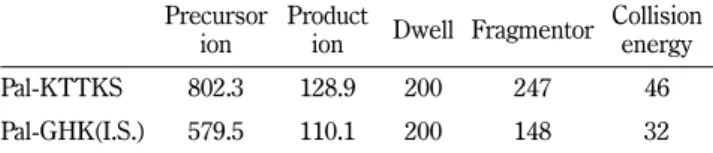
Pal-KTTKS의 확인 및 정량에는 Choi 등의7-9)방법을 참고하여 실험하였다. Pal-KTTKS의 분석에서 이동상은 acetonitrile : 20 mM Ammonium acetate = 70 : 30(v/v%, 0.05% acetic acid 함유)를 사 용하여 유속 0.2 mL/min로 하였다. 컬럼은 Capcell Pak C8 (2.0×100 mm, 5 µm, Shisheido)을 사용하였고 컬럼 온도는 40oC 로 하였다. 내부표준물질로 pal-GHK를 첨가하여 시료로 사용하 였으며 시료의 주입량은 10 µL이었다. LC-MS/MS의 ion product scan mode를 이용하여 얻은 분석 조건은 Table I과 같다.
Formulation 조제
본 실험에서 검토한 아래의 제제 3가지 타입 모두 pal-KTTKS 200µg/ml이 함유되도록 제조하였다.
Hydrophilic formulation의 조제 − Hydrophilic base로 poloxamer hydrogel을 선택하였다. 15% ethanol을 함유한 poloxamer gel에 pal-KTTKS를 함유한 hydrogel을 제조하였다.
제조방법은 먼저 ethanol 15%, poloxamer 20%, water 65%가 되게 혼합한 후, 4oC에서 overnight한다. 그 후, 잘 혼합 된 poloxamer gel과 transcutol를 70 : 30(w/w %)의 비율로 혼합하 고, pal-KTTKS를 넣어 잘 혼합하여 조제하였다.
Hydrophobic formulation의 조제 − Hydrophobic base로
IPM(Isopropyl myristate)를 선택하였다. IPM과 투과촉진제인 transcutol를 70 : 30 (w/w %)의 비율로 교반 혼합한 후 pal- KTTKS를 첨가하고 vortexing 하였다.
Emulsion의 제조−Emulsion 은 water 와 oil phase 그리고 surfactant를 혼합하여 Lee 등10)의 방법을 참고하여 제조하였다.
Oil Phase로는 benzyl alcohol을 사용하였고, surfactant로는 transcutol을 co-surfactant로 ethanol을 첨가하여 조제하였다.
Water 60%, benzyl alcohol 10%, surfactant 15%, co-surfactant 15%의 비율로 제조하였다. Benzyl alcohol은 skin irritation을 일 으킨다는 보고10-11)가 있으므로, 10%(w/w)를 선택하였다. 제조 시 sonication time을 10, 20, 30sec로 각각 조제한 후 입자경 분 석으로 20sec의 sonication이 최적 조건이었으므로 emulsion formulation을 20sec sonication하여 시료로 만들어 실험을 진행 하였다.
Droplet size analysis − emulsion formulation의 평균 입자경 을 알아보기 위해 입도 측정기(model N5/LS-13320, Beckman coulter, USA)를 이용하여 Droplet size를 분석하였다.
In vitro retention test
Skin specimen 조작 − Hairless mouse(25±3 g, male)을 오 리엔트 바이오 사에서 구입하여 사용하였다. Hairless mouse는 경추 탈골 방법을 이용하여 희생시키고 피부를 적출한 후 피하 지방과 조직들을 피부가 상하지 않도록 조심스럽게 제거하고 실 험에 사용하였다.
In vitro retention test − Hairless mouse skin에 retention 되는 pal-KTTKS의 양은 Franz modified diffusion cell을 사용하 여 측정하였으며, 피부의 각질층을 donor compartment 쪽으로 장착하고 37oC로 일정한 온도를 유지시켜주었다. Receptor compartment에는 15% Ethanol을 함유하는 HEPES buffer (10 mM, pH 7.4) 15.5 mL 채운 후 교반하면서 균질한 상태를 유지하였다. Donor compartment에 각각의 제제를 적용하여 24 시간 경과 후, diffusion cell에서 피부를 분리하였다. 피부 표면에 남아있는 제제를 제거하고 증류수로 5회 세척한 후, blunt spatula 를 이용하여 stratum corneum층과 viable layer(epidermis &
dermis)로 분리하였다. 분리한 각 피부층은 가위를 이용하여 충분 히 작은 조각으로 자르고, methanol 0.5 mL를 가하여 24시간 동 안 실온에서 교반하여 추출하였다. 24시간 동안 추출한 시료를 10,000 rpm, 4oC에서 20분 동안 원심분리를 한 후 상층액만 조 심스럽게 취하였다. 얻어진 상층액으로 각 피부층에 retention된 pal-KTTKS의 양을 측정하였다.
Table I − LC-MS/MS condition for analysis of pal-KTTKS Precursor
ion
Product
ion Dwell Fragmentor Collision energy
Pal-KTTKS 802.3 128.9 200 247 46
Pal-GHK(I.S.) 579.5 110.1 200 148 32
98 이규진 · 최윤림 · 신영희
Vol. 61, No. 2, 2017
실험결과 및 고찰
LC-MS/MS 분석
Pal-KTTKS 검량선 작성 및 직선성 − 본 실험의 분석 조건에 따라 분석하여 얻은 pal-KTTKS의 크로마토그램은 Fig. 1에 나 타내었다. pal-KTTKS의 유지시간은 약 1.6분이었으며, I.S로 사 용한 pal-GHK의 유지시간은 약 1.7분 이였다. 작성한 검량선의 계산식은 y = 0.0573x − 0.0174(R2= 0.9999)로 0.5~20 µg/mL 의 농도 범위에서 양호한 직선성을 나타내었다(y: Area ratio, x:
pal-KTTKS concentration).
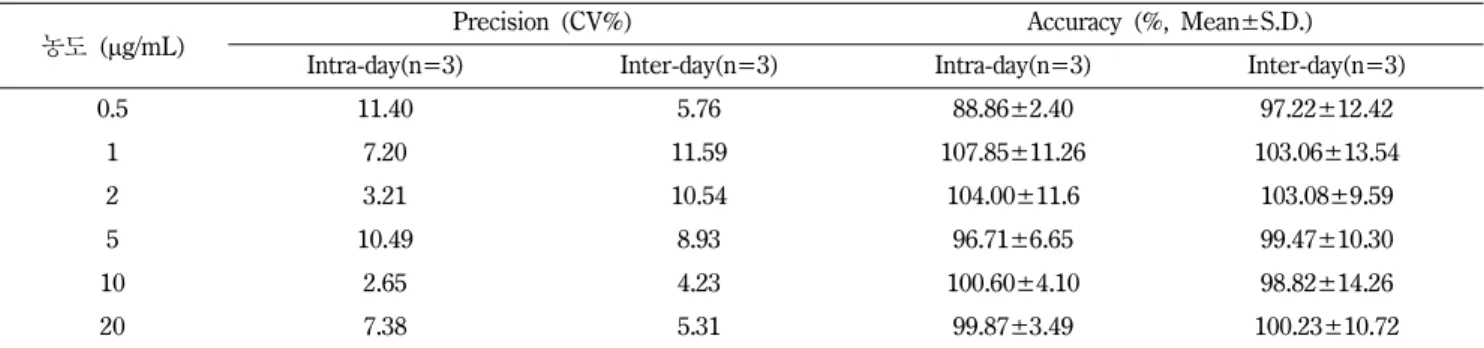
정밀성 및 정확성 − 정밀성은 pal-KTTKS와 내부표준물질의 피크면적 비의 표준편차를 피크면적 비의 평균값으로 나눈 백분 율(%)로 구하였다. 하루에 3번 시행하여 일내 정밀성(CV %)를 구하였고, 3일간 실험을 반복 실행하여 일간 정밀성(CV %)을 구 하였다. 본 분석방법의 정밀성(CV %)는 일내 정밀성, 일간 정밀 성 모두 15% 이내였다. 정확성은 검량선에 의하여 정량한 농도 의 평균값을 pal-KTTKS의 농도로 나눈 비의 백분율(%)로서 구
하였다. Table II에 나타낸 것처럼 일내 정확성, 일간 정확성 모 두 농도 범위에서 ±15% 이내였다.
Droplet size analysis − emulsion formulation의 평균 입자경 을 알아보기 위해 입도 측정기를 이용하여 sonication time을 20sec으로 제조하였을 때 가장 큰 피크를 나타낸 입자의 평균 입 자경이 1207±364 nm임을 확인 할 수 있었다.
In vitro retention test의 평가
In vitro retention test를 통해 다양한 pal-KTTKS formulation 을 피부에 적용하였을 때, pal-KTTKS가 skin barrier인 stratum corneum 층을 통과하여 viable layer(epidermis & dermis)에서 안정한 상태로 어느 정도 retention되는지 확인하기 위한 목적으 로 수행하였다.
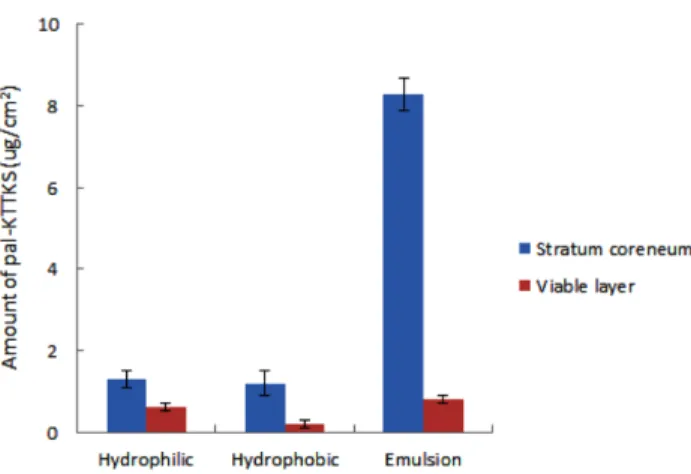
Fig. 2에서 볼 수 있듯이, hydrophilic formulation의 경우, stratum corneum(1.3±0.2µg/cm2), viable layer(0.6±0.1µg/cm2) 층 순으로 높은 축적량을 보였다. Hydrophobic formulation의 경 우, stratum corneum(1.2±0.3 µg/cm2), viable layer(0.2 ±0.1µg/
cm2)층 순으로 hydrophilic formulation과 유사한 축적량을 보였다.
Emulsion formulation은 stratum corneum(8.3±0.4 µg/cm2), viable layer(0.8±0.1µg/cm2)의 순서로 높은 축적량을 보였다.
Emulsion formulation은 hydrophilic, hydrophobic formulation 두 제제보다 stratum corneum 층에서 약 6-7배 정도의 높은 투 과량 증가를 보여 좋은 효과를 나타냈고, viable layer(epidemis
& dermis)에서는 유사한 축적량을 보였다.
In vitro retention test에서 pal-KTTKS제제는 3가지 타입의 제제 모두 공통적으로 stratum corneum 층에서 높은 축적량을 보이고, viable layer(epidermis & dermis)에서 낮은 축적량을 보 였다. 그 이유로는 choi 등의 보고7,8)에서 알 수 있듯이 viable layer(epidermis & dermis)에 분포되어있는 많은 분해효소들의 작용으로 인해 pal-KTTKS가 분해되었기 때문으로 생각된다.
KTTKS 및 pal-KTTKS는 주름개선효과 및 항노화 효과로 화 장품영역에서 많이 검토되고 있다. 피부를 송달을 위한 in vitro 연구가 다소 보고된바 있으며, pentapetides 들의 피부 내 각층
Fig. 1 − LC-MS/MS chromatogram of pal-GHK(I.S.) and pal-
KTTKS.
Table II − Validation of LC-MS/MS method of pal-KTTKS
농도 (µg/mL) Precision (CV%) Accuracy (%, Mean±S.D.)
Intra-day(n=3) Inter-day(n=3) Intra-day(n=3) Inter-day(n=3)
0.5 11.40 5.76 88.86±2.40 97.22±12.42
1 7.20 11.59 107.85±11.26 103.06±13.54
2 3.21 10.54 104.00±11.6 103.08±9.59
5 10.49 8.93 96.71±6.65 99.47±10.30
10 2.65 4.23 100.60±4.10 98.82±14.26
20 7.38 5.31 99.87±3.49 100.23±10.72
경피 전달을 위한 palmitoyl-KTTKS의 최적처방 99
J. Pharm. Soc. Korea
에서의 안정성에 대한 연구도 보고되고 있다.1,12-16) Choi등의7,8)연구에 의하면 KTTKS는 피부추출물에서 매우 불안정하여 피부 송달에 적용하기 어렵고 지방산 유도체인 pal-KTTKS는 다소 안 정하여 피부송달에 유용할 것으로 사료된다. 또한 피부 내 효소 등의 작용을 억제할 수 있는 효소 억제제등을 적용하면 더욱 좋 은 결과를 유도 할 수 있을 것으로 사료된다.
결 론
Pal-KTTKS를 피부적용 국소 제제로 개발 시 효율적인 약물전 달을 위한 방법을 검토하기 위하여 hydrophilic, hydrophobic, 및 emulsion type의 3가지 formulation을 만들고 in vitro retention test를 실시하여 피부 각층에 축적량을 측정하여 평가하였다.
Pal-KTTKS를 피부를 통하여 적용시키고자 하는 경우 emulsion formulation이 다른 formulation보다 효과적임을 알 수 있었다.
하지만, epidermis & dermis층에서 분해효소에 의해 pal-KTTKS 가 분해되어 공통적으로 낮은 축적량을 보여주었기 때문에, 분 해효소의 방해를 받지 않거나 적게 받을 수 있는 제제 연구를 앞 으로 진행할 필요가 있을 것으로 사료된다.
References
1) Abu Samah, N. H. and Heard, C. M. : Topically applied KTTKS:
a review. Int. J. Cosmetic Sci. 33, 483 (2011).
2) Choi, C. M. and Berson, D. S. : Cosmeceuticals. Semin. Cutan.
Med. Surg. 25, 163 (2006).
3) Benson, H. A. E. and Namjoshi, S. : Proteins and peptides:
strategies for delivery to and across the skin. J. Pharm. Sci. 97, 3591 (2008).
4) Katayama, K., Armendariz-Borunda, J., Raghow, R., Kang, A.
H. and Seyer, J. M. : A pentapeptide from type I procollagen promotes extracellular matrix production. J. Biol. Chem. 268, 9941 (1993).
5) Katayama, K., Seyer, J. M., Raghow, R. and Kang, A. H. : Regulation of extracellular matrix production by chemically synthesized subfragments of type I collagen carboxy propeptide. Biochem. 30, 7097 (1991).
6) Robinson, L. R., Fitzgerald, N. C., Doughty, D. G., Dawes, N.
C., Berge, C. A. and Bissett, D. L. : Topical palmitoyl pentapeptide provides improvement in photoaged human facial skin. Int. J. Cosmet. Sci. 27, 155 (2005).
7) Choi, Y. L., Park, E. J., Kim, E. J., Na, D. H. and Shin, Y. H. : Dermal stability and in vitro skin permeation of Collagen Pentapeptides (KTTKS and palmitoyl-KTTKS). Biomol Ther (Seoul). 22, 321 (2014).
8) Park, E. J., Kim, M. S., Choi, Y. L., Shin, Y. H., Lee, H. S. and Na, D. H. : Liquid chromatograpy-tendem mass spectrometry to determine the stability of collagen pentapeptide (KTTKS) in rat skin. J. Chromatogr. B Analyt. Technol. Biomed. Life Sci.
905, 113 (2012).
9) Chirita, R., Chaimbault, P., Archambault, J., Robert, I. and Elfakir, C. : Development of a LC–MS/MS method to monitor palmitoyl peptides content in anti-wrinkle cosmetics. Anal.
Chim. Acta. 641, 95 (2009).
10) Lee, E. A., Balakrishnan, P., Song, C. K., Choi, J. H., Noh, G. Y., Park, C. G., Choi, A. J., Chung, S. J., Shim, C. K. and Kim, D. D. : Microemulsion-based Hydrogel Formulation of Itraconazole for Topical Delivery. J. Pharm. Invest. 40, 305 (2010).
11) Bagley, D. M., Gardner, J. R., Holland, G., Lewis, R. W., Regnier, J. F., Stringer, D. A. and Walker, A. P. : Skin irritation:
reference chemicals data bank. Toxicology in Vitro, 10, 1 (1996).
12) Gorouhi, F. and Maibach, H. I. : Role of topical peptides in preventing or treating aged skin. Int. J. Cosmetic Sci., 31, 327 (2009).
13) Pouillot, A., Dayan, N., Polla, A. S., Polla, L. L. and Polla, B. S. : The stratum corneum: a double paradox. J. Cosmetic Dermatol. 7, 143 (2008).
14) Lau, W. M., White, A. W., Gallagher, S. J., Donaldson, M., McNaughton, G. and Heard, C. M. : Scope and limitations of the co-drug approach to topical drug delivery. Curr. Pharm.
Des. 14, 794 (2008).
15) Foldvari, M., Attah-Poku, S., Hu, J., Li, Q., Hughes, H., Babiuk, L. A. and Kruger, S. : Palmitoyl derivatives of interferon α:
potential for cutaneous delivery. J. Pharm. Sci. 87, 1203 (1998).
16) Benson, H. A. E. and Namjoshi, S. : Proteins and peptides:
strategies for delivery to and across the skin. J. Pharm. Sci. 97, 3591 (2008).