ⓒThe Korean Society of Mushroom Science J. Mushroom Sci. Prod. 11(2):53-62(2013)
53
Optimization of Indole-3-Acetic production by phosphate solubilization bacteria isolated from waste mushroom bed of Agaricus bisporus
Buddhi Charana Walpola1, Jae-Geun Noh1, Chan Kyem Kim1, Ki-Cheon Kyung2, Won-Sik Kong3 and Min-Ho Yoon1*
1Department of Bio-Environmental Chemistry, College of Agriculture and Life Sciences, Chungnam National University, Daejeon 305-764, Korea
2Taean Lily Experiment Station, Chungcheongnam-do Agricultural Research and Extention Services. Taean 357-952, Korea
3Mushroom Research Division, National Institute of Horticultural & Herbal Science, RDA, Eumseong 369-873, Korea.
(Received June 5, 2013. Accepted June 18, 2013)
ABSTRACTA total of 35 phosphate solubilizing bacterial strains were isolated from waste mushroom bed of Agar- icus bisporus in Buyeo-Gun, Chungnam and screened for the production of indole acetic acid (IAA). The best IAA producing strain was identified as Pantoea rodasii using 16S rRNA analysis. In addition to the IAA production, this strain could act as an efficient phosphate solubilizer (1100 µg ml-1 after 5 days of incubation) also. The selected strain was cultured under different conditions in order to assess the optimum conditions for maximum IAA production. The nutrient broth (NB) medium was recorded as the best medium, where the maximum IAA production (229 µg ml-1) was recorded at the start of stationary phase (12 hours after inoculation) of the bacteria growth. The performance of the strain was found to be maximum at the temperature of 30oC followed by 25oC. IAA production was found to be increased with increasing tryptophan concentration (from 0.1 to 0.6%), however beyond this limit, a slight reduc- tion in IAA production was observed. The strains’ ability to produce IAA was further confirmed by extraction of crude IAA and subsequent TLC analysis. A specific spot from the extracted IAA preparation was found corresponding with the standard spot of IAA with same Rf value. The results of HPLC analysis conducted in identifying and quan- tifying the IAA production more precisely, are in agreement with the results of the assessment done with colorimetric method. As revealed by the results of the pot experiment, the isolated strain could significantly enhance the growth (as measured by shoot and root growth) of mung bean plants compared to that of non-inoculated plants. Therefore it can be concluded that the present strain, Pantoea rodasii has great potential to be used as bio-inoculants.
KEYWORDSPantoea rodasii, indole acetic acid, bio-inoculants, phosphate solubilizer
Introduction
Microorganisms can act directly or indirectly resulting in beneficial or detrimental effects on the soil environment. Soil microorganisms such as bac- teria, fungi and algae, which are capable of produc- ing physiologically active quantities of auxins may exert pronounced effects on plant growth and devel- opment. The most common, best characterized and physiologically most active auxin is known to be indole acetic acid (IAA), which is mainly produced by tryptophan dependent pathway (Datta and Basu, 2000; Ahmad et al., 2005; Gosh and Basu, 2006;
Mandal et al., 2007). Some microorganisms are known to produce auxin in the rhizosphere using a substrate of plant exudates which contain amino
acid L-tryptophan (Ahmad et al., 2005)
As stated by Ahmad et al. (2008), both rapid response (e.g. increased cell elongation) as well as long-term response (e.g. cell division and differenti- ation) is distinguished when IAA stimulates plant growth. Furthermore, IAA enhances lateral root for- mation which in turn could facilitate high root sur- face area for better absorption of nutrients (Compant et al., 2010). Therefore, microbes through the pro- duction of IAA could have definite effect on growth of the host plant. It has been reported that micro- bial IAA promotes root growth either directly by stimulating plant cell elongation or cell division or indirectly by its influence on the 1-aminocyclopro- pane-1-carboxylate (ACC) deaminase activity (Pat- ten and Glick, 2002). It has also reported that IAA
*Corresponding author: [email protected]
could effectively contribute towards the defense mechanism in plants against external stress condi- tions (Bianco and Defez, 2009).
Microbial IAA production has been investigated over the years by several researchers (Ahmad et al., 2008; Gulati et al., 2009; Jung et al., 2011). The phosphate solubilizing bacteria which are capable of producing IAA include Pseudomonas sp., Bacillus sp., Burkholderia sp., Enterobacter sp., Klebsiella sp., Azospirium sp., Pantoea sp. and Serratia sp.
(Mirza et al., 2001; Vessey, 2003; Patil et al., 2011;
Kapoor et al., 2012; Kumar et al., 2001).
In vitro screening of the phosphate solubilizing bacte- ria for their potential of IAA production could provide a reliable base for selection of effective plant growth pro- moting bacteria to be used as bio-inoculants. Therefore, the present study was carried out to quantify and opti- mize the production of IAA by Pantoea rodasii, an effi- cient phosphate solubilizing bacteria isolated from green house soils and to assess the strains’ ability to promote the growth of mung bean (Vigna radiata).
Materials and Methods
Isolation of phosphate solubilizing bacterial strains The phosphate solubilizing bacterial (PSB) strains were isolated from tomato growing rhizosphere soil samples collected from green houses at Chungchug- nam-do province, Buyeo-Gun area in South Korea.
Serially diluted aliquots of soil samples were inocu- lated on NBRIP medium (National Botanical Research Institute Phosphate medium) containing 10 g glucose, 5 g Ca3(PO4)2, 5 g MgCl2· 6H2O, 0.25 g MgSO4.7H2O, 0.2 g KCl, 0.1 g (NH4)2SO4 in 1 L distilled water (Nautiyal, 1999). The pH of the media was adjusted to 7. The petri plates were incu- bated for 7 days at 30oC and examined for colonies developing clear zone. Colonies with conspicuous clear zones around them were picked up and fur- ther purified by repeated sub-culturing. Pure cul- tures were maintained as a glycerol suspension (30% v/v) at 80oC until use.
Screening of bacterial isolates for IAA production For qualitative assay of IAA production, nutrient
agar plates containing 0.1% tryptophan were inocu- lated individually with phosphate solubilizing iso- lates in aseptic conditions. Each inoculated plate was overlaid with an 82 mm diameter filter paper immediately after inoculation, and then incubated until formation of 0.5 to 2 mm colonies. After removing the filter papers, the plates were treated with Salkowski’s reagent (2% 0.5 M FeCl3 in 35%
perchloric acid) and kept at room temperature (30oC) until the development of color. IAA produc- ing bacteria were identified by the formation of a characteristic pink to red halo surrounding the col- ony. Diameter of each halo was recorded after 30 min. The strains distinguished with large pink color halo on agar plates were screen for the fur- ther studies.
Identification of the selected bacterial strain The partial sequencing of 16S rRNA for the bac- terial strains was done with the help of DNA sequencing service, SOLGENT, Daejeon, South Korea using universal primers, 27F (5’- AGAGTTTGATCCTGGCTCAG-3’) and 1492R (5’- GGTTACCTTGTTACGACTT-3’). The online pro- gram BLAST was used in identifying the related sequences with known taxonomic information avail- able at the databank of NCBI (http://www.ncbi.nlm.
nih.gov/BLAST). A phylogenetic tree was con- structed using CLUSTAL X program (Thompson et al., 1997), which involved sequence alignment by neighbor joining method (Saitou and Nei, 1987) and maximum parsimony using the MEGA4 program (Kumar et al., 2001). Grouping of sequences was based on confidence values obtained by bootstrap analysis of 1,000 replicates. Gaps were edited in the BioEdit program and evolutionary distances were calculated using Kimura two parameter model. Ref- erence sequences were retrieved from GenBank under the accession numbers indicated in the trees.
Assay of inorganic phosphate solubilization The selected bacterial strain was grown in steril- ized liquid NBRIP medium (20 ml) at 30oC for 2 days with continuous shaking at 150 r min-1. Ali- quots of culture (1 ml) was then transferred to a
500 ml flask (n=3 per strain) containing sterilized liquid medium (250 ml) and incubated with continu- ous shaking at 30oC. Sterilized uninoculated medium served as a control. A sample (10 ml) of each cul- tured and control were taken 2, 5 and 7 days after the inoculation and centrifuged at 8000 rpm for 15 min. The clear supernatant was used in determin- ing the pH and amount of phosphorous released into the medium.
Optimization of IAA production
Effect of incubation period on IAA production The selected strain was cultured in sterilized 100 ml of liquid nutrient broth (NB) contained 0.2%
tryptopan and incubated for 60 hrs with continuous shaking at 30oC. A sterilized uninoculated medium was served as the control. Sample of cultured and control were taken into centrifugation tube with dif- ferent time intervals and centrifuged 10 min at 10000 rpm. The clear supernatant was used to deter- mine IAA production as described by Gutierrez et al. (2009).
Clear supernatant of 1 ml was mixed with 4 ml of the Salkowski’s reagent (50 ml of 35% perchloric acid and 1 ml of 0.05 M FeCl3 solution). The mix- ture was incubated in the dark at 37oC for 30 minutes. With the development of pink color, which indicated the IAA production, the optical density was measured at 535 nm using UV spectro- photometer. The IAA production was quantified with the help of standard graph of IAA obtained in the range of 10-100 µgml-1.
Effect of different media on IAA production The strain was cultured in 250 ml erlenmeyer flasks containing 100 ml of different media such as NB, TSB (Tryptic Soy Broth), LB (Luria-Bertani), and NBRIP medium (National Botanical Research Institute Phosphorus) supplemented with 0.2% tryp- tophan to study the effect of media on IAA produc- tion. Sample of cell culture and control were taken into centrifugation tube after 12 hrs of incubation and centrifuged for 15 min at 10,000 rpm at 4oC.
The clear supernatant was subjected to detection of
IAA production as described by Gutierrez et al.
(2009).
Effect of different temperature on IAA production The effect of temperature on the IAA production was determined by incubating culture medium (NB medium with 0.2% tryptophan) at different tempera- tures ranging from 25-40oC. After incubation, IAA production was assayed as described by Gutierrez et al. (2009).
Effect of different tryptophan concentrations on IAA production
The optimum tryptophan concentration for the maximum IAA production was assayed by adding different tryptophan concentrations (0.1, 0.2, 0.4, 0.6, 0.8 and 1%) to culture medium. The IAA pro- duction was assayed as described by Gutierrez et al.
(2009).
In each experiment, optical density of culture supernatant was measured at 660 nm using UV spectrophotometer to obtain the cell growth.
Extraction of crude IAA and thin layer chromatography (TLC)
Single bacterial colony was inoculated to 200 ml of nutrient broth containing 0.6% of tryptophan and incubated at 30oC for 12 hours on a shaker. Bacte- rial cells were separated from the supernatant by centrifugation at 10,000 rpm for 30 min. The super- natant was acidified to pH 2.5-3.0 with 1 N HCl and extracted twice with ethyl acetate. Extracted ethyl acetate fraction was evaporated in a rotator evaporator at 40oC. The extract was dissolved in 1 ml of methanol and kept at -20oC. Extracted methanol fraction (100 µl) were taken to TLC plates (Silica gel Gf 254, thickness 0.25 mm) and devel- oped by reagent spray n-butanol: ethyl acetate: etha- nol: water – 3:5:1:1. Spots with Rf values identical to authentic IAA were identified by spraying the plates with Ehmann’s reagent (Ehmann, 1977).
Determination of IAA production by HPLC The used column was C18, 5 µm 25 0.46 cm and a UV detector set to 280 nm at 40oC. Mobile
phase consisted of methanol and water (80:20 v/v) run at a flow rate of 1 ml/min. HPLC profiles of the culture filtrate was analyzed by comparison with the elution profiles of those of authentic standards IAA injected separately.
Plant growth promotion bioassay with mung bean (Vigna radiata)
Mung bean (Vigna radiate var. paiyur 1) seeds were surface sterilized by immersing in 0.1%
sodium hypochlorite solution for 10 minutes fol- lowed by washing thrice with distilled water. Seeds of mung bean were soaked in bacterial culture sus- pensions prepared in nutrient broth about 30 min prior to plant. The soil from 15 mm depth was removed from earthen pots and five seeds were placed at equal distance. Control plants received mung bean seeds soaked in nutrient broth without bacteria. Pots were watered daily to maintain the water holding capacity of the soil during the study period. After one week of germination, plants were thinned out allowing 3 plants per plot to remain.
Growth promotion effects of bacterial treatment were assessed by measuring shoot and root length of mung bean plants.
Statistical analysis
Values were given as means SD for triplicate
samples. The data were subjected to analysis of variance (ANOVA) using SAS package (SAS, 1999). The Duncan’s Multiple Range Test (DMRT) was applied to test the significance of treatment means at P0.05.
Results
Isolation of phosphate solubilizing bacterial strains and screening for IAA production
Thirty five bacterial strains (PSB 1 to PSB 35) which exhibited clear zones on the NBRIP agar plates were selected as phosphate solubilizing organ- isms and they were screened for IAA production.
All the tested phosphate solubilizing bacterial iso- lates showed positive response for IAA production with different concentrations as identified by charac- teristic red-pink halo. Out of 35 strains, 3 strains showed high production ability, 20 strains showed moderate while the rest showed low production abil- ity of IAA. A strain with distinguished perfor- mance was selected, based on the results of IAA production and phosphate solubilization, for further studies
Identification of the bacterial strain
According to 16S rRNA sequence analysis, the strain showed close proximity with Pantoea rodasii Fig. 1. Phylogenetic tree based on 16S rDNA gene sequences, showing the position of Pantoea rodasii (PSB-13) with respect to related species. The scale bar indicates 0.02 substitutions per nucleotide position and accession numbers are given in parenthesis.
LGM 26273. Phylogenetic tree (Fig. 1) shows the position of isolated bacterial strain with respect to the related species.
Assay of inorganic phosphate solubilization As shown in Fig. 2, it was apparent that bacte- rial isolate significantly increased available phos- phorus content in the medium. The increment was shown to be pronounced during the first 4-5 days (1100 µg ml-1) of the incubation. However, as incubation progressed, a significant drop in solu- ble phosphorus level was observed. As depicted in Fig. 2, the bacterial inoculation resulted in acidifi- cation of the culture medium also. The pH of the medium was reduced to 3.75 at the end of 5th day of incubation.
Optimization of IAA production
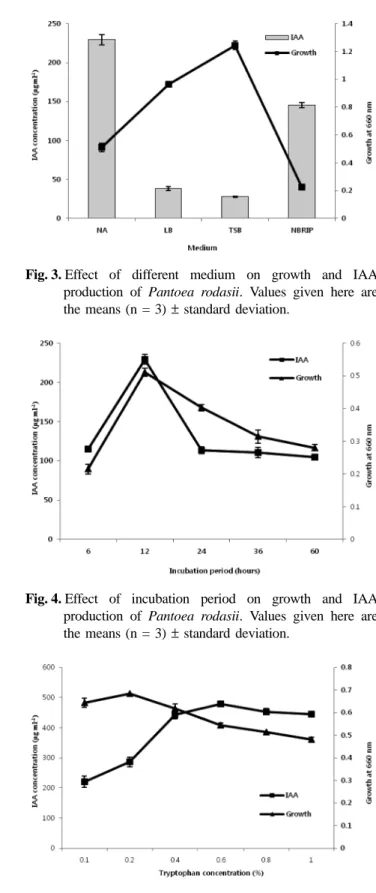
Effect of different media on IAA production As revealed by the results, NB medium was the best medium for IAA production (229.54 µg ml-1) followed by NBRIP medium (145.57 µg ml-1). The strain showed very low IAA production with LB and TSP medium (Fig. 3), though higher bacterial growth was recorded with those two medium also.
Effect of incubation period on IAA production As shown in Fig. 4, the growth of the bacterial strain was found to be parallel to IAA production
which reached to the maximum (229.54 µg ml-1) at the stationary phase (after 12 hrs) of the growth.
Fig. 2. Insoluble Phosphate solubilization (µg ml-1) and changes of pH in NBRIP culture medium containing Pantoea rodasi. Values given here are the means (n = 3) standard deviation.
Fig. 3. Effect of different medium on growth and IAA production of Pantoea rodasii. Values given here are the means (n = 3) standard deviation.
Fig. 4. Effect of incubation period on growth and IAA production of Pantoea rodasii. Values given here are the means (n = 3) standard deviation.
Fig. 5. Effect of tryptophan concentration on growth and IAA production of Pantoea rodasii. Values given here are the means (n = 3) standard deviation.
Effect of different temperature on IAA production The highest IAA production (229.54 µg ml-1) was recorded at 30oC followed by 25oC (201 µg ml-1).
The IAA production was significantly decreased when temperature increased from 30 to 35oC. The growth (after recording the maximum at 25oC) was found to be decreased with the increasing tempera- ture. No growth or IAA production was recorded at the temperature over 40oC (Fig. 5).
Effect of different tryptophan concentration on IAA production
To determine the effect of tryptophan concentra-
tion on the IAA production, various tryptophan con- centrations ranging from 0.1% to 1% were added to the culture medium. As depicted in Fig 6, IAA pro- duction was dramatically increased with increasing amounts of tryptophan up to 0.6%, thereafter a slight reduction was observed. The growth of the strain was increased with increasing tryptophan concentra- tions up to 0.2%, however, decreased thereafter.
TLC and HPLC analysis
The stain’ ability to produce IAA was further con- firmed by TLC and HPLC analysis. As shown in Fig. 7, when TLC plate was treated with Ehmann’s reagent, the ethyl acetate extracts from culture fil- trate showed a clear pink color spot on the TLC plate at the Rf value corresponding to standard IAA (0.93). HPLC analysis was in fact conducted to identify and quantify the IAA production precisely.
As shown in Fig 7, culture filtrate of the strain and corresponding reference authentic standard showed peak at the similar retention time (2.99 min.). The results of HPLC are in close agreement with those assessed by the Salkowski reagent (data not shown).
Plant growth promotion bioassay with mung bean (Vigna radiata)
According to the results of plant growth promo- Fig. 6. Effect of incubation temperature on growth and IAA
production of Pantoea rodasii. Values given here are the means (n = 3) standard deviation.
Fig. 7. Results of HPLC and TLC analysis. (a) HPLC chromatograms of the authentic IAA (upper) and the culture supernatant of pantoea rodasii (lower) using a C18 reverse HPLC column (retention time 2.99 min). (b). TLC chromatograms of the authentic IAA (lane 1) and the ethyl acetate extracted fraction of culture supernatant of pantoea rodasii (lane 2).
tion assay, the strain could significantly promote the shoot and root growth of mung bean as compared with uninoculated seeds. As shown in Table 1, the inoculated seedlings recorded 14.16% and 16.36%
higher shoot and root lengths respectively com- pared to uninoculated control.
Discussion
Apart from releasing available phosphorous to plants, phosphate solubilizing microorganisms (PSMs) are known to be involved in plant-growth promo- tion through biological nitrogen fixation, iron chela- tion, producing plant hormones such as auxins, cytokinins, and gibberellins, producing enzyme 1- aminocyclopropane-1-carboxylate (ACC) deaminase, which lowers plant ethylene levels, antagonism against phytopathogenic microorganisms by produc- ing siderophores, hydrogen cyanide, enzymes and/or fungicidal compounds such as chitinase, cellulose, protease etc (Wani et al., 2007; Lipping et al., 2008; Mittal et al., 2008). Therefore, it is worth to isolate and screen phosphate solubilizing bacteria for other plant growth promoting substances also in order to use them as effective bio-inoculants.
In the present study, thirty five PSB were iso- lated and screened for their IAA production. Based on the results of phosphate solubilization and IAA production, one strain with outstanding perfor- mances was selected for further studies. The strain was identified as Panotea rodasii according to the 16S rRNA sequence analysis. There are some previ- ous reports about Pantoea spp. as efficient IAA pro- ducers and also as efficient phosphate solubilizers (Sergeeva et al., 2002; Manulis and Barash, 2003;
Dastager et al., 2009).
The present strain, once inoculated, decreased the pH in culture medium which indicates the produc-
tion of organic acid and phosphatase enzyme, the main mechanism responsible for phosphate solubili- zation (Chaiharn and Lumyong, 2011). The slight decrease in phosphate solubilization after 5 days of incubation may be due to increased concentration of soluble phosphorus in the culture medium, which has an inhibitory effect on further phosphate solubi- lization (Varsha-Narsian et al., 1994). However, as suggested by some researchers, depletion of nutri- ents in the culture medium, especially carbon source for the production of organic acids may also con- tribute at least in part, to decreased rate of phos- phate solubilization at the later stages of the incubation (Kang et al., 2002; Kim et al., 2005;
Chaiharn and Lumyong, 2009).
The strain released greater quantities of IAA in the presence of L-tryptophan as physiological pre- cursor. This suggests that the present strain is capa- ble of synthesizing IAA from L-tryptophan through the indole-3-pyruvic acid pathway (Patten and Glick, 1996). Under natural conditions, some plants exudates containing amino acid L-tryptophan can be utilized by the microorganisms for IAA biosynthe- sis in the rhizosphere (Ahmad et al., 2005). IAA production greatly varies with incubation period, medium composition, temperature and tryptophan concentration.
As reported previously, different general mediums with different compositions have been used for IAA production. In this regard, Shahab et al. (2009) and Chaiharn and Lumyong (2011) have used NB media and Medipour Moghaddam et al. (2012) have used LB medium as base medium for IAA production.
For the present strain, NB medium was shown to be the best medium for IAA production.
A significant positive correlation was observed between IAA production and bacterial growth in NB medium. The stationary phase of the growth began to appear just 12 hours after the commence- ment of the incubation. IAA production com- menced right from the beginning of the incubation was found to reach the maximum at the stationary phase of the growth, which is analogous to Unya- yar et al. (2000), Hansan (2002) and Swain et al.
(2007) who also observed the maximum IAA pro-
Table 1. Shoot length and root length of mung bean seedlings after inoculation of Pantoea rodasii. Values given here are the means of three replicates (n = 3)
Inoculated Un-inoculated
Shoot length (cm) 37.58 32.31
Root length (cm) 21.22 18.15
duction during stationary phase of the growth. This may be due to availability of maximum tryptophan concentration from the dead bacterial mass (Swain et al., 2007). Reduction in IAA production at the later stages might be due to release of IAA degrad- ing enzymes such as IAA oxidase, peroxidase by the bacteria as reported by Hunter (1989).
As revealed by the results, L-tryptophan at 0.6%
is the best concentration for the maximum produc- tion of IAA. Concentrations over 0.6% of tryp- tophan might be detrimental thus results in slight reduction in IAA production (Mandal et al., 2007).
Similar to our findings, Patil et al. (2011) reported that IAA production by Acetobacter diazotrophicus L1 increased when tryptophan concentration increased from 0.2 to 1.0 g L-1 remained static up to 1.2 g L-1 and then declined from 1.2 to 1.6 g L-1. According to Swain et al. (2007), tryptophan at the concentration of 1g L-1 could increase the IAA pro- duction by Bacillus subtilis CM5, though decrease at higher concentrations. Bacteria are known to use several different biosynthesis pathways for IAA pro- duction and sometimes single strain uses more than one biosynthesis pathway, which explain the spe- cies-dependent manner of IAA production (Patten and Glick, 1996).
It is well known that the growth of bacteria is affected by high temperature (Malboodi et al., 2009), which is further confirmed by the present results with decreased bacterial growth and IAA production when incubated at high temperature over 30oC.
The sensitivity of TLC to identify indole com- pounds is found to be lower as compared to that of HPLC, however, combinations of TLC and chromogenic reagents can provide another means for verification of indole derivatives (Chung et al., 2003). There are many chromogenic reagents with different specificities and sensitivities which can recognize and react with indole derivatives. There- fore, use of them could ensure easy visualization and differentiation of indole derivatives. Ehrlich reagent reacts with IAA to give pink color, which gradually turns to blue color. In this study, we were benefited by the chromogenic stains, which
further confirmed the results obtained from HPLC analysis. Our TLC results are in agreement with Sudha et al. (2012), who observed the same Rf
value (0.93) for IAA produced by rhizobium sp.
and Bacillus sp.
As proved by the increased growth performances of mung bean plant, the isolated strain through its ability to produce IAA, may form a beneficial asso- ciation with the host plants. Though bacteria are known to exhibit several plant growth promoting characteristics, the production of phytohormones such as IAA and gibberellins is considered to be one of the most commonly reported direct plant growth promotion mechanism (Chanway, 2002).
IAA stimulates a rapid response (e.g. increased cell elongation) as well as a long-term response (e.g.
cell division and differentiation) in plants (Ahmad et al., 2008). Furthermore, it involves in development of root structures such as lateral roots and root pri- mordia which in turn could facilitate high root sur- face area for better uptake of water and nutrients from soil (Compant et al., 2010). Sergeeva et al.
(2007) observed 15-37% enhanced root length, root weight or shoot weight in canola, lentil and pea plants inoculated with IAA producing five different Pantoea sp. Chaiharn and Lumyong (2011) also iso- lated high IAA producing Klebsiella (291.97 ppm) SN 1.1 and demonstrated stimulatory effects on bean and maize seedlings.
The findings of the present investigation high- lighted that the isolated strain has great potential to enhance soil fertility and plant growth through phos- phate solubilization and IAA production. However, assessment of other plant growth promoting charac- teristics and further studies under field conditions would be ideal in confirming the present findings and also in recommending the strains as bio-inocu- lants.
Acknowledgment
This study was supported by a grant from the research project(No. PJ0067492011) of National Institute of Horticultural & Herbal Science, Rural Development Administration, Republic of Korea.
References
Ahmad, F., Ahmad, I. and Khan, M.S. 2005. Indole acetic acid production by the indigenous isolates of Azotobacter and fluorescent Pseudomonas in the presence and absence of tryptophan. Turk. J. Biol. 29 : 29-34.
Ahmad, F., Ahmad, I. and Khan, M.S. 2008. Screening of free living rhizobacteria for their multiple plant growth promoting activities. Microbiol. Res. 163 : 173-181.
Bianco, C. and Defez, R. 2009. Medicago truncatula improves salt tolerance when nodulated by an indole-3- acetic acid over producing Sinorhizobium meliloti strain.
J. Exp. Bot. 6 : 3097-3107.
Chaiharn, M. and Lumyong, S. 2011. Screening and optimization of Indole-3-Acetic production and phosphate solubilization from rhizobacteria aimed at improving plant growth. Curr. Microbiol. 62 : 173-181.
Chaiharn, M. and Lumyong, S. 2009. Phosphate solubilization potential and stress tolerance of rhizobacteria from rice soil in Nothern Thailand. World J. Microbiol. Biotechnol.
25 : 305-314.
Chanway, C. P. 2002. Plant growth promotion by Bacillus and relatives. p. 219-235. In: Berkeley R., M. Heyndrickx, N. Logan, P. De Vos (ed.) Bacillus subtilis for biocontrol in variety of plants. Blackwell Publishing, Boston, MA.
Chung, K. R., Shilts, T., Erturk, U. Timmer, L.W. and Ueng, P.P. 2003. Indole derivatives produced by the fungus Colletotrichum acutatum causing lime anthracnose and postbloom fruit drop of citrus. FEMS Microbiol. Lett. 226 : 23-30.
Compant, S., Clément, C. and Sessitsch, A. 2010. Plant growth-promoting bacteria in the rhizo- and endosphere of plants: Their role, colonization, mechanisms involved and prospects for utilization. Soil Biol. Biochem. 42 : 669- 678.
Dastager, S. G, Deepa, C. K., Puneet, S. C., Nautiyal, C. S.
and Pandey, A. 2009. Isolation and characterization of plant growth-promoting strain Pantoea NII-186 from Western Ghat Forest soil, India. Lett. Appl. Microbiol. 49 : 20-25.
Datta, C. and Basu, P. S. 2000. Indole Acetic Acid production by a Rhizobium species from root nodules of leguminous shrub, Cajanus cajan. Microbial. Res. 155 : 123-127.
Ehmann, A. 1977. The van Urk Salkowski reagent - a sensitive and specific chromogenic reagent for silica gel thin layer chromatographic detection and identification of indole derivatives. J. Chromatogr. 132 : 267-276.
Ghosh, S. and Basu, P. S. 2006. Production of metabolism of indole acetic acid in root nodules of Phaseolus mungo.
Microbiol. Res. 161 : 362-366.
Gulati, A., Vyas, P., Rahi, P. and Kasana, R .C. 2009. Plant growth promoting and rhizosphere-competent Acinetobacter rhizosphaerae strain BIHB 723 from the cold deserts of the Himalayas. Curr. Microbiol. 58 : 371-377.
Gutierrez, C. K., Matsui, G. Y., Lincoln, D. E. and Lovell.
C. R. 2009. Production of the phytohormone indole-3- acetic acid by the estuarine species of the genus Vibrio.
Appl. Environ. Microbiol. 75 : 2253-2258.
Hansan, H.A.H. 2002. Gibberellin and auxin production by plant root fungi and their biosynthesis under salinity- calcium interactions. Rostlinna Vyroba. 48 : 101-106.
Hunter, W.J. 1989. Indole-3-acetic acid production by bacteroids from soybean root nodules. Physiol. Plant. 76 : 31-36.
Jung, Y. P., Kyung, K. C., Jang, K. Y. and Yoon, M. H.
2011. Isolation and characterization of plant growth promoting rhizobacteria from waste mushroom bed from Agaricus bisporus. Korean J. Soil Sci. Fert. 44 : 866-871.
Kang, S. C., Ha, C. G., Lee, T. G. and Maheswari, D. K..
2002. Solubilization of insoluble inorganic phosphates by a soil-inhabiting fungus Fomitopsis sp. PS 102. Curr. Sci.
82 : 439-442.
Kapoor, R., Ruchi, Kumar, A., Patil, S., Pratush, A. and Kaur1, M. 2012. Indole Acetic Acid production by fluorescent Pseudomonas isolated from the rhizospheric soils of Malus and Pyrus. Recent Res. Sci. Technol. 4 : 06-09.
Kim, I. G., Lee, M. H., Jung, S. Y., Song, J. J., Oh, T. K.
and Yoon, J. H. 2005. Exiguobacterium aestuari sp nov.
and Exiguobacterium marinum sp nov., isolated from a tidal flat of the yellow sea in Korea. Int. J. syst. Evol.
Microbiol. 55 : 885-889.
Kumar, P.R. and Ram, M.R. 2012. Production of indole acetic acid by Rhizobium isolates from Vigna trilobata (L) Verdc. African J. Microbiol. Res. 27 : 5536-5541.
Kumar, S., Tamura, K., Jakobsen, I.B. and Nei, M. 2001.
MEGA2: molecular evolutionary genetics analysis soft- ware. Bioinformatics. 17 : 1244-1245.
Lipping, Y., Jiatao, X., Daohong, J., Yanping, F., Guoqing, L. and Fangcan, L. 2008. Antifungal substances produced by Penicillium oxalicum strain PY-1-potential antibiotics against plant pathogenic fungi. World J. Microbiol.
Biotechnol. 24 : 909-915.
Malboobi, M. A., Owlia, P., Behbahani, M., Sarokhani, E., Moradi, S., Yakhchali, B., Deljou, A. and Heravi, K. M.
2009. Solubilization of organic and inorganic phosphates by three highly efficient soil bacterial isolates. World J.
Microbiol. Biotechnol. 25 : 1471-1477.
Mandal, S. M., Mondal, K. C., Dey, S. and Pati, B. R.
2007. Optimization of cultural and nutritional conditions for Indole-3-Acetic Acid (IAA) production by a Rhizobium sp. isolated from root nodules of Vigna mungo (L.)Hepper. Res. J. Microbiol. 2 : 239-246.
Manulis, S. and Barash, I. 2003. Pantoea agglomerans pvs gypsophilae and betae, recently evolved pathogens? Mol.
Plant Pathol. 4 : 307-314.
Mehdipour Moghaddam, M. J., Emtiazi, G. and Salehi, Z.
2012. Enhanced auxin production by Azospirillum pure cultures from plant root exudates. J. Agr. Sci. Tech. 14 : 985-994.
Mirza, M. S., Ahmad, W., Latif, F., Haurat, J., Bally, R., Normand, P., and Malik, K. A. 2001. Isolation, partial characterization, and the effect of plant growth promoting bacteria (PGPB) on micro-propagated sugarcane in vitro.
Plant Soil. 237 : 47-54.
Mittal, V., Singh, O., Nayyar, H., Kaur, J. and Tewari, R.
2008. Stimulatory effect of phosphate solubilizing fungal strains (Aspergillus awamori and Penicillium citrinum) on the yield of chickpea (Cicer arietinum L. cv. GPF2). Soil Biol. Biochem. 40 : 718-727.
Nautiyal, C. S. 1999. An efficient microbiological growth medium for screening phosphate solubilizing microorganisms.
FEMS Microbiol. Lett. 170 : 265-270.
Patil, N. B., Gajbhiye, M., Ahiwale, S. S., Gunjal, A. B.
and Kapadnis, B. P. 2011. Optimization of Indole-3-acetic acid (IAA) production by Acetobacter diazotrophicus L1 isolated from Sugarcane. Int. J. Environ. Sci. 2 : 295-302.
Patten, C. L. and Glick, B. R. 1996. Bacterial biosynthesis of indole-3-acetic acid. Can. J. Microbiol. 42 : 207-220.
Patten, C. L. and Glick, B. R. 2002. Role of Pseudomonas putida indole acetic acid in development of the host plant root system. Appl. Environ. Microbiol. 68 : 3795-3801.
Saitou, N. and Nei, M. 1987. The neighbor-joining method:
a new method for reconstructing phylogenetic trees. Mol.
Biol. Evol. 4 : 406-425.
SAS. 1999. SAS/STAT User's Guide Version 8. SAS, Cary, NC.
Sergeeva, E., Hirkala, D.L.M. and Nelson, L.M. 2007.
Production of indole-3-acetic acid, aromatic amino acid aminotransferase activities and plant growth promotion by Pantoea agglomerans rhizosphere isolates. Plant Soil 297 : 1-13.
Sergeeva, E., Liaimer, A., and Bergman. B. 2002. Evidence for production of the phytohormone indole-3-acetic acid by cyanobacteria. Planta. 215 : 229-238.
Shahab, S., Ahmed, N. and Khan. N. S. 2009. Indole acetic
acid production and enhanced plant growth promotion by indigenous PSBs. Afr. J. Agric. Res. 11 : 1312-1316.
Sudha, M., Gowri, S. R., Prabhavathi, P., Astapriya, P., Devi, Y. S. and Saranya, A. 2012. Production and optimization of Indole Acetic by indigenous micro flora using agro waste as substrate. Pakistan J. Biol. Sci. 15 : 39-43.
Swain, M. R., Naskar, S. K. and Ray, R. C. 2007. Indole-3- acetic acid production and effect on sprouting of yam (Dioscorea rotundata L.) minisetts by Bacillus subtilis isolated from culturable cow dung microflora. Pol. J.
Microbiol. 56 : 103-110.
Thompson, J. D., Gibson, T .J., Plewniak, F., Jeanmougin, F.
and Higgins, D. G. 1997. The CLUSTAL X windows interface: flexible strategies for multiple sequence alignment aided by quality analysis tools. Nucleic Acids Res. 25 : 4876-4882.
Unyayar, S., Unyayar, A. and Unal, E. 2000. Production of auxin and abicisic acid by Phanerochaete chrysosporium ME446 immobilized on polyurethane foam. Turk. J Biol.
24 : 769-774.
Varsha-Narsian, J., Thakkar, J. and Patel, H. H. 1994.
Inorganic phosphate solubilization by some yeast. Indian J. Microbiol. 35 : 113-118.
Vessey, J. K. 2003. Plant growth promoting rhizobacteria as biofertilizers. Plant Soil. 255 : 571-586.
Wani, P. A., Khan, M. S. and Zaidi, A. 2007. Co-inoculation of nitrogen fixing and phosphate solubilizing bacteria to promote growth, yield and nutrient uptake in chickpea.
Acta. Agron. Hung. 55 : 315-323.