• 검색 결과가 없습니다.

Effect of Co-inoculation of Two Bacteria on Phosphate Solubilization

N/A
N/A
Protected

Academic year: 2021

Share "Effect of Co-inoculation of Two Bacteria on Phosphate Solubilization"

Copied!
9
0
0

로드 중.... (전체 텍스트 보기)

전체 글

(1)

Effect of Co-inoculation of Two Bacteria on Phosphate Solubilization

Yu-Jin Lee, Heon-Hwak Lee, Chan-Jung Lee

1

, and Min-Ho Yoon*

Department of Bio-Environmental Chemistry, College of Agriculture and Life Sciences, Chungnam National University, Daejeon 34134, Korea

1

Mushroom Research Division, National Institute of Horticultural & Herbal Science, RDA, Eumseong 27709, Korea

(Received: June 13 2016, Revised: August 2 2016, Accepted: August 16 2016)

Two phosphate solubilizing bacteria, Pantoea rodasii PSB-11and Enterobacter aerogenes PSB-12, were isolated from button mushroom compost and employed to assess their synergistic effect in liquid medium and on growth of green gram plants by single and co-inoculation of the strains. Co-inoculation of two strains was found to release the highest content of soluble phosphorus (521 µg ml

-1

) into the medium, followed by single inoculation of Pantoea strain (485 µg ml

-1

) and Enterobacter strain (470 µg ml

-1

). However, there was no significant difference between single inoculation of bacterial strain and co-inoculation of two bacterial strains in terms of phosphorous release. The highest pH reduction, organic acid production and glucose consumption was observed in the E. aerogenes PSB-12 single inoculated culture medium rather than those of co-inoculation.

According to the plant growth promotion bioassay, co-inoculated mung bean seedlings recorded 10.6% and 10.7% higher shoot and root growth respectively compared to the control. Therefore, in concluding, co- inoculation of the strains P. rodasii and E. aerogenes displayed better performance in stimulating plant growth than inoculation of each strain alone. However, being short assessment period of the present study, we recommend in engaging further works under field conditions in order to test the suitability of the strains to be used as bio-inoculants.

Key words: Pantoea rodasii PSB-11, Enterobacter aerogenes PSB-12, Phosphate solubilization, Co-inoculation

Effect of single and co-inoculation of Pantoea rodasii PSB-11 and Enterobacter aerogenes PSB-12 on growth of green gram plants.

Treatment Shoot length Root length Shoot dry matter Root dry matter

(cm Plant

-1

) (cm Plant

-1

) (g Plant

-1

) (g Plant

-1

)

Control + TCP 30.4

a

±1.74 31.32

a

±1.56 3.24

a

±1.43 3.03

a

±1.68

P. rodasii + TCP 31.83

bc

±1.92 32.03

ab

±1.92 3.39

bc

±1.65 3.14

bc

±1.49 E. aerogenes + TCP 31.79

bc

±2.13 31.92

ab

±2.24 3.34

bc

±1.71 3.10

bc

±1.63 PSB-11 + PSB-12 + TCP 32.2

c

±2.17 33.5

c

±2.19 3.46

c

±1.56 3.27

c

±1.97 Values are given as means±SD for triplicate samples (n=3). Within each column, means followed by same letter (s) are not significantly different at P ≤0.05. TCP: tricalcium phosphate.

11)

*Corresponding author: Phone: +82428216733, Fax: +82428239241, E-mail: [email protected]

§
Acknowledgement: This study was supported by a grant from the research project (PJ009961) of National Institute of Horticultural &

Herbal Science, Rural Development Administration, Republic of Korea.

(2)

Introduction

Phosphorous problem is becoming a great matter of concern and a major constraint for soil fertility in the majority of agricultural soils due to acidic nature of these soils. In these regions, Phosphate ions are either adsorbed onto the surface of soil minerals or precipitated by free aluminum and iron leads to widespread phosphorus deficiency (Frossard et al., 2000).

Thus, the release of insoluble and fixed forms of phosphorus is an important aspect of increasing soil phosphorus availability.

To overcome this problem, farmers used to apply several-fold excess phosphorous than the plant needs. This excess application of chemical phosphatic fertilizer cause environmental as well as economic problems.

A diverse group of soil microflora is reported to be involved in solubilizing insoluble phosphate complexes supplying plants with available phosphorus especially in soils with limited phosphorus (Tripura et al., 2005). Microorganisms that convert insoluble phosphates into soluble forms are termed phosphate solubilizing microorganisms. Solubilization is achieved through acidification, chelation, ion exchange reactions and production of low molecular weight organic acids such as gluconic, oxalic and citric acids (Chaiharn and Lumyong, 2009). In addition to providing available phosphorus to plants, phosphate solubilizing microorganisms can enhance plant growth through several different mechanisms, such as symbiotic nitrogen fixation, ammonia production, production of plant hormones and control of phytopathogenic microorganisms (Rangarajan et al., 2003).

Therefore, the use of microorganisms with higher phosphate solubilizing abilities has proved to be an economically sound alternative to the more expensive superphosphates and thus posses a greater agronomic utility (Khan et al., 2007).

It has been reported that plant growth promoting rhizobacteria (PGPR) including phosphate-solubilizing microorganisms (PSMs) are able to solubilize the unavailable forms of P in soil by acidification, chelation, and exchange reaction in the soil environment (Maliha et al., 2004; Ponmurugan and Gopi, 2006). However, soil inhabits several diverse groups of soil microorganisms there is competition in the soil environment between different soil microorganisms owing to synergistic and antagonistic interactions (Sylvia et al., 2005). Metabolic activity, nutrient requirements of microorganisms and environ- mental factors involve in determining dominance species of organisms within the soil. PSMs also exhibit synergistic and antagonistic interactions with each other and therefore, it is important to understand as to how PSMs compete or cooperate with each other in soil before used them as bio-fertilizers.

PSMs have been widely used as inoculants to increase phosphorous uptake and crop yield and there are several previous reports regarding plant growth promotion and increase of phosphorous availability due to co-inoculation of PSMs under green house as well as field conditions (Reyes et al.,

2002; Zaidi et al., 2003; Khalid et al., 2004; Hameeda et al., 2006; Chen et al., 2008;). However, adequate laboratory methods are needed for better understanding of the interactions of the inoculated microorganisms with the soil.

This study evaluates the effect of co-inoculation of phosphate solubilizing bacteria, Pantoea rodasii and Enterobacter aerogenes respectively on solubilization of inorganic phosphate in the growth medium and their effect on growth and nutrient uptake of green gram plants grown under green house conditions.

Materials and Methods

Isolation and identification of bacterial strains Soils used in isolating phosphate solubilizing bacteria were collected from button mushroom composts of Chungnam province, Boryeong-Gun areas in South Korea. Compost soil was mixed with sterile 0.85% NaCl solution and shacked for 30 minutes.

Serial dilutions were inoculated using NBRIP (National Botanical Research Institute Phosphorus) agar plates containing 10 g glucose, 5 g Ca

3

(PO

4

)

2

, 5 g MgCl

2

.6H

2

O, 0.25 g MgSO

4

. 7H

2

O, 0.2 g KCl, 0.1 g (NH

4

)

2

SO

4

in 1 L distilled water (Nautiyal, 1999). The plates were incubated for 5 days at 30°C. The colonies with clear halos were considered to be phosphate solubilizing colonies. Predominant two bacterial strains (PSB- 11 and PSB-12) that exhibited large clear zones on the agar plates were selected as the efficient phosphate solubilizing organisms for further studies.

The partial sequencing of 16S rRNA for the bacterial strains was done with the help of DNA sequencing service, SOLGENT, Daejeon, South Korea using universal primers, 27F (5’-AGAGTTTGATCCTGGCTCAG -3’) and 1492R (5’- GGTTACCTTGTTACGACTT-3’). The online program BLAST was used in identifying the related sequences with known taxonomic information available at the databank of NCBI (http://www.ncbi.nlm.nih.gov/BLAST). A Phylogenetic tree was constructed using CLUSTAL X program (Thompson et al., 1997), which involved sequence alignment by neighbor joining method (Saitou and Nei, 1987) and maximum parsimony using the MEGA4 program (Kumar et al., 2001). Grouping of sequences was based on confidence values obtained by bootstrap analysis of 1,000 replicates. Gaps were edited in the BioEdit program and evolutionary distances were calculated using Kimura two parameter model. Reference sequences were retrieved from GenBank under the accession numbers indicated in the trees.

Inoculum preparation and inoculation A single colony

was transferred into 100 ml flasks containing 25 ml nutrient

broth and was grown aerobically in flasks on a rotating shaker

(150 pm) for 48 hr at 30°C. The bacterial suspension was then

diluted in sterile distilled water to a final concentration 10

8

CFU ml

-1

, and resulting suspensions were used to inoculate

(3)

sterilized 500 ml Erlenmeyer flasks (n = 3) containing 200 ml National Botanical Research Institute Phosphorus (NBRIP) liquid medium as single bacterial inoculation. Another set of sterilized 500 ml Erlenmeyer flasks (n = 3) containing 200 ml NBRIP liquid medium were inoculated by transferring 10 mm diameter mycelia disc from a fully sporulating culture as single fungal inoculation. For dual inoculation, both bacterial and fungal cultures were mixed and then used inoculate NBRIP liquid medium described as earlier. Flasks were incubated for 8 days with continuous shaking at 30°C. Sterilized uninoculated medium served as a control. A 10 ml sample of each cultured and control were taken into centrifugation tube at 2, 5 and 8 days after inoculation and centrifuged in each day for 10 min at 8,000 rpm. The clear supernatant was used to determine phosphorous release into the medium, medium pH, residual glucose content and organic acid production.

Solubilization Index A pin point inoculation of each bacterial strains preserved in sterilized 30% glycerol was placed on NBRIP agar plates (n=3) under aseptic conditions and incubated at 30°C for 7 days. Solubilization Index was measured daily using following formula (Edi-Premono et al., 1996).

Assay of phosphorous release and medium pH Phos- phorous release into the medium was assayed using the phospho-molybdate blue color method (Murphy and Riley, 1962). The pH of the culture medium was recorded with the pH meter equipped with glass electrode.

Assay of residual glucose content The residual glucose content of the culture medium was assayed using DNS (3,5-dinitrosalicylic acid) method as described by Miller (1959).

Assay of organic acid production To determine the organic acid composition of the different cultures, aliquots from the supernatants were analyzed using high-performance liquid chromatography (HPLC-Model). The used column was Inertsil ODS 3V and a UV detector set to 210 nm at 40°C.

Mobile phase consisted of 0.008 M H

2

SO

4

run at a flow rate of 0.2 ml min

-1

. HPLC profiles of the culture filtrates were analyzed by comparison with the elution profiles of pure organic acids (gluconic acid, oxalic acid and citric acid) injected separately. Peaks were identified by retention times against a set of standards from known three organic acids.

Inoculum preparation for pot experiment Single colony transferred into 500 mL flasks containing nutrient broth was grown aerobically in flasks on a rotating shaker (150 rpm) for 48 hr at 30

o

C. The bacterial suspension was then diluted in sterile distilled water to a final concentration 10

8

CFU mL

-1

,

and resulting suspensions were used to treat greengram seeds.

For dual inoculation, equal volume (10

8

CFU mL

-1

of each inoculant) of two cultures were mixed and then used to treat green gram seeds (the same as for single inoculation).

Plant growth promotion bioassay on Pot experiment The experiment was carried out in a greenhouse located at the Chungnam National University, South Korea. The soil used as potting soil was classified as sandy loam and had following characteristics: pH 6.55, NH

4+

-N 300 mg kg

-1

, NO

3-

-N 300 mg kg

-1

, P

2

O

5

255 mg kg

-1

, CEC 10 Cmol

+

L

-1

. The pots were filled with this soil (25 cm diameter, 35 cm height) and basal doses of nitrogen (50 mg kg

-1

soil) and potassium (120 mg kg

-1

soil) were applied in the form of urea and potassium chlorite, respectively. Tricalcium phosphate (TCP) was supplied as phosphate fertilizer in the dose of 160 mg kg

-1

soil based on nutrient requirements of green gram plants. The pots were arranged in a completely randomized block design with three replications per treatments. The experimental plan was based on eight treatments as follows. (1) Soil without TCP, PSB-11 and PSB-12 (2) Soil + TCP (3) Soil + PSB-11 (4) Soil + PSB-11 + TCP (5) Soil + PSB-12 (6) Soil + PSB-12 + TCP (7) Soil + PSB-11 + PSB-12 (8) Soil + PSB-11 + PSB-12 +TCP.

Green gram (Vigna radiate var. paiyur 1) seeds were surface sterilized by immersing in 0.1% sodium hypochlorite solution for 10 minutes and then washed thrice with distilled water. The soil from 15 mm depth was removed from earthen pots and six seeds were placed at equal distance. Initially prepared 1mL of each inoculants were uniformly applied as single and co-inoculation on seeds and then seeds were covered with a 15 mm thick uniform soil layer. Control plants received 1 mL of diluted nutrient broth with no bacteria. Pots were watered daily to maintain the water holding capacity of the soil during the study period. After one week of germination, plants were thinned out allowing 3 plants per plot to remain.

Growth promotion effects of bacterial treatments were assessed by measuring shoot and root length, shoot and root weight and P uptake of green gram plants. The root and shoot portions of plants were separated and air dried before been kept in an oven at 70

o

C to a constant weight. The shoot and root dry weights were recorded separately and the average weight of three plants were expressed in g plant

-1

. Plant samples were finely ground after drying and used to determine phosphorous content of plant by following Vandomolybdate phosphoric yellow color method as described by Jackson (1973).

Statistical analysis Values were given as means±SD for

triplicate samples. The data were subjected to analysis of

variance (ANOVA) using SAS package (SAS, 1999). The

Duncan’s Multiple Range Test (DMRT) was applied to test

the significance of treatment means at P ≤0.05.

(4)

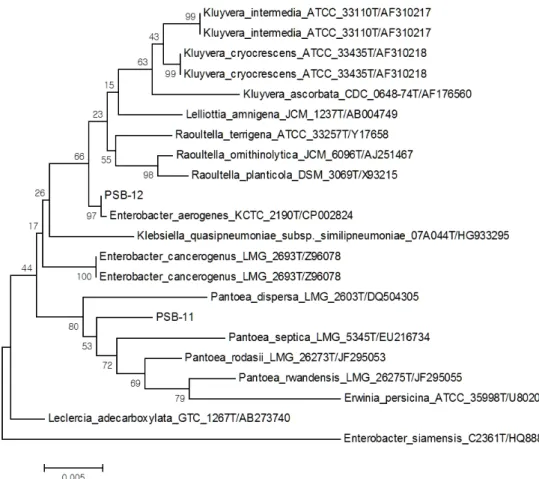
Fig. 1. Phylogenetic tree based on 16S rDNA gene sequences, showing the position of Pantoea rodasii (PSB-11) and Enterobacter aerogenes (PSB-12) strains with respect to related species. The scale bar indicates 0.02 substitutions per nucleotide position and accession numbers are given in parenthesis. The strains used in this study represent bold letters.

Results

Isolation and identification of bacterial strains Selected two bacterial strains (PSB-11 and PSB-12) had a marked insoluble phosphate solubilizing ability as visualized by the clear zone development around the colonies after 3 days of incubation. According to 16S rRNA sequence analysis, the strains were identified as Pantoea rodasii and Enterobacter aerogenes. Comparison of the 16S rRNA sequence among available strains of Pantoea and Enterobacter species showed high homology (>99.0%) to Pantoea rodasii DSM3493 and Enterobacter aerogenes R4183. Neighbor-joining method was employed to construct the phylogenetic tree which illustrates the relationships of 16S r RNA sequence of strain and other Pantoea and Enterobacter species (Fig. 1).

Phosphate solubilization under in vitro conditions Periodic changes of soluble phosphorus content which has been released from the Ca

3

(PO

4

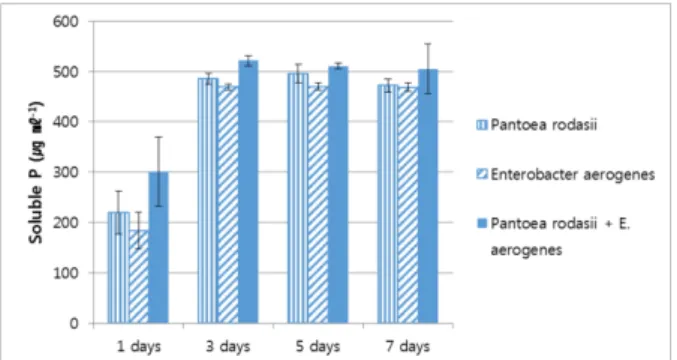
), pH of the culture and residual glucose content in NBRIP medium by single and co-inoculation of P. rodasii PSB-11 and E. aerogenes PSB-12 inoculants during 8 days of incubation are presented in Fig. 2, 3 and 4 respectively. Significant (P ≤0.05) increments in soluble phosphorous content were observed with PSBs Inoculation.

Co-inoculation of two strains was shown to release the

highest content of soluble phosphorus (521 µg ml

-1

) into the

medium and followed by single inoculation of P. rodasii and

E. aerogenes with 485 and 470 µg ml

-1

of soluble phosphorus,

respectively (Fig. 2). Although there was no significant

difference between single inoculation and co-inoculation of

bacterial strains in terms of phosphorous release, the results

clearly depict that co-inoculation enhanced phosphate solubili-

zation in the liquid culture medium. This is in agreement with

Bras and Nahas (2012) who observed similar trend of

phosphate solubilization with Burkholderia cepacea and

Aspergillus niger co-inoculated medium. The average phos-

phorous release of their experiment was recorded as 570 µg

ml

-1

for bacteria, 740 µg ml

-1

for fungi and 760 µg ml

-1

for the

co-culture at the end of the incubation period. Our results also

showed that the content of soluble phosphorus released by the

all inoculants in culture medium increased significantly during

the first 5 days of the incubation and then remained high for

further few days. The single and co-inoculation of P. rodasii and

E. aerogenes caused reduction in pH of the culture medium

(Fig. 3). In bacteria inoculated medium, the pH was reduced

from pH 7.0 to 3.74 after 3 days of incubation. In co-inoculated

medium, it was reduced to 3.42 after 3 days incubation. Both

single and co-inoculation showed negative correlation (P≤

(5)

Fig. 2. Effect of single and co-inoculation of Pantoea rodasii PSB-11 and Enterobacter aerogenes PSB-12 on phosphate solubilization.

Values given here are the means (n = 3) ± standard deviation.

Fig. 3. Effect of single and co-inoculation of Pantoea rodasii and Enterobacter aerogenes on pH change.

Values given here are the means (n = 3) ± standard deviation.

Fig. 4. Effect of single and co-inoculation of Pantoea rodasii PSB-11 and Enterobacter aerogenes PSB-12 on residual glucose content.

Values given here are the means (n = 3) ± standard deviation.

0.05) between soluble phosphorus content and pH in the culture medium. A similar strong negative correlation was observed between residual glucose content and phosphate solubilization. The glucose contents in E. aerogenes and the co-inoculation medium were consumed to 61.6% and 60.9%

levels after 5 days of incubation, respectively (Fig. 4).

Organic acid produced by PSBs The organic acid production by single and co-inoculation of P. rodasii and E.

aerogenes was evaluated with HPLC analysis. As shown in Table 1, gluconic acid was the major organic acid produced by both single and co-inoculated culture medium followed by oxalic acid and citric acid. However two bacterial strains was not capable for production of citric acids unlike other strains.

Similar to phosphate solubilization, no significant difference was observed in organic acid production between single inoculation of fungal strain and co-inoculation of fungal and bacterial strain. In agreement with this work, gluconic acid was the major organic acid produced by Burkholderia cepacia DA23 (Song et al., 2008) Burkholderia cepacia CC-A174 (Lin et al., 2006) Aspergillus flavus and Aspergillus niger (Maliha et al., 2004). Singh and Amberger (1991) reported the production of significant levels of glycolic acid, oxaloacetic acid, succinic acid, fumaric acid, malic acid, tartaric acid and citric acid by Aspergillus niger during the straw composting with rock phosphate. Organic acid production increased with the incubation period, reaching to the maximum at day 5.

Similarly, decrease in pH and glucose content, increase in soluble phosphorous content was observed during the same period. Therefore this inverse relationship between phosphate solubilization and organic acid production with pH suggested that production of organic acids played a significant role in the acidification of culture medium. Single inoculation of A.

awamori was shown to release the highest amount of organic acids compared to co-inoculation. This is evident from higher pH reduction and complete consumption of glucose content within 5 days of incubation. Therefore, organic acid production is not the sole factor responsible for phosphate solubilization as reported previously by Chen et al. (2006).

Growth and phosphorous uptake in green gram plants Increased shoot length, root length and shoot and root dry weight of green gram plants were recorded from the seedlings raised with the PSB inoculated seeds (Table 2). The best growth performances (32.2 cm, 33.5 cm, 3.46 g and 3.27 g plant

-1

respectively for shoot length, root length, shoot dry weight and root dry weight) were recorded from the plants co-inoculated with P. rodasii PSB-11 and E. aerogenes PSB-12 amended with TCP. Though addition of TCP resulted in better growth performances, no significant (P≤0.05) differences in shoot length, root length and shoot-root dry weight were observed between the soil treatments of with and without TCP (Table 2).

As shown in Table 3, P uptake of green gram plants showed

similar trend as the growth parameters. An increase in shoot P

uptake, root P uptake and total P uptake was observed in

plants inoculated with P. rodasii PSB-11 and E. aerogenes

PSB-12 or both strains. Moreover, TCP addition to the PSB

inoculated seeds significantly (P ≤0.05) increased the shoot

and root phosphorous uptake. Co-inoculation of PSB strains

with TCP further improved phosphorous uptake compared to

(6)

Table 1. Organic acids production by single and co-inoculation of Pantoea rodasii PSB-11 and Enterobacter aerogenes PSB-12.

Strains Organic acid composition ( ㎍ mL

-1

)*

Gluconic acid Oxalic acid Citric acid Malonic acid Malic acid Acetic acid

P. rodasii 6.67 0.44 0.28 o.46 ND ND

E. aerogenes 5.13 0.46 0.81 0.59 0.25 0.08

P. rodasii + E. aerogenes 4.26 0.47 0.77 0.51 0.48 0.10

Values given here are the means of three replicates (n=3). ND: Not Detectable

*Organic acid composition was evaluated by HPLC analysis after 5 days incubation.

Table 2. Effect of single and co-inoculation of Pantoea rodasii PSB-11 and Enterobacter aerogenes PSB-12 on growth of green gram plants.

Treatment Shoot length

(cm Plant

-1

)

Root length (cm Plant

-1

)

Shoot dry matter (g Plant

-1

)

Root dry matter (g Plant

-1

)

Control + TCP 30.4

a

±1.74 31.32

a

±1.56 3.24

a

±1.43 3.03

a

±1.68

P. rodasii + TCP 31.83

bc

±1.92 32.03

ab

±1.92 3.39

bc

±1.65 3.14

bc

±1.49

E. aerogenes + TCP 31.79

bc

±2.13 31.92

ab

±2.24 3.34

bc

±1.71 3.10

bc

±1.63

PSB-11 + PSB-12 + TCP 32.2

c

±2.17 33.5

c

±2.19 3.46

c

±1.56 3.27

c

±1.97

Values are given as means±SD for triplicate samples (n=3). Within each column, means followed by same letter (s) are not significantly different at P ≤0.05. TCP: tricalcium phosphate.

Table 3. Effect of Pantoea rodasii PSB-11 and Enterobacter aerogenes PSB-12 on phosphorous uptake by green gram plants.

Treatment P content

in shoots (mg Plant

-1

)

P content in roots (mg Plant

-1

)

Total P uptake (mg Plant

-1

)

Soil + TCP 128.25

a

±1.57 42.66

a

±1.45 170.91

a

±3.97

Soil + PSB-11 + TCP 146.36

b

±2.32 59.35

b

±1.29 205.71

b

±4.52

Soil + PSB-12+ TCP 145.59

b

±2.54 58.46

b

±1.59 204.05

b

±3.89

Soil+PSB-11+ PSB-12+TCP 156.46

c

±2.61 63.65

bc

±1.12 218.11

bc

±4.13

Values are given as means±SD for triplicate samples (n=3). Within each column, means followed by same letter (s) are not significantly different at P ≤0.05. TCP: tricalcium phosphate.

single inoculation with any of the PSB strain and TCP incorporation. The maximum P uptake (156.46 and 63.65 mg plant

-1

respectively for shoot and root) was recorded from co-inoculated plants with TCP. There was no significant difference (P ≤0.05) between un-inoculated seeds treated with and without TCP. However, pH reduction in soil was found to be much lower than that of in the culture medium (Table 1), which could be due to the buffering nature of the soil used for the experiment. According to the plant growth promotion assay, both single and co-inoculation of PSB strains had significantly different effect on shoot and root growth when compared with un-inoculated seeds. Though no significant difference was observed in phosphate solubilization between fungi and co-culture medium, a significant difference in shoot and root length was observed between single and co-inoculation during plant growth promotion assay. This may be due to enhanced phosphorus nutrition and other plant growth promoting activities due to syngerstic action of the co-inoculated medium.

However, being short assessment period of the present study we recommend in engaging further works under field conditions

in order to test the suitability of the strains to be used as bio-inoculants.

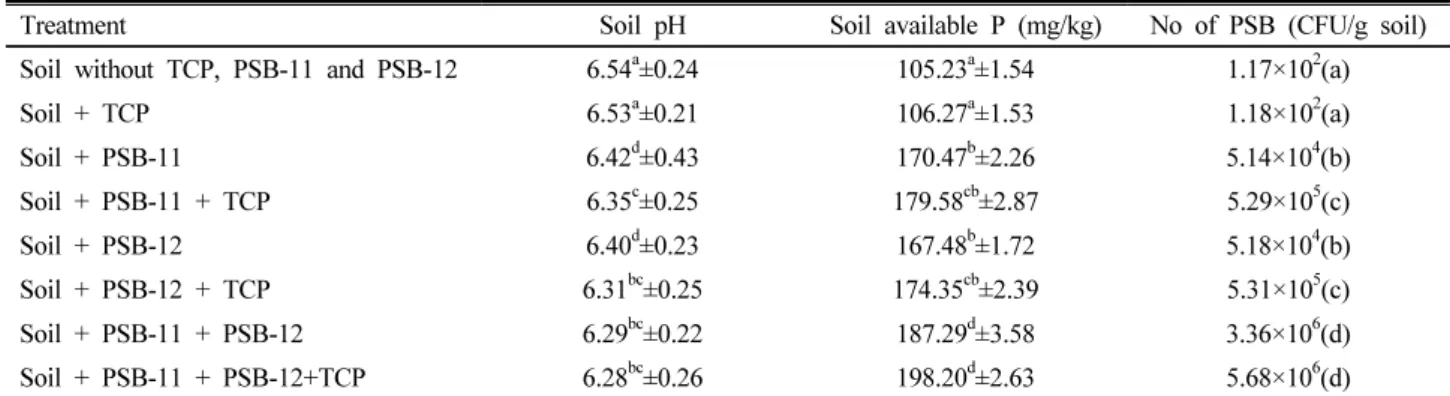
Changes in pH, available soil phosphorous and PSB

population Table 4 presented the effect of single and

co-inoculation of PSB strains on soil pH, available phosphorous

content and total PSB population. A significant decrease (P ≤

0.05) in soil pH was recorded from PSB inoculated soils than

the un-inoculated soils. However, no significant (P ≤0.05)

difference in soil pH was observed between single and

co-inoculated soils. Furthermore, the available phosphorous

content in rhizosphere soil inoculated either single PSB or

both strains were found to be significantly (P≤0.05) higher

than that of the un-inoculated soil. This was further enhanced

by the addition of TCP. The highest available phosphorous

content (198.20 mg kg

-1

soil) recorded from co-inoculation of

PSB strains with TCP was 1.8 times higher than that of the

un-inoculated soil. A remarkable increase in PSB population

was observed in PSB inoculated rhizosphere soil when compared

with un-inoculated soil. The highest PSB population (5.68×10

6

(7)

Table 4. Effect of Pantoea rodasii PSB-11 and Enterobacter aerogenes PSB-12 on soil pH, available phosphorous content and population of phosphate solubilizing bacteria in rhizosphere soil of green gram plants.

Treatment Soil pH Soil available P (mg/kg) No of PSB (CFU/g soil)

Soil without TCP, PSB-11 and PSB-12 6.54

a

±0.24 105.23

a

±1.54 1.17×10

2

(a)

Soil + TCP 6.53

a

±0.21 106.27

a

±1.53 1.18×10

2

(a)

Soil + PSB-11 6.42

d

±0.43 170.47

b

±2.26 5.14×10

4

(b)

Soil + PSB-11 + TCP 6.35

c

±0.25 179.58

cb

±2.87 5.29×10

5

(c)

Soil + PSB-12 6.40

d

±0.23 167.48

b

±1.72 5.18×10

4

(b)

Soil + PSB-12 + TCP 6.31

bc

±0.25 174.35

cb

±2.39 5.31×10

5

(c)

Soil + PSB-11 + PSB-12 6.29

bc

±0.22 187.29

d

±3.58 3.36×10

6

(d)

Soil + PSB-11 + PSB-12+TCP 6.28

bc

±0.26 198.20

d

±2.63 5.68×10

6

(d)

Values are given as means±SD for triplicate samples. Within each column, means followed by same letter (s) are not significantly different at P ≤0.05. TCP: tricalcium phosphate.

CFU g

-1

soil) recorded from co-inoculation of PSB strains with TCP was approximately 2 times higher than that of the un-inoculated soil. In conclusion, Significant (P≤0.05) increments in soluble phosphorous content, titratable acid production and microbial growth were observed with PSB inoculation. Significant reduction in pH of the PSB inoculated medium was also observed compared to the control where it remained constant. Co-inoculation of two PSB strains showed the highest phosphate solubilization when compared with single inoculation. A strong negative correlation between phosphate solubilization and pH, as well as a strong positive correlation between phosphate solubilization and microbial growth could also be observed.

Discussion

The phosphate solubilizing bacteria (PSB) was reported to solubilizing an insoluble phosphate complexes to reduce pH of the surroundings by releasing either organic acids or protons (Hariprasad and Niranjana, 2009). Organic acids such as gluconic acid, oxalic acid and citric acid etc., secreted by PSB can directly solubilize mineral phosphate as a result of anion exchange or indirectly can chelate both Fe and Al ions associated with phosphate. This leads to increase the supple- ment of available phosphorus to plants especially in soils with limited phosphorus (Tripura et al., 2005). Studies in liquid cultures revealed that phosphate solubilizing microorganisms increased the content of available phosphorus by solubilizing suspended tricalcium phosphate due to the release of organic acids into the surrounding medium (Gaur, 1990). Previous reports also described some Burkholderia and Pantoea strains as efficient phosphate solubilizers (Khalimi et al., 2012). In the present study, two efficient PSB strains (Pantoea rodasii PSB-11 and Enterobacter aerogenes PSB-12) which had a marked insoluble phosphate solubilizing ability were isolated and reaffirmed to be involved in the production of organic acids. The negative correlation between the pH and soluble

phosphorous content of the medium, as well as the positive correlation between soluble phosphorous content and titratable acid production suggested that acidification of the medium could facilitate the phosphate solubilization. Comparatively co-inoculation showed higher phosphate solubilizing ability than single inoculation, suggesting that both strains acted synergistically in phosphate solubilization. Yu et al. (2012) also found similar findings after inoculation of Pseudomonas chlororaphis and Bacillus megaterium.

Increase in growth and phosphorous uptake of several crop plants due to inoculation of PSB have also been reported in a number of studies conducted both under growth chamber and green house conditions (Vikram and Hamzehzarghani, 2008;

Hariprasad and Niranjana, 2009; Yu et al., 2011). The increase

in shoot length, root length, shoot dry weight and root dry

weight of greengram plants inoculated with PSB strains could

be attributed to a greater absorption of nutrients especially

phosphorous. Compared to the single inoculation, co-inoculation

showed higher growth performances and phosphorous uptake

suggesting that both strains acted synergistically with each

other in promoting greengram plant growth. However,

phosphate solubilization is not the only way of plant growth

promotion by PSB, because they facilitate the growth of plants

by stimulating the efficiency of producing plant hormones

such as auxins, cytokinins, gibberellins and some volatile

compounds also (Podile and Kishor, 2006). Therefore enhanced

plant growth after inoculation of PSB strains may be

attributed to the ability of strains to make phosphorous available

and to simultaneously produce plant growth promoting

substances (Khalid et al., 2004; Ali et al., 2010). The both

strains used in this study exhibited the capacity to produce

indoleacetic acid (data not shown) and therefore it might have

contributed to the enhanced shoot and root length. Similar

increase in growth and phosphorous uptake of greengram

plants due to inoculation of PSB strains was observed by

Ghanem and Abbas (2009), Ghanem and Abbas (2009) observed

increase in plant height, number of branches, number of pods,

(8)

grain weight and eventually higher seed and straw yields in greengram plants after inoculation of Bacillus megaterium in salt affected soils. The increased growth and phosphorous uptake have been reported from Azotobacter chroococum in wheat (Kumar et al., 2001), Pseudomonas fluorescens in peanut (Dey et al., 2004), Pseudomonas species and Bacillus cereus in walnut (Yu et al., 2011), and Paenibacillus polymyxa and Bacillus megaterium in tomato (EI-Yazeid and Abou-Aly, 2011). According to Fernandez et al. (2007), the shoot length of soybean plants was increased after inoculation of Burkholderia sp. PER2F by 40 and 60% when compared with un-inoculated soil/seed and un-inoculated soil/seed treated with soluble P, respectively.

Present results of maximum plant growth and phosphorous uptake recorded when co-inoculation of two PSB strains with TCP are in line with the findings of Qureshi et al. (2011), who also observed similar results when co-inoculated phosphate solubilizing and nodule forming bacteria Rhizobium phaseoli and Bacillus megaterium into green gram plants. In conclusion, the inoculation of two PSB-11 and PSB-12 into soil attributed to increase total available phosphorous in the soil by the production of organic acids and utilized by greengram plants.

Conclusions

This study has provided an evidence that two PSB strains (Pantoea rodasii PSB-11 and Enterobacter aerogenes PSB-12) have a significant effect both on phosphorus solubilization and promotionment of plant growth by lowering its pH along with the production of organic acids. Co-inoculation of two PSB strains could act synergistically with each other and were responsible for the increase in several growth parameters in comparison with the single inoculation. However, further studies should be continued under field conditions in confirming the present results to demonstrate their higher potential for use as soil inoculants to enhance soil fertility and plant growth.

References

Ali, B., A.N. Sabri, and S. Hasnain. 2010. Rhizobacteial potential to alter auxin content and growth of Vigna radiate (L.). World J. Microbiol. Biotech. 26:1379-1384.

Bras, R.R. and E. Nahas. 2012. Synergistic action of both Aspergillus niger and Burkholderia cepacea in co-culture increases phosphate solubilization in growth medium. FEMS Microbiol. Lett. 332:84-90.

Chen, Z., S. Ma, and L.L. Liu. 2008. Studies on phosphorus solubilizing activity of a strain of phospho bacteria isolated from chestnut type soil in China. Biores. Technol. 99:6702-6707.

Chen, Y.P., P.D. Rekha, A.B. Arun, F.T. Shen, W.A. Lai, and C.C. Young. 2006. Phosphate solubilizing bacteria from

subtropical soil and their tricalcium phosphate solubilizing abilities. Appl. Soil Ecol. 34:33-41.

Chaiharn, M. and S. Lumyong. (2009). Phosphate solubilization potential and stress tolerance of rhizobacteria from rice soil in Nothern Thailand. World J. Microbiol. Biotechnol. 25:305-314.

Dey, R., K.K. Pal, D.M. Bhatt, and S.M. Chauhan. 2004. Growth promotion and yield enhancement of peanut (Arachis hypogaea L.) by application of plant growth-promoting rhizobacteria.

Microbiol. Res. 159:371-394.

Edi-Premono, M.A. Moawad, and P.L.G. Vleck. 1996. Effect of phosphate solubilizing Pseudomonas putida on the growth of maize and its survival in the rhizosphere. Ind. J Crop Sci. 11, 13-23.

EI-Yazeid, A.A. and H.E. Abou-Aly. 2011. Enhancing growth, productivity and quality of tomato plants using phosphate solubilizing microorganisms. Australian J. Basic Appl. Sci. 5:

371-379.

Fernandez, L.A., P. Zalba, M.A. Gomez, and M.A. Sagardoy.

2007. Phosphate solubilization activity of bacterial strains in soil and their effect on soybean growth under greenhouse conditions. Biol. Fert. Soils. 43:805-809.

Frossard, E., L.M. Condron, A. Oberson, S. Sinaj, and J.C.

Fardeau. 2000. Processes governing phosphorus availability in temperate soils. J. Environ. Qual. 29:12-53.

Ghanem, K.H.M. and E. E. Abbas. 2009. Improvement of mung bean growth and productivity in salinity-affected soil after seed inoculation with phosphate-dissolving bacteria. African Crop Science Conference Proceedings 9:385-389.

Gaur, A.C. 1990. Phosphate solubilizing microorganisms as biofertilizers. Omega Scientific Publishers, New Delhi, India.

Hameeda, B., G. Harini, O.P. Rupela, S.P. Wani, and G. Reddy.

2006. Growth promotion of maize by phosphate solubilizing bacteria isolated from composts and macrofauna. Microbiol.

Res. 163:234-242.

Hariprasad, P. and S.R. Niranjana. 2009. Isolation and characteri- zation of phosphate solubilizing rhizobacteria to improve plant health of tomato. Plant and Soil 316:13-24.

Jackson, M.L. 1973. Soil Chemical Analysis. Prentice-Hall of India Pvt. Ltd., New Delhi, India.

Khalid, A., M. Arshad, and Z.A. Zahir. 2004. Screening plant growth promoting rhizobacteria for improving growth and yield of wheat. J. Appl. Microbiol. 96:473-480.

Khalimi, K., D.N. Suprapta, and Y. Nitta. 2012. Effect of Pantoea agglomerans on growth promotion and yield of rice. Agri. Sci.

Res. J. 2:240-249.

Khan, M.S., A. Zaidi, P. Wani. (2007). Role of phosphate solubilizing microorganisms in sustainable agriculture-A review.

Agron. Sustain. Develop. 27:29-43.

Kumar, S., K. Tamura, I.B. Jakobsen, and M. Nei. 2001. MEGA2:

molecular evolutionary genetics analysis software. Bioinformatics 17:1244-1245.

Kumar, V., R.K. Behi, and N. Narula. 2001. Establishment of

(9)

phosphate solubilizing strains of Azotobacter chroococcum in the rhizosphere and their effect on wheat cultivars under green house conditions. Microbiol. Res. 156:87-93.

Lin, T.F., H.I. Huang, F.T. Shen, and C.C. Young. 2006. The protons of gluconic acid are the major factor responsible for the dissolution of tricalcium phosphate by Burkholderia cepacia CC-A174. Biores. Technol. 97:957-960.

Maliha, R., K. Samina, A. Najma, A. Sadia, and L. Farooq. 2004.

Organic acids production and phosphate solubilization by phosphate solubilizing microorganisms under in vitro conditions.

Pakistan J. Biol. Sci. 7:187-196.

Miller, G.L. 1959. Use of dinitrosalicylic acid reagent for determination of reducing sugar. Anal. Chem. 31:426-428.

Mundra, S., R. Arora, and T. Stobdan. 2011. Solubilization of insoluble inorganic phosphates by a novel temperature, pH, and salt tolerant yeast, Rhodotorula sp. PS4, isolated from seabuckthorn rhizosphere, growing in cold desert of Ladakh, India. World J. Microbiol. Technol. 27:2387-2396.

Nautiyal, C.S. 1999. An efficient microbiological growth medium for screening phosphate solubilizing microorganisms. FEMS Microbiol. Lett. 170:265-270.

Podile, A.R. and G.K. Kishor. 2006. Plant growth promoting rhizobacteria. In: Plant associated bacteria. pp. 195-230.

Gnanamanickam, S.S (eds.). Springer, Dordrecht.

Ponmurugan, P. and C. Gopi. 2006. In vitro production of growth regulators of phosphatase activity by phosphate solubilizing bacteria. Afr. J. Biotechnol. 5:348-350.

Qureshi, M.A., M.A. Shakir, A. Iqbal, N. Akhtar, and A. Khan.

2011. Co-inoculation of phosphate solubilizing bacteria and rhizobia for improving growth and yield of mung bean (Vigna radiate L.). J. Animal Plant Sci. 21:491-497.

Rangarajan, S., L.M. Saleena, P. Vasudevan, and S. Nair. (2003).

Biological suppression of rice disease by Pseudomonas sp.

under saline soil condition. Plant Soil. 251:73-82.

Reyes, I., L. Bernier, and H. Antoun. 2002. Rock phosphate solubilization and colonization of maize rhizosphere by wild and genetically modified strains of Penicillium rugulosum.

Microbial Ecol. 44:39-48.

SAS. 1999. SAS/STAT User's Guide Version 8. SAS, Cary, NC.

Saitou, N. and M. Nei. 1987. The neighbor-joining method: a new method for reconstructing phylogenetic trees. Mol. Biol.

Evol. 4:406-425.

Singh, C.P. and A. Amberger. 1991. Solubilization and availability

of phosphorous during decomposition of rock phosphate enriched straw and urine. Biol. Agric. Hortic. 7:1-269.

Song, O.R., S.J. Lee, Y.S. Lee, S.C. Lee, K.K. Kim, and Y.L.

Choi. 2008. Solubilization of insoluble inorganic phosphate by Burkholderia cepacia DA 23 isolated from cultivated soil.

Brazil J. Microbiol. 39:151-156.

Suri, V.K., A.K. Choudhary, C. Girish, T.S. Verma, M.K. Gupta, and N. Dutt. 2011. Improving Phosphorus Use through Co- inoculation of Vesicular Arbuscular Mycorrhizal Fungi and Phosphate-Solubilizing Bacteria in Maize in an Acidic Alfisol.

Commun. Soil Sci. Plan. 42:2265-2273.

Sylvia, D.M., P.G. Hartel, J.J. Fuhrmann, and D.A. Zuberer.

2005. Principles and applications of soil microbiology. Pearson prentice hall. Englewood Cliffs, NJ.

Tripura, C.B., B. Sashidhar, A.R., Podile. (2005). Transgenic mineral phosphate solubilizing bacteria for improved agricultural productivity. In: T. Satyanarayana and B.N. Johri (eds.) Microbial Diversity Current Perspectives and Potential Applications New Delhi, India. I. K. International Pvt. Ltd. pp.

375-392.

Thompson, J.D., T.J. Gibson, F. Plewniak, F. Jeanmougin, and D.G. Higgins. 1997. The clustal x windows interface: flexible strategies for multiple sequence alignment aided by quality analysis tools. Nucleic Acids Res. 25:4876-4882.

Urphy, J. and J.P. Riley. 1962. A modified single solution method for the determination of phosphate in natural waters. Anal.

Chem. Acta. 27:31-36.

Vikram, A. and H. Hamzehzarghani. 2008. Effect of phosphate solubilizing bacteria on nodulation and growth parameters of green gram (Vigna radiate L. Wilchek). Res. J. Microbiol.

3:62-72.

Walpola B.C. and M.H. Yoon. 2013. Phosphate solubilizing bacteria: Isolation and assess their effect on growth promotion and phosphorous uptake of green gram plants (Vigna radiata [L.] R. Wilczek). Chillenean J. Agri. Res. 73:275-281 Yu, X., X. Liu, T.H. Zhu, G.H. Liu, and C. Mao. 2011. Isolation

and characterization of phosphate solubilizing bacteria from walnut and their effect on growth and phosphorus mobilization.

Biol. Fert. Soils. 47:437-446.

Zaidi, A., M.S. Khan, and M. Amil. 2003. Interactive effect of

rhizotrophic microorganisms on yield and nutrient uptake of

chickpea (Cicer arietinum L.). Eur. J. Agron. 9:15-21.

수치

Fig. 1. Phylogenetic tree based on 16S rDNA gene sequences, showing the position of Pantoea rodasii (PSB-11) and Enterobacter  aerogenes (PSB-12) strains with respect to related species
Fig. 2. Effect of single and co-inoculation of Pantoea rodasii  PSB-11 and Enterobacter aerogenes PSB-12 on phosphate  solubilization
Table 1. Organic acids production by single and co-inoculation of Pantoea rodasii PSB-11 and Enterobacter aerogenes PSB-12.
Table 4. Effect of Pantoea rodasii PSB-11 and Enterobacter aerogenes PSB-12 on soil pH, available phosphorous content and  population of phosphate solubilizing bacteria in rhizosphere soil of green gram plants.

참조

관련 문서

The purpose of this study was to analyse effect of primer solution on degree of conversion two-step self-etch adhesive with a Fourier transform infrared

In this study, two experiments were conducted to understand the effects of additional charge on the detailed growth mechanism of Alq 3 and to determine the effect of

4 > Effects of Taro on COX-2 expression and iNOS expression(hot water) in human thyroid cancer cells. The cells were pretreated for 48hours with either

Probiotic properties of lactic acid bacteria isolated from mukeunji, a long-term ripened kimchi. Journal of Food

Borgerdi ng는 struvi te의 용해도는 pH가 증가하면 감소하므로,struvi te의 생성 효율을 높이기 위해서는 pH가 8.. Effect Effect Effect of Effect of of of pH pH pH pH on on

The obligate methanotrophic bacteria Methylococcus, Methylomonas, Methylosinus and related bacteria. Schleifer

Effect of mulberry leaf powder containing the lactic acid bacteria on body weight gain, food intake and food efficiency ratio in a constipation model

Effect of electric current on the microstructure and mechanical properties of hard-to-sinter materials with high melting point.. Effect of electric current on the