KISEP Original Article
생생생생물물물물 정신의학정신의학정신의학정신의학Vol. 11, No. 1, June 2004
알코올 금단과 혈중 아질산염 농도
이병철
*
·손현균*
·최인근*†
Alcohol Withdrawal and Serum Nitrite Concentration
Boung Chul Lee, M.D., * Hyun-Gyun Son, M.D., Ph.D., * Ihn-Geun Choi, M.D., Ph.D. *
†bjective :Nitric oxide(NO) has been known to be associated with tolerance and preference to alcohol. It has also been known to affect various alcohol drinking behavior, alcohol withdrawal symptoms and al- cohol-induced brain damage. The purpose of this study was to determine the difference, among alcohol dependence group, alcohol drinking group and abstinence group, in serum concentration of nitrite, a stable metabolite of NO, and it's relationship to clinical and biochemical markers of alcoholism.
Methods :Forty subjects diagnosed as alcohol dependence according to DSM-IV diagnostic criteria were evaluated for the clinical characteristics and biochemical markers of alcohol dependence including nitrite with their CIWA-Ar scores checked just after admission. Thirty-nine healthy controls were also evaluated, divided into twenty-three alcohol drinking group and sixteen abstinence group. Clinical characteristics were evaluated by CIWA-Ar, CAGE and AUDIT questionnaires. Aspartate aminotransferase(AST), alanine aminotransferase (ALT), gamma glutamyltransferase(GGT) and mean corpuscular volume(MCV) were used as the biochemical markers of alcohol dependence. Serum nitrite concentrations were measured by Griess reaction.
Results :1) The concentrations of nitrite in alcohol dependence patients were not different from those in the control subjects. 2) There were no significant association between the nitrite concentrations and the CIWA- Ar scores in alcohol dependence patients. 3) Nitrites are significantly increased in alcohol dependence group and alcohol drinking group compared with abstinence group.
Conclusions :These findings suggest that serum nitrite concentration has no relation with alcohol withdra- wal symptoms, but alcohol drinking increases serum nitrite concentration influenced by general condition of the body.
KEY WORDS :Alcohol dependence・Nitric oxide(NO)・Nitrite・Alcohol withdrawal・Alcohol drinking.
서 론
산화 질소(Nitric oxide, 이하 NO)는 3가지 isoform
(내피[eNOS], 유발가능[iNOS], 신경세포[nNOS] )의 산화 질소 합성효소(nitric oxide synthase, 이하 NOS) 에 의해 생성되며 체내에서 혈류 조절, 신체 방어, 신경
O
ABSTRACT
*
한림대학교 의과대학 한강성심병원 정신과학교실
Department of Neuropsychiatry, Hangang Sacred Heart Hospital, Hallym University, Seoul, Korea
†
교신저자:최인근, 150-719 서울 영등포구 영등포동 94-200
전화)(02) 2639-5461, 전송)(02) 2677-9095 E-mail) [email protected]
신호 전달 등의 작용에 관여하는 핵심 신호전달물질이 다.
1)즉, NO는 acetylcholine과 bradykinin에 대한 반응 으로 혈관 내피 세포에서 분비되어 혈관 평활근을 이완시 켜 혈관 확장을 일으키는 Endothelial-derived relaxing substance(EDRF)로 작용하며,
2)모든 포유류 유핵 세포 에서 면역학적 자극에 따라 생성된 많은 양의 NO는 암 세 포나 세포 내외의 미생물에 대해 주요 방어 기제로 작용 한다.
3)이러한 NO는 과량에서 혈관성 쇽, 뇌졸중, 당뇨, 신경 퇴화, 관절염, 만성 염증 등의 병태생리학적인 기전 에 기여를 한다고 알려져 있다.
NO는 뇌에서 신경 형태 형성을 조절하는 기능, 시냅스 의 유연성을 조절하는 기능, 신경전달물질 분비를 조절하 는 기능, 성적 행동과 공격적 행동을 조절하는 기능이 있 고, 학습 및 기억과 관련된 장기 상승작용(long-term po- tentiation, LTP)에도 중요한 역할을 하며,
4)noradren- aline, dopamine, glutamate의 분비와 재흡수를 조절하 는 역할과 NMDA 수용체 자극 이후 역행 신경세포 전령 의 역할을 하는 기능
5)이 있다는 것도 밝혀졌다. NO는 알 코올과도 깊은 관련이 있어서 Baraona 등
6)은 알코올에 노출되지 않았던 쥐에게 급성으로 알코올을 투여하면 혈 장내 NO가 63%까지 증가된다고 하였고, Fitzgerald 등
7)은 만성적인 알코올 섭취가 쥐의 전두-두정엽 피질, 해 마, 줄무늬체에서 nNOS의 감소를 일으키고 측 중격핵 에서는 증가를 일으킨다고 하였다. 임상적으로도 간경화 환자는 NO 생성이 증가되어 있으며,
8)알코올성 간질환 이 있는 환자의 혈청 질산염(nitrate)의 농도가 정상 대 조군보다 높고, 아질산염(nitrite)의 농도는 문맥 고혈압 및 복수의 존재와 관련이 있다.
9)10)반면에 Persson과 Gustafsson
11)은 오히려 알코올이 NO 생성을 억제한다 는 보고를 하기도 했으며, Neiman 등
12)은 제독된 알코올 의존 환자군의 뇌척수액에서 질산염과 아질산염의 농도 가 정상 대조군에서의 결과와 차이가 없다고 보고한 바 있고, 다른 연구에서는 제독된 알코올 의존 환자의 말초 혈액에서 아질산염 농도가 알코올 의존 환자군의 말초 혈액에 비해 증가되지 않았다는 결과를 보였다.
13)NO를 생성하는 NOS의 활동성도 알코올 중독과 깊은 관련이 있는데, 동물실험 결과 NOS 억제제는 과활동, 진 전, 경직 등으로 나타나는 알코올 금단 증상을 감소시키 고 NO 제공자(donor)를 금단 기간 중에 사용할 경우 금 단 증상이 더 악화되는 것으로 확인됐다.
14)또한, NOS 의 억제가 알코올로 인해 나타나는 협동운동부전(motor
incoordination)에 대한 급속 내성을 막기도 하고,
15)알 코올에 의한 마취를 NOS 억제제가 강화하고 NO 제공자 가 저해한다는 보고
16)도 있다. NO는 반응성이 크고 매우 불안정한 자유기이므로 NO 자체의 농도를 측정할 수는 없고, 혈액 내에서 혈색소와 반응하여 형성한 질산염(nit- rate)과 아질산염(nitrite)의 농도가 NO의 농도를 반영 한다.
17)따라서, 본 연구에서는 NO가 알코올의 금단 증 상의 정도에 영향을 미친다는 여러 연구 결과
13)14)와, 아 질산염 농도가 알코올 금단 기간에 반비례한다는 연구 결과
13)를 바탕으로 음주력이 아질산염 농도와 관계가 있을 것이라는 가설을 세우고 이를 확인하고자 하였다.
연구대상 및 방법
1. 연구대상
1) 알코올 의존 환자군
2001년 1월부터 2002년 5월까지 한림대학교 한강 성심병원 신경정신과 폐쇄 병동에 입원한 18~65세 사 이의 남자 환자 중 DSM-IV의 알코올 의존 진단 기준
18)을 충족시키는 환자를 대상으로 입원 직후에 연구자가 직 접 면담을 통하여 CAGE 설문
19)과 Alcohol Use Disor- ders Identification Test(AUDIT) 설문
20)을 통해 알코 올 의존 정도를 평가하고 Clinical Institute Withdrawal Assessment for Alcohol(CIWA-Ar) 설문
21)을 시행 하여 금단 증상의 정도를 객관화, 정량화하였다. 혈중 NO 활성도에 영향을 주는 약물을 복용하고 있거나 염증성 질 환이 있는 경우, 빈혈 등 혈색소의 수준에 영향을 미치는 혈액학적 질환이 있는 경우, 알코올 이외의 다른 물질 의 존 병력이 검사전 3개월 이내에 있는 경우, 검사전 6개 월 이내에 만성 신체적 질병이나 주요 정신과적 질환이 있는 경우는 제외한 40명을 대상으로 하였다.
2) 정상 대조군
대조군의 선정은 한림대학교 한강성심병원 건강검진센
터에 신체검사를 받으러 온 18~65세 사이의 사람 중 신
체적 질병이 없고 약물 복용을 하지 않으며 알코올 의존
의 병력이 없으면서, 최근 3개월간 다른 물질의존병력이
없고, 검사전 6개월 이내에 주요 정신질환의 병력이 없는
남자를 대상으로 CAGE와 AUDIT를 실시하여 CAGE
점수 2점 미만이고 AUDIT 점수 10점 미만 4점 이상인
정상 음주자 23명과 CAGE 점수 2점 미만이고 AUDIT 점수 4점 미만인 비음주자 16명으로 구분하여 연구 대 상으로 하였다.
2. 생화학적 지표 및 혈중 아질산염의 측정
알코올 의존 환자는 입원 다음날 아침 공복 상태에서, 정상 대조군은 검사일 아침 공복 상태에서 상완 정맥혈을 5cc 채취한 후 1,500rpm에서 7분간 원심분리하여 혈 청 2cc를 -80℃에 보관하였다가 아질산염 농도를 측정 하였고, 혈청 Aspartate aminotransferase(AST), Ala- nine aminotransferase(ALT), Gamma glutamyltrans- ferase(GGT) 농도는 Hitachi 736 자동분석기로, Com- plete blood count(CBC)는 Technicon H-2 혈구 자 동분석기로 측정하였다.
아질산염 농도는 Griess 반응
22)을 이용하여 혈장 내에 서 측정하였으며 구체적인 방법은 다음과 같다.
1) 냉동 보관했던 혈청을 녹여서 그중 6μl를 취한 후 44μl의 증류수와 혼합한다.
2) 여기에 0.31M, pH 7.5의 인산염 완충액 20ul를 혼합한 후 0.86mM NADPH 10μl와 0.11mM FAD 10μl, 질산염 환원효소(1.0U/ml) 10μl를 차례로 혼합 한 후 상온의 암실에서 1시간 동안 보온한다.
3) 2)에 Griess 반응액 200μl을 혼합한 후 상온에 서 10분간 더 보온한다.
4) Enzyme linked immunosorbent assay(ELISA) 판독기로 540nm에서 농도를 측정한다.
3. 자료 분석
알코올 의존 환자군과 정상 대조군 사이의 일반적인 특
성과 알코올 관련 생화학적 지표 비교는 Student t-test 를, 아질산염과 다른 지표들 사이의 연관성에 대해서는 Pearson 상관 분석을 실시하였다. 알코올 의존 환자군과 음주군, 비음주군의 비교는 ANOVA를 시행하였다. 유의 성 검증은 유의 수준 0.05 미만으로 하였으며, 통계 분 석은 SPSS(version 11.0)를 이용하였다.
결 과
1. 연구 대상의 인구학적인 특성
알코올 의존 환자군은 40명, 정상 대조군 39명이었다.
두 군 사이에 연령 차이는 없었으며(p=0.660), 교육 연 한에도 차이가 없었고(p=0.711), 처음 음주를 시작한 나이에도 차이가 없었다(p=0.324)(표 1).
2. 알코올 관련 지표
두 군 사이에 CAGE 점수와 AUDIT 점수는 유의하 게 차이가 있었다(p<0.000)(표 2).
3. 생화학적 지표 비교
두 군 사이의 AST, ALT, GGT, Mean corpuscular volume(MCV), 아질산염의 검사 결과는 표 3과 같다.
AST는 알코올 의존 환자군이 139.85±168.50(IU/l) 으로 정상 대조군의 24.13±6.38(IU/l)보다 유의하게 높 았으며(p=0.000), ALT도 알코올 의존 환자군이 59.63
±55.20(IU/l)으로 정상 대조군의 29.87±14.98(IU/l) 보다 유의하게 높았다(p=0.002). 또한 GGT도 알코올 의존 환자군이 313.08±417.85(IU/l)로 정상 대조군 의 23.79±12.04(IU/l)보다 유의하게 높았다(p=0.000).
Table 2. Clinical characteristics of alcohol dependence patients and normal controls Alcohol dependence patients(n=40) Normal controls(n=39) Variables
Mean±SD Mean±SD p-value*
CAGE(scores) 03.98±0.16 0.33±0.48 0.000
AUDIT(scores) 33.55±5.45 4.03±3.13 0.000
*:Student’s t-test
Table 1. Demographic characteristics of alcohol de-pendence patients and normal controls Alcohol dependence patients(n=40) Normal controls(n=39) Variables
Mean±SD Mean±SD p-value*
Age(years) 47.53±10.7 46.6±7.2 0.660 Education(years) 11.80±02.6 12.0±2.1 0.711 First drink(years-of-age) 19.30±02.1 19.7±1.8 0.324
*:Student t-test
MCV도 알코올 의존 환자군이 98.11±8.54(IU/l)로 정 상 대조군의 93.13±3.93(IU/l)보다 유의하게 높았다 (p=0.001). 그러나, 아질산염 농도는 알코올 의존 환자 군과 정상 대조군 사이에 유의한 차이가 없었다(p=0.464).
4. 혈청 아질산염과 다른 지표와의 상관관계
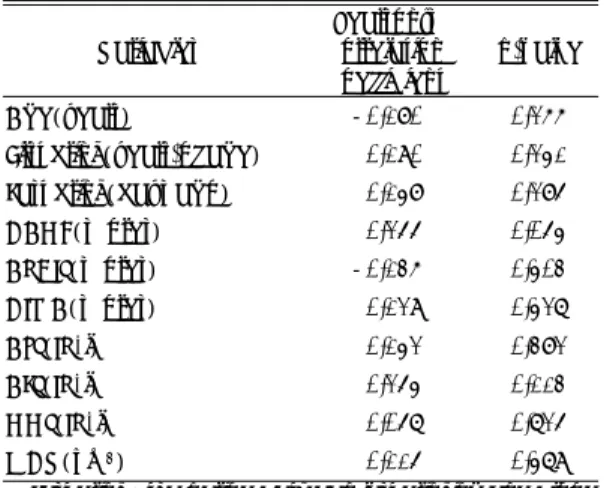
알코올 의존 환자군을 대상으로 한 혈청 아질산염과 나 이, 금주 기간, 음주를 시작한 나이, CAGE, AUDIT, CI- WA-Ar, AST, ALT, GGT 등 다른 변수들과 아질산염 농도 사이에서는 유의한 상관 관계를 보이지 않았다(표 4).
5. 각 군에서 혈청 아질산염 농도
대조군을 AUDIT 점수에 따라 음주자(AUDIT 점수 가 4~9점), 비음주자(AUDIT 점수가 3점 이하)로 나 누고 이를 알코올 의존 환자와 비교해 본 결과 비음주 자들은 음주자 및 알코올 의존 환자들에 비해 유의하게 아질산염 농도가 낮은 것으로 나타났으며(p=0.003)(표
5), Bonferroni 사후 검증 결과에서도 비음주자들과 음 주자는 아질산염 농도가 다른 것으로 나타났다(표 6).
고 찰
NO에 대한 연구는 최근 가장 활발히 진행되는 분야 중의 하나이다. 과거에 NOS 억제제 주입 후 효과를 비 교한다거나 조직에서 이차 전달자를 측정하는 등의 방법 들을 거쳐 현재는 가스 분광기/질량 분광 계측기를 사용 하여 아질산염과 질산염을 측정함으로써 내인성 NO 생 성을 측정하고
22)각 NOS에 특징적인 mRNA를 측정하 는 수준까지 와 있고 현재 각 NOS에 대한 선택적 억제 제가 연구 중이다.
NO의 역할에 대해서는 많은 연구가 진행되었는데, 그 Table 4. Correlation between the variables and serum
nitrite concentrations of subjects Variables
Pearson’s correlation coefficient
p-value
Age(years) -0.180 0.266
First drink(years-of age) -0.190 0.241 Last drink(days ago) -0.148 0.285
CAGE(scores) -0.255 0.054
AUDIT(scores) -0.136 0.403
CIWA(scores) -0.129 0.427
AST(IU/l) -0.142 0.382
ALT(IU/l) -0.254 0.113
GGT(IU/l) -0.057 0.725
MCV(um
3) -0.115 0.479
Last drink:the period between last drinking and blood sampling
Table 3. Biochemical characteristics of alcohol dependence patients and normal controls Alcohol dependence patients(n=40) Normal controls(n=39) Variables
Mean±SD Mean±SD p-value*
AST(IU/l) 139.85±168.50 24.130±06.38 0.000
ALT(IU/l) 059.63±055.20 29.870±14.98 0.002
GGT(IU/l) 313.08±417.85 23.790±12.04 0.000
MCV(um
3) 098.11±008.54 93.130±03.93 0.001
Nitrite(umol/l) 05.086±003.64 05.677±03.50 0.464
*:Student’s t-test, AST:aspartate aminotransferase, ALT:alanine aminotrasferase, GGT:gamma-glutam- yltransferase, MCV:mean corpuscular volume
Table 5. Serum nitrite concentrations among alcohol dependence patients, alcohol-drinking and absta-ining normal controls
Alcohol dependence patients(n=40)
Alcohol-drinking normal controls
(n=23)
Abstaining Normal controls(n=16) 5.08±3.64 7.22±3.48 3.46±2.10
*:ANOVA, F(test statistics)=6.29, df(degree of free- dom)=78, p=0.003, Values are mean±SD
Table 6. Bonferroni post hoc tests (I)Exp.group (J)Exp.group
Mean difference
(I-J)
Std.Error Sig.
Drinking -2.133 0.8740 .051 Dependence
Abstaining -1.626 0.9879 .312 Dependence -2.133 0.8740 .051 Drinking
Abstaining -3.759* 1.0873 .003 Dependence -1.626 0.9879 .312 Abstaining
Drinking -3.759* 1.0873 .003
*:The mean difference is significant at the .05 level
역할이 병적인 진행인지 아니면 그에 대한 신체의 보상 기전인지는 아직 확실치가 않다. Sanchez-Rodriguez 등
23)은 간경화 환자에서 lympho-mononuclear cell에 있는 iNOS가 활성화되어 증가된 NO가 혈역학적 장애를 가져온다고 하였고, Hunt 등
24)은 단핵 세포에서 나온 NO 가 알코올성 간질환 환자에서 증가되어 있고 이것이 간 손상에 중요한 역할을 한다고 설명하였다. 반면에 Yagnik 등
25)은 간에서 NO 생성이 endotoxemia로 인한 간 손상 시 산소 자유기로 인한 조직의 손상을 막아주고 간의 미 세순환을 유지해 주는 역할을 하기도 해 NO 생성 억제 제 사용시 간이식 환자들에서 간손상이 악화된다고 보고 했고, 동물 실험에서는 알코올로 인한 NO 생성 억제가 세포 증식에 장애를 가져온다는 연구도 있었다.
26)이번 연구에서 알코올 의존 환자와 정상 대조군 사이에 아질산염 농도의 차이가 유의하지 않았으나 음주군에서는 비음주군에 비해 유의하게 높은 아질산염 농도를 보였 다. 알코올 의존 환자와 정상 대조군 사이에서 차이를 보이지 않은 것은 정상 대조군에 포함된 음주군에서 아 질산염 농도가 높기 때문이다. 이전 연구들
6)9)10) 27)에서 알코올 의존 환자와 정상 대조군 사이에서 아질산염 농 도의 차이를 보이지 않은 것도 같은 이유 때문이라고 생각된다.
한편 알코올 의존 환자들은 금단 상태에서 오히려 정 상 음주군보다 유의하지 않으나 다소 낮은 아질산염 농 도를 보였다. 또한 알코올 금단 증상의 정도와 아질산염 농도는 관계가 없는 것으로 나타났다. 알코올 의존 환자 에서 음주군에 비해 낮은 아질산염 농도가 나온 이유는 급성기와 만성기에서의 알코올과 NO의 관계를 생각해 보면 설명할 수 있을 것이다. 알코올이 급성기에 NO를 증가시킨다는 연구들이 있는 반면에, 동물 실험에서 만 성적인 알코올 주입시 쥐의 쿠퍼 세포에서 지질다당질(li- popolysaccharide)로 인해 유발되는 iNOS의 생성이 대 조군보다 저하되고 이로 인한 NO 생성의 감소가 쿠퍼 세포의 포식 작용을 저하시켜 알코올로 인한 암 발생율 을 증가시킬 것이라는 연구
28)도 있다. 또한 같은 양의 지질다당질로 자극할 때 급성으로 4주 정도 알코올로 처 치하면 쿠퍼 세포의 활동성을 나타내는 세포내의 칼슘 농 도나 TNF-α의 분비가 유의하게 증가하나 12주 정도 로 만성적인 알코올 처치 상태가 되면 그 감수성이 떨어 져 세포내 칼슘 농도나 TNF-α의 분비가 감소하게 된다 는 보고
29)도 있다. 이렇게 감소하는 TNF-α는 IFN-γ
를 통해 활성화된 NO 생성 경로를 실질적으로 작동하게 하는 역할을 하며 이에 가장 주된 역할을 하는 세포가 간 의 쿠퍼 세포라고 생각된다.
30)Durante 등
31)은 평활 근 육 세포에서 iNOS의 mRNA가 IL-1b에 의해 자극되는 실험을 하면서 25mM 정도의 낮은 알코올은 mRNA 생 성을 증가시키는 반면에 650mM의 고농도에서는 mRNA 생성이 억제되는 것을 밝혀냈고 이로서 이전에 알코올이 적절하게 사용될 경우에는 심혈관계 질환의 발생을 억제 하는 효과가 있으나 만성적인 알코올 남용은 심혈관계 질환을 증가시킨다는 다른 연구들을 설명해 냈다. 한편 Syapin
32)은 만성적인 알코올 처치는 대뇌 피질 세포에서 NMDA에 의해 자극된 NO 생성을 강화시키지만 신경아 교 세포에서 cytokine으로 유도된 NO 생성을 보다 효과 적으로 억제한다고 밝혔다.
이렇듯 알코올의 만성적인 사용은 iNOS의 감소, NO 를 활성화시키는 cytokine의 감소를 통해 NO 생성을 억 제할 수 있다.
31)또한 알코올은 항체 반응 세포와 내피 세 포에서 iNOS를 감소시키고 eNOS를 증가시키는데,
33)증가된 eNOS에도 불구하고 NO의 농도는 감소된 것이 확인됐다.
34)이는 eNOS의 증가가 알코올로 인한 산화 스트레스를 극복하기 위한 생체의 요구로 생각되었다.
위의 연구들을 종합하여 볼 때 NO는 음주를 하는 사 람들에서 전반적으로 증가되어 있는 소견을 보이나 이 것이 금단 증상의 정도와는 관계가 없는 것으로 보인다.
알코올 의존 환자의 금단 상태에서 음주군에 비해 NO 농도가 떨어져 있는 소견을 보이나, 이것이 알코올 의존 환자에서 산화 스트레스를 막기 위해 NO가 사용된 결 과인지, 혹은 알코올 의존 환자의 면역학적인 변화 등의 신체 변화 때문인지는 향후 연구가 필요할 것으로 생각 된다.
결 론
NO는 알코올에 대한 내성, 선호도, 섭취 행동과 관련
이 있으며 알코올로 인한 금단 증상과 뇌 손상에도 영
향을 미치는 물질로 알려져 있다. 본 연구는 알코올 의
존 환자와 정상 대조군 사이에서 NO의 안정적인 대사
산물인 말초혈액 아질산염의 농도를 측정하여 비교하고
알코올 의존 환자군에서 아질산염 농도와 알코올 의존
의 다른 생화학적 지표인 aspartate aminotransferase
(AST), alanine aminotransferase(ALT), gamma-
glutamyltransferase(GGT), mean corpuscular volume (MCV) 등과의 상관 관계와 CAGE, AUDIT, CIWA- Ar, 마지막 음주 후의 시간 등 알코올 관련 지표들과의 상관 관계를 알아보고자 연구를 시행하여 다음과 같은 결과를 얻었다.
1) 알코올 의존 환자와 정상 대조군에서 말초 혈액 아 질산염 농도는 유의한 차이가 없었다.
2) 알코올 의존 환자에서 금단 증상의 정도와 말초 혈 액의 아질산염 농도는 상관 관계가 없었다.
3) 정상 음주군에서 말초 혈액의 아질산염은 비음주 군에 비해 유의하게 높았다.
이상의 결과를 종합해 볼 때 아질산염이 알코올 의존 의 생화학적 표지자로 사용되기는 어렵고 금단 증상의 정도를 반영하기도 어렵다고 하겠다. 하지만, 음주가 신 체내의 NO를 증가시키고 이 작용은 신체의 상태에 따 라서 그 정도가 다르게 나타날 수 있다고 할 수 있다.
중심 단어