ORIGINAL ARTICLE
Korean J Biol Psychiatry 2013;20:97-103
ISSN 1225-8709 / eISSN 2005-7571
서
론
치매 환자에 있어서 행동 및 심리적 증상(behavioral and psychological symptoms of dementia, 이하 BPSD)은 인지기 능의 장애와 서로 영향을 미치며, 질병의 경과에 따라서 진행 되는 신경세포군의 손상 정도를 반영하기도 한다.1)2) 이전의 연 구에 따르면 약 66~88%의 알츠하이머병 치매 환자가 BPSD
증상을 가지고 있다고 하였고,3) 이러한 증상들로 인하여 삶의 질이 저하되며,4) 부양자들의 부담이 더욱 늘어나고,5) 병과 관련 된 비용을 증가시키는 측면이 있다고 하였다.6) 그러므로 치매 환자에게 있어서 BPSD를 진단하고 적절히 치료하는 것은 임 상가에게 있어서 중요한 과제이다.
정신병적 증상이나 조절되지 않는 이상행동 등의 BPSD가 나타날 때 흔히 항정신병 약제를 처방하게 된다. 항정신병 약
치매환자에서 뇌 자기공명영상의특징과 비정형항정신병 약제 사용 여부의상관 관계
순천향대학교 서울병원 정신건강의학과,1 순천향대학교 구미병원 정신건강의학과2
최종택1 ·김지원1 ·노양호1 ·류석환2 ·우성일1 ·한상우1 ·황재욱1
Association between Characteristics of Brain Magnetic Resonance Imaging and Atypical Antipsychotics Use in Dementia Patients
Jongtaek Choi, MD,1 Jiwon Kim, MD,1 Yangho Roh, MD,1 Sukhwan Rhu, MD,2 Sungil Woo, MD,1 Sangwoo Hahn, MD,1 Jaeuk Hwang, MD1
1Department of Psychiatry, Soonchunhyang University Hospital Seoul, Seoul, Korea
2Department of Psychiatry, Soonchunhyang University Gumi Hospital, Gumi, Korea
ObjectivesZZWe aimed to identify the neuroimaging marker for prediction of the use of atypical antipsychotics (AAP) in dementia patients.
MethodsZZFrom April 2010 to March 2013, 31 patients who were diagnosed as dementia at the psychiatric department of Soonchunhy- ang University Hospital, completed the brain magnetic resonance imaging scan and cognitive test for dementia. Ten patients were treat- ed with AAP for the improvement of behavioral and psychological symptoms of dementia (BPSD) and the other 21patients were not.
Using T1 weighted and Fluid Attenuated Inversion Recovery (FLAIR) images of brain, areas of white matter (WM), gray matter (GM), cerebrospinal fluid (CSF) and white matter hyperintensities (WMH) have been segmented and measured. Multivariate logistic regres- sion models were applied for assessment of association between AAP use and the GM/WM ratio, the WMH/whole brain (GM + WM + CSF) ratio.
ResultsZZThere was a significant association between AAP use and the GM/WM ratio (odds ratio, OR = 1.18, 95% confidence inter- val, CI 1.01-1.38, p = 0.037), while there was no association between AAP use and the WMH/whole brain ratio (OR = 0.82, 95% CI 0.27- 2.48, p = 0.73).
ConclusionsZZThe GM/WM ratio could be a biological marker for the prediction of AAP use and BPSD in patients with dementia. It was more likely to increase as dementia progress since atrophy of WM was more prominent than that of GM over aging.
Key WordsZZDementia ㆍBehavioral and psychological symptoms of dementia (BPSD) ㆍBrain atrophy ㆍAtypical antipsychotics.
Received: May 16, 2013 / Revised: June 3, 2013 / Accepted: June 20, 2013 Address for correspondence: Jaeuk Hwang, MD
Department of Psychiatry, Soonchunhyang University Hospital Seoul, 59 Daesagwan-ro, Yongsan-gu, Seoul 140-887, Korea Tel: +82-2-709-9230, Fax: +82-2-709-9936, E-mail: [email protected]
제는 부작용에도 불구하고 치매 환자들의 BPSD에 대한 치료 효과가 증명되었으며,7) 단기간에 적절히 사용한다면 환자의 증 상을 줄여줄 수 있다.8) 그러나 치매 환자가 정형 항정신병 약제 (typical antipsychotics)를 복용할 경우 지연성운동장애가 발 생할 가능성은 약 30%에 이른다고 하며, 인지기능의 감퇴와 일 상생활의 장애가 더욱 빨리질 수 있다고 한다.9) 또한 치매 환자 들에게 항정신병 약제를 처방할 때에 사망률이 높아진다는 미 국 Food and Drug Administration(FDA)의 경고도 있으므 로,10) 치매 환자에서 항정신병 약제의 사용유무는 증상의 심 각도 및 치료 예후와 연관되어 있는 지표가 될 수 있을 것이다.
최근 연구에는 정형 항정신병 약제보다는 추체외로 증후군 등 의 부작용이 적은 비정형 항정신병 약제(atypical antipsycho- tics, 이하 AAP)가 더 선호되고 있으며 더불어 임상적 환경에 서 AAP가 치매환자들의 BPSD 조절에 있어서 가이드라인으 로 제시되고 있다.8)
치매 환자에게 있어서 특정한 BPSD가 뇌의 특정한 부위의 병변과 신경해부학적으로 연관성이 있다는 증거가 밝혀져 있 다.8) 기능적 뇌영상연구에서는 치매환자들 중 무감동증이 있 는 군에서 전두-측두엽(fronto-temporal lobe)과11) 전전두엽 (prefrontal lobe)12) 그리고 우측 측두-두정엽 피질(right tem- poro-parietal cortex)의13) 대사 감소가 나타난다고 하였고, 망 상증의 경우에는 전방-우측 대뇌 반구의14) 대사감소와 관련이 있다고 하였다. 뇌자기공명영상을 이용한 용적분석연구에서는 대상회(cingulate gyrus), 전두-두정엽(fronto-parietal lobe), 섬엽(insula)의 위축이 망상, 무감동증, 초조 등의 BPSD와 연 관이 있다는 결과가 있는 등 대뇌의 위축이 BPSD와 연관이 있 다는 결과가 제시되고 있다.15)16) 또한 대뇌의 위축뿐만 아니라, 우울증상, 이상행동, 불안 등을 가진 환자에서는 백질고신호 (white matter hyperintensities, 이하 WMH)가 더 자주 나타 난다는 연구 결과도 있다.17)18) 이와 같이 대뇌 위축과 WMH는 치매환자에서 흔하게 보이는 뇌영상학적 소견이며 BPSD의 발 생과 연관이 있을 것으로 추정된다.19)
그러나 이러한 연구결과는 실제 임상 상황에서 적용하기 어 렵고, WMH의 정성적 평가 또한 임상적 활용도가 낮은 편이기 에 이를 대신하여 대뇌 위축의 경우 회질과 백질의 위축을 모 두 반영할 수 있는 단일 변수인 회질/백질 비(gray matter/white matter ratio, 이하 GM/WM 비)가 제시된 바가 있으며,20) WMH 또한 정량적 평가를 통해 이의 임상적 의미를 알아보고자 하 는 시도가 있었다.21) 본 연구에서는 실제 임상진료시 사용하는 뇌자기공명영상(brain magnetic resonance imaging, brain MRI) 자료를 이용하여 치매 환자의 GM/WM 비 및 WMH의 정량적 차이를 측정하고, 이들과 AAP 사용여부와의 상관관계 를 살펴봄으로써, 대뇌 손상 정도와 BPSD의 관계를 유추해
볼 것이다. 이 중 어느 지표가 BPSD와 더 관련성이 높은 지 알 아보고자 한다. AAP의 사용에 초점을 맞춘 이유는 BPSD가 항정신병약제 사용의 예측인자가 된다는 이전의 연구 결과에 따른 것이다.22) 또한 AAP의 사용이 심각한 부작용의 발생을 일 으켜 예후에 더욱 큰 영향을 미치기 때문에 AAP의 사용을 확 인하는 것이 중요할 것이기 때문이다.
방
법
연구 대상
2010년 4월부터 2013년 3월까지 일 대학병원 정신건강의학 과 외래 및 입원치료를 받고 치매로 진단받았으며 뇌 MRI를 촬영한 환자들을 대상으로 후향적 연구를 시행하였다. 치매는 정신과 전문의에 의하여 진단 받았고 Diagnostic and Statisti- cal Manual of Mental Disorders, 4th edition, Text Revision (DSM-IV-TR)의23) 치매 진단기준을 만족하는 환자들을 선별 하였다. 과거력에서 두부손상, 두부종양, 약물남용, 알코올중 독, 갑상선 기능이상이나 기타 인지기능에 장애를 줄 수 있는 내과적인 문제가 있는 환자들은 제외하였다. 환자들 중, 동일 한 임상심리전문가에게 한국판 간이정신상태 검사(Korean Mini-Mental State Examination, 이하 K-MMSE)24)와 치매 임상평가척도(Clinical dementia rating, 이하 CDR)25)를 시행 한 경우만 연구에 포함하였다. 본 연구는 임상연구심의위원회 의 승인을 받았다(승인번호 2013-030).
뇌자기공명영상의 획득
본 연구에서는 치매 진단 평가과정에서 시행하게 되는 뇌자 기공명영상을 활용하였다. 자기공명영상은 1.5 테슬라 Siemens Sonata 기기를 이용하여 시행되었다. 임상 진료 목적으로 시행 되는 뇌자기공명영상 촬영은 T1 강조영상으로 시상면, 수평면, T2 강조영상으로 수평면, 관상면, fluid attenuated inversion recovery(이하 FLAIR) 영상으로 수평면 영상을 각각 획득 한다. 이 중, 본 연구에서는 수평면에서 획득된 T1 강조영상과 FLAIR 영상을 이용하였으며, 자세한 영상학적 변수는 다음 과 같다. T1 강조 영상은 스핀 에코 방법(spin echo)으로 반복 시간(repetition time, 이하 TR) 1500 ms, 에코시간(echo time, 이하 TE) 13 ms, flip angle(이하 FA) 90°, 시야범위(field of view, 이하 FOV)는 183 × 199 mm, 영상 매트릭스 212 × 384, 슬라이드 두께 6.5 mm로 22장의 영상을 획득하였다. FLAIR 영상은 반전 회복 스핀 에코 방법(inversion recovery spin echo) 으로 TR 10000 ms, TE 99, 반전시간(inversion time, 이하 TI) 2200 ms, FA 180°, FOV 187 × 200 mm, 영상 매트릭스 216
× 384, 슬라이스 두께 6.5 mm로 T1 강조영상과 같은 위치에
서 22장의 영상을 획득하였다.
뇌자기공명영상의 분석
영상의 전처리(Preprocessing)
획득된 Digital Imaging and Communication in Medicine (DICOM) 형식의 영상은 dcm2nii(http://www.mccausland- center.sc.edu/mricro/mricron/dcm2nii.html) 소프트웨어를 이용하여 Neuroimaging Informatics Technology Initiative (NIFTI) 형식으로 변환하였다. 변환된 T1 강조영상과 FLAIR 영상은 자기공명영상 신호의 불균일(non-uniformity)을 교정 하기 위하여 N3 알고리듬을 이용하여 영상을 처리하였다.26) 이후, 처리된 T1 강조영상을 FLAIR 영상을 기준으로 선형 변 환하였다. FMRIB’s Software List(FSL ; http://fsl.fmrib.ox.ac.
uk)의 FMRIB’s Linear Image Registration Tool(FLIRT) 소 프트웨어를 이용하였으며, 영상의 X, Y, Z축 방향 선형 이동 (translation)만으로 변환하여 영상 촬영 중 있을 수 있는 머 리의 이동으로 인한 T1 강조영상과 FLAIR 영상 간의 영상 획득면의 불일치를 교정하려고 하였다.
회질, 백질, 뇌척수액 영역의 구획
전처리된 T1 강조영상을 Statistical Parametric Mapping (SPM8)27)의 VBM Toolbox 기능28)을 이용하여 회질, 백질, 뇌 척수액 영역으로 구획(segmentation)하였다. 결과로 나온 회 질, 백질, 뇌척수액의 확률지도에서 0.5 이상인 부분으로 이분 화(binarization)하여 마스크로 만들어 각 부분의 면적을 계 산하였다. 본 연구에서 사용된 T1 강조영상 및 FLAIR 영상은 슬라이스 두께가 6.5 mm로서 수평면 영상의 각 화소에서 용 적을 계산하기에는 부적절하여 면적을 계산하여 분석하였다.
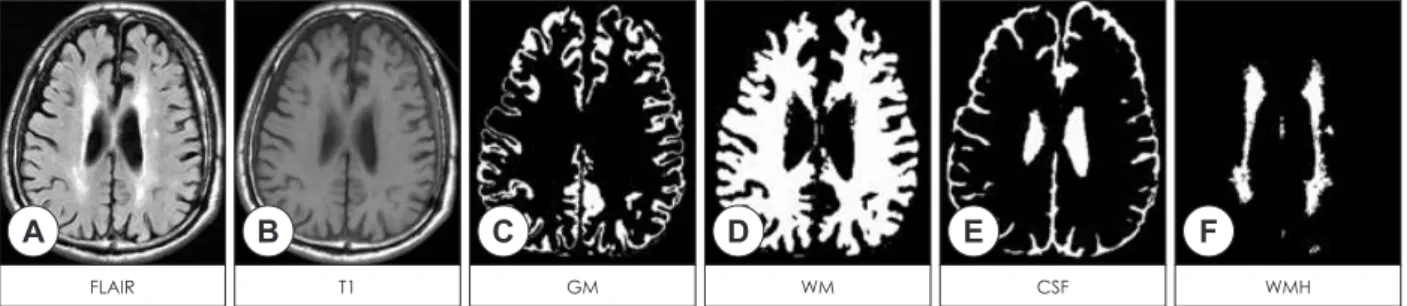
두개강내 영역(Whole brain)의 면적은 회질, 백질, 뇌척수액 부 분의 면적을 합산한 것으로 대체하여, 두개강내 영역 내에서의 회질, 백질과 WMH 분획을 계산하였다(Fig. 1).
WMH 구획
FLAIR 영상에서 WMH 영역을 자동으로 구획하기 위하여, 수평면 영상 중 뇌실주위백질(periventricular)과 심부백질의 WMH가 보일 수 있는 3면을 선택하여, 배경 신호잡음을 제거 한 이후, 영상신호의 분포를 가우시안 혼합 모델(Gaussian Mix- ture Model)을 이용하여 3개의 가우시안 분포로 추정하였다.
추정 과정에서는 Expectation-Maximization 알고리듬을 활 용하였다.29) 추정된 분포 중, 이 중 백질 영역의 신호를 의미하 는 분포의 평균 신호강도에서 3 표준편차 이상이 되는 부분을 WMH로 정의하였다. 백질 이외의 부분에서 구획된 부분을 제 거하기 위하여 T1 강조 영상에서 구획된 백질 부분의 마스크 를 이용하였으며, 신호잡음에 의한 영향을 줄이기 위하여 구 획된 WMH에서 군집된 화소의 수가 9개 이상인 것만을 최종 적으로 WMH로 정하여 면적을 계산하였다. 자동 구획된 WMH 는 이후 연구자에 의하여 육안으로 최종 확인하였다.
통계 분석
통계학적 분석은 SPSS 15.0 프로그램을 이용하여 시행하였 다. 성별과 같은 이분화된 명목 변수는 Fisher’s exact test를 시 행하였고, 서열변수이거나 연속형 변수의 경우 Wilcoxon rank- sum test를 시행하였다. 종속 변수가 연속형 변수일 경우, 선 형 회귀 분석을 이용하여 독립 변수 및 다른 변인을 통제하여 상관관계 분석을 시행하였고, 종속 변수가 AAP 사용과 같은 이분형 변수일 경우 로지스틱 회귀분석을 통해 신뢰구간 및 오 즈비(odds ratio, 이하 OR)를 계산하여 상관관계 분석을 시행 하였다. 결과는 p < 0.05인 경우에 유의한 것으로 판단하였다.
결
과
대상군의 사회인구학적 및 임상적 특성
치매 진단을 받고 뇌 MRI를 촬영한 대상자 69명이 선정되 었으며 이 중에서 뇌 자기공명영상 자료가 부적절하거나, 오류 가 있는 대상 16명을 제외하였고, MRI 촬영을 통하여 뇌종양
A B C D E F
FLAIR T1 GM WM CSF WMH
Fig. 1. Example of (A) fluid attenuated inversion recovery and (B) T1-weighted images including white matter hyperintensities (WMH) on axial plane and segmentation results on the same slice [(C) gray matter, (D) white matter, (E) cerebrospinal fluid space and (F) WMH].
FLAIR : fluid attenuated inversion recovery, GM : gray matter, WM : white matter, CSF : cerebrospinal fluid, WMH : white matter hyperin- tensities.
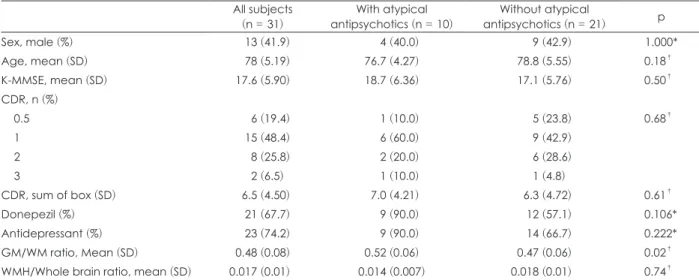
과 경막하뇌출혈을 진단받은 2명이 제외되어 총 51명이 선정되 었다. 이 중에서 K-MMSE와 CDR 평가를 단일한 임상심리 전문가가 시행한 환자만 포함하여 최종적으로 31명이 포함되 었다. 이 중 AAP를 복용한 환자는 10명이었고 복용하지 않은 환자는 21명이었다. AAP 복용 여부에 따라 나뉜 두 군 간에 성 비의 차이 및 연령의 차이는 없었다(p > 0.18). 전체 대상자의 K-MMSE 평균 점수는 17.6점이었고(SD = 5.9), K-MMSE의 평균 점수 및 CDR 평가 점수의 분포, CDR 점수의 합(sum of box)은 두 군 간에 차이가 없었다(p > 0.50)(Table 1).
비정형 항정신병 약제 복용의 예측 인자
두 군 간에 GM/WM 비가 유의한 차이를 보였으나(Wilcox- on rank-sum test, z = -2.49, p = 0.02), WMH/Whole brain 비는 유의한 차이를 보이지 않았다(Wilcoxon rank-sum test, z = 0.202, p = 0.74). 다변량 로지스틱 회귀분석에서는 GM/
WM 비가 높을수록 AAP를 복용할 가능성이 높아진다는 유 의한 결과를 나타내었다(OR = 1.18, 95% CI = 1.01-1.38, p =
0.037).
그러나 WMH/whole brain 비는 로지스틱 회귀분석에서도 AAP 복용여부와 유의한 연관을 보이지 않았다(OR = 0.82, 95% CI = 0.27-2.48, p = 0.73). 그 외, 다변량 로지스틱 회귀분 석에서 K-MMSE 점수 및 CDR 점수의 합은 AAP 복용과 통 계적으로 유의한 연관성을 보이지 않았다(Table 2).
고
찰
본 연구에서는 치매 환자들의 GM/WM 비 및 WMH/Whole brain 비가 AAP 사용과 연관성이 있는 지를 알아보았다. 그 결과 치매 환자들에서 GM/WM 비가 높을수록 AAP의 사용 이 늘어난다는 것을 알 수 있었다. 회질의 위축이 BPSD의 발 생에 기여할 것이라는 이전 연구의 결과들이 있으나 본 연구 의 결과는 추가적으로 대뇌 회질의 용적뿐만 아니라 대뇌 백 질의 용적 또한 BPSD와 연관이 있다는 점을 시사한다. WMH 의 비율과 AAP의 사용이 유의한 연관성이 없는 것은, 이전 연 Table 1. Demographic and clinical characteristics of the participants
All subjects
(n = 31) With atypical
antipsychotics (n = 10) Without atypical
antipsychotics (n = 21) p
Sex, male (%) 13 (41.9) 4 (40.0) 9 (42.9) 1.000*
Age, mean (SD) 78 (5.19) 76.7 (4.27) 78.8 (5.55) 0.18†
K-MMSE, mean (SD) 17.6 (5.90) 18.7 (6.36) 17.1 (5.76) 0.50†
CDR, n (%)
0.5 6 (19.4) 1 (10.0) 5 (23.8) 0.68†
1 15 (48.4) 6 (60.0) 9 (42.9)
2 8 (25.8) 2 (20.0) 6 (28.6)
3 2 (6.5) 1 (10.0) 1 (4.8)
CDR, sum of box (SD) 6.5 (4.50) 7.0 (4.21) 6.3 (4.72) 0.61†
Donepezil (%) 21 (67.7) 9 (90.0) 12 (57.1) 0.106*
Antidepressant (%) 23 (74.2) 9 (90.0) 14 (66.7) 0.222*
GM/WM ratio, Mean (SD) 0.48 (0.08) 0.52 (0.06) 0.47 (0.06) 0.02†
WMH/Whole brain ratio, mean (SD) 0.017 (0.01) 0.014 (0.007) 0.018 (0.01) 0.74†
* : Fisher's exact test, † : Mann-Whitney U test. SD : standard deviation, K-MMSE : Korean Mini-Mental State Exam, CDR : Clinical Dementia Rating, GM : gray matter, WM : white matter, WMH : white matter hyperintensities
Table 2. Univariate and multivariate logistic regression analyses on predictors of the atypical antipsychotic treatment in the subjects with dementia
Variables Univariate analysis Multivariate analysis
OR 95% CI p OR 95% CI p
GM/WM ratio (%) 1.10 0.98-1.22 0.11 1.18 1.01-1.38 0.037
WMH/Whole brain ratio (%) 0.70 0.34-1.44 0.33 0.82 0.27-2.48 0.73
Age 0.92 0.08-1.07 0.30 0.84 0.68-1.04 0.11
Sex 1.12 0.24-5.21 0.88 3.61 0.27-47.5 0.33
K-MMSE 1.05 0.91-1.21 0.49 1.24 0.97-1.58 0.08
CDR, sum of box 1.04 0.88-1.27 0.68 1.27 0.93-1.72 0.84
OR : odds ratio, CI : confidence interval, GM : gray matter, WM : white matter, WMH : white matter hyperintensities, K-MMSE : Ko- rean Mini-Mental State Exam, CDR : Clinical Dementia Rating
구에서 WMH가 알츠하이머병 치매 환자에서 불안감, 이상행 동, 수면장애 등과 같은 특정 BPSD와는 연관이 있었으나 망 상 등과 같은 정신병적 증상과는 유의한 관계가 없었다는 결 과를 고려할 때, 이러한 부분적인 연관 관계로 인하여 본 연구 에서 그 연관성이 나타나지 않았을 가능성이 있다.18) 대뇌 백 질은 두개강내 용적의 30~40% 정도로 넓은 용적을 차지하고 있고,30) 대뇌 위축이 진행될수록 회질의 위축비율보다 상대적 으로 위축되는 용적이 넓으며 또한 정상 노화 과정에서 회질 위축은 일차곡선의 형태(linear pattern)로 감소하는 반면에 백질 위축은 이차곡선의 형태(quadratic pattern)로 감소하기 때문에 GM/WM 비는 대뇌 위축이 진행될수록 커질 것으로 생각된다.20) 따라서 GM/WM 비가 대뇌 위축을 반영한 단일 한 지표이자 정량적 지표로서 효과적일 것이다.
최근의 연구들은 치매환자의 백질 손상의 기전에 대하여 Wallerian 퇴행모델(Wallerian degeneration model)과 역발 생이론(retrogenesis theory)의 두 가지 병리학적 가설을 들어 설명을 하고 있으며 일차적으로 백질의 손상이 생긴다는 역발 생이론 및 대뇌 피질의 손상에 따라서 이차적으로 백질의 손 상이 생긴다는 Wallerian 퇴행 모델 두 가지의 기전이 모두 작 용하는 것이라는 근거들이 일관적으로 제시되고 있다.31-35) 또 한 Sjo¨beck 등36)은 사후연구에서 알츠하이머병 치매 환자들의 뇌부위 중 특히 전두-두정엽 부위 백질의 탈수초화(demyeli- nation)가 심하다는 결과를 토대로 백질의 손상이 특정 인지기 능에 큰 영향을 미치며 그러므로 임상적으로 백질에 대한 뇌 영상학적 소견이 진단에 중요한 도구가 될 수 있음을 주장하였 다. 더욱 나아가 백질의 병소가 알츠하이머병 치매의 발생과 진 행에 있어서 대뇌 피질 못지않게 중요한 역할을 할 것이라는 주 장도 있다.37) 그러므로 백질의 위축도 함께 반영할 수 있는 GM/
WM 비가 치매 증상의 심각도 및 BPSD의 예측에도 기여할 가능성이 있는 것이다. 현재까지 밝혀진 대뇌 백질의 특정 손 상부위에 대해서 살펴보면, 뇌량(corpus callusum), 대상회다 발(cingulum bundle), 뇌궁(fornix), 구상다발(uncinate fasci- culus) 부위가 알츠하이머병 치매에서 특히 손상을 받는다는 뇌영상연구 결과들이 보고되어 왔다.38-40) Villain 등41)은 뇌영 상학을 이용한 시간적 연구를 통하여 건망증형 경도 인지 저 하(amnestic mild cognitive impairment)와 초기 알츠하이머 병 환자에서 나타나는 해마위축이 대뇌 백질, 특히 구상다발 (uncinate fasciculus), 대상회다발(cingulum bundle)의 단절 을 일으키고 이어서 다른 부위의 뇌 대사감소를 일으킬 것이라 고 주장하였다. 본 연구에서는 GM/WM 비가 높을수록 AAP 의 사용이 많아진다는 것을 확인하였다. 이를 통하여 백질 및 회질 위축 등의 병변이 심할수록 증상이 심각하고 예후가 나 쁠 가능성이 높아진다는 것을 알 수 있었다. WMH의 경우에
는 미세혈관의 허혈로 인해 발생하는 것으로 생각되며 알츠하 이머병 치매의 병리를 심화시키고 인지기능의 저하를 악화시 키는 것으로 알려져 있다.42) 병리적 기전으로는 미세혈관의 병 리로 인한 반복적인 저산소성 손상이 신경 축삭의 소실, 탈수 초화, 신경교질화 등을 일으켜 WMH를 유발하는 것으로 설명 할 수 있다.43) 이러한 변화들이 또한 우울증상, 불안감, 이상행 동 등의 BPSD를 유발한다는 결과들이 있으나,17)18) 본 연구에 서는 그 연관성이 밝혀지지 않았다. 이는 항우울제 등 BPSD 에서 사용할 수 있는 다른 약제를 제외하고 AAP의 사용만을 확인하였기 때문일 것으로 생각된다.
본 연구의 제한점으로는 첫째, 대상의 수가 적어서 해석에 있 어서 어려움이 있을 수 있고, 둘째, 임상적으로 AAP를 사용하 는 상황이 수면장애와 섬망 등과 같이 BPSD 외 다른 이유 때 문일 수도 있기 때문에 BPSD의 예측인자로서 부족할 수 있 다. 특히 흔한 BPSD 중의 하나인 우울증상만 있는 경우에는 AAP를 처방하지 않을 가능성이 있으므로 AAP의 사용은 망 상, 행동장애, 초조 등의 부분적인 증상의 예측인자로 제한될 가능성이 있다. 마지막으로 대학병원을 찾아온 환자를 대상으 로 하였기 때문에 지역사회 치매환자군 보다 BPSD가 더 많을 수 있다는 점이다. 또한 뇌 자기공명영상은 3차원으로 정밀한 재구성이 가능한 자료가 아니라, 임상 진료를 위하여 일반적으 로 회질, 백질 용적 구획을 위해 사용되는 영상자료보다 위- 아래 방향(superior-inferior)의 해상도가 낮아 본 연구에서 사 용한 각 구획된 각 영역의 면적이 실제 용적을 대표하기에 비 뚤림(bias)이 포함될 가능성이 있어 추후 연구에서는 이의 개 선이 필요하다. 또한 추후 연구를 통하여 GM/WM 비로 표현 되는 대뇌 위축과 WMH의 병변 위치에 따른 추가적인 분석 도 필요하다.
결론적으로, 본 연구를 통하여 대뇌 위축이 AAP의 사용을 증가시킬 수 있음을 추정할 수 있으며, 이는 치매 초기 평가 검 사로서 측정되는 뇌 자기공명영상을 이용하여 GM/WM 비를 측정하여 예측할 수 있음을 알게 되었다.
중심 단어:치매·BPSD·뇌자기공명영상·비정형 항정신병 약제.
Acknowledgments
본 연구는 순천향대학교 학술연구비의 일부지원과 2011년도 정부 (교육과학기술부)의 재원으로 한국연구재단의 지원을 받아 수행된 기초연구사업임(No. 2011-0014500).
Conflicts of interest
The authors have no financial conflicts of interest.
REFERENCES
1) Fernández M, Gobartt AL, Balañá M; COOPERA Study Group. Be-
havioural symptoms in patients with Alzheimer’s disease and their association with cognitive impairment. BMC Neurol 2010;10:87.
2) Piccininni M, Di Carlo A, Baldereschi M, Zaccara G, Inzitari D. Be- havioral and psychological symptoms in Alzheimer’s disease: frequen- cy and relationship with duration and severity of the disease. Dement Geriatr Cogn Disord 2005;19:276-281.
3) Assal F, Cummings JL. Neuropsychiatric symptoms in the demen- tias. Curr Opin Neurol 2002;15:445-450.
4) Shin IS, Carter M, Masterman D, Fairbanks L, Cummings JL. Neu- ropsychiatric symptoms and quality of life in Alzheimer disease. Am J Geriatr Psychiatry 2005;13:469-474.
5) Berger G, Bernhardt T, Weimer E, Peters J, Kratzsch T, Frolich L.
Longitudinal study on the relationship between symptomatology of dementia and levels of subjective burden and depression among fam- ily caregivers in memory clinic patients. J Geriatr Psychiatry Neurol 2005;18:119-128.
6) Beeri MS, Werner P, Davidson M, Noy S. The cost of behavioral and psychological symptoms of dementia (BPSD) in community dwell- ing Alzheimer’s disease patients. Int J Geriatr Psychiatry 2002;17:
403-408.
7) Ballard C, Waite J. The effectiveness of atypical antipsychotics for the treatment of aggression and psychosis in Alzheimer’s disease.
Cochrane Database Syst Rev 2006:CD003476.
8) Liperoti R, Pedone C, Corsonello A. Antipsychotics for the treatment of behavioral and psychological symptoms of dementia (BPSD).
Curr Neuropharmacol 2008;6:117-124.
9) Chui HC, Lyness SA, Sobel E, Schneider LS. Extrapyramidal signs and psychiatric symptoms predict faster cognitive decline in Alzhei- mer’s disease. Arch Neurol 1994;51:676-681.
10) FDA.gov [homepage on the Internet]. Public Health Advisory: Deaths with Antipsychotics in Elderly Patients with Behavioral Disturbanc- es [undated 2013 Aug 16; cited 2005 Apr 11]. Available from: http://
www.fda.gov/.
11) Craig AH, Cummings JL, Fairbanks L, Itti L, Miller BL, Li J, et al. Ce- rebral blood flow correlates of apathy in Alzheimer disease. Arch Neu- rol 1996;53:1116-1120.
12) Benoit M, Koulibaly PM, Migneco O, Darcourt J, Pringuey DJ, Rob- ert PH. Brain perfusion in Alzheimer’s disease with and without ap- athy: a SPECT study with statistical parametric mapping analysis.
Psychiatry Res 2002;114:103-111.
13) Ott BR, Noto RB, Fogel BS. Apathy and loss of insight in Alzheim- er’s disease: a SPECT imaging study. J Neuropsychiatry Clin Neuro- sci 1996;8:41-46.
14) Staff RT, Shanks MF, Macintosh L, Pestell SJ, Gemmell HG, Venneri A. Delusions in Alzheimer’s disease: spet evidence of right hemisp- heric dysfunction. Cortex 1999;35:549-560.
15) Bruen PD, McGeown WJ, Shanks MF, Venneri A. Neuroanatomical correlates of neuropsychiatric symptoms in Alzheimer’s disease.
Brain 2008;131(Pt 9):2455-2463.
16) Rosen HJ, Allison SC, Schauer GF, Gorno-Tempini ML, Weiner MW, Miller BL. Neuroanatomical correlates of behavioural disorders in dementia. Brain 2005;128(Pt 11):2612-2625.
17) Krishnan KR, Taylor WD, McQuoid DR, MacFall JR, Payne ME, Provenzale JM, et al. Clinical characteristics of magnetic resonance imaging-defined subcortical ischemic depression. Biol Psychiatry 2004;55:390-397.
18) Berlow YA, Wells WM, Ellison JM, Sung YH, Renshaw PF, Harper DG. Neuropsychiatric correlates of white matter hyperintensities in Alzheimer’s disease. Int J Geriatr Psychiatry 2010;25:780-788.
19) Brickman AM, Honig LS, Scarmeas N, Tatarina O, Sanders L, Albert MS, et al. Measuring cerebral atrophy and white matter hyperinten- sity burden to predict the rate of cognitive decline in Alzheimer dis- ease. Arch Neurol 2008;65:1202-1208.
20) Ge Y, Grossman RI, Babb JS, Rabin ML, Mannon LJ, Kolson DL. Age-
related total gray matter and white matter changes in normal adult brain. Part I: volumetric MR imaging analysis. AJNR Am J Neuro- radiol 2002;23:1327-1333.
21) Gibson E, Gao F, Black SE, Lobaugh NJ. Automatic segmentation of white matter hyperintensities in the elderly using FLAIR images at 3T. J Magn Reson Imaging 2010;31:1311-1322.
22) CalvÓ-Perxas L, de Eugenio RM, Marquez-Daniel F, Martínez R, Ser- ena J, Turbau J, et al. Profile and variables related to antipsychotic consumption according to dementia subtypes. Int Psychogeriatr 2012;
24:940-947.
23) American Psychiatric Association. Diagnostic and Statistical Man- ual of Mental Disorders: text revision. 4th ed. Washington DC: Ameri- can Psychiatric Association;2000.
24) Kang Y, Na DL, Hahn S. A validity study on the Korean Mini-Men- tal State Examination (K-MMSE) in dementia patients. J Korean Neurol Assoc 1997;15:300-308.
25) Choi SH, Na DL, Lee BH, Hahm DS, Jeong JH, Yoon SJ, et al. Esti- mating the Validity of the Korean Version of Expanded Clinical De- mentia Rating (CDR) Scale. J Korean Neurol Assoc 2001;19:585-591.
26) Sled JG, Zijdenbos AP, Evans AC. A nonparametric method for au- tomatic correction of intensity nonuniformity in MRI data. IEEE Trans Med Imaging 1998;17:87-97.
27) Ashburner J, Friston KJ. Voxel-based morphometry--the methods.
Neuroimage 2000;11(6 Pt 1):805-821.
28) Luders E, Gaser C, Jancke L, Schlaug G. A voxel-based approach to gray matter asymmetries. Neuroimage 2004;22:656-664.
29) Dempster AP, Laird NM, Rubin DB. Maximum Likelihood from In- complete Data via the EM Algorithm. Journal of the Royal Statistical Society, Series B 1977;39:1-38.
30) Guttmann CR, Jolesz FA, Kikinis R, Killiany RJ, Moss MB, Sandor T, et al. White matter changes with normal aging. Neurology 1998;50:
972-978.
31) Alves GS, O’Dwyer L, Jurcoane A, Oertel-KnÖchel V, KnÖchel C, Pr- vulovic D, et al. Different patterns of white matter degeneration us- ing multiple diffusion indices and volumetric data in mild cognitive impairment and Alzheimer patients. PLoS One 2012;7:e52859.
32) Acosta-Cabronero J, Williams GB, Pengas G, Nestor PJ. Absolute dif- fusivities define the landscape of white matter degeneration in Al- zheimer’s disease. Brain 2010;133(Pt 2):529-539.
33) Bosch B, Arenaza-Urquijo EM, Rami L, Sala-Llonch R, Junqué C, Solé-Padullés C, et al. Multiple DTI index analysis in normal aging, amnestic MCI and AD. Relationship with neuropsychological per- formance. Neurobiol Aging 2012;33:61-74.
34) Salat DH, Tuch DS, van der Kouwe AJ, Greve DN, Pappu V, Lee SY, et al. White matter pathology isolates the hippocampal formation in Alzheimer’s disease. Neurobiol Aging 2010;31:244-256.
35) O’Dwyer L, Lamberton F, Bokde AL, Ewers M, Faluyi YO, Tanner C, et al. Multiple indices of diffusion identifies white matter damage in mild cognitive impairment and Alzheimer’s disease. PLoS One 2011;
6:e21745.
36) SjÖbeck M, Haglund M, Englund E. Decreasing myelin density re- flected increasing white matter pathology in Alzheimer’s disease--a neuropathological study. Int J Geriatr Psychiatry 2005;20:919-926.
37) Bartzokis G. Age-related myelin breakdown: a developmental mod- el of cognitive decline and Alzheimer’s disease. Neurobiol Aging 2004;
25:5-18; author reply 49-62.
38) Li S, Pu F, Shi F, Xie S, Wang Y, Jiang T. Regional white matter de- creases in Alzheimer’s disease using optimized voxel-based mor- phometry. Acta Radiol 2008;49:84-90.
39) Bai F, Zhang Z, Watson DR, Yu H, Shi Y, Yuan Y, et al. Abnormal in- tegrity of association fiber tracts in amnestic mild cognitive impair- ment. J Neurol Sci 2009;278:102-106.
40) Stricker NH, Schweinsburg BC, Delano-Wood L, Wierenga CE, Ban- gen KJ, Haaland KY, et al. Decreased white matter integrity in late-
myelinating fiber pathways in Alzheimer’s disease supports retrogen- esis. Neuroimage 2009;45:10-16.
41) Villain N, Fouquet M, Baron JC, Mézenge F, Landeau B, de La Say- ette V, et al. Sequential relationships between grey matter and white matter atrophy and brain metabolic abnormalities in early Alzheim- er’s disease. Brain 2010;133:3301-3314.
42) Esiri MM, Nagy Z, Smith MZ, Barnetson L, Smith AD. Cerebrovas- cular disease and threshold for dementia in the early stages of Al- zheimer’s disease. Lancet 1999;354:919-920.
43) Englund E. Neuropathology of white matter changes in Alzheimer’s disease and vascular dementia. Dement Geriatr Cogn Disord 1998;9 Suppl 1:6-12.