• 검색 결과가 없습니다.

Effects of Fertilizer on Growth, Carbon and Nitrogen Responses of Foliage in a Red Pine Stand

N/A
N/A
Protected

Academic year: 2021

Share "Effects of Fertilizer on Growth, Carbon and Nitrogen Responses of Foliage in a Red Pine Stand"

Copied!
7
0
0

로드 중.... (전체 텍스트 보기)

전체 글

(1)

Effects of Fertilizer on Growth, Carbon and Nitrogen Responses of Foliage in a Red Pine Stand

Choonsig Kim*, Nam-Gyu Ju, Hye-Yeon Lee, and Kwang-Soo Lee

1

Department of Forest Resources, Gyeongnam National University of Science and Technology, Jinju 660-758, Korea

1

Southern Forest Research Center, Korea Forest Research Institute, Jinju 660-300, Korea

This study was to examine growth, carbon and nitrogen responses in foliage following forest fertilization in a red pine stand. Two types of fertilizer (N:P:K=113:150:37 kg ha

-1

; P:K=150:37 kg ha

-1

) were applied on late April 2011. Growth, carbon and nitrogen responses of foliage were monitored 3 times (July, September, November) after fertilization. Morphological growth responses (dry mass, leaf area, specific leaf area) with foliage age were not significantly ( P > 0.05) affected by fertilizer application, while needle dry mass and leaf area of July were significantly lower in current-year-old than in one-year-old or two-year-old needles of September or November. Carbon concentration and content in foliage was little affected by fertilizer application compared with sampling month or needle age, while the NPK fertilizer produced high nitrogen concentration and content of foliage. The results indicate that nitrogen concentration and content in foliage may serve as an indicator of the nitrogen status by fertilization in a red pine stand.

Key words: Carbon, Fertilization, Foliage analysis, Nitrogen, Red pine

Received : 2012. 10. 2 Accepted : 2013. 1. 9

*Corresponding author : Phone: +82557513247 E-mail: [email protected]

Introduction

Needle analysis following fertilizer application has received considerable research attention because the nutrient concentrations of foliage are an important parameter to assess the nutrient requirements and deficiencies in forest stands (Weetman and Wells, 1990; Barron-Gafford et al., 2003; Tausz et al., 2004). Generally, nutrient concentrations of foliage have been accepted as good indicators of growth and soil fertility on site (Bauer et al., 1997), although the nutrient status in foliage could be attributed to many environmental factors, such as soil properties, season length, water supply, and other environmental factors (Weetman and Wells, 1990).

Fertilizer application increased tree growth by the positive effects on leaf area and foliar photosynthetic rate (Garrison et al., 2000; Amponsah et al., 2005). Also, the nutrient concentrations in the living parts (needles, leaves, bark, and root) of trees increased following fertilizer application because the nutrient status of the tree is dependent on the nutrient status of the soil (Miller et al., 2006). However, the status of nutrient in foliage was depended on fertilizer types and dose, site characteristics, and tree species (Mugasha et al., 1999; Brockley, 2000; Miller et al., 2006).

There have been a myriad of nutritional problems such as nitrogen and phosphorus deficiency on forest stands in Korea (Byun et al., 2006; Son et al., 2007; Park et al., 2008). Despite of many studies on the nutrient status of forest stands following fertilizer application, there still is a lack of knowledge about growth, carbon and nitrogen responses of foliage involved in the fertilizer reaction in Korea forest stands. In addition, an understanding of nutrient status is essential for designing and timing of fertilizer application in forest stands. The objective of this study was to determine the growth, carbon and nitrogen responses of the foliage by fertilizer application, sampling month, and needle age in red pine (Pinus densiflora S. et Z.) which is the most widespread conifer tree species throughout the country.

Materials and Methods

This study was conducted in about 40-year-old natural

red pine stands in the Wola National Experimental Forest

administered by the Southern Forest Research Center,

Korea Forest Research Institute. The annual average

precipitation and temperature in this area are 1,490 mm

y

-1

and 13.1 ℃, respectively. The soil is slightly dry,

dark-brown forest soil (mostly Inceptisol, United States

Soil Classification System) originating from sandstone

or shale with a silt loam texture (Table 1 and 2). The

(2)

Table 1. Stand characteristics in the study site (n=6).

Treatments Stand density DBH

Basal area

trees ha

-1

cm m

2

ha

-1

Control 1200 15.51 22.35

(141)

(0.81) (1.96)

PK 1283 16.32 22.61

(149) (1.48) (2.01)

NPK 1150 15.80 20.62

(193) (1.11) (2.38)

DBH: diameter at breast height (1.2 m).

Standard errors in parenthesis.

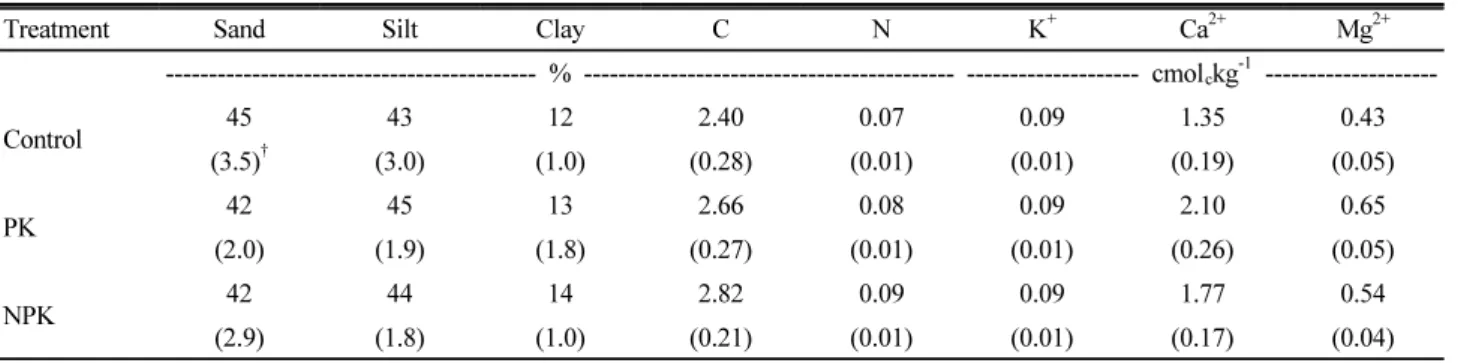
Table 2. Soil properties of the study site before fertilizer application (n=6).

Treatment Sand Silt Clay C N K

+

Ca

2+

Mg

2+

--- % --- --- cmol

c

kg

-1

---

Control 45 43 12 2.40 0.07 0.09 1.35 0.43

(3.5)

(3.0) (1.0) (0.28) (0.01) (0.01) (0.19) (0.05)

PK 42 45 13 2.66 0.08 0.09 2.10 0.65

(2.0) (1.9) (1.8) (0.27) (0.01) (0.01) (0.26) (0.05)

NPK 42 44 14 2.82 0.09 0.09 1.77 0.54

(2.9) (1.8) (1.0) (0.21) (0.01) (0.01) (0.17) (0.04)

Standard errors in parenthesis.

site index indicates low forest productivity (site index, 8-10 at 20-year-old base age) suggesting poor soil fertility.

The treatment plots were established on the same facing slopes and aspects under a similar environmental condition to minimize spatial variation in soil properties. The experimental design consisted of a completely randomized design with 2 blocks (35°12' 32" N, 128° 10' 23" E, 180 m; 35°

12' 26" N; 128° 10' 25" E, 195 m) involving total 18 plots [3 treatments (NPK, PK, Control) × 2 blocks × 3 replicated plots] in a mature red pine stand.

Treatment plots (plot size=10 x 10m) were randomly assigned with a 5 m buffer zone between each plot.

The combination of fertilizer types was based on the guideline (N:P:K = 113:150:37 kg ha

-1

) of forest fertilization in Korea forests (Joo et al., 1982) and without nitrogen fertilizer (P:K=150:37 kg ha

-1

). Urea, fused superphosphate, and potassium chloride fertilizers were used as sources of nitrogen (N), phosphorus (P), and potassium (K), respectively.

Fresh foliage samples following fertilizer application were collected at three times (1st of July, 8th of September, and 7th of November, 2011) with pole pruners from the mid-crown of two or three dominant trees per each treatment plot. The foliage samples with plastic zipper bags were transported to the laboratory and sorted by

several foliage age classes (current-year-old, one-year-old, and two-year-old needles) from twigs or small branches.

For each treatment, three repetitions of 10 fascicles were counted and weighted. Needle leaf area was measured by fresh needle samples by using scanned leaf meter (CI-202 area meter CID, Inc. USA). Specific leaf area of needle was determined by leaf area (cm

2

) and dry mass (mg) of ratio (Bauer et al., 1997).

The needle leaf samples were oven-dried at 65 ℃ for 48 h and the dried samples were ground in a Wiley mill to pass a 40-mesh stainless steel sieve. Carbon and nitrogen concentrations from the ground materials were determined on an elemental analyzer (Thermo Scientific, Flash 2000, Italy).

All data were analyzed by three-way analysis of variance (ANOVA) to determine the significance of main effects [fertilizer type (F), sampling month (M), needle age (A)] and their interactions (F×M, M×A, F×A, F×M×A).

The model describing the data analysis is as follows:

Y

ijk

= u + F

i

+ M

j

+ A

k

+ (FM)

ij

+ (FA)

ik

+ (MA)

jk

+ (FMA)

ijk

+ e

ijk

where u is the overall mean effect, F is fertilizer type

(k=1, 2, 3), M is sampling month (i=1, 2, 3), and A

is needle age (j=1, 2, 3). All ANOVA were executed

(3)

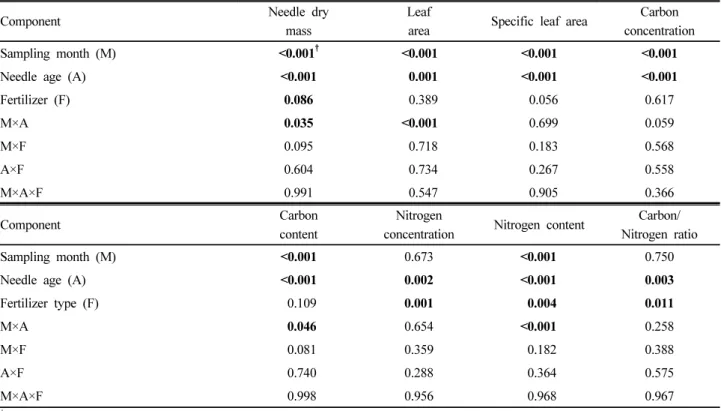
Table 3. P-value from results of ANOVA on sampling month, needle age and fertilizer type on growth and carbon and nitrogen responses of foliage in red pine stands.

Component Needle dry

mass

Leaf

area Specific leaf area Carbon

concentration

Sampling month (M) <0.001

<0.001 <0.001 <0.001

Needle age (A) <0.001 0.001 <0.001 <0.001

Fertilizer (F) 0.086 0.389 0.056 0.617

M×A 0.035 <0.001 0.699 0.059

M×F 0.095 0.718 0.183 0.568

A×F 0.604 0.734 0.267 0.558

M×A×F 0.991 0.547 0.905 0.366

Component Carbon

content

Nitrogen

concentration Nitrogen content Carbon/

Nitrogen ratio

Sampling month (M) <0.001 0.673 <0.001 0.750

Needle age (A) <0.001 0.002 <0.001 0.003

Fertilizer type (F) 0.109 0.001 0.004 0.011

M×A 0.046 0.654 <0.001 0.258

M×F 0.081 0.359 0.182 0.388

A×F 0.740 0.288 0.364 0.575

M×A×F 0.998 0.956 0.968 0.967

Bold values denote a significance at P=0.05.

Fig. 1. Dry mass, leaf area and specific leaf area of foliage by fertilizer application in a red pine stand. Different letters on the bars indicate a significant difference among treatments at P=0.05.

using the General Linear Models procedure in SAS (SAS Institute Inc., 2003). The main and interaction effects on the growth and carbon and nitrogen status in foliage were tested at P=0.05 and a Tukey’s test used for the mean separation.

Results

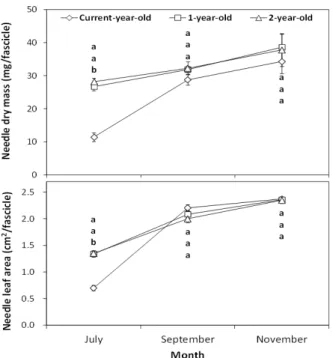
Morphological growth response According to ANOVA results, morphological growth responses (dry mass, leaf area, specific leaf area) of foliage were not significantly (P > 0.05) affected by fertilizer application (Table 3, Fig. 1). Needle dry mass and leaf area showed a significant two-factor interaction between sampling month and needle age (Table 3). Needle dry mass and leaf area of July were significantly lower in current-year-old than in one- year-old or two-year-old needles of September or November (Fig. 2). However, there was a significant main effect of specific leaf area on sampling month and needle age with no significant two- or three-factor interaction (Table 3).

Carbon and nitrogen responses There were significant

main effects of carbon responses (concentration and content)

on sampling month and needle age with no significant

(4)

Fig. 2. Dry mass and leaf area of foliage by sampling month and needle age in a red pine stand. Different letters on the bars indicate a significant difference among treatments at P=0.05.

Fig. 3. Specific leaf area of foliage by sampling month and needle age in a red pine stand. Different letters on the bars indicate a significant difference among treatments at P=0.05.

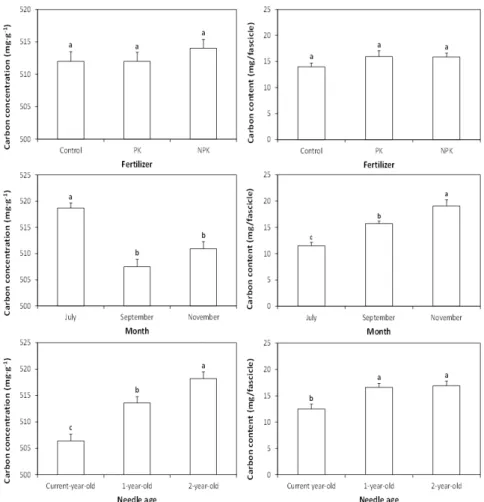
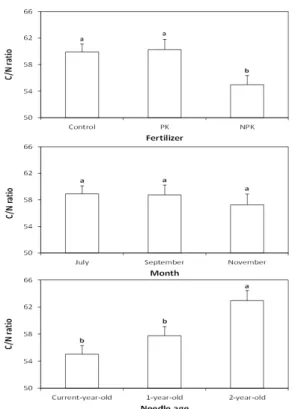
three-factor interaction (Table 3). Nitrogen and C/N ratio of foliage were significantly affected (P < 0.05) by fertilizer application. There was a significant interaction effect of sampling month and needle age on carbon and nitrogen content (Table 3). Carbon concentration of foliage was significantly higher in July than in September and November, while significantly lower in current-year-old than in one-year-old or two-year-old needles (Fig. 4).

However, carbon concentration of foliage was not significantly affected by fertilizer application (Fig. 4). In contrast to carbon concentration, nitrogen concentration and content of foliage were significantly higher (P < 0.05) in the NPK than in the PK or control treatments (Fig. 5). Carbon and nitrogen content of foliage was closely related to dry mass of foliage. Carbon and nitrogen ratio was significantly lower in the NPK than in the PK or control treatments (Fig. 6).

Discussion

Because nutrient availability is generally considered the major environmental factor limiting growth in many forest tree species (Binkley, 1986), foliage growing with fertilization would have greater dry mass than those growing without fertilization. However, dry mass of fascicle was not significantly greater in the fertilizer (NPK: 30.99 mg/fascicle; PK: 31.20 mg/fascicle) than in the control (27.22 mg/fascicle) treatments. Needle or specific leaf areas were also not significantly different between the fertilizer and control treatments because both factors are closely related to dry mass of foliage (Fig. 1). Growth and development in foliage following fertilizer application could be regulated by physiological responses such as uptake and allocation of carbon and nutrient in tree components (Gough et al., 2004). Therefore, fertilization response potential can be estimated from increase of foliage biomass in tree levels rather than from dry mass of each fascicle (Gough et al., 2004). Similarly, nitrogen fertilization increased the number of fascicles of loblolly pine trees (Zhang et al., 1997). In contrast to this result, PK fertilization increased the dry mass of foliage in Scots pine stands suffered from the PK deficiency sites (Silfverberg and Moilanen, 2008). The lack of significant fertilization effects on morphological growth response of foliage in this study could be due to primordial characteristics of foliage initiated in the previous year prior to fertilization (Zhang et al., 1997) or other nutrient imbalances caused by nitrogen fertilization (Amponsah et al., 2005).

Dry mass by foliage was significantly lower in the

current-year-old (24.80 mg/fascicle) than in one-year-old

or two-year-old (32.37 - 32.31 mg/fascicle) needles

with the two-factor interaction of needle age and sampling

time. Dry mass in current-year-old needles was significantly

lower in July than in September or November samplings

(5)

Fig. 4. Carbon concentration and content area of foliage by fertilizer application, sampling month, and needle age in a red pine stand. Different letters on the bars indicate a significant difference among treatments at P=0.05.

Fig. 5. Nitrogen concentration and content area of foliage by by fertilizer application, sampling month, and needle age in a red pine

stand. Different letters on the bars indicate a significant difference among treatments at P=0.05.

(6)

Fig. 6. Carbon (C) and nitrogen (N) ratio of foliage by fertilizer application, sampling month, and needle age in a red pine stand. Different letters on the bars indicate a significant difference among treatments at P=0.05.

(Fig. 2). Seasonal patterns of foliage dry mass could be attributed to needle maturation or allocation of resources between woody (root, stemwood, and branches) and photosynthetic compounds (Mugasha et al., 1999, Gough et al., 2004). Needle and specific leaf area by sampling month were significantly lower in July than in September or November (Fig. 2, Fig. 3) because of relationship between needle maturation and dry mass of foliage in this season. In addition, low needle leaf area in July indicated that current-year-old needle was not fully to be elongated in this season. The variations of specific leaf area under identical conditions of the same species could be attributed to multi-factorial influences that occur during the leaf life-span, such as light environment, nutrients, temperature and water supply (Wilson et al., 1999).

Carbon concentration and content in foliage were not affected by (P > 0.05) the fertilizer application (Fig. 4).

Similarly, carbon concentration in black pine seedlings was a poor indicator of fertilizer response (Jeong et al., 2010) because the inter- and intra- specific variations of carbon concentration in tree species were determined by genetic and environmental factors (Bert and Danjon, 2006; Zhang et al., 2009). In contrast to this result, carbon concentration of tree components was generally greater

in nutrient deficient conditions compared with trees grown in better nutrient conditions because of low mineral concentration of tree components or the difference of carbon allocation (Poorter and De Jong, 1999).

Carbon concentration in foliage was significantly higher in July (519 mg g

-1

) than in September (508 mg g

-1

) or November (511 mg g

-1

), while carbon content was lower in July than in September or November (Fig. 4). Seasonal patterns of carbon concentration and content in foliage were due to needle maturation related to translocation of carbohydrates and other cellular materials to active growing tissues (Mugasha et al., 1999).

Nitrogen concentration and content in foliage increased significantly following the NPK fertilization (9.6 mg g

-1

), while insignificant increases in foliage nitrogen occurred following the PK fertilization (8.8 mg g

-1

) compared with control (8.7 mg g

-1

) treatments (Fig. 5). A high concentration of nitrogen in foliage with NPK application is likely due to increased nitrogen uptake after fertilizer application (Mugasha et al., 1999; Gough et al., 2004), as tree species with high nitrogen availability tend to produce foliage with high nitrogen concentration (Sariyildiz and Anderson, 2005). In contrast to the NPK treatment, low nitrogen concentration of foliage found in the PK and control treatment may be deficient and limiting to tree growth in this study site. Nitrogen concentration and content in foliage were not related to sampling season or needle age, although the decrease in foliar nitrogen concentration during needle elongation was a result of dilution due to greater relative accumulation of carbohydrates (Silfverberg and Moilanen, 2008).

The fertilizer application was associated with the change in C/N ratio of foliage because of high nitrogen concentration and content of foliage with the NPK fertilizer compared with the PK or control treatments (Fig. 6). The C/N ratio was not significantly different among sampling month, while C/N ratio among needle age was significantly higher two-year-old than current-year-old or one-year-old needles. High C/N ratio in two-year-old needles could be due to nitrogen retranslocation before heavy litterfall season (Hagon-Thorn et al., 2006).

Conclusion

Growth characteristics such as dry mass, leaf area,

and specific leaf area in foliage were not affected by

NPK or PK fertilizer application, while NPK fertilizer

(7)

produced high nitrogen concentration and content of foliage in a red pine stand. The C/N ratio in foliage was associated with increased nitrogen concentration following NPK fertilizer application. However, carbon concentration and content in foliage was little affected by fertilizer application compared with sampling month or needle age. The result suggests that nitrogen concentration and content in foliage may be an essential tool for needle analysis following fertilizer application in a red pine stand.

Acknowledgement

This research was supported by Basic Science Research Program through the National Research Foundation of Korea (NRF) funded by the Ministry of Education, Science and Technology (2010-0022193).

References

Amponsah, I.G., P.G. Comeau, R.P. Brockley, and V.J. Lieffers.

2005. Effects of repeated fertilization on needle longevity, foliar nutrition, effectivse leaf area index, and growth characteristics of lodgepole pine in interior British Columbia, Canada. Can.

J. For. Res. 35:440-451.

Barron-Gafford, G.A., R.E. Will, C. Burkes, B. Shiver, and R.O.

Teskey. 2003. Nutrient concentrations and content, their relation to stem growth, of intensively managed Pinus taeda and Pinus elliottii stands of different planting densities. For. Sci. 49:

291-300.

Bert, D. and D. Danjon. 2006. Carbon concentration variations in the roots, stem and crown of mature Pinus pinaster (Ait.).

For. Ecol. Manage. 222:279-295.

Binkley, D. 1986. Forest nutrition management. John Wiley &

Sons, New York, USA.

Bauer, G., E-D. Schulze, and M. Mund. 1997. Nutrient contents and concentrations in relation to growth of Picea abies and Fagus sylvatica along a European transect. Tree Physiol.

17:777-786.

Brockley, R.P. 2000. Using foliar variables to predict the response of lodgepole pine to nitrogen and sulphur fertilization.

Can. J. For. Res. 30:1389-1399.

Byun, J.K., Y.S. Kim, M.J. Yi, Y. Son, C. Kim, J.H. Jeong, C.Y.

Lee, and Y.H. Jeong. 2006. Growth characteristics of Pinus densiflora, Larix leptolepis, Quercus acutissima, and Betula platyphylla var. japonica seedlings on different fertilizer types and amount. Korean J. For. Measure. 9:132-14. (in Korean) Garrison, M.T., J.A. Moore, T.M. Shaw, and P.G. Mika. 2000.

Foliar nutrient and tree growth response of mixed-conifer stands to three fertilization treatments in northeast Oregon and north central Washington. For. Ecol. Manage. 132:183-198.

Gough, C.M., J.R. Seiler, and C.A. Maier. 2004. Short-term

effects of fertilization on loblolly pine (Pinus taeda L.) physiology.

Plant, Cell and Environ. 27:876-886.

Jeong, J., J.-H. Park, J.-I. Kim, J.-T. Lim, S.-R. Lee, and C. Kim.

2010. Effects of container volumes and fertilization on red (Pinus densiflora) and black pine (Pinus thunbergii) seedlings growth. For. Sci. Tech. 6: 80-86.

Joo, J.S., W.K. Lee, T.H. Kim, C.Y. Lee, I.S Jin, and S.K. Park.

1983. Studies on fertilization in pruning and thinning stands.

The Res. Rep. For. Res. Inst., Korea. 30:155-189. (In Korean) Miller, J.H., H.L. Allen, B.R. Zutter, S.M. Zedaker, and R.A.

Newbold. 2006. Soil and pine foliage nutrient responses 15 years after competing-vegetation control and their correlation with growth for 13 loblolly pine plantations in the southern United States. Can. J. For. Res. 36:2412-2425.

Mugasha, A.G., D.J. Pluth, and S.E. Macdonald. 1999. Effects of fertilization on seasonal patterns of foliar mass and nutrients of tamarack and black spruce on undrained and drained minerotrophic peatland sites. For. Ecol. Manage. 116:13-31.

Park, J., C. Kim, J. Jeong, J.K. Byun, Y. Son, and M.J. Yi. 2008.

Effect of fertilization on litterfall amounts in a Quercus acutissima stand. J. Korean For. Soc. 97:582-588. (In Korean).

Poorter, H. and R. De. Jong. 1999. A comparison of specific leaf area, chemical composition and leaf construction costs of field plants from 15 habitats differing in productivity. New Phytol.

143:163-176.

Sariyildiz, T. and J.M. Anderson. 2005. Variation in the chemical composition of green leaves and leaf litters from three deciduous tree species growing on different soil types. For. Ecol. Manage.

210:303-319.

SAS Institute Inc. 2003. SAS/STAT Statistical software. Version 9.1. SAS publishing Cary, NC, USA.

Silfverberg, K. and M. Moilanen. 2008. Long-term nutrient status of PK fertilized Scots pine stands on drained peatlands in North-Central Finland. Suo. 59:71-88.

Son, Y., M.H. Lee, N.J. Noh, B.O. Kang, K.O. Kim, M.J. Kim.

2007. Fertilization effects on understory vegetation biomass and structure in four different plantation. J. Korean For. Soc.

96:520-527.

Tausz, M., W. Trummer, A. Wonisch, W. Goessler, D. Grill, M.S. Jiménez, and D. Morales. 2004. A survey of foliar mineral nutrient concentrations of Pinus canariensis at field plots in Tenerife. For. Ecol. Manage. 189: 49-55.

Weetman, G.F. and C.G. Wells. 1990. Plant analyses as an aid in fertilizing forests. p. 659-690. R.L. Westerman (ed). 3rd ed.

In soil testing and plant analysis. SSSA, Wisconsin, USA.

Wilson, P.J., K. Thompson, and J.G. Hodgson. 1999. Specific leaf area and leaf dry matter content as alternative predictors of plant strategies. New Phytol. 143:155-162.

Zhang, Q., C. Wang, X. Wang, and X. Quan. 2009. Carbon concentration variability of 10 Chinese temperate tree species.

For. Ecol. Manage. 258:722-727.

Zhang, S., H.L. Allen, and P.M. Dougherty. 1997. Shoot and

foliage growth phenology of loblolly pine trees as affected by

nitrogen fertilization. Can. J. For. Res. 27:1420-1426.

수치

Table 2. Soil properties of the study site before fertilizer application (n=6).
Fig. 1. Dry mass, leaf area and specific leaf area of foliage  by fertilizer application in a red pine stand
Fig. 2. Dry mass and leaf area of foliage by sampling month  and needle age in a red pine stand
Fig. 4. Carbon concentration and content area of foliage by fertilizer application, sampling month, and needle age in a red pine  stand
+2

참조

관련 문서

High level of nitrogen fertilizer application increased the nitrogen contents in all the parts of citrus trees.. But there was no change in sugar and

In conclusion, the growth and yield of potato was not different between mixed fertilizer(chemical fertilizer : liquid pig manure = 1:1) and the

That is, the dry powder of the sludge wastes, generated during the decommissioning of nuclear power plants, were compacted, and a study, focused on

In an effort to develop a new method to remove nitrogen, this study examined the effects of C/N ratio, carbon source and nitrogen concentration on

In this study, two experiments were conducted to understand the effects of additional charge on the detailed growth mechanism of Alq 3 and to determine the effect of

• For dry or semi-dry concrete exposed to water, capillary suction pressure has the same effect on flow as a pressure head of 2.4 MPa in saturated concrete.. •

The &lt;Taebaeksanmaek&gt; reflects dialects of eastern area of Jeollanamdo sincerely, and this study examines phonological and morphological aspects of the

Contents of total cholesterol in the epididymal adipose tissue of STZ-induced diabetic rats containing barley leaf powder for 4 weeks ··· 147 Fig.. The change of growth rate