복숭아 주간부 동해 예방을 위한 피복재의 보온성 평가
신현석†· 윤석규†,* · 최인명 · 김성종 · 윤익구 · 남은영 · 권정현 농촌진흥청 국립원예특작과학원 과수과
Evaluation of Thermal Insulation Properties of Covering Materials to Protect Peach Trunks against Freezing Injury
Hyunsuk Shin†, Seok Kyu Yun†,*, In Myung Choi, Sung Jong Kim, Ik Koo Yun, Eun Young Nam, and Jung Hyun Kwon
Fruit Research Division, National Institute of Horticultural & Herbal Science, Wanju 55365, Korea
Abstract. The study was performed to evaluate thermal insulation covering materials (TICMs) to protect peach trunks against freezing temperatures in winter season by investigating thermo-physical properties and practical ther- mal insulation effect of the TICMs which was made of white non-woven fabrics, yellow paper sheets, and water- proof fabric pads. Among the three TICMs, Waterproof fabric pad (double layer) possessed the best performance about thermal insulation rate and thermal resistance among three kinds of TICMs. Day thermal insulation effects of waterproof fabric pad, which prevent from temperature rise on the bark tissues of trunks during the day time, were 14.09oC. Night thermal insulation effects of them, which prevent from temperature decline on the bark tissues of trunks at night time, were 7.23oC. Waterproof fabric pad showed the highest day and night thermal insulation effects.
Thus our results suggest that development of TICMs using waterproof fabric pad might be helpful to protect the bark tissues of trunks from freezing injury.
Additional key words : cold hardiness, freezing injury, heat insulation, Prunus persica
서 론
동해는 온대과수의 주요한 환경스트레스 중 하나로 수체를 약화시키고 과실의 생산성을 감소시킨다. 복숭 아는 온대과수로 사과, 배보다 동해에 약하며, 특히 핵 과류 내에서도 상대적으로 내한성이 약한 것으로 알려 져 있다(Flore, 1994). 온대과수의 동해는 한 겨울 극 저온 또는 내재휴면타파 후 환경휴면기 중 봄철의 서 리에 의해 발생되며(Johnson and Howell, 1981), 최근 이상기후에 따른 봄철의 불규칙한 온도 변화로 동해 피해의 우려가 더욱 커지고 있다(Pagter et al., 2011).
현재까지 복숭아의 내한성과 관련된 연구는 주로 저 온순화, 탈순화 또는 재순화 동안 세포막과 세포벽의 구조 변화, 세포구조를 보호하기 위한 조직 내 가용성 탄수화물, 단백질, 아미노산과 같은 화합물의 축적, 유 전자 발현의 변화 등 식물체 내에서 발생되는 생리적
반응에 관심을 집중해온 반면(Arora et al., 1992;
Shin et al., 2015, 2016; Wisniewski et al., 1987), 복 숭아 동해 경감을 위한 농가에서의 실제 재배적 활용 을 위한 연구는 거의 전무한 실정이다.
대부분의 온대과수는 저온순화를 통해 내한성을 획득 할 수 있으며(Thomashow, 1999), 일반적으로 복숭아는 겨울철 복사냉각으로 활발하게 생장하는 꽃눈이나 신초 가 주간부보다 더 낮은 온도까지 초과냉각(deep supercooling)된 상태가 되지만, 빙핵(ice crystal) 형성 은 오히려 주간부의 수피에서 시작되어 활발하게 생장 하는 꽃눈이나 신초로 퍼져나간다(Wisniewski et al., 2003). 그러므로 복숭아의 동해를 예방하기 위해서는 보온을 통한 주간부의 빙핵 형성을 최대한 억제하는 것 이 매우 중요하다.
본 연구는 복숭아 주간부 보호를 위해 백색부직포, 황색일반지, 방수패드로 만들어진 피복재의 물리적 특 성 및 보온성을 평가하고 실제 겨울철 복숭아 주간부 보온효과를 구명하여 복숭아 주간부 동해 예방을 위 한 피복재로서의 이용가능성을 검토하기 위해 수행하 였다.
†These authors contributed equally to this work.
*Corresponding author: [email protected]
*Received October 10, 2016; Revised October 28, 2016;
*Accepted November 17, 2016
재료 및 방법
1. 실험 재료
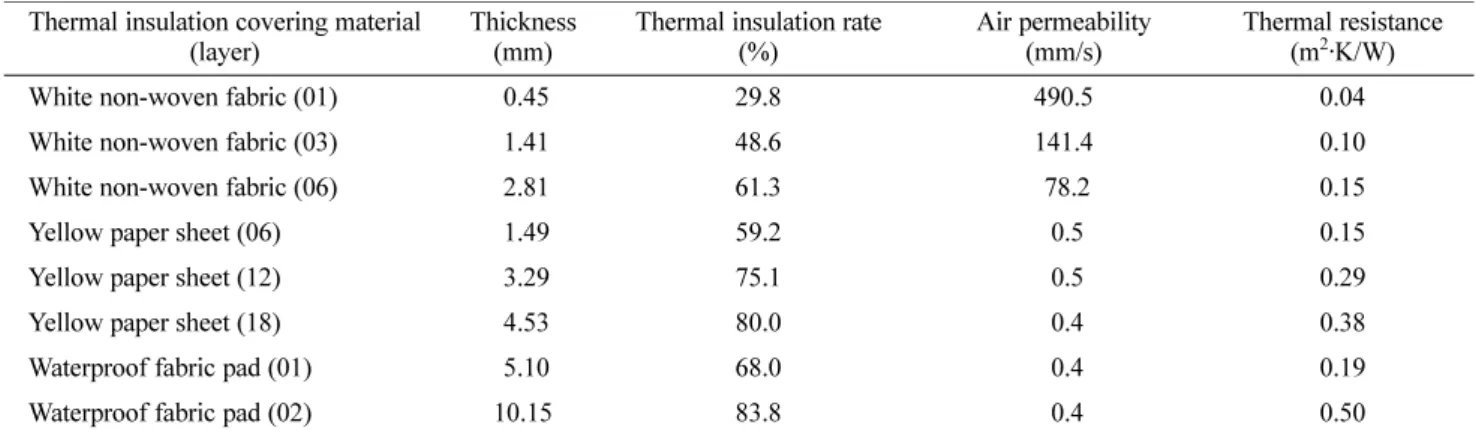
피복재료로 이용된 백색부직포는 시설재배의 피복자재 로서 많이 이용되는 polyester(PE) 제품 중에서 무게 100g/m2 제품을 사용하였다. 황색일반지는 국내에서 가 축 사료용 포대로 사용되는 종이를 재활용하였으며 무게 80g/m2 제품을 사용하였다. 방수패드는 자체 제작하였으 며 130g/m2 무게의 방수천 2겹 사이에 227g/m2 무게의 PET가 주성분인 화학솜 1겹을 넣어 제작하였다. 백색부 직포, 황색일반지, 방수패드의 구성 및 특성은 Table 1과 같았다.
2. 피복재의 물리적 특성 조사
피복재 샘플을 한국의류시험연구원(KATRI)에 의뢰하여 물리적 특성을 측정하였다. KATRI에서 측정 가능한 보 온과 관련되는 항목을 중심으로 두께(KS K 0506:2006), 보온율(KS K 0560:2011), 공기투과도(KS K ISO 9237 :2011), 열저항(KS K 0466:2015)을 측정하였다(Kim et al., 2009). 데이터는 3반복하여 평균하였다.
보온율(%)은 시험편을 투과하여 방산되는 열손실을 측 정하여 계산하였으며, 보온율 측정을 위해 시험편을 50cm× 50cm 크기로 채취하여 항온발열체에 덮고 시험편 이 있을 때와 없을 때 방열량을 측정하여 이를 보온율로 계산하였다. 보온율은 다음의 식에 따라 계산하였다.
보온율(%) = (1 − a2 / a1) × 100
a1:발열체에 시험편이 없을 때의 방열량(W/cm2), a2:발열체에 시험편을 부착하였을 때의 방열량(W/cm2)
공기투과도(mm/s)는 천의 일정 면적 및 압력 하에서 수직으로 공기를 통과하게 하여 일정시간 동안 천의 면 적에 대해 투과된 공기흐름속도를 측정하였으며, 시험편 을 20cm × 20cm 크기로 채취하여 시험편을 수직으로 통 과하는 압력을 100 Pa로 설정하여 측정하였다.
열저항(m2·K/W)은 열전달 계수를 먼저 측정하고 열전 달 계수의 역수로 계산하였다. 열전달계수는 열저항 측 정장치에서 시험편의 소비 전력, 시험편의 온도, 공기의 온도 등을 측정하여 혼합 열전달계수 및 시험편 열전달
Table 1. Components and properties of different thermal insulation covering materials used in this study.z Thermal insulation covering material Components and properties
White non-woven fabric White color non-woven fabrics made of polyester, 100g/m2
Yellow paper sheet Packing paper made of pulp, 80g/m2
Waterproof fabric pad
Waterproof woven polyester fabric 1 layer, 130g/m2 + chemical wool 1 layer, 227g/m2
+ waterproof woven polyester fabric 1 layer, 130g/m2
zWeight of the covering materials was investigated according to the quality test procedures of textile products of Korea Apparel Testing &
Research Institute (KATRI). Data are presented as means of three separate measurements.
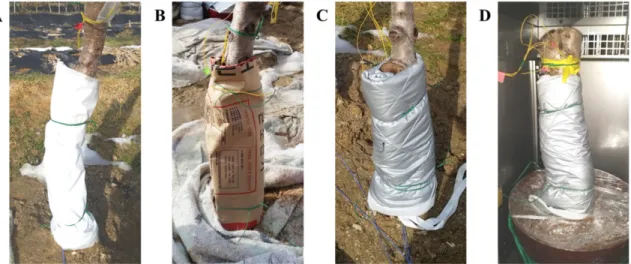
Fig. 1. A representative visual of 4-year-old ‘Janghowon Hwangdo’ peach trunks covered by different thermal insulation covering materi- als in the field (A, B, C) and chamber (D) conditions. A, white non-woven fabric; B, yellow paper sheet; C, waterproof fabric pad; D, waterproof fabric pad.
계수를 구하고 이를 환산하여 시험편 고유의 열전달계수 를 구하였다. 시험편의 열저항은 열전달 계수(R)를 다음 의 식에 따라 계산하였다.
R = 1 / V2 (V2 : 시험편 고유 열전달계수) 3. 포장에서의 피복재의 주간부 보온효과 조사 2015년 2월에 전북 장수군 장수읍 지역에 열간이 북 동-남서 방향으로 식재된 직경이 11cm 내외의 4년생 ‘장 호원황도’ 복숭아 나무 주간부에 피복재를 설치하지 않은 대조구 3주를 제외한 피복재 종류별로 3주씩 24주에 피 복재를 설치한 후 3월까지 주간부 수피조직의 온도를 4- channel thermocouple logger (HOBO, Onset Computer Corporation, Pocasset, MA, USA)를 이용하여 측정하였 다. 피복재의 주간단열효과는 낮 시간대에 햇볕에 노출 된 줄기의 온도와 피복재로 피복된 부위의 온도를 측정 하고 그 차이를 계산하여 평균하였다. 피복재의 야간보 온효과는 조사기간 중에서 최저기온이 -10~-15oC에 도 달한 날의 피복된 주간부 온도와 무처리 주간부 온도를 발췌하여 그 차이를 계산하였으며, 주간부 온도는 주간 부 남향의 지면에서 20cm 높이에서 수피 표면으로부터 약 5~10mm 깊이 부위의 온도를 측정하여 평균하였다.
데이터는 3반복하여 평균하였다.
4. 챔버에서의 피복재의 주간부 보온효과 조사 온도 제어가 가능한 저온프로그램챔버(VS-1203P4S-3C, Vision Scientific Co. Ltd., Daejeon, Korea)에서 복숭아 주간부에 피복재를 설치하고 주간부 수피조직의 온도를 측정하였다. 포장 조건과 동일한 환경에서 재배되었던 주간부 직경이 11cm 내외의 4년생 ‘장호원황도’ 복숭아 나무를 화분에 옮겨 주간부를 제외한 나머지를 제거한
뒤 사용하였으며, 챔버 온도는 -5oC에서 시작하여 15시 간에 걸쳐 -20oC까지 하강시키고 -20oC에서 2시간 유지 하였다. 그리고 온도처리 기간 동안에 챔버 대기 온도, 피복재로 피복된 부위의 주간부 온도, 피복되지 않은 무 처리의 주간부 온도를 측정하였다. -20oC에서 2시간 경과 하는 동안 피복된 부위의 주간부 수피 온도와 무처리 부 위의 주간부 온도의 차이값을 피복재의 보온효과로 계산 하여 평균하였다. 주간부 온도측정은 수피 표면으로부터 약 5~10mm 깊이 부위의 온도를 4-channel thermocouple logger를 이용하여 기록하였다. 데이터는 3반복하여 평균 하였다.
5. 통계 분석
연관성 데이터 분석은 SigmaPlot 12.5(Systat Software, Inc., San Jose, CA, USA)를 이용하여 수행하였다.
결과 및 고찰
1. 피복재의 물리적 특성
백색부직포, 황색일반지, 방수패드로 만들어진 세 종류 의 피복재의 열과 관련된 물리적 특성을 분석한 결과 (Table 2), 피복재의 두께가 증가할수록 보온율이 증가하 였다. 보온율이 가장 높았던 재료는 방수패드 2겹으로 83.8%를 나타냈다. 공기투과도는 황색일반지와 방수패드 가 0.4~0.5mm/s로 백색부직포 78.2~490.5mm/s에 비하 여 현저히 낮아 황색일반지와 방수패드가 공기차단 효과 가 우수한 것을 확인하였다. 열저항은 세 종류의 피복재 에서 모두 두께가 증가할수록 열저항값이 증가하는 것으 로 나타났으며, 열저항값은 방수패드2겹이 가장 높은 0.50m2·K/W을 나타냈다. 또한 보온율과 열저항값이 정의 상관을 보이는 것으로 확인되었다. 특히 동해 예방을 위
Table 2. Thermo-physical properties of different thermal insulation covering materials.z Thermal insulation covering material
(layer)
Thickness (mm)
Thermal insulation rate (%)
Air permeability (mm/s)
Thermal resistance (m2·K/W)
White non-woven fabric (01) 0.45 29.8 490.5 0.04
White non-woven fabric (03) 1.41 48.6 141.4 0.10
White non-woven fabric (06) 2.81 61.3 78.2 0.15
Yellow paper sheet (06) 1.49 59.2 0.5 0.15
Yellow paper sheet (12) 3.29 75.1 0.5 0.29
Yellow paper sheet (18) 4.53 80.0 0.4 0.38
Waterproof fabric pad (01) 5.10 68.0 0.4 0.19
Waterproof fabric pad (02) 10.15 83.8 0.4 0.50
zThickness (KS K 0506:2006), thermal insulation rate (KS K 0560:2011), air permeability (KS K ISO 9237:2011), and thermal resistance (KS K 0466:2015) of the covering materials were investigated according to the quality test procedures of textile products of Korea Apparel Testing & Research Institute (KATRI). Data are presented as means of three separate measurements.
한 피복재의 역할 중 포장에서 야간의 주간부 온도하강을 최대한 억제하는 것이 중요한데, 세 종류의 피복재의 보 온율, 열저항과 야간보온효과와의 연관성 분석 결과(Fig.
2), 피복재의 보온율(R2= 0.8222)과 열저항(R2= 0.7648)이 주간부 야간보온효과에 큰 영향을 미치는 것으로 확인되 었으며, 보온피복재의 선정에 있어 보온율과 열저항이 중요한 지표가 될 수 있다.
2. 피복재의 주간부 보온 효과
온대 목본식물이 저온을 견디는 기작은 동결회피 (freezing avoidance)와 동결내성(freezing tolerance)이 있 다(Thomashow, 1999). 동결회피는 세포내 수분의 어는 점을 현저히 낮춤으로써 준안정상태에서 수분상태를 유 지하는 초과냉각을 통해 세포외 결빙에도 불구하고 식물 체에 치명적인 세포내 결빙을 막는 기작을 말하며
(Wisniewski et al., 2004), 복숭아의 목부조직의 경우 -25~-45oC까지, 복숭아의 꽃눈은 약 -25oC까지 초과냉각 이 가능한 것으로 알려져 있다(Burke et al., 1976;
Wisniewski et al., 2004). 동결내성은 온도가 0oC 이하 로 내려갈 때, 식물세포에서 상대적으로 어는점이 높은 세포간극에서 먼저 빙핵이 형성되고, 화학포텐셜 구배에 의해 세포내 수분이 세포외부로 탈수되면서 평형상태를 유지하며 저온을 견디는 기작을 말한다(Thomashow, 1999). 복숭아의 수피조직은 이러한 동결내성 기작을 가 지고 있다.
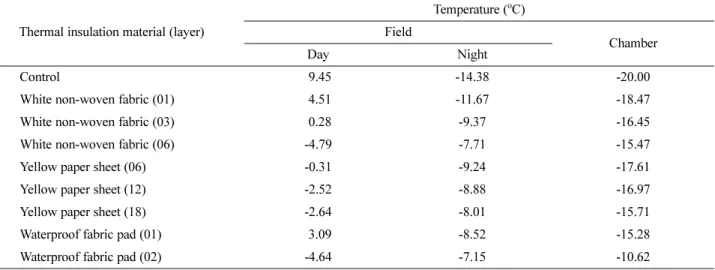
포장과 실험실에서 4년생 ‘장호원황도’ 복숭아의 주간 부를 피복재로 피복한 후 수피조직의 온도를 측정한 결 과는 Table 3과 같았다. 포장조건에서 피복재의 주간단 열효과는 무처리구와 비교하여 모든 피복재 처리구에서 보온효과가 있는 것으로 나타났으며, 특히 백색부직포6
Fig. 2. Logarithmic curves for relationship between thermal insulation rate or thermal resistance, and night thermal insulation effect.
Table 3. Temperatures (oC) on the bark tissues of the trunks covered by different thermal insulation covering materials in 4-year-old
‘Janghowon Hwangdo’ peach trees in the field and chamber conditions.
Thermal insulation material (layer)
Temperature (oC) Field
Chamber
Day Night
Control 9.45 -14.38 -20.00
White non-woven fabric (01) 4.51 -11.67 -18.47
White non-woven fabric (03) 0.28 -9.37 -16.45
White non-woven fabric (06) -4.79 -7.71 -15.47
Yellow paper sheet (06) -0.31 -9.24 -17.61
Yellow paper sheet (12) -2.52 -8.88 -16.97
Yellow paper sheet (18) -2.64 -8.01 -15.71
Waterproof fabric pad (01) 3.09 -8.52 -15.28
Waterproof fabric pad (02) -4.64 -7.15 -10.62
겹, 황색일반지18겹, 방수패드2겹이 무처리와 비교하여 각각 14.24, 12.09, 14.09oC 만큼 온도상승을 막았던 것 을 관찰하였다. 포장조건에서 피복재의 야간보온효과는 또한 무처리구와 비교하여 모든 피복재 처리구에서 보온 효과가 있는 것으로 나타났으며, 특히 백색부직포6겹, 황색일반지18겹, 방수패드2겹이 무처리와 비교하여 각각 6.67, 6.37, 7.23oC 만큼 온도하강을 막았던 것을 확인하 였다. 실험실조건에서 피복재의 보온효과는 무처리구와 비교하여 백색부직포6겹, 황색일반지18겹, 방수패드2겹 이 -20oC의 온도에 반응하여 각각 4.53, 4.29, 9.38oC 만 큼 보온효과를 보였다. 일반적으로 온도가 -10°C일 경 우, 세포내 수분의 90% 이상이 세포외부로 탈수되며 (Thomashow, 1998), 이 과정에서 세포의 원형질분리 (plasmolysis)가 발생한다. 한편 낮시간 동안 양광면의 경 우 수피조직의 온도가 15~20oC까지 상승할 수 있으며, 온도가 상승할 때 세포외부의 수분이 다시 세포내부로 들어가면서 원형질복귀(deplasmolysis)가 일어난다. 또한 복숭아의 수피조직 및 목부조직은 모두 고온에 의한 탈 순화로 발생되는 내한성의 소실이 저온순화에 의한 내한 성 획득보다 훨씬 더 빠른 속도로 진행된다(Shin et al., 2015). 따라서 겨울철 주야간의 온도편차가 심할 경우 빠르게 내한성을 소실할 수 있고, 반복된 원형질분리와 원형질복귀에 의해 심각한 원형질막의 손상이 나타날 수 있으며(Thomashow, 1998), 이는 곧 복숭아 주간부의 동 해로 이어질 수 있다. 본 연구에서 피복재의 설치에 의 한 보온효과는 이러한 원형질막의 손상으로 인한 복숭아 주간부 동해 피해를 경감시켜줄 수 있을 것으로 판단되 었다.
적 요
본 연구는 복숭아 주간부 동해 예방을 위한 피복재 의 보온성을 평가하기 위해 백색부직포, 황색일반지, 방수패드로 만들어진 피복재의 물리적 특성 및 보온성 을 평가하고 실제 겨울철 복숭아 주간부 보온효과를 구명하여 피복재로서의 이용가능성을 검토하기 위해 수행하였다. 세 피복재 중 2겹방수패드 처리가 보온율 과 열저항성이 가장 우수하였다. 2겹방수패드 처리의 주간단열효과는 14.09oC 만큼 온도상승을 차단하였고, 야간보온효과는 7.23oC 만큼 온도하강을 차단하여 보 온효과가 가장 우수함을 확인하였다. 따라서 방수패드 재질을 보온피복재로 개발·보급할 경우 복숭아 주간부 동해 피해를 경감시키는데 도움을 줄 수 있을 것으로 생각되었다.
추가 주제어 : 내한성, 단열, 동해
사 사
본 연구는 농촌진흥청 농업기후변화 대응체계 구축 과 제(과제번호 : PJ010169012016)의 지원에 의해 이루어 진 것임.
Literature Cited
Arora, R., M.E. Wisniewski, and R. Scorza. 1992. Cold accli- mation in genetically related (sibling) deciduous and ever- green peach (Prunus persica [L.] Batsch). I. Seasonal changes in cold hardiness and polypeptides of bark and xylem tissue. Plant Physiol. 99:1562-1568.
Burke, M.J., L.V. Gusta, H.A. Quamme, C.J. Weiser, and P.H.
Li. 1976. Freezing and injury in plants. Ann. Rev. Plant Physiol. 27:507-528.
Flore, J.A. 1994. Stone fruit, pp. 233-270. In: B. Schaffer and P.C. Andersen (eds.). Handbook of environmental physiol- ogy of fruit crops. CRC Press. Boca Raton, Fla, USA. 310p.
Johnson, D.E. and G.S. Howell. 1981. Factors influencing crit- ical temperatures for spring freeze damage to developing primary shoots on Concord grapevines. Amer. J. Enol. Vitic.
32:144-148.
Kalberer, S.R., M.E. Wisniewski, and R. Arora. 2006. Deaccli- mation and reacclimation of cold-hardy plants: Current understanding and emerging concepts. Plant Sci. 171:3-16.
Kim, Y.-B., S.-Y. Lee, and B.R. Jeong. 2009. Analysis of the insulation effectiveness of the thermal insulator by the installation methods. J. Bio-Environ. Cont. 18:332-340.
Pagter, M., I. Lefevre, R. Arora, and J.F. Hausman. 2011.
Quantitative and qualitative changes in carbohydrates asso- ciated with spring deacclimation in contrasting Hydrangea species. Environ. Exp. Bot. 72:357-367.
Shin, H., Y. Oh, and D. Kim. 2015. Differences in cold hardi- ness, carbohydrates, dehydrins and related gene expressions under an experimental deacclimation and reacclimation in Prunus persica. Physiol. Plant. 154:485-499.
Shin, H., S. Oh, R. Arora, and D. Kim. 2016. Proline accumu- lation in response to high temperature in winter-acclimated shoots of Prunus persica: A response associated with growth resumption or heat stress? Can. J. Plant Sci. 96:630- 638.
Thomashow, M.F. 1998. Role of cold-responsive genes in plant freezing tolerance. Plant Physiol. 118:1-7.
Thomashow, M.F. 1999. Plant cold acclimation: Freezing tol- erance genes and regulatory mechanisms. Annu. Rev. Plant Physiol. Plant Mol. Biol. 50:571-599.
Wisniewski, M., E. Ashworth, and K. Schaffer. 1987. The use of lanthanum to characterize cell wall permeability in rela- tion to deep supercooling and extracellular freezing in woody plants. I. Intergeneric comparisons between Prunus, Cornus, and Salix. Protoplasma 139:105-116.
Wisniewski, M., C. Bassett, and L.V. Gusta. 2003. An over- view of cold hardiness in woody plants: Seeing the forest through the trees. HortScience 38:952-959.
Wisniewski, M., M. Fuller, J. Palta, J. Carter, and R. Arora.
2004. Ice nucleation, propagation, and deep supercooling in woody plants. J. Crop. Improv. 10:5-16.