Characteristics of Agronomy to Selected 3 Lines from Native Green Waxy Rice ( Oryza sativa L.)
Hyun-Sik Chun*
Department of Crop Science & Biotechnology, College of Life Science & Natural Resources, Jinju National University Received January 18, 2010 /Accepted January 22, 2010
In order to find out better cultivation practices for environmentally-friendly agriculture, an experi- ment with four fertilizer levels and one cultivar, ‘Boseokchal’, and three lines, GG-05-03, GG-05-04, and GG-05-07 was carried out. Those lines had been selected from native green waxy rice over a pe- riod of five years (2004~2008). The tillering numbers of both the GG-05-03 and GG-05-04 lines were similar, but GG-05-07 was less than those. Regarding plant height, both GG-05-04 and GG-05-07 were higher than ‘Boseokchal’, while GG-05-03 was similar to it. There was no marked difference of quantitative character amond the three lines regarding grain weight and grain number of ear.
1000-grain weights of all three lines were slightly light compared to ‘Boseokchal’ cultivar. Head rice yields of both the GG-05-03 and GG-05-07 lines were less than ‘Boseokchal’, but the GG-05-04 line was similar to it. Only total lipids of all compositions of brown rice showed a slightly different rate compared to ‘Boseokchal’. These results summarize that the GG-05-07 line was shown to be better than both the GG-05-03 and GG-05-04 lines for environmentally-friendly agriculture practices.
Key words : Oryza sativa, waxy rice, environmentally-friendly agriculture
*Corresponding author
*Tel:+82-55-751-3222, Fax:+82-55-751-3229
*E-mail : [email protected]
서 론
재래종 품종에 관한 연구는 건강식품에 대한 관심이 높아 짐에 따라 현실적으로 재배면적이 해마다 증가되고 있음[1]
에도 불구하고, 재래종의 양적 형질의 특성 및 재배기술과 관련한 문헌으로서 정보가 거의 없다[2,6,7]. 그러나 일반농 가에서 오래 동안 재배 되어왔고 이를 뒷받침 할 수 있는 연 구가 이루어지지 않았다는 점에서 연구의 필요성이 제기되 어왔다. 그리고 재래종은 유전적 특성상 gene pool 상태를 유지하고 있어 불량한 환경조건에서도 잘 적응하는 경향이 있으므로 친환경농업을 지향하는 현재의 농업상 더욱이 그 중요성을 아무리 강조해도 부족함이 없다 할 것이다. 지속 가능한 농업경영과 농업환경뿐만 아니라 생태환경의 전체를 생각하고 보호․보존하고자 하는 노력들이 있어왔다. 이러 한 노력의 한 분야로서 전체 경지면적 중에 차지하는 논의 환경과 이 환경의 보존을 위해서는 저투입과 저생산의 고품 질 쌀생산이 필요하다. 작물의 재배학적 중요한 요소는 그 토양과 환경에 적절한 품종 선택일 것이다. 이와 더불어 재 배 환경적으로 적은 시비량으로 고품질의 쌀을 생산할 수 있 는 재래종 품종을 선발할 필요성이 있다 할 것이다. 일반 농 가에서 많이 재배하는 품종인 ‘녹원찰’은 본 실험재료인 녹 색현미찰인 ‘생동찰’을 한국원자력연구원 방사선생명공학연 구센터가 종자에 감마선을 조사한 뒤 후대 검정 및 선발 과
정을 통해 육성한 신품종이다. 출수가 8월 20일경으로 빠르 고 키가 작아 내도복성의 특성이 있고 전국 어디서나 재배가 가능한 계통으로 보고된 바가 있다[2]. 이와 더불어 재래 품 종의 보존과 보급하는 것은 약재로서의 필요성, 유전자원으 로서 가치가 높으며, 재래품종으로서 종의 고정화를 위한 기 초 연구, 재배적 특성의 확립, 재배기술의 보급을 위한 연구 가 또한 필요하다.
따라서 본 연구에서는 재래종 계통 중에서 생육 특성, 시 비량 및 포기당 식재본수를 달리하여 분얼수, 초장, 이삭당 낟알수, 이삭당 낟알무게, 임실율, 천립중, 수량을 조사하고 자 하였다. 본 연구의 자료와 함께 보다 연구를 하면 향후 우 수한 품종이 친환경적 수도작 재배에 적합할 것으로 기대가 된다.
재료 및 방법
공시재료 및 재배방법
본 실험에 사용된 재래종 계통은 농가에서 일반적으로 재배
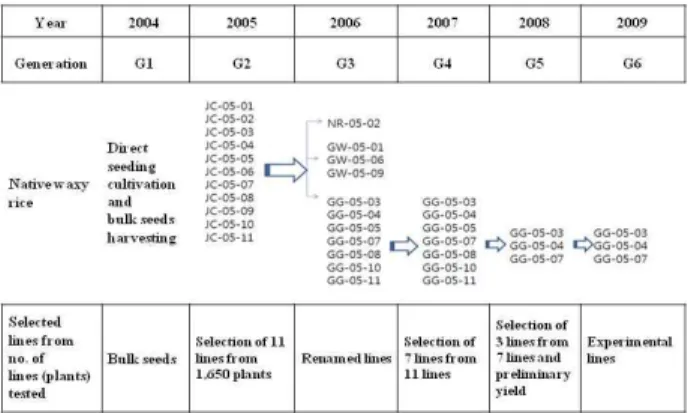
되고 있는 것을 수집하여 Fig. 1과 같이 선발하였다. 2004년
진주산업대학교 종합농장에서 재배를 시작하여 2005년에 11
계통을 선발하고, JC-05-01부터 JC-05-11까지 11 계통을 명명
하였고, 2006년에 11 계통 중 3 계통은 현미색이 흰색이고 찰
벼로 GW-05-01, GW-05-06, GW-05-09로 다시 명명하였으며,
1 계통은 현미색이 붉고 메벼로 NR-05-02로 다시 명명하였고,
그리고 7 계통은 현미색이 녹색이고 찰벼로 GG-05-03, GG-05-04,
GG-05-07, GG-05-08, GG-05-10, GG-05-11로, 찰벼와 메벼 그
Fig. 1. The pedigree diagram of new lines selected from native waxy rice.
리고 현미색의 차이에 따라 특성 별로 나누어서 다시 명명 하였다. 2007년에는 3 계통(GG-05-03, GG-05-04, GG-05-07)을 선발하고, 이 3개 계통을 2008년에 심어 수확한 종자를 실험재 료로 사용하였다(Fig. 1).
비교를 위한 공시 재료로써 ‘보석찰(Boseokchal)’을 사용하 였다. 공시포장은 창원시 북면과 진주산업대학교 종합농장에 서 실시하였으며, 재식거리는 30×15 cm이고, 처리구간의 거리 는 60 cm이었다. 시비량은 10a 당 기준으로 각각의 비료 30 kg를 밑거름으로 전량 시비하였다. 실험기간은 2009년 5월 4 일에 원예용 포트에 파종(못자리)하여 6월 5일 시험포에 손으 로 이앙(모내기)하고 10월 30일에 수확하였다.
실험설계
시비량에 따른 생육 및 수량을 조사하기 위하여 무시비 구, N-P-K:21-17-17% (w/w) (남해화학)로 조성된 관행 복합 비료 시비구, N-P-K:22-12-12% (w/w)와 3% 고토가 포함된 (신세대
Ⓡ, 남해화학) 환경 보존형 복합비료 시비구, N-P-K:
9-5-6% (w/w)와 1% 고토, 0.1% 붕소, 40% 유기물(한번에
Ⓡ, 동부한농화학)이 포함된 친환경 유기 복합비료 시비구 등으 로 4개의 처리구가 설계되었고, 분얼수 조사를 위하여 포기 당 1, 2, 3, 7본씩 각각 원예용 200구 포트에 파종하여 각 포 기를 4개 처리구로 하였다. 각각의 전체 처리구는 16개 처리 구이었다.
생육 및 미질조사
본답 이앙 후 5일 간격으로 초장, 분얼수를 조사하였으며, 천립중, 임실률, 수량 및 미질은 수확 후 수분함량 15%로 자연 건조하여 조사하였다.
결과 및 고찰
입본수(立本數)가 분얼수에 미치는 영향
무시비구에서 포기당 1본을 심었을 경우 분얼수는 ‘보석찰’
이 18개, GG-05-03와 GG-05-04가 19개, GG-05-07이 24개이었
Fig. 2. Changes of tillering number in rice lines transplanted with one seedling (A) and two seedlings (B) as treated with no fertilizer in paddy field.
으며(Fig. 2A), 포기당 2본을 심었을 경우 ‘보석찰’이 17개, GG-05-03이 19개, GG-05-04가 17개, GG-05-07이 24개이었다 (Fig. 2B). 포기당 3본을 심었을 경우 ‘보석찰’이 17개, GG-05-03이 17개, GG-05-04가 20개, GG-05-07이 25개이었고 (Fig. 3A), 포기당 7본을 심었을 경우 ‘보석찰’이 14개, GG-05-03이 24개, GG-05-04가 18개, GG-05-07이 23이었다 (Fig. 3B). 그러나 같은 계통에서 포기당 1, 2, 3, 7본을 심었 을 경우 전체 포기당 줄기수는 ‘보석찰’의 경우 각각 19개, 19개, 20개, 21개로서 큰 차이를 보이지 않았고, GG-05-03의 경우 각각 20개, 21개, 20개, 31개이었으며, GG-05-04의 경우 각각 20개, 19개, 23개, 25개이었고, GG-05-07의 경우 각각 25개, 26개, 28개, 30개이었다(Figs. 2, 3). 각 계통별 1, 2, 3, 7본을 심은 ‘보석찰’의 경우 본당으로 계산을 해 보면 19개 (19/1), 9.5(19/2), 6.7개(20/3), 3개(20/7)씩 각각 분얼되었으 며, GG-05-07의 경우 본당 25개(25/1), 13개(26/2), 9.3개 (28/3), 4.3개(30/7)씩 각각 분얼이 되었다. 포기로 보아 본당 분얼수가 다르지만 포기당 전체 줄기수에서는 큰 차이를 보 이지 않는 것은 분얼이 포기당 입본의 수에 의해 결정된다 하더라도 결과적으로는 포기당 재식 밀도와 관계가 있어 분 얼이 포기당 제한을 받는 것으로 보아진다[4,8,9]. 이러한 결 과가 포기당 입본수를 3 이하로 하더라도 포기당 분얼수에 는 큰 차이를 보이지 않는 것으로 나타났다. 본 실험에서 ‘보 석찰’과 비교하여 선발한 재래종 녹색현미찰의 분얼수가 다 소 많으므로 같은 3개 입본수로 하고 무시비구의 경우에서 비교하면 선발한 GG-05-07의 분얼수가 28개 이므로 ‘보석 찰’ 20개 보다는 수량면에서 다소 유리할 것으로 보아진다.
Fig. 3. Changes of tillering number in rice lines transplanted
with three seedlings (A) and seven seedlings (B) as treat-
ed with no fertilizer in paddy field.
Table 1. Agronomy characteristics of a cultivar and the different lines of rice Cultivar and
lines Plant height
(cm) Grain weight
per ear (g) Grain No.
per ear Grain yield
per 10a (kg) Tiller No.
per hill Boseokchal
GG-05-03 GG-05-04 GG-05-07
103.0±2.45 106.5±2.52 123.3±1.26 114.0±3.92
52.3±5.24 43.5±1.62 54.2±2.31 55.6±0.85
2076.5±36.25 1872.5±57.00 2195.3±93.25 2490.5±38.00
729.0±73.00 606.5±22.50 755.8±32.25 774.3±11.75
19.8±0.75 23.0±4.80 21.8±2.25 27.3±1.75 Data were expressed as the mean±standard error (SE, n=4).
비료 시비구별 계통의 분얼수를 조사하기 위해 무시비구, N-P-K:21-17-17% (w/w)로 조성된 관행 복합비료 시비구, N-P-K:22-12-12% (w/w)와 3% 고토가 포함된 환경 보존형 복 합비료 시비구, N-P-K:9-5-6% (w/w)와 1% 고토, 0.1% 붕소, 40% 유기물이 포함된 친환경 유기 복합비료 시비구에서 재배 실험되었다.
‘보석찰’의 경우 유기 복합비료, 관행 복합비료, 환경 보존 형 복합비료, 무시비구 순으로 분얼수가 많았으며, GG-05-03 의 경우 관행 복합비료, 환경 보존형 복합비료, 유기 복합비료, 무시비구 순으로 분얼수가 많았고, GG-05-04의 경우 관행 복 합비료, 유기 복합비료, 무시비구, 환경보존형 복합비료 순으 로 분얼수가 많았으며, GG-05-07의 경우 관행 복합비료, 환경 보존형 복합비료, 무시비구, 유기 복합비료 순으로 많았다 (Fig. 4).
관행 복합비료구에서만 대조구인 무시비구보다 3 계통의 분얼수가 많았으나, GG-05-04의 계통은 환경 보존형 복합비료 구와 유기 복합비료구가 오히려 무시비구보다 분얼수가 적었 다. 10a당 N-P-K: 6.3-5.1-5.1kg 성분비로 되었을 경우 3 계통의 분얼수가 모두 많으므로 권장 복합비료로 간주할 수 있겠다.
Fig. 4. Tillering number of differnet line, ‘Boseokchal’, GG-05-03, GG-05-04 and GG-05-07, and varied fertilizer. Control, No fertilizer; 21-17-17, compound fertilizer mixed with N-P-K: 21-17-17% (w/w) each; 22-12-12+3, compound fertilizer mixed with N-P-K: 22-12- 12% (w/w) each, and contained 3% Magnesia; 9-5-6, compound fertilizer mixed with N-P-K: 9-5-6% (w/w) each, and contained 1% Magnesia, 0.1% Boron and 40% organic compounds.
계통별 초장은 ‘보석찰’이 103 cm에 비해 GG-05-04는 123 cm 이고 GG-05-07은 114 cm로 다소 크고, GG-05-03은 107 cm로 비슷하였다. 작물학적 생육과 수량의 특성을 볼 때는 3계통 중 GG-05-07 계통이 보다 우수한 계통인 것으로 보이나(Table 1), 앞으로는 쌀의 이화학적 성질, 세포 생리활성력, 항산화력 등 에 대한 보다 깊이 있는 연구가 있어야 할 것으로 보인다.
시비량이 생장과 수량에 미치는 영향
무시비구, N-P-K: 21-17-17% (w/w)을 시비한 관행 복합비 료 시험구, N-P-K: 21-12-12% (w/w)에 고토 3%가 포함된 환경 보존형 복합비료 시험구, N-P-K: 9-5-6 % (w/w)에 1% 고토, 0.1% 붕소, 40% 유기물이 포함된 유기 복합비료 시험구에 각각
‘보석찰’, GG-05-03, GG-05-04, GG-05-07를 재배한 결과, 초장 은 GG-05-03의 경우 시비량의 차이와 관계없이 다소 클 뿐 시 비량이 각 계통별 초장에는 영향을 미치지 않았다(Fig. 5A).
이삭당 낟알의 무게는 무시비구, GG-05-04에서 가장 무거웠 고, GG-05-04는 시비량에 따라 낟알의 무게에 큰 차이를 보이 지 않았고, ‘보석찰’, GG-05-03, GG-05-07 계통의 경우 무시비 구에 비해 각 시비구에서 낟알의 무게가 무거웠다(Fig. 5B).
시비량에 따른 이삭당 낟알수는 이삭당 낟알 무게의 결과와 유사하였다(Fig. 6A). 시비량에 따른 각 계열의 임실률은 시비 량에 관계없이 유사하였고, 계통간에도 큰 차이를 보이지
Fig. 5. Plant height (A) and grain weight per ear (B) of different line, ‘Boseokchal’, GG-05-03, GG-05-04 and GG-05-07, and varied fertilizer. Control, No fertilizer; 21-17-17, com- pound fertilizer mixed with N-P-K: 21-17-17% (w/w) each; 22-12-12+3, compound fertilizer mixed with N-P-K:
22-12-12% (w/w) each, and contained 3% Magnesia;
9-5-6, compound fertilizer mixed with N-P-K: 9-5-6%
(w/w) each, and contained 1% Magnesia, 0.1% Boron
and 40% organic compounds.
Table 2. Main composition of the different lines of brown rice Cultivar and
lines Carbo-hydrate
(%) Water
(%) Total protein
(%) Total lipid
(%) Fiberoid
(%) Ash
(%) Boseokchal
GG-05-03 GG-05-04 GG-05-07
78.1±0.26 77.5±0.63 77.6±0.26 78.0±0.27
10.8±0.07 10.4±0.02 10.4±0.09 10.5±0.06
7.5±0.07 8.1±0.56 7.4±0.08 7.5±0.06
1.9±0.29 2.3±0.11 2.8±0.16 2.2±0.15
0.8±0.10 0.8±0.06 0.8±0.08 0.9±0.04
0.9±0.04 0.9±0.07 1.1±0.04 0.9±0.04 Data were expressed as the mean±standard error (SE, n=4).
Fig. 6. Grain number per ear (A) and percent of fertile grain (B) of different line, ‘Boseokchal’, GG-05-03, GG-05-04 and GG-05-07, and varied fertilizer. Control, No fertil- izer; 21-17-17, compound fertilizer mixed with N-P-K:
21-17-17% (w/w) each; 22-12-12+3, compound fertilizer mixed with N-P-K: 22-12-12% (w/w) each, and con- tained 3% Magnesia; 9-5-6, compound fertilizer mixed with N-P-K: 9-5-6% (w/w) each, and contained 1%
Magnesia, 0.1% Boron and 40% organic compounds.
Fig. 7. 1000-grain weight (A) and grain yield per 10a (B) of dif- ferent line, ‘Boseokchal’, GG-05-03, GG-05-04 and GG-05-07, and varied fertilizer. Control, No fertilizer; 21- 17-17, compound fertilizer mixed with N-P-K: 21-17-17%
(w/w) each; 22-12-12+3, compound fertilizer mixed with N-P-K: 22-12-12% (w/w) each, and contained 3%
Magnesia; 9-5-6, compound fertilizer mixed with N-P-K:
9-5-6% (w/w) each, and contained 1% Magnesia, 0.1%
Boron and 40% organic compounds.
않았다(Fig. 6B). 천립중의 경우 시비량별 ‘보석찰’과 비교하여 GG-05-03, GG-05-04, GG-05-07이 다소 가벼웠다(Fig. 7A). 수 량의 경우 무시비구에서 GG-05-04가 다소 많았으며, ‘보석찰’
과 GG-05-04는 시비량에 따른 차이가 크지 않았으나, GG-05-03과 GG-05-07에서는 무시비구에 비해 수확량이 다소 많았다(Fig. 7B). 질소함량이 22%로 가장 많은데도 불구하고 GG-05-07의 경우 수량이 무시비구와 유사한 결과는 질소질
비료가 많을 경우 오히려 수량에는 좋지 않은 것으로 나타났 다[3,5]. 이로 미루어 볼 때, GG-05-04는 시비량에 따른 수량의 차이가 없는 반면에 GG-05-03과 GG-05-07은 시비량에서 차이 를 보이나 질소질이 많을 경우 GG-05-07에서는 수량이 적은 것으로 나타났다. 결과적으로 9%의 질소가 포함된 유기물 함 량이 40%인 경우에도 크게 수량에는 영향을 미치지 않은 것으 로 보아 화학비료량을 줄일 수 있는 계통은 GG-05-04와 GG-05-07인 것으로 나타났으며, 재래종 녹색현미찰에서 선발 한 3 계통이 생태환경을 보존하고, 저투입과 지속 가능한 농업 경영에 적합한 계통인 것으로 보여지나, 특히 GG-05-07의 경 우 질소함량이 많은 환경 보존형 복합비료 시비구에서 수량이 낮게 나타났으므로 질소질 비료 사용에 유의하여야 할 것으로 보여진다.
탄수화물, 조단백질, 수분함량, 조지방 함량 등 현미 품질 특성과 관련한 항목을 조사한 결과(Table 2), 탄수화물 함량 은 ‘보석찰’ 78.1%에 비해 3개 계통은 77.5~78.0%, 수분함량
‘보석찰’의 10.8%에 비해 10.4~10.5%, 조단백질 함량은 ‘보 석찰’ 7.5%에 비해 7.4~8.1%, 섬유질 함량은 ‘보석찰’ 0.8%
에 비해 0.8~0.9%, 회분은 ‘보석찰’ 0.9%에 비해 0.9~1.1%
범위로 비슷하였지만, 조지방에서 ‘보석찰’ 1.9%에 비해 2.2
~2.8% 범위로 약간 많은 함량의 차이를 보였다. 조지방의 함량이 다소 차이를 보인 ‘보석찰’와 GG-05-04를 비교해 보 았을 경우 탄수화물과 수분함량이 ‘보석찰’이 다소 적은 것 에 의해 GG-05-04의 조지방 함량이 다소 많은 비율로 나타 난 것으로 보인다.
감사의 글
이 논문은 2008년도 진주산업대학교 기성회 연구 지원금으 로 수행되었음.
References