필발(Piper longum Linn.)로부터 전립선암 세포사멸물질 pipernonaline의 분리 및 동정
김광연†․김윤진†․이완1․유선녕․조효진2․이선이3․이한승4․손재학4․오현철4․안순철*
부산대학교 의학전문대학원, 1부산대학교병원 비뇨기과, 2국립암센타, 3농촌진흥청 국립원예특작과학원,
4신라대학교 의생명과학대학 바이오식품소재학과
Received April 16, 2009 /Accepted May 21, 2009
Purification and Identification of Apoptosis Modulator Pipernonaline from Piper longum Linn.
against Prostate Cancer Cells. Kwang-Youn Kim
†, Yun-Jin Kim
†, Wan Lee
1, Sun-Nyoung Yu, Hyo-Jin Cho
2, Sun-Yi Lee
3, Han-Seung Lee
4, Jae-Hak Sohn
4, Hyuncheol Oh
4and Soon-Cheol Ahn*. Pusan National University School of Medicine, Yangsan 626-770, Korea,
1Department of Urology, Pusan National University Hospital, Busan 602-739, Korea,
2Division of Translational Clinical Research I, National Cancer Center, Goyang 410-769, Korea,
3Rural Development Administration, National Institute Horticultural & Herbal Science, Jeju 697-943, Korea,
4Department of Bio-Food Materials, College of Medical and Life Sciences, Silla University, Busan 617-736, Korea - Prostate cancer has been a critical health problem due to an increase of prostate cancer-related deaths worldwide. Also, a frequent treatment option for prostate cancer is androgen ablation, but this treatment has a limited scope, especially for hormone-refractory cancer.
There is an urgent need for the identification of alternative therapeutic strategies for prostate cancer.
Previously, over one hundred species of dried-plant methanol extracts were tested for inhibitory ef- fects on proliferation. One of them, Piper longum Linn. was selected based on its potent anti-pro- liferation effect. The dried root of P. longum Linn. was extracted with 100% methanol for 2-3 days and its extract was fractionated using chloroform. The chloroform layer was then subjected to column chromatography on silica gel, reverse phase-18 (RP-18) and Sephadex LH-20, in turn. Finally, the pure compound was obtained and identified as pipernonaline by NMR spectroscopic and physico-chemical analysis. In this study, anti-proliferation and cell cycle arrest effects of pipernonaline on human pros- tate cancer PC-3 cells were investigated using the MTT and PI staining, respectively. Our findings suggest that pipernonaline represents a dose-dependent growth inhibition pattern on PC-3 cells and, moreover, its growth inhibition is associated with sub-G1 and G0/G1 cell cycle accumulation in PC-3 cells. Also, these results provide an anticancer candidate for human prostate cancer.
Key words : Prostate cancer, purification, pipernonaline. Piper longum, growth inhibition
*Corresponding author
*Tel:+82-51-510-8092, Fax:+82-55-382-8090
*E-mail : [email protected]
서 론
전립선암은 최근 우리나라 남성들에게 가장 빠르게 증가하 고 있는 암으로 대부분 50대 이상의 중․장년층에서 발생한 다. 북미나 서구 유럽 등의 남성암 중 가장 흔한 암으로 미국의 경우 연간 발생하는 남성 암 중에서 빈도가 가장 높으며 암으 로 인한 사망원인 중 폐암에 이어 2위를 차지하고 있다. 우리 나라의 경우도 평균 수명의 증가 및 노인 인구의 증가, 서구 식생활로 인해서 발병 빈도가 빠르게 증가하고 있다[11]. 현재 까지 전립선암을 치료하는 방법으로는 androgen 제거술, 방 사선 요법, 화학적 치료법 등이 많이 사용되었으나 치료영역 이 제한적이고 다시 재발할 가능성 또한 있어서 근본적인 치 료책으로는 사용되지 못하는 실정이다. 게다가 나이, 인종, 식 습관, 신진대사 등과 같은 요인들이 전립선 암 발생에 관련되 어 있다고 알려져 있으나 정확한 매커니즘은 밝혀져 있지 않
다[15,16]. 최근에는 새로운 전립선암 치료방법으로 생약이나 식물, 항생물질들을 이용해 세포 사멸을 유도하는 화학요법이 많이 연구되어지고 있다[8].
필발(Piper longum Linn.)은 후추나무과(Pieperaceae) Piper 종에 속하고, 열대 및 아열대에 걸쳐 약 700종 이상이 존재하 며 상업적, 경제적 및 의학적으로 가치가 있는 식물 중 하나이 다. 또한 경제적으로도 세계 향료시장에서 후추생산에 중요한 위치를 차지하며, 몇몇 종들은 지역적으로 원예용 관엽식물로 재배되고 있다[11]. 현재까지 후추나무과의 식물에서 많은 화 합물이 분리되어졌으며[10,13], 이 화합물들에 대해 살충 [9,14,18] 및 살균활성[7]과 같은 효과에 관한 연구가 수행되었 다. 이들 중 piperlongumine은 구조적으로 3,4,5-trimethox- ycinnamic acid (TMCA)를 모체로 하여 piperidine을 포함하 고 있으며[9] 세포독성에 관한 활성[7]이 보고되어진바 있다.
본 연구에서는 다양한 한약재 가운데 세포독성이 높게 관찰
된 필발의 MeOH 추출물로부터 chloroform으로 추출하여 용
매 분획하고, chromatography로 분리․정제하여 활성 화합물
을 분리하고 그 화합물의 구조를 동정하고, 이 화합물에 대하
여 세포독성에 대한 활성을 검토하여 얻어진 결과를 보고하고 자 한다.
재료 및 방법
한약 재료
본 연구에 사용된 필발(P. longum Linn.)는 2007년 부산광역 시 서구 소재 한약건재상에서 구입하여 분쇄기로 분말로 제조 한 다음 시료로 사용하였다.
시약 및 기기
시료의 추출 및 용매분획에 이용한 유기용매는 시약용 (extra pure, Duksan, Ansan, Korea)을 그리고 HPLC에는 HPLC grade (J.T.Baker, Ashland,USA)의 용매를 이용하였다.
Open Column chromatography 충진용 silica gel로는 Kiesel gel 60 (230-400 mesh, Merck, Germany)을 사용하였고, thin layer chromatography (TLC)용 plate로는 precoated silica gel 60F254 (Merck, Germany)과 RP-18 F254 (Merck, Germany) 을, 발색시약으로는 10% H
2SO
4을 사용하였다. 본 실험에 사용 한 HPLC는 SCL-10A cotroller, SPD-M10A UV spectrophoto- metric detector, LC-10AT liquid chromatograph, FCV-10AL, DGU-14A (Shimadzu Scientific Co., Tokyo, Japan)로 구성되 었다. 각종 proton 및 carbon NMR spectra는 JEOL Eclipse NMR spectrometer (JEOL, Tokyo, Japan)을 이용하여 측정하 였으며 internal standard로 tetramethylsilane (TMS)를 이용 하여 chemical shift치를 정하였으며 δ (ppm)으로 표시하였다.
마지막으로 [3-(4,5-dimethyl-thiazol-2-yl)-2,5-diphenyl] tetra- zolium bromide (MTT), propidium iodide (PI)는 sigma사에 서 구입하였다.
암세포주와 세포배양
인간 전립선암 세포주인 PC-3 세포와 LNCaP 세포주는 American Type Culture Collection (ATCC, Manassas, VA, USA)로부터 분양받아 10% fetal bovine serum (FBS) (Hyclone Co.), 100 unit/ml penicilin, 100 µg/ml streptomy- cin (Hyclone Co.)이 첨가된 DMEM 배지(Hyclone Co., Logan, UT, USA)와 RPMI-1640 배지(Hyclone Co., Logan, UT, USA)에서 37
oC, 5% CO
2조건에서 배양하였다.
MTT assay를 이용한 세포 증식률의 측정
세포배양용 48 well plate를 이용하여 1×10
4cells/well의 농도로 전립선 암 세포주인 PC-3 세포와 LNCaP 세포를 분주 하고 24시간 동안 안정화시킨 후, 동정한 pipernonaline을 MeOH로 희석하여 각 well 당 적정 농도로 처리하였다. 24시 간 후 배지를 제거하고 [3-(4,5-dimethylthiazol-2-yl)-2,5- diphenyl] tetrazolium bromide (MTT)를 0.5 mg/ml 농도가
되게 배지로 희석하여 37
oC에서 4 시간 반응시킨 후, MTT 시 약을 제거하고 dimethylsulfoxide (DMSO)로 각 well에 생성 된 formazan을 녹인 후 ELISA reader로 540 nm에서 흡광도를 측정하였다. 이 흡광도는 MTT가 세포에 의해서 환원된 양으 로, 각 well에 존재하는 세포의 생존 수와 비례한다.
세포주기 분석
세포배양용 6-well plate를 이용하여 1×10
4cells/well의 농도로 전립선 암 세포주인 PC-3 세포를 분주하고 24시간 동 안 안정화시킨 후, 동정한 pipernonaline을 MeOH로 희석하 여 각 well 당 적정 농도로 처리하였다. 정상 및 pipernona- line이 처리된 배지에서 배양한 PC-3 세포들을 phosphate- buffered saline (PBS) 용액으로 세척한 후, 4
oC에서 12시간 70% ethanol에 고정하였다. 고정한 후 RNase A를 37
oC에서 1시간동안 처리하고 DNA intercalating dye인 propidium iodide(Sigma)로 DNA를 염색하였다. 다시 PBS로 세척 과정 을 거친 후 DNA flow cytometry (Becton Dickinson Co., Franklin Lakes, NJ, USA)에 적용시켜 형광반응에 따른 his- togram을 Modifit software (Becton Dickinson Co.)를 사용 하여 분석하였다.
물질의 분리 및 동정
건조된 필발 1.2 kg을 100% methanol (MeOH) 8 l로 2회 반복 추출하여 MeOH 추출물을 얻었다. MeOH 추출물을 증 류수에 현탁 시켜 chloroform (CHCl
3)층과 water층으로 분 리하여 chloroform 추출물 130 g을 얻었다. 정제되지 않은 chloroform 추출물을 silica gel (230-400 mesh, 1 kg, Merck) column chromatography를 이용하여 chloroform/n-hexane (1:1, v/v), n-hexane/ethylacetate (EtOAc) (3:1, 2:1, 1:1, v/v) 을 사용하여 순차적으로 용매 분획하였다. 각각의 분획물은 증발 건조시킨 후, 농축하여 TLC와 MTT assay를 통해서 활 성을 관찰하였다. 활성이 관찰된 분획을 초기의 용매인 chloroform/n-hexane (1:1)로 녹인 후에 reverse phase (RP-18) column chromatography와 Sephadex LH-20 col- umn chromatography에 충진 시켜 70% 와 100% MeOH의 용매로 분리하였다. 각각의 분획을 증발 건조시킨 후, 농축하 여 위에서 언급한 TLC와 MTT assay를 통해서 활성 분획을 선별하여 75% MeOH에 녹여서 항암효과를 나타내는 분획 을 검출하였다. 검출된 분획을 HPLC를 수행하여 분리 및 정 제하였으며, 각종 proton 및 carbon NMR spectra를 이용하 여 구조 동정하였다.
통계 분석
모든 실험은 2회 이상 실시하였으며, Microsoft office Excel
프로그램을 이용하여 평균값과 표준 편차를 산출하였으며 표
준편차는 그림에서 bar로 표시하였다.
결과 및 고찰
활성물질의 분리 및 정제
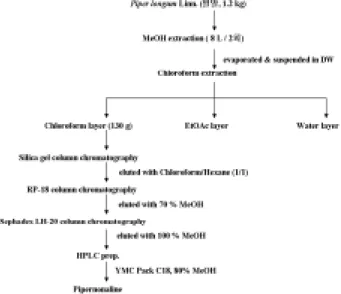
본 저자들은 백여 가지의 한약재 MeOH 추출물로부터 전 립선암의 세포 독성을 조사한 결과[4], 후추나무과에 속하는 필발의 건조된 열매 MeOH 추출물이 강력한 세포독성 효과를 나타내었다. 따라서 본 연구에서는 필발의 열매를 MeOH로 추출한 뒤, 증류수에 현탁 시켜 chloroform 용매로 용매 분획 하였다. 필발 1.2 kg을 분말로 분쇄한 후 건조하여 MeOH로 추출하고 chloroform으로 용매 분획하여 chloroform층 130 g 을 얻었다. 이들을 silica gel (230-400 mesh, Merck) column chromatography, reverse phase (RP-18) column chromatog- raphy와 Sephadex LH-20 column chromatography를 이용하 여 분획하여 TLC와 MTT 법으로 항암효과를 나타내는 분획을 검출하였다. 마지막으로 활성 분획을 YMC-PACK ODS C18 column (φ 6×150 mm, YMC-Gel Company, Tokyo, Japan)으 로 분당 0.5 ml의 유속으로 UV 254 nm에서 분리하였다(Fig.
1). 활성 화합물은 retention time 15.3분에서 확인하였고, pho- todiode array를 이용한 UV spectrum 측정 시 자외선 최대 흡수대(UV λmax)는 220, 260, 300 nm를 나타내었다(data not shown).
활성물질의 구조해석
본 연구에서 분리, 정제 된 활성 분획은 황색 분말의 형태로 서
1H-NMR,
13C-NMR을 통한 구조 분석한 결과(Fig. 2), ole- finic proton signal이 δ 6.02 (d, J=15.6 Hz), δ 6.83 ppm (dt, J=15.0, 7.0Hz)으로 trans double bond가 존재하는 것으로 추 정되었다. 또한
1H-NMR에서 δ 2.13-2.23 ppm에서 2개의 al- lylic methylene group이 존재하고, piperidine ring의 proton
Fig. 1. Isolation procedure of anticancer from chloroform layer of Piper longum Linn..
(A) (B)
Fig. 2. 1H-NMR and 13C-NMR analysis of pipernonaline purified from Piper longum Linn.. Spectra were taken at 500 MHz for proton (A) and 125 MHz for carbon (B). Chemical shifts were assigned the basis of the relative shift to TMS as an internal standard.
Fig. 3. Chemical structure of pipernonaline.
과 겹쳐지는 δ 1.43-1.59에서 두 개의 aliphatic methylene이 존재하였다. 한편, δ 1.50-1.63에서는 3개의 aromatic methyl- ene이 확인 되었고, δ 6.71-6.83에서는 aliphatic proton이 확인 되었다. 이와 같은 NMR spectrum의 정보를 기반으로 하여 LRESIMS (Fig. 4) 및 HMQC spectrum (Fig. 5) 등의 결과를 기존의 논문[17,19]들과 비교 분석한 결과, 필발로부터 분리한 전립선암 세포사멸조절물질은 piperidine 계열의 pipernona- line으로 최종 동정하였으며(Fig. 3).
1H-NMR과
13C-NMR에서 의 chemical shift (ppm)는 Table 1과 같았다.
활성물질의 세포 독성 측정
필발의 건조된 열매로부터 piperettine, pipereoctadecalidine 및 piperlongumine 등과 같은 화학 성분들이 보고되어졌고 [1,3,12], 그 화합물들이 항암 효과와 면역조절 효과 및 암 전이 에 대한 억제 효과가 보고되어져 있다[2,5,6]. 따라서 본 연구에 서는 필발 열매로부터 분리한 활성 화합물인 pipernonaline이 사람의 전립선암 세포주에서 세포독성 및 세포사멸에 효과가 있는 지를 확인하기 위하여 PC-3 및 LNCaP 세포주를 사용하 였으며, 두 세포주에 대한 세포 독성 영향을 먼저 조사하였다.
Fig. 4. LRESIMS data of pipernonaline.
Table. 1. NMR data for pipernonaline
Position δH (int., mult., J in Hz) δC
2 3 4 5 6 1' 2' 3' 4' 5' 6' 7' 8' 9' 2'' 3a'' 4'' 5'' 6'' 7'' 7a''
3.43-3.52 (2H, m) 1.50-1.63 (2H, m) 1.55-1.69 (2H, m) 1.50-1.63 (2H, m) 3.51-3.64 (2H, m)
-- 6.23 (1H, d, 15.0) 6.83 (1H, dt, 15.0, 7.0)
2.13-2.23 (2H, m) 1.54-1.59 (2H, m) 1.43-1.51 (2H, m) 2.15-2.23 (2H, m) 6.02 (1H, dt, 15.6, 7.0)
6.26 (d1H, d, 15.6) 5.92 (2H, s)
-- 6.87 (1H, br s)
-- 6.73 (1H, m) 6.71 (1H, m)
--
47.1*
26.2*
24.7 26.2*
43.5*
165.7 120.5 145.9 32.8 28.0 29.1 32.5 128.9 129.6 101.0 146.7 105.5 132.4 120.3 108.3 148.0
*Broad signals in 13C spectrum
Fig. 5. HMQC spectrum of pipernonaline.
(A) (B)
Fig. 6. Dose-dependent growth inhibition of pipernonaline in PC-3 cells and LNCaP cells. The effect of pipernonaline on the viability of PC-3 cancer cells was determined by using MTT assay. PC-3 cells (A) and LNCaP cells (B) were exposured to pipernonaline at a concentration of 1, 3, 10, 20, and 30 µM for 24 hrs, respectively.
이를 위하여 다양한 농도를 처리한 세포들을 대상으로 MTT assay를 실시한 결과(Fig. 6), pipernonaline을 처리한 암세포 에서 농도 의존적으로 세포의 생존률이 감소하는 것을 관찰하 였다. 또한 androgen dihydrotestosterone (DHT)을 처리한 LNCaP 세포보다 DHT를 처리하지 않은 세포에서 더 높은 세 포독성을 나타내었고, androgen-independent 세포주인 PC-3 세포가 androgen-dependent 세포주인 LNCaP 세포보다 더 높은 세포독성을 나타냄을 확인하였다. 이 결과들로 미루어 보아, pipernonaline은 인간 전립선 암세포의 성장 억제를 유 도하고, 특히 호르몬에 영향을 받지 않는 세포에서 더 큰 세포 독성을 보임을 알 수가 있었다.
활성물질의 세포주기 조절 분석
본 연구에서는 pipernonaline이 사람의 전립선암 세포주의 세포분열 주기상에 미치는 영향을 조사하였다. Fig. 7에서 보 는 바와 같이 정상세포의 경우, G0/G1기에 해당하는 세포는 약 29% 정도였으며, S 및 G2/M기에 해당하는 세포는 각각 18% 및 26% 정도의 분포를 보였다. 10, 20 µM의 농도로 pi- pernonaline이 처리된 전립선 암세포주의 경우 G1기가 정상 에 비하여 약 1.5 배 증가된 50% 정도였으며, 상대적으로 S기
(A)
(B)
Fig. 7. Effect of pipernonaline on cell cycle distribution in PC-3 cells. Intracellular DNA contents with PI staining and cell cycle arrest analysis were observed by flow cytometry.
PC-3 cells were seeded at 1×10⁴ cells/well in 6-well plates and exposed to a different concentration of pipernonaline for 24 hrs. The cells were harvested, washed, and then fixed with ice-cold 70% (v/v) ethanol. After that, PI (1 mg/ml) was stained at 4oC for 5 min. PC-3 cells were untreated (A) or treated with the concentrations of 3 (B), 10 (C), 20 (D) and 30 µM (E), respectively.
와 G2/M기에 해당하는 세포의 빈도는 다소 감소함을 알 수 있었다. 또한 30 µM을 처리하였을 경우에는 세포사멸을 나타 내는 G
0기가 급격하게 증가함을 알 수 있었다. 이러한 결과들 을 종합해 볼 때, 필발의 열매로부터 분리한 활성물질 pi- pernonaline은 세포주기 중 G
1기를 억제함으로써 항암 효과를 나타냄을 알 수 있으며 인간 전립선 암세포 성장 억제는 세포 주기 억제와 밀접한 연관성이 있음을 알 수 있었다. 따라서 pipernonaline의 전립선암에 대한 세포사멸 기작에 대한 추가 적인 연구가 필요한 것으로 사료된다.
감사의 글
이 논문은 부산대학교 자유과제 학술연구비(2년)에 의하여 연구되었음.
References
1. Ahn, J. W., M. J. Ahn, O. P. Zee, E. J. Kim, S. G. Lee, H.
J. Kim, and I. Kubo. 1992. Piperidine alkaloids from Piper restrofractum fruits. Phytochemistry 31, 3609-3612.
2. Bezerra, D. P., C. Pessoa, M. O. Moraes, E. R. Silveira, M.
A. S. Lima, F. J. M Elmiro, and L. V. Costa-Lotufo. 2005.
Antiproliferative effects of two amides, piperine and pipla- tine, from Piper species. Zeitschrift für Naturforschung 60, 539-543.
3. Chaetterjee, A. and C. P. Dutta. 1967. Alkaloids of Piper lon- gum Linn. I. structure and synthesis of piperlongumine and piperlonguminene. Tetrahedron 23, 1769-1781.
4. Cho, H. J., S. N. Yu, K. Y. Kim, J. H. Sohn, H. C. Oh, and S. C. Ahn 2009. Screening and purification of an anti-pros- tate cancer compound, deoxypodophyllotoxin, from Anthriscus sylvestris Hoffm. Journal of Life Science 19, 9-14.
5. Duh, C. Y. and Y. C. Wu. 1990. Cytotoxic pyridone alkaloids from the leaves of Piper aborescens. Jornal of Natural Products 53, 1575-1577.
6. Duh, C. Y., Y. C. Wu, and S. K. Wang. 1990. Cytotoxic pyr- idone alkaloids from Piper aborescens. Phytochemistry 29, 2689-2691.
7. Lee, S. E., B. S. Park, M. K. Kim, W. S. Choi, H. T. Kim,
K. Y. Choi, S. G. Lee, and H. S. Lee. 2001. Fungicidal activity of pipernonaline, a piperidine alkaloid derived from long pepper, Piper longum L. against phytopathogenic fungi.
Crop. Prot. 20, 523-528.
8. Mann, J. 2002. Natural products in cancer chemotherapy;
past, present and future. Nature Reviews/Cancer 2, 143-148.
9. Miyakado, M., M. I. Nakayama, H. Yoshioka, and N.
Nakatani. 1979. The piperanceae amides I: structure of pi- pericide, a new insecticidal amide from Piper nigrum L. Agri.
Biol. Chem. 43, 1609-1611.
10. Parmer, V. S., S. C. Jains, K. S. Bisht, R. Jain, P. Taneja, A. Jha, O. D. Tyagi, A. K. Prasad, J. Wengel, C. E. Olsen, and P. M. Boll. 1997. Phytochemistry of the genus Piper.
Phytochemistry 46, 597-673.
11. Reddy, L., B. Odhav, and K. D. Bhoola. 2003. Natural prod- ucts for canerprevention: a global perspective. Phamacology and Therapeutics 99, 1-13.
12. Rao, J. M, K. Subrahmayam, and K. V. J. Rao. 1974. Alkaloids from the fruits of Piper auranticum Wall. (Piperaceae). Cur.
Sci. 43, 76-77.
13. Sengupta, S. and A. G. Ray. 1987. The chemistry of Piper species: a review. Fitoterapia 58, 147-166.
14. Su, H. C. F. and R. Horvat. 1981. Isolation, identification and insecticidal properties of Piper nigrum amides. J. Agri.
Food Chem. 29, 115-118.
15. Swanson, G. P., M. Riggs, and J. Earle. 2004. Failure after primary radiation or surgery for prostate cancer; differences in response to androgen ablation. J. Urol. 172, 525-528.
16. Swanson, G. P. 2006. Management of locally advanced pros- tate cancer; past, present, future. J. Urol. 176, S34-41.
17. Tabuneng, W., H. Bando, and T. Amiya. 1983. Studies on the constituents of the crude drug "Piperis Longi Frutus"
on the alkaloids of fruits of Piper longum L. Chem. Pham.
Bull. 31, 3562-3565.
18. Tyagi, O. D., S. Jensen, P. M. Boll, N. K. Sharma, K. S. Bish, and V. S. Parmer. 1993. Lignans and neolignans from Piper schmidtii. Phytochemistry 32, 445-448.
19. Yang, Y. C., S. G. Lee, H. K. Lee, M. K. Kim, S. H. Lee, and H. S. Lee. 2002. A Piperidine Amide Extracted from Piper longum L. Fruit Shows Activity against Aedes aegypti Mosquito Larvae. J. Argic. Food Chem. 50, 3765-3767.