
〈연구논문(학술)〉
여러 가지 천연 염재를 이용한 면 , 견 , 모직물의 염색 및 소취 특성
황은경1․이영희2․김한도*
1한국실크연구원, 2한국전통복식연구소, 부산대학교 유기소재시스템공학과
Dyeing and Deodorizing Properties of Cotton, Silk, and Wool Fabrics Dyed with Various Natural Colorants
Eun-Kyung Hwang 1 , Young-Hee Lee 2 and Han-Do Kim *
1
Korea Silk Research Institute, Jinju 660-904, Korea
2
Korean Traditional Costume Research Institute, Pusan National Univ., Busan 609-735, Korea Department of Organic Material Science Engineering, Pusan National Univ., Busan 609-735, Korea
(Received: September 27, 2007/Revised: November 5, 2007/Accepted: November 29, 2007)
Abstract ― Four kinds of natural dying solutions (natural colorant extracts) were obtained by extraction from sappan wood, black tea, peony, and clove usingwater as extracting solvent at 90℃ for 90 min with liquor ratio (solid natural colorant material/solvent water, weight ratio) of 1/10. The dyeing, colour fastness and deodorizing properties of fabrics (cotton, silk, and wool fabrics) dyed with natural colorant extracts were compared. It was found that these properties were significantly dependent on the concentration of extracts, the structure of colorant,and the kind of fabrics. The K/S value of dyed cotton fabric increased in the order of peony < sappan wood < clove < black tea, however, the values of dyed silk and wool fabrics were in the order of peony <
sappan wood < black tea < clove. Colour fastness (light, water, and perspiration fastness) was in the range of 3 – 5 grade except for sappan wood. The deodorizing performance of fabrics dyed with various natural colorants extracts was in the range of 56 - 99%. The deodorizing performance increased in the order of peony < black tea
< sappan wood < clove. Especially, the deodorizing performance of all fabrics dyed with clove was found to be the highest at 98-99%.
Keywords: natural colorants (Sappan wood, Black tea, Peony, Clove), natural colorant extraction, dyeing, fastness, deodorizing performance
1. Introduction
Since prehistoric times, natural dyes have been used for many purposes such as the coloring of natural fibers like wool, cotton and silk as well as fur and leather. The natural dyes have been also used for color cosmetics, watercolour painting and inks. The use of natural dyes to color textiles declined rapidly after the discovery of synthetic dyes in 18561-2).
Recentlythe world has become increasingly aware
*
Corresponding author. Tel.: +82-51-510-2410; Fax.: +82-51-512-8175; e-mail: [email protected]
of environmental issue. Synthetic dyestuffs in particular have come under severe criticism on the grounds of being highly polluting in their manufacturing and application. A search for safer alternatives has created a widespread renewal of interest in natural dyes3).
This is a result of the stringent environmental standards imposed by many conturies in response to the toxic and allergic reactions associated with synthetic dyes. Natural dyes are more friend to the environment than synthetic dyes
and can exhibit better biodegradability. They have low toxicity and allergic reactions and also show beautiful and multi-hued shades4).
Problems in dyeing usingnatural dyes are the low exhaustion of the dyes and badfastness of dyed fabrics. Attempts to overcome these pro- blems have been mainly focused on the use of metallic salts as mordants, which are traditionally used to improve fastness properties or exhaustion and to develop different shades with same dye5). Metal ions can act as electron acceptors to electron donor to form co-ordinate bonds with the dye molecules, which are insoluble in water6). There were many studies on the dyeing and fastness properties of various fabrics using various natural dyes with various mordants7-13).
We also investigated the dyeing and fastness properties of cotton and silk fabrics dyed with cherry extract and Cassia tora L. extracts using various mordants14-16).
However, the synthetic mordants are also pollu- tive components. Researches on dyeing property using natural colorants without mordants are not available. Especially studies on the functions such as deodorization performance, antimicro- bialability, and the emission of far-infrared radiation using natural colorants can be hardly found.
In recent years, concern for health and hygiene is constantly rising. People are extremely sen- sitive to smells, and deodorizing is becoming an entrenched social need.There are smells which almost everyone finds unpleasant. Deodorizing
Fabric Thickne ssa(mm)
Yarn number (Tex)
Fabric counts (thread/cm)
Weight
(g/m2) K/S L* a* b* WI YI BI
Warp Weft Warp Weft
Cotton 0.27 14 16.5 31 35 115 0.08 88.97 -0.25 1.10 68.51 1.97 73.08
Silk 0.10 2.3/2 2.3 38 55 26 0.11 86.87 -0.21 1.03 64.34 1.93 68.88
Wool 0.33 15.6/2 15.6/2 18 21 125 0.27 86.38 -1.23 5.00 43.65 8.69 64.76 Weave: plain
aThickness: under 1kpa pressure WI: Whiteness Index, 10deg./D65/Ganz YI: Yellowness Index, 2deg./C/ASTM D1925 BI: Brightness Index, 2deg./C/TAPP1452/ISO2470 Table1. Characteristics of control fabrics
performance aims to protect the health and living environment of citizens by regulating the dis- charge of foul smelling substances which are generated by factories and other commercial activity17). Therefore, we investigated the improve- ment of deodorization performance of various fabrics (cotton, silk, and wool) dyed using various natural colorants without mordants.
In this study, the influences of natural colorant extracts (sappan wood, black tea, peony, and clove) on dyeing, fastness (light, water, and perspiration fastness), and deodorizing propertiesof fabrics (cotton, silk, and wool) were investigated.
2. Experimental
2.1 Materials
Cotton, silk and wool fabrics (Standard Adjacent Fabrics for Staining of Fastness Test: KS K 0905) were used. The characteristics of these fabrics are shown in Table 1.
Mordants [Aluminium sulfate hydrate (Al2(SO4)3
·13∼14H2O, MW: 585, Junsei Chemical Co. Ltd), Manganese (Ⅱ) sulfate hydrate (MnSO4· 5H2O, MW: 241, Junsei Chemical Co. Ltd), Zinc sulfate hydrate (ZnSO4·7H2O, MW: 287.56, Junsei Chem- ical Co. Ltd), Nickel sulfate hydrate (NiSO4· 6H2O, MW:262.87, Junsei Chemical Co. Ltd), Copper sulfate hydrate (CuSO4·5H2O, MW:249.68, Junsei Chemical Co. Ltd), Iron(Ⅱ) sulfate hydrate (FeSO4·7H2O, MW:278.03, Junsei Chemical Co.
Ltd), Stannous sulphate (SnSO4, 95%, MW: 214.75, Hayashi Pure Chemical Industries Ltd), and
Cobalt (Ⅱ) sulfate hydrate (CoSO4·7H2O, MW:
281.10, Shinyo Pure Chemicals Co. Ltd)] were used without further purification.
Sappan wood, black tea, peony, and clove were used as natural colorants.
2.2 Extraction
Dyeing solutions were obtained by extraction from sappan wood, black tea, peony, and clove using water as extracting solvent at 90℃ for 90 min. at a fixed liquor ratio (solid natural colorant /water weight ratio) of 1:10.
2.3 Mordanting
To compare the deodorizing properties of mor- danted fabrics and dyed fabrics with natural colorant extracts, fabrics were pre-mordanted at 40℃ for 60 min using 3% o.w.f. mordant solutions (except aluminium sulfate hydrate 10% o.w.f) with bath ratio 1:50.
2.4 Dyeing
Dyeing was carried out using a 1:100 bath ratio at 80℃ for 60 min by exhaustion method.
2.5 IR spectrometry
To confirm the structure of natural colorants, FTIR spectrometer (Impact 400D, Nicolet, Madison, WI) was used to measure the infrared spectra of sappan wood, black tea, peony, and clove extract solution in the wavenumber of 400-4000 cm-1 at room temperature. For each IR spectro- meter samples 32 scans at 4 cm-1 resolution was collected in the transmittance mode.
2.6 Colour measurement
The reflectance values and the corresponding CIE L*, a*, b*, C*, HV/C, and colour strength (K/S) values forthe dyed samples were measured using a CCM (Gretag Macbath Color-Eye 7000A, USA) interfaced to a digital PC under illuminant D65, with a 100 standard observer. K/S was calculated from the reflectance values using the Kubelka-Munk equation as follows:
K/S = (1-R)
2/2R - (1-R
0)
2/2R
0Where, R is the reflectance of the coloured fabric, R0is the reflectance of the uncoloured fabric, and K/S is the ratio of the absorption coefficient (K) to scattering coefficient (S): the higher the value, the greater the colour strength.
2.7 Colour fastness test
The light fastness, the water fastness, and the perspiration fastness were determined according to KS K 0700, KS K 0645, and KS K 0715, respectively.
2.8 Deodorizing test
Gas detecting tube method was used to measure ammonia gas concentration. The change of con- centration of ammonia gas in the tube with fabrics over the elapse of time was measured at 25℃. The concentration of ammonia gas in blank (reference) tube was about 500ppm. The deodo- rizing performance was calculated as follows:
Deodorization performance (%) = (Cb
- C
s) / Cb x 100 Where, Cb is the gas concentration (ppm) of test tube without fabric (blank state), and Cs is the concentration of tube with fabrics.3. Results and Discussion
3.1 Confirmation of sappan wood, black tea, peony, and clove extracts
Fig. 1 show the IR spectra of sappan wood (a), black tea (b), peony (c), and clove (d) extracts.
Main components in these extracts were iden- tified as follows:
Sappan wood extract (a) have the characteristic peaks corresponding to the OH stretch at 3354cm-1, ring stretch(benzene ring in aromatic compounds) at 1613cm-1 and 1507cm-1, C-O-C stretch in cyclic ethers at 1248cm-1, C-OH stretch (secondary alcohol) at 1113cm-1were observed indicating the presence of brazilin component in the sappan wood extract.
Black tea extract (b) shows the characteristic
Fig. 1. Infraed spectra of extracted natural colorants : (a) Sappan wood, (b) Black tea, (c) Peony, and (d) Clove extracts.
peaks corresponding to the OH stretch at near 3372cm-1, CH anti-symmetric and symmetric stretch at 2926cm-1, C=O stretch at 1697cm-1, ring stretch (benzene ring in aromatic compounds) at 1618cm-1, at CH3 antisymmetric deformation at 1451cm-1, O-H deformation and C-O stretch in phenol at 1372cm-1, C-O-C stretch in cyclic ethers at 1234cm-1 were observed indicating the presence of catechin component in black tea.
Peony extract (c) shows characteristic peaks corre- sponding to the phenol at 3200cm-1and 1238cm-1, CH stretch in phenyl at 2903cm-1, ring stretch (benzene ring in aromatic compounds) at 1636cm-1, the C=O stretching at 1419, 1086, and 1040cm-1 were observed indicating the presence of paenoni- florin / paenol in peony extract.
Clove extract (d) have the characteristic peaks corresponding to the =CH stretching in vinyl at
2931cm-1, overtone of CH2 out-of-plane wagging in vinyl and C=O stretch at 1724cm-1, ring stretch (benzenering in aromatic compounds) at 1608 cm-1, CH3 antisymmetric deformation at 1447cm-1 and 1359cm-1, phenol at 1220cm-1, C-O stretch at 1044cm-1 were observed indicating the presence of eugenol in colve extract.
3.2 Concentrations of extracted natural colorants
From the results of our previous study, the optimum liquor ratio was found to be 1:1018). Therefore, all natural colorants were extracted at a liquor ratio of 1:10. The concentrations of sappan wood, black tea, peony, and clove extracts were found to be 0.19, 3.45, 1.71, and 0.92g/100ml, respectively. The concentration of extract increased in the order of sappan wood <
clove < peony < black tea. The effect of the concentration on the dyeing properties was considered.
3.3 Dyeing properties
In this study the dyeing time and temperature were fixed at 60 min and 80℃, respectively. It was because the preliminary experiment found that the optimum dyeing time and temperature at a fixed liquor ratio (1:10) were 60 min and 80℃ respectively, to give the highest K/S value for all fabrics.
The colorimetric results (K/S, L*, a*, b*, and HV/C) of the fabrics (cotton, silk, and wool) dyed with sappan wood, black tea, peony, clove extractsare given in Table 2. Generally, the dyeing affinity for fibres is dependent on the content of functional polar groups in fibres. It is well known that the number of functional group in wool is larger than that of silk19), and polarity of protein fibres is higher than that of cellulose fibre. The K/S value was in the order of cotton < silk < wool fabric for all natural colorants. It was found that this order of dyeing affinity matched the order of polarity/functional group content of fabrics very well.
Fabric Natural colorant K/S L* a* b* C* H V/C
Cotton
Control 0.08 88.97 -0.25 1.10
Sappan wood 0.78 93.18 2.52 5.78 6.31 7.7R 9.54/4.90
Black tea 1.43 95.51 0.80 3.93 4.01 17RP 9.70/3.40
Peony 0.35 94.48 0.38 1.80 1.84 8.1RP 9.62/0
Clove 1.32 96.11 0.14 3.13 3.14 13.1RP 9.74/14.7
Silk
Control 0.11 86.87 -0.21 1.03
Sappan wood 3.34 89.71 4.65 16.43 17.08 16.3R 9.63/4.2
Black tea 7.02 91.91 2.09 8.68 8.93 4.3R 9.71/6.3
Peony 1.06 89.19 1.52 4.59 4.83 12RP 9.6/13.5
Clove 7.54 94.05 0.15 6.62 6.63 4.5R 9.79/6.0
Control 0.27 86.38 -1.23 5.00
Wool
Sappan wood 9.35 84.91 10.20 21.74 24.01 12.2R 9.63/4.8
Black tea 11.41 89.08 2.79 12.27 12.58 4.4R 9.74/6.2
Peony 2.90 89.26 0.98 7.40 7.47 13.1RP 9.74/14.6
Clove 18.70 91.82 0.28 11.59 11.59 7.9RP 9.58/0
Table 2. Colorimetric data of fabrics dyed with sappan wood, black tea, peony, and clove extracts
The K/S value of dyed cotton fabric increased in the order of peony < sappan wood < clove
< black tea, however, the values of dyed silk and wool fabrics were in the order of peony <
sappan wood < black tea < clove.
This result might be related to the concen- tration and structural feature of these colorants.
The reason why this trend occurred is not clear at the present moment. More detailed studies should be done. From the colorimetric results (L*, a*, b*, and HV), it was found that we could get diverse natural colour tone fabrics dyed with various natural colour materials.
3.4 Colour fastness
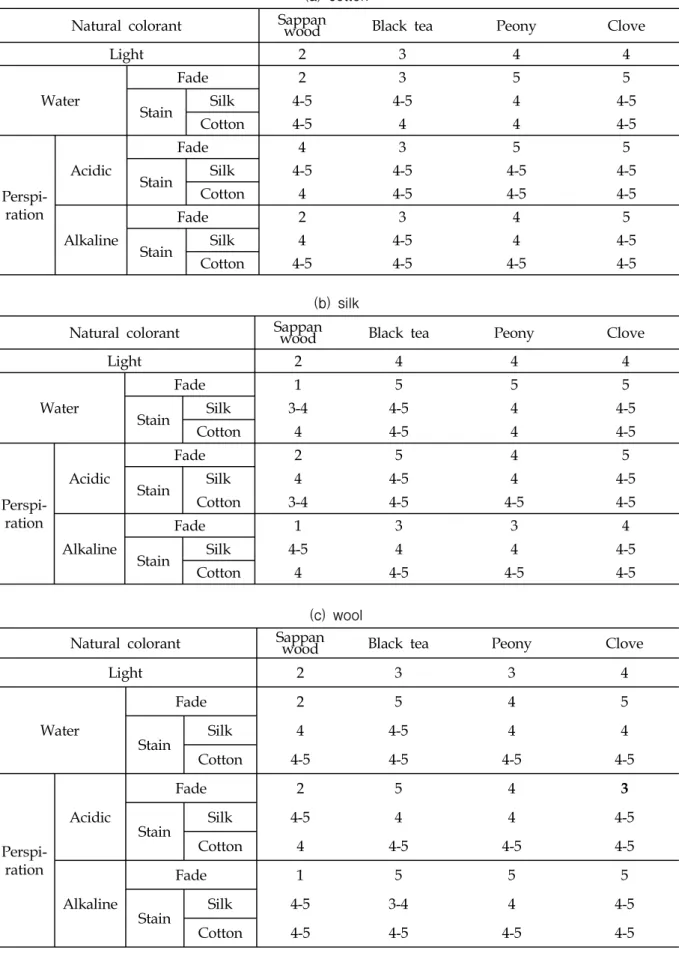
Colour fastness (light, water, and perspiration fastness) of fabrics dyed with sappan wood, black tea, peony, and clove extracts are shown in Table 3. Colour fastness (light, water, and perspiration fastness) was in the range of 3 – 5 rating with the exception of fabrics dyed with sappan wood. Generally, it is well known that the light fastness of natural dyes was poor. The light fastness of all dyed fabrics was found to be in the range of 3-4 rating with the exception of fabrics dyed with sappan wood.
Natural colorant Sappan
wood Black tea Peony Clove
Light 2 3 4 4
Water
Fade 2 3 5 5
Stain Silk 4-5 4-5 4 4-5
Cotton 4-5 4 4 4-5
Perspi- ration
Acidic
Fade 4 3 5 5
Stain Silk 4-5 4-5 4-5 4-5
Cotton 4 4-5 4-5 4-5
Alkaline
Fade 2 3 4 5
Stain Silk 4 4-5 4 4-5
Cotton 4-5 4-5 4-5 4-5
Table 3. Colour fastness of (a) cotton, (b) silk, and (c) wool fabrics dyed with sappan wood, black tea, peony, and clove extracts
(a) cotton
Natural colorant Sappan
wood Black tea Peony Clove
Light 2 4 4 4
Water
Fade 1 5 5 5
Stain Silk 3-4 4-5 4 4-5
Cotton 4 4-5 4 4-5
Perspi- ration
Acidic
Fade 2 5 4 5
Stain Silk 4 4-5 4 4-5
Cotton 3-4 4-5 4-5 4-5
Alkaline
Fade 1 3 3 4
Stain Silk 4-5 4 4 4-5
Cotton 4 4-5 4-5 4-5
(b) silk
Natural colorant Sappan
wood Black tea Peony Clove
Light 2 3 3 4
Water
Fade 2 5 4 5
Stain Silk 4 4-5 4 4
Cotton 4-5 4-5 4-5 4-5
Perspi- ration
Acidic
Fade 2 5 4
3
Stain Silk 4-5 4 4 4-5
Cotton 4 4-5 4-5 4-5
Alkaline
Fade 1 5 5 5
Stain Silk 4-5 3-4 4 4-5
Cotton 4-5 4-5 4-5 4-5
(c) wool
Considering natural dyes generally have low light fastness, fastness of dyed fabrics obtained in this study are considerably good.
3.5 Deodorizing performance
The deodorizing performance with the lapse of time for control cotton, silk, and wool fabrics are given in Fig. 2. The deodorizing performance increased with increasing elapsed time up to 5 min and then levelled off. The deodorizing performance of control fabrics was in the order of cotton (length x width x thickness: 10cm x 10cm x 0.27mm, 1.2g) < silk (10cm x 10cm x 0.10mm, 0.3g) < wool (10cm x 10cm x 0.33mm, 1.3g).
This result indicated that the deodorization performance of protein fibres was higher than that of cotton fibre. However, we could not compare the deodorizing performance of silk and wool directly, because the volume and weight of these fabrics were not same in spite of having same surface area (10cm x 10cm).
Table 4 shows the deodorizing performance of cotton, silk, and wool fabrics mordanted with various metallic sulfate salts.
The deodorization performance of mordanted fabrics using mordants (CuSO4, ZnSO4, Al2(SO4)3,
FeSO4, NiSO4, CoSO4, MnSO4 and SnSO4) was in the range of 62-99%.
Generally, it was well known that mordanting
Elapsed time (min)
0 30 60 90 120
Deodorizing performance (%)
0 20 40 60 80 100
Cotton Silk Wool
Fig. 2. Effect of elapsed time on the deodorizing performance of fabrics (cotton, silk, and wool) dyed with coffee sludge.
improved the deodorization performance, since the mordant metallic salts could absorb smelling molecules through the formation of coordination bonds between transition metal ions and unshared electron pairs of smelling molecules7).
The deodorizing performance of cotton, silk, and wool fabrics dyed with various natural colorant extracts without treatment of mordants are given Fig. 3.
The deodorizing performance of dyed fabrics was in the range of 50-99%. The deodorizing performance increased in the order of peony <
black tea < sappan wood < clove. Especially, the deodorizing performance of all fabrics dyed with clove was found to be the highest at 98-99%. The highest value of clove might be related to the action of the main component eugenol of clove.
It is well known that eugenol is used in per- fumeries, flavorings, essential oils and in medicine as a local antiseptic and anesthetic. However, the exact cause of the hightest deodorizing per- formance of clove is not clear.
The deodorization performance of dyed fabrics and mordanted fabrics are mostly similar except for few samples. These results clearly demon- strate that utilizing extracted natural colorants as dyeing materials significantly facilitate to obtain prominent deodorizing fabrics.
Natural colorant
Control Sappan wood Black tea Peony Clove
Deodorizing performance (%)
0 20 40 60 80
100 cotton
silk wool
Fig. 3. Comparison of deodorizing performance of undyed fabrics [(cotton, silk, and wool): control] and dyed fabrics using sappan wood, black tea, peony, and clove.
Fabric Mordants
None Mn Cu Zn Al Fe Ni Co Sn
Cotton Silk Wool
28 61 86
67 62 96
99 87 98
97 97 98
99 88 99
89 79 99
99 87 98
86 84 96
99 92 99 Time: 120 min
Table 4. Deodorizing performance (%) of fabrics mordanted with various metallic sulfate salts
4. Conclusions
Natural colorants were extracted from sappan wood, black tea, peony, and clove using water as extracting solvent. The optimum extraction temperature, time and liquor ratio were found to be 90℃, 90min and liquor ratio (solid natural colorant material/water, weight ratio) of 1/10, respectively. The effect of natural colorant solution on dyeing, fastness, and deodorizing properties of fabrics (cotton, silk, and wool fabrics) were investigated. For all colorant solutions, the K/S value was in the order of cotton < silk
< wool. The K/S value of dyed cotton fabric increased in the order of peony < sappan wood
< clove < black tea, however, the values of dyed silk and wool fabrics were in the order of peony < sappan wood < black tea < clove.
Colour fastness (light, water, and perspiration fastness) was in the range of 3–5 rating except for sappan wood. The deodorizing performance of fabrics dyed with various natural colorants extracts was in the range of 50-99%.
The deodorizing performance increased in the order of peony < black tea < sappan wood <
clove. Especially, the deodorizing performance of all fabrics dyed with clove was found to be the highest at 98-99%. Despite most natural dyes have low fastness, diverse natural colour tone fabrics having high fastness and prominent deodorizing property using various natural colorants were prepared in this study.
References
1. D. J. Hill, Is there a future for natural dyes,
Rev. Prog. Coloration, 27, 18-25(1997).
2. Daniela Cristea and Gerard Vilarem, Improving light fastness of natural dyes on cotton yarn,
Dyes and Pigments, 70, 238-245(2006).
3. D. B. Gupta and M. L. Gulrajani, The light fading mechanism of dyes derived from rhubarb extract, J. Soc. Dyers Colourists, 112, 269-272(1996).
4. F. A. Nagia, R.S.R.EL-Mohamedy, Dyeing of wool with natural anthraquinone dyes from Fusarium oxysporum, Dyes and Pigments, 71, 550-555(2007).
5. E. Tsatsaroni, M. Liakopoulou-Kyriakides, Effect of enzymatic treatment on the dyeing of cotton and wool fibers with natural dyes,
Dyes and Pigments, 29, 203-209(1995).
6. E. R. Trotman, "Dyeing and Chemical Technology
of Textile Fibres", 5th ed., Charles Griffin &
Co. Ltd., London, 1975.
7. H. S. Lee, J. H. Chang, I. H. Kim, and S. W.
Nam, Dyeing of Cotton with Clove Extract,
J. Korean Soc. Dyers & Finishers, 10(3), 29-35
(1998).8. Y. S. Shin and H. Choi, Characteristics and Dyeing Properties of Green Tea Colorants (Part 2), J. Korean Society of Clothing and
Textiles, 23(3), 385(1999).
9. E. K. Hwang, M. S. Kim, D. S. Lee, and K.
B. Kim, Color Development of Natural Dyes with Some Mordants, J. Korean Fiber Society,
35(8), 490-497(1998).
10. B. H. Kim and S. S. Cho, Dyeing of silk fabric with Amur Cork Tree, J. Korean Soc.
Dyers & Finishers, 8(1), 26-33(1996).
11. Y. J. Chu and H. O. Soh, The study of cochineal dyeing, J. Korean Soc. Dyers & Finishers, 10(1), 11-19(1998).
12. S. R. Lee, Y. H. Lee, I. H. Kim, and S. W.
Nam, A Study on the antibacterial and deo- dorization of silk fabrics dyed with natural dye(2), J. Korean Soc. Dyers & Finishers, 7(4), 74(1995).
13. K. R. Cho, Studies on the natural dyes(11), J.
Korean Soc. Dyers & Finishers, 11(4), 39(1999).
14. Y. H. Lee, E. K. Hwang, and H. D. Kim, Dyeing and fastness of silk and cotton fabrics dyed with cherry extract, J. Korean Soc. Dyers
& Finishers, 12, 53-59(2000).
15. Y. H. Lee and H. D. Kim, Dyeing properties and colour fastness of cotton and silk fabrics dyed with Cassia tora L. Extract, Fibers and
Polymers, 5, 303-308(2004).
16. Y. H. Lee. Dyeing, fastness and deodorizing properties of cotton, silk, and wool fabrics dyed with coffee Sludge (Coffea Arabica L.) extract, J. Applied Polymer Science, 103, 251-257 (2007).
17. Yasuhiro Washino, "Functional Fibers": TORAY RESEARCH CENTER, INC., 1993.
18. E. K. Hwang, Y. H. Lee, and H.D. Kim, Dyeing, fastness, and deodorizing properties of cotton, silk, and wool fabrics dyed with gardenia, coffee sludge, Cassia tora. L., and pomegranate extracts, accepted.
19. Thomas Vickerstaff, "The Physical of Chemistry


![Fig. 3. Comparison of deodorizing performance of undyed fabrics [(cotton, silk, and wool): control] and dyed fabrics using sappan wood, black tea, peony, and clove.](https://thumb-ap.123doks.com/thumbv2/123dokinfo/5066462.558416/7.892.106.426.833.1067/comparison-deodorizing-performance-undyed-fabrics-cotton-control-fabrics.webp)

