• 검색 결과가 없습니다.

Successful EDTA-Tris treatment of Pseudomonas aeruginosa infection of urinary bladder secondary to urolithiasis in a dog

N/A
N/A
Protected

Academic year: 2021

Share "Successful EDTA-Tris treatment of Pseudomonas aeruginosa infection of urinary bladder secondary to urolithiasis in a dog"

Copied!
4
0
0

로드 중.... (전체 텍스트 보기)

전체 글

(1)

大韓獸醫學會誌(2006) 第46卷 第1號

Korean J Vet Res

(2006) 46(1) : 83~86

83

Successful EDTA-Tris treatment of Pseudomonas aeruginosa infection of urinary bladder secondary to urolithiasis in a dog

Sang-Gwan Lee

1

, Woo-Pil Hoh

1

, Ki-Dong Eom, Keun-Woo Lee, Tae-Ho Oh*

1

Joeun Animal Hospital, Daegu 706-808, Korea

College of Veterinary Medicine, College of Veterinary Medicine, Kyungpook National University, Daegu 702-701, Korea

(Accepted: January 27, 2006)

Abstract : About 8 year-old castrated male Yorkshire terrier was presented for evaluation of dysuria, stranguria, hemtauria, and pollakiuria. On history taking, dysuria first was observed three months ago and these signs were waxed and waned. Physical examination revealed mild left perineal swelling. On routine laboratory examination, no significant findings were identified. Positive contrast urogram identified peritoneal herniation of urinary bladder. Urinalysis showed proteinuria and hematuria. Urine sediment revealed epithelial cells, white blood cells and rod-shaped bacteria. Pseudomonas aeroginosa was isolated from urine obtained through cystocentesis, and had resistance against fourteen antibiotics. Cystitis caused by P. aeruginosa concurrent with cystolithiasis and perineal hernia was diagnosed. Cystotomy, herniorrhaphy and EDTA-Tris solution lavage of bladder were performed. The patient was recovered to normal condition 2 days after treatment. Two weeks later, bacterial culture of urine was negative and any abnormality in ultrasonogram and urinalysis was not observed except calcium oxalate dihydrate crystals.

Keywords : cystitis, Pseudomonas aeruginosa , EDTA-Tris, perineal hernia, dog

Introduction

Urinary tract infections (UTIs) are more common in dogs than in cats. Most UTIs in dogs involve bacterial inflammation of the lower urinary tract. The most common pathogens are E. coli (45%), Staphylococcus (13%), and Proteus (10%). Enterococcus, Klebsiella, Streptococcus, Enterbacter , and Pseudomonas are patho- gens isolated in less than 10% [2, 17].

Pseudomonas aeruginosa is known as avirulent organism and an opportunistic infection in a compro- mised urinary tract, but it tends to be exceedingly resistant to antimicrobial agents [17]. UTIs caused by resistant Pseudomonas aeruginosa are difficult to treat so that colonization and subsequent bacterial tissue invasion recur soon after cessation of antimicrobial treatment [8].

EDTA-Tris showed specific synergic effects with tetracycline, quinolone, aminoglycoside, macrolide and b-lactam antibiotics against resistant Gram positive and

negative bacteria [7, 22, 23]. Irrigations with EDTA- Tris solution have been successfully used in combination with antimicrobial agents against soft tissue infections in small animals caused by resistant pathogens [1, 8, 18].

This case report describes the management of cystitis caused by resistant Pseudomonas aeruginosa infection in a dog with urolithiasis.

Case Report

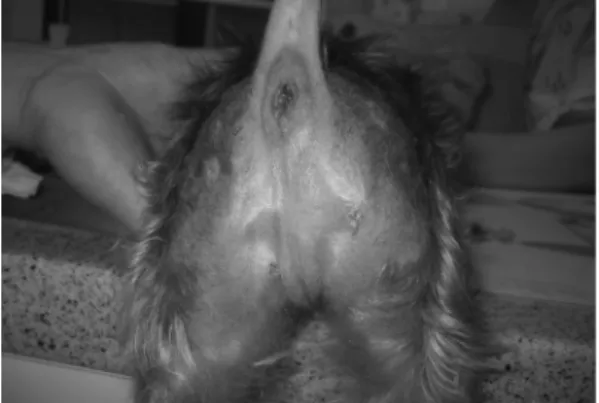
About 8 year-old castrated male Yorkshire terrier weighing 2.8 kg was presented for dysuria, stranguria, hemtauria, and pollakiuria. The patient was vaccinated, dewormed, and prevented from heartworm infection. On history taking, dysuria and mild hematuria was observed three months ago. Since then, clinical signs had been wax and wane, and became suddenly worsen 3 days ago before presentation. Physical examination revealed mild left perineal swelling (Fig. 1). On routine laboratory examination, no significant findings were identified.

*Corresponding author: Tae-Ho Oh

College of Veterinary Medicine, Kyungpook National University, Daegu 702-701, Korea

[Tel: +82-53-950-5959, Fax: +82-53-244-2367, E-mail: [email protected]]

(2)

84 Sang-Gwan Lee et al.

In survey radiography, gas-filled structures and soft mass opacity were observed in perineal area and urinary bladder was not observed in caudoventral abdomen (Fig. 2). Calculi in urinary bladder and focal thickened caudodorsal part of urinary bladder wall were observed in ultrasonographic examination (Fig. 3).

Positive contrast urogram confirmed perineal herniation of urinary bladder (Fig. 4).

For urinalysis urine collected from cystocentesis.

Urine pH was 5.0 and specific gravity was 1.050 in urinalysis. Protein and blood were detected in urine.

Also, urine sediment test revealed many epithelial cells, calcium oxalate dihydrate crystals, white blood cells, and rod-shaped bacteria. The urine culture and sensitivity test was pending. Finally cystitis caused by P.

aeruginosa concurrent with cystolithiasis and perineal hernia was diagnosed.

Urinary bladder calculi were removed by cystotomy and perineal herniation of urinary bladder was corrected by herniorrhaphy. The calculi were sent for the

analysis. Calcium oxalate was identified in urolith analysis. Ampicillin (20 mg/kg IV q12hrs) was admini- stered for the prevention of post operation and urinary catheter was inserted for 3 days after surgery. And then, amoxicillin (20 mg/kg PO bid) was administered for 7 days. However, the heamturia was not completely disappeared. During the therapy urine culture and sensitivity results came out and revealed that Pseudo- monas aeruginosa had resistance against fourteen antibiotics. After suture removed, EDTA-tris solution (TrizEDTA, Dermapet) lavage was performed for 15 minutes, two times per day for 5 days through the urethral catheter after the urinary bladder emptied as treatment of cystitis.

Clinical signs included dysuria, pollakiuria and stran- guria were improved 2 days after surgery except hamturia. Two weeks later, heamturia was completely disappeared. The bacterial culture was negative. Any abnormality was not observed in ultrasonogam, urina- lysis, and urine sediment test.

Fig. 1. Mild left perineal swelling was observed at.

Fig. 2. Gas-filled structures and soft mass opacity were observed in perineal area and urinary bladder was not observed in caudoventral abdomen in survey radiography.

Fig. 3. Ultrasonographic findings showed calculi in urinary bladder (A), and focal thickened caudodorsal part of urinary bladder wall (B).

Fig. 4. Positive contrast urogram confirmed perineal

herniation of urinary.

(3)

EDTA-Tris treatment of Pseudomonas aeruginosa infection of urinary bladder in a dog 85

Discussion

In this case we assumed that urolithiasis and perineal herniation of urinary bladder were underlying problems to cause the urinary tract infections. Therefore, this case managed with the surgical treatment of these problems followed by irrigation of urinary bladder with EDTA- Tris solutions, and the patient recovered successfully.

Interestingly clinical signs were suddenly worsen after perineal swelling was observed in this case.

Perineal hernia was identified by radiographic exami- nation. Perineal hernia occurs when pelvic diaphragm muscles fail to support the rectal wall, allowing persistent rectal distension and impaired defecation.

The cause of pelvic diaphragm weakening is poorly understood but believed to be associated with male hormones, straining, and congenital or acquired muscle weakness or atrophy. Any condition included prostatitis, cystitis, urinary tract obstruction, colorectal obstruction, rectal deviation and/or dilation, perianal inflammation, anal sacculitis, diarrhea, and constipation that causes straining may stress the pelvic diaphragm [14]. In this case, it was thought that perineal hernia was caused by cystitis and/or cystolithiasis, which could cause the opportunistic infection of Pseudomonas aeruginosa in urinary tract. Pseudomonas aeruginosa infection could be a factor of perineal hernia thorough the deterioration of urinary bladder inflammation.

Pseudomonas aeruginosa is considered as a relatively avirulent opportunistic pathogen of urinary tract, capable only invading a compromised urinary tract, but may be exceedingly resistant to antimicrobial resistant to antimicrobial agents. When is isolated from a urine culture, the host defenses are probably compromised.

This indicate that the need for a more extensive diagnostic evaluation in practice [17]. In this case, P.

aeruginosa isolated from urine obtained by cystocentesis and had resistance to 14 antibiotics including especially fluoroquinolones. Therefore, we thought that this case should be treated another therapeutic agent except antibiotics or surgical correction of cystolithiasis and perineal hernia of urinary bladder.

EDTA-Tris can damage the cell surface of Gram- negative bacteria. And EDTA-Tris increase permeability of cell wall to extracellular solutes and induce leakage of intracellular solute leading to rapid lysis of bacterial cell wall leading to sensitization to lysozyme, bactero- cides, and antibiotics [4, 6, 9, 11-13, 16, 19]. Particularly

EDTA-Tris is active against Pseudomonas aeruginosa and cause the death of organism by rapid lysis [6, 12].

EDTA-Tris has been applied for the treatment of bacterial rhinitis in dog [21] and metritis caused by Pseudomonas aeruginosa in mare [25]. In human medicine, combinations of EDTA-Tris and lysozyme have been used as lavage in persistent bladder infection caused by Gram-negative bacteria [10]. The combina- tions of EDTA-Tris and lysozyme or antibiotics have been used to treat otitis externa and cystitis experi- mentally induced by P. aeruginasa in dogs [3, 8, 24], keratitis in rabbits [5, 20]. The adverse tissue reactions were not noticed in the use of EDTA-Tris in the bladder, ear, or eye [3, 5, 15, 20]. In this case EDTA- Tris lavage of urinary bladder was applied after cystotomy and herniorrhaphy. And then, the dog was completely recovered from cystitis and culture of P.

aeruginosa was negative. Also, any adverse effects were not occurred.

References

1. Ashworth CD, Nelson DR. Antimicrobial potentiation of irrigation solutions containing tris-(hydroxymethyl) aminomethane-EDTA. J Am Vet Med Assoc 1990, 197 , 1513-1514.

2. Bartges JW. Urinary tract infection. In: Textbook of Veterinary Internal Medicine. 6th ed. pp. 1800-1808, Saunders, Philadelphia, 2005.

3. Blue JL, Wooley RE, Eagon RG. Treatment of experimentally induced Pseudomonas aeruginosa otitis externa in the dog by lavage with EDTA-tromethamine- lysozyme. Am J Vet Res 1974, 35, 1221-1223.

4. Brown MR, Richards RM. Effect of ethylene- diaminetetraacetate on the resistance of Pseudomonas aeruginosa to antibacterial agents. Nature 1965, 207 , 1391-1393.

5. Brown SI, Akeya S, Weller CA. Prevention of the ulcers of the alkali-burned cornea. Preliminary studies with collagenase inhibitors

.

Arch Ophthalmol 1969, 82 , 95-97.

6. Eagon RG, Carson KJ. Lysis of cell walls and intact cells of Psuedomonas aeruginosa by ethylenediamine- tetraacetic acid and by lysozyme. Can J Microbiol 1965, 11 , 139-201.

7. Farca AM, Nebbia P, Re G. Potentiation of the in vitro

activity os some antimicrobial agents against selected

Gram-negative bacteria by DETA-tromethamine. Vet

(4)

86 Sang-Gwan Lee et al.

Res Comm 1993, 17 , 77-84.

8. Farca AM, Piromalli G, Maffei F, Re G. Potentiating effect of EDTA-Tris on the activity of antibiotics against resistant bacterial associated with otitis, dermatitis and cystitis. J Small Anim Pract 1997, 38 , 243-245.

9. Gilleland HE, Jr., Stinnett JD, Roth IL, Eagon RG.

Freeze-Etch study of Pseudomonas aeruginosa : localization within the cell wall of an ethylenediamine- tetraacetic acid component. J Bacteriol 1973, 113 , 417- 10. 432. Goldschmidt MC, Kuhn CR, Perry K, Johnson DE.

EDTA and lysozyme lavage in the treatment of pseudomonas and coliform bladder infections. J Urol 1972, 107 , 969-972.

11. Goldschmidt MC, Wyss O. The role of tris in EDTA toxicity and lysozyme lysis. J Gen Microbiol 1967, 47 , 421-431.

12. Gray GW, Wilkinson SG. The action of ethylenediamine- tetraacetic acid on Pseudomonas aeruginosa . J Appl Bacteriol 1965, 28 , 153-164.

13. Haslam DF, Best GK, Durham NN. Quantitation of the action of ethylenediamine-tetraacetic acid and tris (hydroxymethyl) aminomthane on a gram-negative bacterium by vancomycin adsorption. J Bacteriol 1970, 103 , 523-524.

14. Hedlund CS. Surgery of the perineum, rectum, and anus. In: Small Animal Surgery. 2nd ed. pp. 415-447, Mosby, St. Louis, 2002.

15. Neu HC. The role of amine buffers in EDTA toxicity and their effect on osmotic shock. J Gen Microbiol 1969, 57 , 215-220.

16. Russell AD. Effect of magnesium ions and ethylenediamine-tetraacetic acid on the activity of vancomycin against Escherichia coli and Staphylococcus

aureus . J Appl Bacteriol 1967, 30, 395-401.

17. Senior DF. Management of difficult urinary tract infections. In: Current Veterinary Therapy XIII. Small Animal Practice. pp. 883-886, Saunders, Philadelphia.

2000.

18. Sparks TA, Kemp DT, Wooley RE, Gibbs PS.

Antimicrobial effect of combinations of EDTA-Tris and amikacin or neomycin on the microorganisms associated with otitis externa in dogs. Vet Res Comm 1994, 18, 241-249.

19. Voss JG. Effects of organic cations on the gram- negative cell wall and their bactericidal activity with ethylenediamine-tetraacetic acid and surface active agents. J Gen Microbiol 1967, 48, 391-400.

20. Wilson LA. Chelatin in experimental Pseudomonas keratitis. Br J Ophthalmol 1970, 54, 587-593.

21. Wooley RE, Berman AP, Shotts EB Jr. Antibiotic- tromethamine-EDTA lavage for the treatment of bacterial rhinitis in a dog. J Am Vet Med Assoc 1979, 175, 817-818.

22. Wooley RE, Jones MS, Gilbert JP, Shotts EB Jr. In

vitro action of combinations of antimicrobial agents with EDTA-tromethamine on Escherichia coli. Am J Vet Res 1983, 44 , 1154-1158.

23. Wooley RE, Jones MS, Gilbert JP, Shotts EB Jr. In

vitro effect of combinations of antimicrobial agents with EDTA-tromethamine on certain Gram positive bacteria. Am J Vet Res 1983, 44, 2167-2169.

24. Wooley RE, Schall WD, Eagon RG, Scott TA.

Efficacy of EDTA-tris-lysozyme lavage in the treatment of experimentally induced Pseudomona aeruginosa cystitis in the dog. Am J Vet Res 1974, 35 , 27-29.

25. Youngquist RS . Pseudomonas metritis in a mare. Vet

Med Small Anim Clin 1975, 70 , 340-342.

수치

Fig. 1.  Mild left perineal swelling was observed at.

참조

관련 문서

Alginate appears to play a key role in the stabilization of biofilms formed by Pseudomonas aeruginosa and some other pseudomonas, with most Pseudomonas strains producing

A Contracting State shall at any time be free to withhold or to withdraw in whole or in part any item in its schedule of concessions in respect of which it determines that

"ESKAPE" pathogens, consist of Enterococcus faecium, Staphylococcus aureus, Klebsiella pneumoniae, Acinetobacter baumannii, Pseudomonas aeruginosa,

The purpose of this study was to provide primary material in discussing methods to activate the treatment effects of diabetes and reduce the rate of

paper disc FDV-3 Staphylococcus aureus, Escherichia coli, Listeria monocytogenes, Pseudomonas aeruginosa, Salmonella typhimurium, Yersinia enterocolitica 와 Lodderomyces

But, in this case, it cause damage the near by houses, factories, railroads due to the soil disturbance due to soft ground improvement and also cause

It was disclosed from the results that the color extracted from eucalyptus leaves was reddish yellow tone that could be manifested in a wide spectrum of

In the proposed optical fiber-based digital holography, the degree of phase shift could be precisely controlled by the pump light, and it was confirmed that