Print ISSN: 2233-4165 / Online ISSN 2233-5382 JIDB website: http://www.jidb.or.kr
doi:http://dx.doi.org/10.13106/jidb.2021.vol12.no8.41
Effects of Wage on FDI Inflows Based on the Threshold of Institutional Quality
Sunhae LEE1, Young-Hoon JEON2
Received: July 13, 2021. Revised: July 31, 2021. Accepted: August 05, 2021.
Abstract
Purpose: The study aims to analyze effects of wage on FDI inflows based on the threshold of institutional quality in 14 developing economies of Southeast and South Asia over the period from 2000-2017. Research design, data, and methodology: The study applies a fixed effect panel threshold regression. As a proxy for the institutional quality, it uses the six components of Worldwide Governance Indicators or a compound index obtained by an average of the six components. The data were taken from World Bank, the Chinn & Ito Database, and UNCTAD. To the best of our knowledge, no researches so far have considered the threshold of institutional quality in estimating the effect of wage on FDI inflows. Results: The composite index and each component of the six indicators of institutional quality except for voice and accountability, and regulatory quality are found to have nonlinear effects on FDI inflows. When the institutional quality is below the threshold, wage affects FDI inflows negatively. When the institutional quality is above the threshold, however, wage does not significantly affect FDI inflows. Conclusions: The effect of wage on FDI inflows varies depending on whether the institutional quality of the target countries is above or below the threshold.
Keywords: Developing Countries, FDI, Institutional Quality, Panel Threshold Regression, Wage JEL Classification Code: C33, F21, F23, M31
1. Introduction
12FDI inflows to Southeast and South Asia have been increasing despite worldwide decline in FDI activities since 2015. In 2000, our target countries in this area attracted no more than US$26.6 billion FDI inflow. But, it increased to US$193.5 billion in 2017, US$ 203.8 billion in 2018 and US$213.2 billion in 2019 (UNCTAD, 2020).
Some studies (Donaubauer & Dreger, 2016) argue that the
1 First Author and Corresponding Author. PhD. Lecturer.
Department of Business Administration, Changwon National University, Korea (Postal Address: 20 Changwondaehak-ro Uichang-gu Changwon-si, Gyeongsangnam-do 51140 Republic of Korea) Email: [email protected]
2 Ph. D. Department of Business Administration, Changwon National University, Korea. Email: [email protected]
ⓒ Copyright: The Author(s)
This is an Open Access article distributed under the terms of the Creative Commons Attribution Non-Commercial License (http://Creativecommons.org/licenses/by-nc/4.0/) which permits unrestricted noncommercial use, distribution, and reproduction in any medium, provided the original work is properly cited.
increase of FDI inflows to this area can be attributed to China’s ever rising labor costs. This region has been gathering attention as the next production base which can replace China, once called the world’s chimney, with relatively low wages. Reduction of production costs resulting from lower labor costs in a host country, particularly in efficiency-seeking FDI, can be one of the most important objectives of outward FDI. However, production costs include not only visible direct costs such as wages, but also hidden indirect costs which may arise due to the inefficiency of institutions in the host country.
For example, obtaining government permission to do business in a country may take a long time or it may not be possible without giving bribes to public officials, either of which can function as hidden indirect costs for foreign companies. For these reasons, foreign investors consider institutional quality as well as labor costs in selecting where to invest. Most prior studies show that institutional quality and FDI inflows have a linear relationship. That is, good institutional quality attracts more FDI inflows.
However, according to a study by Kurul (2017), the effect of institutional quality on FDI inflows is shown to be non- linear, which means that improved institutional quality can attract FDI inflows only when the quality is above a certain threshold level, and that improved institutional quality cannot contribute to attracting FDI inflows when below the threshold level. His study supports that only when the institutional quality is above a threshold level, improvement in institutional quality can send a good signal for reducing foreign companies’ hidden indirect costs in the host country. In this situation, due to the expectation for reducing the hidden costs, wage may not become the number one determinant in foreign investors’ location choices, whereas it becomes a crucial factor when the quality is below the level.
Based on Kurul (2017) which supported this non-linear effect of institutional quality on FDI inflows, this study used a fixed effect panel threshold regression. The study investigated the effect of wage on FDI inflows in 14 developing countries in Southeast and South Asia (See Appendix) considering the threshold of the institutional quality.
Our study can contribute to the literature in some aspects. To the best of our knowledge, no researches so far have considered the threshold of institutional quality in estimating the effect of labor costs on FDI inflows. We can, through this empirical analysis results, provide important implications for government officials for developing countries in Southeast and South Asia where they struggle to develop their economies by attracting FDI inflows.
This study is structured as follows: we review the literature and develop hypotheses in Section 2, and describe the methodology in Section 3. Section 4 provides results and discussion, and Section 5 concludes.
2. Literature Review and Hypothesis
2.1. Literature ReviewLabor costs are considered one of the key economic factors in the discussion of the determinants of FDI location choice (Bellak, Leibrecht, & Riedl, 2008).
Multinational enterprises (MNEs) consider a range of factors in determining their FDI locations. The literature on the determinants of FDI location choice has been influenced by theories of international business (OLI- paradigm: Dunning, 1998). In the OLI-paradigm, labor costs appear as one of the country–level cost-related location determinants and in the general equilibrium models, FDI responds to factor cost differentials (comparative advantages) which are inter alia based on differences in labor costs (Bellak et al., 2008). Among four
types of motives for which MNEs undertake outward FDI such as market-seeking, efficiency-seeking, natural resource-seeking, and strategic asset-seeking, efficiency seeking MNEs, in particular, will invest in countries with low labor costs if other conditions are the same. Therefore, high labor costs are thought to be negatively linked to FDI inflows.
However, there may also be other factors that can mitigate the negative effects of high labor costs on FDI.
Public expenditures for good infrastructure or education system may compensate investors for high labor costs because well–trained and healthy workers are usually more productive and less often on sick leave (Bellak et al., 2008).
In addition, a higher quality of the institution of a host country would reduce the indirect cost of businesses, thereby mitigating the negative effects of high labor costs.
Most of the previous studies on the effect of institutional quality on FDI inflows (Ghazalian &
Amponsem, 2019; Globerman & Shapiro, 2002; Marson &
Nor, 2013) show that the institutional quality has a linearly positive effect on FDI inflows.
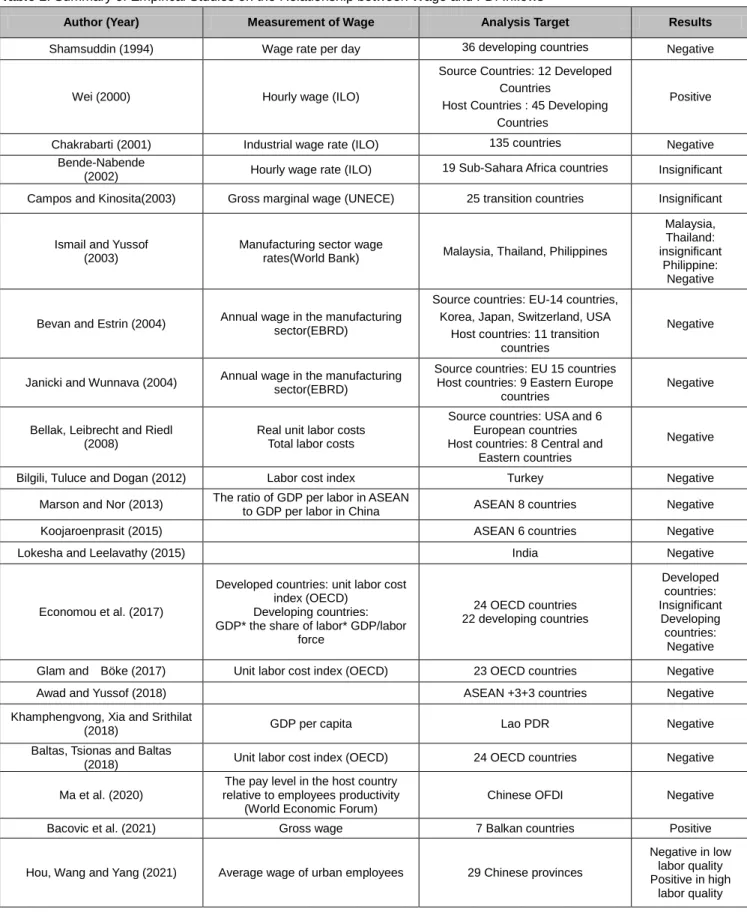
There are a number of studies that empirically analyze the effects of labor costs on FDI location choice. These studies show a wide variety of results with respect to the significance and the size of the coefficient of the labor cost proxy. We present a summary of 21 papers dealing with labor costs and FDI. Table 1 provides information on measurement of wage, analysis target, and sign of the coefficient and significance of labor cost variable. Among the 21 underlying studies, 14 studies find a negative impact of labor costs on FDI inflow while two reveal a positive coefficient. The 4 papers reveal insignificant results. Lastly, Hou et al. (2021) argue that wage has a nonlinear effect on FDI inflows based on labor quality. It implies that under low labor quality, foreign investors prefer locations with high wages, while under high labor quality, they prefer locations with low wages.
Wei (2000)’s result of a positive coefficient of labor cost does not support the hypothesis that FDI chases cheap wage in developing countries, but shows that the presence of skilled labor or good educational system may play a significant role in attracting FDI inflows (Bellak et al., 2008).
Bacovic et al. (2021) who find a significantly positive sign for gross wage variable in a study on FDI in Balkan countries argue that the variable may express not only labor cost effects but also labor productivity effects. The aforementioned two empirical evidences are thus not in favor of a significant positive impact of high labor costs on FDI inflow, but rather support that foreign investors will invest in countries with high labor costs if the countries have high education level, labor productivity, and institutional quality.
Table 1: Summary of Empirical Studies on the Relationship between Wage and FDI Inflows
Author (Year) Measurement of Wage Analysis Target Results
Shamsuddin (1994) Wage rate per day 36 developing countries Negative
Wei (2000) Hourly wage (ILO)
Source Countries: 12 Developed Countries
Host Countries : 45 Developing Countries
Positive
Chakrabarti (2001) Industrial wage rate (ILO) 135 countries Negative
Bende-Nabende
(2002) Hourly wage rate (ILO) 19 Sub-Sahara Africa countries Insignificant Campos and Kinosita(2003) Gross marginal wage (UNECE) 25 transition countries Insignificant
Ismail and Yussof (2003)
Manufacturing sector wage
rates(World Bank) Malaysia, Thailand, Philippines
Malaysia, Thailand:
insignificant Philippine:
Negative
Bevan and Estrin (2004) Annual wage in the manufacturing sector(EBRD)
Source countries: EU-14 countries, Korea, Japan, Switzerland, USA
Host countries: 11 transition countries
Negative
Janicki and Wunnava (2004) Annual wage in the manufacturing sector(EBRD)
Source countries: EU 15 countries Host countries: 9 Eastern Europe
countries
Negative
Bellak, Leibrecht and Riedl (2008)
Real unit labor costs Total labor costs
Source countries: USA and 6 European countries Host countries: 8 Central and
Eastern countries
Negative
Bilgili, Tuluce and Dogan (2012) Labor cost index Turkey Negative
Marson and Nor (2013) The ratio of GDP per labor in ASEAN
to GDP per labor in China ASEAN 8 countries Negative
Koojaroenprasit (2015) ASEAN 6 countries Negative
Lokesha and Leelavathy (2015) India Negative
Economou et al. (2017)
Developed countries: unit labor cost index (OECD)
Developing countries:
GDP* the share of labor* GDP/labor force
24 OECD countries 22 developing countries
Developed countries:
Insignificant Developing countries:
Negative Glam and Böke (2017) Unit labor cost index (OECD) 23 OECD countries Negative
Awad and Yussof (2018) ASEAN +3+3 countries Negative
Khamphengvong, Xia and Srithilat
(2018) GDP per capita Lao PDR Negative
Baltas, Tsionas and Baltas
(2018) Unit labor cost index (OECD) 24 OECD countries Negative
Ma et al. (2020)
The pay level in the host country relative to employees productivity
(World Economic Forum)
Chinese OFDI Negative
Bacovic et al. (2021) Gross wage 7 Balkan countries Positive
Hou, Wang and Yang (2021) Average wage of urban employees 29 Chinese provinces
Negative in low labor quality Positive in high
labor quality
As mentioned above, numerous studies have analyzed the effect of wage on FDI inflows, but none have shed light on the threshold of institutional quality in their examination of the effect of wage on FDI. To fill the gap in the previous studies, we elaborately incorporate the institutional quality level into our analysis of the effect of wage on FDI inflows.
The sources for labor cost data used in previous studies vary as shown in Table 1, and are often missing. This is because OECD publishes labor cost statistics for only OECD countries, and the ILO, EBRD, World Bank, and World Economic Forum publish labor cost statistics for some other countries. For this reason, a proxy variable used for labor costs varies in the previous studies. Table 1 presents a summary of empirical studies on the relationship between wage and FDI inflows.
2.2. Hypothesis Development
Kurul (2017) argues that the effect of institutional quality on FDI inflows appears nonlinear, which means that improved institutional quality attracts inward FDI only when the quality is above the threshold level, and that improved institutional quality cannot contribute to attracting inward FDI when the quality is below the threshold level.
When the institutional quality is lower than the threshold, improved quality does not significantly reduce the hidden indirect costs and thus does not increase FDI inflows. Therefore, in a situation where the institutional quality is below the threshold, rising wage is expected to negatively affect FDI inflows.
H1: If the institutional quality does not reach the threshold level, rising wage negatively affects FDI inflows.
If the institutional quality is above the threshold, the improved institutional quality significantly increases FDI inflows because it can reduce the hidden indirect costs. In this situation, rising wage is unlikely to have a significantly negative effect on FDI inflows.
H2: If the institutional quality exceeds the threshold level, rising wage does not significantly affect FDI inflows.
3. Methodology and Data
MNEs are motivated to invest in foreign countries to benefit from a set of advantages the host countries possess by internalizing firm-specific advantages (Kang, 2018).
Four primary motives for FDI are identified by the eclectic theory such as market seeking, efficiency seeking, natural
resources seeking, and strategic assets seeking (Dunning, 1993). These motivations are incorporated into our empirical model except for that of strategic asset seeking because our target countries do not seem to possess strategic assets like advanced science and technology.
To investigate the motivation for market seeking FDI, we consider GDP and GDP growth of host countries, and for efficiency seeking, we regard labor cost, institutional quality, inflation, labor force supply, export orientation, infrastructure, financial development, capital market openness, and the ICT environment. Natural resources variable is also considered to investigate the motivation for natural resources seeking FDI.
We choose developing countries in Southeast and South Asia as target countries for the analysis because FDI inflows to these countries have been rather increasing despite the worldwide decline. This increase may result from China’s rising labor costs which might have forced MNEs look for other production bases replacing China. For these reasons, we consider these countries appropriate target for analyzing the effect of rising labor costs on FDI inflows. The analysis period is from 2000 to 2017.
In most cases, FDI inflows to this region are motivated to seek economic efficiency, and so the labor cost is a crucial factor. Yet, additional indirect costs incurred from low institutional quality also cannot be ignored. If institutional quality has nonlinear effect on FDI inflows, the effect of labor costs on FDI inflows may vary depending on institutional quality.
In order to analyze the nonlinear effects of institutional quality on FDI inflows, we employ a panel threshold regression, following Hansen (1999).
Our first step is to test whether there is a threshold for institutional quality. If the null hypothesis of the single- threshold model is rejected, then a single threshold exists (Wang, 2015). As a next step, we analyze a fixed-effect panel threshold regression with this single threshold (Wang, 2015).
The reason for using one-year lagged values of the independent variables is that current FDI decisions are based on past information (Cheung et al., 2012; Nondo, Kahsai, & Haulu, 2016). Therefore, the fixed effect panel threshold regression equation is:
𝐹𝐷𝐼𝑖𝑡= 𝛽0+ 𝛽1𝑊𝑎𝑔𝑒𝑖𝑡−1(𝑞𝑖𝑡−1 )
+ 𝛽2𝑊𝑎𝑔𝑒𝑖𝑡−1(𝑞𝑖𝑡−1 ) + 𝛽3𝐺𝐷𝑃𝑖𝑡−1 + 𝛽4𝐺𝐷𝑃 𝐺𝑟𝑜𝑤𝑡𝑖𝑡−1+ 𝛽5𝐼𝑛𝑓𝑙𝑎𝑡𝑖𝑜𝑛 𝑖𝑡−1 + 𝛽6𝐿𝑎𝑏𝑜𝑟 𝐹𝑜𝑟𝑐𝑒 𝑆𝑢𝑝𝑝𝑙𝑦𝑖𝑡−1
+ 𝛽7𝐸𝑥𝑝𝑜𝑒𝑟 𝑂𝑟𝑖𝑒𝑛𝑡𝑎𝑡𝑖𝑜𝑛𝑖𝑡−1 + 𝛽8𝐼𝑛𝑓𝑟𝑎𝑠𝑡𝑟𝑢𝑐𝑡𝑢𝑟𝑒𝑖𝑡−1
+ 𝛽9𝐹𝑖𝑛𝑎𝑛𝑐𝑖𝑎𝑙 𝐷𝑒𝑣𝑒𝑙𝑜𝑚𝑒𝑛𝑡𝑖𝑡−1
+ 𝛽10𝐶𝑎𝑝𝑖𝑡𝑎𝑙 𝑀𝑎𝑟𝑘𝑒𝑡 𝑂𝑝𝑒𝑛𝑛𝑒𝑠𝑠𝑖𝑡−1 + 𝛽11𝐼𝐶𝑇 𝐸𝑛𝑣𝑖𝑟𝑜𝑛𝑚𝑒𝑛𝑡𝑖𝑡−1
+ 𝛽12 𝑁𝑎𝑡𝑢𝑟𝑎𝑙 𝑅𝑒𝑠𝑜𝑢𝑟𝑐𝑒𝑠𝑖𝑡−1+ 𝜇𝑖+ 𝑒𝑖𝑡
Where 𝐹𝐷𝐼𝑖𝑡 is the 𝐹𝐷𝐼 inflow to country 𝑖 at time t, 𝑞𝑖𝑡−1 is the threshold variable (institutional quality), and 𝛽1 and 𝛽2 are the threshold parameters that divide the equation into two regimes with the coefficient. 𝑊𝑎𝑔𝑒𝑖𝑡−1 is the relative wage for country 𝑖 at time 𝑡 𝐺𝐷𝑃𝑖𝑡−1 is real GDP of country 𝑖 at time 𝑡 , 𝐺𝐷𝑃 𝐺𝑟𝑜𝑤𝑡𝑖𝑡−1
is GDP growth of country 𝑖 at time 𝑡 , 𝐼𝑛𝑓𝑙𝑎𝑡𝑖𝑜𝑛𝑖𝑡−1 is the inflation of country 𝑖 at time 𝑡 , 𝐿𝑎𝑏𝑜𝑟 𝐹𝑜𝑟𝑐𝑒 𝑢𝑝𝑝𝑙𝑦𝑖𝑡−1 is the labor force supply of country 𝑖 at time 𝑡 , 𝐸𝑥𝑝𝑜𝑟𝑡 𝑂𝑟𝑖𝑒𝑛𝑡𝑎𝑡𝑖𝑜𝑛𝑖𝑡−1 is the export orientation of
country 𝑖 at time 𝑡 , 𝐼𝑛𝑓𝑟𝑎𝑠𝑡𝑟𝑢𝑐𝑡𝑢𝑟𝑒𝑖𝑡−1 is the infrastructure of country 𝑖 at time 𝑡 , 𝐹𝑖𝑛𝑎𝑛𝑐𝑖𝑎𝑙 𝐷𝑒𝑣𝑒𝑙𝑜𝑝𝑚𝑒𝑛𝑡𝑖𝑡−1is the financial development
of country 𝑖 at time 𝑡 ,
𝐶𝑎𝑝𝑖𝑡𝑎𝑙 𝑀𝑎𝑟𝑘𝑒𝑡 𝑂𝑝𝑒𝑛𝑛𝑒𝑠𝑠𝑖𝑡−1 is the capital market openness of country 𝑖 at time 𝑡 , 𝐼𝐶𝑇 𝐸𝑛𝑣𝑖𝑟𝑜𝑛𝑚𝑒𝑛𝑡𝑖𝑡−1 is the ICT environment of country 𝑖 at time 𝑡 , 𝑁𝑎𝑡𝑢𝑟𝑎𝑙 𝑅𝑒𝑠𝑜𝑢𝑟𝑐𝑒𝑠𝑖𝑡−1 is the natural resource of country 𝑖 at time 𝑡 and 𝛽0 is constant.
Parameter 𝜇𝑖 is an individual effect, while 𝑒𝑖𝑡 is the disturbance.
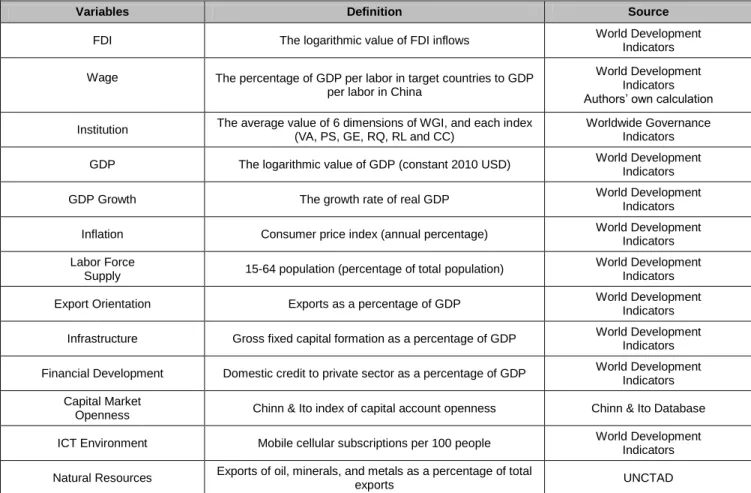
Table 2: Definition of Variables and Data Sources
Variables Definition Source
FDI The logarithmic value of FDI inflows World Development
Indicators Wage The percentage of GDP per labor in target countries to GDP
per labor in China
World Development Indicators Authors’ own calculation Institution The average value of 6 dimensions of WGI, and each index
(VA, PS, GE, RQ, RL and CC)
Worldwide Governance Indicators
GDP The logarithmic value of GDP (constant 2010 USD) World Development
Indicators
GDP Growth The growth rate of real GDP World Development
Indicators
Inflation Consumer price index (annual percentage) World Development
Indicators Labor Force
Supply 15-64 population (percentage of total population) World Development Indicators
Export Orientation Exports as a percentage of GDP World Development
Indicators Infrastructure Gross fixed capital formation as a percentage of GDP World Development
Indicators Financial Development Domestic credit to private sector as a percentage of GDP World Development
Indicators Capital Market
Openness Chinn & Ito index of capital account openness Chinn & Ito Database ICT Environment Mobile cellular subscriptions per 100 people World Development
Indicators Natural Resources Exports of oil, minerals, and metals as a percentage of total
exports UNCTAD
Note: VA is voice and accountability, PS is political stability, GE is government effectiveness, RQ is regulatory quality, RL is rule of law, CC is control of corruption.
Table 2 shows definition of variables and data sources.
The logarithmic value of FDI inflows is used as the dependent variable (Ghazalian & Ampsem, 2019). In the absence of long observations of wage data for developing countries in Southeast and South Asia, we use the concept of relative labor cost, which Marson and Nor (2013) proposed, in the analysis. The relative labor cost, here, is the ratio of GDP per labor of developing countries in Southeast and South Asia to the GDP per labor of China.
For the institutional variable, we use seven proxies, namely, the average of six components and each of the six components (i.e. voice and accountability, political stability, government effectiveness, regulatory quality, rule of law, and control of corruption) in Worldwide Governance Indicators of World Bank. The six components are so highly correlated with each other that it may cause multicollinearity concern if the six components and the average of them are used together in a
single equation. Thus, each of the six components and the average of them are used in separate models. Worldwide Governance Indicators are available in two forms: scores and percentile ranks. Our study uses both of these two measures. Scores have a value of -2.5-2.5 while percentile ranks have a value of 0-100, which means that the higher the value is, the better the institutional quality is. The former represents the absolute level of institutional quality while the latter shows the relative level of it.
Based on the previous studies, we incorporate ten control variable. To investigate the motivation for market seeking FDI, we regard GDP and GDP growth, while for efficiency seeking FDI, we consider inflation, labor force supply, export orientation, infrastructure, financial development, capital market openness, ICT environment.
For natural resource seeking FDI, we use natural resource variable.
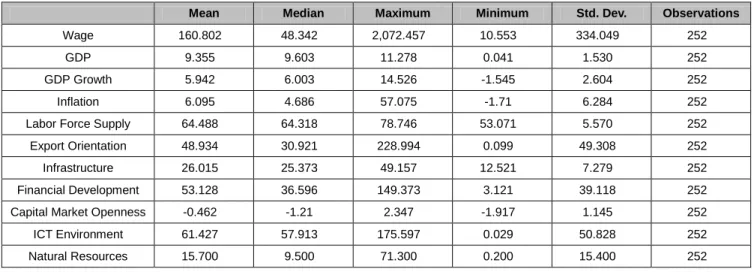
Table 3: Descriptive Statistics of Variables Panel A: Macro-economic Variables
Mean Median Maximum Minimum Std. Dev. Observations
Wage 160.802 48.342 2,072.457 10.553 334.049 252
GDP 9.355 9.603 11.278 0.041 1.530 252
GDP Growth 5.942 6.003 14.526 -1.545 2.604 252
Inflation 6.095 4.686 57.075 -1.71 6.284 252
Labor Force Supply 64.488 64.318 78.746 53.071 5.570 252
Export Orientation 48.934 30.921 228.994 0.099 49.308 252
Infrastructure 26.015 25.373 49.157 12.521 7.279 252
Financial Development 53.128 36.596 149.373 3.121 39.118 252
Capital Market Openness -0.462 -1.21 2.347 -1.917 1.145 252
ICT Environment 61.427 57.913 175.597 0.029 50.828 252
Natural Resources 15.700 9.500 71.300 0.200 15.400 252
Panel B: Scores of Institutional Quality
Mean Median Maximum Minimum Std. Dev. Observations
Average -0.448 -0.538 1.615 -1.648 0.694 252
VA -0.661 -0.574 0.468 -2.233 0.688 252
PS -0.723 -0.899 1.586 -2.81 0.941 252
GE -0.172 -0.271 2.437 -1.618 0.875 252
RQ -0.276 -0.426 2.261 -1.618 0.805 252
RL -0.37 -0.549 1.825 -1.74 0.766 252
CC -0.484 -0.62 2.326 -1.673 0.856 252
Panel C: Percentile Ranks of Institutional Quality
Mean Median Maximum Minimum Std. Dev. Observations
Average 36.477 34.797 89.975 3.245 20.133 252
VA 31.525 32.227 63.184 0.000 17.484 252
PS 29.089 18.465 99.048 0.474 25.091 252
GE 44.514 45.806 100.000 2.392 25.094 252
RQ 40.625 36.637 100.000 0.000 24.145 252
RL 38.901 35.141 96.635 0.957 23.252 252
CC 34.211 31.491 98.99 0.474 24.243 252
Note: VA is voice and accountability, PS is political stability, GE is government effectiveness, RQ is regulatory quality, RL is rule of law, CC is control of corruption.
Here, GDP, frequently used as a proxy for domestic market size, is represented by the logarithmic value of GDP (constant 2010 USD) (Marson & Nor, 2013; Yang et al., 2018). GDP growth indicating domestic market potential is represented by the growth rate of real GDP (Ghazalian & Amponsem, 2019). Inflation, an indicator of economic stability, may affect FDI inflows (Aziz, 2018;
Walsh & Yu, 2010). We use an annual percentage of the consumer price index to indicate inflation. Labor force supply also has impact on FDI inflows, particularly on efficiency seeking FDI (Nondo et al., 2016). The population aged 15-64 (percentage of total population) is used as a proxy for labor force supply which is the measure of active labor. Export orientation of host countries is one of the determinants of FDI (Bende-Nabende, 2002). Export orientation is represented by exports as a percentage of GDP. Well-developed infrastructure enhances ease of doing business and therefore attracts FDI inflows. We employ gross fixed capital formation as a percentage of GDP as a proxy for infrastructure. When MNEs raise part of their investment funds through local financing, financial development becomes an important factor in the choice of the location. We use domestic credit to private sector as a percentage of GDP for financial development. Capital market openness has the positive impact on FDI inflows (Wang & Li, 2018). For capital market openness, we use the Chinn & Ito index of capital account openness.
Information, Communication and Technology (ICT) infrastructure has an important role in attracting FDI inflows (Ibrahim, Adam, & Sare, 2019). The ICT environment is represented by mobile phone subscriptions per 100 people. If other conditions are the same, MNEs may choose host countries rich in natural resources (Kang, 2018). To explain this as well, we use exports of oil, minerals, and metals as a percentage of total exports. The data were taken from World Bank (2020 a, b), the Chinn and Ito Database (Chinn & Ito, 2006) and UNCTAD (2020).
Table 3 presents the descriptive statistics in terms of mean, median, maximum, minimum, standard deviation, and observation count. Panel A shows the descriptive statistics of macro-economic variables, Panel B reveals those of the institutional quality variables by scores, and Panel C exposes those of the institutional quality variables by percentile ranks.
4. Results and Discussion
Table 4 presents the results of the single-threshold test, which we obtained after repeating the bootstrap procedures 50 times. As shown in Table 4, p-values of scores and percentile ranks of the averages of the six components are
significant with the single-threshold at 1% or 5% level.
However, the results of the subcomponents are not significant in some cases.
Among the score measures for the six components, political stability, government effectiveness, rule of law, and control of corruption are significant, whereas the others are not. Among the percentile ranks measures of the six components, political stability and control of corruption are significant, whereas the others are not. Here, we find that the score measures have more significant variables than the percentile ranks. It means the score measures of the institutional quality can show non-linear effects on FDI inflows more clearly than the percentile ranks. This may be because MNEs value scores that represent the absolute level of institutional quality of a host country more than percentile ranks that represent the relative level of it.
Threshold values for the scores of the institutional quality are: political stability is -1.9961, government effectiveness is -0.2923, rule of law is -0.7173, and control of corruption is -0.9116. Threshold values for the percentile ranks of the institutional quality show: political stability is 4.3478, and control of corruption is 19.2893.
The relatively low threshold value of political stability means that, if the host country is politically stable, a slight improvement in political stability could increase FDI inflows. On the other hand, the relatively high threshold values of components of institutional quality such as government effectiveness, rule of law and control of corruption imply that a host country government may need to make considerable effort to upheave these factors to reach the high threshold level.
Based on the estimated threshold of the average score of – 0.6790, the average score of institutional quality is divided into two regimes: a low regime (score<-0.6790) and a high regime (score ≥-0.6790). Political stability, government effectiveness, rule of law, and control of corruption also have two regimes divided by their threshold values measured by score.
According to the estimated threshold of the average percentile ranks 30.5207, the average percentile ranks of institutional quality are divided into two regimes: a low regime (percentile ranks <30.5207) and a high regime (percentile ranks ≥30.5207). Political stability, and control of corruption also have two regimes divided by their threshold values measured by percentile ranks.
According to World Bank statistics, the average scores of institutional quality of countries such as Singapore, Malaysia, Thailand, India, Sri Lanka, Philippines, Vietnam and Indonesia appear to be above the threshold, while those of the other target countries do not (World Bank, 2020a).
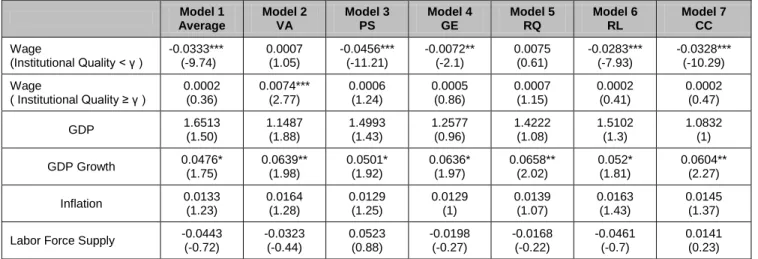
Table 5 presents the results of the single-threshold model on the impact of each variable on FDI inflows.
While Panel A shows the results of the institutional quality by sore, panel B shows those by percentile ranks. In models with significant threshold value in the single threshold test, wage variable shows significantly negative coefficients at the low regime of institutional quality, while
it appears insignificant at the high regime. For example, in the model using average score, the coefficient of wage is negative at a 1% significance level when the average score is less than -0.6790, whereas it is positive but statistically insignificant when the average score surpasses -0.6790.
Table 4: The Single Threshold Effect Test Panel A: Score
Institutional
Quality Variables F-statistics P-value Threshold Value 95% Confidence Interval
Lower Upper
Average 104.73 0.00 -0.6790 -0.7048 -0.6532
VA 6.86 0.64 0.1538 0.1471 0.1539
PS 136.21 0.00 -1.9961 -2.0259 -1.9083
GE 38.03 0.04 -0.2923 -0.2976 -0.2772
RQ 29.39 0.44 -0.7959 -0.7967 -0.7803
RL 69.93 0.04 -0.7173 -0.7181 -0.6725
CC 118.84 0.00 -0.9116 -0.9256 -0.9083
Panel B: Percentile Ranks Institutional
Quality Variables F-statistics P-value Threshold Value 95% Confidence Interval
Lower Upper
Average 103.93 0.02 30.5207 29.8454 31.1189
VA 4.35 0.86 55.2885 55.2239 55.7214
PS 151.61 0.00 4.3478 3.3333 4.3689
GE 23.58 0.24 46.1538 46.1165 46.4115
RQ 36.01 0.22 42.3077 41.9299 42.3469
RL 72.63 0.06 28.7129 28.6385 29.6651
CC 121.12 0.00 19.2893 19.2308 19.5122
Notes: The average is the average of all elements, VA is voice and accountability, PS is political stability, GE is government effectiveness, RQ is regulatory quality, RL is rule of law, and CC is control of corruption.
Table 5: The Estimated Coefficients of Each Variable with a One-threshold Model Panel A: Score
Model 1 Average
Model 2 VA
Model 3 PS
Model 4 GE
Model 5 RQ
Model 6 RL
Model 7 CC Wage
(Institutional Quality < γ )
-0.0333***
(-9.74)
0.0007 (1.05)
-0.0456***
(-11.21)
-0.0072**
(-2.1)
0.0075 (0.61)
-0.0283***
(-7.93)
-0.0328***
(-10.29) Wage
( Institutional Quality ≥ γ )
0.0002 (0.36)
0.0074***
(2.77)
0.0006 (1.24)
0.0005 (0.86)
0.0007 (1.15)
0.0002 (0.41)
0.0002 (0.47)
GDP 1.6513
(1.50)
1.1487 (1.88)
1.4993 (1.43)
1.2577 (0.96)
1.4222 (1.08)
1.5102 (1.3)
1.0832 (1)
GDP Growth 0.0476*
(1.75)
0.0639**
(1.98)
0.0501*
(1.92)
0.0636*
(1.97)
0.0658**
(2.02)
0.052*
(1.81)
0.0604**
(2.27)
Inflation 0.0133
(1.23)
0.0164 (1.28)
0.0129 (1.25)
0.0129 (1)
0.0139 (1.07)
0.0163 (1.43)
0.0145 (1.37) Labor Force Supply -0.0443
(-0.72)
-0.0323 (-0.44)
0.0523 (0.88)
-0.0198 (-0.27)
-0.0168 (-0.22)
-0.0461 (-0.7)
0.0141 (0.23)
Export Orientation -0.0087 (-1.29)
-0.0119 (-1.49)
-0.0101 (-1.57)
-0.0138*
(-1.74)
-0.0142*
(-1.76)
-0.0099 (-1.4)
-0.0115*
(-1.75) Infrastructure 0.0260***
(2.42)
0.0488***
(3.9)
0.0316***
(3.11)
0.0436***
(3.47)
0.0459***
(3.62)
0.0321***
(2.85)
0.0198*
(1.87) Financial Development 0.0100**
(2.24)
0.0066 (1.26)
0.0031 (0.72)
0.0072 (1.35)
0.007 (1.29)
0.0105**
(2.22)
0.0066 (1.52) Capital Market Openness 0.0744
(0.45)
-0.0763 (-0.42)
-0.033 (-0.23)
0.0032 (0.02)
-0.0429 (-0.23)
0.0906 (0.56)
0.0145 (0.1) ICT Environment 0.0019
(0.61)
0.0102***
(2.83)
0.0049*
(1.72)
0.0065*
(1.78)
0.0081**
(2.21)
0.0027 (0.84)
0.0027 (0.9) Natural Resources 0.3744
(0.45)
0.84441 (0.86)
0.2963 (0.38)
0.7251 (0.74)
0.698 (0.7)
0.5275 (0.61)
0.3876 (0.48)
Constant -6.7476
(-0.62)
-3.6870 (-0.28)
-11.7058 (-1.12)
-4.9548 (-0.38)
-7.3464 (-0.56)
-5.4096 (-0.47)
-4.1357 (-0.39) R-Squared
Within 0.5222 0.3280 0.5628 0.3246 0.3092 0.4675 0.5393
Between 0.3616 0.2002 0.4049 0.2119 0.1940 0.3168 0.2854
Overall 0.3861 0.2353 0.4477 0.2395 0.2155 0.3487 0.3985
Panel B: Percentile Ranks
Model 1 AIQ
Model 2 VA
Model 3 PS
Model 4 GE
Model 5 RQ
Model 6 RL
Model 7 CC Wage
(Institutional Quality ≤ γ)
-0.0318***
(-9.21)
0.0007 (1.08)
-0.047***
(-11.84)
-0.0154***
(-4.5)
-0.0195***
(-5.62)
-0.0287***
(-8.08)
-0.0334***
(-10.46) Wage
(Institutional Quality > γ)
0.0002 (0.41)
0.0069**
(2.23)
0.0006 (1.25)
0.0003 (0.54)
0.0004 (0.73)
0.0002 (0.45)
0.0003 (0.6)
GDP 1.5628
(1.4)
1.2177 (0.93)
1.5173 (1.47)
1.047 (0.83)
1.8017 (1.46)
1.5702 (1.36)
1.3015 (1.21)
GDP Growth 0.0528*
(1.91)
0.0619*
(1.91)
0.0487*
(1.91)
0.0632**
(2.03)
0.0674**
(2.22)
0.0548*
(1.92)
0.0582**
(2.19)
Inflation 0.0134
(1.22)
0.0163 (1.26)
0.013 (1.29)
0.0105 (0.85)
0.0198 (1.63)
0.0164 (1.44)
0.0171 (1.62) Labor Force Supply -0.0386
(-0.61)
-0.0365 (-0.49)
0.0526 (0.9)
-0.0022 (-0.03)
-0.0504 (-0.73)
-0.0371 (-0.57)
0.0341 (0.56) Export Orientation -0.0093
(-1.37)
-0.0122 (-1.52)
-0.0099 (-1.58)
-0.0115 (-1.5)
-0.0129*
(-1.72)
-0.01 (-1.42)
-0.0117*
(-1.79) Infrastructure 0.0279**
(2.57)
0.0493***
(3.9)
0.0318***
(3.2)
0.0393***
(3.23)
0.0402***
(3.4)
0.032***
(2.86)
0.019*
(1.8) Financial Development 0.0102**
(2.26)
0.007 (1.32)
0.0029 (0.7)
0.0076 (1.48)
0.0079 (1.59)
0.0104**
(2.22)
0.0067 (1.55) Capital Market Openness 0.0682
(0.44)
-0.0802 (-0.44)
-0.0301 (-0.21)
0.0196 (0.11)
0.1787 (1.03)
0.082 (0.51)
-0.0221 (-0.15) ICT Environment 0.0023
(0.73)
0.0101***
(2.77)
0.0048*
(1.71)
0.0042 (1.18)
0.0042 (1.23)
0.0024 (0.75)
0.0017 (0.58) Natural Resources 0.3454
(0.41)
0.7251 (0.74)
0.3283 (0.42)
0.7722 (0.82)
1.1264 (1.21)
0.4252 (0.49)
0.2135 (0.26)
Constant -6.2536 (-0.56)
-4.1419 (-0.32)
-11.9064 (-1.16)
-3.4229 (-0.27)
-8.5426 (-0.7)
-6.6113 (-0.58)
-7.7161 (-0.72) R-Squared
Within 0.5064 0.3209 0.5803 0.3716 0.4006 0.4721 0.5442
Between 0.3541 0.2003 0.4121 0.3347 0.3241 0.3392 0.3192
Overall 0.3796 0.2297 0.4589 0.3372 0.3215 0.3573 0.3967
Notes: The average is the average of all elements, VA is voice and accountability, PS is political stability, GE is government effectiveness, RQ is regulatory quality, RL is rule of law, and CC is control of corruption.
*, **, and *** indicate significance at the 10%, 5%, and 1% level.
This means that when the institutional quality is below the threshold value, rising labor cost reduces FDI inflows, but when the institutional quality is above the threshold value, it does not significantly affect FDI inflows. In other words, if the institutional quality of a host country is improved above the threshold value, the invisible costs of businesses decrease, and thus the level of labor costs may not be an important consideration in MNEs’ investment decisions. Therefore, hypothesis 1 and 2 cannot be rejected.
Infrastructure appears to have a significantly positive impact on FDI inflows in all the models. Both GDP growth and ICT environment are significantly positive in some models. Unlike GDP growth, however, GDP has positive but insignificant coefficients in all the models. We can confirm from this result of insignificant GDP that MNEs investing in Southeast and South Asia do not consider the current market size important, whereas from the significant GDP growth that they consider the potential for future market growth important.
Macroeconomic variables such as inflation, export orientation, and capital market openness appear to be insignificant in all the models. The reason for these poor results of the macroeconomic variables may be the aggregation of heterogeneous FDI inflows which have different, and at times opposing, determinants (Walsh &
Yu, 2010). The coefficient of natural resource variable is positive but not significant. This may be because while some countries, including Myanmar, and Laos, have a high proportion of exports of natural resources, most of them do not.
5. Conclusion and Implications
5.1. ConclusionWe find that the overall institutional quality and its subcomponents except voice and accountability, and regulatory quality have nonlinear effects on FDI inflows.
When the institutional quality is below the threshold, labor costs affect FDI inflows negatively. But when the institutional quality is above the threshold, labor costs do not significantly affect FDI inflows. With these results, though, we cannot conclude that labor costs do not affect FDI inflows when the institutional quality is above the threshold, because of the limited sample and some missing determinants such as labor quality and the level of education. Yet, it may be safe to say that developing countries can at least maintain current FDI levels or attract new FDI even if labor costs rise in the future, if they improve institutional quality significantly. Since the result shows infrastructure and the ICT environment also significantly affect FDI inflows, the governments of the developing countries of our subject should endeavor to improve their infrastructure and the ICT environment.
5.2. Implications
The empirical results of this study provide some policy implications for the developing countries in Southeast Asia and South Asia. According to the analysis, the mean value of average index and six subcomponents of institutional quality in the target countries is slightly higher than the threshold. It means that the institutional quality of about 50%
of the target countries may not be a big obstacle in attracting FDI, while the rest including Myanmar, Pakistan, Lao PDR, Nepal, Bangladesh and Cambodia are in urgent need of improving the quality to boost inward FDI.
Threshold regression results showed a relatively high threshold for government effectiveness. Therefore, Asian developing countries should make particular efforts to improve government effectiveness.
World Bank index for government effectiveness captures perceived quality of the public services.
Improving the institutional quality may not be an easy task, though. The efforts to eradicate corruption, for example, may face tremendous resistance from groups of vested rights such as bureaucrats and politicians. In another
example, institutional quality index for voice and accountability of Thailand by score and percentile ranks has dropped sharply since the military regime took power in 2014. Democratization is necessary to improve this index, but the country is not likely to be democratized in the near future. It may take time and effort to improve the institutional quality.
Boudreaux and Holcombe (2018) argue, from an examination on institutional quality over 30 years, that countries with low institutional qualities have improved their institutional qualities. This means the institutional quality is not deterministic. So the governments, particularly of the developing countries, may need to put forth a multilateral effort to improve their institutional quality so that they achieve economic growth triggered by inward FDIs.
Through this study based on Asian developing countries, we demonstrate empirically that the effect of wage on the FDI inflows may vary depending on the institutional quality. Yet, different data and methodology may produce totally different results.
5.3. Limitations and Future Research
The limitations and future research avenue are as follows:
First, the study used FDI aggregate data because the data for investment motives were not available. Since the motives for investment were not considered, some macroeconomic variables were not significant unlike what was expected. This may be because the determinants differ depending on the investment motivation.
Second, due to data unavailability for some target countries, the study cannot consider such variables as tax rate and workers’ education level that may be considered important in foreign investors’ location choices.
Last, empirical studies on ways to improve institutional quality are needed in the future to practically help developing countries with low institutional quality.
References
Awad, A. & Yussof, I. (2018). Determinants of intra-FDI flows among ASEAN+3+3 economies. Global Business and Economics Review, 20(2), 161-181.
Aziz, O. G. (2018). Institutional quality and FDI inflows in Arab economies. Financial Research Letters, 25(c), 111-123.
Bacovic, M., Jacimovic, D, Lipovina Bozovic, M. & Ivanovic, M.
(2021). The Balkan paradox: are wages and labour productivity significant determinants of FDI inflows?. Journal of Balkan and Near Eastern Studies, 23(1), 144-162.
Baltas, N., Tsionas, M. G. & Baltas, K. (2018). Foreign direct investment in OECD countries: A special focus in the case of
Greece. Applied Economics, 50(52), 5579-5591.
Bellak, C., Leibrecht, M & Reidl, A. (2008). Labour costs and FDI inflows into Central and Eastern European Countries: A survey of the literature and empirical evidence.
Structural Change and Economic Dynamics, 19(1), 17-37.
Bende-Nabende, A. (2002). Foreign direct investment determinants in Sub-Sahara Africa: A co-integration analysis.
Economic Bulletin, 6(1), 1-19.
Bevan, A. A. & Estrin, S. (2004). The determinants of foreign direct investment in European transition economies. Journal of Comparative Economics, 32(4), 775-787.
Bilgili, F., Tuluce, N. S. H. & Dogan, I. (2012). The determinants of FDI in Turkey: A Markov regime-switching approach.
Economic Modelling, 29(4), 1161-1169.
Boudreaux, C. J. & Holcombe, R. G. (2018). Is institutional improvement possible?. Applied Economics Letters, 25(11), 758-761.
Campos, N. & Kinoshita, Y. (2003). Why does FDI go where it goes? New evidence from the transitional economies. IMF Working Paper, WP/03/228.
Chakrabarti, A. (2001). The determinants of foreign direct investment: Sensitivity analyses of cross-country regression.
KYKLOS, 54(1), 89-114.
Cheung, Y-W, Haan, J., Qian, X. & Yu, S. (2012). China’s outward direct investment in Africa. Review of International Economics, 20(2), 201-220.
Chinn, M. D. & Ito, H. (2006). What matters for financial development? Capital controls, institutions, and Interactions.
Journal of Development Economics, 81(1), 163-192.
Danaubauer, J. & Dreger, C. (2016). The end of cheap labour are foreign investors leaving China. Discussion Paper No. 10097, Bonn, Germany: The Institute of the Study of Labor.
Dunning, J. H. (1993). Multinational Enterprises and the Global Economy, New York, U.S.A.: Addison-Wesley.
Dunning, J. H. (1998). Location and multinational enterprises: A neglected factor. Journal of International Business Studies, 29(1), 45-66.
Economou, F., Hassapis, C. Philippas, N. & Tsionas, M. (2017).
Foreign direct investment determinants in OECD and developing countries. Review of Development Economics, 21(3), 527-542.
Glam, B.B.-S. & Böke, S. S. (2017). Labor costs and foreign direct investment: A panel VAR approach.
Economies, 5(4), Article 36.
Ghazalian, P. L. & Amponsem, F. (2019). The effects of economic freedom on FDI inflows: An empirical analysis.
Applied Economics, 51(11), 1111-1132.
Globerman, S. & Shapiro, D. (2002). Global foreign direct investment flows: The role of governance infrastructure, World Development, 30(11), 1898 – 1919.
Hansen, B. E. (1999). Threshold effects in non-dynamic panels:
Estimation, testing, and inference. Journal of Econometrics, 93(2), 345-368.
Hou, L., Li, Q., Wang, Y. & Yang, X. (2021). Wage, labor quality, and FDI inflows: A new non-linear approach.
Economic Modelling, 102, 105557.
Ibrahim, M., Adam I. O. & Sare Y. A (2019). Networking for foreign direct investment in Africa: How important are ICT environment and financial sector development?. Journal of Economic Integration, 34(2), 346-369.
Ismail, R. & Yussof, I. (2003). Labour market competitiveness and foreign direct investment: The case of Malaysia, Thailand and the Philippines. Papers in Regional Science, 82(3), 389- 402.
Janicki, H. & Wunnava, P. (2004). Determinants of foreign direct investment: Empirical evidence from EU accession candidates.
Applied Economics, 36(5), 505-509.
Kang, Y. (2018). Regulatory institutions, natural resource endowment and location choice of emerging-market FDI: A dynamic panel data analysis. Journal of Multinational Financial Management, 45(C), 1-14.
Khamphengvong, V., Xia, E. & Srithilat, K. (2018). Inflow determinants of foreign direct investment. Human Systems Management, 37(1), 57-66.
Koojaroenprasit, S. (2015). Determinants of foreign direct investment in AEC countries. International Journal of Economic Research, 12(1), 113-120.
Kurul, Z. (2017). Nonlinear relationship between institutional factors and FDI flows: Dynamic threshold analysis.
International Review of Economics and Finance, 48(C), 148- 160.
Lokesha, B. K. & Leelavathy, D. S. (2012). Determinants of foreign direct investment: A macro perspective. Indian Journal of Industrial Relations. 47(3), 459-469.
Ma, S., Xu, X. Zeng, Z. & Wang, L. (2020). Chinese industrial outward FDI location choice in ASEAN countries.
Sustainability (Switzerland), 12(2), Article 674.
Masron, T. A. & Nor, E. (2013). FDI in ASEAN-8: Does institutional quality matter?. Applied Economics Letters, 20(2), 186-189.
Nondo, C., Kahsai, M. & Haulu, Y. G. (2016). Does institutional quality matter in foreign direct investment? : Evidence from Sub-Saharan African countries. African Journal of Economic and Sustainable Development, 5(1), 12-30.
Shamsuddin, A. (1994). Economic determinants of foreign direct investment in less developed countries. The Pakistan Development Review, 33(1), 41-51.
UNCTAD (2020). World Investment Report 2020, Geneva, Switzerland: Author.
Walsh, J. P. & Yu, J. (2010). Determinants of foreign direct investment: A sectoral and institutional approach. IMF Working Paper, No. 10/187, Washington, D. C.: IMF.
Wang, Q. (2015). Fixed –effect panel threshold model using STATA. The STATA Journal, 15(1), 121-134.
Wang, L. & Li, S. (2018). Determinants of foreign direct and indirect investments from the institutional perspective.
International Journal of Emerging Markets, 13(5), 1330-1347.
Wei, S. J. (2000). How taxing is corruption on international business. Review of Economics and Statistics, 82(1), 1-11.
World Bank (2020a). Worldwide Governance Indicators.
Washington D.C.: Author: Retrieved March 30. 2020 from https://databank.worldbank.org/source/worldwide-governance-
indicators.
World Bank (2020b). World Development Indicators.
Washington D.C.: Author: Retrieved March 30. 2020 from https://databank.worldbank.org/source/world-development- indicators.
Yang, J. H., Wang, W., Wang, K-L & Yeh, C-Y (2018). Capital intensity, natural resources, and institutional risk preferences in China outward foreign direct investment. International Review of Economics and Finance, 55(C), 259-272.
Appendix:
List of Sample CountriesSoutheast Asia: Cambodia, Indonesia, Lao PDR, Malaysia, Myanmar, Philippines, Thailand, Vietnam, Singapore
South Asia: Bangladesh, India, Nepal, Pakistan, Sri Lanka