Received: November 5, 2012; Accepted: November 25, 2012
Corresponding author: Sung Bum Hur
Tel: +82 (51) 629-5911 e-mail: [email protected] 1225-3480/24452
미세조류 3종의 먹이에 따른 피조개
Scapharca broughtonii
유생과 부착치패의 성장과 생존민병희, 김병학1, 권오남2, 박흠기2, 허성범3
부산광역시 수산자원연구소, 1국립수산과학원 남서해수산연구소,
2강릉원주대학교 해양생명공학부, 3부경대학교 해양바이오신소재학과
Effect of Three Microalgal Species on Growth and Survival of Larvae and Spat of Ark Shell Scapharca broughtonii
Byeong-Hee Min, Byeong-Hak Kim1, O-Nam Kwon2, Heum-Gi Park2 and Sung Bum Hur3 Busan Marine Fisheries Resources Research Institute, Busan 618-814, Korea
1Southwest Sea Fisheries Research Institute, National Fisheries Research & Development Institute, Yeosu 556-823, Korea
2Faculty of Marine Bioscience and Technology, Gangneung-Wonju National University, Gangneung 210-702, Korea
3Department of Marine Bio-materials and Aquaculture, Pukyong National University, Busan 608-737, Korea
ABSTRACT
Growth and survival (%) of the larvae and spats of Scapharca broughtonii fed on three different microalgal species (Isochrysis galbana, Pavlova lutheri and Chaetoceros simplex) were investigated with the analysis of fatty acid composition. The larvae fed on mixed diet with three microalgal species showed the highest growth in shell length (261.3 ± 13.5 μm) and survival (27.4 ± 5.3%). The growth and survival (%) of the larvae fed on the single diet with C. simplex were significantly higher than those of the larvae fed on I. galbana or P. lutheri (P < 0.05). The growth and survival (%) of S. broughtonii spats reared for 30 days were also highest in the mixed diet group with 1,114.8 ± 128.0 μm and 61.3 ± 5.5%, respectively, and followed by C. simplex, I. galbana and P. lutheri. With respect to composition of fatty acid of the single or mixed microalgal diet, the content of PUFA and n-3 HUFA were the highest in C. simplex. This result can be considered as the reason for high growth and survival (%) of the larvae and the spats. C. simplex was the best species as the single diet, but the mixed diet with three microalgal species showed better dietary value than single diet did for the larvae and spat of S. broughtonii.
Key words: Ark Shell, Scapharca broughtonii, Larvae and Spat, Microalgal Diets, Growth and Survival
서 론
피조개 Scapharca broughtonii는 1970년대부터 한국과 일본에서 채란방법 및 초기 유생사육 등에 대한 연구 (Imai and Nishikawa, 1969; Pyen et al., 1976; Cheong et al., 1982) 를 수행하였으나, 1980년대까지는 자연채묘의 호조로 인공채묘를 위한 체계적인 연구가 거의 이루어지지 않았다. 그 러나 최근에 이르러 자연채묘의 부진과 생산량 격감 등으로 인
공채묘에 대한 연구의 필요성이 제기되고 있다.
조개류 유생의 성장과 생존은 난질 (Lannan et al., 1980a, b; Gallager and Mann, 1986), 환경요인 (Helm and Millican, 1977; Nell and Holliday, 1988, His et al., 1989), 사육밀도 (Min et al., 1995), 먹이생물 (Web and Chu, 1983; Laing, 1995; Hur, 2004; Hur et al., 2008;
Min, 2012) 등에 좌우된다. 특히 생존율은 먹이로 이용되는 미세조류의 양과 질 (Wilson, 1978; Helm and Laing, 1987; Min et al., 1995), 공급횟수 (Langton and McKey, 1976; Martínez et al., 1995; Powell et al., 2002) 에 따 라 크게 영향을 미친다. 미세조류의 영양소는 같은 종이라 하 더라도 배양 배지, 수확시기 및 배양 환경조건에 따라 달라진 다. 특히 사육대상 생물에 따른 적정 먹이생물의 선정은 대상 생물의 최적 성장과 생존율을 높이는데 매우 중요하다
(Ballantine et al., 1979; Brown et al., 1997; Hur, 2004).
따라서 본 연구는 조개류 먹이생물로 널리 이용되는 Isochrysis galbana, Pavlova lutheri 및 Chaetoceros simplex가 피조개 유생과 부착치패의 성장 및 생존에 미치는 영향을 아미노산 및 지방산 조성과 연계하여 구명하고자 하 였다.
재료 및 방법
1. 미세조류의 종류에 따른 유생의 성장
유생 실험에 사용된 유생은 경남 진해만산 피조개 어미로터 2005년 8월 8일 수정란을 얻어 D형 유생으로 발생시켰으며, 이를 수거하여 5마리/mL 로 100 L 사각수조에 수용하였다.
먹이로 사용한 미세조류는 I. galbana, C. simplex와 국립수 산과학원 남해특성화연구센터에서 보유한 P. lutheri를 0.25 FMM [0.25 FM (복합비료 0.0294 g/L, 요소비료 0.0409 g/L) + 미량원소 0.1 mL/L] 배지로 5-500 L 규모에 20℃, 33 psu, 5,000 lux 연속 조명하에서 배양한 후 이용하였다.
먹이공급은 단독 또는 3종 미세조류를 세포수 기준 1:1:1로 혼합하여 공급하였다. 실험기간 중 먹이공급량은 유생의 밀도 와 성장에 따라 0.5-5 × 10⁴ cells/mL로 유지하며 부착기까 지 유생의 성장과 생존율을 조사하였다. 유생은 수온 25 ± 1℃에서 20일 동안 지수식으로 사육하며 매 2일 마다 전환수 를 실시하였다.
유생의 성장은 2일 마다 30마리의 유생을 무작위로 택하여 Profile-Project (Nikon-v12, Japan) 와 Quadra-Chek 4000 Program (Metroics, USA) 을 이용하여 각장과 각고 를 0.1 μm 단위로 측정하였다.
2. 미세조류의 종류에 따른 부착치패의 성장과 생존 부착치패는 유생 사육 실험과 동일한 어미로부터 얻은 유생 을 부착기 유생까지 사육하여 8월 25일 채묘 후 실내에서 사 육한 평균 각장 556.6 ± 60.8 μm의 부착치패를 이용하였 다. 부착치패의 사육밀도는 채묘연에 붙어있는 상태로 100 L 사각수조 당 1,000마리를 수용하였다. 유생 사육 실험과 동일 한 미세조류와 먹이공급구로 구분하여 30일 동안 사육하였다.
사육기간 중 수온 변화는 19.5-25.0℃였고, 10일 마다 부착치 패의 성장과 생존율을 조사하였다. 미세조류를 매일 2회 공급 하였고 먹이 공급 후 4시간 동안 지수 상태를 유지하였고, 그 후에는 유수식 (0.35 L/min) 으로 하였다. 수조 내 먹이 농도 는 5-20 × 104 cells/mL 로 유지하였다. 부착치패의 성장은 10일 마다 30마리의 부착치패를 무작위로 택하여 유생의 성 장과 동일한 방법으로 측정하였다.
3. 미세조류와 부착치패의 아미노산 및 지방산 조성 미세조류는 0.25 FMM [0.25 FM (복합비료 0.0294 g/L, 요소비료 0.0409 g/L) + 미량원소 0.1 mL/L] 배지로 30 L 원형용기에 20℃, 33 psu, 5,000 lux 연속 조명하에서 10일 간 배양하여 대수기에 원심분리하여 수거하였다.
총 단백질 함량은 원소분석기 (Elemental analyzer, CHNS-O Mode, CE instruments EA 1110) 를 이용하여 상온진공건조를 통해 얻은 시료의 C, H, N의 함량 중 N의 함 량 [N% × 6.25 = protein (%)] 으로 계산하였다 (Coultate, 1989). 아미노산은 high speed amino acid analyzer (L-8800, Hitachi) 를 이용하여 측정하였다.
지질은 flame ionization detector가 장착된 thin layer chromatography (TLC/FID MARK V new, Iatron Laboratories, Tokyo, Japan) 를 이용한 Parrish (1987) 의 방법을 사용하였다. 지방산 분석은 15 ml test tube에 일 정량의 시료 (20 mg 이상) 를 수용한 후 10% BF3- methanol 2 ml로 첨가하고 질소로 충전한 다음 85℃에서 1 시간 30분간 가열하여 methyl ester화 하였다. 시료는 약 30-40℃로 냉각한 후 물과 hexane을 첨가하여 지방산을 분리 추출하였다. 추출된 지방산은 HP autosampler가 설치된 HP GC 6890 plus (Agilent, USA) 를 이용하여 분석하였 다. 지방산 분석에 사용된 GLC는 DB-225 (20 m × 0.1 mm, i.d., 0.1 μm film thickness, J&W Scientific, Agilent Technologies, USA) 를 이용하였다. 분석 조건은 column 온도 60-195℃ (25℃/min), 195-205℃ (3℃/min) 그리고 205-230℃ (8℃/min) 의 승온 조건으로 injector와 detector 온도는 250℃, 그리고 carrier gas는 He (60 cm/sec) 을 사용하였다. 지방산의 분석은 동일조건에서 분석 한 standard (PUFA 1, 10 및 37 component FAME Mix, Supelco, Ontaro, Canada) 를 이용하여 동정하였다.
위의 실험에서 4개의 실험구 (3개의 단일 공급구, 1개의 혼 합 공급구) 로 사육한 부착치패를 실험 종료 시 수거하였다.
이들 시료는 아미노산과 지방산 분석 전까지 - 80℃에 냉동 보관하였고, 2반복으로 분석하였다. 부착치패의 아미노산 및 지방산 분석은 위의 미세조류의 아미노산 및 지방산 조성에서 이용한 분석 방법과 동일하게 하였다.
통계처리
모든 실험은 3회 반복으로 하였고, 실험 결과는 one-way ANOVA test를 실시하여 Duncan's multiple range test (Duncan, 1955) 로서 평균 간의 유의성 (P < 0.05) 을 SPSS (SPSS Inc., 1997) program (Ver. 10.1) 으로 검정 하였다.
0 20 40 60 80 100
0 2 4 6 8 10 12 14 16 18 20 22 24 Rearing days
Survival (%)
c
b a a
50 100 150 200 250 300
0 2 4 6 8 10 12 14 16 18 20 22 24
Shell length (㎛)
Isochrysis galbana Pavlova lutheri Chaetoceros simplex mixed
c b a a
D-shaped Umbonal veliger Pediveliger
Fig. 1. Growth (up) and survival (bottom) of the larvae of Scapharca broughtonii fed single and mixed microalgal species during 24 days (mixed; Isochrysis galbana + Pavlova lutheri + Chaetoceros simplex). Different letter on the final day means significantly difference at P <
0.05.
결 과
1. 미세조류의 종류에 따른 유생의 성장과 생존
서로 다른 미세조류를 먹이로 공급한 피조개 유생의 성장은 Fig. 1과 같다. 사육 6일째 유생 (D형 유생 단계) 의 성장은 혼합 공급구에서 106.2 ± 9.5 μm로 가장 빨랐으나 다른 실 험구와 유의한 차이는 없었다.
사육 18일째 유생 (각정기 단계) 의 성장은 혼합 공급구에 서 평균 각장 219.7 ± 21.7 μm로 가장 빨랐으며 (P <
0.05), 그 다음으로 C. simplex, I. galbana, P. lutheri의 순 으로 나타났다.
사육 20일째 유생의 성장은 혼합 공급구에서 평균 각장 230.8 ± 17.1 μm로 가장 빨랐으며 (P < 0.05), 단일 공급 구에서 C. simplex 공급구의 평균 각장 205.8 ± 14.2 μm
로 나타났고, 그 다음으로 I. galbana, P. lutheri의 순으로 나타났다. 그리고 혼합 공급구는 부착기 유생 단계 (230 μm) 까지 매우 빠른 성장을 나타내었으나 단일 먹이공급구는 각장 200 μm 내외의 느린 성장을 나타내었다.
사육 24일째 유생 (부착기 유생 단계) 의 성장은 혼합 공급 구에서 평균 각장 261.3 ± 13.5 μm로 가장 빨랐으며 (P <
0.05), 단일 공급구에서 C. simplex 공급구는 평균 각장 240.5 ± 15.4 μm로 혼합공급구 보다 낮게 나타났으나 다른 단일 공급구인 I. galbana, P. lutheri 공급구 보다 높게 나타 났다 (P < 0.05).
서로 다른 미세조류를 먹이로 공급한 피조개 유생의 생존율 (Fig. 1) 은 사육 6일째 (D형 유생 단계) 혼합 공급구에서 69.7 ± 8.2%로 가장 높았으나 (P < 0.05), 단일 공급구인 C. simplex와 I. galbana 공급구와는 유의한 차이가 없었고, P. lutheri 공급구에서 58.8 ± 10.0%로 가장 낮게 나타났으 며 (P < 0.05), 이후로는 생존율이 점차 감소하는 경향을 보 였다.
사육 18일째 유생 (각정기 단계) 의 생존율은 혼합 공급구 에서 28.0 ± 6.7%로 C. simplex 공급구의 17.6 ± 3.0% 보 다 높게 나타났고 (P < 0.05), I. galbana와 P. lutheri 공급 구는 각각 10.2 ± 3.9%와 5.0 ± 2.4%로 낮게 나타났으며 두 실험구 간에는 유의한 차이가 없었다.
사육 24일째 유생 (부착기 유생 단계) 의 생존율은 혼합 공 급구에서 27.4 ± 5.3%로 C. simplex 공급구의 14.5 ± 2.3% 보다 높게 나타났고 (P < 0.05), I. galbana와 P.
lutheri 공급구는 각각 6.3 ± 1.1%와 3.0 ± 1.2%로 낮게 나타났으며 두 실험구 간에는 유의한 차이가 없었다.
2. 미세조류의 종류에 따른 부착치패의 성장과 생존 서로 다른 미세조류를 먹이로 공급한 피조개 부착치패의 성 장은 Fig. 2와 같다. 사육 10일째 부착치패의 성장은 혼합 공 급구에서 각장 707.4 ± 84.10 μm로 가장 빨랐으며 (P <
0.05), C. simplex 공급구가 689.5 ± 76.9 μm로 높았으나 다른 단일 공급구와 유의한 차이는 없었다. 사육 20일째 부착 치패의 성장은 혼합 공급구에서 각장 819.7 ± 85.5 μm로 가장 빨랐으며 (P < 0.05), C. simplex 공급구가 789.0 ± 98.9 μm로 P. lutheri 공급구의 759.1 ± 90.8 μm 보다 유의 하게 높았다 (P < 0.05). 사육 30일째 부착치패의 성장은 혼 합 공급구에서 각장 1,114.8 ± 128.0 μm로 C. simplex 공급 구의 897.9 ± 89.7 μm 보다 유의하게 더 빨랐으며(P<0.05), C. simplex 공급구의 성장은 P. lutheri 공급구의 801.3 ± 106.9 μm 보다 유의하게 높았고 (P < 0.05), I. galbana 공 급구의 876.2 ± 76.3 μm와 유의한 차이는 없었다.
서로 다른 미세조류를 먹이로 공급한 피조개 부착치패의 생
400 600 800 1,000 1,200 1,400
Shell length (㎛)
Isochrysis galbana Pavlova lutheri Chaetoceros simplex mixed
c
b ab a
0 20 40 60 80 100
0 10 20 30
Rearing days
Survival (%)
c b
a a
Fig. 2. Growth (up) and survival (bottom) of the spat of Scapharca broughtonii fed single and mixed microalgal species during 30 days (mixed : Isochrysis galbana + Pavlova lutheri + Chaetoceros simplex). Different letter on the final day means significantly difference at P <
0.05.
존율 (Fig. 2) 은 사육 10일째 혼합 공급구에서 85.4 ± 5.2%
로 P. lutheri 공급구의 76.3 ± 4.5% 보다 유의하게 높았으 나 (P < 0.05), 단일 공급구인 C. simplex나 I. galbana 공 급구와 유의한 차이는 없었다. 사육 20일째 부착치패의 생존 율은 혼합 공급구에서 69.9 ± 5.6%로 C. simplex 공급구의 62.7 ± 6.6% 보다 유의하게 높았고 (P < 0.05), C.
simplex 공급구의 생존율은 P. lutheri 공급구의 54.9 ± 7.6% 보다 유의하게 높았으나 (P < 0.05), I. galbana 공급 구의 61.9 ± 6.5%와 유의한 차이는 없었다. 사육 30일째 부 착치패의 생존율은 혼합 공급구에서 61.3 ± 5.5%로 C.
simplex 공급구의 54.4 ± 6.1% 보다 유의하게 높았고 (P <
0.05), C. simplex 공급구의 생존율은 I. galbana 공급구의 49.2 ± 4.7% 보다 높았으며 (P < 0.05), P. lutheri 공급구 에서 43.7 ± 7.0%로 가장 낮게 나타났다 (P < 0.05).
3. 미세조류의 아미노산 및 지방산 조성
피조개 유생 및 부착치패의 먹이로서 I. galbana, P.
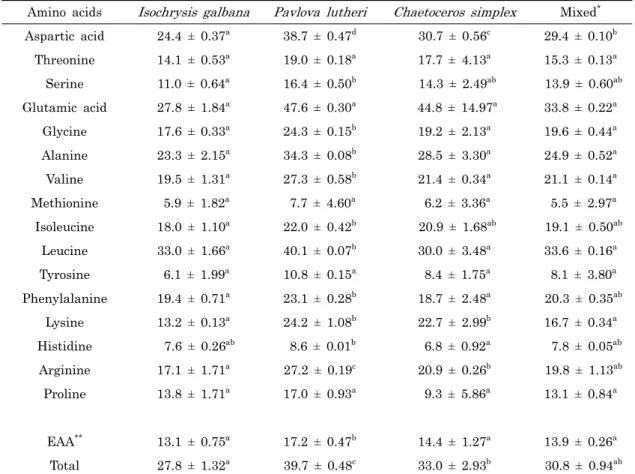
lutheri, C. simplex 등 3종을 단일 또는 동일비율로 혼합한 미세조류의 아미노산 조성은 Table 1에 나타내었다. 아미노산 조성은 미세조류의 종류에 관계없이 비슷한 경향을 보였으나, aspartic acid와 glutamic acid가 24.4 ± 0.37-47.6 ± 0.30%로 가장 높은 조성을 보였고, methionine, tyrosine과 histidine은 5.5 ± 2.97-10.8 ± 0.15%로 비교적 낮은 조성 을 보였다. 착편모조류인 I. galbana와 P. lutheri 중에서 P.
lutheri가 아미노산 함량이 높은 경향을 보였고, 착편모조류인 P. lutheri와 규조류인 C. simplex 중에서 아미노산 함량은 전반적으로 P. lutheri가 유의하게 높게 나타났으나 (P <
0.05), glutamic acid, threonine, methionine 등에서는 유 의한 차이가 없었다. 혼합 먹이는 C. simplex와 비슷한 경향 을 보였고, glutamic acid의 경우 혼합 먹이 보다 C.
simplex에서 44.8 ± 14.97%로 매우 높게 나타났다.
피조개 유생 및 부착치패의 먹이로서 I. galbana, P.
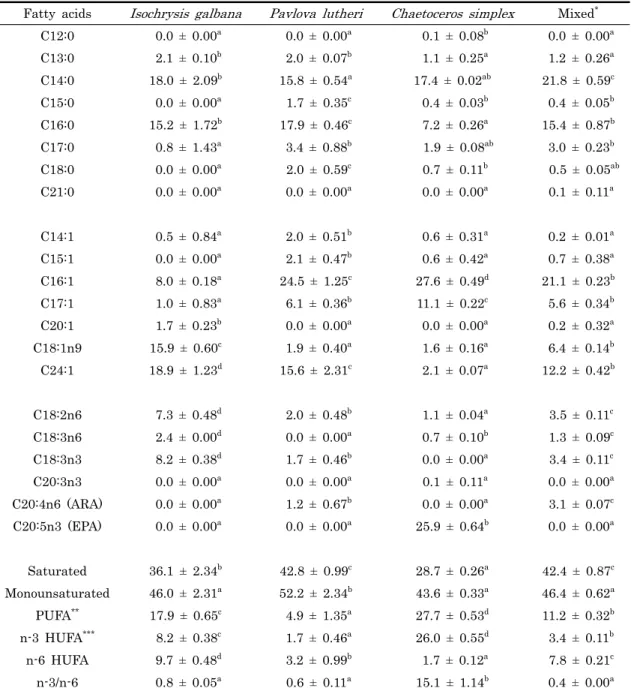
lutheri, C. simplex 등 3종을 단일 또는 동일비율로 혼합한 미세조류의 지방산 조성은 Table 2에 나타내었다. Palmitic acid (16:0) 함량은 P. lutheri에서 17.9 ± 0.46%로 가장 높 았고 (P < 0.05), I. galbana와 혼합구인 I + P + C는 각 각 15.2 ± 1.72%, 15.4 ± 0.87%로 C. simplex 보다 유의 하게 높았으나 (P < 0.05) 두 실험구 간에는 차이가 없었으 며, C. simplex는 7.2 ± 0.26%로 가장 낮게 나타났다.
Stearic acid (18:0) 함량은 P. lutheri에서 2.0 ± 0.59%로 가장 높게 나타났고 (P < 0.05), 다음으로 C. simplex가 0.7
± 0.11%, 혼합구가 0.5 ± 0.05%였으며, I. galbana에서는 나타나지 않았다.
Oleic acid (18:1n9) 함량은 I. galbana에서 15.9 ± 0.60%로 혼합구의 6.4 ± 0.14% 보다 높게 나타났고 (P <
0.05), P. lutheri와 C. simplex는 각각 1.9 ± 0.40%, 1.6 ± 0.16%로 유의하게 낮게 나타났다. Linoleic acid (18:2n6) 함량은 다른 미세조류보다 I. galbana에서 7.3 ± 0.48%로 가장 높게 나타났으며 (P < 0.05), 다음으로 혼합구의 3.5 ± 0.11%, P. lutheri의 2.0 ± 0.48%, C. simplex의 1.1 ± 0.04% 순으로 나타났다. α-linolenic acid (18:3n3) 함량은 다른 미세조류보다 I. galbana에서 8.2 ± 0.38%로 가장 높 게 나타났고 (P < 0.05), 다음으로 혼합구의 3.4 ± 0.11%, P. lutheri의 1.7 ± 0.46% 순이었으며, C. simplex에서는 나 타나지 않았다.
Arachidonic acid (20:4n6, AA) 함량은 혼합구에서 3.1
± 0.07%로 P. lutheri의 1.2 ± 0.67% 보다 유의하게 높게 나타났으며 (P < 0.05), eicosapentaenoic acid (20:5n3, EPA) 함량은 C. simplex에서만 25.9 ± 0.64%로 나타났다.
Amino acids Isochrysis galbana Pavlova lutheri Chaetoceros simplex Mixed* Aspartic acid 24.4 ± 0.37a 38.7 ± 0.47d 30.7 ± 0.56c 29.4 ± 0.10b
Threonine 14.1 ± 0.53a 19.0 ± 0.18a 17.7 ± 4.13a 15.3 ± 0.13a Serine 11.0 ± 0.64a 16.4 ± 0.50b 14.3 ± 2.49ab 13.9 ± 0.60ab Glutamic acid 27.8 ± 1.84a 47.6 ± 0.30a 44.8 ± 14.97a 33.8 ± 0.22a
Glycine 17.6 ± 0.33a 24.3 ± 0.15b 19.2 ± 2.13a 19.6 ± 0.44a Alanine 23.3 ± 2.15a 34.3 ± 0.08b 28.5 ± 3.30a 24.9 ± 0.52a Valine 19.5 ± 1.31a 27.3 ± 0.58b 21.4 ± 0.34a 21.1 ± 0.14a Methionine 5.9 ± 1.82a 7.7 ± 4.60a 6.2 ± 3.36a 5.5 ± 2.97a Isoleucine 18.0 ± 1.10a 22.0 ± 0.42b 20.9 ± 1.68ab 19.1 ± 0.50ab
Leucine 33.0 ± 1.66a 40.1 ± 0.07b 30.0 ± 3.48a 33.6 ± 0.16a Tyrosine 6.1 ± 1.99a 10.8 ± 0.15a 8.4 ± 1.75a 8.1 ± 3.80a Phenylalanine 19.4 ± 0.71a 23.1 ± 0.28b 18.7 ± 2.48a 20.3 ± 0.35ab
Lysine 13.2 ± 0.13a 24.2 ± 1.08b 22.7 ± 2.99b 16.7 ± 0.34a Histidine 7.6 ± 0.26ab 8.6 ± 0.01b 6.8 ± 0.92a 7.8 ± 0.05ab
Arginine 17.1 ± 1.71a 27.2 ± 0.19c 20.9 ± 0.26b 19.8 ± 1.13ab Proline 13.8 ± 1.71a 17.0 ± 0.93a 9.3 ± 5.86a 13.1 ± 0.84a
EAA** 13.1 ± 0.75a 17.2 ± 0.47b 14.4 ± 1.27a 13.9 ± 0.26a Total 27.8 ± 1.32a 39.7 ± 0.48c 33.0 ± 2.93b 30.8 ± 0.94ab Values (mean ± s.d. of two replication) in the same row not sharing a common superscript are significantly
different (P < 0.05).
*mixed : Isochrysis galbana + Pavlova lutheri + Chaetoceros simplex.
**EAA : essential amino acids.
Table 1. Amino acids composition (% of total amino acid) of single and mixed microalgal species
포화지방산 (saturated fatty acids) 함량은 P. lutheri에 서 42.8 ± 0.99%로 I. galbana의 36.1 ± 2.34% 보다 유의 하게 높게 나타났으나 (P < 0.05), 혼합구의 42.4 ± 0.87%
와는 유의한 차이를 보이지 않았으며, C. simplex에서는 28.7
± 0.26%로 가장 낮게 나타났다. 단순불포화지방산 (mono–
unsaturated fatty acids) 함량은 다른 미세조류보다 P.
lutheri에서 52.2 ± 2.34%로 유의하게 높게 나타났다 (P <
0.05). 다불포화지방산 (polyunsaturated fatty acids, PUFA) 함량은 C. simplex에서 27.7 ± 0.53%로 I.
galbana의 17.9 ± 0.65% 보다 유의하게 높게 나타났고 (P
< 0.05), 다음으로 혼합구의 11.2 ± 0.32% 순이었으며 P.
lutheri에서 4.9 ± 1.35%로 가장 낮게 나타났다. n–3 고도 불포화지방산 (highly unsaturated fatty acid, HUFA) 함 량은 C. simplex에서 26.0 ± 0.55%로 가장 높게 나타났고 (P < 0.05), 다음으로 I. galbana의 8.2 ± 0.38%, 혼합구의 3.4 ± 0.11% 순이었으며, P. lutheri에서 1.7 ± 0.46%로 가
장 낮게 나타났다.
4. 부착치패의 아미노산 및 지방산 조성
피조개 부착치패의 먹이로서 I. galbana, P. lutheri, C.
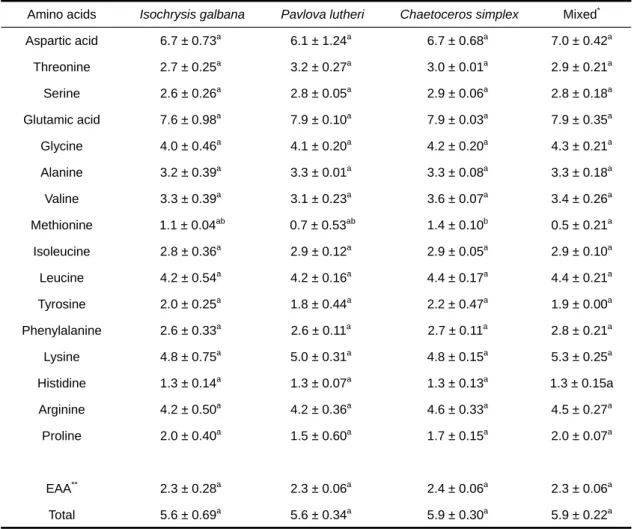
simplex 등 3종을 단일 또는 동일비율로 혼합하여 공급한 피 조개 부착치패의 아미노산 조성은 Table 3에 나타내었다. 아 미노산 조성은 미세조류의 종류에 관계없이 비슷한 경향을 보 였으며, 먹이 공급구 간에 유의한 차이는 없었다. Methionine 은 C. simplex 공급구에서 1.4 ± 0.10%로 다른 실험구 보다 유의하게 높게 나타났다 (P < 0.05).
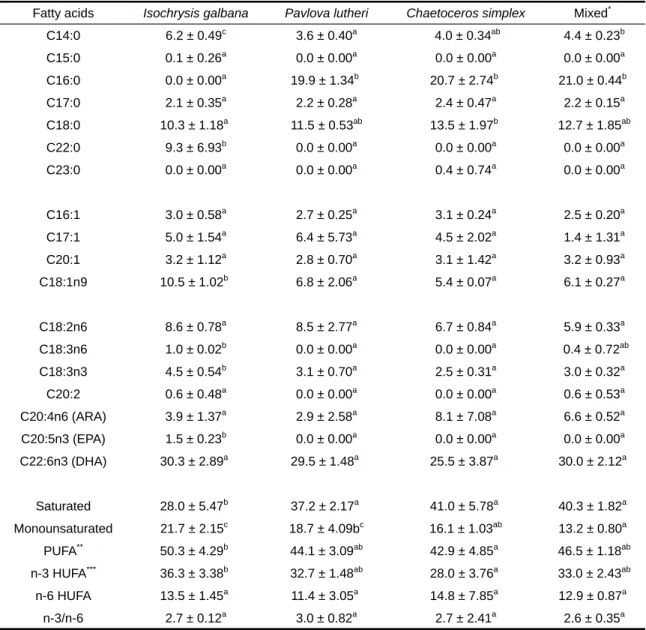
서로 다른 미세조류를 먹이로 공급한 피조개 부착치패의 지 방산 조성은 Table 4에 나타내었다. Palmitic acid (16:0) 함 량은 혼합 공급구에서 21.0 ± 0.44%로 가장 높게 나타났으 나, C. simplex 공급구의 20.7 ± 2.74%와 P. lutheri 공급구 의 19.9 ± 1.34%와 유의한 차이는 없었다. 그리고 stearic acid (18:0) 함량은 C. simplex 공급구에서 13.5 ± 1.97%
Fatty acids Isochrysis galbana Pavlova lutheri Chaetoceros simplex Mixed* C12:0 0.0 ± 0.00a 0.0 ± 0.00a 0.1 ± 0.08b 0.0 ± 0.00a C13:0 2.1 ± 0.10b 2.0 ± 0.07b 1.1 ± 0.25a 1.2 ± 0.26a C14:0 18.0 ± 2.09b 15.8 ± 0.54a 17.4 ± 0.02ab 21.8 ± 0.59c C15:0 0.0 ± 0.00a 1.7 ± 0.35c 0.4 ± 0.03b 0.4 ± 0.05b C16:0 15.2 ± 1.72b 17.9 ± 0.46c 7.2 ± 0.26a 15.4 ± 0.87b C17:0 0.8 ± 1.43a 3.4 ± 0.88b 1.9 ± 0.08ab 3.0 ± 0.23b C18:0 0.0 ± 0.00a 2.0 ± 0.59c 0.7 ± 0.11b 0.5 ± 0.05ab C21:0 0.0 ± 0.00a 0.0 ± 0.00a 0.0 ± 0.00a 0.1 ± 0.11a
C14:1 0.5 ± 0.84a 2.0 ± 0.51b 0.6 ± 0.31a 0.2 ± 0.01a C15:1 0.0 ± 0.00a 2.1 ± 0.47b 0.6 ± 0.42a 0.7 ± 0.38a C16:1 8.0 ± 0.18a 24.5 ± 1.25c 27.6 ± 0.49d 21.1 ± 0.23b C17:1 1.0 ± 0.83a 6.1 ± 0.36b 11.1 ± 0.22c 5.6 ± 0.34b C20:1 1.7 ± 0.23b 0.0 ± 0.00a 0.0 ± 0.00a 0.2 ± 0.32a C18:1n9 15.9 ± 0.60c 1.9 ± 0.40a 1.6 ± 0.16a 6.4 ± 0.14b C24:1 18.9 ± 1.23d 15.6 ± 2.31c 2.1 ± 0.07a 12.2 ± 0.42b
C18:2n6 7.3 ± 0.48d 2.0 ± 0.48b 1.1 ± 0.04a 3.5 ± 0.11c C18:3n6 2.4 ± 0.00d 0.0 ± 0.00a 0.7 ± 0.10b 1.3 ± 0.09c C18:3n3 8.2 ± 0.38d 1.7 ± 0.46b 0.0 ± 0.00a 3.4 ± 0.11c C20:3n3 0.0 ± 0.00a 0.0 ± 0.00a 0.1 ± 0.11a 0.0 ± 0.00a C20:4n6 (ARA) 0.0 ± 0.00a 1.2 ± 0.67b 0.0 ± 0.00a 3.1 ± 0.07c C20:5n3 (EPA) 0.0 ± 0.00a 0.0 ± 0.00a 25.9 ± 0.64b 0.0 ± 0.00a
Saturated 36.1 ± 2.34b 42.8 ± 0.99c 28.7 ± 0.26a 42.4 ± 0.87c Monounsaturated 46.0 ± 2.31a 52.2 ± 2.34b 43.6 ± 0.33a 46.4 ± 0.62a PUFA** 17.9 ± 0.65c 4.9 ± 1.35a 27.7 ± 0.53d 11.2 ± 0.32b n-3 HUFA*** 8.2 ± 0.38c 1.7 ± 0.46a 26.0 ± 0.55d 3.4 ± 0.11b n-6 HUFA 9.7 ± 0.48d 3.2 ± 0.99b 1.7 ± 0.12a 7.8 ± 0.21c n-3/n-6 0.8 ± 0.05a 0.6 ± 0.11a 15.1 ± 1.14b 0.4 ± 0.00a Values (mean ± s.d. of two replication) in the same row not sharing a common superscript are significantly
different (P < 0.05).
*Mixed : Isochrysis galbana + Pavlova lutheri + Chaetoceros simplex.
**PUFA : polyunsaturated fatty acids, ***HUFA : highly unsaturated fatty acids.
Table 2. Fatty acids composition (% of total fatty acid) of single and mixed microalgal species
로 가장 높게 나타났으며 (P < 0.05), 혼합 공급구와 P.
lutheri 공급구와는 유의한 차이가 없었고, I. galbana 공급 구에서 10.3 ± 1.18%로 가장 낮게 나타났다 (P < 0.05).
Oleic acid (18:1n9) 함량은 I. galbana 공급구에서 10.5
± 1.02%로 가장 높게 나타났고, C. simplex 공급구에서 5.4
± 0.07%로 가장 낮게 나타났으며 (P < 0.05), P. lutheri 공
급구와 혼합 공급구와는 유의한 차이가 없었다. Linoleic acid (18:2n6) 함량은 I. galbana 공급구에서 8.6 ± 0.78%로 가 장 높게 나타났고, 혼합 공급구에서 5.9±0.33%로 낮게 나타 났으나 유의한 차이는 없었다. α–linolenic acid (18:3n3) 함량은 I. galbana 공급구에서 4.5 ± 0.54%로 가장 높게 나 타났으며 (P < 0.05), 그 다음으로 P. lutheri 공급구가 3.1
Amino acids Isochrysis galbana Pavlova lutheri Chaetoceros simplex Mixed* Aspartic acid 6.7 ± 0.73a 6.1 ± 1.24a 6.7 ± 0.68a 7.0 ± 0.42a
Threonine 2.7 ± 0.25a 3.2 ± 0.27a 3.0 ± 0.01a 2.9 ± 0.21a Serine 2.6 ± 0.26a 2.8 ± 0.05a 2.9 ± 0.06a 2.8 ± 0.18a Glutamic acid 7.6 ± 0.98a 7.9 ± 0.10a 7.9 ± 0.03a 7.9 ± 0.35a Glycine 4.0 ± 0.46a 4.1 ± 0.20a 4.2 ± 0.20a 4.3 ± 0.21a Alanine 3.2 ± 0.39a 3.3 ± 0.01a 3.3 ± 0.08a 3.3 ± 0.18a Valine 3.3 ± 0.39a 3.1 ± 0.23a 3.6 ± 0.07a 3.4 ± 0.26a Methionine 1.1 ± 0.04ab 0.7 ± 0.53ab 1.4 ± 0.10b 0.5 ± 0.21a Isoleucine 2.8 ± 0.36a 2.9 ± 0.12a 2.9 ± 0.05a 2.9 ± 0.10a Leucine 4.2 ± 0.54a 4.2 ± 0.16a 4.4 ± 0.17a 4.4 ± 0.21a Tyrosine 2.0 ± 0.25a 1.8 ± 0.44a 2.2 ± 0.47a 1.9 ± 0.00a Phenylalanine 2.6 ± 0.33a 2.6 ± 0.11a 2.7 ± 0.11a 2.8 ± 0.21a Lysine 4.8 ± 0.75a 5.0 ± 0.31a 4.8 ± 0.15a 5.3 ± 0.25a Histidine 1.3 ± 0.14a 1.3 ± 0.07a 1.3 ± 0.13a 1.3 ± 0.15a Arginine 4.2 ± 0.50a 4.2 ± 0.36a 4.6 ± 0.33a 4.5 ± 0.27a Proline 2.0 ± 0.40a 1.5 ± 0.60a 1.7 ± 0.15a 2.0 ± 0.07a
EAA** 2.3 ± 0.28a 2.3 ± 0.06a 2.4 ± 0.06a 2.3 ± 0.06a
Total 5.6 ± 0.69a 5.6 ± 0.34a 5.9 ± 0.30a 5.9 ± 0.22a
Values (mean ± s.d. of two replication) in the same row not sharing a common superscript are significantly different (P < 0.05).
*Mixed : spat fed on mixed diets (Isochrysis galbana + Pavlova lutheri + Chaetoceros simplex)
**EAA : essential amino acids.
Table 3. Amino acids composition (% of total amino acid) of the spat of Scapharca broughtonii fed single and mixed microalgal diets during 30 days
± 0.70%, 혼합 공급구가 3.0 ± 0.32%, C. simplex 공급구 가 2.5 ± 0.31%의 순이었다.
Arachidonic acid (20:4n6, AA) 함량은 C. simplex 공급 구에서 8.1 ± 7.08%로 가장 높게 나타났으나 다른 먹이공급 구와 유의한 차이는 없었다. Eicosapentaenoic acid (20:5n3, EPA) 함량은 I. galbana 공급구에서만 1.5 ± 0.23%로 나타났고, docosahexaenoic acid (22:6n3, DHA) 함량은 I. galbana 공급구와 혼합공급구에서 각각 30.3 ± 2.89%와 30.0 ± 2.12%로 나타났으나 유의한 차이는 없었다.
포화지방산 (saturated fatty acids) 함량은 C. simplex 공급구에서 41.0 ± 5.78%로 가장 높게 나타났으며 (P <
0.05), 혼합 공급구의 40.3 ± 1.82%와 유의한 차이는 없었 다. 단순불포화지방산 (mono-unsaturated fatty acids) 함
량은 I. galbana 공급구에서 21.7 ± 2.15%로 가장 높게 나 타났으며 (P < 0.05), 혼합 공급구가 13.2 ± 0.80%로 가장 낮은 함량을 보였다. 다불포화지방산 (polyunsaturated fatty acids, PUFA) 함량은 I. galbana 공급구에서 50.3 ± 4.29%로 가장 높게 나타났으며 (P < 0.05), C. simplex 공 급구가 42.9 ± 4.85%로 가장 낮은 함량을 보였다. n–3 고도 불포화지방산 (highly unsaturated fatty acids, HUFA) 함 량은 I. galbana 공급구에서 36.3 ± 3.38%로 가장 높게 나 타났으며 (P < 0.05), C. simplex 공급구가 28.0 ± 3.76%
로 가장 낮은 함량을 보였고, 혼합 공급구와 P. lutheri 공급구 는 각각 33.0 ± 2.43%와 32.7 ± 1.48%로 유의한 차이가 없었다.
Fatty acids Isochrysis galbana Pavlova lutheri Chaetoceros simplex Mixed* C14:0 6.2 ± 0.49c 3.6 ± 0.40a 4.0 ± 0.34ab 4.4 ± 0.23b C15:0 0.1 ± 0.26a 0.0 ± 0.00a 0.0 ± 0.00a 0.0 ± 0.00a C16:0 0.0 ± 0.00a 19.9 ± 1.34b 20.7 ± 2.74b 21.0 ± 0.44b C17:0 2.1 ± 0.35a 2.2 ± 0.28a 2.4 ± 0.47a 2.2 ± 0.15a C18:0 10.3 ± 1.18a 11.5 ± 0.53ab 13.5 ± 1.97b 12.7 ± 1.85ab C22:0 9.3 ± 6.93b 0.0 ± 0.00a 0.0 ± 0.00a 0.0 ± 0.00a C23:0 0.0 ± 0.00a 0.0 ± 0.00a 0.4 ± 0.74a 0.0 ± 0.00a
C16:1 3.0 ± 0.58a 2.7 ± 0.25a 3.1 ± 0.24a 2.5 ± 0.20a C17:1 5.0 ± 1.54a 6.4 ± 5.73a 4.5 ± 2.02a 1.4 ± 1.31a C20:1 3.2 ± 1.12a 2.8 ± 0.70a 3.1 ± 1.42a 3.2 ± 0.93a C18:1n9 10.5 ± 1.02b 6.8 ± 2.06a 5.4 ± 0.07a 6.1 ± 0.27a
C18:2n6 8.6 ± 0.78a 8.5 ± 2.77a 6.7 ± 0.84a 5.9 ± 0.33a C18:3n6 1.0 ± 0.02b 0.0 ± 0.00a 0.0 ± 0.00a 0.4 ± 0.72ab C18:3n3 4.5 ± 0.54b 3.1 ± 0.70a 2.5 ± 0.31a 3.0 ± 0.32a
C20:2 0.6 ± 0.48a 0.0 ± 0.00a 0.0 ± 0.00a 0.6 ± 0.53a C20:4n6 (ARA) 3.9 ± 1.37a 2.9 ± 2.58a 8.1 ± 7.08a 6.6 ± 0.52a C20:5n3 (EPA) 1.5 ± 0.23b 0.0 ± 0.00a 0.0 ± 0.00a 0.0 ± 0.00a C22:6n3 (DHA) 30.3 ± 2.89a 29.5 ± 1.48a 25.5 ± 3.87a 30.0 ± 2.12a
Saturated 28.0 ± 5.47b 37.2 ± 2.17a 41.0 ± 5.78a 40.3 ± 1.82a Monounsaturated 21.7 ± 2.15c 18.7 ± 4.09bc 16.1 ± 1.03ab 13.2 ± 0.80a PUFA** 50.3 ± 4.29b 44.1 ± 3.09ab 42.9 ± 4.85a 46.5 ± 1.18ab n-3 HUFA*** 36.3 ± 3.38b 32.7 ± 1.48ab 28.0 ± 3.76a 33.0 ± 2.43ab n-6 HUFA 13.5 ± 1.45a 11.4 ± 3.05a 14.8 ± 7.85a 12.9 ± 0.87a
n-3/n-6 2.7 ± 0.12a 3.0 ± 0.82a 2.7 ± 2.41a 2.6 ± 0.35a Values (mean ± s.d. of two replication) in the same row not sharing a common superscript are significantly
different (P < 0.05).
*Mixed : spat fed on mixed diets (Isochrysis galbana + Pavlova lutheri + Chaetoceros simplex)
**PUFA : polyunsaturated fatty acids, ***HUFA : highly unsaturated fatty acids.
Table 4. Fatty acids composition (% of total fatty acid) of the spat of Scapharca broughtonii fed single and mixed microalgal diets during 30 days
고 찰
조개류 부유유생기의 성장에 미치는 중요한 요인은 수온, 염 분, 조도, 유생의 밀도 및 먹이생물 등이 있으나 그중에서 수 온이 성장을 지배하는 가장 중요한 요인이며, 수온에 따라 먹 이생물의 섭취량이 달라지고 성장도 큰 영향을 받는다 (Loosanoff, 1950; Loosanoff and Davis, 1963; Walne, 1974).
조개류는 미세조류를 여과 섭식하므로 실내에서 유생 및 어 미 사육을 위해서는 미세조류의 확보가 가장 중요하며 (Epifanio, 1979), 이러한 미세조류는 세포 내에 함유된 영양 가치에 따라 성장, 생식소의 성숙, 유생의 변태 및 생존율에 영향을 미치게 된다 (Holland, 1978; O'Connor et al., 1992).
조개류 유생사육시 I. galbana 와 P. lutheri 는 초기 먹이 생물로서 크기 및 영양 가치면에서 우수한 먹이로 알려져
(Enright et al., 1986), 주로 많이 이용되는 종류이다 (Delaunay et al., 1992; Marty et al., 1992). 따라서 본 연 구는 3종 (I. galbana, P. lutheri, C. simplex) 의 미세조류 가 피조개 유생과 부착치패의 성장, 생존에 미치는 영향을 아 미노산 및 지방산 조성과 연계하여 조사하였다.
본 연구에서 이들 3종을 단일 또는 동일비율로 혼합한 미세 조류의 지방산 조성 분석 결과, eicosapentaenoic acid (20:5n3, EPA) 는 C. simplex에서만 25.9 ± 0.64%로 나타 났고, 다불포화지방산 (polyunsaturated fatty acids, PUFA) 과 n–3 고도불포화지방산 (highly unsaturated fatty acid, HUFA) 도 C. simplex에서 가장 높게 나타났다.
피조개의 유생기 먹이생물에 관하여 Imai and Nishikawa (1969) 은 P. lutheri는 번식속도가 늦고 배양하기 어려운 반 면 먹이효율이 높다고 보고하였다. Helm and Laing (1987) 은 I. galbana 와 C. calcitrans 의 먹이공급에 따른 조개류 유생의 성장에 관한 비교 연구에서 2종을 혼합 공급한 것 보 다 단일종을 공급한 경우가 영양적인 측면에서 중요한 요소가 결핍되었기 때문에 부진한 성장을 나타내었다고 보고한 바 있 다. 본 연구에서도 3종을 혼합하여 먹이로 공급한 유생과 부착 치패의 성장과 생존율은 혼합 공급구에서 가장 높았고, 단일 공급구 중에서는 C. simplex, I. galbana, P. lutheri의 순이 었다.
n-3 HUFA 계열 지방산은 양식에 필요한 미세조류를 선택 하는데 중요한 요건이며 (Watanabe et al., 1983; Rezeq and James, 1987), 미세조류의 성장률과 영양성분의 변화, 특히 지방함량과 불포화지방산은 배양 환경에 관여하는 여러 가지 조건과 관련이 있다고 보고된 바 있다 (Iwamoto and Sugimoto, 1955; De Pauw et al., 1984). 본 연구에서 C.
simplex는 다른 2종의 미세조류 보다 포화지방산 및 n–3 고 도 불포화 지방산의 함량이 높으므로 피조개 유생 사육시 단일 공급구 중에서 빠른 성장을 나타내었고 생존율도 높은 것으로 사료된다.
미세조류의 지방산 함량 중 HUFA, 특히 EPA와 DHA는 조개류 유생의 성장과 생존율에 영향을 준다 (Langdon and Waldock, 1981; Enright et al., 1986; Brown et al., 1989).
n-3 HUFA 계열 지방산은 양식에서 필요한 미세조류를 선 택하는데 중요한 요건이다 (Watanabe et al., 1983). 그러나 미세조류의 성장률과 영양성분의 변화, 특히, 지방함량과 불포 화지방산은 배양환경에 관여하는 여러 가지 조건과 관련이 있 다고 보고되고 있다 (Iwamoto and Sugimoto, 1955; De Pauw et al., 1984).
지방산 조성은 먹이가치와 영양요구량을 결정하는 매우 중 요한 요소이며, 먹이가치 판단의 직접적인 평가 요소이다.
Palmitic acid, 단일불포화지방산은 주로 성장 및 활동에너지 로 이용 (Enright et al, 1986; Thompson et al., 1993) 되 며, 고도불포화지방산, EPA, DHA는 조개류, 새우류, 어류 등 해산동물 (Volkman et al., 1993; Castell et al., 1994) 의 유생과 치패의 성장에 관여하는 필수지방산으로 밝혀져 있다 (Langdon and Waldock, 1981; Thompson et al., 1993;
Brown et al., 1997). 그리고 arachidonic acid는 포유동물, 해산어류 및 무척추동물의 생명활동에 매우 중요한 prostaglandin의 전구물질, 이온 수송 및 삼투조절에 중요한 역할을 하는 것으로 밝혀져 필수지방산으로 보고되고 있다 (Castell et al., 1994).
본 연구에서 피조개 부착치패의 먹이로서 I. galbana, P.
lutheri, C. simplex 등 3종을 단일 또는 동일비율로 혼합하 여 공급한 피조개 부착치패의 아미노산 조성은 미세조류의 종 류에 관계없이 비슷한 경향을 보여 먹이 공급구 간에 유의한 차이는 없었다.
본 연구에서 서로 다른 미세조류 3종을 단일 또는 혼합하여 먹이로 공급한 피조개 부착치패의 stearic acid (18:0) 함량은 C. simplex 공급구에서 13.5 ± 1.97%로 가장 높게 나타났 으며, 포화지방산 함량은 C. simplex 공급구에서 다른 실험구 보다 높은 경향을 나타내었다. Arachidonic acid (20:4n6, AA) 함량은 C. simplex 공급구에서 8.1 ± 7.08%로 가장 높 게 나타내었고, 불포화지방산 함량은 C. simplex 공급구에서 arachidonic acid의 함량이 다른 실험구에 비해 높은 경향을 보였다.
C. simplex 공급구에서 빠른 성장을 보였고, 혼합 공급구에 서 가장 빠른 성장을 보였고, I. galbana, P. lutheri 공급구 는 상대적으로 성장이 부진하였으며, 실험구별 유생의 생존율 도 성장과 동일한 경향을 나타내었다. 그리고 부착치패의 경우 에도 유생에서와 동일한 경향을 나타내었다.
이와 같은 결과를 나타낸 것은 먹이생물로서 C. simplex는 I. galbana, P. lutheri 보다 포화지방산 및 n-3 고도불포화지 방산의 함량이 높아 빠른 성장과 높은 생존율에 영향을 미친 것으로 판단된다. 포화지방산, 단일불포화지방산은 주로 성장 및 활동에너지로 이용되므로 (Enright et al, 1986;
Thompson et al., 1993) 단일 공급구 중 C. simplex 공급구 에서 불포화지방산 함량이 높아 성장과 활동에너지로 이용되 어 빠른 성장을 보였고, 무척추동물의 생명활동에 매우 중요한 역할을 하는 arachidonic acid의 함량도 다른 단일 공급구에 비해 높아 다른 실험구에 비해 부착치패의 성장과 생존이 높은 것으로 판단된다. 그러나 먹이생물의 공급은 단일종 만을 공급 하는 것 보다는 C. simplex를 포함한 2-3종을 혼합하여 공급 할 경우 빠른 성장과 높은 생존율로 생산성을 더욱 향상시킬 수 있었다.
요 약
I. galbana, P. lutheri 및 C. simplex 3종을 먹이로 공급 하며, 미세조류 종류에 따른 피조개 유생과 부착치패의 성장과 생존율 등을 비교하였다.
서로 다른 미세조류 3종을 단일 또는 혼합하여 먹이로 공급 한 피조개 유생의 성장은 혼합 공급구에서 가장 빠르게 나타내 었고, 단일 공급구 중에서 C. simplex 공급구에서 가장 높은 성장을 보였다. 또 유생의 생존율은 혼합 공급구에서 27.4 ± 5.3%로 가장 높게 나타내었고, 단일 공급구 중에서 C.
simplex 공급구에서 14.5 ± 2.3%로 가장 높았다.
I. galbana, P. lutheri, C. simplex 3종을 단일 또는 동일 비율로 혼합한 미세조류의 지방산 조성은 EPA의 경우 C.
simplex에서만 25.9 ± 0.64%로 나타났고, 다불포화지방산 (PUFA) 과 n–3 HUFA 함량은 C. simplex에서 가장 높게 나타났다.
또 이들 미세조류를 먹이로 공급한 피조개 부착치패의 경우 C. simplex 공급구에서 포화지방산과 AA 함량이 유의하게 높았다. 이와 같은 C. simplex의 지방산 조성이 피조개 유생 과 부착치패의 성장과 생존율의 원인으로 판단된다. 따라서 단 일종으로는 C. simplex가 가장 적합하나 3종을 혼합하여 공 급하는 것이 더 좋은 먹이효율을 유도할 수 있다.
REFERENCES
Ballantine, J.A., Lavis, A. and Morris, R.J. (1979) Sterols of the phytoplankton-effects of illumination and growth stage. Phytochemistry, 18: 1459-1466.
Brown, M.R., Jeffrey, S.W. and Garland, C.D. (1989) Nutritional aspects of microalgae used in mariculture: a literature review. C.S.I.R.O Marine Laboratories Report 205. C.S.I.R.O., Australia, 44pp.
Brown, M.R., Jeffrey, S.W., Volkman, J.K. and Dunstan, G.A. (1997) Nutritional properties of microalgae for mariculture. Aquaculture, 151: 315-331.
Castell, J.D., Bell, J.G., Tocher, D.R. and Sargent, J.R.
(1994) Effects of purified diets containing different combinations of arachidonic and docosahexaenoic acid on survival, growth and fatty acid composition of juvenile turbot (Scophthalmus maximus).
Aquaculture, 128: 315-333.
Cheong, S.C., Kang, H.W. and Lee, J.M. (1982) Experiments on the early artificial seedling production of ark shell Anadara broughtonii (SCHRENCK). Bulletin of the national Fisheries Research and Development, 28: 185-197. [in Korean]
Coultate, T.P. (1989) Food : the chemistry of its components. Royal Society of Chemistry Editiors, Letchworth, Herts (England), 325pp.
Delaunay, F., Marty, Y., Moal, J. and Samain, J.F. (1992) Growth and lipid class composition of Pecten
maximus (L) Larvae grown under hatchery conditions. Journal of Experimental Marine Biology and Ecology, 163: 209-219.
De Pauw, N., Morales, J. and Persoone, G. (1984) Mass culture of microalgae in aquaculture systems : progress and constraints. Hydrobiologia, 116/117:
121-134.
Duncan, D.B. (1955) Multiple-range and multiple F tests. Biometrics, 11: 1-42.
Enright, C.T., Newkirk, G.F., Craigiel, J.S. and Castell, J.D. (1986) Evaluation of phytoplankton as diets for juvenile Ostrea edulis L. Journal of Experimental Marine Biology and Ecology, 96: 1-13.
Epifanio, C.E. (1979) Comparison of yeast and algal diets for bivalve molluscs. Aquaculture, 16: 187-192.
Gallager, S.M. and Mann, R. (1986) Growth and survival of larvae of Mercenaria mercenaria (L.) and Crassostrea virginica (Gmelin) relative to brood conditioning and lipid content of eggs. Aquaculture, 56: 105-121.
Helm, M.M. and Millican, P.F. (1977) Experiments in the hatchery rearing of Pacific oyster larvae (Crassostrea gigas Thunberg). Aquaculture, 11: 1-12.
Helm, M.M. and Laing, L. (1987) Preliminary observation on the nutritional value of "Tahiti Isochrysis" to bivalve larvae. Aquaculture, 62:
281-288.
His, E., Robert, R. and Dinet, A. (1989) Combined effects of temperature and salinity on fed and starved larvae of the Mediterranean mussel Mytilus galloprivincialis and the Japanese oyster Crassostrea gigas. Marine Biology, 100: 455-463.
Holland, D.L. (1978) Lipid reserves and energy metabolism in the larvae of benthic marine invertebrates. In: Malins, D.C. and Sargent, J.R.
(Eds.), Biochemical and Biophysical Perspectives in Marine Biology, Vol 4, Academic Press, London and New York, 85-123.
Hur, Y.B. (2004) Dietary value of microalgae for larvae culture of Pacific oyster, Crassostrea gigas. Ph.D.
thesis, Pukyong National University, 133pp. [in Korean]
Hur, Y.B., Min, K.S., Kim, T.E., Lee, S.J. and Hur, S.B.
(2008) Larvae growth and biochemical composition change of the Pacific oyster Crassostrea gigas, larvae during artificial seed production. Journal of Aquaculture, 21: 203-212. [in Korean]
Imai, S. and Nishikawa, M.S. (1969) Seedling production of Scallop, Patinopecten yessoensis and Ark shell, Anadara broughtonii. Japanese Society for Aquaculture Research, 16: 309-316.
Iwamoto, H. and Sugimoto, H. (1955) Fat synthesis in unicellular algae: Part Ⅱ. Chemical composition of nitrogen deficient Chlorella cells. Bulletin of the Agricultural and Chemical Society Japan, 19:
247-252.
Laing, I. (1995) Effect of food supply on oyster spatfall.
Aquaculture, 131: 315-324.