• 검색 결과가 없습니다.

Influence of Annealing Temperatures on Corrosion Resistance of Magnesium Thin Film-Coated Electrogalvanized Steel

N/A
N/A
Protected

Academic year: 2021

Share "Influence of Annealing Temperatures on Corrosion Resistance of Magnesium Thin Film-Coated Electrogalvanized Steel"

Copied!
4
0
0

로드 중.... (전체 텍스트 보기)

전체 글

(1)

116

한국표면공학회지 J. Kor. Inst. Surf. Eng.

Vol. 46, No. 3, 2013.

http://dx.doi.org/10.5695/JKISE.2013.46.3.116

<연구논문>

Influence of Annealing Temperatures on Corrosion Resistance of Magnesium Thin Film-Coated Electrogalvanized Steel

Myeong-Hoon Lee

a*

, Seung-Hyo Lee

a

, Jae-In Jeong

b

, Young-Jin Kwak

c

, Tae-Yeob Kim

c

, Yeon-Won Kim

a

a

Division of Maritime System Engineering, Korea Maritime University, Korea

b

Hybrid Materials Research Department, Research Institute of Industrial Science & Technology, Gyeong-buk 790-330, Korea

c

POSCO, Gwangyang-Si, Jeonnam, Korea

(Received May 13, 2013; revised May 31, 2013; accepted June 7, 2013)

Abstract

To improve the corrosion resistance of an electrogalvanized steel sheet, we deposited magnesium film on it using a vacuum evaporation method and annealed the films at 250-330

o

C. The zinc-magnesium alloy is consequently formed by diffusion of magnesium into the zinc coating. From the anodic polarization test in 3% NaCl solution, the films annealed at 270-310

o

C showed better corrosion resistance than others. In X- ray diffraction analysis, ZnMg

2

was detected through out the temperature range, whereas Mg

2

Zn

11

and FeZn

13

were detected only in the film annealed at 310

o

C. The depth composition profile showed that the compositions of Mg at 270-290

o

C are evenly and deeply distributed in the film surface layer. These results demonstrate that 270-290

o

C is a proper temperature range to produce a layer of MgZn

2

intermetallic compound to act as a homogeneous passive layer.

Keywords: Magnesium, Zinc, Corrosion resistance, Physical vapor deposition, Annealing

1. Introduction

Zinc and zinc alloy coatings have been commercially used to improve the corrosion resistance of various steel construction materials. These coatings provide an anti-corrosive barrier and galvanic protection of steel substrate applied in the automotive and building industries. When zinc-coated steel is exposed to a corrosive environment, active zinc tends to produce corrosion products like ZnO or Zn(OH)

2

. These low conductive corrosion products can play the role of an anti-corrosive barrier against corrosive environments.

The function of a sacrificial anode is expected by the active zinc coating when the bare steel substrate is exposed to a corrosive environment. However, as severe corrosive environments have garnered great attention, the need for a zinc coating method with better corrosion resistance has arisen.

Although undamaged Zn coating on steel has good corrosion resistance, this protection cannot be expected to endure severe corrosive environments without increasing thickness through use of conventional coating methods. Thus, coatings that offer better galvanic or sacrificial protection for steel without increasing Zn coating thickness are required. To this end, Zn-Mg alloy coatings were studied in an effort to extend the lifetime of steel constructions and reduce costs. Much effort has been exerted to optimize Zn coating composition by alloying it with magnesium.

On the other hand, Zn-coated steel is usually produced by electro deposition or hot-dipping. Both coating methods inevitably lend themselves to high volume and continuous production. Also that is the preferred reality as it is cheap producing method.

However, in more corrosion-sensitive areas, coatings with superior corrosion resistance compared to Zn- coated steel became an issue

1-3)

. Magnesium-added Zn alloy coatings on steel material have been strongly

*

Corresponding author. E-mail : [email protected]

(2)

Myeong-Hoon Lee 외/한국표면공학회 46 (2013) 116-119 117

recognized as a next generation of anticorrosive coating, offering enhanced corrosion resistance without increased coating thickness

4)

.

In this study, Zn-Mg alloy coatings were prepared by the deposit of magnesium onto the electrogalvanized steel substrate using the physical vapor deposition method and then heat treatment was performed at 250-330

o

C. The intermetallic compounds and depth compositions of the films were then investigated using X-ray diffraction (XRD) and glow discharge spectroscopy (GDS), respectively. The influence of the Zn-Mg alloy coating on corrosion resistance was evaluated by electrochemical anodic polarization tests in 3% NaCl solution.

2. Experimental

The vacuum evaporation method was used to prepare Mg coating film (thickness: 0.5 mm) on EG (electro galvanized steel) sheet (Zn thickness: 2.7 mm).

Fig. 1 shows a schematic diagram of the deposition system. The deposition conditions are shown in table 1. After depositing magnesium onto EG steel sheet, the samples were annealed to produce Zn-Mg alloy coating in temperature range from 250 to 330

o

C. In addition, the surface intermetallic compositions of coating film were analyzed by X-ray diffractmeter (XRD: D/Max-2000, Rigaku Co., Japan) with Cu K α radiation. Potentio-dynamic anodic polarization mea- surements were carried out by Potentio-stat (CMS100 System, GamryIns., America) at 1 mV/s scan rate in 3% NaCl solution at room temperature.

3. Results and Discussion

GDS has been used to examine the effect of annealing temperature on the diffusion of Mg to Zn material within the surface alloyed layers. Fig. 2

shows the depth profile of the prepared film at 290

o

, 310

o

, and 330

o

C, respectively. The film annealed at 250

o

C in Fig. 2(a) showed high Mg content in the film surface layer (about 68 wt%) and then sharply decreased according to depth. This result indicates that much of the deposited Mg remained on the top surface layer. However, at the annealing temperature of 290

o

C (Fig. 2(b)), the Mg content on the top surface layer measured <20 wt% and remained constant until about 0.6 mm from the top surface. These results suggest that Mg was more deeply diffused than the Zn-Mg alloy coating annealed at 250

o

C and evenly distributed from top surface to about 0.7 mm in the coating layer. On the other hand, the depth profile of the Zn-Mg alloy coating annealed at 330

o

C showed results. As shown in Fig. 2(c), although the Mg content on the top surface layer measured <20%, the holing depth of the constant magnesium contents was definitely reduced compared to that of the Zn- Mg alloy coating annealed at 290

o

C. XRD examination was performed to identify the intermetallic phases formed within the surface alloyed layer on the Zn- Mg alloy film. Fig. 3 shows the XRD spectra of the films annealed at various temperatures. MgZn

2

and Zn peaks were detected throughout the temperature range. MgZn

2

is known to have a lower corrosion potential and corrode faster than zinc. It will there by have a beneficial effect on zinc corrosion and on exposed iron

5-7)

.

The highest ZnMg

2

peak tended to increase with increasing temperatures up to 290

o

C. However, ZnMg

2

intensity decreased at a 310

o

C annealing temperature, while Mg

2

Zn

11

and FeZn

13

peaks were detected at a 330

o

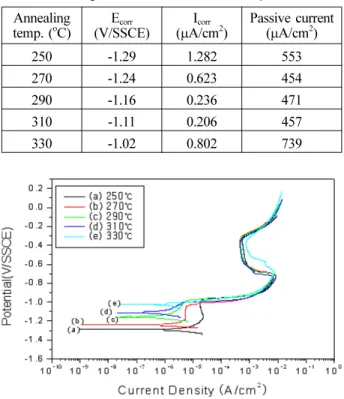
C annealing temperature. To further quantitatively investigate the corrosion performance of the surface alloy layer, potentiodynamic anodic polarization curves were determined in 3% NaCl solution. The results are shown in Fig. 4, where the x-axis is the current density defined as corrosion rate and the y-axis is the corrosion potential relative to the sodium-saturated calomel electrode. Corrosion potential changed to novel potential after changes in annealing temperature.

Fig. 1. Schematic diagram of vacuum deposition apparatus.

Table 1. Preparation condition of Zn-Mg thin films Substrate Electrogalvanized steel sheet Vacuum condition 5 × 10

−4

Torr Evaporation metal 99.99% magnesium

Temperatures of

annealing (

o

C) 250 270 290 310 330 Holding time of

annealing 3 sec.

(3)

118 Myeong-Hoon Lee 외/한국표면공학회 46 (2013) 116-119

On the other hand, Zn-Mg coating films annealed at 270-310

o

C showed relatively high corrosion resistance compared to that at 250

o

C and 330

o

C (Table 2). Both corrosion current density and passive current density were relatively low. These results suggest that corrosion potential and current density are related to annealing temperature. The Zn-Mg alloy film is thought to be

protected by selective dissolution of the magnesium from Mg-containing alloy phases, which hinders the oxygen reduction probably because of the good insulating Zn-Mg alloy film connected to a low cathodic reaction

7)

. However, the main role of annealing is limiting the rate of the anodic reaction by shifting the corrosion potential of Zn-Mg alloys close to the corrosion potential of zinc; thus, the corrosion rate that was determined by the anodic reaction became even lower. On the other hand, the Zn-Mg alloy coating at an annealing temperature of 330

o

C showed Fig. 2. Glow discharge spectra of Zn-Mg alloy coating

annealed at various temperatures.

Fig. 3. X-ray diffraction spectra on surface layer of Zn- Mg alloy coatings.

Table 2. Electro chemical parameters of Zn-Mg alloy coatings annealed at various temperatures Annealing

temp. (

o

C)

E

corr

(V/SSCE)

I

corr

(µA/cm

2

)

Passive current (µA/cm

2

)

250 -1.29 1.282 553

270 -1.24 0.623 454

290 -1.16 0.236 471

310 -1.11 0.206 457

330 -1.02 0.802 739

Fig. 4. Anodic polarization curves of Zn-Mg alloy

coating measured in 3% NaCl solution.

(4)

Myeong-Hoon Lee 외/한국표면공학회 46 (2013) 116-119 119

relatively poor corrosion resistance. A relative high annealing temperature may make it possible to produce Mg

2

Zn

11

and FeZn

138)

. This intermetallic compound formed at that temperature was coarse and too weak to play the role of a barrier against corrosive environment. Therefore, the intermetallic compound accelerated the anodic reaction and dissolved quickly in solution.

4. Conclusions

We deposited magnesium film on an electrogalvanized steel sheet using the vacuum evaporation method and annealed the samples in temperature range of 250- 330

o

C. These results allow us to propose the proper temperature range in which the Zn-Mg alloy coating provides good corrosion resistance. The Zn-Mg alloy film demonstrated good resistance in the temperature range of 270-310

o

C. This may be due to the deeply diffused ZnMg

2

alloy phase, which acts as an anti- corrosive barrier and has a corrosion potential close to the zinc potential.

Acknowledgement

This study was financially supported by the Smart

Coating Steel Development Center, World Premier Materials (WPM) Program of the Korea Ministry of Knowledge Economy.

References

1. M. Vlot, R. Bleeker, T. Maalman, E. van Perlstein, ILZRO and IZA, Dusseldorf, Germany, 2006.

2. T. Koll, K. Ullrich, J. Faderl, J. Hagler, A. Spalek, Association for Iron and Steel Technology, April 4-7, Chicago, IL,United States, 2004, pp.803-812.

3. M. H. Lee, Kor. Inst. Surf. Eng., 29 (1996) 585.

4. B. Schuhmacher, C. Schwerdt, U. Seyfert, O. Zimmer, Surf. Coat. Technol., 163-164 (2003) 703-709.

5. J. Kawafuku, J. Katoh, M. Toyama, K. Ikeda, H.

Nishimoto, H. Satoh, in: Proc. 5th Automotive Corr.

& Prevention Conference, 21-23 October 1991, Michigan, USA: SAE paper no. 912272, Philadelphia, 1991, pp. 43-50.

6. N. C. Hosking, M. A. Ström, P. H. Shipway, C.

D. Rudd, Corros. Sci. 41 (2007) 3669.

7. RenHausbrand, Martin Stratmann, Michael Rohwerder, Corros. Sci., 51 (2009) 2107.

8. R. Hausbrand, M. Stratmann, M. Rohwerder, Steel

Res. Int., 74 (2003) 453.

수치

Fig. 1. Schematic diagram of vacuum deposition apparatus.
Fig. 4. Anodic polarization curves of Zn-Mg alloy coating measured in 3% NaCl solution

참조

관련 문서