INTRODUCTION
Oysters (Mollusca: Bivalvia: Pteioida: Ostreidae) can be divided into three genus (Crassostrea, Ostrea, Pycnodonta) and more than 100 species, with a worldwide distribution ranging from the tropical regions to the cold latitudes (Ran- son 1950; 1960). Pacific oysters (Crassostrea gigas), sumi- noe oysters (Crassostrea ariakensis), iwagaki oysters (Cras- sostrea nippona), and flat oysters (Ostrea denselamellosa) make up the dominant species among nine oyster species reported in Korea (Kwon et al. 1993).
Crassostrea gigas plays a large role in Korea as a prin- cipal oyster export (Rana 1998) and has become an impor- tant species for farming throughout the world (Ventilla 1984; Kusaki 1991; Kobayashi et al. 1997; Hyun et al. 2001).
Oysters, invertebrates that filter-feed large volumes of ambi- ent water, have been investigated as bioindicators of the water quality in their surrounding environment by numerous researchers (Boesch and Rosenberg 1981; Clark and War- wick 1994; Park and Yi 2002). However, energy flow pat- terns among primary producers and macrobenthos remain unclear in estuarine and coastal environments.
Stable isotope ratios of carbon and nitrogen (δ13C, δ15N) have traditionally been used to trace energy flow in the food web as well as the assimilation of nutrient and organic mat- ter sources (Hobson and Welch 1992; Hansson et al. 1997).
In general, the δ13C value of an organism reflects the δ13C value of its diet with little to no change (Fry and Sherr 1984), and the δ15N value of an organism increases an average of 3~4‰ with each raise in trophic level (Minagawa and Wada 1984). This nitrogen enrichment is due to the excretion of
15N-depleted nitrogen (Peterson and Fry, 1987).
Additionally, the effects of human-derived waste or efflu-
─
─ 279 ──
Identification of the Food Sources-Metabolism of the Pacific Oyster Crassostrea gigas using Carbon and
Nitrogen Stable Isotopic Ratios
Jin-Yong Yang and Kyung-Hoon Shin*
Department of Environmental Marine Sciences, Hanyang University, Ansan 425-791, Korea
Abstract -- In order to understand food sources-metabolism for the pacific oyster (Crassostrea gi- gas), the stable isotope ratios of carbon (δδ13C) and nitrogen (δδ15N) of its gut, gill, and muscle as well as potential food sources (particulate organic matter, sedimentary organic matter, benthic micro- algae, seagrass detritus) were determined in Dongdae Bay. Average δδ13C and δδ15N values reflect that oysters primarily fed on sedimentary organic matter as opposed to suspended organic matter during summer and winter seasons. However, the relatively enriched 15N values of particulate organic matter (¤¤250μμm) and sedimentary organic matter in the summer may be due to the pho- tosynthetic incorporation of 15N-enriched nitrogen (DIN) or the spawning events of bivalves. Speci- fic oyster tissues (gut, gill, and muscle) revealed different metabolic pathways, which were deter- mined through analysis of δδ13C and δδ15N in each organ. The present results suggest the determina- tion of carbon and nitrogen stable isotopes to be a useful approach in ecological research related to the food sources-metabolism of Crassostrea gigas.
Key words : Dongdae Bay, stable isotope ratios, Crassostrea gigas, food source
* Corresponding author: Kyung-Hoon Shin, Tel. 031-400-5536, Fax. 031-416-6173, E-mail. [email protected]
ent were observed via anomalous increases in δ15N value (McKinney et al. 2002) and variations of δ13C were depen- dant on the turnover rates of metabolic tissue related to the health of the organism (Gannes et al. 1997).
The objective of this study was to identify potential energy sources and to assess seasonal variation among C. gigas food sources-metabolism using carbon and nitrogen stable isoto- pic ratios.
MATERIALS AND METHODS
1. Study area and sample collection
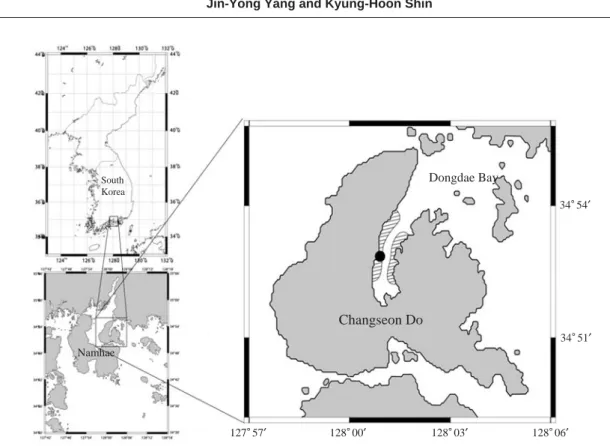
Particulate organic matter (POM), sedimentary organic matter (SOM), seagrass detritus, benthic microalgae (BM), and oysters (C. gigas) were sampled monthly during the win- ter and summer seasons (November 2004~March 2005 and June 2005~September 2005, respectively). The sampling site (34�52′57′′N×128�1′2′′E) is located at Dongdae Bay on the southern coast of Korea (Fig. 2). The bay is semi-clos- ed, 5 km in length, 1 km in width, and has extensive sea- grass beds. It has a fluctuating water depth of 3~12 m at
high tide, with some part of the seagrass bed exposed to the atmosphere at low tide. C. gigas is a dominant filter feeder in the bay.
A method modified by Couch (1989) was used to separate benthic microalgae from sediments, with a more detailed procedure described by Riera and Richard (1996). The sedi- ment, which was collected by scraping the upper 2 mm of dense microalgal mats, was spread under a light and covered with combusted silica powder (60~120μm) on a nylon screen (63-μm mesh).
Oysters were taken by hand, cleaned, and kept alive over- night at the laboratory in filtered seawater to allow the evac- uation of gut contents. They were then removed from their shells, rinsed in distilled water, and dissected into three types of tissue (adductor muscle, gill, and gut) for tissue specific analysis.
Samples of POM were filtered onto pre-combusted glass fibre filter papers (GF/F) for 4 hours at 450�C. The summer season POM sample was divided into three size fractions (⁄30μm, ¤30 μm, and ¤250 μm) using zoo-and phyto- plankton nets to verify the chemical specificity among the different sizes of POM.
Jin-Yong Yang and Kyung-Hoon Shin 280
Fig. 1. Sampling location in Dongdae Bay (●).
Dongdae Bay
Changseon Do
127�57′ 128�00′ 128�03′ 128�06′
34�54′
34�51′
Namhae South Korea
2. Organic carbon and total nitrogen stable isotope analysis
Freeze-dried and homogenized samples were treated with 1 N HCl to remove carbonates, and then placed into tin cups.
Samples were not acidified for nitrogen isotope ratio analy- sis because acidification could significantly influence δ15N values (Carabel et al. 2006). The samples were analyzed for organic carbon and nitrogen isotope ratios using an elemen- tal analyzer (Costech ECS4010) combined with mass spec- trometer (Delta plus, Finnigan MAT). All isotopic results are provided in conventional delta (δ) notation in units of parts per thousands (‰) and the standards for δ13C and δ15N are Pee Dee Belemnite and atmospheric nitrogen, respec- tively:
δ13C or δ15N=={R (sample)/R (standard)-1}×1000 (‰)
R==13C/12C, 15N/14N.
RESULTS AND DISCUSSION
1. Seasonal isotopic variation of potential food sources and oysters
The average stable isotope values of oysters and potential food sources (POM, SOM, BM, seagrass) were plotted dur- ing the winter and summer seasons (Fig. 2A and 2B). There were distinctive differences between the stable isotope ratios of the winter and summer seasons, indicating significant seasonal variation of environmental conditions in the bay.
The average δ13C values of POM ranged from -26 to -23
‰, reflecting the mixed contributions of isotopically lighter terrigenous organic matter and isotopically heavier phyto- planktonic organic matter to the estuarine POM pool (Fichez et al. 1993).
On the other hand, seagrass detritus demonstrated consis- tently heavier δ13C values (-12 to -10‰ range) that are typically observed in C4plants due to the different photosyn- thetic pathways in C3plants (Ehleringer 1991). In contrast to the seagrass detritus δ13C values, δ15N variation in sea- grass detritus during the winter season was larger than the summer season (Fig. 2). Variation in δ15N values of seagrass detritus was caused by nitrogen isotopic fractionation during microbial decomposition, which included deamination once seagrass withered during the winter season (Danovaro 1996).
In the winter season, δ13C and δ15N values of SOM were similar to the isotopic range of benthic microalgae, demon- strating that benthic microalgae significantly contributed to surface sediment organic matter. Indeed, primary production of benthic microalgae greatly exceeded the production of phytoplankton in shallow aquatic environments including estuarine tidal flats (Knox 1987; Fielding et al. 1988; Pinck- ney and Zingmark 1993). Oysters demonstrated similar δ13C values to SOM, but they experienced a 4‰ rise in δ15N val- ues (Fig. 2A). In the winter season, oysters preferentially consumed resuspended surface sedimentary organic matter, consisting mainly of benthic microalgae, over suspended particulate organic matter. Oysters as filter feeders could accelerate the utilization of sedimentary organic matter re- suspended by wind and tide in estuarine tidal flats (Heral et al. 1983).
Fig. 2. Carbon and nitrogen stable isotope values for oysters and primary producers in Dongdae Bay during the winter (November 2004~March 2005, A) and summer seasons (June 2005~September 2005, B).
δ15N(‰) 10
9
8
7
6
5
-28 -26 -24 -22 -20 -18 -16 -14 -12 -10 -84 δ13C (‰)
POM SOM
B.M
(B)
δ15N(‰) 12
10
8
6
4
2-30 -28 -26 -24 -22 -20 -18 -16 -14 -12 -10 δ13C (‰)
B.M POM
SOM Oyster
Seagrass
Increased SOM δ15N values in the summer may be due to the contributions of organic matter, which include enriched δ15N values derived from ammonium and oxidized nitrogen in wastewater (Fig. 2B). McClelland et al. (1997) have reported that nutrients derived from wastewater could be reflected in phyto-and zooplankton, benthos, and sediments via photosynthesis, aggregation, and deposition in the estu- arine food chain.
To determine factors contributing to surface sedimentary organic matter, the δ13C and δ15N values of three size-frac- tionated POM during the summer period are provided in Fig.
3. POM larger than 250μm had distinctive δ13C and δ15N values when compared to POM smaller than 250μm, which exhibited relatively similar values with SOM in the summer period. Although the isotopic distinction of SOM in the sum- mer can be explained by various possibilities, the surface sediments can be significantly influenced by larvae origina- ting from the spawning of bivalves such as oysters and scal- lops. Typically, the heavier isotope ratios (e.g. 13C or 15N) in the proteins of organisms are enriched through isotopic frac- tionation in the deamination and transamination processes, compared to those in lipids (DeNiro et al. 1981; Hobson et al. 1993). Considering that the eggs of bivalves consist pri- marily of protein (Marcelo et al. 2003), it is highly probable that larvae have anomalously heavier stable isotope values.
Mature oysters spawn at a temperature ranging from 21 to 26�C and the fertilized eggs grow to a larvae size of 270~
350μm within a few weeks (Nelson et al., 1928; Breese et al., 1975). According to the National Oceanographic Re- search Institute of Korea database (http://www.nori.go.kr/),
water temperature averages in the study area are 10.5±4.05
�C and 23.2±1.60�C for the winter and summer seasons, respectively. It is possible that bivalve larvae mainly affect POM larger than 250μm. SOM in the summer appears to have heavier δ15N values than in the winter because of potential influence by the supplement of 15N-enriched orga- nic matter via aggregation and sedimentation of large POM such as larvae.
In summer, oysters exhibited similar δ13C values to SOM, whereas δ15N values of oyster demonstrated a 2~4‰ differ- ence between SOM in the summer season and the winter season. The difference in nitrogen isotopic values between oyster and SOM may be caused by the release of eggs con- taining relatively 15N-enriched protein during spawning periods, as discussed previously.
2. Fractionation of internal specific tissues in oysters
Carbon and nitrogen stable isotope ratios of specific tis- sues in organisms have been applied to understand different energy metabolisms as well as to trace the incorporation of nutrients over various temporal and spatial scales (Riera 1998; Piola et al. 2006). Results for the specific tissues (gut, gill, and muscle) in oysters during the study period indicat- ed different isotopic fractionation among the three organs (Fig. 4). The lighter isotopes (e.g. 12C or 14N) tend to react more than the heavier isotopes (e.g. 13C or 15N) as a result of weaker coherence (Hoefs, 1980). From analysis of δ13C values (~-19‰) for SOM, which may have been consum- ed by oysters during this study period, it could be speculated Jin-Yong Yang and Kyung-Hoon Shin
282
Fig. 3. Carbon and nitrogen stable isotope values for oysters, SOM, and size-fractionated POM during the summer season.
Fig. 4. Average (±SD, n==65) carbon and nitrogen stable isotope values for oyster tissues collected over 12 months.
δ15N(‰) 12
10
8
6
4
2
-28 -26 -24 -22 -20 -18 -16
δ13C (‰) 250μm⁄
30μm⁄
⁄30μm
Oyster
SOM
δ15N(‰) 12
11
10
9
8
-21 -20 -19 -18 -17 -16
δ13C (‰)
Muscle
Gill
Gut
that carbon and nitrogen became isotopically heavier through selective elimination of the lighter isotope (e.g. 12C or 14N) during metabolism via food digestion and the resorbed ener- gy pathway. In this study, the heaviest isotopic values of the muscle demonstrated that the muscle may be the last organ to resorb food-derived carbon and nitrogen in the oyster. The same results have been reported for the Sydney rock oyster, Saccostrea glomerata (Piola et al. 2006), and several fish species (Gaston 2004).
The digestive pathway in oysters supports the idea that the stable isotope ratios of the gut and gill reflect the ingesta for a short period of time. However, the mature oyster gut is comprised of the gonad and digestive systems, and the oys- ters’ biochemical state (physiological conditions and spawn- ing events) may substantially affect the carbon and nitrogen stable isotope ratios of the gut (Beesley et al. 1998; Piola et al. 2006). As a result, oysters have demonstrated potential as bio-indicators for aquatic environments, with the gill and muscle in oysters as appropriate parts for the assessment of food ingestion over short-and long-term scales, respectively.
CONCLUSION
In this study, food sources for C. gigas were investigated using carbon and nitrogen isotope signatures, thus showing that the oysters selectively assimilated sedimentary organic matter. Also, this study suggests that specific tissues in oys- ters may be useful as bio-indicators in environmental moni- toring research over diverse time scales.
ACKNOWLEDGEMENTS
This study was supported by the Research program(R01- 2003-000-116580) of National Research Foundation of Korea and also J. Y. Yang (First author) was supported by a Science and Technology scholarship from Hanyang Uni- versity.
REFERENCES
Beesley PL, GLB Ross and A Wells. 1998. Mollusca: The Sou- thern Synthesis. Fauna of Australia. CSIRO Publishing,
Melbourne.
Boesch DF and R Rosenberg. 1981. Responses to stress in ma- rine benthic communities. pp.179-200. In Stress effect of natural ecosystems. (Barret GW and R Rosenberg eds.).
John Wiley and sons. NY.
Breese WP and RE Malouf. 1975. Hatchery manual for the Pacific oyster. Oreg, State Univ. Sea Grant Publ, ORE54- 4-75-002.
Carabel S, E Godinez-Dominguez, P Verisimo, L Fernandez and J Freire. 2006. An assessment of sample processing methods for stable isotope analyses of marine food webs.
J. Exp. Mar. Biol. Ecol. 336:254-261.
Clark KR and RM Warwick. 1994. Change in marine commu- nities: an approach to statistical analysis and interpretation.
Plymouth marine laboratory, London. 188.
Couch CA. 1989. Carbon and nitrogen stable isotopes of meio- benthos and their food resources. Estuar. Coast. Shelf. Sci.
28:433-441.
Danovaro R. 1996. Detritus-Bacteria-Meiofauna interations in a seagrass bed (Posidonia oceanic) of the NW Mediter- ranean. Mar. Biol. 127:1-13.
DeNiro MJ and S Epstein. 1981. Influence of diet on the distri- bution of nitrogen isotopes in animals. Geochim. Cosmo- chim. Acta 45:341-351.
Ehleringer JR. 1991. 13C/12C fractionation and its utility in terrestrial plant studies. pp.187-200. In (Coleman DC and B Fry eds.). Carbon Isotope Techniques. Academic Press.
San Diego.
Fichez, R, P Dennis, MF Fontaine and TD Jickells. 1993. Isoto- pic and biochemical composition of particulate organic matter in a shallow water estuary (Great Ouse, North Sea, England). Mar. Chem. 43:263-276.
Fielding PJ, KStJ Damstra and GM Branch. 1988. Benthic dia- tom biomass, production and sediment chlorophyll in Lan- gebaan Lagoon, South Africa. Estuar. Coast. Shelf. Sci. 27:
413-416.
Fry B and EB Sherr. 1984. δ13C measurements as indicators of carbon flow in marine and freshwater ecosystems. Contrib.
Mar. Sci. 27:13-47.
Galois R, P Richard and B Fricourt. 1996. Seasonal variations in suspended particulate matter in the Marennes-Ole’ron bay, France, using lipids as biomarkers. Estuar. Coast.
Shelf. Sci. 43:335-357.
Gannes LZ, DM O’Brien and C Martínez del Rio. 1997. Stable isotopes in animal ecology: assumptions, caveats, and a call for more laboratory experiments. Ecology 78:1271-1276.
Gaston TF. 2004. Spatial variation in 13C and 15N of liver, mus- cle and bone in a rocky reef planktivorous fish: the relative contribution of sewage. J. Exp. Mar. Biol. Ecol. 304:17-33.
Hansson S, JE Hobbie, R Elmgren, U Larsson, B Fry and S
Food Sources of the Pacific Oyster 283
Johansson. 1997. The stable nitrogen isotope ratio as a mar- ker of food-web interactions and fish migration. Ecology 78:2249-2257.
Heral M, D Razet, JM Deslous-Paoli, JP Berthome and J Garni- er. 1983. Caracteristiques saisonnieres de l’hydrobiologie du complexe estuarien de Marennes-Ole’ron (France).
Revue des Travaux de l’Institut des Pêches Maritimes 46:
97-119.
Hobson KA and HE Welch. 1992. Determination of trophic relationships within a high Arctic marine food web using δ13C, and δ15N analysis. Mar. Ecol. Prog. Ser. 84:9-18.
Hobson KA, RT Alisauskas and RG Clark. 1993. Stable-nitro- gen isotope fractionation during isotope enrichment in avian tissues due to fasting and nutritional stress: Implications for isotopic analysis of diet. Condor 95:388-394.
Hoefs J. 1980. Stable Isotope Geochemistry. Berlin: Springer- Ver-lag.
Hyun KH, IC Pang, JM Klinck, KS Choi, JB Lee, EN Powell, EE Hofmann and EA Bochenek. 2001. The effect of food composition on Pacific oyster Crassostrea gigas (Thunberg) growth in Korea: a modeling study. Aquaculture 199:41- 62.
Knox GA. 1987. Estuarine Ecosystems: A Systems Approach, CRC Press Inc., Boca Raton, Florida. 1:289.
Kobayashi M, EE Hofmann, EN Powell, JM Klinck and K Ku- saka. 1997. A population dynamics model for the Japanese oyster, Crassostrea gigas. Aquaculture 149:285-321.
Kwon OJ. 1993. An illustrated book of the Korean Shellfish 1:446.
Kusaki Y. 1991. Oyster culture in Japan and adjacent countries:
Crassostrea gigas (Thunberg). pp.227-243. In (Menzel W ed.). Estuarine and Marine Bivalve Mollusk Culture.
CRC Press. Boca Raton.
Marcelo GG, SR Ilie and V Humberto. 2003. Variation in lipid, protein, and carbohydrate content during the embryonic development of the crayfish cherax quadricarinatus (deca- poda: parastacidae). J. Crust. Biol. 23:1-6.
McClelland JW, I Valiela and RH Michener. 1997. Nitrogen- stable isotope signatures in estuarine food webs: a record of increasing urbanization in coastal watersheds. Limnol.
Oceanogr. 42:930-937.
McKinney RA, JL Lake, MA Charpentier and S Ryba. 2002.
Using mussel isotope ratios to assess anthropogenic nitrogen input to freshwater ecosystems. Environ. Monit. Assess.
74: 167-192.
Morris RJ, MJ McCartney, IR Joint and GA Robinson. 1985.
Further studies of a spring phytoplankton bloom in an enclosed experimental ecosystem. J. Exp. Mar. Biol. Ecol.
86:151-170.
Minagawa M and E Wada. 1984. Stepwise enrichment of 15N along food chains: Further evidence and the relation bet- ween δ15N and animal age. Geochim. Cosmochim. Acta 48:
1135-1140.
Nelson Th C. 1928. Relation of spawning of the oyster to tem- perature. Ecology 9:145-154.
Park HS and SK Yi. 2002. Assessment of benthic environment conditions of oyster and mussel farms based on macroben- thos in Jinhae bay. J. Korean Soc. Mar. Environ. Engin. 5:
68-75.
Peterson BJ and B Fry. 1987. Stable isotopes in ecosystem stu- dies. Annu. Rev. Ecol. Syst. 18:293-320.
Pinckney JL and RG Zingmark. 1993. Modeling the annual pro- duction of intertidal benthic microalgae in estuarine ecosys- tems. J. Phycol. 29:396-407.
Piola RF, SK Moore and IM Suthers. 2006. Carbon and nitrogen stable isotope analysis of three types of oyster tissue in an impacted estuary. Estuar. Coast. Shelf. Sci. 66: 255-266.
Rana KJ. 1998. Global overview of production and production trend. FAO Fish. Circ. 163.
Ranson G. 1950. Le chamber promyaire et la classification Zoologoque des Ostreides. Journal de Conchyliologie 90.
Ranson G. 1960. The prolem of physiological species with special reference to oysters and oyster drills. Ecology 31:
109-118.
Riera P and P Richard. 1996. Isotopic determination of food sources of Crassostrea gigas along a trophic gradient in the estuarine bay of Marennes-Ole’ron. Estuar. Coast. Shelf.
Sci. 42:347-360.
Riera P. 1998. δ15N of organic matter sources and benthic inver- tebrates along an estuarine gradient in Marennes-Ole’ron Bay (France): implications for the study of trophic structure.
Mar. Ecol. Prog. Ser. 166:143-150.
Ventilla RF. 1984. Recent developments in the Japanese oyster culture industry. Adv. Mar. Biol. 21:1-57.
Manuscript Received: June 10, 2009 Revision Accepted: September 5, 2009 Responsible Editor: Baik Ho Kim Jin-Yong Yang and Kyung-Hoon Shin
284
확인요망!!!