§These authors contributed equally to this work
*Corresponding author: Byung-Jun Park Phone: +82-63-238-3238; Fax: +82‐63-238-3837;
E-mail: [email protected]
Korean J Environ Agric. 2015;34(3):217-222. Korean Online ISSN: 2233-4173
Published online 2015 August 20. http://dx.doi.org/10.5338/KJEA.2015.34.3.28 Print ISSN: 1225-3537
Head-space GC-MS를 활용한 마늘추출물 함유 유기농자재 중 Allylmethyl Sulfide, Dimethyl Disulfide 및 Dipropyl Sulfide 분석
임성진§, 오영탁§, 김진효, 최근형, 박병준*
국립농업과학원 농산물안전성부 화학물질안전과
Quantitative Analysis of Allylmethyl Sulfide, Dimethyl Disulfide, and Dipropyl Sulfide in Biopesticides Containing
Allium sativum
Extract Using GasChromatography Mass Spectrometry–Head Space Sampler
Sung-Jin Lim
§, Young-Tak Oh
§, Jin-Hyo Kim, Geun-Hyoung Choi and Byung-Jun Park
*(Chemical Safety Division, Agro-Food Safety & Crop Protection Department, National Academy of Agricultural Science, Rural Development Administration, Wanju 55365, Korea)
Received: 4 March 2015 / Revised: 12 June 2015/ Accepted: 10 August 2015 Copyright ⓒ 2015 The Korean Society of Environmental Agriculture
This is an Open-Access article distributed under the terms of the Creative Commons Attribution Non-Commercial License (http://creativecommons.org/licenses/by-nc/3.0) which permits unrestricted non-commercial use, distribution, and reproduction in any medium, provided the original work is properly cited.
217
Abstract
BACKGROUND: Garlic (Allium sativum) contains polyphenols and sulfur compounds that are recognized as antioxidant, antithrombotic, anticancer, antibacterial, antimicrobial, nematicidal, and insecticidal activity. For this reason, the Environmentally-friendly Agriculture Promotion Act allowed the garlic extract as commercial biopesticide material for crop protection, nine commercial biopesticides containing A. sativum extract have been marketed in Korea.
METHODS AND RESULTS: The determination of allylmethyl sulfide (AMS), dimethyl disulfide (DMDS), and dipropyl sulfide (DPS) in biopesticides containing A.
sativum extract was developed and validated by gas chromatography (GC) mass spectrometry (MS) with head-space sampler. The developed method was validated, and the limit of quantification (LOQ) and recovery rates of AMS, DMDS, and DPS were 0.08, 0.32, and 0.09 mg/L and 90.3-91.3, 86.2-88.3, and 87.6-89.5%, respectively. From the nine commercial biopesticide samples, contents of
AMS, DMDS, and DPS were analyzed using the developed method and results showed <LOQ, <LOQ-20.0 mg/L, and
<LOQ, respectively.
CONCLUSION: The developed method would contribute to manufactures producing commercial biopesticides and the quality control of biopesticides containing A. sativum extract.
Key words: Allium sativum, Allylmethyl sulfide, Dimethyl disulfide, Dipropyl sulfide, Head-space
서 론
국민의 건강과 환경을 중요시하는 웰빙욕구의 확산과 우 리나라 친환경농업 실천농가 및 재배면적 확대로 인한 친환 경 농산물 생산과 소비가 빠르게 증가하고 있다(Kim et al ., 2006). 이에 동반하여 유기농자재 시장규모 또한 2000년 1천 억원에서 2010년 6천억원으로 급속히 증가한 것으로 추정되 고 있다.
지중해 연안, 아시아, 아프리카 및 유럽에 광범위하게 분 포하는 마늘 ( Allium sativum )은 백합과(Liliaceae)의 파속 ( Allium )에 속하는 다년생 식물로서 요리와 약용의 재료로서 사용되어 왔다(Simonetti, 1990; Ensminger, 1994). 마늘에 함유되어 있는 다량의 유기황화합물들은 마늘의 주요 생리활
Research Article Open Access
Table 1. Analytical conditions for allylmethyl sulfide, dimethyl disulfide, and dipropyl sulfide
Item Analytical conditions
Headspace Sampler (Agilent 7694)
Vial Oven Temp. 95oC
Loop Temp. 98oC
Transfer Line Temp. 100oC
Gas Chromatography (Agilent 6890)
Oven Temp. 43oC, 10min, 30oC/min, 200oC, 3 min
Injector mode Split (10:1)
Flow Rate 1.0 mL/min
Column DB-5MS (30 m×0.25 mm×0.25 μm)
Mass Spectrometry (Agilent 5973 MSD)
Scan range 20-500
Voltage 1,900 V
Ion source temp. 230oC
성 기능에 관여하고 있으며 강한 향과 매운맛을 유발한다 (Jung et al ., 2013). 이들 유기황화합물들 중 alliin, allicin, allyl methylsulfide (AMS), allyl sulfide (AS), dimethyl disulfide (DMDS), dipropyl sulfide (DPS), diallyl disulfide (DADS) 및 diallyl trisulfide (DATS)는 작물보 호를 위한 살균과 살충활성을 가지는 것으로 알려져 있다 (kyung and Fleming, 1997; Ankri and Mirelman, 1999;
Dugravot et al ., 2003; Kim et al ., 2004; Ogita et al , 2007; Pongsak and Parichat, 2008; Casella et al ., 2013).
우리나라 친환경농업육성법은 마늘추출물을 유기농자재의 자재로서 허용하고 있어 마늘추출물을 함유한 유기농자재 9 개 제품이 현재 국내에서 유통되고 있지만, 이들 모두 작물보 호를 위한 유효성분명과 함량의 표기 없이 유통되고 있다. 최 근 Lim 등(2014)은 마늘추출물 함유 유기농자재 중 마늘의 고유성분으로서 다량으로 함유되어 있는 휘발성의 작물보호 활성 성분 DADS, DATS 및 DMDS를 지표성분으로 선정하 고, hydrophilic lipophilic balance (HLB) 카트리지 정제 방법을 사용한 gas chromatography (GC, flame ionization detector) 분석법을 보고한 바 있다. 또한 시료전처리 과정이 요구되지 않아 분석시간을 크게 단축할 수 있는 head-space sampler 장치는 다수의 휘발성 물질 분석에 사용되어 왔다 (Oston and Kumarathasan, 1995; Escobal et al ., 1999;
Reboredo-Rodriguez et al ., 2012: Sanjuan-Herraez et al ., 2014). 따라서 본 연구에서는 작물보호를 위한 살균・살 충 활성을 지닌 alliin 등 8개의 휘발성분에 대하여 head- space sampler가 장착된 GC-MS를 활용하여 분석이 가능 한지를 조사하고, 이들 중 분석 가능한 성분을 마늘추출물 함 유 유기농자재의 지표성분으로 하는 정량분석법을 개발하고 자 하였다. 또한 이 분석법을 활용하여 유통되고 있는 마늘추 출물 함유 유기농자재 중 지표성분 함량을 조사하고자 하였다.
재료 및 방법
시료 및 시약
본 연구에서 지표성분 후보로 선정된 alliin, allicin,
AMS, AS, DPS, DMDS, DADS 및 DATS는 CromaDex (California, USA)로부터 구입하여 사용하였고, dimethyl sulfoxide (DMSO)와 내부표준물질 fluorobenzene은 Sigma- Aldrich Korea (Yongin, Korea)로부터 구입하여 사용하였 다. 또한 9개의 마늘추출물 함유 유기농자재(150-1000 mL 액제)는 국내의 7개 제조사로부터 구입하여 사용하였다.
지표성분 선정
마늘의 고유성분으로 다량 함유되어 있으며 작물보호활성 을 나타내는 물질 alliin, allicin, AMS, AS, DPS, DMDS, DADS 및 DATS 성분을 마늘추출물 함유 유기농자재의 지표성분 후보물질로 선발하였다. 선발된 지표성분 후보물 질들의 기기분석 가능성을 검토하기 위하여 100 mg/L의 저장액으로부터 20 mL의 head-space vial에 10 mg/L 수 준이 되도록 희석하고, 여기에 내부표준물질 10,000 mg/L fluorobenzene 10 μl를 가한 후 총 부피가 3 mL가 되도록 dimethyl sulfoxide (DMSO)를 첨가하여 head-space sampler가 장착된 GC-MS로 분석하였다. 후보 지표성분들 중 분석이 가능한 AMS, DMDS 및 DPS를 마늘추출물 함유 유기농자재의 지표성분으로 선정하였다.
기기분석
지표성분 AMS, DMDS 및 DPS는 DB-5 MS (Agilent, USA) column을 사용하여 각각 88, 94 및 118 m/z를 정량 이온, 61과 73, 64와 79, 76과 89 m/z를 정성이온으로 하여 head-space sampler가 장착된 GC-MS (Agilent, USA)의 selected ion monitoring (SIM) mode로 분석하였으며 기 기분석 조건은 Table 1에 나타냈다.
분석법 검증
본 연구에서 확립된 분석법을 검증하기 위하여 검량곡선
의 직선성은 20 mL의 head-space vial에 0, 0.1, 0.5, 1, 5
및 10 mg/L이 수준으로 첨가한 다음 여기에 내부표준물질
10,000 mg/L fluorobenzene 10 μl를 가하고, 총 부피가 3
mL가 되도록 DMSO를 첨가하여 Table 1의 조건에서 각각
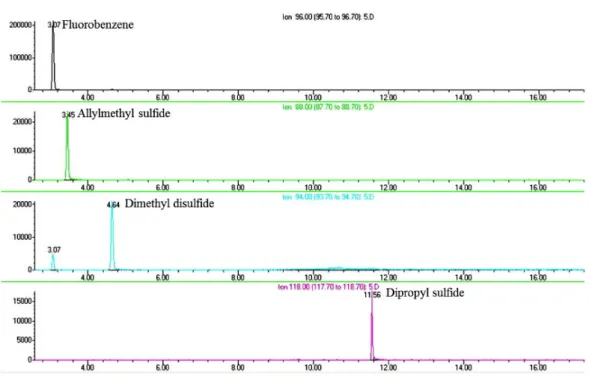
Fig. 1. Ion chromatogram of allylmethyl sulfide, dimethyl disulfide, and dipropyl sulfide.
Table 2. Validation parameters
Materials Linearity (R2)
Recovery ratea (%)
Limit of quantification (mg/L)
Relative standard deviationb (%)
1 mg/L 2 mg/L 1 mg/L 2 mg/L
Allylmethyl sulfide 0.9972 90.3±5.3 91.3±2.8 0.08 5.9 3.1
Dimethyl disulfide 0.9959 88.3±6.0 86.2±4.3 0.32 6.7 5.0
Dipropyl sulfide 0.9957 87.6±3.2 89.5±3.0 0.09 3.7 3.4
aThe data represent the mean values ±SD(standard deviation) of three replicates.
bRelative standard deviation (SD/Average×100).
5반복 실시하여 구하였다. 회수율 시험은 마늘추출물을 함유 하지 않은 유기농자재를 증류수로 10배 희석한 다음 지표성 분으로 선정된 AMS, DMDS 및 DPS를 각각 1과 2 mg/L 수준으로 첨가하여 3반복 실시하고, 이 결과로부터 회수율과 상대표준편차(relative standard deviation, RSD)를 구하였 다. 정량한계(limit of quantification, LOQ)는 정량기기의 정량한계(Signal/Noise=10)를 측정하고, 정량한계 부근의 농도를 반복 측정하여 얻은 결과의 표준편차에 10배 한 값으 로부터 계산하였다.
결과 및 고찰
마늘추출물 함유 유기농자재 품질관리를 위한 지표성분 선정
마늘의 고유성분으로 다량 함유되어 있으며 작물보호 활 성을 가지는 8개의 sulfide류 alliin, allicin, AMS, DMDS, AS, PS, DADS 및 DATS를 마늘추출물 함유 유기농자재의 품질관리를 위한 지표성분의 후보물질로 조사하였다. 표 1의
기기분석 조건에서 8개의 후보물질 중 AMS, DMDS 및 DPS는 간섭물질의 영향이 없는 머무름시간(retention time, RT)인 3.45, 4.64 및 11.56 분에 각각 검출되었으나 alliin, allicin, AS, DADS 및 DATS는 동일 분석조건에서 검출되 지 않았다(Fig. 1). 따라서 AMS, DMDS 및 DPS를 마늘 추 출물 함유 유기농자재의 품질관리를 위한 지표성분으로 선정 하고, 이들에 대한 분석법을 검증하고자 하였다.
분석법 검증
AMS, DMDS 및 DPS의 표준검량선은 0-10 mg/L의 각
각의 표준용액의 peak 면적과 내부표준물질 fluorobenzene
peak의 면적비로 작성되었다. 이들 물질의 표준검량선의 직
선성은 상관계수(r
2)가 0.9957 이상으로 양호하였고, signal-to-
noise level의 10에 해당하는 값(MacDougall과 Crummett,
1980)으로 산출한 정량한계는 각각 0.08, 0.32 및 0.09
mg/L 이었다. AMS, DMDS 및 DPS의 회수율 시험은 이
들의 혼합표준용액을 마늘추출물이 함유되지 않은 유기농자
재에 1 mg/L 수준으로 첨가하고, 표준검량선 작성시의 동일
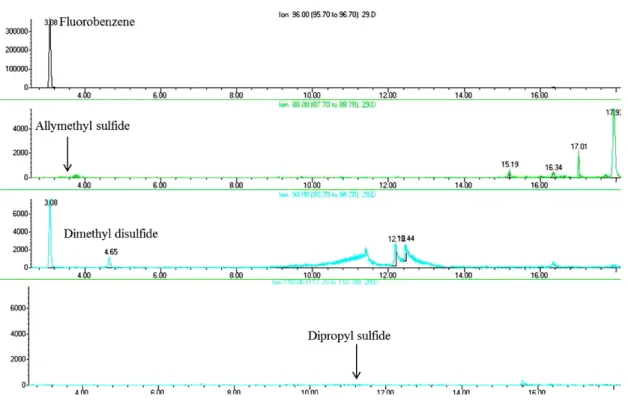
Fig. 2. Representative ion chromatogram of allylmethyl sulfide (< limit of quantification), dimethyl disulfide (2.0 mg/L), and dipropyl sulfide (< limit of quantification) in biopesticide samples.
Table 3. Content of allylmethyl sulfide, dimethyl disulfide, and dipropyl sulfide in commercial biopesicides containing
A. sativum
extractSamples Allylmethyl sulfide (mg/L) Dimethyl disulfide (mg/L) Dipropyl sulfide (mg/L) Total (mg/L)
1 < LOQ* 12.1 < LOQ 12.1
2 < LOQ < LOQ < LOQ < LOQ
3 < LOQ 14.7 < LOQ 14.7
4 < LOQ 13.1 < LOQ 13.1
5 < LOQ 18.9 < LOQ 18.9
6 < LOQ 13.1 < LOQ 13.1
7 < LOQ 15.3 < LOQ 15.3
8 < LOQ 20.0 < LOQ 20.0
9 < LOQ 9.7 < LOQ 9.7
*LOQ, limit of quantification
조건에서 3반복하여 분석하였다. 1 및 2 mg/L 수준에서 실 시한 AMS, DMDS 및 DPS의 회수율은 86.2-91.3%, RSD 는 3.4-6.7%의 범위(Table 2)로 EU의 잔류분석법 가이드라 인 회수율 70-120%, RSD 20% 이하의 기준에 잘 부합하였 다(de Kok Food et al. , 2007). 상기의 검증방법에 따라 입 증된 마늘추출물 함유 유기농자재 중 AMS, DMDS 및 DPS 에 대한 head-space sampler GC- MS 분석방법은 최근 Lim 등(2014)이 보고한 동일 유기농자재의 HLB 카트리지 정제를 통한 GC (FID) 분석법에 비해 시료의 전처리 과정이 필요치 않아 빠르게 분석할 수 있는 이점을 가지고 있다.
마늘추출물 함유 유기농자재 중 AMS, DMDS 및 DPS 함량
유통되고 있는 마늘추출물 함유 유기농자재 중 AMS, DMDS 및 DPS 함량을 개발된 분석방법을 적용하여 분석하 였고, 대표적인 크로마토그램을 Fig. 2에 나타냈다. Table 3 은 유통되고 있는 마늘추출물 함유 유기농자재 중 AMS, DMDS 및 DPS 함량을 나타낸 결과로, 이들의 함량은 각각
<LOQ, <LOQ-20.0 mg/L 및 <LOQ의 범위이었다.
AMS (1.1 mM)는 시간 당 Actinobacillus pleuropneumoniae
의 생장을 8% 저해하는 것으로 알려져 있고(Becker et al .,
2012), Giardia intestinalls 에 대한 AMS와 DMDS의 50%
치사농도(LC
50)는 각각 550과 200 mg/L로 보고된바 있다 (Harris et al ., 2000). 또한 공기 중 DMDS의 Dinarmus basalis , Callosobruchus maculatus 및 Periplaneta Americana 에 대한 LC
50는 각각 0.31, 0.65 및 1.01 mL/L으로 알려져 있고(Dugravot et al ., 2003), DPS의 Staphylococcus aureus B31과 Candida utilis ATCC42416에 대한 최소저 해농도(minimum, ihbibitory concentration, MIC)는 500 mg/L 이상으로 보고된 바 있다(Kim et al ., 2004). 따라서 본 연구에서 조사한 시중유통 유기농자재 중 지표성분 함량 은 DMDS 만이 작물보호를 위한 충분한 양이 함유되어 있는 결과를 나타냈으나, DMDS 함량 또한 유기농자재가 물로 100-1000배 희석한 후 사용되는 점을 고려하면 많은 제품에 서 작물보호 활성에 요구되는 유효성분의 농도가 IC
50과 MIC 수준에 이르지 못하는 결과를 나타냈다. 마늘추출물 함 유 유기농자재 중 AMS, DMDS 및 DPS함량은 작물보호 활 성과 밀접한 관련이 있으므로 유기농자재 중 이들의 함량에 대한 품질관리가 이루어져야 할 것으로 판단된다.
결 론
마늘추출물 함유 유기농자재의 품질관리를 위해 마늘의 고유성분으로 다량 함유되어 있으며 작물보호 활성을 지닌 8 개의 지표성분 후보물질로부터 head-space sampler가 장착 된 GC-MS로 분석 가능한 AMS, DMDS 및 DPS 3개 성분 을 지표성분으로 선정하고, 이들 성분에 대한 동시분석법을 개발하였다.
이 동시분석법을 적용해 유통중인 마늘추출물 함유 유기 농자재 중 선정된 지표성분들에 대한 분석결과는 작물보호를 위해 요구되는 농도 수준보다 적게 함유되어 있음을 나타냈 다. 따라서 본 연구에서 계발된 분석법은 많은 시간을 요구하 는 시료전처리 과정 없이 신속하게 AMS, DMDS 및 DPS에 대한 정량분석이 가능하므로, 마늘추출물 함유 유기농자재의 품질관리를 위한 분석방법으로서 활용이 가능할 것으로 판단 된다.
Acknowledgement
This study was carried out with the support of
“Research Program for Agricultural Science &
Technology Development (PJ010117 and PJ010922)”
and “Postdoctoral Fellowship Program of Chemical Safety Division”, National Academy of Agricultural Science, Rural Development Administration, Republic of Korea.
References