Print ISSN: 2288-4637 / Online ISSN 2288-4645 doi:10.13106/jafeb.2021.vol8.no7.0055
The Effect of Macroeconomic Factors on Income Inequality:
Evidence from Indonesia
Andi SESSU
1, Yulia Tri SAMIHA
2, Maya LAISILA
3, Nurul CHAMIDAH
4, Imaduddin MURDIFIN
5, Aditya Halim Perdana Kusuma PUTRA
6Received: March 20, 2021 Revised: May 23, 2021 Accepted: June 01, 2021
Abstract
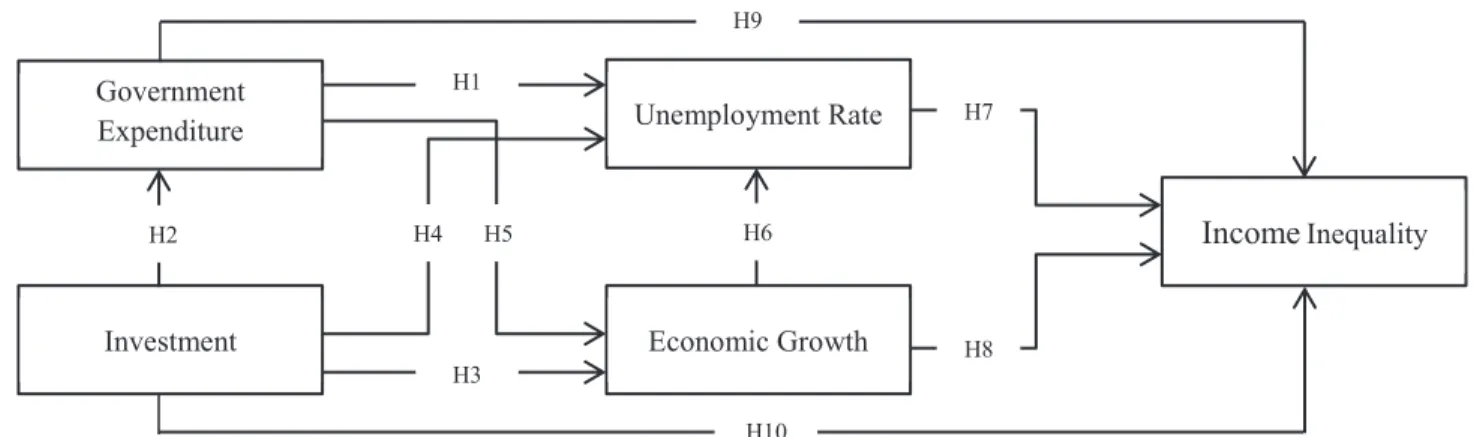
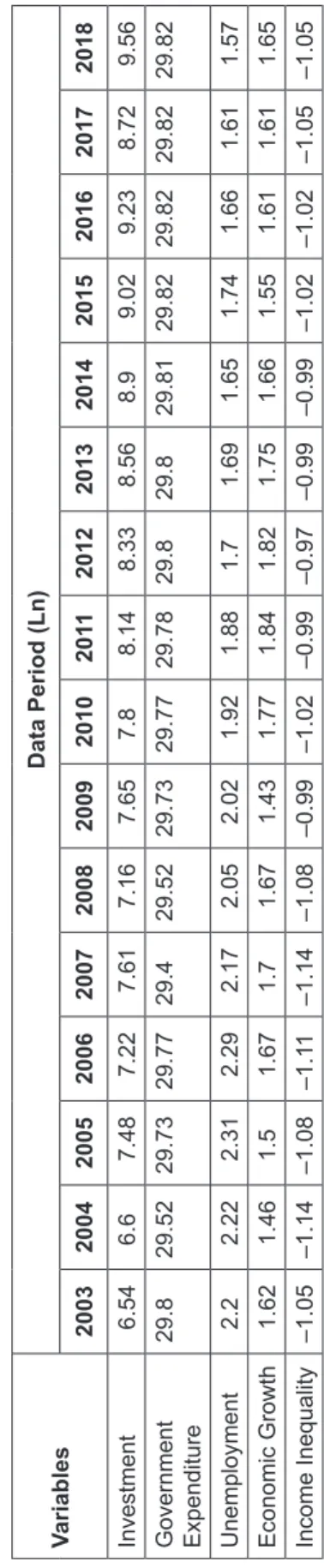
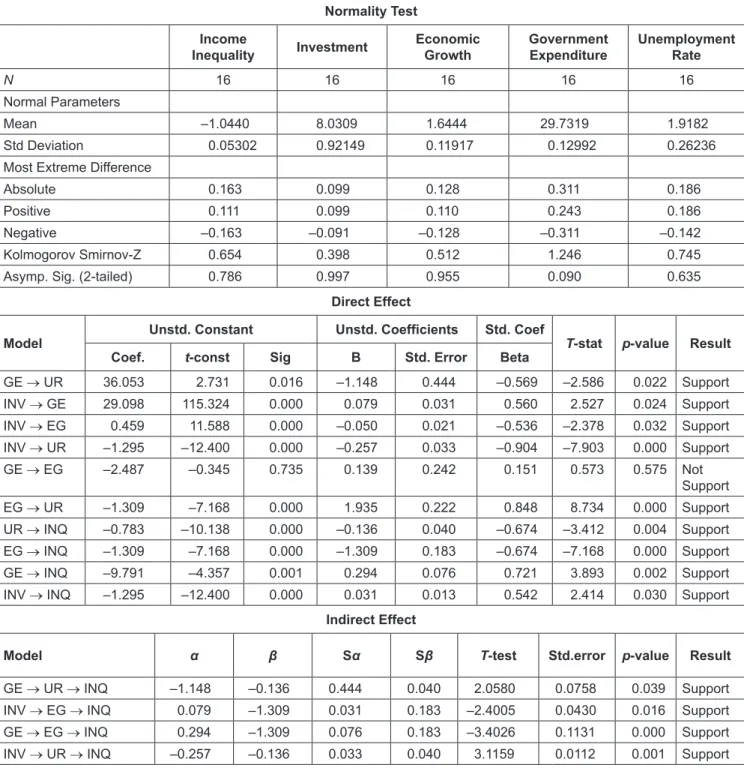
The purpose of this study is to analyze the relationship and effects of variables both directly and indirectly (e.g., investment (INV), government expenditure (GE), unemployment rate (UR), economic growth (EG), and income inequality). The analytical phases consist, first, to transform the data using the Log Natural (Ln) method. Second, to check normality and multicollinearity of data. Third, to test direct effects of variables (government expenditure and investment effect on the unemployment rate and economic growth; investment on government expenditure; economic growth on unemployment rate; economic growth and unemployment rate on income inequality). Fourth, to test indirect effects using Sobel test, which involves UR and EG as intervening variable. Fifth, to test hypotheses with p-value < 0.05.
The results of the study reveal that, of the 12 relationships, statistics show that 11 variations of the association have significant positive and negative effects. Theoretically, the different characters and goals of GE and INV in each country will have a different impact on EG and UR goals. The study provides an input, especially for the government. To create optimal EG through GE and INV, it is necessary to allocate budgets to industrial sectors that can absorb a massive labor force and to new economic growth sectors.
Keywords: Government Expenditure, Investment, Unemployment, Economic Growth, Income Inequality JEL Classification Code: E12, E22, E24, O47, D63
1. Introduction
The current Indonesian government’s investment activity focuses on increasing access to capital, both foreign and domestic. In particular, investment in the manufacturing and infrastructure industries is welcomed to improve connectivity throughout Indonesia. Of course, the Indonesian government’s investment projection aims to reduce logistics costs and increase national competitiveness, amid the current opportunities, given the direction of the world economy moving to the Asian continent; Indonesia has several great opportunities to create an investment climate that is conducive to both macro and micro scales in the long term, one of which is investment in infrastructure and investment in the creative and digital economy. Even so, the classic obstacles to investment problems in Indonesia also continue to roll. One of the main obstacles is the weight of bureaucracy and licensing, which is considered not to have optimal coordination between the center and the regions, and weaknesses in meeting the industry’s energy supply and the concentration of investment distribution that is only to the center in one particular area. Therefore, improving
1
First Author and Corresponding Author. Associate Professor, Faculty of Economic and Business, Department of Management, Universitas Muhammadiyah Prof. Dr. Hamka, Jakarta, Indonesia [Postal Address: Limau II, South Jakarta, Jakarta City, 12130, Indonesia] Email: [email protected]
2
Associate Professor, Faculty of Education and Teacher Training, UIN Raden Fatah, Palembang, South Sumatera, Indonesia.
Email: [email protected]
3
Assistant Professor, Faculty of Economic, Department of Management, Universitas Kristen Indonesia Maluku, Ambon City, Maluku, Indonesia. Email: [email protected]
4
Associate Professor, Faculty of Social Science & Political Science, Department of Communication, Universitas Muhammadiyah Cirebon, Cirebon, West Java, Indonesia.
Email: [email protected]
5
Associate Professor, Faculty of Economics and Business, Department of Management, Universitas Muslim Indonesia, Makassar City, South Sulawesi, Indonesia.
6
Associate Professor, Faculty of Economics and Business, Department of Management, Universitas Muslim Indonesia, Makassar City, South Sulawesi, Indonesia.
Email: [email protected]
© Copyright: The Author(s)
This is an Open Access article distributed under the terms of the Creative Commons Attribution Non-Commercial License (https://creativecommons.org/licenses/by-nc/4.0/) which permits unrestricted non-commercial use, distribution, and reproduction in any medium, provided the original work is properly cited.