Print ISSN: 2288-4637 / Online ISSN 2288-4645 doi:10.13106/jafeb.2020.vol7.no4.205
Factors Affecting Intention to Purchase Green Products in Vietnam
Thi Kim Chi NGUYEN*, Dat Minh NGUYEN**, Van Thien TRINH***, Thi Phuong Diu TRAN****, Tuan Phong CAO*****
Received: February 11, 2020 Revised: February 24, 2020 Accepted: March 1, 2020.
Abstract
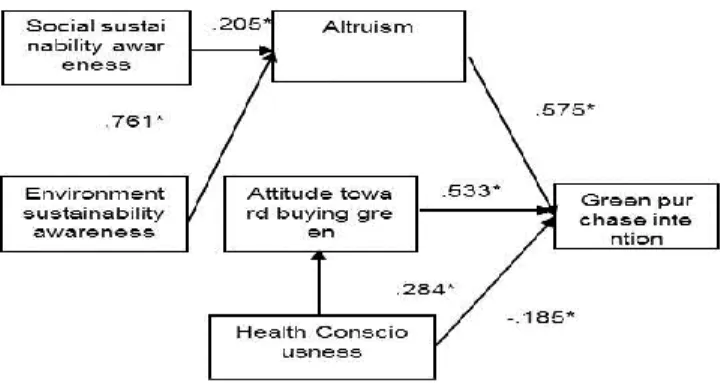
The study aims to assess factors affecting intention to purchase green products in Vietnam. The study employs samples from customers who have actually experienced green consumption in Vietnam. The samples were collected by convenient sampling methods. The survey obtained 206 responses with full information. The survey was conducted from October 2019 to January 2020. The measurement scale was a 5-point scale with 1- completely disagree and 5- strongly agree. This study employs factor analysis and structural equation modelling analysis. The results showed that the social and environment sustainability awareness have positive effects on altruism of customers who are interested in green consumption.
Altruism also has the same direction on green purchase intention. Besides, the attitude toward buying green and health consciousness affects green purchase intention. At the same time, the altruism and attitude towards buying green products also influence positively on green purchase intention. Besides, the health consciousness positively affects attitude towards buying green products. The results show that the health consciousness has a negative impact on intention to purchase green products. The findings suggest that it is necessary to raise customers' health consciousness, customers' altruism from disseminating knowledge about environmental protection as well as society to enhance the green consumption in Vietnam.
Keywords : Green Purchase Intention, Social Sustainability Awarenes, Environment Sustainability Awareness, Health Consciousness JEL Classification Code : C38, D70, M21
1. Introduction
1718Environmental protection issues have been receiving the attention of society as well as many countries around the world (Ho, Bui, Nguyen, Dao, & Nguyen, 2020). Vietnam is one of the countries facing environmental protection challenges as well as sustainable development (Nguyen,
*First Author and Corresponding Author. Lecturer, Hanoi University of Business and Technology, Vietnam [Postal Address: 29A/124 Vinh Tuy Street, Hai Ba Trung District, Hanoi, 100000, Vietnam]
Tel: +84 985004618, Email: [email protected]
**Management Faculty, Ho Chi Minh City University of Law, Vietnam. Email: [email protected]
***Thanh Ha District People's Committee, Hai Duong Province, Vietnam. Email: [email protected]
****Academy of Finance, Vietnam.
Email: [email protected]
*****Academy of Social Sciences, Vietnam.
Email: [email protected]
ⓒ Copyright: The Author(s)
This is an Open Access article distributed under the terms of the Creative Commons Attribution Non-Commercial License (http://Creativecommons.org/licenses/by-nc/4.0/) which permits unrestricted noncommercial use, distribution, and reproduction in any medium, provided the original work is properly cited.
Nguyen, Nguyen, & Vu, 2017). With a population of more than 96.9 million people brings challenges of environmental protection in people's consumption (Worldometer, 2020). With increasing consumption activities leading to an increase in the amount of waste released into the environment (Environment Administration, 2020). Therefore, the implementation / application of green consumption and green procurement policies in Vietnam to encourage sustainable production and consumption is an essential need nowadays.
Excessive use of natural resources has consequences for the environment, so environmental issues have become a global concern (Chen, Huang, Wang, & Chen, 2020;
Kumar, Luthra, Khandelwal, Mehta, Chaudhary, & Bhatia,
2017). Green consumption is considered a behavior to help
protect the environment (Mostafa, 2006), in which green
consumers always pay attention to environmental
protection, use of pollution reduction products / services,
responsible use of natural resources, and recyclable
products after use. Consumers are increasingly aware that
their consumption activities have caused bad impacts on the
environment and they are always inclined to consume green
in their consumption decisions. (Choi & Johnson, 2019;
Kumar et al., 2017; Mostafa, 2006).
There have been many studies on green consumption behavior as well as customers' intention to purchase green products. In particular, there are studies that show that health consciousness has a positive influence on attitudes and intentions to purchase green products. (Xu, Wang, &
Yu, 2020; Yadav & Pathak, 2017); Some studies have shown that altruism and environmental and social awareness also positively influence the intention to purchase green products (Choi & Johnson, 2019; Mostafa, 2006; Panda, Kumar, Jakhar, Luthra, Garza-Reyes, Kazancoglu, & Nayak, 2020). Among the factors influencing intention to use, studies all use attitudes towards green consumption behavior as in the classic studies on intentions of behavior (Ajzen, 1985; Choi &
Johnson, 2019; Panda et al., 2020; Xu et al., 2020).
In Vietnam, there have been some researchers conducted on green consumption behavior, but the studies focused on exploiting elements in the traditional TPB and TRA models (Hung, Quyen, & Nhi, 2018). Factors on environmental, health and social awareness have not been evaluated by studies in Vietnam. Therefore, this study assesses the factors that influence consumers' intention to purchase green products in Vietnam.
2. Literature Review and Hypothesis 2.1. Purchasing Intention
Intention is a person's subjective ability to perform a specific action (Ajzen, 1985, 1991; Ajzen & Fishbein, 1975) or described as the readiness of customers to purchase and use the product (Ercan & Matt, 2008; Sousa, Nobre, &
Farhangmehr, 2018). The actual behavior of a person depends on his or her intention or intention to be considered as an important prerequisite for behavior (Ajzen & Fishbein, 1975), by the consumer decision-making process consists of 5 stages (1) identifying needs, (2) seeking information, (3) evaluating options, (4) purchasing decisions, (5) operating vi after purchase (Kotler & Armstrong, 2012).
When the demand for products / services is large enough, consumers will seek information and will consider evaluating, choosing procurement options and in the process, they will form an intention to buy.
Besides, the intention derived from the definition of Fishbein and Aizen (1975) is understood as the weak power of the intention related to the purchase behavior of customers, so the intention is a good guide for buying behavior of cutomer (Venkatesh, Morris, Davis, & Davis, 2003). Understanding intention is one of the most authoritative ways to predict customers' decisions, because
the larger the intention is in general, the higher the ability to make purchase and use decisions, and the factors of completion. Unpredictable scenes are difficult to predict. In addition, based on a number of theories, customer intent is considered as a basis for guessing future demand (Ajzen &
Fishbein, 1975).
2.2. Green Consumption Behavior
Green products are defined as products that are environmentally friendly, non-polluting, and capable of recycling or preserving. Green products can be products made from paper, glass (recyclable or reusable packaging), energy-saving devices, and detergents that must be biodegradable and no pollution (Mostafa, 2006). Green consumption behavior is consumer activities that do not pollute, deplete natural resources and these products are recyclable. (Choi & Johnson, 2019; McEachern & McClean, 2002; Mostafa, 2006).
2.2.1. Social and Environmental Sustainability Awareness and Altruism
There are many definitions and measures of social sustainability such as health, influence, impartiality;
meaning-making, competence (Missimer, Robèrt, &
Broman, 2017). According to McKenzie (2005), definition of sustainable society is: a life-enhancing condition within communities, and a process within communities that can achieve that condition (McKenzie, 2005). Social sustainability brings sustainable benefits to people in the community, including: Income, employment, health, and social activities.
Customer altruism is defined as customer behavior when always taking care of the feelings of others or in other words, taking care of the happiness of others in contexts related to their behavior (Schwartz, 1977). Besides, Panda et al. (2020) thinks that altruism will help customers control their behaviors related to sustainable development;
Customers are said to be willing to help others and are always concerned about the environment (Panda et al., 2020). Therefore, customers have good awareness about sustainable development will increase their altruism (Panda et al., 2020; Schwartz, 1977). Therefore, the hypotheses are as follows:
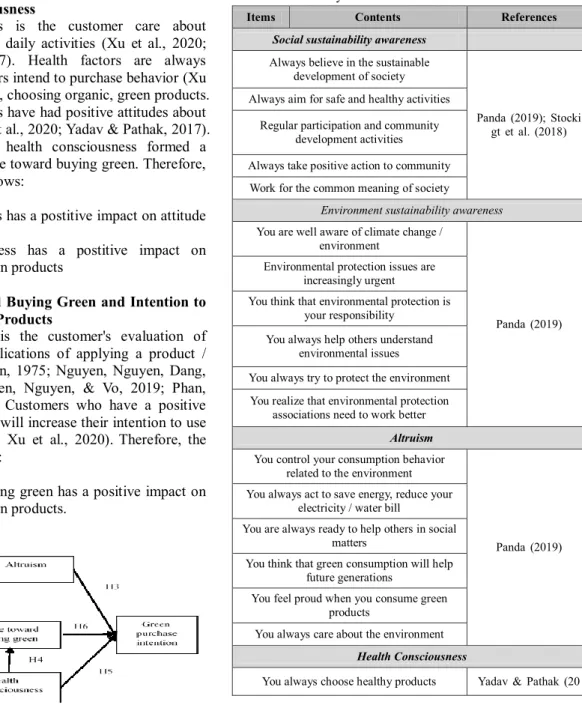
H1: Social sustainability awareness has a positve on altruism
H2: Environmental sustainability awareness has a positve on altruism
2.2.2. Intention to Purchase Green Products and Altruism
Altruism is considered in two respects the role that
social altruism (concern for the welfare of others), and biospheric altruism (a concern for the non-human elements of the environment) play in influencing green behavior (Mostafa, 2006). And when customers are altruistic, they will be more aware of the harmful effects of the environment. From there, they will take actions to protect the environment as well as green consumer behavior.
Therefore, the hypotheses are as follows:
H3: Altruism has a positive impact on intetion to purchase green products
2.2.3. Health Consciousness
Health consciousness is the customer care about protecting their health in daily activities (Xu et al., 2020;
Yadav & Pathak, 2017). Health factors are always mentioned when customers intend to purchase behavior (Xu et al., 2020), For example, choosing organic, green products.
In recent years, customers have had positive attitudes about green consumption (Xu et al., 2020; Yadav & Pathak, 2017).
At the same time,the health consciousness formed a positive impact on attitude toward buying green. Therefore, the hypotheses are as follows:
H4: Health consciousness has a postitive impact on attitude toward buying green
H5: Health consciousness has a postitive impact on intention to purchase green products
2.2.4. Attitude toward Buying Green and Intention to Purchase Green Products
Consumer behavior is the customer's evaluation of positive or negative implications of applying a product / service (Ajzen & Fishbein, 1975; Nguyen, Nguyen, Dang,
& Nguyen, 2016; Nguyen, Nguyen, & Vo, 2019; Phan, Nguyen, & Bui, 2019). Customers who have a positive attitude about the service will increase their intention to use the service (Davis, 1989; Xu et al., 2020). Therefore, the hypotheses are as follows:
H6: Attitude toward buying green has a positive impact on intention to purchase green products.
Figure 1 : The research model and hypotheses
3. Research Method 3.1. Research Design
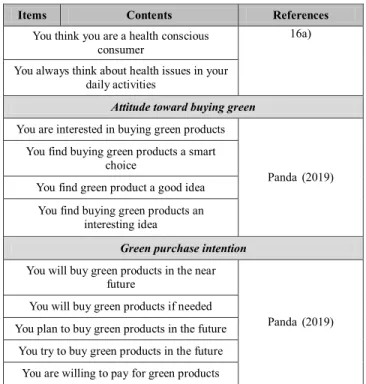
The measurement questionnaire for each factor in the model is referenced from previous studies (Panda et al., 2020; Yadav & Pathak, 2017). The survey period is from October 2019 to January 2020. The research scale used is a 5-point scale with 1- completely disagree and 5- strongly agree (see Table 1).
Table 1: The survey
Items Contents References
Social sustainability awareness
Always believe in the sustainable
development of society
Panda (2019); Stocki gt et al. (2018) Always aim for safe and healthy activities
Regular participation and community development activities Always take positive action to community
Work for the common meaning of society
Environment sustainability awareness You are well aware of climate change /
environment
Panda (2019) Environmental protection issues are
increasingly urgent
You think that environmental protection is your responsibility
You always help others understand environmental issues
You always try to protect the environment You realize that environmental protection
associations need to work better
AltruismYou control your consumption behavior
related to the environment
Panda (2019) You always act to save energy, reduce your
electricity / water bill
You are always ready to help others in social matters
You think that green consumption will help future generations
You feel proud when you consume green products
You always care about the environment
Health ConsciousnessYou always choose healthy products Yadav & Pathak (20
Items Contents References You think you are a health conscious
consumer
16a)
You always think about health issues in your daily activities
Attitude toward buying green
You are interested in buying green products
Panda (2019) You find buying green products a smart
choice
You find green product a good idea You find buying green products an
interesting idea
Green purchase intention