• 검색 결과가 없습니다.

Consumer Preference for the Types of Labels of Cereal Products and Purchase Intention of Nutrition-labeled Products

N/A
N/A
Protected

Academic year: 2021

Share "Consumer Preference for the Types of Labels of Cereal Products and Purchase Intention of Nutrition-labeled Products"

Copied!
16
0
0

로드 중.... (전체 텍스트 보기)

전체 글

(1)

I. Introduction

Cereal products are consumed at breakfast by many consumers for more than 20 years in Western

countries. However, it took very long time for Korean consumers to accept the products, since Korean food culture is different to those of Western countries. During that period, Nongsim

: 2013 8 6 : 2013 9 6 : 2013 9 27

Corresponding Author: You, So-Ye Tel: 82-63-270-4082 e-mail: [email protected]

This is an Open-Access article distributed under the terms of the Creative Commons Attribution Non-Commercial License (http://creativecommons.org/licenses/by-nc/3.0) which permits unrestricted non-commercial use, distribution, and reproduction in any medium, provided the original work is properly cited.

http://dx.doi.org/10.7856/kjcls.2013.24.3.327

Consumer Preference for the Types of Labels of Cereal Products and Purchase Intention of Nutrition-labeled Products

You, So-Ye

ㆍ Park, Myeong Eun

Department of Business Administration, Chonbuk National University, Jeonju, Korea

시리얼제품의 표시유형별 선호와 영양표시 제품의 구매의도

1)

ABSTRACT

The purposes of this study were to explore consumer preference for the types of nutrition label of cereal products and to identify some influencing factors on purchase intention and choice probability of nutrition-labeled products. First, most of the respondents preferred the nutrition fact panel with traffic light-GDA(TL-GDA), while the nutrition fact panel only type and the nutrition fact panel with front-of-package(FOP) type were preferred by few respondents.

However, consumers evaluated higher for TL-GDA type and FOP symbol type, while the nutrition fact panel only type was evaluated much lower. Second, consumer preference for label types was partially related with ‘eating breakfast’ and consumer evaluations of the types of labels for the nutrition fact panel only and the nutrition fact panel with FOP were found to be significantly different by gender. Lastly, both purchase intention and choice probability for nutrition-labeled products were found to be significantly influenced by information search and product attitude. In addition, choice probability was found to be significantly influenced by individual characteristics such as gender and grade. It is necessary to find the relationship between nutrition labels and consumer response as this can help consumers make a better choice of food as well as providing some useful information on consumers to the related parties such as companies and consumer organizations.

Key words: nutrition fact panel, front-of-package, traffic light-GDA, purchase intention, choice

probability

(2)

Kellog and Dongseo food have been leading companies in the Korean market. In 2008, their combined market share was 190 billion KRW(Kim

& Yoon 2011).

However, it was found recently that some of the cereal products in England had “too much” sugar, while they were marketed as a “healthy food” with whole sugar. According to an article, “The great scandle”, Kellogg’s Frosties had the largest portion of sugar(37%), twice the standard amount recommended by the UK Food Standard Agency, and Rice Krispies and Kellogg’s Corn Flakes were found to contain 10% and 8% of sugar, respectively (MailOnline 2012). This is a significant concern for consumers, since having too much sugar could increase the risk of obesity, diabetes, heart disease, and cancer. High-sugar foods are one of the most significant factors for obesity and related diseases(Chung & Kim 2007).

Thus, research has been focused on the diet with less sugar due to the increasing concerns over and desires for improving health condition. In addition, the well-being trend for food along with complementary legislation has prompted food companies put labels of nutrition factors on their products(Eo et al. 2012). Under this trend, consumers are very cautious to prevent those diseases by taking an appropriate level of nutrition. Thus, many people have some nutrition education in the process of food choice, and consider food labeling as the major information source(i.e., the most frequently used). Nutrition labels on food are intended to contribute to maintaining the public health.

However, too much information from marketing promotions makes people misapprehend nutrition knowledge. Consumers may experience monetary loss and health problem as a result of these practices(Chang 1997). Therefore, a desirable type of nutrition labeling, such as the front-of- package(FOP) nutrition symbol, should be determined for consumers to select effectively and efficiently.

The FOP symbol helps consumers have an appropriate level of perception and recognize nutrition information accurately from the product packaging(Hieke & Taylor 2012).

Kellogg presents six nutrients(calorie, fat, salt, sugar, and vitamins A and C) on the front of package based on the European Guideline Daily Amounts(GDA)(Kim 2012). This type of nutrition symbol was considered to be the most effective way for consumers to obtain food information and might help consumers develop beneficial food attitudes(Tepper & Trail 1998). In other words, the food nutrition label could be the most important source of information when consumers select food products. However, consumers can be confused in the process of utilizing information for products due to the various formats of labels. In addition, many relatively unimportant nutritional factors are presented, which may cause consumers to have difficulties in accurately understanding nutritional value of products. Furthermore, there exists a problem of information asymmetry between companies and consumers, with general consumer ignorance concerning production processes and complexities of food distribution. Thus, most consumers want to have an appropriate level of information with desirable formats(Choi & Chung 2003).

According to previous research, consumers would prefer some formats of nutrition information over others. In particular, consumers preferred a simpler format by providing information easier to process and compare. Hieke and Taylor(2012) suggested that consumers might not be satisfied with the current level and the type of information made available. In addition, Wansink(2003) found that combining information of nutrition facts panels on the back with a FOP nutrition symbol might be effective in promoting information processing by consumers and creating consumer trust.

Furthermore, recent research about healthy diet

and attitudes or beliefs has been conducted by

(3)

providing theoretical concepts and developing constructs. Most previous research has concerned consumer behavior related to food by explaining the effect of health concern and demographic factors. However, the relationship between them has not yet been fully explained(Ares & Ga’mbaro 2007). In addition, most studies about food labeling with Korean consumers have been conducted to explore research trends of food label systems(Chung 2001; Choi 2005), and consumer awareness of and behavior toward nutrition labeling(Kim & Lee 2002; Chung & Kim 2007; Eo et al. 2012). Thus, there is a research gap concerning consumer preference for effective nutrition labels and purchase intention for nutrition-labeled products.

Therefore, related factors must be explained to understand food choices of consumers. This study was intended to explore consumer preference for the types of nutrition labels of cereal products and purchase intention of nutrition-labeled products. It is necessary to find the relationship between nutrition labeling and consumer response since it can help consumers make a better choice of food.

Furthermore, it can provide useful information about consumer response to related parties, such as companies and consumer organizations.

II. Conceptual Background

1. Nutrition labels of food

Food labeling is a way of providing effective information to help consumer choices for maintaining good health conditions. To do this, producers have to provide desirable nutrition information by stating types and amounts of nutrients through food labels(Eo et al. 2012; Kim 2012).

Korea introduced the nutrition label system first in 1995, and the system has since been extended to various food items. Due to increasing concern of chronic diseases, presenting various kinds of

nutrients in the labels has been issued(Choi 2009) and regulations about nutrients and labeling method have been revised continuously. In 2006, 9 nutrients(calories, carbohydrate, sugar, protein, fat, salt, and saturated fat, trans-fat, and cholesterol) were forced to be labeled in food products(Chung

& Kim 2007; KFDA 2010; Kang et al. 2011).

Furthermore, some nutrients such as sugar, fat, saturated fat and sodium were recommended to be labeled with colorful symbols(green, orange and red) for being easily recognized and maintaining balanced diet(Kang et al. 2011). In addition, the percentage of products with nutrition labels attached was 18.7% in 2001, 24.1% in 2005, and then 79%

in 2007(Eo et al. 2012).

In this situation, many studies in Korea have been conducted to find actual conditions about nutrition labeling and labeling types(Choi & Chung 2003). In addition, some research about food behavior such as awareness and choice and the effect of nutrition labeling has been flourished(Lee et al. 2002; Joo et al. 2006; Chung & Kim 2007;

Lee & Kim 2008; Kim & Lee 2010; Ko & Kim 2010; Chung et al. 2011; Chung et al. 2011).

However, consumers can be confused by too much information and have been shown to exercise poor decision making(Drichoutis et al. 2006). To solve these problems, food-related companies began to provide FOP information to help consumers make a quick decision, although this format may not provide enough nutrition profiles(Hassan et al.

2010; Kim 2012). Nevertheless, this may be an effective way for consumers to utilize nutrition information for maintaining good health, as consumers process information very often by heuristics or using a peripheral route(Petty & Cacioppo 1986; Eagley & Chaiken 1993; Andrews et al.

2011). This method of information processing helps

consumers make judgments and evaluation by

simplistic cues or heuristics, with less complicated

decision making requirements(Eagly & Chaiken

(4)

1993; Andrews et al. 2011). While the FOP system can cause a halo effect because consumers perceive other nutrients not in the FOP as being good(Roe et al. 1999; Andrews et al. 2011), it could be a useful format to provide information. In addition, the traffic light-guideline daily amounts(TL-GDA) system also helps consumers to easily understand information of the major nutrients. Although this type of label system provides less specific information, signals can be a heuristic cue for consumers who have some trouble with too much information to process(Andrews et al. 2011).

2. Purchase intention for nutrition-labeled products

For a few decades, the labeling system has been considered to be an important research area in the literature for the food decision making since health problems related to food diet have increased worldwide. In particular, nutritional facts of food have been considered to be an attribute of credence goods, but this kind of food could be a search good, if consumers were able to use trustful information on nutrition. Thus, nutrition labels may influence consumer behavior via perception and evaluation of products since most consumers want to avoid negative nutrients from food. Most empirical studies suggest that using nutrition information may significantly change consumer patterns of food consumption (Drichoutis et al.

2006). Furthermore, it is necessary to explore some factors related with effective nutrition labeling systems, though it is difficult to analyze effectively due to complicated consumer behavior. For example, it is necessary for studies to uncover how to provide effective information by simplified means, such as the FOP labeling system and to understand how to influence consumer decision making for food with nutrition information (Hieke

& Taylor 2012).

In addition, prior studies have suggested that

there are many influencing factors for purchasing behavior by consumers. First, consumers use information from food labels to make decisions.

However, simply having information is not enough to choose a specific food diet. Rather, it is important for consumers to have some ability to understand the nutrition labels associated with food diet and health(Kim 2012). Derby & Levy(2001) found that one third of consumers reported changing purchasing decision of products due to nutrition label information in 1990, and this figure rose to 48% in 1995. Abbott(1997), Shine et al.(1997), and Hawkes(2004) found that nutrition information could influence to food choices. In addition, some studies found that nutrition labels of food changed consumer behavior when associated with an education campaign(Teisl & Levy 1997; Teisl et al.

2001; Drichoutis et al. 2006). Thus, it is expected that usage and ability to understand the nutrition information by consumers may influence purchasing behavior.

Second, economists have recognized the importance of information and knowledge associated with consumer behavior per se(Pauly & Satterthwaite 1981; Kenkel 1990). However, the effect of nutrition knowledge on purchasing behavior of food remains unclear. For example, some studies found that total fat intake was not changed by nutrition education and media exposure. Thus, it is not evident that increasing nutrition knowledge can influence food diet directly(Shepherd & Stockley 1987; Sapp 1991; Shepherd & Towler 1992; Nayga 2000). Shepherd & Stockley(1987) and Sapp(1991) also suggested that nutrition knowledge did not influence use of nutrition information of products and that the relationship between knowledge and behavior was weak. However, another study suggested that labeling of nutrients had to be presented using specific and technical terms to persuade consumers (Adelaja et al. 1997).

Third, according to Stigler(1961), using product

(5)

information is assumed to be an active search process. To choose a product, consumers evaluate information gathered and make a decision based on the evaluation. During the process of information search, the economics of information posits that consumers try to obtain information until benefit is no longer increased by additional cost of getting information(Nayga 2000). In addition, Nelson(1970;

1974) categorized products into search and experience attributes, and Darby & Karni(1973) added the credence attribute into the categories. Furthermore, Caswell & Mojduszka(1996) contended that the credence attribute could be transferred to a search attribute in the presence of nutrition labels. Thus, nutrition labels help consumers to choose healthy foods, which decrease the incidence of diet-related diseases(Drichoutis et al. 2006).

Fourth, consumers can be better off if they decide to choose nutritionally superior food products (Burton & Andrews 1996). In particular, the negative effect of obesity has been a controversial issue in government policies, and providing desirable information to consumers as an important issue is considered to encourage people to consume less fat, sugar, and salt. To this end, presenting a label on the package is required to provide nutrition information to obtain health benefits for consumers and reduce obesity(Hassan et al. 2010).

In addition, according to Roe et al. (1999), consumers preferred the FOP symbol to nutrition panel information at the back of the package and showed higher purchase intention for the FOP- labeled products.

Fifth, attitude for buying products implies a positive or negative evaluation for specific behavior (Ajzen & Madden 1986) and is a very important factor in purchase behavior(Engel et al. 1995;

Agarwal & Malhortra 2005). In addition, consumer attitude is the individual perception of a desirable

situation associated with specific actions for product purchase and thus, has to be considered to explain consumer choices(Chen 2007).

Finally, socio-demographic factors such as gender, age, and education level were found to be important factors in the previous studies. In particular, healthy food choice has been a major concern for households to improve health status for children and family members(Lichtenstein et al.

1993; Verbeke, Ward & Viaene 2000; Park &

Chung 2004; Tivadar & Luthar 2005; Binkley 2006). Thus, these factors should be considered to explain purchase behavior of nutrition-labeled products.

III. Method

1. Data and Variables

This study conducted a survey of college students in Jeonbuk province in the Republic of Korea from October 29 to November 6 in 2012.

Three types of labels for cereal products(appendix 1) were presented and then, respondents were asked to rank their preference to be “most preferred”,

“preferred”, and “least preferred” among them 1) and evaluate them with respect to product attitude and purchase intention. Furthermore, data on degree of purchase intention and choice probability for nutrition-labeled products were collected. Finally, respondents were asked to answer for questions measuring degree of understanding nutrition labels, prior knowledge, information search, health benefit, product attitude, and individual characteristics. Two hundred and fifty survey questionnaires were distributed, and 239 of them were collected and used for the data analysis. Several constructs, such as degree of understanding nutrition label, prior knowledge, information search, health benefit,

1) Three different types of nutrition labels were presented to the students(appendix 1). Type A includes Nutrition fact panel

only, type B includes nutrition fact panel with front-of-package and type C includes nutrition fact panel with TL-GDA.

(6)

Variables Measurement Consumer

preference for the types of labels

Rank of consumer preference for 3 types of nutrition labels(most preferred, preferred, least preferred) type A: Nutrition fact panel only

type B: Nutrition fact panel with front-of-package type C: Nutrition fact panel with TL-GDA

Purchase intention

I would like to choose the products labelled with nutrition symbol for the next time.

I would like to highly purchase the products labelled with nutrition symbol for the next time.

Kozup et al.

2003

Likert-type 5 point scale (1=strongly disagree~5=

strongly agree) Choice

probability

What is the probability to choose the nutrition labelled products if you choose processed products for the next time? (0%, 10%, 20%, 30%, 40%, 50%, 60%, 705, 80%, 90%, 100%)

Degree of Understanding Nutrition label

v1 v2 v3 v4

I know the nutrition label.

I can understand total calorie from the nutrition label.

I can understand the amount of fat from the nutrition label.

I understand the nutrient criteria as the form of %. Brucks 1986

Likert-type 5 point scale (1=strongly disagree~5=

strongly agree) Prior

knowledge v5 v6 v7

I know better the additives(purified salt, fructose, food colors) than others.

I know better some nutrients(calcium, protein, fat) than others.

I know well nutrition information of products as some specialists do.

Information search

v8 v9 v10 v11 v12

It is interesting for me to search nutrition information of food.

I can get useful information by information search of food.

I search nutrition information of food via word-of-mouth from others.

It is very useful for me to search nutrition information of food.

I search nutrition information of food frequently.

Hwang 2001

Health benefit v13 v14 v15 v16 v17

Products with nutrition label might be highly nutritious.

Products with nutrition label might be helpful for healthy diet.

Products with nutrition label might provide required nutrients.

Products with nutrition label might be good for health.

Products with nutrition label seem to be healthy.

(Kozup et al.

2003, Kim &

Yang 2010

Attitude for products

v18 v19 v20 v21 v22

It is clever for me to purchase products with nutrition label.

It is good for me to purchase products with nutrition label.

It is beneficial for me to purchase products with nutrition label.

I have a favorable attitude for purchasing products with nutrition label.

I have a positive attitude for purchasing products with nutrition label.

Homer 1990

Evaluation of types of label

Negative-positive Dislike-like

Unfavorable-favorable

Purchase with low possibility -Purchase with high possibility

Purchase recommendation with low possibility -Purchase recommendation with high possibility

Homer 1990, Kozup

et al.

2003

Likert-type 7 point scale (1=strongly negative~7=

strongly positive) Gender Male, Female(=1)

Age How old are you?

Grade Freshman & Sophomore, Junior & Senior(=1) Frequency of

eating breakfast Never, 1-2 times per week, 3-4 times per week, 5-6 times per week, Everyday

Table 1. Measurement of variables

(7)

product attitude, purchase intention and evaluation of types of labels were modified and developed from prior studies(Brucks 1986; Homer 1990; Hwang 2001; Kozup et al. 2003; Kim & Yang 2010).

All variables used in this study were presented in Table 1. Constructs such as degree of understanding nutrition label(4 items), prior knowledge(3 items), information search(5 items), health benefit(5 items), product attitude(5 items) and purchase intention(2 items) were measured by Likert-type 5 point scale(1=strongly disagree~5=

strongly agree), and evaluation for the label types(5 items) was measured by Likert-type 7 point scale(1=strongly negative~7=strongly positive). In addition, students were asked to check one of 0%, 10% 20%, 30%, 40%, 50%, 60%, 70%, 80%, 90%

and 100% to measure the choice probability with the question of “what is the probability to choose the nutrition labelled products if you choose processed products for the next time?”. Finally, gender (female=1) and grade(junior/senior=1) were measured as a binary variable, while age was measured as a continuous variable and frequency of breakfast was measured by ‘never’, ‘1-2 times per week’, ‘3-4 times per week’, ‘5-6 times per week’, and ‘everyday’.

2. Research questions and statistical methods The research questions in this study are as follows. First, this study tries to explain what consumer preference is for the types of nutrition

labels of cereal products and how consumers may evaluate the types of labels. To do this, this study surveyed consumer preferences and evaluation for the 3 types of nutrition labels of cereal products analyzed by mean and frequency analysis.

Second, this study tries to explain how preference and evaluation for the types of nutrition labels are statistically different by consumer characteristics. To do this, this study used χ

2

test to find the relevance between preference of labels and consumer characteristics(gender, grade, frequency of eating breakfast) and t-test to analyze the difference of evaluation for the types by consumer characteristics.

Third, this study tries to find how the independent variables are correlated with each other and what are the influencing factors to purchase intention and choice probability of consumers for nutrition-labeled products. The independent variables included in the regression model were selected based on the prior studies presented in the conceptual background. In addition, to test the validity and reliability of constructs included in the model, factor analysis and cronbach’s α were conducted. And means of the constructs as variables were included to find the influencing factors on purchase intention and choice probability.

IV. Result & Discussion

1. Characteristics of the respondents

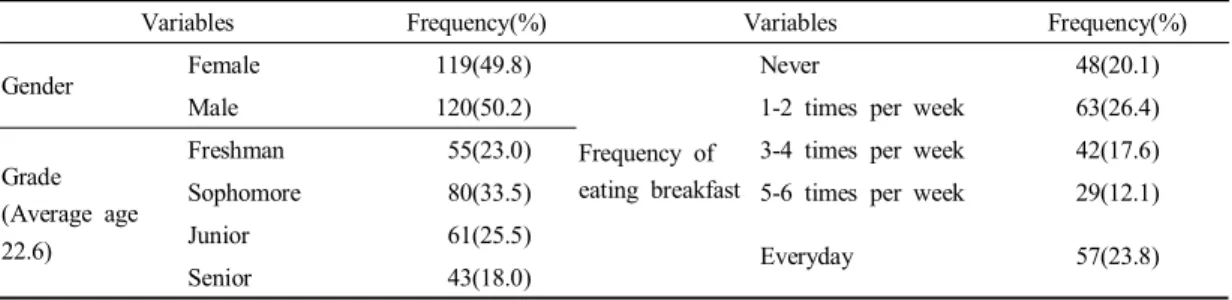
Variables Frequency(%) Variables Frequency(%)

Gender Female 119(49.8)

Frequency of eating breakfast

Never 48(20.1)

Male 120(50.2) 1-2 times per week 63(26.4)

Grade (Average age 22.6)

Freshman 55(23.0) 3-4 times per week 42(17.6)

Sophomore 80(33.5) 5-6 times per week 29(12.1)

Junior 61(25.5)

Everyday 57(23.8)

Senior 43(18.0)

Table 2. Characteristics of respondents (N=239)

(8)

Characteristics of the respondents were presented in Table 2. 50.2% of them were males and 49.8%

were females. 56.5% of them were freshmen and sophomores, while 43.5% were juniors and seniors (average age 22.6). In addition, 20.1% of them reported ‘not eating breakfast’, while 23.8% were

‘eating breakfast everyday’.

2. Validity and reliability test of constructs To test the validity and reliability of constructs,

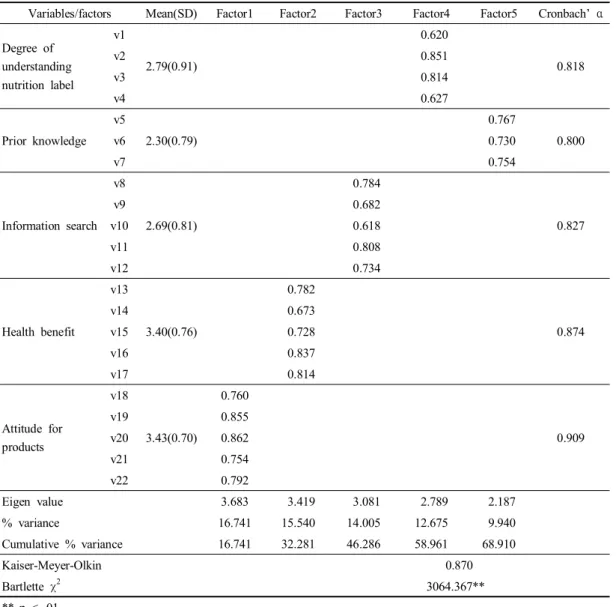
factor analysis and Cronbach’s α were conducted and the result was presented in Table 3. First, for the factor analysis, Principle Component analysis and VariMax as a rotation technique were used. In addition, Eigen Value criterion was used to find the number of factors. From the result, 5 factors were categorized and named to be degree of understanding nutrition label, prior knowledge, information search, health benefit and product attitude. Second, for the reliability test, all items for each factor were found

Variables/factors Mean(SD) Factor1 Factor2 Factor3 Factor4 Factor5 Cronbach’ α

Degree of understanding nutrition label

v1

2.79(0.91)

0.620

0.818

v2 0.851

v3 0.814

v4 0.627

Prior knowledge v5

2.30(0.79)

0.767

0.800

v6 0.730

v7 0.754

Information search v8

2.69(0.81)

0.784

0.827

v9 0.682

v10 0.618

v11 0.808

v12 0.734

Health benefit

v13

3.40(0.76)

0.782

0.874

v14 0.673

v15 0.728

v16 0.837

v17 0.814

Attitude for products

v18

3.43(0.70)

0.760

0.909

v19 0.855

v20 0.862

v21 0.754

v22 0.792

Eigen value 3.683 3.419 3.081 2.789 2.187

% variance 16.741 15.540 14.005 12.675 9.940

Cumulative % variance 16.741 32.281 46.286 58.961 68.910

Kaiser-Meyer-Olkin 0.870

Bartlette χ

2

3064.367**

** p < .01

Table 3. Validity and reliability test of constructs (N=239)

(9)

to be satisfied the criteria(0.6) and values of Cronbach’s α for all the constructs were high enough to satisfy the criteria of reliability. Finally, the constructs(degree of understanding nutrition labels, prior knowledge, and information search) were found to be less than average(2.79, 2.30, 2.69), while perceptions about health benefit and product attitude were found to be higher than average(3.40, 3.43).

3. Consumer preference for and evaluation of the types of nutrition labels

First, the result of consumer preference for the types of labels was presented in Table 4. In this study, most of the respondents(89.5%) preferred the TL-GDA nutrition fact panel(type C) most, while the nutrition fact panel only type(type A) and the FOP panel type(type B) were preferred by few

respondents(3.3% and 7.1%, respectively). Furthermore, most of them(64.4%) ranked type A as the preferred preference(second). This result implies that college students may also prefer the nutrition fact panel only type of label.

However, consumers evaluated higher for types B and C(5.18 and 5.06, respectively, out of 7), while the evaluation of type A was much lower(3.56 out of 7). This implies that consumer preference for the types of labels may be different with the evaluation for the labels. While previous study presents that consumers would prefer a simpler format and combining information of nutrition facts panels on the back with a FOP nutrition symbol might be effective(Wansink 2003), consumer would be familiar with the nutrition fact panel only type for a long time. Thus, further research is necessary to determine the causes of the

Labels Preference(Frequency, %) Evaluation

Most preferred Preferred Least preferred Mean(SD) Cronbach’s α

Type A 8( 3.3) 154(64.4) 77(32.2) 3.56(1.17) 0.940

Type B 17( 7.1) 70(29.3) 152(63.6) 5.18(1.01) 0.922

Type C 214(89.5) 15( 6.3) 10( 4.2) 5.06(0.99) 0.925

Table 4. Consumer preferences and evaluation for the types of nutrition label (N=239)

Variables/

Frequency(%)

Gender Grade Breakfast

Male Female χ

2

Junior/senior Freshman/

Sophomore χ

2

No Yes χ

2

Most preferred

Type A 5( 2.1) 3( 1.3) 3.677

4( 1.7) 4( 1.7) 1.580

2( 0.8) 6( 2.5) 0.274 Type B 12( 5.0) 5( 2.1) 12( 5.0) 5( 2.1) 4( 1.7) 13( 5.4) Type C 103(43.1) 111(46.4) 119(49.8) 95(39.7) 42(17.6) 172(72.0)

Preferred

Type A 73(30.5) 81(33.9) 2.307

89(37.2) 65(27.7) 3.037

23( 9.6) 131(54.8) 7.326*

Type B 37(15.5) 33(13.8) 35(14.6) 35(14.6) 20( 8.4) 50(20.9) Type C 10( 4.2) 5( 2.1) 11( 4.6) 4( 1.7) 5( 2.1) 10( 4.2)

Least preferred

Type A 42(17.6) 35(14.6) 2.890

42(17.6) 35(14.6) 0.412

23( 9.6) 54(22.6) 6.975*

Type B 71(29.7) 81(33.9) 88(36.8) 64(26.8) 24(10.0) 128(53.6)

Type C 7( 2.9) 3( 1.3) 5( 2.1) 5( 2.1) 1( 0.4) 9( 3.8)

* p < .05

Table 5. Relevance between preferences of labels and consumer characteristics (N=239)

(10)

differences.

Second, consumer preference for ‘preferred’ and

‘least preferred’ types of labels was found to be significantly related with ‘eating breakfast’(Table 5).

It partially implies that consumers eating breakfast may concern more for the types of labels. In addition, degree of consumer evaluation of the types of labels(types B) was found to be significantly different by gender. It was slightly lower for type B(Table 6). However, other characteristics(grade, eating breakfast) were not found to be significant.

4. Purchase intention and choice probability of nutrition-labeled products

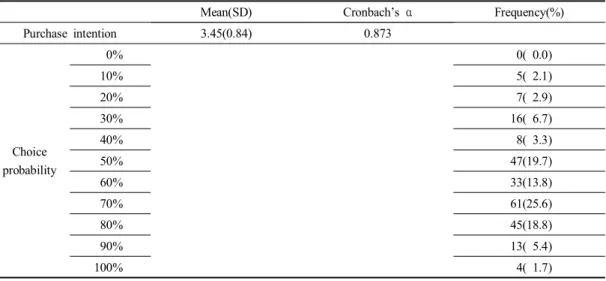
Data on purchase intention and choice probability of nutrition-labeled products was presented in Table 7. Participants showed above-average purchase intention(3.45 out of 5). In addition, it was found that most of them would like to purchase nutrition- labeled products at the next time of purchase, with the probability between 50% and 80%.

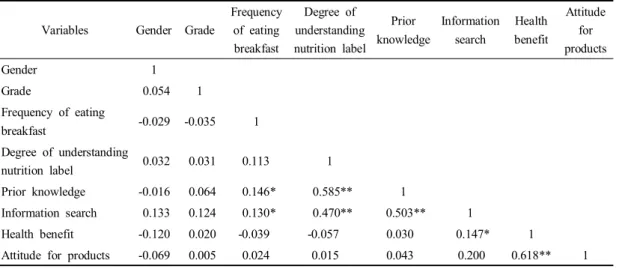
The result of influencing factors on the purchase intention and choice probability of nutrition-labeled products was presented in Table 9. Before conducting regression analysis, correlation analysis was conducted to test the linearity between independent variables for the concern of multicollinearity and the result was presented in Table 8. Although two Mean(SD) Male Female t value

Freshman

&

Sophomore

Junior &

Senior t value

Breakfast

t value

No Yes

Evaluation

Type A 3.70

(1.02) 3.43

(1.30) 1.80 3.47 (1.15)

3.69

(1.20) -1.40 3.64 (1.17)

3.54

(1.18) 0.51

Type B 5.04

(1.08) 5.32

(0.91) -2.15* 5.13 (1.01)

5.25

(1.00) -0.88 5.02 (1.15)

5.22

(0.96) -1.27

Type C 4.99

(1.03) 5.12

(0.96) -0.96 5.01 (0.95)

5.11

(1.05) -0.72 5.17 (0.88)

5.03

(1.03) 0.94

* p < .05

Table 6. Evaluation of the types of labels by consumer characteristics (N=239)

Mean(SD) Cronbach’s α Frequency(%)

Purchase intention 3.45(0.84) 0.873

Choice probability

0% 0( 0.0)

10% 5( 2.1)

20% 7( 2.9)

30% 16( 6.7)

40% 8( 3.3)

50% 47(19.7)

60% 33(13.8)

70% 61(25.6)

80% 45(18.8)

90% 13( 5.4)

100% 4( 1.7)

Table 7. Purchase intention and choice probability of nutrition-labeled products (N=239)

(11)

variables(health benefit and product attitude) were found to be somewhat highly correlated, it could not cause multicollinearity because values of variance inflation factor(VIF) for all variables were found to be less than the criterion(10.0)(Table 9).

Then, regression analysis was conducted and both purchase intention and choice probability were found to be significantly influenced by information search and product attitude. If they perceived information search to be a useful thing to do, they would be likely to have higher purchase intention, and choice probability might be increased. In addition, if they had a more favorable attitude to nutrition-labeled products, they would be likely to have higher purchase intention, and choice probability might be increased.

These results may confirm those of prior studies of consumer behavior associated with information search and product attitude. In other words, consumers may increase their intention to purchase and choice probability of nutrition-labeled products if they have positive feelings toward and benefitted from information search(Stigler 1961; Nayga 2000) and have favorable attitude toward the products (Engel et al. 1995; Agarwal & Malhortra 2005;

Drichoutis et al. 2006; Chen 2007).

In addition, choice probability was found to be significantly influenced by individual characteristics such as gender and grade. If they were females and freshman or sophomore, the choice probability of nutrition-labeled products would be likely to be increased. This result might be interesting since some of individual characteristics were found to be significant only for choice probability. It confirmed the findings of prior studies demonstrating that socio- demographic factors such as gender, age, and education level were important factors for consumer behavior. According to Binkley(2006) and Park &

Chung(2004), female and the older were very significant for choosing types of food and food expenditure. In addition, Tivadar & Luthar(2005) presented the gender differences with respect to food culture and behavior. However, the effect of grade(age) in this study was found to be contradictory to the prior studies(Park & Chung 2004; Binkley 2006). Therefore, further study of the effect of grade may be necessary.

Variables Gender Grade

Frequency of eating breakfast

Degree of understanding nutrition label

Prior knowledge

Information search

Health benefit

Attitude for products

Gender 1          

Grade 0.054 1

Frequency of eating

breakfast -0.029 -0.035 1

Degree of understanding

nutrition label 0.032 0.031 0.113 1

Prior knowledge -0.016 0.064 0.146* 0.585** 1

Information search 0.133 0.124 0.130* 0.470** 0.503** 1

Health benefit -0.120 0.020 -0.039 -0.057 0.030 0.147* 1

Attitude for products -0.069 0.005 0.024 0.015 0.043 0.200 0.618** 1

* p < .05, ** p < .01

Table 8. Correlation among independent variables (N=239)

(12)

V. Summary and Conclusion

This study were intended to explore consumer preference for the types of nutrition labels of cereal products and to find influencing factors on purchase intention and choice probability of nutrition-labeled products. First, most of the respondents preferred type C, while types A and B were preferred by few respondents. However, consumers evaluated higher for types B and C, while type A was evaluated much lower. Second, consumer preference of label types was partially found to be related with ‘eating breakfast. And degree of consumer evaluation of types A and B was found to be significantly different by gender. Lastly, both purchase intention and choice probability were found to be significantly influenced by information search and product attitude. In addition, choice probability was found to be significantly influenced by individual characteristics such as gender and grade.

According to Capon & Lutz(1979), consumers

could have greater power to choose processed products by easier accessibility to nutrition information.

Moorman(1996) also mentioned that nutrition information from the product labels could influence consumer response in terms of acceptance of information at the point of purchase as well as consumer behavior of the products. Thus, a better choice of nutritious products by consumers could be made through more information searched from the labels. In addition, if they had more favorable attitudes toward nutrition-labeled products, they would be likely to have higher purchase intention and choice probability might be increased. Thus, to increase purchase intention and choice probability of the products by consumers, a favorable attitude of consumers toward the products has to be established in advance.

The results of this study have several interesting implications. First, this study extended the research area by exploring consumer preference for nutrition information simplifying symbols such as FOP panels and traffic light symbol panels. Thereby, it

Variables Purchase intention Choice probability

β (SE) t VIF β (SE) t VIF

Constant 0.341(0.27) 1.283 1.424(0.68) 2.086*

Gender (Female) 0.107(0.08) 1.307 1.055 0.423(0.21) 2.017* 1.055

Grade (Junior/Senior) -0.083(0.08) -1.023 1.022 -0.512(0.21 -2.459* 1.022 Frequency of eating breakfast -0.017(0.03) -0.603 1.037 0.066(0.07) 0.850 1.037 Degree of Understanding nutrition label 0.055(0.06) 0.980 1.656 -0.029(0.14) -0.199 1.656

Prior knowledge -0.099(0.67) -1.509 1.723 -0.268(0.17) -1.581 1.723

Information search 0.199(0.06) 3.211** 1.582 0.739(0.16) 4.639** 1.582

Health benefit 0.072(0.07) 1.068 1.671 0.159(0.17) 0.917 1.671

Attitude for products 0.707(0.07) 9.711** 1.659 1.090(0.19) 5.830** 1.659

F value 26.91** 15.17**

R

2

0.48 0.35

Adj R

2

0.47 0.32

Durbin-Watson 1.949 2.040

* p < .05, ** p < .01

Table 9. The influencing factors on purchase intention and choice probability of nutrition-labeled products

(N=239)

(13)

offers useful information about consumer response to nutrition label types. In addition, the findings suggest that more desirable label formats can and should be developed for consumers to access and understand label information effectively. Moreover, this study confirmed that product attitude can be an important factor on the choice of nutrition-labeled products. Thus, some marketing strategies have to be applied to increase favorable attitudes of consumers. In addition, consumer research about food has been conducted for several decades in many countries because it was considered to be a very important research area. In particular, the United States has enforced the National Labeling and Education Act, and consumer research has been focused on the nutrition label area. Also, Korean studies on consumer behavior associated with the nutrition labels have been increased recently(Lee et al. 2002; Choi & Chung 2003; Joo et al. 2006;

Chung & Kim 2007; Lee & Kim 2008; Kim &

Lee 2010; Ko & Kim 2010; Chung et al. 2011;

Chung et al. 2011). It implies that exploring consumer aspects for dealing with food and labeling has also been considered and issued to be a very important research area in Korea.

Finally, this study has some limitations in terms of generalizability of the result. This study was conducted by a survey on college students to find consumer preference for the various label formats and consumer behavior toward nutrition-labeled products. Thus, it cannot be concluded that other consumers might act in line with the present findings.

References

Abbott R(1997) Food and nutrition information: A study of sources, uses and understanding. Br Food J 99(2), 43-49

Adelaja A, Nayga RM, Lauderbach T(1997) Income and racial differential in selected nutrient intakes.

Am J Agri Econ 79, 1452-1460

Agarwal J, Malhortra NK(2005) An integrated model of attitude and affect: Theoretical foundation and an empirical investigation. J Bus Res 58(4), 483-493

Ajzen I, Madden TJ(1986) Prediction of goal-directed behavior: Attitudes, intentions, and perceived behavioral control. J Experi Soc Psy 22, 453-474 Andrews JC, Burton S, Kees J(2011) Is simpler

always better? Consumer evaluations of front-of- package nutrition symbols. J Public Policy Marketing 30(2), 175 190 –

Ares G, Ga’mbaro A(2007) Influence of gender, age and motives underlying food choice on perceived healthiness and willingness to try functional foods. Appetite 49, 148 158 –

Binkley JK(2006) The effect of demographic, economic, and nutrition factors on the frequency of dining out. J Consumer Affairs 40(2), 372-391

Brucks M(1986) The effects of product class knowledge on information search behavior. J Consumer Res 12, 1-16

Burton S, Andrews JC(1996) Age, product nutrition, and label format effects on consumer perceptions and product evaluation. J Consumer Affairs 30(1), 68-89

Capon N, Lutz RJ(1979) A model and methodology for the development of consumer information programs. J Marketing 43, 58-67

Caswell JA, Mojduszka EM(1996) Using informational labeling to influence the market for quality in food products. Am J Agri Econ 78(5), 1248-1253 Chang S-O(1997) A study of the comprehension and preference of consumers to four different formats of nutrition label. J Korean Nutr Soc 30(6), 679-689

Chen, Mei-Fang(2007) Consumer attitudes and purchase intentions in relation to organic food in Taiwan:

Moderating effects of food-related personality traits. Food Quality Preference 18, 1008-1021 Choi JH, Chung Y-J(2003) Consumer preferred

formats of nutrition labels- Housewives of Daejon City-. Korean J Community Nutr 8(2), 220-230 Choi SH(2005) Current issues of food labeling. J of

Korean Women Economists Assoc 2(1), 61-79 Choi Y(2009) National and international research

trends of nutrition labeling. Food Industry Nutr 14(2), 1-8

Choi JH, Chung YJ(2003): Consumer preferred formats of nutrition labels. Korean J Community Nutr 8(2): 220-230

Chung HR(2001) Recent studies of nutrition labels.

2001 Korean Distri Assoc Spring Conference, 128-142

Chung SK, Kang JH, Lee HY(2011) Usefulness,

attitude for using and purchase intention on food

(14)

labeling of housewives and university students.

Korean J Community Nutr 16(1), 86-97

Chung J, Kim M(2007) Using and understanding of nutrition labels and related factors among female adults in the Seoul area. Korean J Community Nutr 12(4), 417-425

Chung JY, Kim MJ(2007) Using and understanding of nutrition labels and related factors among female adults in the Seoul area. Korean J Community Nutr 12(4), 417-425

Darby MR, Karni E(1973) Free competition and the optimal amount of fraud. J Law Econ 16(1), 67-88

Derby BM, Levy AS(2001) Do food labels work?

Gauging the effectiveness of food labels pre- and post-NLEA. In P. N. Bloom and G. T. Gundlach (Eds.), Handbook of marketing and society (pp.

372-398): Sage, Thousand Oaks, CA

Drichoutis AC, Lazaridis P, Nayga Jr RM(2006) Consumers' use of nutritional labels: A review of research studies and issues. Academy Marketing Sci Rev 2006(9), 1-22

Eagly AH, Chaiken S(1993) The psychology of attitudes. Fort Worth, TX: Harcourt Brace College Engel JF, Blackwell RD, Miniard PW(1995) Consumer behavior. 8th Edition, Forth Worth, TX: Dryden

Eo HS, Lee JS, Min HE, Hong H(2012) A study on the perception of nutrition labeling among high school boys based on their weight. Korean J Nutr 45(2), 150-158

Hassan LM,, Shiu EMK, Michaelidou N(2010) The influence of nutrition information on choice: The role of temptation, conflict and self-control. J Consumer Affairs 44(3), 499-515

Hawkes C(2004) Nutrition labels and health claims:

the global regulatory environment. World Health Organi-zation, Geneva

Hieke S, Taylor CR(2012) A critical review of the literature on nutritional labeling. J Consumer Affairs 46(1), 120-156

Homer PM(1990) The mediating role of attitude toward the Ad: Some additional evidence. J Advertising Res 27(1), 78-86

Hwang YY(2001) The role of search motivation on the relationship between external consumer information search and prior knowledge. J Consumer Stud 12(2), 1-22

Joo NM, Yoon JY, Kim OS, Park SH, Ko YJ, Kim JY(2006) A study on the awareness of female consumers for nutrition labeling system. Korean J Food Cult 21(2), 209-215

Kang H, Shin E, Kim H, Eom K, Kwon K, Kim S, Moon G, Kang B, Kim J(2011) Food nutrition labeling(Processing food, food service businesses)

in Korea. Food Science Industry 44(1), 21-27.

Kenkel D(1990) Consumer health information and the demand for medical care. Rev Econ Stat 72, 587-595

KFDA(Korea Food & Drug Administration)(2010):

Food labeling. Available from http://www.foodnara.

go.kr [cited 2013 September 11]

Kim DS, Lee JW(2002) Use and recognition of nutrition labelings in processed foods among middle school students and their parents. J Korean Diet Assoc 8(3), 301-310

Kim JY, Yoon HN(2011) A study on the cereal package design and transition of the retail structure. J Brand Design Assoc Korea 9(1), 56-69

Kim M-H, Yang J(2010) Effects of nutrition claims on consumers’ health believes, brand attitudes and perceptions of disease-related risks. J Consumer Stud 21(3), 53-81

Kim SY(2012) Effective food labeling and consumer behavior. Society Korea Illusart 15(1), 11-20 Kim S, Lee J(2010) Effect of nutrition labeling use

on consumers’ food choices. J Consumer Stud 21(3), 107-128

Ko SY, Kim KW(2010) Nutrition label use, self-efficacy, snacking and eating behavior of middle school students in Kyunggi area. Korean J Community Nutr 15(4), 513-524

Kozup JC, Creyer EH, Burton S(2003) Making healthful food choices: The influence of health claims and nutrition information on consumers’

evaluations of packaged food products and restaurant menu items. J Marketing 67(2), 19-34 Lee IS, Choi BS, You DR, Park YM(2002) College

students characteristics and utilization of the nutrition labels on food package. Korean J Diet Cult 17(3), 299-308

Lee HY, Kim MK(2008) Dietary behavioral correlates of nutrition label use in Korean women. Korean J Nutr 41(8), 839-850

Lichtenstein DR, Ridgway NM, Netemeyer RG(1993) Price perceptions and consumer shopping behaviour: A field study. J Marketing Res 30, 234-245

MailOnline(2012) The great cereal scandal: One of Britain’s leading consumer experts reveals the shocking truth about sugary breakfast cereals.

Available from http://www.dailymail.co.uk/health/

article-2107361/Sugary-breakfast-cereals-1-Britains-l eading-consumer-experts-reveals-shocking-truth.html [cited 2012 December 23]

Moorman C(1996) A quasi experiment to assess the

consumer and informational determinants of

nutrition information processing activities: The

case of the nutrition labeling and education act. J

(15)

Public Policy Marketing 15(1), 28-44

Nayga Jr RM(2000) Nutrition knowledge, gender and food label use. J Consumer Affairs 34(1), 97-112 Nelson P(1970) Information and consumer behavior. J

Political Economy 78, 311-329

Nelson P(1974) Advertising as information. J Political Economy 83, 729-754

Park YS, Chung YS(2004) Determinants of food away from home and consumption patterns.

Korean J Food Culture 19(1), 118-127

Pauly MV, Satterthwaite MA(1981) The pricing of primary care physicians’ services: A test of the role of consumer information. Bell J Econ 12, 488-506

Petty RE, Cacioppo JT(1986) The elaboration likelihood model of persuasion. Advances Experi Soc Psy 19, 123-205

Roe B, Levy AS, Derby BM(1999) The impact of health Claims on consumer search and product evaluation outcomes: Results from FDA experimental data. J Public Policy Marketing 18(1), 89-105 Sapp SG(1991) Impact of nutrition knowledge within

expanded rational expectations model of beef consumption. J Nutr Edu 23, 214-222

Shepherd R, Stockley L(1987) Nutrition knowledge, attitudes and fat consumption. J Am Diet Assoc 87, 615-619

Shepherd R, Towler G(1992) Nutrition knowledge, attitudes and fat intake: Application of the theory of reasoned action. J Hum Nutr Diet 5, 387-397 Shine A, O'Reilly S, O’Sullivan K(1997) Consumer

use of nutrition labels. Br Food J 99(8), 290-296 Stigler GJ(1961) The Economics of information. J

Political Economy 69, 213-225

Teisl MF, Bockstael NE, Levy AS(2001) Measuring the welfare effects of nutrition information. Am J Agri Econ 83 (1), 133-149

Teisl MF, Levy AS(1997) Does nutrition labeling lead to healthier eating? J Food Distri Res 28(3), 18-27

Tepper BJ, Trail AC(1998) Taste or health: A Study on consumer acceptance of corn chips. Food Quality Preference 9(4), 267-272

Tivadar B, Lutha B(2005) Food, ethics and aesthetics.

Appetite 44, 215-233

Verbeke W, Ward RW, Viaene J(2000) Probit analysis of fresh meat consumption in Belgium:

Exploring BSE and television communication impact. Agribusiness 16(2), 215-234

Wansink B(2003) How do front and back package

labels influence beliefs about health claims. J

Consumer Affairs 37(2), 305-316

(16)

Appendix 1.

type A. Nutrition fact panel only Nutrition fact panel on the side

type B. Nutrition fact panel with the front-of-package

type C. Nutrition fact panel with TL-GDA

수치

Table 2. Characteristics of respondents (N=239)
Table 3. Validity and reliability test of constructs (N=239)
Table 4. Consumer preferences and evaluation for the types of nutrition label (N=239)
Table 7. Purchase intention and choice probability of nutrition-labeled products (N=239)
+3

참조

관련 문서

An Exploratory Study Examining the Effects of Place Creativity and Workplace Attire on Consumer Trust, Attitude, and Purchase Intention in the Virtual E-Commerce Environment*..

In this paper, we will construct a model of the relationship between intelligent music products and consumers' intention to buy, and introduce the function

Key words: SNS social capital (bridging social capital, bonding social capital), food product, trust, purchase intention, perceived risk, SNS

While established country-of-origin studies generally presumes direct relationship between consumers’ product judgments and purchase behavior, the animosity

Lee, Ji-Eun (2011), “The Effectiveness of Consumer’s Environmental Consciousness on Environment-Friendly Agricultural Products Perception and Purchase Intention”, Korean

Print ISSN: 2233-4165 / Online ISSN 2233-5382 doi:http://dx.doi.org/10.13106/jidb.2020.vol11.no1.49 Effects of the Attributes of Mobile Shopping Apps on Purchase Intention of Fashion