A Study on Ship's Maneuverability Evaluation by Real Ship Test
Nam-kyun Im
*․Song-Hee Han
**․Thanh Nhat Lai Nguyen
***†*, ** Division of Maritime Transportation System, Mokpo National Maritime University, Mokpo, 530-729, Korea
*** Graduate school of Maritime Transportation System, Mokpo National Maritime University, Mokpo, 530-729, Korea
선박조종성능 평가를 위한 실선 실험연구
임남균
*․한송희
**․구엔탈날라이
***†*, ** 목포해양대학교, *** 목포해양대학교 대학원
Abstract : At the design stage, it is very important to know the ship maneuvering characteristics from the view point of ship performance and for the safety of navigation. IMO only gives some criteria for ships in full load even keel condition. However, the ship generally is operated not only in full load condition but also in half load condition or ballast condition. Therefore we must estimate the ship maneuvering in different loading condition to ensure that the ship will satisfy with IMO rules and navigate safely in every condition. In this paper, we have investigated the maneuvering characteristics of a ship by simulation and experiments with real ship. By comparing with the results of simulation, the real ship tests conform with simulation test and previous researches. Therefore, the method base on real data is well done to estimate the ship maneuvering in different loading conditions. The change of ship's manoeuverability accoriding to ship's operation conditions was estimated.
Key Words : Loading condition, Ship maneuverability, Zigzag maneuver, Ship mathematical model, Ship trial
요 약 :선박 성능과 항해 안전의 관점에서 선박조종 특성을 아는 것은 선박 설계에서 중요한 일이다. IMO 규정에 의하면 만재 적하된 even 조건(트림=0)에서 몇가지 선박 조종 기준이 제시되어 있다. 그러나 선박은 일반적으로 항상 만재 적재 조건으로 운항되지 않는다. 따라서 선박 이 IMO 규정을 만족시키고, 모든 적재 조건에서 안전하게 항행하도록 하기 위해 다양한 적재 조건에서 선박 조종 특성을 추정해야 한다. 본 논 문에서 우리는 실선 실험과 시뮬레이션을 수행하여 조종특성을 조사하였다. 시뮬레이션 결과와 비교하였을 때 실선실험은 시뮬레이션 값 및 이 전 연구와 그 경향이 일치한다. 실 해역에서 얻은 조종실험 데이터가 선박 조종성능 추정에 활용 될 수 있음을 확인하였고, 실시한 실해역 실험 을 통하여, 선박 운항 상태에 따른 조종성의 변화를 추정할 수 있었다.
핵심용어 : 재하 상태, 선박의 조종성능, 지그재그 조종, 선박의 수학적 모형, 실선시운전
1)
1. Introduction
The sea trial test for new ship is mostly executed in ballast condition. Moreover, the maneuvering performance of ship, in general, will be estimated in fully loaded condition, when it required getting the information of the maneuverability. However, the ship generally is operated not only in full load or ballast but also in half load and trimmed condition, In each loading condition, the ship have a difference of maneuvering performance and in order to apply the maneuvering standards we must check and find out the ship maneuverability in different conditions. From these points, it should be considered that a loading
* First author : [email protected], 061-240-7177
†Corresponding author : [email protected], 010-2814-0286
condition is one of the most important parameter to predict the maneuvering performance.
Many studies and paper(Kijima et al., 2000; Kijima et al.,1990; Kose, 1991) relate to effect of loading condition to ship’s maneuverability have been published. On their research, the previous researchers propose the approximate formulae for estimating the hydrodynamic forces acting on ship in any loading condition. By comparing with the measured results of free running model test, the prediction results using these approximately formulae agree well with the model test results.
A few researcher use real data to solve the problem. In
this study, it is a little different with them. We have
investigated the maneuvering characteristics of a ship
through experiments with real ship. Zigzag maneuver have
been carried out with MMU training ship to compare with simulation results to prove that the method base on real data also well done to define the effect of loading condition on ship maneuverability.
This paper presents test data and simulation results.
Some discussions on the characteristics of ship and effects of loading condition were also presented based on simulation and real ship test. Base on the results, we can estimate the maneuverability of ship in different loading condition.
2. Relationship between ship maneuverability and loading condition
In December 2002, International Maritime Organization (IMO) has adopted the Resolution MSC.137(76)(IMO, 2003) Standards for Ship Maneuverability.
In applying the standards, we have to estimate and evaluate the maneuverability of a ship at the design stage as accurately as possible. IMO only gives some criteria for ships in full load even keel condition but most of sea trial was carried out in ballast or heavy ballast condition.
Although IMO suggest some correction methods from the sea trial data at ballast condition to those at full load condition, the maneuvering characteristic at full load condition and ballast condition or half load condition have too much different. To improve the correction method, it is very important to understand the relationship between loading condition and ship maneuverability.
Since IMO adopted interim maneuvering standards, there have been many studies on predicting the ship maneuvering performance in different loading condition(Kijima et al., 2000; Kose, 1991) because the effect of loading condition on ship maneuverability is very important for the view points of ship performance and also for the safety of navigation.
In order to estimate the ship maneuverability in different loading condition by zigzag test, the trend of overshoot angle during the different trim and draft of ship was analysed and discussed on the previous researches. On their research, Kijima(Kijima et al., 1990) and Kuniji Kose(Kose, 1991) use MMG model to make a simulation of zigzag test of many kind of ships in full load, half load, ballast (even draft), and ballast (aft trim). By comparing with the measured results of free running model ship, their researches prove that the values overshoot angles in full load is more than the values in half load, ballast condition and the values of overshoot angle in ballast (even draft) is
more than the values in ballast (aft trim). It means that the ships have a good course keeping and yaw-checking ability in small draft and big trim. In the Explanatory Note to the Standards for Ship Maneuverability(IMO, 2003), IMO also impressed that a change of trim will have a marked effect mainly on the location of the centre-of-pressure of the side force resulting from sway. This is easily seen that a ship with a stern trim, a common situation in ballast trial condition, is likely to be much more stable than it would be on an even draught.
In our research, we try to find out the tendency of overshoot angle when the zigzag tests of real ship were carried out in different trim and draft. The results of zigzag tests are repetitive with the Explanatory Note to the Standards for Ship Maneuverability to prove that the real ship test also well done to find out the relationship between loading condition and ship maneuverability.
3. Simulation of zigzag test
3.1 Ship mathematical model
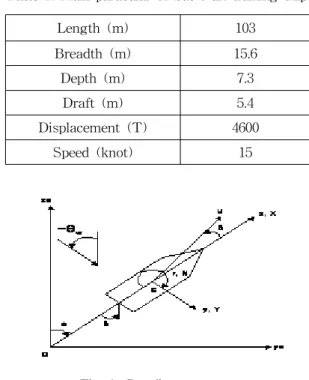
In this study, the training ship SAE NURI was adopted as a ship model and principal particulars are given in Table 1 and axes coordinates of ship model are produced in Fig. 1.
Length (m) 103
Breadth (m) 15.6
Depth (m) 7.3
Draft (m) 5.4
Displacement (T) 4600
Speed (knot) 15
Table 1. Main particular of Sae Nuri training ship
Fig. 1. Coordinate system.
In simulation of zigzag test, MMG mathematical model
was used to calculate the ship maneuvering. As explained
in MMG models(Hamamoto, 1997; Ogawa, 1978) divided
the hydrodynamic forces and moments acting on a ship in maneuvering motion into the modules such as hull, propeller, rudder and other considerable external hydrodynamic forces and moments. The equation of ship maneuvering motion is introduced as equation (1).
The hydrodynamic force acting on the hull are expressed in the form of non-linear terms, hydrodynamic force coefficients were obtained from a research by Kijima (2) and hydrodynamic force were also calculated by non-linear equation (2), (3), (4).
) 1 ( '
) ' ' ( ) )(
(
' cos ' ) ' ' ( ) cos sin
)(
)(
' ' (
' sin ' ) ' ' ( ) sin cos
)(
)(
' ' (
2
ú ú
ú ú ú ú ú
û ù
= - +
= +
+ -
+ -
= +
+ -
+
N L r r U L U U i L I
Y r
m U m
U U m L m
X r
m U m
U U m L m
ZZ ZZ
Y Y
X X
&
&
&
&
&
&
b b
b b
b b
b b
(1)
T vr
H
X v r C
X ' = ' × ' ' - (2)
' ) ' ' ' ( ' ' ' '
' ' '
'
Y Y r Y Y r r Y Y r rYH
=
bb +
r+
bbb b +
rr+
bbrb +
brrb (3)
' ) ' ' ' ( ' ' ' '
' ' '
' N N r N N rr N N r r
NH= b
b
+ r + bbb b
+ rr + bbrb
+ brrb (4)
The hydrodynamic forces and angular moment generated by the rudder angle can be expressed by considering the rudder’s normal force and the rudder angle as follow.
ú ú ú û ù
+ -
= - -
= - -
=
d d d
cos ' ) ' '
( '
cos ' ) 1 ( '
sin ' ) 1 ( '
N H H R R
N H R
N R R
F x a x N
F a Y
F t X
(5)
3.2 Numerical simulation
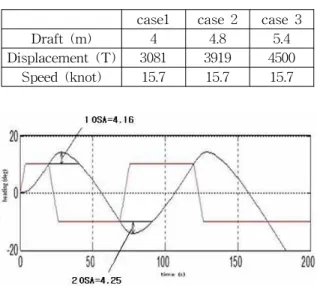
The simulation zigzag test was carried out in three cases of even keel condition with the same speed but different drafts of ship. Three case of zigzag test was show clearly in table 2.
Fig 2, 3, 4 show the results of zigzag test in case 1, case 2, case 3 and then in Fig 5 three case of simulation test was summarized and analysis to find out the effect of loading condition on ship maneuverability.
As shown in Fig 5, 1 overshoot angle and 2 overshoot angle increase when the drafts of ship increase. The results was defined that the course keeping and yaw checking ability of the ship are better when the ship navigates in the small draft and the course keeping and yaw checking ability was decrease when the draft of ship increases.
case1 case 2 case 3
Draft (m) 4 4.8 5.4
Displacement (T) 3081 3919 4500
Speed (knot) 15.7 15.7 15.7
Table 2. Three case of simulation zigzag test
Fig. 2. Time histories of simulation zigzag test in case 1.
Fig. 3. Time histories of simulation zigzag test in case 2.
Fig. 4. Time histories of simulation zigzag test in case 3.
Fig. 5. The tendency of overshoot angle when simulation
test was carried out in different draft.
4. Zigzag test with real ship
4.1 Model ship
Before, many researchers use simulation and free running model test to estimate the ship maneuvering in different loading condition. A few researches use real data to solve the problem.
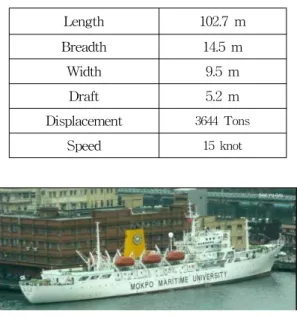
In this research, it is a little different with them because the zigzag test with real ship was carried out to compare with free running model test and simulation results to prove that the method based on real data also well done to define the effect of loading condition on ship maneuverability. Training ship Sae Yu Dal was used in zigzag test with real ship. The main particular of ship was show in table 3. and Fig. 6.
Length 102.7 m
Breadth 14.5 m
Width 9.5 m
Draft 5.2 m
Displacement
3644 TonsSpeed
15 knotTable 3. Main particular of Sae Yu Dal
Fig. 6. Training ship Sae Yu Dal.
The zigzag test was carried out in 2 locations. There are East China Sea and Luzon West Coast. In each location, the ship navigatedin different loading condition to estimate the effect of loading condition on training ship maneuverability.
Table 4, 5, 6 show the wind, current and ship's condition in East China Sea and Luzon West Coast. As shown in these figure., the wind speed in Luzon West Coast was stronger than the wind in Ease China Sea, but the current speed in Luzon West Coast is slower than in East China Sea.. Otherwise, the current speed and wind speed in Luzon West Coast and East China Sea is a little strong.
Therefore, the zigzag maneuver with Sae Yu Dal was affected by the environment in these Location.
Ship
Heading 200˚ 210˚ 200˚ 180˚
Wind SW 5.2 kts SE 8. 2kts SE 10.5 kts NW 17 kts Current NE 2 kts NW 1 kts NW 2 kts S 1 kts Ship speed
(kts) 16 14.3 16.0 15.0
Df (m) 4.40 4.40 4.40 4.40
Da (m) 5.60 5.60 5.60 5.60
RPM 210 210 210 210
Table 4. Zigzag test in East China Sea
Ship
Heading 340˚ 340˚ 340˚ 340˚
Wind W 17.5 Kts W 16 kts W 15 Kts SE, 18 Kts Current SE 0.2 Kts SE, 0.2 kts SE, 0.2 Kts W 0.2 Kts Ship speed
(kts) 13.2 13.2 13.0 13
Df (m) 4.20 4.20 4.20 4-20
Da (m) 5.70 5.70 5.70 5.70
RPM 215 215 215 215
Table 5. Zigzag test in Luzon West Coast 1
Ship
Heading 160˚ 160˚
Location Luzon West coast Luzon West coast
Wind NW 7 Kts SW 8 Kts
Current SE, 0.6 kts SW, 0.5 kts Ship speed
(kts) 13.4 Kts 13.8 Kts
Df 4-40 m 4-40 m
Da 5-20 m 5-20 m
RPM 210 210
Table 6. Zigzag test in Luzon West Coast 2
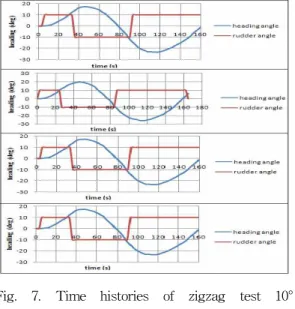
4.2 Experimental data
The zigzag tests were carried out in many times with
different draft and trim of ship. Fig 7, 8, 9 explains the
results of zigzag test in East China Sea and Luzon West
Coast. Time histories of heading angle and rudder angle
was showed in these figures.
Fig. 11. The effect of trim on Sae Yu Dal maneuverability.
Fig. 7. Time histories of zigzag test 10°
starboard in East China Sea.
Fig. 8. Time histories of zigzag test 10°
starboard in Luzon West Coast 1.
Fig. 9. Time histories of zigzag test 10°
starboard in Luzon West Coast 2.
Firstly in Fig 10 the effect of draft on ship maneuverability was explained. Comparing with simulation zigzag test in different draft, we can find that the tendency of overshoots angle in zigzag test with real ship is not clear as the results in simulation.
The zigzag maneuver with real ship was carried out in different location with different environment. Throughout the experiment we try to find out the tendency that the overshoot angle increase when the draft of ship increase.
We found out that the course keeping and yaw checking of Sae Yu Dal in a small draft is better than in a big draft and they will decrease when the draft of ship increase.
Secondly, according to the Fig 11, the effect of trim on ship maneuverability was show. The overshoot angles decease when the trims of ship increase. It prove that the ship has a good course keeping and yaw checking ability when maneuver in the big trim and the course keeping and yaw checking ability will decrease when the trim of ship decrease.
Fig. 10. The effect of draft on Sae Yu Dal maneuverability.
5. Conclusion
In this study, the effect of loading condition on ship maneuverability was mentioned and estimated by two methods. The zigzag test was carried out with real ship, and simulation in different loading condition to find out the tendency of ship maneuverability when the loading condition of ship changes.
Firstly, we use Sae Nuri as a model to calculate the ship motion and make zigzag test in 3 case of even keel condition with different draft. The result of simulation zigzag test shows that the overshoot angles increase when the draft of ship increases. It is prove that the course keeping and yaw checking ability in small draft is better than in a big draft.
Secondly, zigzag maneuvers were done with training ship Sae Yu Dal in 10 cases with different draft and trim.
When the ships navigate with small draft and big trim, the values of overshoot angles are less than results in big draft and small trim. Therefore the course keeping and yaw checking ability is better than the ships maneuver with big draft and small trim.
Finally, according to this research, we can find out the trend of ship maneuverability in different loading condition.
The overshoot angles increase when the draft of ship increase and overshoot angles decrease when the trim of ships increases. Otherwise, the results of real ship test agree well with simulation results and previous research. It is the main goal of our research.
However there is still remain some problem to be solved to apply this method to the prediction of ship maneuverability in different loading condition. It is the limitation of our research because there is not enough case of experiment to suggest the equation to evaluate the ship maneuverability in different loading condition. In the next researches, real ship test should be done in the same environment to reduce the effect of wind and current on ship maneuvering. And then, other method should be used to estimate ship maneuverability such as free running model ship. With more data of test, we can suggest the equation for estimation the ship maneuverability in different loading condition.
Acknowledgement
This work was supported by the National Research
Foundation of Korea(NRF) grant funded by the Korea government(MEST)(R01-2008-000-10046-0-2008).
List of used symbols L : Ship length
U : Ship speed
Cn : Yaw moment coefficient F
N: Rudder normal force
t
R: Coefficient for additional drag a
H: Ratio of additional lateral force
x
H: Distance from the center of gravity of ship to the center of additional lateral force
b: Sway angle of a ship
m
x: Added mass in surge direction
my
: Added mass in sway direction
R R
R
Y N
X , , : Force and moment due to a rudder
H H
H