장류용 내병・내도복 다수성 콩 신품종 ‘청아’
하건수1* ・ 최재근1・ 조수현1・ 변학수1・ 김세원1・ 장진선1・ 윤홍태2・ 문중경2・ 김시주2・ 박금용2
1강원도농업기술원, 2국립식량과학원
A New Tofu and Soy-paste Soybean Cultivar, ‘Cheonga’ with Disease Resistance, Lodging Tolerance and High Yield
Keon-Soo Ha1*, Jae-Keun Choi1, Soo-Hyun Cho1, Hak-Soo Byun1, Se-Won Kim1, Jin-Seon Jang1, Hong-Tae Yun2, Jung-Kyung Moon2, Si-Ju Kim2, and Keum-Yong Park2
1Gangwondo Agricultural Research & Extension Services, Chuncheon 250-150, Korea
2National Institute of Crop Science (NICS), RDA, Suwon 441-100, Korea
Abstract : A new soybean cultivar ‘Cheonga’ was released by Gangwondo Agricultural Research & Extension Services, Republic of Korea in 2009. The Goal of breeding was for high yield, lodging tolerance, and resistance to diseases such as Soybean mosaic virus and bacterial pustule. The ‘Cheonga’ was selected from progenies obtained from a cross between ‘Shinpaldal 2’, showing yellow seed coat, lodging tolerance and high yield, and ‘SS91809’, showing yellow seed coat, lodging tolerance and early maturity. It has a determinate growth habit, white flower, yellow seed coat, yellow hilum and large spherical seed (25.2 g per 100 seeds). The ‘Cheonga’ has 11 days early in flowering date and 5 days early in maturity than the check cultivar ‘Taekwang’.
The ‘Cheonga’ has 6days longer in maturity period than the check cultivar. The ‘Cheonga’ is partial tolerant to soybean mosaic virus and bacterial pustule, the major soybean disease in Korea. Especially, ‘Cheonga’ shows lodging tolerance. The average yield of ‘Cheonga’ was 2.72 ton per hectare in the regional yield trials carried out in two years from 2006 to 2007, which was 14 percent higher than that of check cultivar, ‘Taekwang’.
Keywords : Soybean, Cultivar, Cheonga, Lodging
*Corresponding author (E-mail: [email protected], Tel: +82-33- 248-6038, Fax: +82-248-6048)
(Received on August 30, 2013. Revised on October 10, 2013.
Accepted on October 10, 2013.)
Copyright ⓒ 2013 by the Korean Society of Breeding Science 452
This is an Open-Access article distributed under the terms of the Creative Commons Attribution Non-Commercial License (http://creativecommons.org/licenses/by-nc/3.0) which permits unrestricted non-commercial use, distribution, and reproduction in any medium, provided the original work is properly cited.
서 언
콩은 우리나라 3대 식량작물의 하나로서 장류, 두부, 콩나 물 등의 전통식품의 재료로 국민건강에 기여해왔다. 콩 재배면 적은 처음으로 100,000 ha 이하를 기록한 1996년(97,989 ha) 이후 지속적으로 감소하여 2009년 70,265 ha로 가장 적은 재 배면적을 기록한 후 2012년 80,842 ha까지 점진적으로 증가 세를 보이고 있다. 국내 콩 산업 기반을 유지하기 위한 품종 개발은 2012년까지 142개 품종이 국가품종목록으로 등재되 어 있는 등 용도별로 다양한 품종이 육종되어 이용되고 있다.
국내 콩의 품종개발은 기계화 적응성 품종 개발(Kim et al.
2010), 성숙기 고온 다습 조건에서 빈발하여 생육에 큰 피해 를 주는 불마름병 저항성 품종 육성(Kim et al. 2010, Seo et al. 2009), 분자표지를 이용한 콩 모자이크병 저항성 품종 개 발(Lee et al. 2009) 등이 이루어지는 등 육종 방향 또한 다변 화 하고 있다. 최근에는 생산자인 농업인의 입장에서 장류용 콩의 경우 대립이며 색택이 양호하고 도복 등 재해에 강하고 다수성인 품종 요구도가 증가하고 있으나 이러한 목적의 이 상적 초형을 갖추기에는 어려움이 있다(Kim et al. 2008). 따 라서 강원도농업기술원에서는 여름철 집중 강우와 가을철 태 풍 등 기상재해에 대응하기 위한 장류용 콩 품종 개발을 위하 여 노력한 결과 대립이며 도복에 강하고 조숙이면서 성숙기 간이 긴 장류용 콩 품종 ‘청아’를 개발, 보급하고 있으며 그 육성경위와 주요특성을 보고하고자 한다.
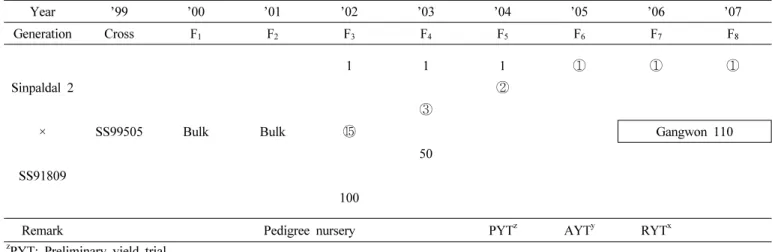
Year ’99 ’00 ’01 ’02 ’03 ’04 ’05 ’06 ’07
Generation Cross F
1F
2F
3F
4F
5F
6F
7F
81 1 1 ① ① ①
Sinpaldal 2 ②
③
× SS99505 Bulk Bulk ⑮ Gangwon 110
50 SS91809
100
Remark Pedigree nursery PYT
zAYT
yRYT
xz
PYT: Preliminary yield trial
y
AYT: Advanced yield trial
x
RYT: Regional yield trial
Fig 1. Pedigree diagram of ‘Cheonga’.
Table 1. Inherent characteristics of ‘Cheonga’.
Variety Growth habit Leaflet shape Flower color Pubescence color Seed coat color Hilum color Seed shape Shattering
Cheonga Determinate Oval White Gray Yellow Yellow Spherical None
Taekwang Determinate Oval Purple Gray yellow Yellow Spherical None
재료 및 방법
생산력 검정 시험은 2004년부터 2005년까지 2개년간 강원도 춘천시에 소재한 강원도농업기술원 작물연구과 전작시험포장에 서 실시하였다. 지역적응성 검정 시험은 춘천, 철원, 평창, 연천 등 4개 지역에서 2006년부터 2007년까지 2개년간 실시하였으 며, 장류용 콩 표준품종인 ‘태광’(Kim et al. 1992)을 대조품종 으로 사용하였다. 파종기는 강원지역 단작 재배지 표준 파종기 인 5월 20일 전후 5일 이내로 하였고, 재식밀도는 휴폭 60 cm, 주간 15 cm, 1주 2본으로 하였으며 재식밀도의 영향을 비교하 기 위하여 주간 30 cm와 비교하였다. 시비관리는 토양을 검정 하여 시비하거나, 콩 재배 시 표준시비량인 1,000 m2당 질소-인 산-가리를 3.0-3.0-3.4 kg을 기비로 시용하였다. 작물학적 생육 특성 조사는 2004년과 2005년에 걸쳐 실시하였으며 주요 특성 조사는 농촌진흥청 농사시험연구조사기준에 따라 수행하였다.
결과 및 고찰
육성경위
콩 신품종 ‘청아’는 내도복, 다수성 품종인 ‘신팔달콩 2호’
(Kim et al. 1993)를 모본으로 하고 국립식량과학원에서 육성 한 SS91809를 부본으로 하여 1999년도에 인공교배 후 계통 육종법으로 선발한 SS99505-15-3-2-1계통이다. 2004년부터 2005년까지 실시한 생산력검정시험에서 대립, 내도복 계통으 로 유망하여 ‘강원 110호’의 계통명을 부여하였다. 2006년부 터 2007년까지 2년간 춘천 등 4지역에서 지역적응시험을 실 시한 결과 콩의 품질 특성이 우수하고 내도복성이 강하며 성 숙기를 단축하여 콩 단작 재배지인 강원 및 경기지역 적응성 계통으로 인정되어 2007년 12월 강원도농업기술원 농작물 직무육성 신품종 선정위원회에서 강원도 단작지에 재배 가능 한 신규 등록품종으로 결정 후 ‘청아’로 명명하였다(Fig. 1).
주요특성
‘청아’의 신육형은 유한 신육형이며 엽형은 난형이고 꽃은 백색이다. 모용색은 회색이고 종피색과 자엽색은 모두 황색이 다. 종실의 형태는 구형이며 자연상태에서 협의 개열은 잘되 지 않는다(Table 1). ‘청아’의 개화기는 7월 20일로 대조품종 인 ‘태광’보다 11일 빠르고 성숙기는 9월 30일로 10월 5일인
‘태광’보다 5일 빨라 조숙종이면서도 오히려 생식생장기간은 6일 더 길다(Table 2). ‘청아’의 백립중은 25.2 g으로 ‘태광’
Table 2. Quantitative characteristics of ‘Cheonga’.
Variety Flowering date
zMaturity date
zPlant height (cm) Lodging (0-9)
y100-seed weight (g)
Cheonga Jul. 20 Sep. 30 62 0 25.2
Taekwang Aug. 1 Oct. 5 79 3 22.8
z
Data at Chuncheon
y
0: Resistance, 9: Susceptible
Table 3. The resistance of ‘Cheonga’ to the disease of soybean.
Variety Bacterial pustule
zSMV Percentages of damaged seed
Purple seed Seed spot Phomopsis
Cheonga 1
y0 0 0.1 0.0
Taekwang 3 0 0 0.2 0.1
z
Data in test field
y
0: Resistance, 9: Susceptible
Table 4. Seed quality characteristics in ‘Cheonga’.
Variety Crude protein (%)
Crude oil (%)
Isoflavone ( μg/g)
Amino acid (mg/100 g)
Asp. Glu. Met. Cys. Total
Cheonga 37.6a
z18.6a 1,805a 3,062a 5,782a 142a 171a 34,258a
Taekwang 37.2a 18.3a 1,598b 3,190a 5,794a 131b 152b 34,322a
z
Means with the same letter are not significantly different at 5% level by DMRT
Table 5. Soybean malt and fermented soybean process ability of ‘Cheonga’.
Cultivar Soybean malt Fermented soybean
Dgree of fermentation (1-5)
zYield (%) Flavor (1-5)
zDgree of fermentation (1-5)
zYield (%) Flavor (1-5)
zCheonga 4.5 81.2 4.1 3.5 198.4 3.5
Taekwang 4.2 79.8 3.1 3.2 190.6 3.4
z
1: Very bad, 2: Bad, 3: Fair, 4: Good, 5: Excellent
보다 2.4 g 더 무거운 중대립종이며, 단간종으로 내도복성이 매우 우수하다(Table 2).
내병충성
‘청아’의 내병충성은 포장에서 검정하였으며 세균성병해에 는 대조품종인 ‘태광’보다 조금 강한 정도를 보였고, 콩 모자 이크 바이러스에는 저항성을 보였다. 종실의 이병정도에서는 대조품종과 비슷한 정도로 이병립율이 매우 적게 나타났다.
품질특성
‘청아’의 조단백 함량은 37.6%로 대조품종인 ‘태광’의 37.2%
와 유사하였고 조지방 함량도 18.6%로 ‘태광’의 18.3%와 유
사하였다. 아이소플라본 함량은 1,805 ㎍/g으로 ‘태광’의 1,598 ㎍/g보다 다소 높았다. 아미노산 조성에서는 ‘청아’의 경우 34,258 mg/100g으로 ‘태광’의 34,322 mg/100g과 유사 하였다. 주요 아미노산 조성 역시 함량이 유사하였으나, 황 함 유 아미노산인 메치오닌 함량은 142 mg/100g, 시스테인 함 량은 171 mg/100g으로 대조품종인 ‘태광’보다 다소 높았다 (Table 4).
메주와 청국장 가공 적성
‘청아’의 메주와 청국장 가공적성 검정결과 메주가공 시 수 율은 ‘태광’과 유사한 81.2%를 나타내었으나 발효 정도와 풍 미가 양호하였다. 청국장 가공 시에는 ‘청아’의 수율이 198.4%
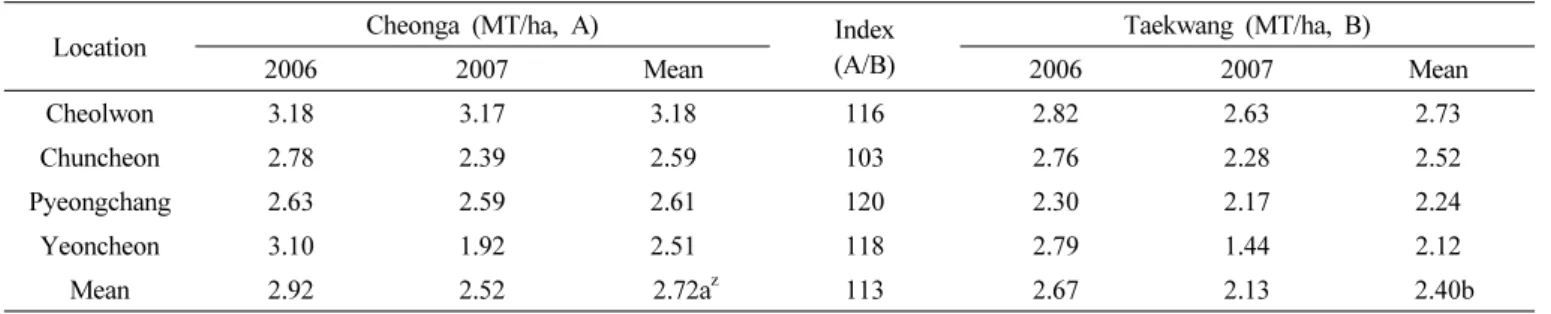
Table 6. Yield of ‘Cheonga’ on the regional yield trials carried out at 4 locations.
Location Cheonga (MT/ha, A) Index
(A/B)
Taekwang (MT/ha, B)
2006 2007 Mean 2006 2007 Mean
Cheolwon 3.18 3.17 3.18 116 2.82 2.63 2.73
Chuncheon 2.78 2.39 2.59 103 2.76 2.28 2.52
Pyeongchang 2.63 2.59 2.61 120 2.30 2.17 2.24
Yeoncheon 3.10 1.92 2.51 118 2.79 1.44 2.12
Mean 2.92 2.52 2.72a
z113 2.67 2.13 2.40b
z
Means with the same letter are not significantly different at 5% level by DMRT
Table 7. Agronomic characteristics and yield of ‘Cheonga’ in different planting density.
Planting density Variety Plant hight (cm) No. of nodes No. of pods Yield (ton/ha) Index (%)
60 × 15 cm Cheonga 63 15.9 54 3.17a
z121
Taekwang 75 16.6 52 2.63b 100
60 × 30 cm Cheonga 50 15.5 60 2.68a
z116
Taekwang 63 16.6 54 2.31b 100
z
Means with the same letter are not significantly different at 5% level by DMRT
로 ‘태광’ 190.6%보다 높았으며, 발효 정도와 풍미 또한 양호 하였다(Table 5).
수량성
2006년부터 2007년까지 2년간 강원지역 3개소 경기지역 1 개소 등 단작재배지역 4개소에서 실시한 지역적응시험에서
‘청아’의 평균수량은 2.72 MT/ha로 ‘태광’의 2.40 MT/ha 대 비 13% 증수하였다(Table 6). 또한 품종 육성을 위한 표준재 식거리인 개체간 거리 15 cm와 농가 현장 재식거리인 30 cm 를 비교한 결과 재식거리가 15 cm일 때에는 ‘청아’가 21%
증수하였으나, 30 cm로 소식할 경우 ‘청아’가 ‘태광’보다 16% 증수하여 ‘청아’의 경우 밀식 적응성이 더 높은 것으로 나타났다(Table 7).
‘청아’의 적응지역은 강원도 고랭지를 제외한 경기, 강원의 콩 단작지이다. 특히 ‘청아’는 내도복성이 우수하고 밀식적응 성이 높으므로 적심작업을 하지 않고 다소 많이 파종하는 것 이 경영비 절감이나 수량증대에 유리하다.
적 요
‘청아’는 내재해 다수성 장류용콩 신품종을 육성하기 위하 여 내도복, 다수성 품종인 ‘신팔당콩 2호’를 모본으로 1999년 도에 인공교배한 SS99505 조합으로 계통육성법으로 선발하
였으며 계통명은 ‘강원 110호’이다. 꽃색은 백색이고 잎모양 은 난형이며, 종자모양은 구형이다. 종피색과 배꼽색은 황색 이고 백립중은 25.2 g으로 ‘태광’보다 2.4 g 무거운 대립이다.
‘태광’에 비하여 개화기는 7월 20일로 11일 빠르고 성숙기는 9월 30일로 5일 빨라 조숙종이면서도 등숙기간은 6일 길다.
특히, 도복에 강하며 불마름병과 바이러스에 강하다. 수량성 은 ‘태광’보다 생산력검정시험에서는 15% 증수하였고, 철원 등 4개 단작지역 적응성검정시험에서는 14% 증수하여 평균 종실수량이 ha당 2.72톤이다.
References