• 검색 결과가 없습니다.

The Use and Study of Time-Lapse Tools in Virtual Sound Field Design

N/A
N/A
Protected

Academic year: 2021

Share "The Use and Study of Time-Lapse Tools in Virtual Sound Field Design"

Copied!
8
0
0

로드 중.... (전체 텍스트 보기)

전체 글

(1)

The Use and Study of Time-Lapse Tools in Virtual Sound Field Design

1)

Yan-bing Wang*

Abstract

In this paper, we propose a methodology of using time-lag, make it serve the sound field, in order to smoothen the music production and reduce conflicts. The importance of music production in today's music industry chain is becoming more and more apparent. In the process of music production, the creators pay more attention to the design and adjustment of virtual sound field, especially the late mixing and production. In the process, as a commonly used tool for the adjustment of sound field, “time-lapse” plays a decisive role.

▸Keywords: music production; sound field adjustment; time-lapse

I. The contemporary digital delayer

In the network era today, with the rapid development of audio technology, audiences hold higher and higher standards toward the tone quality of music production and music production technology has gradually become the focus of music production industry. In the music production system, virtual instrument is an indispensable part. Currently, the gradually mature virtual instrument technology provides modern composers and music producers with richer creation techniques and diversified control means. However, the consequent emergence of a situation led to people’s deep thinking and increasing attention. That is, facing the virtual instrument integrated with a variety of new digital technologies, many music creators and producers find it hard to handle. Although they do their best, the ultimate music work and sound produced through virtual instrument are still far from the real performance effect that people are still familiar with.

This paper puts forward the importance of the design of virtual sound field in music production through the deepened study of “time-lapse” tool. On this basis, a further analysis of the main reasons for the difference in the parameter use of all audio effectors and the excellent

sound field of music works is carried out.[1]

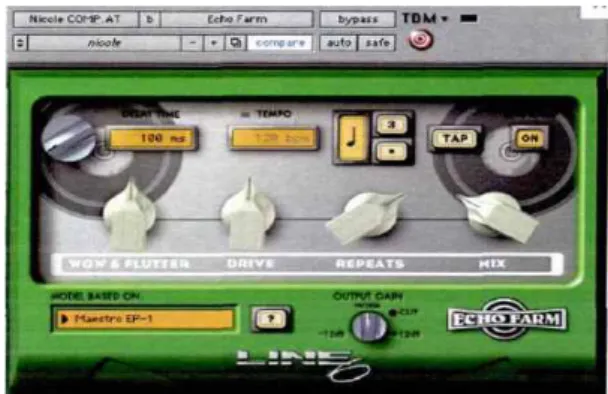
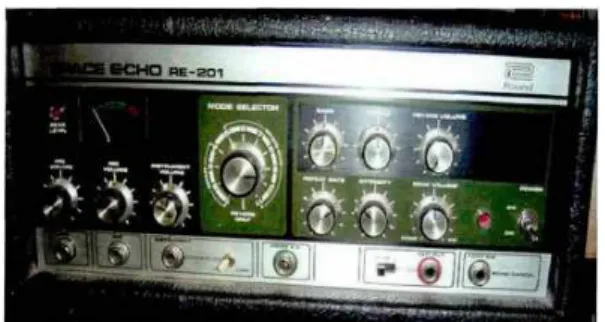
Earlier, audio engineers used analog tapes to produce delayed echoes, called Tape-Echo. But now most people will make delayed sound using digital delayer. Some famous delayers include Line6 Echo and Roland RE201 Space Echo whose sounds are quite unique.[2] Combined with other effectors (such as Modulation), delayer can produce effects like chorus, flanger and double.

Fig. 1. Line6 Echo Farm software imitate Line6 ECHO hardware

∙Author: Yanbing Wang, Corresponding Author: Yanbing Wang

*Yanbing Wang ([email protected]), Dept. of Applied Arts, Kyung Hee University, Korea

∙Received: 2017. 05. 19, Revised: 2017. 05. 30, Accepted: 2017. 06. 19.

(2)

Fig. 2. Roland RE201 Space Echo hardware

The delayer usually includes the following modules:

input / output level adjustment module, delayed time module and feedback suppression module. The only thing to be noted in the input / output level adjustment module is that it shouldn’t be overloaded. If the signal of one track enters into the delayer and the track itself is not overloaded, the delayer input level is zero, that is, no increase nor attenuation. Then the delayer input is not overloaded. But if the signal of several tracks enters into the delayer at the same time, then the level of the superposed signal may lead to overload in the delayer input. If overload is generated, the solution is to attenuate the input. Output is of the same principle. A track signal will not cause output overload but if the signal of several tracks shares one delayer, we should be careful then.

Especially when the delayer is used as chorus, flanger or double effector, the delay signal has to be set as large as the original signal or a little bit larger. At the moment, overload will easily be caused.[3]

The time-lapse module is mainly used to control the time interval between each delay. Different effectors will be formed according to the scale of delay duration, including long delay (250ms-Is), beat echo (100ms-250ms), double (20ms-70ms), chorus (10ms-20ms), flanger (0. 05ms-10ms) and synchronization delay (depending on the speed of the work).

Next, all the effects and their practical application to the sound field will be explained.

Ⅱ. Long Time-Lapse

 The most common value of long time-lapse is about 400ms, which can be used as a good starting point.

Time-lapse effector is usually added in Aux (auxiliary) method. That is, we send the original signal to the delayer through the Aux (auxiliary) fader of Post-Fader,

and then return the signal processed by the delayer to the two-way input of mixer or make Aux Return (auxiliary return). We set the delay time of the delayer to 400ms and then a commonly used delay effect is produced.[4]

Generally, we will pick a word or note and add a long time-lapse to it. We don’t do the same to other words or notes. If the mixer does not have the automation function, then we can practice.[5] Turn off signal-delivery most of the time and turn it on when necessary so as to stimulate the time-lapse effector and get appropriate time-lapse signal. After repeating for several times, the time-lapse will gradually fade out and it will not interfere with the following notes. But this traditional way needs full concentrate and if there is a little negligence, it will be very difficult to obtain the ideal effect. The time-lapse effect will be managed with an effort when it is the the whole work rather than just a word that needs to be delayed or when other effects are needed for the whole work.

Under normal circumstances, setting the time-lapse to 400ms does not fit all the songs. Fixed delay time is not even suitable for all the paragraphs of a song if there is speed change. There are generally three ways to determine how long the delay time should be set. The three methods are:

(1) calculation; (2) Tap method; (3) estimation.

The premise for the first method is that we must know the speed of the work (if there is speed change, then we have to know the speed of each paragraph). Then we can calculate the delay mount of the quarter note by the following formula:

BPM 60000 /

1000 / *

e = 60 MS s =

BPM m laytime s

D

(BPM is short for Beat per Minute, referring to the number of beats per minute). If the song is of 4/4 beat, then the delaytime of the quarter note calculated in the formula is a good starting point.

 For example, if the speed of the song is 80BPM, then the delaytime if the quarter note is 60000/80 = 750ms. If you want to extend the delaytime to the length of half note, that is, 2 beat, then the delaytime can be simply adjusted to 750X2 = 1500ms. To shorten the delaytime to the length of eighth note, the delaytime should be adjusted to 750/2 = 375ms.

If the song is a 4/4 swing style, triplet is the basic

rhythm which sounds very similar to the 12/8 rhythm. In

(3)

order to obtain the same effect with the song and avoid rhythm disorder, we should divide 750ms by 3. Except for the delay amount of half note, quarter note, eighth note and triplet quaver, there is a commonly used delaytime with the same length as the eighth note, that is, 750X3 / 4 = 562. 5ms. The effect produced this way can breakthrough the original monotonous delay effect.

Although the delay effect is on the beat point of the music, the time point when it appears is very surprising.

In audio sense, it is just an additional multiple-rhythm effect to the song. That is, there is repeated three-beat effect on four-beat mode, giving audiences a novel feeling of the coexistence of stability and change.

Generally speaking, adding long time-lapse to a work can make the sound field more profound and it can even create a more clear and clean sound field than reverberation effector. For instance, the ending of some instruments of prolonged sound like violin or vocals will mask the role of reverberation and make us unable to hear the reverberation. But increasing the amount of reverberation usually makes the whole work extremely turbid. Fortunately, this can be solved by time-lapse.

Even if the amount is not very large, intermittent delay sound will appear in the ending of prolonged sound, producing the same effect as reverberation. Especially if modulation effect is added to the time-lapse, then the returned delay signal will have some teetering-and-tottering pitch and volume, making the tone of the delay effect more smooth and the effect more similar to reverberation. Thus in many cases, especially when there are several musical instruments, we will choose time-lapse instead of reverberation.

 In the obtainment of spatial sense and deep feeling, delayer plays a significant role. Because for listeners, the early reflected sound on the reflectors near the sound field will greatly influence our judgment of the characteristics of the sound field and the position of the sound in the sound field. To some extent, reverberator behaves better than the delayer in simulating the real sound field. Although the effect produced by the delayer is very rare in real situations, we still need delayer to provide us with certain spatial sense and deep feeling in music production. Reverberation is actually formed by large amount of extremely dense delay effect. In the case of fewer instruments, reverberation works very well and it can make very natural and broad effect in reconstructing the sound field. But in the case of more

devices, we will find that the entire sound field will become turbid and the prolonged ending of reverberation often masks other instruments. The design principle of delayer makes it contain only several returned echos so that we can get a virtual sound field that is not the same as the real one but it makes people feel refreshing and beyond reality rather than a very familiar space.

Similar to the role of reverberator, a small amount of delay effect will make the sound produced by close recording become more lively. The most common way is to add a time delay to human voice and solo guitar.

Added with vitality, the human voice and solo guitar can keep its front position in the sound field as well as audiences’ attention.[6]

 If the delay signal and the original signal are exactly the same, it will make people feel untrustworthy and boring. And if the returned delay signal is relatively large, it will interfere with the original signal. Then it will be considered an error rather than a means of treatment.

Thus, we often conduct high-cut and low-cut processing on returned delay signal so that the delay signal can be distinguished from the original signal.[7] For instance, high cut on the delay signal can make the signal darker, and because the returned delay signal is getting weaker and weaker, it will create a profound feeling in the sound field. Of course, low cut on the returned signal can also help distinguish the delay signal from the original signal and keep the warmth of the original signal undisturbed.

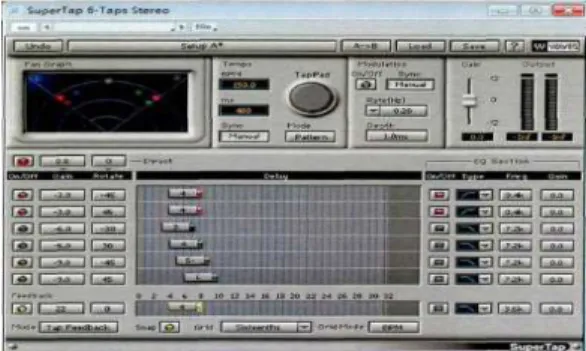
The warmth sense of the original signal is generally around 300HZ-500HZ, therefore, low-cut frequency will be set to 400Hz. Meanwhile, the sound field is usually filled with the fundamental frequency (usually between 200HZ and 800HZ) of many instruments, so low cut on the delay signal will release the limited space in the sound field, making the sound field more broad and relaxed without too much medium frequency.[8]

Fig. 3. Low cut on delay signal below 400Hz

using the SuperTaps delayer of waves

(4)

III. Beat Tone Echoes

In addition to long time-lapse, we also use beat tone echoes.

When the delay time is adjusted to 100ms-250ms, the effect of beat echo will appear. This effect is most commonly used in American rock and roll in the 1950s. This type of rock and roll will usually adopt more beat echoes and it sounds like in the sound field of a club or a bar. Human voice is the most frequently used part for beat echoes and it will bring some feeling of old fashion. Blues guitarists often use this effect and their style is usually very nostalgic. The use of this effect in old music is so common that we feel as if we’re back to the old times when hearing it. But it does not mean that we can’t use beat echoes in modern times.

To distinguish from the previous large reverberation and large time-lapse style, modern music style is usually more

“dried”. But this does not mean that it is without even a bit reverberation and time-lapse effect. Instead, reverberation and time-lapse are hidden. The volume of beat echo is usually very small and short (such as 120ms). When this effect is added to human voice, the dragged ending of human voice will cover up a considerable amount of the delayed sound, so that only a little reverberation can be heard and people can’t be clearly aware of the characteristics of the room.[9]

It is also very common to add the echoes to guitar. Only a little echo effect can make the guitar sound more bright, full of impact and sense of immediacy. But since guitar is a plucked instrument and its sound will fade away quickly after plucking, it can’t mask the delay signal. So it is necessary to turn down the delay time (such as 100ms) and reduce the number of return, only once under special circumstances.[10]

Ⅳ. Flanger

Fig. 4. Modulation software of Sonitus [Fl] using Flanger preset

Sometimes we also use a very short delaytime (such as 0.05ms-10ms) and this will produce a so-called flanger effect. Typical flanger effect is usually accompanied by modulation. That is, use LFO (low frequency oscillator) to modulate delaytime so that the delay signal will be slightly changed repeatedly with the development of low-frequency oscillator frequency and the sound can also produce a slight change in pitch. Sometimes we also use LFO to modulate the acoustic image so that the sound changes back and forth and audiences can be more clearly about sound change.

Therefore, when the delaytime becomes very short, it does not mean that we can not hear the delay signal. It is just superimposed with the original signal and we sound like another feeling. Especially when the ratio between delay signal and the original signal is 1: 1, the feeling will be very prominent.

To make the feeling more obvious, we can also enlarge the feedback coefficient. Then the mutual interference between the delay signal and the original signal will become greater and the sound can be even stranger. It is usually explained that this phenomenon can be used in the case of phase interference. If you superimpose two identical sine waves and stagger the time (0.05ms-10nis), then you can clearly feel the sudden sound changes. This phenomenon is called “beat” caused by phase interference. The frequency of unsteady strength and weakness repetition is called “beat frequency”. If the sound is a complex tone rather than a pure tone signal, then the interference between the phases will be more complicated. We will use comb filter to describe this phenomenon.

For instance, the sound of electric guitar has a rich and complicated complex tone signal. When added short delay signal, some frequencies will get strengthened while others are reduced. Synthesized signal has a great difference from the signal of the original electric guitar in frequency. From the frequency rate analysis, it can be seen that the effect after adding short delay is more like the result of equalizer. The comb filter can also be achieved by equilibrium. If you lift 30 frequency points while reducing the other 30 frequency points and set Q value to a very narrow range, you can get a close effect of comb filter. But in fact, our purpose of using short delay is to get this complicated and weird balance effect which we have a fixed title: flanger.

Flanger can also be found in natural environment. Here

is an example. When a guitarist plays guitar facing a

(5)

piece of glass, the produced sound and the reflected sound from the glass will reach listeners’ ears at the same time. But because of the difference in the distance of propagation, the time they reach listeners’ ears is different. If the distance difference between the two is 1 meter and the delay amount is 3ms, then the listener will hear obvious flanger effect. Sound picked up by microphone will be with an irreplaceable flanger feeling.

Some producers and guitarists are fond of this feeling because such voice is extraordinary and is hard to produce. But others do not like to add this effect when recording, because it is easy to record but it’s hard to remove it. Now more and more people tend to add this effect at post-production stage since current production means are richer and there are more and more software effectors while in the era of purely hardware this may occupy one more delayer.

Audibly, the effect of flanger is very similar to reverberation. Instruments like electric guitar and electric piano themselves have the feeling of reverberation. If you add reverberation to them when you create sound field, then the effect will be very turbid. But it is quite different when you add flanger effect. Since the flanger effect lasts so short that we wouldn’t recognize it as two sounds (From Haas Effect, we know that only when the delaytime is above 50ms can we detect the existence of two sounds and each sound has its own characteristics), we just hear the signal of the superimposed delay signal and non-delay signal. Flanger effect duration is very short. When the original signal stops producing sounds, the delay signal will stop immediately and do not interfere with the next note. Because it will not cover other notes, the effect volume can be enlarged, generally equal to the size of the original signal. Then electric guitar and electric piano will sound like water dripping with a very large reverberation while not causing turbidity of the sound field. But the only drawback is that the flanged sound will sound a little strange on the spectrum with some kind of alien feeling or the feeling of high-tech era or beyond reality.[11]

But sometimes when we do not need the flanger effect, flanger may appear and damage our sound field effect.

When recording guitar or other instrumental sounds, we often use two microphones to pick up the sound. They are recorded on two separate tracks for the convenient of later adjustment. They can also be recorded on the same track. For example, when recording an acoustic guitar, we can use a close-up microphone to record detailed guitar

sound and a long-distance microphone to pick up the environmental sound of the room. A “close” will be marked on the track of the close-up microphone and a

“room” is marked on the track of the long-distance microphone. By adjusting the level ratio of the two tracks, you can get sounds of different feelings: more details or more reverberation. But it should be noted that because of the difference in the distance between the two microphones and the sound source, the recorded signals will also have a time difference.[12] When the distance between them is within 3. 3 meters, flanger effect will be generated. If the sound picked up by the remote microphone is very weak, flanger effect can’t be generated when the sound is superimposed with the signal of close-up microphone. When we mix later, if the signal from the long-range microphone is pushed as large as the close-up microphone, the flanger effect is generated. With the change of the signal from the long-range microphone, the flanger effect will also subtly change, like the slight changes of a pitch.[13]

Therefore, when placing multiple microphones to pick up sounds, we should carefully handle and coordinate the signal between each microphone and other microphones to avoid producing unwanted flanger results. During the tight prerecording period, we do not have the leisure time to carefully check the reflected sound of the ceiling, wall and floor recorded by each microphone to ensure the later sound field design. We have no time to conduct mathematical calculations to figure out the flanger effect.

We can only carefully monitor it and do not let excess sound interfere with our recording. We should keep the recording as pure as possible.

V. Chorus

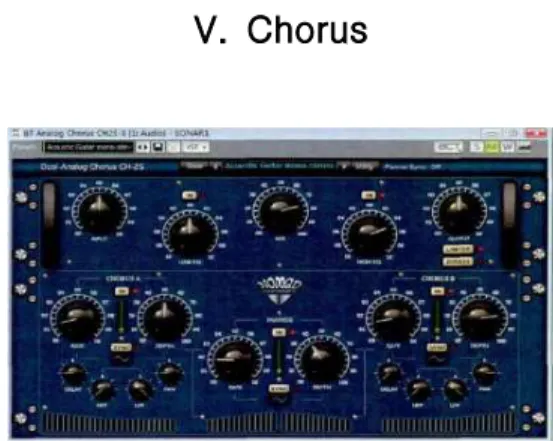
Fig. 5. BT Analog Chorus chs-3 chorus

effector produced by Bluetube Company

(6)

The so-called chorus effect refers to the effect generated by the equivalent volume of the original signal and the delay signal when the delay time is set to 10ms-20rns. When the feedback is large and coupled with a little modulation, the effect will be more obvious. In acapella electric guitar, this effect is usually used. After adding this effect, electric guitar’s voice becomes more sweet and broad. Although it sounds like a large amount of melodious and appropriate reverberation, the music is still clean and clear, and not easily masked by the ending of the reverberation (after adding reverberation, electric guitar will mask itself as well as other instruments).

Therefore, the addition of chorus effect to acapella electric guitar will help ensure a clean and transparent sound field effect.

In addition to acapella electric guitar, chorus effect is also used in electric piano and organ. By increasing the amount of feedback and modulation, we can make chorus more obvious. But note that sometimes a single instrument with chorus effect will produce nice sound but if all the musical instruments are added with chorus effect, the whole sound field will become bloated and a bit weird. Although the degree of oddness is not so much as the flanger, it still makes people feel very uncomfortable. So do not overdo it.

Chorus effect is quite important in music production.

The standard sound source of GM usually contains at least two effectors: reverberator and chorus maker. It is a common way to compensate for the lack of thickness caused by the large amount of sampling compression by adding a chorus effect to the sound.

VI. Double

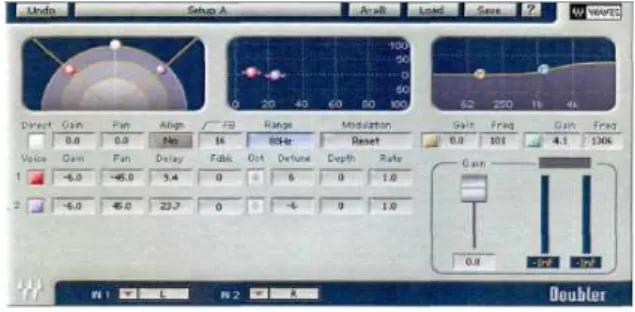
When the delay effect is adjusted to 20ms-70ms, a doubling effect is formed. Limiting the delay time between 20ms and 70ms will help perform the small difference between the performance very well. When the delay time is set between 20ms and 30ms, the doubling effect sounds tight; when the delay time is set between 30ms and 70ms, the sound will be very loose. We usually add a little feedback so that the sound duration can last longer.

But a little phase offset will also be caused so it sounds more like the actual situation. Sometimes modulation is added to the delay time then the delay will continue to

make some changes to keep consistence with the natural sound effects. If you do not add modulation, sometimes the delay will be too fake and sound like an unchangeable layer on the original instrument, without the feeling of ensemble and chorus of several players.

Fig. 6. Doubler doubling effector of Waves Company

In general, when the instrument is doubled, the delay signal needs to be raised as large as the original signal. If the delay signal is larger than the original signal, it will sound like the front echo of the original signal; if the delay signal is much weaker than the original signal, it sounds more like the addition of early reflected sound, rather than doubling effect.

The purpose of doubling the sound is to improve group sense. The commonly used sound sources are vocal chorus and string music. However, there is still big difference between a vocal with 30 delay chorus effects and the vocals of 31 people singing at the same time. It is not very common to adapt double effect to only a vocal or a violin. The original signal should be at least two vocals or two violins. Then there will be a little bit performance difference between the original signals. The adaption of double effect will form a more complex sound so that listeners can’t distinguish the processed effect of electric acoustics from the original signal.

According to the specific role of the vocal chorus string ensemble in the musical works, we adopt corresponding doubling schemes. The most commonly used doubling scheme of vocal accompaniment is as follows: if the accompaniment content is like “Aah” and

“Ooh”, then the accompaniment is used as the background

vocals to enhance the atmosphere and acts as a bridge

between the solo and musical instruments to improve

their connection and integration. In recording, in order not

to interfere the position and dominance of the lead singer

in the sound field, the accompaniment group will be asked

to replace their real sound resonance by light and

aspiration sound. To prevent the reflection of the room,

(7)

the close-up recording will be adopted to ensure the recording of pure sound. After the performance, the first track is played again and recorded on the second track.

Then the doubling effect is more natural than the delay effect. If it is other factors that make the song can’t be played twice (such as the same period recording), delayed doubling can be added to the accompaniment track.

Doubled vocals can be placed on both sides of the sound image to give the middle space to the lead singer. In the depth of the sound field, the accompaniment is placed in the middle of the sound field. To achieve this purpose, reverberation and beat echoes can be added to the accompaniment of the two tracks and high cut and low cut should be conducted, with a high cut frequency of 11000Hz and low cut frequency of 120Hz. If you want to get some nostalgic style such as country music,you can make space for the lead singer at 500Hz and 4000Hz so as to highlight the lead singer's warmth and immediacy.

Then the nonverbal vocal accompaniment will be more powerful without interference with the lead singer.

For the verbal accompaniment part, it will be a little more complicated. The prerecording is similar to the nonverbal accompaniment part, but in some styles (such as the newer and fashionable RNB) the verbal accompaniment part is often treated as the lead singer part (at the moment the lead singer will make impromptu performance to echo accompaniment part). Under this situation, several dB should be added around 8000Hz so as to highlight the accompaniment part, without too much treatment on 500Hz and 4000Hz. Then the position of the accompaniment in the sound field should only be slightly longer than the main singer and don’t have to be as back as the nonverbal accompaniment.

There are also many options for doubling strings. The doubling of the string will generally take the natural doubling scheme, that is, repeat it for 1 to 2 times after the first playing and superimpose it with the original signal. In addition to the natural way of doubling, if it is not convenient or economically allowed, we can also use the method of adding a delay to double the effect. String music is generally designated as medium shot or distant view in the depth of the sound field. For different musics, the level, the sound image settings and the addition of reverberation of delay are also different.

When the string acts as a melody or a very important main rhythm in the texture of a piece of music, it should be put in the medium shot of the sound field rather than

in the close shot like solo piano or in the distant view like the bottom harmony. When double effect is applied to the situation, the signals of several times should be separated from each other using the sound image knob. The width of the knob depends on the work. It can be in the middle, on the left or all-roundly spread. The doubled signal is the same as the original signal and the times of doubling should be about 3-4 times (including the original signal).

When the string plays harmony and continuous sound in the texture of a piece of music or acts as the bottom signal, the sound should be light, misty and transparent.

String in this style will be played in weak intensity.

Sometimes a mute may even be used get this “misty”

style. At this time, the sound field has to be filled with string music. To achieve this purpose, the doubled signal should be distributed averagely on the sound image to the extreme left and central part. The signal at both ends should be slightly stronger than the signal in the middle so as to produce a broad feeling. But it shouldn’t be too much, otherwise it will be “hollow” in the middle part where the signal is extremely weak. The other way is also inappropriate: if the signal in the middle is too strong, it is easy to make people pay too much attention to the middle sound image while ignoring the signal on both sides. The sound image will be too concentrated and lacking in broadness.

VII. Conclusion

The sound field design template I studied is: a delay of eight-note length with the feedback of 0 so that there is only one returned echo thus the volume of the original sound can be increased without obvious tail to disturb the entire sound field; a delay of quarter-note length with the feedback of about 10, providing 2-3 times of delay; a ping-pong delay of eight-point or four-point note length to provide clear echoes in a word or note; a beat echo delay of 100-150ms, sometimes replacing the reverberation of some prolonged musical instruments without prolonging the sound; a flanger effector; a chorus effector; a delayer with the delaytime of about 15ms, for widening sound image; a delayer of about 35-50ms with the feedback amount of 10, as a doubling effector.

In addition to reverberator and delayer, we can also

add other effectors in the template: such as electric

(8)

guitar speaker simulator, distortion, pitch effector and exciter in case of need.

Except for these effectors, we can also use all styles of pressure limiters, equalizers, tape style simulators and tube saturation simulators. Link them in the channel to speed up the adjustment process, improving work efficiency to the largest extent. Sometimes we also add some channel strips in the channel with commonly used effectors like pressure limiter, equalizer, noise gate and expander core on its top.

If you are using a DAW-based mixing, then save the effectors as a template file and directly open the file if you need it. Then you can instantly find all the effectors you need and speed up the process of work production.

If you are in a simulation or digital-hardware mixing process, you should make route design in advance according to the work requirements.

In addition, you should improve your study on the parameters of all the effectors and be more careful about the effect differences before and after treatment using your audio psychology. The techniques of adjusting the tools are obtained through my repeated practices, tests and analysis so as to achieve the ultimate goal of producing unique music works, improving the efficiency of music creation, saving production time and bettering the quality of the music works. The practical significance of this topic is mainly embodied in music production teaching inland and application. The author noticed domestic related majors remain in the model of emphasizing on individual experience and feeling, ignoring common rules, industry analysis and summing up for a long time in the process of many years of professional teaching and practice. Necessary acoustic explanation of the principle of the production chain is also omitted. Therefore, only through the study of real sound field and virtual sound field, can we avoid being overwhelmed when facing the requirements of making innovation in the new era.

REFERENCES

[1] Hatschek,Keith ,The Golden Moment:Recording Secrets from the Pros, San Francisco: Backbeat Books,2005.

[2] John M.Eargle,1995, Music ,Sound, Technology .VAN NOSTRAND REINHOLD.

[3] Ken C. Pohlmann .Principles of Digital Audio .McGraw.-HillsCompanies,2000.

[4] Rumsey;Francis and Tim McCormick,Sound and Recording :An Introduction, Fifth Edition ,Oxford :Focal Press,2006.

[5] Newell,Philip,Recording Spaces ,Oxford :Focal Press,2000. Newell, Philip,Recording Studio Design,

Oxford :Focal Press,2003.

[6] Nisbett,Alec, The Technique of the Sound Studio ,Fourth Edition, Boston: Focal Press, 1979.

[7] Nisbett ,Alec ,The Use of Microphones, Second Edition ,Boston :Focal Press, 1983.

[8] Willian,Moylan Understanding and Crafting the Mix :The Art of Recording,2009.

[9] Paul Gilreath, The Guide to MIDI Orchestration 3rd edition,2004.

[10] Roey Izhaki,Mixing Audio Concepts,

Practices&Tools,2008.

[11] A Knight ,Evaluating Electronic Music Technology Resources for Music Therapy: Arts in Psychotherapy,2016.

[12] Verdonk, D. Visible Excitation Methods : Energy and Expressiveness in Electronic Music Performance. In Proceedings of the International Conference on New Interfaces for Musical Expression,2015.

[13] P López-Serrano ,C Dittmar ,J Driedger ,M Müller,

Towards Modeling and Decomposing Loop-Based Electronic Music :International Conference on Music Information Retrieval,2016.

Author

Yanbing Wang received the B.S., M.S.

degrees in Musicology from Henan Normal University, China, in 2009 and 2012, Doctor of Applied Arts from Kyung Hee University in 2016. Dr. Wang joined the faculty of the Arts

Department at Yangzhou Business University,

Yangzhou, China, in 2013. She is currently an

associate Professor in the Department of Musicology,

Yangzhou Business University. She is interested in

Composing, Harmonics, Musicology etc.

수치

Fig.  1.  Line6  Echo  Farm  software  imitate  Line6  ECHO  hardware
Fig.  2.  Roland  RE201  Space  Echo  hardware
Fig.  3.  Low  cut  on  delay  signal  below  400Hz  using  the  SuperTaps  delayer  of  waves
Fig.  4.  Modulation  software  of  Sonitus  [Fl]  using  Flanger  preset
+3

참조

관련 문서

Digital Output CM1-YT32B 32-Point Source Output Module CM1-YR16A 16-Point Relay Output Module Analog Input CM1-AD08V 14-Bit 8Ch Voltage Analog Input Analog Output CM1-DA04V

Module Initialization function block is used in a program with setting of A/D conversion module located base number, slot number of located module on base, specifying a

1 John Owen, Justification by Faith Alone, in The Works of John Owen, ed. John Bolt, trans. Scott Clark, "Do This and Live: Christ's Active Obedience as the

Bit(s) Field Name Description Type Reset 31:3 Reserved, write zero, read as don’t care.. 2 SPI2 enable If set the SPI 2

(2011), “The Value of Module Efficiency in Lowering the Levelized Cost of Energy of Photovoltaic Systems,” Renewable and Sustainable Energy

In this study, we have fabricated the 660 nm red LED illumination controller and LED array module and evaluated the proliferation and differentiation

 The Autodesk Raster Design module supports grids and images and the Autodesk Onsite module handles all of the standard GIS data operations.  extensive tools

•• A connected multigraph has an Euler path A connected multigraph has an Euler path A connected multigraph has an Euler path A connected multigraph has an Euler path (but