디지털 비디오 방송-지상파에서 연쇄 터보 부호화의 성능분석
장극*ㆍ서희종**
Performance Analysis of Concatenated Turbo Coding Scheme over DVB-T Transmission Channel
Ke Zhang
*ㆍHee-Jong Suh
**요 약
본 논문에서는 OFDM(Orthogonal Frequency-Division Multiplexing)에서 터보코드, RS( Reed-Solomon)코 드를 연구하고, DVB-T(digital terrestrial video broadcasting)에서 OFDM에 적용된 FEC(Forward Error Correct)의 성능을 분석한다. 그리고 표준 AWGN 통신로의 경우와 비교한다. 모의실험을 한 결과 반복해서 터보코드를 사용하면 성능이 현저히 개선됨을 확인할 수 있었다. 이는 컨케이트네이티드 FEC에 적절한 인터 리버를 적용해서 구현가능 할 것이다.
ABSTRACT
This paper studies the Turbo Codes, the concatenation of Turbo Codes and Reed-Solomon (RS) codes on Orthogonal frequency-division multiplexing (OFDM) in digital communication channel, and then analysis the performances of the new concatenated Forward Error Correct (FEC) scheme applied to an OFDM system based on the digital terrestrial video broadcasting (DVB-T) scheme. We compared the results with the standard DVB-T convolutional codes performances on Additive White Gaussian Noise (AWGN) channels. The simulation results shown that by employing turbo codes with only a few numbers of iterations, the performances of the overall system can be improved significantly. These results will be obtained by applying an appropriate interleaver technique in the concatenated FEC procedure.
키워드
OFDM, DVB-T, Turbo Codes, Concatenated FEC Scheme
직교 주파수 분할 다중화, 디지털 비디오 방송-지상파, 터보 코드, 연쇄 순방향 오류 정정법
* 북경석유화공학원(Email)
** 교신저자 : 전남대학교 전자통신공학과 ㆍ접 수 일 : 2017. 12. 13
ㆍ수정완료일 : 2018. 01. 14 ㆍ게재확정일 : 2018. 02. 15
ㆍReceived : Dec. 13, 2017, Revised : Jan. 14, 2018, Accepted : Feb. 15, 2018 ㆍCorresponding Author : Hee-Jong Suh
Dept. Electro. Comm. Eng., Chonnam Nat’l University, Email : [email protected]
Ⅰ. INTRODUCTION
In Digital Mobile Communication, such as Digital Television over terrestrial channel, the modulated signal is influenced by multipath fading and Doppler frequency shifting, due to the presence of
multipath propagation that would degrade the system performance. In order to solve this problem, the methods of suited digital modulation technology and effective channel coding have to be taken.
Orthogonal frequency-division multiplexing
(OFDM) is an efficient technology for wireless
http://dx.doi.org/10.13067/JKIECS.2018.13.1.69
b
data transmission[1-4]. It is currently used in the Europe digital audio broadcasting (DAB) standard[5], in digital terrestrial video broadcasting, and broadband indoor wireless systems[6], ADSL or Wireless LAN (IEEE 802.11). The advantages of OFDM include robustness against multipath fading and high spectral efficiency.
Transmission over wireless channels can lead to intersymbol interference (ISI), which is caused by time dispersion due to multipath propagation.
We will refer to channels that are time dispersive to present OFDM scheme. OFDM systems with guard-time interval or cyclic prefix can efficiently prevent ISI. But only with the OFDM, all other influences in the frequency selectivity cannot be eliminated. Coding OFDM scheme can be used to solve the problems and to improve the performance of communication system, without adding the signal power and bandwidth[7]. This characteristic, combined a robust channel coding scheme with interleaving techniques may yield very good performances.
The classical coding scheme applied to this modulation approaches is based on a concatenated scheme where two coding levels are used: a inner coder and an outer coder. The inner coder usually is adapted to the channel and to the modulation and pre-process the data detecting the errors. The objective is to reduce the error ratio up to an acceptable value and to group the packets with errors. The outer coder has as objective to further decrease the error rate. The performances of such coding scheme are then increased by using time and frequency interleaving techniques. Thus, coding and interleaving applied to OFDM constitutes a very effective tool to average selective fading errors over the signal bandwidth and over the time interleaved frame.
In this paper, Turbo codes are studied. Then,
a new Forward Error Correction (FEC) scheme based on Turbo codes is proposed to enhance the DVB-T performances for video broadcasting.
The scheme uses the same modulation parameters of DVB-T standard, but achieves an higher robustness against frequency and time selective fading. The new system performances are evaluated and compared using the reference AWGN DVB-T reference performances described in the document[10-12].
Ⅱ. TURBO CODES
In channel coding, redundancy is introduced in the information sequence in order to increase its reliability. The channel coding theorem states that even at relatively low Eb/N0 environment, reliable communication can still be maintained. However, the theorem tells us nothing about how to design the code that achieves such performance. All what it says is that the code should appear random.
Unfortunately random codes are very difficult to decode. We need to have some structure in the code to make the decoding feasible. Researchers have been trying to resolve these two seemingly conflicting needs: structure and randomness.
To give an idea of how powerful turbo codes are, for a frame size of 256256 = 65536 bits we can achieve a BER=
over AWGN channel at only
= dB, which is very close to Shannon limit[8]. For a Rayleigh fading channel a BER=
can be achieved at
=4.3dB which represents a gain of 2.3dB as compared to classical convolutional codes with similar complexity[9].
2.1 Maximum A Posteriori (MAP) Algorithm
Two well-developed and widely used
algorithms for determining the state sequence of a trellis encoder are the Viterbi algorithm (VA)[7]
and the maximum a posteriori (MAP) algorithm[8]. The Viterbi algorithm is widely used for decoding of convolutional codes, but variants of the MAP algorithm are more suitable for turbo-code decoding. Given the received observation sequence y, the Viterbi algorithm determines the most probable state sequence
arg (1)
This implies that, the states estimated by the Viterbi algorithm will always form a connected path through the trellis. The MAP algorithm, on the other hand, attempts to determine each state transition, without regard to the overall sequence of the trellis
arg
(2) For this paper, we will only focus on variations of the MAP algorithm. Given the noisy observations of symbols produced by a Markov process, the maximum a posteriori (MAP) algorithm calculates the a posteriori probability (APP) of each message bit/symbol that must have been transmitted at the encoder. During the decoding sequence, the APPs obtained after every iteration are put into LLR form for manipulation by the next decoder, and hard-decisions are only made after the last iteration. In order to find the APP for each message symbol from the given noisy observations, the MAP algorithm first calculates the probability of each state transition
→
→
(3)
where
,
, and
→
are defined below, and
→
→
(4) The term
gives the probability of being in a present trellis state after receiving the given channel observations up to a particular instant in
time
⋯
. It can be found by using the forward recursion
∈
→
(5) where is the set of states
connected to si. Conversely, given a particular trellis state
at a specific instant in time ,
gives the probability of having the subsequent channel observations from that instant in time till the end of the code block
⋯
. The probability
can be found by using the backward recursion
∈
→
(6) where is the set of states
connected to
. The term
→
is the branch metric, which represents the chances of making a transition from state
to
. In the case where states
and
are not connected on the trellis diagram, a
→
transition would be impossible, thus, the branch metric would have a value of zero. The branch metric can be calculated as
→
(7) where
is the message and
, the output associated with the
→
transition. After determining the APP for each state transition, the probabilities for the message bits/symbols are then determined by
→
(8) and
→
(9)
where
→
is the set of all
state transitions associated with transmitting a 1,
and
→
is the set of all state
transitions associated with transmitting a . The
log-liklihood ratio is thus defined as
ln
→
→
(10)
The MAP algorithm is implemented thus 1) Forward recursion
a) Create a 2-dimensional array
≤ ≤
, ≤ ≤ to store recursion results. Array should be initialized as:
i f i f ≠ (11) b) Begin with time index , and state index
.
c) Let
and update as:
∈
′
→
(12) d) Increment , and until
return to step 1(c).
e) Increment , and until , return to step 1(c).
2) Backward recursion
a) Create a 2-dimensional array to store recursion results. If terminated, array should be initialized as
≤ ≤
, ≤ ≤
i f i f ≠ (13) but, if not terminated, it should be initialized as
∀ (14)
b) Begin with time index , and state index
c) Let
and update as:
∈
′
→
(15) d) Increment , and until
return to step 2(c).
e) Decrement , and until , return to step 2(c).
3) For ⋯ , determine LLR by:
ln
→
′
→
′
(16)
where
→
is the set of all state transitions associated with transmitting a 1, and
→
is the set of all state transitions associated with transmitting a .
2.2 Log-MAP Algorithm
Although the MAP algorithm produces very accurate APP calculations, it is burdened by a very high computational complexity as well as a high sensitivity to round-off errors during finite precision implementation. By implementing bulk of the calculations of the MAP algorithm in the log-domain, the log-MAP algorithm reduces the computational complexity of the SISO decoder. The reduction in computational complexity is achieved by the replacement of all multiplication operations by addition operations in the log-domain. However, all addition operations also have to be replaced by a maximization operation followed by a correction function in the log-domain:
ln
max ln exp- (17) where
max
is a tabulated correction function. The correction term can simply be implemented by performing a search through a pre-determined one-dimensional look-up table. In replacing the values used in the MAP calculations by their logarithmic counterparts, the logarithm of
becomes
ln
max
∈
→
(18) the logarithm of
becomes
ln
max
∈
→
(19)
and the LLR is determined to be
max
→
max
→
(20)
Consequently, the log-MAP algorithm is implemented thus:
1) Forward recursion
a) Create a 2-dimensional array to store recursion results. Array should be initialized as:
∞ i f i f ≠ (21) b) Begin with time index =1, and state index
=0.
c) Let
and update as:
∈
′
→
(22)
d) Increment , and until
return to step 1(c).
e) Increment , and until , return to step 1(c).
2) Backward recursion
a) Create a 2-dimensional array
≤ ≤
, ≤ ≤
to store recursion results. If terminated, array should be initialized as
∞ i f i f ≠ (23) but, if not terminated, it should be initialized as
∀ (24)
b) Begin with time index , and state index .
c) Let
and update as:
∈
′
→
(25)
d) Increment , and until
return to step 2(c).
e) Decrement , and until , return to step 2(c).
3) For ⋯ , determine LLR by:
max
→
′
max
→
′
(26)
where
→
′
is the set of all state transitions associated with transmitting a 1, and
→
′
is the set of all state transitions associated with transmitting a .
Ⅲ. DVB-T FEC SCHEME AND CONCATENATED TURBO CODE SCHEME
The Coded-OFDM (COFDM) was developed to broadcast digital terrestrial TV by DVB-T modulation scheme. The DVB-T FEC system has been developed to work with fixed length MPEG-2-TS (Transport Stream) packets. First, an energy dispersal is placed in appropriate randomization to ensure the adequate binary transitions. This outer coder adds 16 bytes and provides a maximum correction capability of 8 random bytes, the 188 bytes packets are coded using a Reed-Solomon coding scheme. After that, the outer interleaving is performed to scatter the errors and to improve the outer coding efficiency by spreading the data bytes over 12 packets. Fig. 1 is an block diagram of DTV-T FEC.
Fig.1 DTV-T FEC Block Diagram
Turbo Codes are used in a DVB-T framework
due to the possibility to exploit the excellent error
correction characteristic with a low latency decoder
and a fixed and reasonably low amount of
computational power. The new scheme of
Concatenated Turbo Code and RS Code with
COFDM system derived by a classical DVB-T
scheme as FEC is shown in Fig.2. The incoming
TS packets are grouped; each block of packets
forms an OFDM frame that starts with a
synchronization symbol followed by a reference symbol. After the energy dispersal, Reed Solomon encoded and interleaver are followed with the same DVB-T scheme. The OFDM modulation (QPSK and 16QAM) is applied over 2k carriers with programmable guard interval length.
Fig. 2 Turbo COFDM Block Diagram
Ⅳ. SIMULATION RESULTS
The Concatenated Turbo Code and RS Code with COFDM system performance is evaluated by several simulations in different encoding configurations over an AWGN channel. All the simulations have been calculated with 80 frames containing 12 packets each. It is assumed that the channel information is available at the receiver and the synchronization mechanism is considered perfect. The main goal is to evaluate the performances of Turbo Codes as inner coder for concatenated schemes. The impact of the Turbo coding parameters in terms of coding polynomials, number of decoding iterations, code rate and modulation scheme are investigated. In the DVB-T scheme the inner coder reduces the error rate to an acceptable value ( ×
) in order to achieve BER=
at the output of the Reed-Solomon decoder. The simulations are shown as follows:
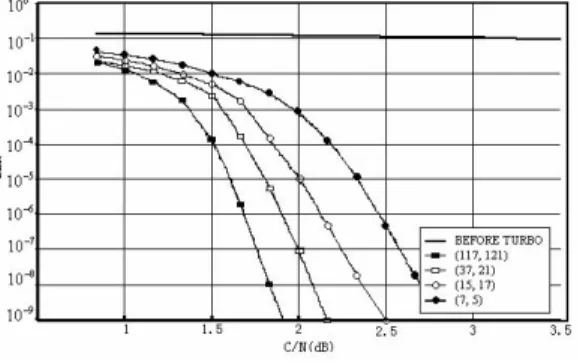
The BER performances for different polynomials
with 3 iterations, QPSK modulation and R=1/3 are in Fig. 3. The impact of the polynomials for RSC encoders to get high coding gains is very effective especially with low SNR. The best result is obtained with the (117, 121) code with minimum SNR to get BER=
performance link of 1.5 dB.
Fig. 3 Performance (after Turbo Decoder) in AWGN channel, Decoder) in AWGN channel QPSK, R=1/3
and 3 iterations
Ⅴ. CONCLUSIONS
In this paper a new FEC scheme of concatenated
Turbo Codes and Reed Solomon for OFDM system
is expressed. With this scheme we can achieve the
better performances than the results achievable by
using DVB-T schemes. The results of only Turbo
code schemes can be improved with the number of
iterations, but the processing complexity becomes
unpractical for real implementations. Indeed, the use
of long memory codes increases significantly the
performances, but also drastically increases the
decoder complexity. It has been shown that a FEC
scheme based on concatenation of Reed-Solomon
and Turbo Codes is suitable for implementation,
with limited latency and reasonable processing
power while still achieving excellent performances
at lower SNR.
References
[1] S. Hara and R. Prasad,“Overview of Multicarrier CDMA,” IEEE Comm. Mag., no. 9, Dec. 1997, pp. 126-133.
[2] J. Chuang, L. J. Cimini, Y. Li, B. Mcnair, N.
Sollenberger, H. Zhao, Combining EDGE with Wideband OFDM,” IEEE Comm. Mag., vol. 37, November 1999, pp. 92-98.
[3] Y. Li and L. J. Cimini, “Bounds on the Interchannel Interference of OFDM in Time-varying Impairments,” IEEE Trans. Comm., vol. 49, no. 3, March 2001, pp. 401-404.
[4] W. Zou and Y. Wu,“COFDM: An overview,”
IEEE Trans. Broadcast., vol. 41, March 1995, pp.
1-8.
[5] D. Castelain, B. Floch, and R. Halbert- Lassalle,
“Digital sound broadcasting to mobile receivers,” IEEE Trans. Consumer Electron., vol.
73, Jan. 1989, pp. 30-34.
[6] A. Macedo and E. Sousa, “Coded OFDM for broadband indoor wireless systems,” in Proc.
IEEE Int. Conf. Communications (ICC), vol. 2, 1997, pp. 934-938.
[7] G. Ungerboeck, “Channel Coding with Multilevel Phase Signals,”IEEE Trans. Info. Theory, vol.
IT-28, pp. 55-67, Jan. 1982, pp. 55-67.
[8] C. Berrou A. Glavieux, and P. Thitimajshima:
”Near Shannon Limit error-correcting coding and decoding: Turbo Codes” ICC’93, Conf. Rec., Geneva, May 1993, pp. 1064-1070.
[9] Hagenauer, J. and Papke, L., i.Decoding turbo codes with the soft-output Viterbi algorithm (SOVA), lm in Proceedings of International Symposium On Information Theory (Trondheim, Norway), June 1994, p. 164.
[10] Yanji and H. Suh, “A Comparision of Raptor Code Using LDGM and LDPC Code,” The Korean Institute of Electronic Comm. Science, vol.
18, No. 1, 2013, pp.65-70.
[11] S. Chen and H. Suh, “An Effective Decoding Algorithm of LDPC Codes with Lowering Error
Floors,” J. of the Korea Institute of Electronic Communication Sciences, vol. 9, no. 10, 2014, pp.
1111-1116.
[12] Hao Chen and H. Suh, “An Improved Bellman-Ford Algorithm based on SPFA,” J. of the Korea Institute of Electronic Communication Sciences, vol. 7, no. 4, 2012, pp. 721-726.
저자 소개
張克(Ke Zhang)
1985년 북경사법대학 졸업 2004년 여수대학교 대학원 석사 졸업
1993년 ∼현재 북경석유화공학원 교수
※ 관심분야 : 통신이론
서희종(Hee-Jong Suh)