This is an Open Access article distributed under the terms of the Creative Commons Attribution Non-Commercial License (http: //creativecommons.org/licenses/by- nc/4.0/) which permits unrestricted non-commercial use, distribution, and reproduction in any medium, provided the original work is properly cited.
Copyright: © 2019 Korean Journal of Agrcultural Science
https://doi.org/10.7744/kjoas.20180059
ANIMAL
Effects of multi-enzyme supplementation in a corn and soybean meal-based diet on growth performance, apparent digestibility, blood characteristics, fecal microbes and noxious gas emission in growing pigs
Jia Yin, In-Ho Kim*
Department of Animal Resource & Science, Dankook University, Cheonan 31116, Korea
*Corresponding author: [email protected]
Abstract
The objective of this study was to determine the effect of multi-enzyme supplementation in a corn and soybean meal-based diet on the growth performance, apparent nutrient digestibility, blood profile, fecal microbes and noxious gas emission in growing pigs. A total of 80 crossbred [(Landrace × Yorkshire) × Duroc] growing pigs with an average body weight (BW) of 25.04 ± 1.44 kg were used in a 6-week experiment. The experimental treatments were as follows: CON, basal diet and; T1, basal diet + 100 mg/kg multi-enzyme. During the experiment, the pigs fed the diet with multi-enzyme supplementation had a higher gain to feed ratio (G/F) (p < 0.05) than the pigs fed the diet without multi-enzyme supplementation. On day 42, the pigs fed the diet with multi-enzyme supplementation had decreased H2S and NH3 emissions (p < 0.05) than the pigs fed the diet without multi-enzyme supplementation. However, no effect was observed on nutrient digestibility, blood profiles and fecal microbes among the treatments (p > 0.05). In conclusion, it is suggested that multi-enzyme supplementation in a corn and soybean meal based diet can partly improve the growth performance and noxious gas emission of growing pigs.
Keywords: growing pigs, growth performance, multi-enzyme, noxious gas emission
Introduction
Enzymeproductshavebeenextensivelyevaluatedinpoultry, cattleandswinedietsfocusingon enzymepreparations, thephysiologicalstatusoftheanimalandfeedingredient. Beneficialeffectsof addition of single or multiple enzyme preparations, such as cellulase, β-glucanase, α-amylase, β-mannanase, xylanase, andproteasetodietsfedtoswinehavebeenreported (Ngocetal., 2011; O’Shea etal., 2014; Passosetal., 2015; Upadhayaetal., 2016a; Upadhayaetal., 2016b). Cornhas beenconsideredasthebestqualitygrainespeciallyforpig. Inaddition, theresponseanditsdegree OPEN ACCESS
Accepted: August 1, 2018 Revised: June 26, 2018 Received: May 3, 2018 DOI:
Citation: Yin J, Kim IH. 2019. Effects of multi-enzyme supplementation in a corn and soybean meal-based diet on growth performance, apparent digestibility, blood characteristics, fecal microbes and noxious gas emission in growing pigs.
Korean Journal of Agricultural Science.
https://doi.org/10.7744/kjoas.20180059
theprimarynon-starchpolysaccharides (NSP) incorniscellulose, astructuralinsolublefiber, enzymeshydrolyzingsoluble fiberdidnotrespondwelluponsupplementation. Therefore, cellulaseand proteasesupplementationtoswinedietwas provenmoreeffectivecomparedtootherenzymeswithoutcellulase (deSouzaetal., 2007). Inaddition, Willamiletal. (2012) showedthatmulti-enzyme (xylanaseandβ-glucanaseasmainactivities) supplementationtowheat-baseddietimproved nutrientutilizationandgrowthperformanceingrowingpigs. However, mannanase-onlysupplementationtocornbaseddiet wasfailedtoimprovefeedtogainratio (F/G), buttheF/Gwasimprovedbymulti-enzymesupplementationincluding cellulaseaswellasmannanaseinnurserypig (Raglandetal., 2008). Ontheotherhand, mannanasesupplementationto distillersdriedgrainswithsolubles (DDGS) includedpigdietwaseffectivetoimproveaveragedailygain (ADG) (Yoonet al., 2010), probablyduetorelativelyhighermannaninDDGSthancorngrain. Owingtodecreasedfibercontentandhigh nutrientdigestibility, ithasbeenmorechallengingtoobtainbeneficialeffectsforcornandsoybeanmeal (SBM) dietsthrough theexogenousenzymessupplementation.
Mostoftheavailableinformationontheapplicationofmulti-enzymehasbeengeneratedfromyoungerpigstudies. In addition, olderpigsappearlesseffectivebecauseolderpigsaremoreabletodigestfiberthanyoungerpigs (Aoetal., 2010).
Theobjectiveofthecurrentstudywastoexaminetheeffectsofmulti-enzyme (protase, cellulase, β-glucanase, β-mannanase, xylanase, andamylase) supplementationongrowthperformance, apparentnutrientdigestibility, bloodcharacteristics, fecal microbial, andnoxiousgasemissioningrowingpigsfedcornandSBMdiet.
Materials and Methods
TheexperimentalprotocolusedinthisstudywasapprovedbytheAnimalCareandUseCommitteeofDankookUniversity. The multi-enzyme was provided by commercial company (Da-Sion Product Co., Ltd., Busan, Korean). The multi-enzyme contained 180 units/gprotase, 5,826units/gcellulase, 2,677units/gβ-glucanase, 518units/gβ-mannanase, 6,299units/g xylanase, and1,624units/gamylase.
Experimental design, animal, and housing
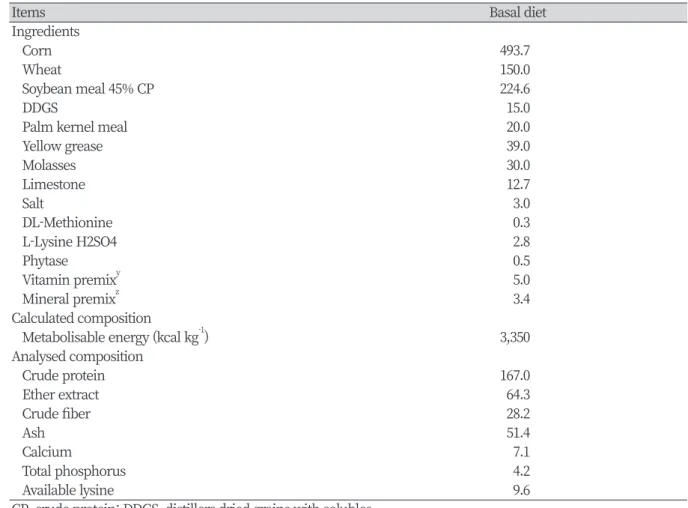
Atotalof80crossbred [(Landrace × Yorkshire) × Duroc] growing pigs with an average body weight (BW) of 25.04 ± 1.44 kg wereusedina6-weekexperiment. Pigswererandomlyassignedintooneofthetwoexperimentaldietsaccordingto BW. Pigswerehousedingroupsoffivebarrows perpenwitheightreplicatespertreatment. Pigs werehousedinan environmentallycontrolledfacilityandroomtemperaturewasmaintainedatapproximately24°C. Eachpen (1.2 × 1.6) was equippedwithaself-feederandnipplewaterertoallowadlibitumaccesstofeedandwaterthroughouttheexperimental period. Theexperimentaltreatments included: CON, basal diet; T1, basal diet + 100 mg/kg multi-enzyme. Alldietswere providedinmashformandformulatedtomeetorexceedtheNRC (2012) recommendationforallnutrientsandregardless oftreatments (Table1).
Sampling and measurements
BWandfeedintakewererecordedinitiallyandweek6oftheexperimentperiod. Feedconsumptionwasrecordedona penbasisduringtheexperimenttocalculatetheADG, averagedailyfeedintake (ADFI) andgaintofeedratio (G/F). Chromic oxide (Cr2O3) wasaddedtothedietasanindigestiblemarkerat2g/kgofthedietfor7dayspriortofecalcollectionat6th
weektocalculatedrymatter (DM) andnitrogen (N) digestibility. Fecalsampleswerecollectedrandomlyfrom2pigsineach pen, mixedandpooled. Allfecalsamples, aswellasfeedsamples, werestoredat - 20°Cuntilanalysis.
Beforechemicalanalysis, thefecalsampleswerethawedanddriedat60°Cfor72h, afterwhichtheyweregroundtopass througha1-mmscreen. TheproceduresusedfordeterminationofDMandNdigestibilitywereinaccordancewiththe methodsestablishedby AOAC (2005). Nwas determinedusingaKjeltec2300 NitrogenAnalyzer (FossTecatorAB, Hoeganaes, Sweden). CrudeproteinwascalculatedasN × 6.25. DietaryDM (method930.15), crudeprotein (method 968.06), calcium (method984.01), phosphorus (method965.17), crudeash (method942.05), etherextract (method920.39), andcrudefiber (method962.09) wereanalyzedaccordingtotheproceduresdescribedbyAOAC (2005). Individualamino acidcompositionwasmeasuredusinganAminoAcidAnalyzer (Beckman6300, BeckmanCoulterInc., Fullerton, USA) aftera24hfor6N-HClhydrolysisat110°C. Chromiumwasanalyzedbyultravioletabsorptionspectrophotometry (UV- 1201; Shimadzu, Tokyo, Japan) accordingtothemethodsofWilliamsetal. (1962). Thedigestibilitywasthencalculated
usingthefollowingformula: Digestibility (%) = [1 – {(Nf × Cd)/ (Nd × Cf)}] × 100, whereNf = nutrientconcentrationin feces (%DM), Cd = chromiumconcentrationindiets (%DM), Nd = nutrientconcentrationindiets (%DM), andCf = chromium
Table 1. Composition of the basal growing diets (as-fed basis; g kg-1).
Items Basal diet
Ingredients
Corn 493.7
Wheat 150.0
Soybean meal 45% CP 224.6
DDGS 15.0
Palm kernel meal 20.0
Yellow grease 39.0
Molasses 30.0
Limestone 12.7
Salt 3.0
DL-Methionine 0.3
L-Lysine H2SO4 2.8
Phytase 0.5
Vitamin premixy 5.0
Mineral premixz 3.4
Calculated composition
Metabolisable energy (kcal kg-1) 3,350
Analysed composition
Crude protein 167.0
Ether extract 64.3
Crude fiber 28.2
Ash 51.4
Calcium 7.1
Total phosphorus 4.2
Available lysine 9.6
CP, crude protein; DDGS, distillers dried grains with solubles.
yProvided per kg of complete diet: vitamin A, 4000 IU; vitamin D3, 800 IU; vitamin E, 17 IU; vitamin K, 2 mg;
vitamin B2, 4 mg; vitamin B6, 1 mg; vitamin B12, 16 μg; pantothenic acid, 11 mg; niacin, 20 mg; biotin, 0.02 mg.
zProvided per kg of complete diet: Cu, 220 mg; Fe, 175 mg; Zn, 191 mg; Mn, 89 mg; I, 0.3 mg; Co, 0.5 mg; Se, 0.15 mg.
concentrationinfeces (%DM).
Forthebloodprofile, fourpigswererandomlyselectedfromeachtreatmentandbledviajugularvenipunctureandadded toheparinizedtubesforbloodureanitrogen (BUN) analysis, andnon-heparinizedtubesforserumcreatinineanalysisatthe 6thweekoftheexperiment, respectively. Aftercollection, BUNconcentrationwasanalyzedusingtheAbbottSpectrumurea nitrogentest (SeriesII, AbbotLaboratories, Dallas, USA). Creatinineconcentrationsweredeterminedusing anAstra-8 Analyzer (BeckmanInstruments, Inc., Brea, USA).
Forfecalmicrobial, fecalsampleswerecollecteddirectlybymassagingtherectumof2pigsrandomlyselectedfromeach penonday42, andtransportedtothelaboratory. Theobtainedfecalsample (1g) fromeachpenwasdilutedwith9mLof10 gL-1peptonebroth (Becton, DickinsonandCo., FranklinLakes, USA) andhomogenized. Viablecountsofbacteriainthe fecalsampleswerethenconductedbyplatingserial10-folddilutions (in10gL-1peptonesolution) ontoMacConkeyagar plates (DifcoLaboratories, Detroit, USA) and lactobacillimediumIIIagarplates (Medium638, DSMZ, Braunschweig, Germany) toisolatetheE. coliandLactobacillus, respectively. TheMacConkeyagarplatesandlactobacillimediumIIIagar plateswerethenincubatedfor24hat37°Cand48hat39°C, respectively. TheE. coliandLactobacilluscolonieswere countedimmediatelyafterremovalfromtheincubator.
Fecesandurinewerecollectedond42from4pigspertreatment. Theurinewascollectedinabucketviaafunnelbelow thecage. Sampleswerekeptinsealedcontainersandwereimmediatelystoredat - 4°Cforthedurationoftheperiod. After thecollectionperiod, fecesandurinesampleswerepooledandeachmixedwellforeachpen. Thesubsamplesofslurry (150 gfecesand150gofurineweremixedwell; 1 : 1onthewetweightbasis) weretakenandstoredin2.61plasticboxesin duplicateasdescribedbyChoetal. (2008). Eachboxhadasmallholeinthemiddleofonesidewall, whichwassealedwith adhesiveplastersoastomaintainanaerobiccondition. Thesampleswerepermittedtofermentfor7datroomtemperature (25°C). Afterthefermentationperiod, aGastec (modelGV-100) gas-samplingpumpwasutilizedforgasdetection (Gastec Corp., GastecdetectortubeNo. 3Mand3LaforNH3andH2S; No. 70and70LforR.SH (totalmercaptan), GastecCorp., detectortube, Japan). Theadhesiveplasterswerepunctured, and100mLofheadspaceairwassampledapproximately2.0 cmabovethefecessurface.
Statistical analysis
Alldataweresubjectedtothegenerallinearmodel (GLM) proceduresofSASasarandomizedcompleteblockdesign (SASinstitute, 2001). Penwasusedasexperimentalunitforgrowthperformance, digestibilityandfecalmicrobial, whereas pigwasusedasexperimentalunitforbloodprofileandnoxiousgasemission. Variabilityindatawasexpressedasstandard errorofmeans (SEM). DifferencesamongalltreatmentswereseparatedbyusingtheTukey’stest. Aprobabilitylevelofp <
0.05wasconsideredtobestatisticallysignificant.
Results
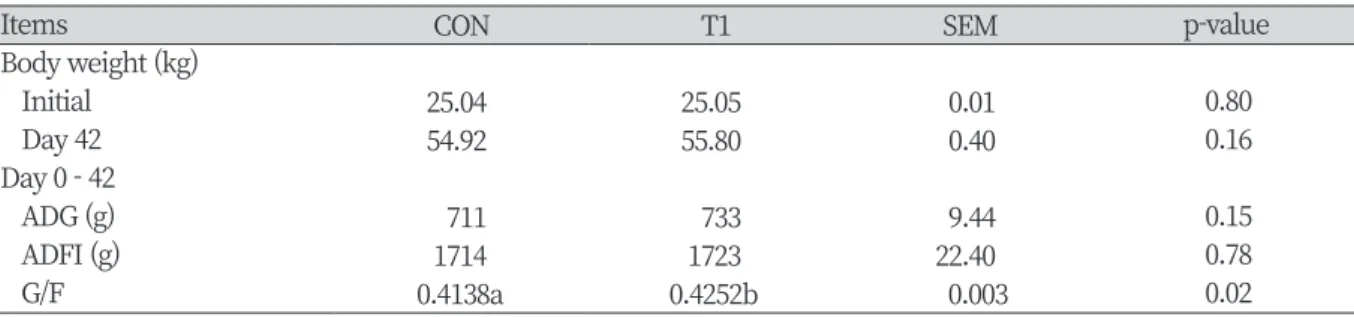
Theeffects of dietary multi-enzyme on growth performance, nutrient digestibility, blood profile, fecal microbial, and noxious gas emission were summarized in Table 2 - Table 6. However, there were no differences (p > 0.05) in ADFI, ADG, DM and N digestibility, blood profile and fecal microbial among all the treatments. During the experiment, pigs fed the diet containing multi-enzyme had higher G/F (p < 0.05) compared with pigs fed the diet without multi-enzyme supplementation.
On day 42, pigs fed the diet containing multi-enzyme had decreased H2S and NH3 emission (p < 0.05) compared with pigs fed the diet without multi-enzyme supplementation.
Table 2. Effect of dietary multi-enzyme on growth performance in growing pigs.
Items CON T1 SEM p-value
Body weight (kg)
Initial 25.04 25.05 0.01 0.80
Day 42 54.92 55.80 0.40 0.16
Day 0 - 42
ADG (g) 711 733 9.44 0.15
ADFI (g) 1714 1723 22.40 0.78
G/F 0.4138a 0.4252b 0.003 0.02
ADG, average daily gain; ADFI, average daily feed intake; CON, basal diet; T1, CON + 100 mg/kg multi-enzyme;
SEM, standard error of means.
a, b: Means in the same row with different superscript differ significantly (p < 0.05).
Table 3. Effect of dietary multi-enzyme on apparent digestibility in growing pigs.
Items (%) CON T1 SEM p-value
Dry matter 77.11 78.06 0.60 0.30
Nitrogen 76.45 77.44 0.59 0.28
CON, basal diet; T1, CON + 100 mg/kg multi-enzyme; SEM, standard error of means.
Table 4. Effect of dietary multi-enzyme on blood characteristics in growing pigs.
Items (mg/dL) CON T1 SEM p-value
BUN 11.3 10.0 0.84 0.36
Creatinine 0.85 0.64 0.14 0.37
BUN, blood urea nitrogen; CON, basal diet; T1, CON + 100 mg/kg multi-enzyme; SEM, standard error of means.
Table 5. Effect of dietary multi-enzyme on fecal microbial in growing pigs.
Items (log10cfu/g) CON T1 SEM p-value
Lactobacillus 7.23 7.51 0.07 0.08
E. coli 5.91 5.79 0.05 0.20
CON, basal diet; T1, CON + 100 mg/kg multi-enzyme; SEM, standard error of means.
Table 6. Effect of dietary multi-enzyme on noxious gas emission in growing pigs.
Items (ppm) CON T1 SEM p-value
NH3 4.6a 4.0b 0.11 0.03
Total mercaptans 3.7 3.6 0.31 0.80
H2S 3.1a 2.4b 0.13 0.04
CON, basal diet; T1, CON + 100 mg/kg multi-enzyme; SEM, standard error of means.
Discussion
Growth performance
Theresultsofthecurrentstudyindicatedthatmulti-enzymesupplementationaffectedonG/Fbuthadnoinfluenceon ADFIandADGamongalltreatmentgroups. OurfindingsaresimilarlywithastudyconductedbyOmogbenigunetal. (2004), whoreportedthatanimprovementinADGand G/Fhadbeenobservedinpigletsfeddietsbasedon cornandwheat supplementedwithanenzymecocktailcontainingcellulase, galactanase, mannanaseandpectinase. Besides, Aoetal. (2010) observedthatADGandG/Fwasincreasedwith100mg/kgenzymecomplex (α-1,6-β-galactosidase, β-1,4-mannanase, and β-1,4-mannosidase) supplementationtocornandSBMbaseddietsforgrowingpigs. However, theresultsarenotalways consistent. InastudywithrapeseedmealandDDGS-baseddietssupplementedwithxylanaseandβ-glucanaseenzymes, Mc Alpineetal. (2012) foundnoimprovementinADFI, ADGandfeedconversionefficiencyofgrower-finisherpigs. The contradictionsintheimpactofmulti-enzymesupplementationongrowthperformancemaybeattributedtothedifferences inthedietscomposition, andtheageofpigsused. Inaddition, theenzymesource, thesituationsunderwhichthespecific ingredientwasgrown, thestorageandprocessoffeed, theinteractionsamongdietarycompositionsandhealthstatusmay alsoexertasignificanteffectongrowthperformance (Kimetal., 2003; Willamiletal., 2012).
Nutrient digestibility
Previousreportsindicatethatdifferentexogenousenzymesupplementationinswinedietcanenhancethedigestibility, leadingtoimprovedgrowthperformanceandnutrientdigestibility (Nyachotietal., 2006; Kiarieetal., 2013). Astudyby Omogbenigunetal. (2004) demonstratedthatmulti-enzyme (cellulase, galactase, mananase, andpectinase) havingactivity whensupplementedtocornandSBMdietonthedigestibilityofnutrientsinbothileumandtotaltractinpiglets. Incontrast, Wubbenetal. (2000) foundthatmultipleenzymes (cellulase, hemicullulase, amylase, xylanase, alpha-galactosidase, and
protease) supplementationincornandSBMdietsdidnotexertbenefitsonnutrientdigestibilityofgrowingpigs. Inaddition, theilealdigestibilityofDMandNwerenotaffectedingrowingpigsfedcornandSBMdietsupplementedornotwith α-galactosidase (Smirickyetal., 2002). Inthecurrentexperiment, therewerenodifferencesin DM and N digestibility among allthetreatments.
Theapparentcontradictionsintheeffectivenessofenzymesupplementationamongstudiesaremainlyattributableto differencesinageofthepigsand thecompositionofdietsused (Omogbenigunetal., 2004). Ingeneral, theimpactof enzymessupplementationonnutrientdigestiondeclineswithageofthepigparticularly, becausedigestivecapacityinpigs improveswithageastheenzymesystemmaturesandgutmicrobialpopulationincreases (Lindemannetal., 1986). Older pigshaveamorematuregastrointestinalsystem, increasingtheabilityoftheguttodigestcerealcomponentsoftheration throughtheeffectsofboth pancreaticenzyme sectionand bacterialfermentation. Also, theextent towhich enzymes supplementationimprovenutrientdigestibilitytendtobelowwhenusingdietscontaininghighlydigestibleingredients (Johnsonetal., 1993). Fromapracticalswinenutritionperspective, itwouldappearthatsupplementingenzymestopigdiets willbemorebeneficialwhenusingdietsbasedoningredientsthatareoflowerqualityandpoorlydigested.