SWMM 모형을 활용한 평야부 관개효율 및 용수공급 취약성 평가
Assessment of Irrigation Efficiency and Water Supply Vulnerability Using SWMM
신지현a⋅남원호b,†⋅방나경c⋅김한중d⋅안현욱e⋅이광야f
Shin, Ji-HyeonㆍNam, Won-HoㆍBang, Na-KyoungㆍKim, Han-JoongㆍAn, Hyun-UkㆍLee, Kwang-Ya
ABSTRACT
Agricultural drought is a natural phenomenon that is difficult to observe and quantitatively express, and agricultural water use is high and usage patterns are diverse, so even if there is a lack of rainfall. The frequency and severity of agricultural drought are increased during the irrigation period where the demand for agricultural water is generated, and reasonable and efficient management of agricultural water for stable water supply is required. As one method to solve the water shortage of agricultural water in an unstructured method, it is necessary to analyze the appropriate supply amount and supply method through simulation from the intake works to the canals organization and paddy field. In this study, irrigation efficiency was analyzed for irrigation systems from April to September over the past three years from the Musu Reservoir located in Jincheon-gun, Chungcheongbuk-do and Pungjeon Reservoir located in Seosan-si, Chungcheongnam-do. SWMM (Storm Water Management Model) was used to collect agricultural water, and irrigation efficiency analysis was conducted using adequacy indicators, and water supply vulnerability. The results of the agricultural water distribution simulation, irrigation efficiency and water supply vulnerability assessment are thought to help the overall understanding of the agricultural water supply and the efficient water management through preliminary analysis of the methods of agricultural water supply in case of drought events.
Keywords: Agricultural drought; SWMM; agricultural reservoir; water supply; irrigation efficiency; vulnerability
Ⅰ. 서 론
최근 급격한 이상기후의 영향으로 한반도 내의 가뭄의 발 생빈도와 강도가 증가하는 추세이며 과거에 경험해보지 못했 던 극심한 가뭄이 빈번하게 발생하고 있다 (Kim et al., 2016a;
Kim et al., 2019). 가뭄은 한 계절에서 1년, 길게는 수년 동안 지속되는 시간 특성을 가지며 구체적인 발생 시기, 장소, 원인 등을 규명하기에 어려움이 있으며, 장기간 가뭄 발생 시 농업 과 수자원을 포함한 사회, 경제, 인문 분야까지 막대한 피해를 받는다 (Ryu et al., 2002; Nam et al., 2015; Kim et al., 2017).
농업가뭄은 농작물 생육 및 수확량에 직접적으로 영향을 미치는 토양수분의 부족한 정도와 농업용 저수지의 관개용수 가 부족하여 농작물에 피해가 발생하는 것으로 정의한다 (Rosenberg, 1979; Yoon et al., 2018; Mun et al., 2020a; Mun et al., 2020b).
농업용 저수지는 농업용수를 공급하는 단일 목적으로 축조 되어 수자원의 시간적 및 공간적인 편중을 극복하는 방법으 로 홍수기의 풍부한 수량을 저류한 후 관개기 또는 갈수기에 이용하는 수단으로서 농업용 저수지의 역할은 중요하다 (Ahn et al., 2004; Kim et al., 2005; Nam et al., 2012a). 우리나라의 경우 지형적인 여건과 농경지 분포가 영세하여 농업용 저수 지의 유역 규모가 작고 저수용량 부족으로 내한능력이 취약하 다 (Jee, 2011; Nam et al., 2012b). 따라서 저수지운영 모의모형 인 DIROM (Daily Irrigation Reservoir Operation Model), 농업 용 저수지의 적정 저수용량을 결정하는 모형인 HOMWRS (Hydrological Operation Model for Water Resources System), 준분포형 연속 강우 유출 모형인 SWAT (Soil and Water
aGraduate Student, School of Social Safety and Systems Engineering, Hankyong National University, Anseong, Republic of Korea
b Associate Professor, School of Social Safety and Systems Engineering, Institute of Agricultural Environmental Science, National Agricultural Water Research Center, Hankyong National University, Anseong, Republic of Korea
cPh.D. Studendt, Department of Convergence of Information and Communi- cation Engineering, Hankyong National University, Anseong, Republic of Korea
d Professor, School of Social Safety and Systems Engineering, Institute of Agricultural Environmental Science, Hankyong National University, Anseong, Republic of Korea
eAssociate Professor, Department of Agricultural and Rural Engineering, Chungnam National University, Daejeon, Republic of Korea
fDirector, Integrated Water Management Supporting Department, Water Resources Planning Office, Korea Rural Community Corporation, Sejong, Republic of Korea
† Corresponding author
Tel.: +82-31-670-5137 Fax.: +82-31-670-5139 E-mail: [email protected]
Received: October 7, 2020 Revised: October 23, 2020 Accepted: October 26, 2020
Assessment Tool) 모형을 사용한 저수율 추정 및 관개지구의 관행 물관리를 고려한 저수지 용수공급량을 추정하는 연구 등 저수지, 수원공 중심의 용수공급량을 평가하는 연구들이 수행되었다 (Ahn et al., 2013; Kang and Lee, 2014; Song et al., 2015; Kim et al., 2016b; Nam et al., 2018; Kim et al., 2020).
농업용수의 부족이 발생하고 있는 상황에서 극심한 가뭄 대 응과 현실에 부합하는 농업용수 공급을 위해 기존의 농업용 수리시설물의 물 공급 능력 평가 및 물 부족지역의 정확한 파악을 위한 연구가 필수적이다 (Ahn et al., 2013; Bang et al., 2020).
농업용수의 공급은 관개구역별 수혜면적에 따라 지점별로 용수로 취수문을 통하여 용수지선에 유입된 후 관개구역에 공급되어 논 관개용수로 이용되며 (Hong et al., 2014), 농업용 저수지의 주수원공만으로 농업용수 부족 시 양수저류를 통한 순환형 물관리의 적용이 가능하다 (Bang et al., 2020). 용수공 급과 관련된 연구는 Lee et al. (2012)는 저수지 모의운영 모형 을 이용하여 용수공급능력 재평가 및 추가용수공급 가능 여 부를 판단하였고, Choi et al. (2019)는 미래의 가상 시나리오 를 구성하고 각 시나리오 경로별 분석을 통한 미래의 용수공
급능력 변화를 분석하였다. 또한 농업용수의 효율적 활용을 위해 지선별 실제 공급량 파악 및 용수공급량 대비 농업용수 관리 효율에 대한 연구가 필요하다 (Kumar and Singh, 2003;
Unal et al., 2004; Irmak et al., 2011; Hong et al., 2015). Nam et al. (2013)은 동진지구의 용수지선 물수지 분석을 통해 농업 용수 이용량에 대한 분석과 용배수로 유입되는 공급량 파악 및 간선별 농업용수의 물 사용량을 기반으로 관개효율을 평 가하였고, Shin et al. (2020)은 SWMM 모형을 활용하여 필지 와 간선의 농업용수 공급모의와 간선에 포함된 필지면적 대 비 관개량과 간선별 공급량 대비 관개량을 통해 관개효율을 분석하였다.
본 연구에서는 유체의 흐름에 대한 수리적 특성을 모의할 수 있는 SWMM (Storm Water Management Model) 모형 기반 수로 네트워크 모의를 통하여 농업용수 분배 모의와 농업용 수 공급 취약성 및 용수공급 효율을 분석하고자 한다. 충청도 지역의 풍전, 무수 저수지를 대상으로 2017년부터 2019년까 지 농업기반시설관리시스템 (Rural Infrastructure Management System, RIMS) 저수율 데이터를 구축하였고, 현장 조사 및 용수공급 모의를 통해 관개기 동안의 농업용수 공급효율을
Fig. 1 Location of watershed, irrigated areas and irrigation canals in Musu reservoir, Chungcheongbuk-do and Pungjeon reservoir, Chungcheongnam-do
분석하고자 한다. 또한, 저수지 공급 가능량과 관개지구 수요 량 비교를 통한 농업용수공급 취약성과 용수공급 지표를 활 용한 관개효율을 분석하고자 한다.
Ⅱ. 재료 및 방법 1. 연구 대상 지역
연구대상지는 충청북도 진천군 광혜원면 회죽리에 위치한 무수 저수지와 충청남도 서산시 인지면 풍전리에 위치한 풍 전 저수지를 대상지구로 선정하였다. Fig. 1과 Table 1은 각각
대상저수지 간선의 위치와 현황을 나타낸 것이다. 무수 저수 지는 1959년 준공된 유효저수량은 1320.0천 m3이며, 유역면 적 857.0 ha, 수혜면적 239.0 ha, 유역배율 5.5의 10년 한발빈 도 규모로 설계되었다. 풍전 저수지의 경우 1944년 준공된 유 효저수량은 2621.2천 m3이며, 유역면적 1110.0 ha, 수혜면적 655.1 ha 이다. 용수계통도의 경우 무수 저수지는 42 개의 필 지와 2 개의 간선 (회죽간선, 금곡간선) 및 6 개의 지선 (회죽1 지선, 회죽2지선, 회죽3지선, 회죽4지선, 금곡1지선, 금곡2지 선)으로 이루어져있으며, 풍전 저수지는 50 개의 필지와 2 개 의 간선 (예천간선, 임지간선)으로 축조되었다.
본 연구에서는 Fig. 2에 도시한 바와 같이, 한국농어촌공사
Name Construction completed year
(year)
Watershed area
(ha)
Irrigated area
(ha)
Design frequency of drought
(year)
Unit reservoir storage (103 m3/ha)
Effective storage capacity
(103 m3)
Musu 1959 857 239 10 5.5 1,320
Pungjeon 1944 1,110 655 10 4.0 2,621
Table 1 Characteristics of the agricultural reservoir and irrigation area used in Musu and Pungjeon reservoir
Fig. 2 Flow chart of the process of the process used to SWMM and HOMWRS based water allocation, irrigation efficiency and water supply vulnerability modeling
RIMS의 저수율 데이터를 기반으로 최근 3년간 (2017∼2019) 4월부터 9월까지 관개기간을 대상으로 SWMM 모형을 활용 하여 농업용수 분배 모의와 적정성 지표를 활용한 관개효율 분석 및 용수공급 취약성 평가를 하였다.
2. SWMM 모형 기반 수로네트워크 모의
SWMM 모형은 1971년 미국 환경청 (Environmental Protection Agency, US EPA)에서 도시 유역 하천유량과 수질 을 모의할 수 있도록 개발된 모델로 (Lee and Choi, 2015) 유역 의 강우로 인해 발생하는 지표면 유출, 지하수 및 증발 등 수 문학적 특성분석과 관수로, 개수로 등 관망 및 하천에 대한 유출량과 수질 예측에 활용할 수 있다 (Koo and Seo, 2017).
도시유역 및 비도시유역에 적용할 수 있으며, 단일 및 연속강 우에 의한 모의 및 배수구역의 크기에 상관없이 적용이 가능 하다 (Han and Seo, 2014). 또한 수로 네트워크를 이용하여 유체 흐름에 대한 수리적 특성 모의 및 개수로, 관수로, 펌프, 오리피스 등 수로 네트워크 요소의 수리 계산이 가능하므로 개수로 위주인 농업용수 공급 모의에 활용이 가능하다 (Rossman, 2017; Bang et al., 2020; Shin et al., 2020).
SWMM 모의 시 침투량, 증발산량, 저수지 공급유량, 초기 담수심 및 목표담수심, 수문개도율 등의 입력자료가 필요하 다. 증발산량의 경우 FAO-56 Penman-Monteith 공식을 활용 (Jeon et al., 2019)하여 산정하였으며, 침투량의 경우 변수를 최소화하기 위하여 모형의 기본값인 무수 저수지와 풍전 저 수지 모두 3 mm로 설정하였다. 초기담수심 및 목표담수심의 경우 일반 벼 대상으로 각각 0 mm와 60 mm로 설정하였다.
Table 2는 관개지구의 목표담수심 도달 일수 기반 관개효 율 범례를 나타낸 것이다. 모의기간에 대한 목표담수심 만족 도를 활용하여 분석하였으며, 파란색의 경우 80%이상으로 목 표담수심 도달 일수가 모의기간 183일 중 146일 이상 만족, 녹색의 경우 60%에서 80%로 110일에서 146일 만족, 노란색 의 경우 40%에서 60%로 73일에서 110일 만족, 주황색의 경우 20%에서 40%로 37일에서 73일 만족, 붉은색의 경우 20% 이 하로 37일 이하 만족으로 정의하였다 (Shin et al., 2020).
Value Less
20% 20 to
40% 40 to
60% 60 to
80% Over 80%
Period Less 37 days
37 to 73 days
73 to 110 days
110 to 146 days
Over 146 days Table 2 Classification of irrigation efficiency values where the
threshold level is less than each irrigated period as determined by the ponding depth
3. 농업용수 공급 취약성 분석
저수지 유역 및 관개 면적의 크기에 따라 기준 수위가 다르 므로 단순히 저수율로 용수공급 상황 파악이 어렵기 때문에, 본 연구에서는 저수지 공급 가능량 (Potential Water Supply Capacity, PWS)과 관개지구의 수요량 (Irrigation Water Requirement, IWS)으로 농업용수공급 취약성 분석을 하였다 (Nam and Choi, 2013). 공급 가능량이 수요량보다 작을 경우 용수공급에 취약한 것으로 정의하였으며, 식 (1)과 식 (2)는 저수지 공급 가능량 (PWS)과 수요량 (IWR) 산정식을 나타낸 다. 식 (1)에서 RC는 저수량, RWI는 유역의 유입량, RO는 월 류량을 나타내며, 식 (2)에서 PWR은 논의 필요수량을 의미한 다. 공급 가능량 산정을 위해 RIMS 기반 월평균 저수량과 HOMWRS 기반 필요수량, 유역유입량을 산정하였다.
(1)
(2)
4. 용수공급 지표를 활용한 농업용수 관개효율 분석 관개효율 분석을 위해 적정성 (Adequacy, ) 지표와 효율 성 (Efficiency, ) 지표를 활용하여 농업용수 공급 평가를 하였다. 적정성 및 효율성 지표는 실제 용수공급량과 용수공 급계획량의 비율로 산정하며 (Molden and Gates, 1990; Hong et al., 2014), 본 연구에서는 SWMM 모형을 기반으로 실제 용수공급량은 수원공 공급량, 용수공급 계획량은 필요수량으 로 산정하였다. 식 (3)과 식 (4)는 적정성 및 효율성 지표 산정 식을 나타내며, 는 실제 용수공급량, 은 용수공급계획 량을 의미한다.
if ≤ and (3)
if ≤ and (4)
Table 3은 적정성 및 효율성 지표 평가기준을 나타낸다. 적 정성 지표의 경우 값이 1.00 또는 1.00에 가까울 경우
Measure Performance classes
Good Fair Poor
Adequacy () 0.09 to 1.00 0.80 to 0.89 less 0.80 Efficiency () 0.85 to 1.00 0.70 to 0.84 less 0.70 Table 3 Evaluation standard for water delivery indicators (Molden
and Gates, 1990; Nam et al., 2016)
용수공급이 적절히 이루어진 것으로 판단하며, 0.80 이하일 경우 용수공급에 실패한 것으로 분석한다. 효율성 지표의 경 우 값이 1.00 또는 0.85 이상일 경우 물을 효율적으로 사용한 것으로 평가하며, 0.70 이하일 경우 물이 효율적으로 사용되고 있지 않은 것으로 판단한다.
Ⅲ. 적용 및 고찰
1. SWMM 모형 적용성 평가
SWMM 모형이 적절하게 활용될 수 있는지에 대한 적정성 평가를 위해 RIMS 저수율 데이터를 SWMM 모형에 적용하여 실제 공급량과 모의결과 공급량을 비교하였다. Fig. 3은 최근 3년 관개기인 4월부터 9월까지 (a) 무수 저수지와 (b) 풍전 저수지의 실제 공급량과 모의결과 공급량 비교를 나타내며, 전일대비 음의 저수변화량의 평균을 산정하여 분석 일수를 곱한 값을 공급량으로 산정하여 SWMM 모형 모의 후 실제 공급량과 모의결과 공급량을 비교하였다. 무수 저수지의 경 우 2017년 7월, 2018년 4월, 2019년 4월, 풍전 저수지의 경우 2017년 4월과 7월, 2018년 4월에 저수변화량이 나타나지 않았 다. 실제 공급량과 모의결과 공급량 차이는 (a) 무수 저수지의
경우 최대 0.9천 m3, 평균 0.38천 m3, (b) 풍전 저수지의 경우 최대 236.6천 m3, 평균 32.6천 m3로 나타났다. 본 연구에서는 실제 공급량과 모의결과 공급량이 유사하며 오차가 적은 전 일대비 음의 저수변화량의 평균을 산정하여 분석일수를 곱한 저수량 데이터를 사용하여 용수공급 모의 및 관개효율 분석 을 진행하였다.
2. 관개기의 농업용수 공급 모의
농업용수 공급 모의를 위해 RIMS 기반 일별 저수율 자료 를 이용하여 SWMM 모형에 적용하였다. 농업용수 분배 모형 의 모의조건은 관개조건의 경우 목표 담수심 도달 후 저수지 및 포장 공급을 중단하도록 설정하였으며, 공급조건은 목표 담수심 도달 후 메인수로 및 보조수로 공급을 중단하도록 설 정하였다. 관개방법의 경우 연속관개로 설정하였으며, 취입 보 수혜면적의 경우 저수지에서 공급하지 않으므로 초기값으 로 설정 후 분석에서 제외하였다.
Fig. 4는 2017년부터 2019년까지 관개기의 SWMM 모형을 활용한 농업용수 공급 모의결과를 나타낸다. 무수 저수지의 경우 금곡간선, 금곡1지선, 금곡2지선, 회죽간선에 80% 이상 의 용수공급 효율이 나타나며, 회죽1지선, 회죽2지선, 회죽3 지선, 회죽4지선은 전체적으로 40% 이상 60% 미만의 용수공
Fig. 3 Comparison of observed and simulated reservoir storage in Musu and Pungjeon reservoir
Fig. 4 Assessment of irrigation water distribution simulation results for Musu and Pungjeon irrigated areas in irrigation period from 2017 to 2019
급 효율을 나타낸다. 풍전저수지의 경우 상류부는 80% 이상 의 용수공급 효율을 나타내며, 하류부에 위치할 경우 용수공급 효율이 40% 이상 60% 미만으로 감소하는 경향을 나타낸다.
3. 관개기의 농업용수 공급 취약성 평가
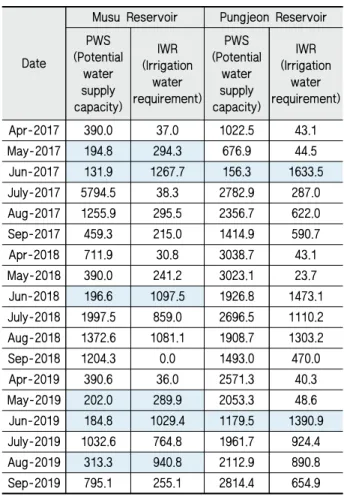
RIMS 기반 저수율 데이터와 HOMWRS를 활용하여 필요 수량과 유역유입량을 산정하여 농업용수 공급 취약성 지표에 적용하였으며, 저수지 공급 가능량이 관개지역 수요량보다 적을 시 농업용수 공급에 취약한 것으로 정의하였다. Table 4는 2017년부터 2019년까지 관개기의 저수지 공급 가능량과 관개지역 수요량을 나타낸다. 무수저수지의 경우 2017년 5월, 2017년 6월, 2018년 6월, 2019년 5월, 2019년 6월, 2019년 8월, 풍전저수지의 경우 2017년 6월, 2019년 6월에 저수지 공급
가능량이 수요량보다 적으므로 농업용수 공급에 취약한 것으 로 판단하였다.
저수지 공급 가능량 대비 필요수량의 농업용수 공급에 취 약한 경우 PWS와 IWR 값의 차이를 산정하여 비교 분석하였 다. 2017년 6월 풍전 저수지 1477.16천 m3, 무수 저수지 135.75 천 m3으로 가장 큰 차이가 나타났으며, 2017년 5월과 2019년 5월에 무수 저수지 99.52천 m3과 87.94천 m3으로 차이가 가장 적은 것으로 나타났다.
4. 관개효율 지표를 활용한 농업용수 공급 평가 최근 3년간 관개기 4월부터 9월까지 SWMM 모형 기반 공 급량과 필요수량을 산정하여 적정성과 효율성 지표에 적용하 였다. Fig. 5는 무수, 풍전 저수지의 공급량 및 누적공급량, 필요수량 및 누적필요수량을 나타낸다. 무수 저수지의 경우 공급량이 필요수량보다 많으며, 풍전 저수지의 경우 공급량 보다 필요수량이 많은 것으로 나타났다.
Date
Musu Reservoir Pungjeon Reservoir PWS
(Potential water supply capacity)
(Irrigation IWR water requirement)
PWS (Potential
water supply capacity)
(Irrigation IWR water requirement)
Apr-2017 390.0 37.0 1022.5 43.1
May-2017 194.8 294.3 676.9 44.5
Jun-2017 131.9 1267.7 156.3 1633.5
July-2017 5794.5 38.3 2782.9 287.0
Aug-2017 1255.9 295.5 2356.7 622.0
Sep-2017 459.3 215.0 1414.9 590.7
Apr-2018 711.9 30.8 3038.7 43.1
May-2018 390.0 241.2 3023.1 23.7
Jun-2018 196.6 1097.5 1926.8 1473.1
July-2018 1997.5 859.0 2696.5 1110.2
Aug-2018 1372.6 1081.1 1908.7 1303.2
Sep-2018 1204.3 0.0 1493.0 470.0
Apr-2019 390.6 36.0 2571.3 40.3
May-2019 202.0 289.9 2053.3 48.6
Jun-2019 184.8 1029.4 1179.5 1390.9
July-2019 1032.6 764.8 1961.7 924.4
Aug-2019 313.3 940.8 2112.9 890.8
Sep-2019 795.1 255.1 2814.4 654.9
* Units: 103 m3
Table 4 Comparison of Potential water supply capacity and agricultural water requirement from April to September in 2017-2019
Fig. 6 Analysis of adequacy indicator from April to September in 2017-2019 years Fig. 5 Comparison of supply and water requirements in irrigation period from 2017 to 2019
Fig. 7 Analysis of efficiency indicator from April to September in 2017-2019 years
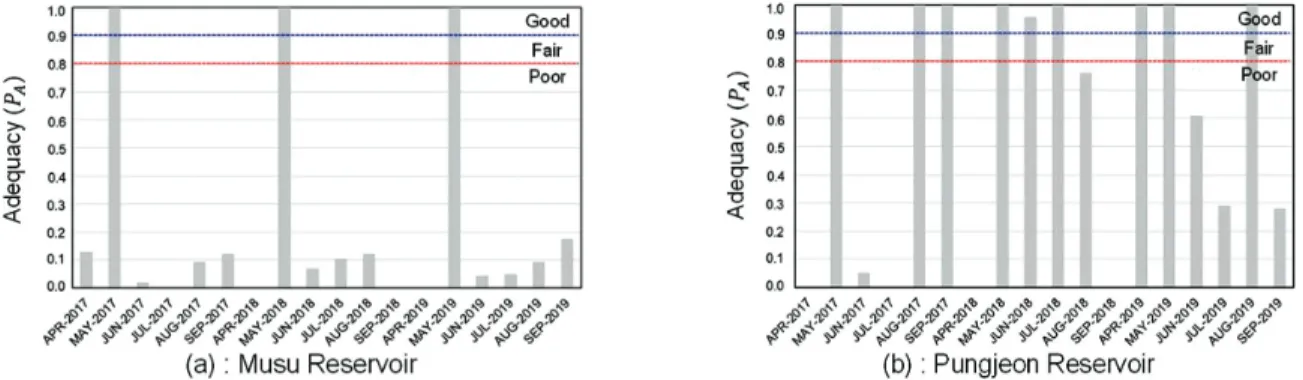
Fig. 6과 Fig. 7은 무수, 풍전 저수지의 적정성 및 효율성 지표 산정 결과를 나타낸다. 적정성 지표 산정 결과 무수 저수 지는 2017년 5월, 2018년 5월, 2019년 5월 산정 값이 1.0 으로 물 공급이 적정히 이루어진 것으로 나타나며, 이를 제외하고 모두 0.8 이하의 값으로 물 배분이 적정히 이루어지지 않은 것으로 판단된다. 풍전 저수지의 경우 2018년 8월, 2019년 6 월, 2019년 7월, 2019년 9월 0.8 이하로 물 공급에 실패한 것으 로 판단되며, 이를 제외하고 모두 1.0 이상으로 적절한 물 공 급이 이루어진 것으로 나타난다. 효율성 지표의 경우 무수 저 수지는 2017년 5월, 2018년 5월, 2019년 5월 0.7 이하로 낮은 효율성을 보이며, 이를 제외하고 모두 1.0으로 효율적인 농업 용수 사용을 나타낸다. 풍전 저수지의 경우 2017년 5월, 2017 년 9월, 2018년 5월, 2018년 9월, 2019년 4월, 2019년 5월 0.70 이하로 효율적인 물 사용이 이루어지지 않은 것으로 판단된 다. 적정성 및 효율성 지표 결과의 시기별 차이는 월별로 산정 한 RIMS 기반 실제 공급량과 HOMWRS 시스템으로 산정한 필요수량의 차이로 인한 결과로 판단된다.
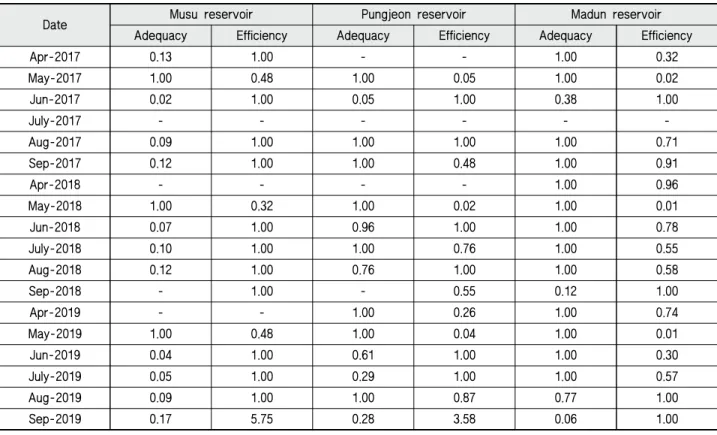
Table 5는 연구대상 저수지와 마둔 저수지의 적정성 및 효 율성 지표 산정 값을 도시한 것이다. 마둔 저수지의 적정성 지표 산정 결과 대부분 1.0 으로 물 공급이 적절히 이루어 진 것으로 판단되며, 효율성 지표의 경우 필요수량보다 더 많은 용수공급으로 대부분 0.7 이하로 낮은 공급효율을 나타냈다.
Ⅳ. 결 론
본 연구에서는 무수 및 풍전 저수지를 대상으로 농업용 저 수지의 용수공급 및 관개효율 분석을 위해 일별 저수율 데이 터를 활용하여 SWMM 모형 모의를 하였으며, 용수공급 취약 성 및 적정성 지표를 적용하여 분석하였다. SWMM 모형 기반 정확한 분석을 위해 실제 공급량과 모의결과 공급량 비교를 하였으며, 두 값이 유사하며 오차가 적은 전일대비 음의 저수 변화량의 평균을 산정하여 분석일수를 곱한 저수량 데이터를 사용하였다.
SWMM 모형 모의 결과 풍전 저수지의 경우 용수공급 효율 이 상류부 80% 이상, 하류부 40% 이상 60% 미만으로 감소하 였으며, 무수 저수지의 경우 하류부에 위치한 필지에 낮은 용 수공급 효율이 나타났다. 저수지 공급 가능량과 수요량 비교 를 통한 용수공급 취약성 분석 결과, 무수 저수지의 경우 2017 년 5월과 6월, 2018년 6월, 2019년 5월, 6월, 8월, 풍전 저수지 의 경우 2017년 6월, 2019년 6월에 저수지 공급 가능량이 수 요량보다 적으므로 농업용수 공급에 취약한 것으로 판단된다.
용수공급 적정성 및 효율성 지표를 활용하여 용수공급 효 율평가를 하였다. 적정성 지표 분석 결과 무수 저수지의 경우 2017년, 2018년, 2019년 5월 산정 값이 1.0으로 물 공급이 적 정히 이루어진 것으로 판단된다. 풍전 저수지의 경우 2018년
Date Musu reservoir Pungjeon reservoir Madun reservoir
Adequacy Efficiency Adequacy Efficiency Adequacy Efficiency
Apr-2017 0.13 1.00 - - 1.00 0.32
May-2017 1.00 0.48 1.00 0.05 1.00 0.02
Jun-2017 0.02 1.00 0.05 1.00 0.38 1.00
July-201 7 - - - - - -
Aug-2017 0.09 1.00 1.00 1.00 1.00 0.71
Sep-2017 0.12 1.00 1.00 0.48 1.00 0.91
Apr-201 8 - - - - 1 .00 0.96
May-2018 1.00 0.32 1.00 0.02 1.00 0.01
Jun-2018 0.07 1.00 0.96 1.00 1.00 0.78
July-2018 0.10 1.00 1.00 0.76 1.00 0.55
Aug-2018 0.12 1.00 0.76 1.00 1.00 0.58
Sep-2018 - 1.00 - 0.55 0.12 1.00
Apr-2019 - - 1.00 0.26 1.00 0.74
May-2019 1.00 0.48 1.00 0.04 1.00 0.01
Jun-2019 0.04 1.00 0.61 1.00 1.00 0.30
July-2019 0.05 1.00 0.29 1.00 1.00 0.57
Aug-2019 0.09 1.00 1.00 0.87 0.77 1.00
Sep-2019 0.17 5.75 0.28 3.58 0.06 1.00
Table 5 Comparison of the study destination reservoir and the Madun reservoir from April to September in 2017-2019
8월, 2019년 6월, 7월, 9월 0.8 이하로 물 공급에 실패한 것으 로 판단되며, 이를 제외하고 모두 1.0 이상으로 적절한 물 공 급이 이루어진 것으로 나타난다. 효율성 지표 결과 무수 저수 지의 경우 2017년, 2018년, 2019년 5월, 풍전 저수지의 경우 2017년 5월, 2017년 9월, 2018년 5월, 2018년 9월, 2019년 4월, 2019년 5월 0.7 이하로 낮은 효율성을 보이며, 이를 제외하고 모두 1.0으로 효율적인 농업용수 사용으로 판단된다.
본 연구의 용수분배 모의와 용수공급 취약성 및 지표를 활 용한 용수공급 평가 결과는 농업용수가 부족한 가뭄 시 관개 조직의 합리적인 용수공급 효율 평가와 농업용수 공급 방법 에 대한 사전 분석을 통한 효율적인 물 관리에 기여할 것으로 판단된다.
감사의 글
본 연구는 농림축산식품부의 재원으로 농림식품기술기획 평가원의 첨단생산개발사업의 지원을 받아 연구되었습니다 (과제번호: 318060-3).
REFERENCES
1. Ahn, S. R., G. Y. Park, and S. J. Kim, 2013. Assessment of agricultural water supply capacity using MODSIM-DSS coupled with SWAT. Journal of the Korean Society of Civil Engineers 33(2): 507-519 (in Korean). doi:10.12652/
Ksce.2013.33.2.507.
2. Ahn, T. J., D. H. Cho, S. H. Lee, G. W. Choi, and Y.
N. Yoon, 2004. Evaluation of the effective storage of existing agricultural reservoir. Journal of the Korean Water Resources Association 37(5): 353-361 (in Korean). doi:
10.3741/JKWRA.2004.37.5.353.
3. Bang, N. K., W. H. Nam, J. H. Shin, H. J. Kim, K. Kang, S. C. Baek, and K. Y. Lee, 2020. Water balance analysis of pumped-storage reservoir during non-irrigation period for recurrent irrigation water management. Journal of the Korean Society of Agricultural Engineers 62(4): 1-12 (in Korean). doi:10.5389/KSAE.2020.62.4.001.
4. Choi, S. J., D. R. Lee, and S. G. Kang, 2019. Analysis of water supply capacity based on future various scenarios in Geum river basin. Journal of the Korean Society of Hazard Mitigation 19(5): 315-321 (in Korean). doi:10.9798/
KOSHAM.2019.19.5.315.
5. Han, Y. I., and D. I. Seo, 2014. Application of LID
methods for sustainable management of small urban stream using SWMM. Journal of Korean Society of Environmental Engineers 36(10): 691-697 (in Korean). doi:10.4491/
KSEE.2014.36.10.691.
6. Hong, E. M., W. H. Nam, J. Y. Choi, and J. T. Kim, 2014.
Evaluation of water supply adequacy using real-time water level monitoring system in paddy irrigation canals. Journal of the Korean Society of Agricultural Engineers 56(4): 1-8 (in Korean). doi:10.5389/KSAE.2014.56.4.001.
7. Hong , E. M., J. Y. Choi, W. H. Nam, S. H. Lee, J. K.
Choi, and J. T. Kim, 2015. Analysis of water loss rate and irrigation efficiency in irrigation canal at the Dong-Jin district. Journal of the Korean Society of Agricultural Engineers 57(2): 93-101 (in Korean). doi:10.5389/KSAE.
2015.57.2.093.
8. Irmak, S., L. O. Odhiambo, W. L. Kranz, and D. E.
Eisenhauer, 2011. Irrigation efficiency and uniformity, and crop water use efficiency. University of Nebraska-Lincoln Extension Circular EC732.
9. Jee, H. K., 2011. Local balanced development for use of agricultural reservoir. Magazine of Korea Water Resources Association 44(9): 27-32 (in Korean).
10. Jeon, M. G., W. H. Nam, E. M. Hong, S. A. Hwang, J.
H. Ok, H. R. Cho, K. H. Han, K. H. Jung, Y. S. Zhang, and S. Y. Hong, 2019. Comparison of reference evapotranspiration estimation methods with limited data in South Korea. Korean Journal of Agricultural Science 42(2): 137-149 (in Korean). doi:10.7744/kjoas.20190004.
11. Kang, T. U., and S. H. Lee, 2014. Development on an automatic calibration module of the SWMM for watershed runoff simulation and water quality simulation. Journal of Korea Water Resources Association 47(4): 343-356 (in Korean). doi:10.3741/JKWRA.2014.47.4.343.
12. Kim, J. H., J. H. Lee, M. J. Park, and J. G. Joo, 2016a.
Effect of climate change scenarios and regional climate models on the drought severity-duration-frequency analysis. Journal of Korean Society of Hazard Mitigation 16(2): 351-361 (in Korean). doi:10.9798/KOSHAM.2016.
16.2.351.
13. Kim, J. S., J. Y. Lee, J. B. Lee, C. M. Song, and J. S.
Park, 2016b. Evaluation of agricultural water supply potential in agricultural reservoirs. Journal of the Korean Society of Agricultural Engineers 58(2): 65-71 (in Korean).
doi:10.5389/KSAE.2016.58.2.065.
14. Kim, J. T., K. W. Park, and U. J. Ju, 2005. Reservoir water
monitoring system with automatic level meter. Journal of the Korea National Committee on Irrigation and Drainage 12(1): 60-68 (in Korean).
15. Kim, J. U., J. Y. Lee, and S. J. Kim, 2019. Evaluation of the future agricultural drought severity of South Korea by using Reservoir Drought Index (RDI) and climate change scenarios. Journal of Korea Water Resources Association 52(6): 381-395 (in Korean). doi:10.3741/JKWRA.
2019.52.6.381.
16. Kim, S. R., M. W. Jang, S. J. Kim, and S. J. Bae, 2017.
Spatial and temporal analysis of drought using the storage data of agricultural reservoirs in Chungnam province in 2015. Journal of the Korean Society of Agricultural Engineers 59(2): 29-36 (in Korean). doi:10.5389/KSAE.
2017.59.2.029.
17. Kim, Y. Y., J. W. Lee, S. Y. Woo, and S. J. Kim, 2020.
Inter-basin water transfer modeling from Seomjin river to Yeongsan river using SWAT. Journal of Korea Water Resources Association 53(1): 57-70 (in Korean). doi:10.3741/
JKWRA.2020.53.1.57.
18. Koo, Y. M., and D. G. Seo, 2017. Parameter estimations to improve urban planning area runoff prediction accuracy using Storm Water Management Model (SWMM). Journal of Korea Water Resources Association 50(5): 303-313 (in Korean). doi:10.3741/JKWRA.2017.50.5.303.
19. Kumar, R., and J. Singh, 2003. Regional water management modeling for decision support in irrigated agriculture.
Journal of Irrigation and Drainage Engineering 129:
432-439. doi:10.1061/(ASCE)0733-9437(2003)129:6(432).
20. Lee, D. H., C. W. Choi, M. S. Yu, and J. E. Yi, 2012.
Reevaluation of multi-purpose reservoir yield. Journal of Korea Water Resources Association 45(4): 361-371 (in Korean). doi:10.3741/JKWRA.2012.45.4.361.
21. Lee, H. W., and J. H. Choi, 2015. Analysis of rainfall- runoff characteristics in Shiwha industrial watershed using SWMM. Journal of Korean Society of Environmental Engineers 37(1): 14-22 (in Korean). doi:10.4491/KSEE.
2015.37.1.14.
22. Molden, D. J., and T. K. Gates, 1990. Performance measures for evaluation of irrigation-water-delivery systems. Journal of Irrigation and Drainage Engineering 116: 804-823. doi:10.1061/(ASCE)0733-9437(1990)116:
6(804).
23. Mun, Y. S., W. H. Nam, M. G. Jeon, H. J. Kim, K. Kang, J. C. Lee, T. H. Ha, and K. Y. Lee, 2020a. Evaluation
of regional drought vulnerability assessment based on agricultural water and reservoirs. Journal of the Korean Society of Agricultural Engineers 62(2): 97-109 (in Korean). doi:10.5389/KSAE.2020.62.2.97.
24. Mun, Y. S., W. H. Nam, T. G. Kim, E. M. Hong, and C. Y. Sur, 2020b. Evaluation and comparison of meteorological drought index using multi-satellite based precipitation products in East Asia. Journal of the Korean Society of Agricultural Engineers 62(1): 85-95 (in Korean).
doi:10.5389/KSAE.2020.62.1.085.
25. Nam, W. H., T. G. Kim, J. Y. Choi, and H. J. Kim, 2012a.
Evaluation of irrigation vulnerability characteristic curves in agricultural reservoir. Journal of the Korean Society of Agricultural Engineers 54(6): 39-44 (in Korean). doi:
10.5389/KSAE.2012.54.6.039.
26. Nam, W. H., T. G. Kim, J. Y. Choi, and J. J. Lee, 2012b.
Vulnerability assessment of water supply in agricultural reservoir utilizing probability distribution and reliability analysis methods. Journal of the Korean Society of Agricultural Engineers 54(2): 37-46 (in Korean). doi:10.5389/
KSAE.2012.54.2.037.
27. Nam, W. H., and J. Y. Choi, 2013. Development of operation rules in agricultural reservoirs using real-time water level and irrigation vulnerability index. Journal of the Korean Society of Agricultural Engineers 55(6): 77-85 (in Korean). doi:10.5389/KSAE.2013.55.6.077.
28. Nam, W. H., J. Y. Choi, E. M. Hong, and J. T. Kim, 2013.
Assessment of irrigation efficiencies using smarter water management. Journal of the Korean Society of Agricultural Engineers 55(4): 45-53 (in Korean). doi:10.5389/KSAE.
2013.55.4.045.
29. Nam, W. H., M. J. Hayes, M. D. Svoboda, T. Tadesse, and D. A. Wilhite, 2015. Drought hazard assessment in the context of climate change for South Korea.
Agricultural Water Management 160: 106-117. doi:
10.1016/j.agwat.2015.06.029.
30. Nam, W. H., E. M. Hong, and J. Y. Choi, 2016.
Assessment of water delivery efficiency in irrigation canals using performance indicators. Irrigation Science 34(2):
129-143. doi:10.1007/s00271-016-0488-6.
31. Nam, W. H., H. J. Kwon, and K. S. Choi, 2018.
Reevaluation of design frequency of drought and water supply safety for agricultural reservoirs under changing climate and farming methods in paddy field. Journal of the Korean Society of Agricultural Engineers 60(1):
121-131 (in Korean). doi:10.5389/KSAE.2018.60.1.121.
32. Rosenberg, N. J., 1979. Drought in the great plains-research on impact and strategies. In Proc. of the Workshop on Research in Great Plains Drought Management Strategies, 26-28, University of Nebraska, Lincoln, NE.
33. Rossman, L. A., 2017. Storm water management model reference manual volume II – Hydraulics. United States Environmental Protection Agency (U.S. EPA).
34. Shin, J. H., W. H. Nam, N. K. Bang , H. J. Kim, H. U.
An, J. W. Do, and K. Y. Lee, 2020. Assessment of water distribution and irrigation efficiency in agricultural reservoirs using SWMM model. Journal of the Korean Society of Agricultural Engineers 62(3): 1-13 (in Korean).
doi:10.5389/KSAE.2020.62.3.001.
35. Song, J. H., I. Song, J. T. Kim, and M. S. Kang, 2015.
Simulation of agricultural water supply considering yearly
variation of irrigation efficiency. Journal of Korea Water Resources Association 48(6): 425-438 (in Korean). doi:
10.3741/JKWRA.2015.48.6.425.
36. Unal, H. B., S. Asik, M. Avci, S. Yasar, and E. Akkuzu, 2004. Performance of water delivery system at tertiary canal level: A case study of the Menemen Left Bank Irrigation System, Gediz Basin, Turkey. Agricultural Water Management 65(3): 155-171. doi:10.1016/J.AGWAT.
2003.10.002.
37. Yoon, D. H., W. H. Nam, H. J. Lee, E. M. Hong, T. G.
Kim, D. E. Kim, A. K. Shin, and D. S. Mark, 2018.
Application of Evaporative Stress Index (ESI) for satellite-based agricultural drought monitoring in South Korea. Journal of the Korean Society of Agricultural Engineers 60(6): 121-131 (in Korean). doi:10.5389/KSAE.
2018.60.6.121.