Protective Effects of Silymarin against the Toxicity of Bisphenol A (BPA) on Boar Sperm Quality
Hyun-Young Jang
1,a, Hong Sik Kong
3,a, Byoung-Yang Choi
1, Jong-Suh Shin
1, Hee-Tae Cheong
2, Jong-Tack Kim
2, In-Chul Park
2, Choon-Keun Park
1and Boo-Keun Yang
1,*1
College of Animal Life Science, Kangwon National University, Chuncheon 201-701, Korea
2
School of Veterinary Medicine, Kangwon National University, Chuncheon 201-701, Korea
3
Dept. of Biotechnology, Genomic Engineering Center, Hankyong National University, Ansung 456-749, Korea
ABSTRACT
BPA, a diphenyl compound containing groups, that make it structurally similar to synthetic estrogen and is considered as one of the major endocrine disruptors. Silymarin has extensively been used to prevent and/or alleviate some human disease, especially for the treatment of adverse liver conditions. It has an antioxidative efficacy and cancer preventive efficacy. Therefore, we examined the hypothesis that silymarin can inhibit BPA-induced toxicity in boar sperm duing in vitro storage.
Sperm characteristics (motility, viability, membrane integrity and mitochondrion activity) in semen exposed to BPA (10 ~200 uM) were sharply lowered, while it increase in a dose and time dependent manner due to silymarin addition (50 ~200 uM) into semen extender in the presence of BPA (100 uM). All of the evaluated characteristics were gradually improved in the groups that were treated with silymarin (50 ~200 uM) in the presence of BPA (100 uM) in comparison to BPA 100 uM alone group, irrespective of incubation periods (3 and 6 h).
These results demonstrate that silymarin can ameliorate the toxicity of BPA on boar sperm characteristics during in vitro storage, suggesting that silymarin indirectly act as an antioxidant.
(Key words : endocrine disruptors, silymarin, bisphenol A, sperm characteristic, mitochodria activity)
a
These authors contributed equally to this work.
†
This work was supported by the Korea Research Foundation Grant funded by the Korean Government (MOEHRD) (KRF-2009-351- 1-F00015). The authors are grant to tihe Institute of Animal Resources in Kangwon National University for the helping in working the study.
*
Correspondence : E-mail : [email protected]
INTRODUCTION
Recently, there are increasing concerns about endocrine disruptors which are present in the environment a result of industrial development and their impact on reproductive abi- lities of animals and possibly humans. BPA, a known endo- crine disruptor, is widely used as a monomer of polycarbonate plastics and in a variety of applications such as constituents of epoxy resins in the food and beverage containers, baby bottles and table plates, electrical laminants and dental sealants (Bro- tons et al., 1995; Magure, 1998; Papaconstantinou et al., 2000).
A variety of endocrine disrupting chemicals are increased in male reproductive disorders such as inhibition of spermatoge- nesis, cryptorchidism, hypospadias and low sperm counts in mammal (Game et al., 2006). The exposure of BPA in rodents is able to adversely affect the reduction in body weight, semen volume, sperm number, reproductive organ weight and testos-
terone concentration and increase in prostate gland in male (Stoker et al., 1999; Takao et al., 1999) as well as the mam- mary gland. In females, exposure to BPA also reduce uterus weight and increase in progesterone receptor and prolactin gene expression (Krishnan et al., 1993; Colerangle and Roy, 1997). BPA has a mimicking estrogen action in inducing vaginal cornification, uterine vascular permeability, growth and differentiation of the mammary gland and c-fos gene expre- ssion in female reproductive tracts (Colerangle and Roy, 1997;
Milligan et al., 1998; Steinmetz et al., 1998). The toxicity of BPA is manifested by lipidation and generation of free radical causing oxidative stress (Siu et al., 2006). The prevention of toxicity caused by BPA has been shown by using antioxidants such as vitamine C, n-acetyl-cysteine and melatonin (Siu et al., 2006).
Silymarin is one of the most frequently studied bioflavonoid
in the class of flavonols. It is a polyphenolic flavonoid anti-
oxidant isolated from the fruits and seeds of milk thistle. An active constituent of milk thiethele (Silybum marianum) is basically a flavolignan, silymarin is a major active constituents among four isomeric fluonoids such as silibinin, isosilibinin, silydianin and silychristin (Kaur and Agarwal, 2007). Silymarin possesses special biological effects, such as an antioxidative activity (Valenzuela et al., 1989), anti-inflammatory effects (Manna et al., 1999) and an inhibitory action on tumor necrosis factor-a (TNFa) expression (Zi et al., 1997). Flavonolic antioxi- dants such as silymarin and quercertin are reported to quench oxygen derived free radicals as well as substrate-derived free radicals by nonationg a hydrogen atom or an electron to free radical, protect cell constituents against oxidative damage (Fra- schi et al., 2002). Silymarin has also shown a protective action against oxidative damage and revealed an iron-chelating effect and remakable effect in inhibitin of Cu
2+-mediated LDL oxi- dation (Soose, 1994; Skottova et al., 1997; Marco et al., 2001). Although there is plenty of information on beneificial and biological properties of sylimarin, it has not been attempted to evaluate the protective effects of silymarin against BPA toxicity in boar semen quality.
Therefore, the present study was conducted to investigate the effects of silymarin against toxicity caused by in boar semen during in vitro storage.
MATERIALS AND METHODS
1. Semen Preparation
Sperm-rich fractions (30 to 50 ml) were collected from 1 ~ 3 pure breed (Duruc, Yorkshire and Landrace) and 85 % of motile sperm was obtained by the gloved hand method at the local AI center (Wonju). After collection, semen was diluted with Modena extender (Funahashi and Sano, 2005) and trans- ported to the laboratory within 2 h of collection at 17 ℃. Se- men was treated with BPA alone (1, 10 and 100 uM) and silymarin (50 ~200 uM) in the presence of BPA (100 uM). The semen of each treated group was incubated for 3 and 6 at 37 ℃ under 5 % CO
2in high humidified air. All of the treatments were repeated at least 5 times with the semen samples from the different boars. Unless otherwise noted, all chemicals were purchased from Sigma-Aldrich (USA) and were analytical grade.
2. Sperm Analysis
The analysis of semen quality was evaluated based on the motility, viability, membrane integrity and mitochondria acti-
vity. Each evaluation method was evaluated a total out of 200 spermatozoa with two different semen samples at least 5 times at 400 × magnification under an inverted phase contrast mi- croscope (Nikon, Japan).
1) Sperm Motility
Sperm motility was subjectively assessed by visual estima- tions, which was measured by determining the percentage of spermatozoa showing any movement of the flagellum from wave to progressive motion.
2) Sperm Viability
The MTT [3-4,5-dimethylthiazol-2-yl-2,5-diphenyltetrazolium- bromide] assay that depend on the ability of metabolically active cells to reduce the tetrazolium salt to formazan was used to evaluate the sperm viabiltiy (Jang et al., 2010). The semen samples were washed twice with Hepes-BSA sol. and adjusted to 30×10
6spermatozoa/ml. A 100 ul of semen samples plus 10 ul of MTT stock sol. (5 mg MTT/ml of PBS) was transferred in each well of 96-well microplate and incubated at 37 ℃ for 1 h. After incubation, the optical density (OD) va- lues were measured at 570 nm by microtiter plate reader (Bio-Tek, USA). For determination of sperm viability, relative sperm viability (%) was calculated as OD of treated sample/
control OD×100.
3) Hypoosmotic Swelling Test (HOST)
The HOST was based on methods described by Jang et al.
(2010), modified as indicated below. The semen sample was incubated for 30 min at 37 ℃ followed by mixing a 50 ul se- men sample with 1 ml of a hypoosmotic solution (7.35 g Na- citrate and 13.51 g fructose in 1 liter of distilled water). Vi- able spermatozoa (positive) had coiled or swollen tails after incubation when observed under inverted phase contrast micro- scopy.
4) Fluorescent Assay of Mitochondrial Activity
Mitochondrial activity was evaluated by employing the tech-
nique developed by Fraser et al. (2007), modified as indicated
below. The percentage of live spermatozoa with functional mi-
tochondria was assessed using a combination of the fluorescent
stains Rhodamine 123 (R 123) and propidium iodide (PI). For
this assay, 3 ul of R123 solution was added to 1 ml of semen
sample (20×10
6spermatozoa/ml) and incubated for 15 min at
37 ℃ in the dark. Subsequently, the semen sample was stained
with 10 ul of PI and incubated for 10 min at 37 ℃. Following the second incubation, the suspension (10 ul) was placed on slides and examined at 400 magnification under epifluore- scence microscopy (Zeiss, Germany) equipped with an excita- tion/barrier filter of 490/515 nm for R123 and an excitation/
barrier filter of 545/590 nm for PI. Sperm cells displaying only green fluorescence at the mid-piece region were consi- dered viable spermatozoa with functional mitochondria.
3. Statistical Analysis
Statistical analysis of replicated experiment results were used for treatment comparisons and were carried out one-way analysis of variance (ANOVA) using SAS program. Duncan's multiple range tests was used to compare the mean value of individual treatments. A p-value less than 0.05 were consi- dered to be significant.
RESULTS
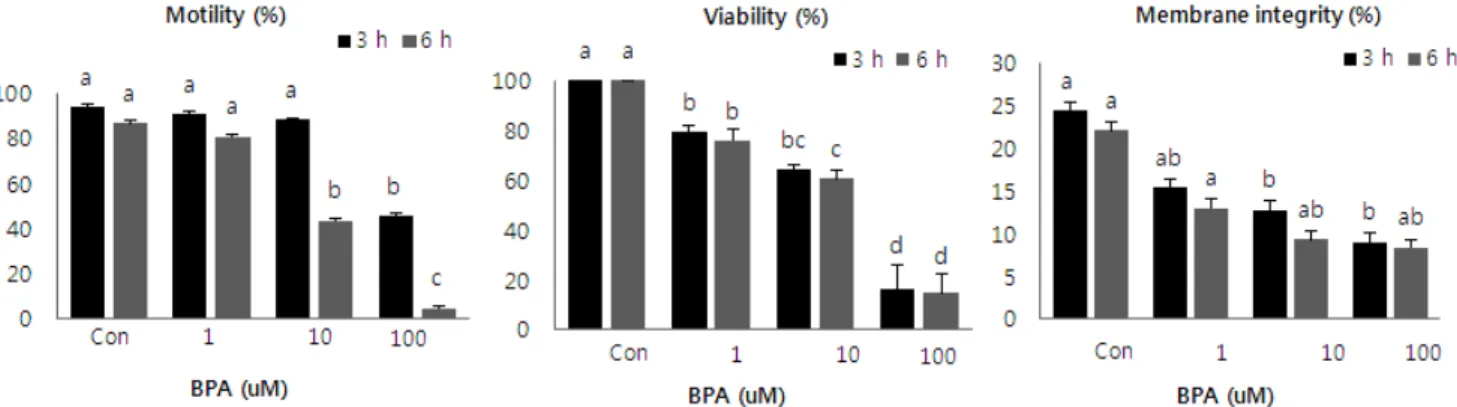
The effect of BPA alone and sylimarin (50 ~200 uM) against BPA (100 uM) on the sperm characteristics (motility, viability, membrane integrity and mitochondria activity) were evaluated for 3 and 6 h incubation periods at 37 ℃. The motility, vi- ability and membrane integrity treated with BPA significantly decreased in a dose- and time-dependent manner (Fig. 1, p<
0.05).
As shown in Fig. 2, sperm motility between control and silymarin group (200 uM) was not significantly differ, but both groups were significantly increased than BPA alone (100 uM) group (p<0.05). The sperm motility in BPA plus siylma-
Fig. 1. Evaluation of sperm characteristics (motility, viability and membrane integrity) in boar semen. Boar sperm were incubated for 3 or 6 h in Modena extender with different concentration of BPA (1, 10 and 100 uM). Con=Control.
a~dMean values with different superscripts within same incubation periods are significantly differ, p<0.05. Data are expressed as are the mean ± SEM of three experiments.
rin group slightly increased in silymarin dose-dependent manner irrespective of incubation periods.
Viability in the sylimarin 100 uM plus BPA 100 uM (72.6%±
2.5 and 82.1%±5.0), sylimarin 200 uM plus BPA 100 uM group (73.2%±4.4 and 87.3%±3.0) for 3 and 6 h incubation periods was significantly higher than that of the BPA 100 uM group (58.0%±5.4 and 47.0%±5.1, p<0.05).
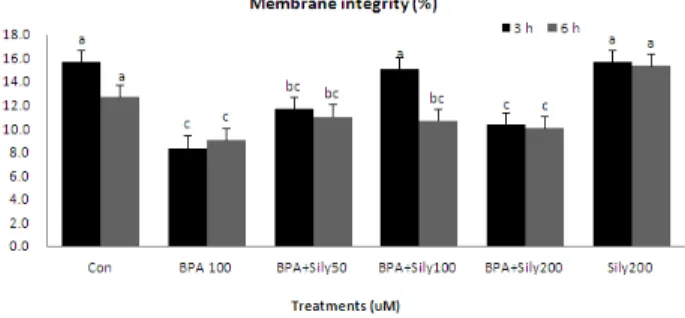
In the results of spermatozoal membrane integrity evaluated by HOST, no significantly changes was observed for 3 and 6 h incubation periods between the BPA 100 uM and sylimarin 200 uM plus BPA 100 uM groups, but sylimarin 200 uM group (15.7%±0.5 and 15.3%±0.5) and control groups (15.7±2.0 and
Fig. 2. Effects of silymarin against BPA on boar sperm motility during in vitro storage. Boar sperm were incubated for 3 or 6 h in Modena extender with different concentration of silymarin (50~200 uM) in the presence or absence of 100 uM BPA. Con=Control, BPA+Sily50=BPA 100 uM+
Silymarin 50 um, BPA+Sily100=BPA 100 uM+Silymarin 100 uM, BPA+Sily200=BPA 100 uM+Silymarin 200 uM.
a~c