형태학적 형질에 의한 한국산 현삼속(현삼과)의 분류학적 연구
장현도, 오병운*
충북대학교 생물학과
A Taxonomic Study of Korean Scrophularia L. (Scrophulariaceae) Based on Morphological Characters
Hyun-Do Jang and Byoung-Un Oh*
Department of Biology, Chungbuk National University, Cheongju 361-365, Korea
Abstract - Morphology of Korean Scrophularia species were reviewed to clarify taxonomic characters, their variations and taxon delimitation. Habitats, root forms, foliaceous types, glandular trichomes on stems and leaves, flowering seasons, calyx shapes, corolla colors and shapes, as well as ovary basal shapes are diagnostic characters to classify series in this genus. From the result, 1) S. alata is distinguished from its closely related species S. takesimensis by lengths of stem ribs, widths of petioles, and types of corolla lobes; 2) S. buergeriana is characterized by spike-like inflorescences, short peduncles and pedicels, and yellowish green corollas; 3) lanceolate-shaped leaves and calyces, and axillary-like cyme inflorescences delimitate S. koraiensis easily from the other taxa; 4) smaller leaves discriminate S. kakudensis var.
microphylla from S. kakudensis var. kakudensis, and 5) S. cephalantha is distinguished from S. kakudensis by broadly ovate to sub-orbicular shaped leaves, earlier flowering seasons, and smaller numbered flowers on shorter inflorescences. In conclusion, the Korean Scrophularia is classified as 7 taxa, 6 species and 1 variety in 2 series. Keys to the series and taxa are provided.
Key words -Scrophularia, Scrophulariaceae, Morphology, Taxonomy, Korea flora
*교신저자(E-mail) :[email protected]
서 언
현삼속(Scrophularia L.)은 주로 유럽, 아시아, 북미 등 북 반구의 온대지역에 약 270종이 분포한다(Stiefelhagen, 1910;
Hong, 1983; Yamazaki, 1993). 동양권 문화에서는 항염, 해 열, 해독 등의 치료를 위해 현삼속 식물의 뿌리를 한약재로 이용하여 왔다(Woo, 1963; Yook, 1989). 국내에서는 현삼(S.
buergeriana Miq.)을 생약명 현삼(玄蔘, scrophulariae radix) 의 기원식물로 보고 있으며(Lee et al., 2010), 또한 큰개현삼 (S. kakudensis Franch.), 토현삼(S. koraiensis Nakai), 섬현삼 (S. takesimensis Nakai)을 대용품으로 이용하고 있다(Hwang et al., 1998).
전통적으로 의웅예(staminode)의 유무와 형태, 약의 색, 열매의 크기, 식물체의 습성 등이 현삼속 내 절(section)을
구분하는 식별형질로 사용되었고, Bentham(1846)과 Bentham and Hooker(1876)는 위 형질에 따라 3개의 절로 정리하였 다. 또한 잎의 형태, 화관 열편의 크기 및 모양 등도 속 내 분류체계를 논의하는 중요 형질로 취급하였다(Boissier, 1879). 근래에는 잎의 형태, 의웅예의 유무 및 형태 등에 따 라 현삼절(sect. Scrophularia L.)과 sect. Canina G. Don 등 2개의 절로 구분하고 있으며(Stiefelhagen, 1910; Ortega- Olivencia and Devesa, 1993), 이후, 염색체를 이용한 세포학 적 연구를 비롯하여(Carlbom, 1968; Grau, 1988; Ortega- Olivencia and Devesa, 1990), nrDNA와 cpDNA를 이용한 분 자생물학적 연구가 이루어지면서 속 내 분류군간의 유연관 계와 진화양상이 논의되고 있다(Olmstead et al., 2001;
Oxelman et al., 2005; Scheunert and Heubl, 2011).
한반도를 비롯한 동북아시아산 현삼속은 약 20분류군이 분포하는 것으로 알려져 있으며(Lee and Yamazaki, 1983;
Yamazaki, 1993; Gorschkova, 1994; Hong et al., 1998), 이들은 Original Research Article
모두 명확한 망상맥을 갖는 현삼절에 포함된다(Stiefelhagen, 1910). Yamazaki(1949)는 직근이 길게 발달하며, 엽신은 두 껍고, 광택이 있는 것을 개현삼열(ser. Grayanae T. Yamaz.) 로, 방추형 괴근을 가지며, 엽신이 종이질인 것을 큰개현삼 열(ser. Kakudenses T. Yamaz.)로 구분하였다. 그 중 한국산 개현삼열에는 개현삼(S. alata A. Gray), 섬현삼 및 설령개현 삼(S. borealikoreana Nakai)이 알려져 있고, 큰개현삼열에는 현삼, 제주현삼(S. buergeriana var. quelpaertensis T. Yamaz.), 몽울토현삼(S. cephalantha Nakai), 큰개현삼, 좀현삼(S. kaku- densis var. microphylla Nakai), 토현삼, 우단현삼(S. koraiensis var. velutina Sakata) 및 일월토현삼(S. pilosa Nakai)이 포함 된다(Park, 1949; Nakai, 1952; Lee and Yamazaki, 1983; Lee, 1996a).
개현삼과 섬현삼은 외부형태학적 형질이 매우 유사하여 줄기와 엽병에 존재하는 날개의 유무로 구분하고 있다 (Yamazaki, 1949; Choi, 2007; Han et al., 2009). 하지만 섬현 삼은 개현삼의 변종으로 취급되기도 하였으며(Yamazaki, 1962), 이들 분류군에 대한 형태학적 비교 연구는 미비한 실정이다. 최근 형태학적 연구와 분자생물학적 연구를 통 해, Han et al.(2009)과 Jang(2010)은 화서가 짧게 발달하는 몽울토현삼과 잎의 크기가 소형인 좀현삼을 생육환경이나 이른 개화기에 나타나는 형태적 변이로 간주하여 큰개현삼 의 이명으로 처리하였다. 그러나 Jang et al.(2011)은 줄기의 마디 수, 잎의 형태와 크기, 개화기, 화서의 형태 등에 의해 몽울토현삼과 좀현삼을 별개의 분류군으로 인정하였다. 한 편, 일월토현삼에 관하여 Han et al.(2009)은 ITS 염기서열 의 결과를 바탕으로 큰개현삼의 이명으로 처리한 바 있으 나 학명 사용에 문제가 있으며, Jang(2010)은 식물체 전체에 조밀하게 발달한 선모의 특징과 DNA 염기서열 분석을 통 해 일월토현삼을 독립된 분류군으로 인식하였으나, Jang et al.(2011)은 기준표본 관찰과 외부형태학적 형질을 토대로 큰개현삼의 이명으로 처리하였다.
이와 같이 학자에 따라 한국산 현삼속에 대한 분류학적 처리가 상이한 이유는 분류군간의 형태학적 유사성으로 동 정이 어려울 뿐만 아니라, 식별형질에 대한 형태학적 연구 가 소상하게 이루어지지 않았기 때문이다. 따라서 본 연구 에서는 한국산 현삼속 식물의 생육지 특성, 지하부의 구조, 줄기와 잎에서 나타나는 형질, 화서형, 꽃, 열매와 종자의 형태 등 전반적인 외부형태학적 형질을 재검토하였다. 이 를 바탕으로 분류군간의 변이 한계를 설정하고, 유용한 식
별형질을 제시하여 종의 한계를 규명하고자 하였다.
재료 및 방법
본 연구에서는 한반도에 생육하는 것으로 알려진 11분류 군 중, 북한에 분포하거나 분류군의 실체가 불명확한 설령 개현삼, 우단현삼 및 제주현삼은 연구 대상에서 제외하였 고, Jang et al.(2011)에 의해 큰개현삼의 이명으로 처리된 일월토현삼은 큰개현삼에 포함시켜 총 7분류군을 대상으로 연구를 수행하였다(Table 1). 형질관찰에 사용된 재료는 2009년 9월부터 2011년 9월까지 개화기와 결실기를 중심으 로 채집된 개체를 건조표본과 70% Ethanol로 고정한 액침 표본으로 제작하여 사용하였으며, 일부는 실험포장에 이식․
재배하여 관찰하였다. 실험에 사용된 재료의 증거표본은 충북대학교 생물학과 식물표본실(CBU)에 보관하였다.
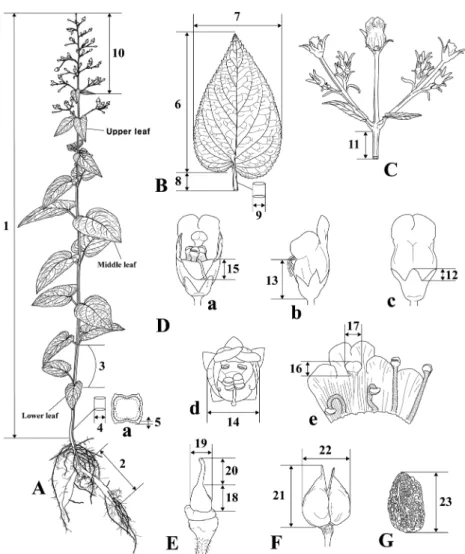
정성적 형질은 육안 또는 해부현미경(Zoom 2000, Leica) 으로 관찰하였고, 형질에 사용된 색은 생체 재료를 대상으 로 색도계(RHS colour chart)를 이용하여 구분하였다. 정량 적 형질은 분류군 당 30개체를 기준으로 하였으나, 재료 확 보가 어려운 분류군(개현삼, 좀현삼, 몽울토현삼)은 5개체 를 최소단위로 하였으며, vernier calipers를 이용하여 측정 하였다(Fig. 1, Table 2). 아울러, 정성적 형질은 변이 정도에 따라 배열하여 경향성을 파악하였으며(Plate 1, Table 3), 일 부 형질은 도해하였다(Figs. 2-10). 형태와 구조에 대한 용어 는 Harris and Harris(2001)를 참고하였다.
관찰 및 결과
생육지(Habitat)
개현삼열의 개현삼과 섬현삼은 해안가 양지의 바닷물이 닿지 않는 바위 틈에 자란다. 큰개현삼열에 속하는 현삼, 큰 개현삼, 좀현삼, 토현삼, 몽울토현삼은 주로 산지의 능선 및 계곡의 낙엽수림 하에 생육한다. 토현삼은 고산 지대에만 분포하는 반면, 큰개현삼은 고산 지대에서부터 구릉지대, 심지어 강가 등의 저지대에서도 자생한다(Table 3).
뿌리의 형태(Root form)
개현삼과 섬현삼의 뿌리는 줄기와 수직으로 20 cm 이상, 길고 곧게 뻗는다. 현삼, 큰개현삼, 좀현삼, 토현삼, 몽울토 현삼은 길이 14 cm 미만의 불규칙한 방추형 괴근이 발달한
Table 1. Collection data and voucher information of inves- tigated accessions in this study. All vouchers were deposited at the Herbarium Chungbuk National University (CBU) Sect. Scrophularia L. 현삼절
1. Ser. Grayanae T. Yamaz. 개현삼열 1) S. alata A. Gray 개현삼
GWz: Yeongnang-dong, Sokcho-si, B.U.Oh et al. 110723-1~6 GW: Yeongnang-dong, Sokcho-si, B.U.Oh et al. 110906-1~2 2) S. takesimensis Nakai 섬현삼
GB: Chusan, Ulleung-gun, H.D.Jang & M.S.Park 110803-1~5 GB: Hyeonpo, Ulleung-gun, H.D.Jang & M.S.Park 110806-1~5 GB: Namyang, Ulleung-gun, B.U.Oh et al. 090901-1~10 GB: Dodong, Ulleung-gun, H.D.Jang & M.S.Park 110805-1 GB: Sadong, Ulleung-gun, H.D.Jang & M.S.Park 110804-1~4 GB: Seokpo, Ulleung-gun, B.U.Oh et al. 090901-1~15
GB: Seonchang, Ulleung-gun, H.D.Jang & M.S.Park 110803-1~2 GB: Tonggumi, Ulleung-gun, B.U.Oh et al. 090901-1
GB: Wadal-li, Ulleung-gun, H.D.Jang & M.S.Park 110805-1~3 2. Ser. kakudenses T. Yamaz. 큰개현삼열
3) S. buergeriana Miq. 현삼
GG: NIHHSy, Suwon-si, J.S.Sung MPS000601~10 CB: NIHHS, Eumseong-gun, H.D.Jang 091015-1~3 CB: NIHHS, Eumseong-gun, H.D.Jang 100720-1~3 4) S. kakudensis Franch. 큰개현삼
GG: Sangbaek-ri, Yeoju-gun, B.U.Oh et al. 110831-1~5 GW: Hambaeksan, Jeongseon-gun, B.U.Oh et al. 090912-1~7 GW: Hambaeksan, Jeongseon-gun, B.U.Oh et al. 100913-1~5 GW: Yeongnang-dong, Sokcho-si, B.U.Oh. et al. 110723-1~4 CB: Sobaeksan, Danyang-gun, B.U.Oh et al. 090913-1~6 CB: Sobaeksan, Danyang-gun, B.U.Oh et al. 091016-1~8 CB: Woraksan, Jecheon-si, B.U.Oh et al. 100831-1~33 GB: Bohyeonsan, Yeongcheon-si, B.U.Oh et al. 090907-1~21 GB: Bohyeonsan, Yeongcheon-si, B.U.Oh et al. 100720-1 GB: Irwolsan, Yeongyang-gun, H.D.Jang & N.Lee 100720-1 GB: Irwolsan, Yeongyang-gun, B.U.Oh et al. 100901-1~14 GB: Irwolsan, Yeongyang-gun, B.U.Oh et al., 110730-1~5 GN: Mireuksan, Tongyeong-si, H.D.Jang & R.Y.Lee 100521-1~10 GN: Mireuksan, Tongyeong-si, H.D.Jang & M.S.Park 110619-1~2 JB: Jeokseongsan, Muju-gun, B.U.Oh et al. 090913-1~2 JN: Baegunsan, Gwangyang-si, B.U.Oh et al. 100918-1~9 JN: Ibapsan, Jangseong-gun, B.U.Oh et al. 101018-1 JN: Jirisan, Gurye-gun, B.U.Oh et al. 091020-1~5 JN: Jirisan, Gurye-gun, B.U.Oh et al. 100716-1~5
Table 1. Continued
JJ: Muryeongari, Seogwipo-si, B.U.Oh et al. 110819-1~3 JJ: Sangumburi, Jeju-si, B.U.Oh et al. 110725-1 5) S. kakudensis var. microphylla Nakai 좀현삼
JJ: Sangumburi, Jeju-si, B.U.Oh et al. 110819-01 JJ: Yonggang-dong, Jeju-si, B.U.Oh et al. 110819-01~4 6) S. koraiensis Nakai 토현삼
GW: Hwaaksan, Gapyeong-gun, B.U.Oh et al. 100912-1~5 GW: Seoraksan, Inje-gun, B.U.Oh et al. 110721-1~16 GW: Taegisan, Hoengseong-gun, B.U.Oh et al. 090910-1~3 GW: Taegisan, Hoengseong-gun, B.U.Oh et al. 100719-1~8 GW: Taegisan, Hoengseong-gun, B.U.Oh et al. 100831-1~11 CB: Sobaeksan, Danyang-gun, B.U.Oh et al. 110819-1~5 7) S. cephalantha Nakai 몽울토현삼
GN: Mireuksan, Tongyeong-si, B.U.Oh et al. 100521-1 GN: Mireuksan, Tongyeong-si, B.U.Oh et al. 110619-1~4
zGG: Gyeonggi-do, GW: Gangwon-do, CB: Chungcheongbuk-do, GB: Gyeongsangbuk-do, GN: Gyeongsangnam-do, JB: Jeollabuk- do, JN: Jeollanam-do, JJ: Jeju-do.
yNIHHS: National Institute of Horticultural and Herbal Science, Korea Rural Development Administration.
다(Plate 1-A, Table 3).
줄기(Stem) 길이와 너비
식물체의 높이는 36.0~182.0 cm로 현삼에서 평균 143.2 cm로 가장 크고, 몽울토현삼에서 평균 49.1 cm로 가장 작으 며, 너비는 1.8~11.7 mm로 섬현삼에서 평균 9.4 mm로 가장 넓고, 좀현삼에서 평균 2.3 mm로 가장 좁다(Table 3).
능각의 길이
모든 분류군에서 4개의 능각이 뚜렷하게 발달한다. 줄기 의 절단면을 살펴보면 개현삼은 능각의 길이가 0.8~1.7 mm 까지 신장되어 날개처럼 발달하나, 나머지 분류군들은 능 각의 길이가 0.6 mm 이하로 짧다(Fig. 2, Table 3).
선모의 유무
큰개현삼, 좀현삼, 토현삼, 몽울토현삼은 줄기 표면에 다 세포성 선모(glandular trichome)가 존재한다. 아울러, 토현 삼과 몽울토현삼은 생육 초기에 선모가 밀생하지만, 개화 기에는 매우 드물게 관찰된다. 개현삼, 섬현삼 및 현삼은 줄
Fig. 1. Morphological characteristics measured in the study (adopted from Jang et al., 2011). A. habit (a. cross-section of stem), B. leaf, C. Cyme, D. flower (a. dorsal view; b. lateral view; c. ventral view; d. top view; e. dissected corolla), E. pistil, F. fruit, G. seed.
Table 2. Quantitative morphological characters measured of Korean Scrophularia. See Fig. 1 for each character numbered 1. height of plant (cm) 13. length of corolla tube (mm)
2. length of root (cm) 14. width of corolla tube (mm) 3. number of stem node (no.) 15. length of corolla lower lobe (mm) 4. width of stem (mm) 16. length of staminode (mm)
5. length of stem rib (mm) 17. width of staminode (mm) 6. length of middle leaf blade (cm) 18. length of ovary (mm) 7. width of middle leaf blade (cm) 19. width of ovary (mm) 8. length of petiole (mm) 20. length of style (mm) 9. width of petiole (mm) 21. length of capsule (mm) 10. length of inflorescence (cm) 22. width of capsule (mm) 11. length of peduncle (mm) 23. length of seed (mm) 12. length of calyx lobe (mm)
Plate 1. External morphology of Korean Scrophularia. A. two types of underground structures (a. simple and stout; b.
fusiform), B. colors of corollas (a. red; b. yellowish green; c. red with partly green), C. shapes and surfaces of stem (a. S. alata; b. S. takesimensis; c. S. buergeriana; d. S. kakudensis; e. S. kakudensis var. microphylla; f. S. koraiensis;
g. S. cephalantha), D. foliaceous types (a. glossy; b. non-glossy).
기 표면에 다세포성 선모가 발달하지 않는다(Plate 1-C, Table 3).
마디의 수
몽울토현삼은 6개 이하의 마디가 발달하나, 나머지 분류 군은 7개 이상의 마디가 발달한다(Table 3).
잎(Leaf) 크기
중부엽의 길이는 4.6~22.2 cm로 섬현삼에서 평균 18.1 cm로 가장 길고, 좀현삼에서 평균 5.1 cm로 가장 짧다. 너 비는 2.1~14.4 cm로 섬현삼에서 평균 10.4 cm로 가장 넓고, 좀현삼에서 평균 2.9 cm로 가장 좁다(Table 3).
모양
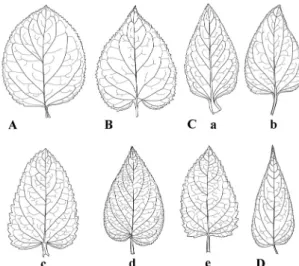
몽울토현삼은 중부엽의 길이와 너비의 비율이 3:2 미만
인 광난형(broadly ovate)~아원형(sub-orbicular)이고, 토현삼 은 1:3 이상인 피침형(lanceolate)이며, 나머지 분류군은 1:2 이상에서 3:2 이하인 난형(ovatze)으로 관찰되었다(Fig. 3).
표면
개현삼과 섬현삼은 잎 표면에 광택이 있으며, 다른 분류 군은 광택이 없다(Plate 1-D, Table 3).
엽정
토현삼은 점첨두(acuminate)이며, 다른 분류군은 예두 (acute)이다(Table 3).
엽병
중부엽 엽병의 길이는 3.9~55.3 mm로 섬현삼에서 평균 37.7 mm로 가장 길고, 현삼에서 평균 10.7 mm로 가장 짧다.
평균 너비는 0.9~11.9 mm로 개현삼에서 평균 8.3 mm로 가
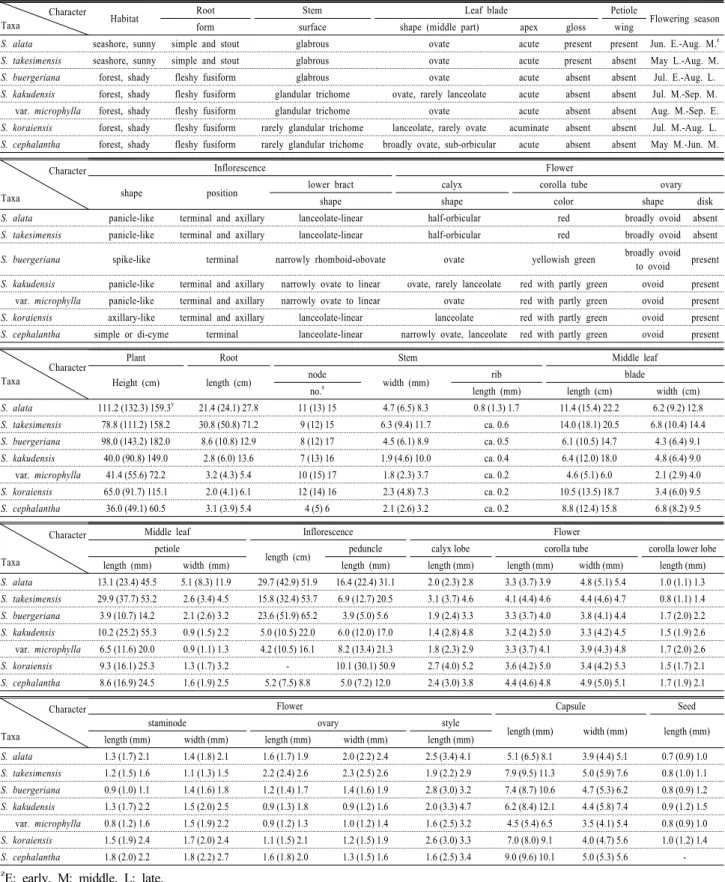
Table 3. Qualitative and quantitative characters of the genus Scrophularia in Korea
Character
Taxa Habitat Root Stem Leaf blade Petiole
Flowering season
form surface shape (middle part) apex gloss wing
S. alata seashore, sunny simple and stout glabrous ovate acute present present Jun. E.-Aug. M.z
S. takesimensis seashore, sunny simple and stout glabrous ovate acute present absent May L.-Aug. M.
S. buergeriana forest, shady fleshy fusiform glabrous ovate acute absent absent Jul. E.-Aug. L.
S. kakudensis forest, shady fleshy fusiform glandular trichome ovate, rarely lanceolate acute absent absent Jul. M.-Sep. M.
var. microphylla forest, shady fleshy fusiform glandular trichome ovate acute absent absent Aug. M.-Sep. E.
S. koraiensis forest, shady fleshy fusiform rarely glandular trichome lanceolate, rarely ovate acuminate absent absent Jul. M.-Aug. L.
S. cephalantha forest, shady fleshy fusiform rarely glandular trichome broadly ovate, sub-orbicular acute absent absent May M.-Jun. M.
Character Taxa
Inflorescence Flower
shape position lower bract calyx corolla tube ovary
shape shape color shape disk
S. alata panicle-like terminal and axillary lanceolate-linear half-orbicular red broadly ovoid absent
S. takesimensis panicle-like terminal and axillary lanceolate-linear half-orbicular red broadly ovoid absent
S. buergeriana spike-like terminal narrowly rhomboid-obovate ovate yellowish green broadly ovoid
to ovoid present S. kakudensis panicle-like terminal and axillary narrowly ovate to linear ovate, rarely lanceolate red with partly green ovoid present var. microphylla panicle-like terminal and axillary narrowly ovate to linear ovate red with partly green ovoid present S. koraiensis axillary-like terminal and axillary lanceolate-linear lanceolate red with partly green ovoid present S. cephalantha simple or di-cyme terminal lanceolate-linear narrowly ovate, lanceolate red with partly green ovoid present
Character Taxa
Plant Root Stem Middle leaf
Height (cm) length (cm) node
width (mm) rib blade
no.x length (mm) length (cm) width (cm)
S. alata 111.2 (132.3) 159.3y 21.4 (24.1) 27.8 11 (13) 15 4.7 (6.5) 8.3 0.8 (1.3) 1.7 11.4 (15.4) 22.2 6.2 (9.2) 12.8 S. takesimensis 78.8 (111.2) 158.2 30.8 (50.8) 71.2 9 (12) 15 6.3 (9.4) 11.7 ca. 0.6 14.0 (18.1) 20.5 6.8 (10.4) 14.4 S. buergeriana 98.0 (143.2) 182.0 8.6 (10.8) 12.9 8 (12) 17 4.5 (6.1) 8.9 ca. 0.5 6.1 (10.5) 14.7 4.3 (6.4) 9.1
S. kakudensis 40.0 (90.8) 149.0 2.8 (6.0) 13.6 7 (13) 16 1.9 (4.6) 10.0 ca. 0.4 6.4 (12.0) 18.0 4.8 (6.4) 9.0
var. microphylla 41.4 (55.6) 72.2 3.2 (4.3) 5.4 10 (15) 17 1.8 (2.3) 3.7 ca. 0.2 4.6 (5.1) 6.0 2.1 (2.9) 4.0
S. koraiensis 65.0 (91.7) 115.1 2.0 (4.1) 6.1 12 (14) 16 2.3 (4.8) 7.3 ca. 0.2 10.5 (13.5) 18.7 3.4 (6.0) 9.5
S. cephalantha 36.0 (49.1) 60.5 3.1 (3.9) 5.4 4 (5) 6 2.1 (2.6) 3.2 ca. 0.2 8.8 (12.4) 15.8 6.8 (8.2) 9.5
Character Taxa
Middle leaf Inflorescence Flower
petiole
length (cm) peduncle calyx lobe corolla tube corolla lower lobe
length (mm) width (mm) length (mm) length (mm) length (mm) width (mm) length (mm)
S. alata 13.1 (23.4) 45.5 5.1 (8.3) 11.9 29.7 (42.9) 51.9 16.4 (22.4) 31.1 2.0 (2.3) 2.8 3.3 (3.7) 3.9 4.8 (5.1) 5.4 1.0 (1.1) 1.3 S. takesimensis 29.9 (37.7) 53.2 2.6 (3.4) 4.5 15.8 (32.4) 53.7 6.9 (12.7) 20.5 3.1 (3.7) 4.6 4.1 (4.4) 4.6 4.4 (4.6) 4.7 0.8 (1.1) 1.4 S. buergeriana 3.9 (10.7) 14.2 2.1 (2.6) 3.2 23.6 (51.9) 65.2 3.9 (5.0) 5.6 1.9 (2.4) 3.3 3.3 (3.7) 4.0 3.8 (4.1) 4.4 1.7 (2.0) 2.2 S. kakudensis 10.2 (25.2) 55.3 0.9 (1.5) 2.2 5.0 (10.5) 22.0 6.0 (12.0) 17.0 1.4 (2.8) 4.8 3.2 (4.2) 5.0 3.3 (4.2) 4.5 1.5 (1.9) 2.6 var. microphylla 6.5 (11.6) 20.0 0.9 (1.1) 1.3 4.2 (10.5) 16.1 8.2 (13.4) 21.3 1.8 (2.3) 2.9 3.3 (3.7) 4.1 3.9 (4.3) 4.8 1.7 (2.0) 2.6 S. koraiensis 9.3 (16.1) 25.3 1.3 (1.7) 3.2 - 10.1 (30.1) 50.9 2.7 (4.0) 5.2 3.6 (4.2) 5.0 3.4 (4.2) 5.3 1.5 (1.7) 2.1 S. cephalantha 8.6 (16.9) 24.5 1.6 (1.9) 2.5 5.2 (7.5) 8.8 5.0 (7.2) 12.0 2.4 (3.0) 3.8 4.4 (4.6) 4.8 4.9 (5.0) 5.1 1.7 (1.9) 2.1
Character Taxa
Flower Capsule Seed
staminode ovary style
length (mm) width (mm) length (mm)
length (mm) width (mm) length (mm) width (mm) length (mm)
S. alata 1.3 (1.7) 2.1 1.4 (1.8) 2.1 1.6 (1.7) 1.9 2.0 (2.2) 2.4 2.5 (3.4) 4.1 5.1 (6.5) 8.1 3.9 (4.4) 5.1 0.7 (0.9) 1.0 S. takesimensis 1.2 (1.5) 1.6 1.1 (1.3) 1.5 2.2 (2.4) 2.6 2.3 (2.5) 2.6 1.9 (2.2) 2.9 7.9 (9.5) 11.3 5.0 (5.9) 7.6 0.8 (1.0) 1.1 S. buergeriana 0.9 (1.0) 1.1 1.4 (1.6) 1.8 1.2 (1.4) 1.7 1.4 (1.6) 1.9 2.8 (3.0) 3.2 7.4 (8.7) 10.6 4.7 (5.3) 6.2 0.8 (0.9) 1.2 S. kakudensis 1.3 (1.7) 2.2 1.5 (2.0) 2.5 0.9 (1.3) 1.8 0.9 (1.2) 1.6 2.0 (3.3) 4.7 6.2 (8.4) 12.1 4.4 (5.8) 7.4 0.9 (1.2) 1.5 var. microphylla 0.8 (1.2) 1.6 1.5 (1.9) 2.2 0.9 (1.2) 1.3 1.0 (1.2) 1.4 1.6 (2.5) 3.2 4.5 (5.4) 6.5 3.5 (4.1) 5.4 0.8 (0.9) 1.0 S. koraiensis 1.5 (1.9) 2.4 1.7 (2.0) 2.4 1.1 (1.5) 2.1 1.2 (1.5) 1.9 2.6 (3.0) 3.3 7.0 (8.0) 9.1 4.0 (4.7) 5.6 1.0 (1.2) 1.4 S. cephalantha 1.8 (2.0) 2.2 1.8 (2.2) 2.7 1.6 (1.8) 2.0 1.3 (1.5) 1.6 1.6 (2.5) 3.4 9.0 (9.6) 10.1 5.0 (5.3) 5.6 - zE: early, M: middle, L: late.
yMinimum (Average) Maximum.
xno.: number.
Fig. 2. Variations of stem cross-section shapes in Korean Scrophularia. A. S. alata, B. S. takesimensis, C. S. buerge- riana, D. S. kakudensis, E. S. kakudensis var. microphylla, F. S. koraiensis, G. S. cephalantha. Note that only S. alata (A) has very well developed ribs on stems.
Fig. 3. Variations of leaf shapes in Korean Scrophularia.
A. sub-orbicular (S. cephalantha), B. broadly ovate (S.
cephalantha), C. ovate (a. S. alata; b. S. takesimensis; c.
S. buergeriana; d. S. kakudensis; e. S. kakudensis var.
microphylla), D. lanceolate (S. koraiensis).
Fig. 4. Variations of inflorescences in Korean Scrophularia.
A. spike-like (S. buergeriana), B. simple or di-cyme type (S. cephalantha), C. panicle-like (S. kakudensis), D. axillary- like (S. koraiensis).
장 넓고, 좀현삼에서 평균 1.1 mm로 가장 좁다(Table 3). 개 현삼은 엽병의 양쪽 끝이 날개처럼 넓게 발달하며(Fig.
3-Ca), 나머지 분류군은 엽병이 날개처럼 발달하지 않는다.
개화기(Flowering season)
개현삼열의 개현삼과 섬현삼의 개화기는 5월 하순~8월 중순으로 다른 분류군에 비해 지속기간이 길다. 큰개현삼 열의 몽울토현삼은 5월 중순~6월 중순으로 다른 분류군에 비해 개화기가 이르고, 지속기간이 짧다. 반면, 현삼, 큰개 현삼, 토현삼은 7월 초순~10월 초순이며, 좀현삼의 개화기 는 8월 중순~10초순으로 다른 분류군에 비해 개화개시기가 늦다(Table 3).
화서(Inflorescence) 화서의 길이
식물체 정단에 발달하는 화축의 길이는 4.2~65.2 cm로 현삼에서 평균 51.9 cm로 가장 길고, 몽울토현삼에서 평균 7.5 cm로 가장 짧다(Table 3).
화서의 형태
현삼은 화경과 소화경이 짧게 발달하여 수상형(spike- like)을 띠고, 몽울토현삼의 화서는 길게 신장하지 않으며, 단순~2회 취산화서(simple or di-cyme)가 화축에 1~6개 정도 달린다. 개현삼, 섬현삼, 큰개현삼, 좀현삼은 화축이 길게
신장하여 원추형(panicle-like)을 띤다. 토현삼의 화서는 잎 이 점진적으로 포로 변하는 형태로, 잎과 포의 경계가 모호 하기 때문에 화서가 마치 엽액에서만 발달한 것(axillary- like)처럼 보인다(Fig. 4, Table 3).
화서의 위치
현삼과 몽울토현삼은 정생(terminal)하고, 나머지 분류군 은 혼생(terminal and axillary)한다(Table 3).
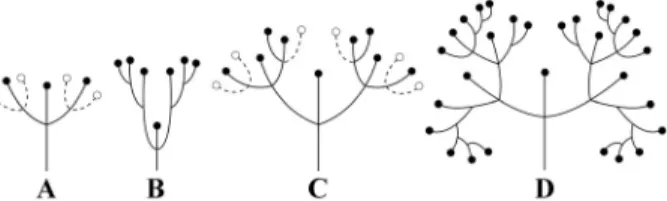
Fig. 5. Variations of cyme branching patterns in Korean Scrophularia. A. simple or di-cyme (S. cephalantha), B.
tri-cyme with short peduncle and apical pedicel (S. buer- geriana), C. tri-cyme (S. kakudensis, S. koraiensis), D.
tetra-cyme with more helicoid cyme (S. alalta, S.
takesimensis).
Fig. 6. Variations of calyx lobe shapes in Korean Scro- phularia. A. half orbicular, B. ovate, C. narrowly ovate, D. lanceolate.
화경의 길이
3.9~50.9 mm로 토현삼에서 평균 30.1 mm로 가장 길고, 현삼이 평균 5.0 mm로 가장 짧다(Table 3).
취산화서의 분지 유형
기본적인 화축의 분지는 취산화서의 형태에 따라 화경에 서 일직선으로 정소화경이 발달하고, 정소화경의 기부에서 부터 차례로 2회~다회의 측소화경이 발달해 나간다. 몽울 토현삼은 정소화경에서 2차 측소화경이 1~2회 분지하고 (Fig. 5-A), 현삼은 화경과 정소화경이 짧게 발달하며, 측소 화경은 약 3회 분지한다(Fig. 5-B). 큰개현삼, 좀현삼 및 토 현삼은 취산화서의 정해진 발달 순서에 따라 소화경이 약 3회 분지하며(Fig. 5-C), 개현삼과 섬현삼은 소화경이 약 4 회 이상 분지 후 권산상(helicoid cyme)으로 수 회 더 분지한 다(Fig. 5-D).
하부포의 형태
현삼은 하부포의 형태가 좁은 능형~도란형이고, 개현삼, 섬현삼, 토현삼 및 몽울토현삼은 피침형~선형이며, 큰개현
삼과 좀현삼은 좁은 난형~선형이다(Table 3).
꽃(Flower) 모양
하나의 화관 통부와 모양이 다른 5개의 화관 열편으로 구성되는 합판화이고, 양성화이다.
꽃받침 열편
꽃받침은 기부가 융합되어 있고, 5개의 열편으로 나누어 진다. 그중 화관 정면의 2개보다 화관 뒷면의 3개의 열편이 조금 더 길다. 열편의 길이는 1.4~5.2 mm로 토현삼이 평균 4.0 mm로 가장 길고, 개현삼과 좀현삼이 평균 2.3 mm로 가 장 짧다. 개현삼과 섬현삼의 열편은 반원형이고, 토현삼은 피침형이며, 몽울토현삼은 좁은 난형~피침형이고, 현삼, 큰 개현삼, 좀현삼은 난형이다(Fig. 6, Table 3).
화관 통부
통부는 원형 또는 아원형이다. 통부의 길이는 몽울토현 삼이 평균 4.6 mm로 가장 길고, 개현삼, 현삼, 좀현삼이 평 균 3.7 mm로 가장 짧다. 너비는 개현삼이 평균 5.1 mm로 가장 넓고, 현삼이 평균 4.1 mm로 가장 좁다(Table 3).
화관 색
현삼은 화관 전체가 연녹색(yellowish green)을 띠고, 개 현삼과 섬현삼은 화관 전체가 붉은색(red)을 띠며, 큰개현 삼, 좀현삼, 몽울토현삼, 토현삼은 부분적으로 연녹색을 띠 는 붉은색(red with partly green)이다(Plate 1-B, Table 3).
화관 열편의 위치
5개의 열편 중 하부열편(lower lobe)은 1개이고, 화관의 아래 방향으로 구부러진다. 1쌍의 측열편(lateral lobe)과 상 부열편(upper lobe)은 화관 위로 곧추선다(Fig. 1-D).
하부열편의 길이
개현삼과 섬현삼은 하부열편이 매우 짧게 발달하며, 길 이가 1.4 mm 이하이다. 나머지 분류군은 하부열편의 길이가 1.5 mm 이상으로 개현삼열에 비해 길게 발달한다(Fig. 7).
측엽편과 상부열편의 중첩 정도
개현삼은 측열편과 상부열편이 중첩되지 않고(Fig. 8-A),
Fig. 7. Variations of corolla lower lobe lengths. A. short type (less than 1.4 mm), B. long type (more than 1.5 mm), a. corolla lower lobes.
Fig. 8. Variations of corolla lateral and upper lobes overlapping in Korean Scrophularia. A. non-overlapping margins (S. alata), B. nearly bordered margins (a. S. koraiensis; b. S. cephalantha;
c. S. kakudensis), C. overlapping margins (S. buergeriana).
Fig. 9. Variations of corolla upper lobes division depths in Korean Scrophularia. A. shorter than the half of upper lobe, B. longer than the half of upper lobe.
Fig. 9. Variations of corolla upper lobes division depths in Korean Scrophularia. A. shorter than the half of upper lobe, B. longer than the half of upper lobe.
Fig. 10. Variations of pistil basal shapes in Korean Scrophularia.
A. non-disked, B. disked.
현삼은 측열편과 상부열편이 명확하게 중첩되며(Fig. 8-B), 다른 분류군은 그 정도가 미미하다(Fig. 8-C).
상부열편의 함입 정도
개현삼은 1쌍의 상부열편 사이가 상부열편 전체 길이의 절반 미만으로 갈라지며, 나머지 분류군은 절반 이상 갈라 진다(Fig. 9).
수술(Stamen)
이강웅예로 4개의 수술 중 화관 정면에 위치하는 2개의 수 술이 먼저 화관 밖으로 노출되며, 이후에 나머지 수술이 화관 밖으로 노출된다. 화사는 선형으로 선모가 존재한며, 약의 형 태는 타원형이며, 열개부(stomium)는 1열로 횡열개한다.
의웅예
5번째 수술이 퇴화된 것으로서, 하나의 의웅예(staminode) 가 존재하며 화관 통부의 내측, 상부 열편 아래에 위치한다.
길이는 몽울토현삼이 평균 2.0 mm로 가장 길고, 현삼이 평 균 1.0 mm로 가장 짧다. 너비는 몽울토현삼이 평균 2.2 mm 로 가장 넓고, 섬현삼에서 평균 1.3 mm로 가장 좁다(Table 3).
암술(Pistil) 자방
상위자방이며, 난형 또는 광난형이다. 표면은 매끄럽고, 연녹색이다. 길이는 0.9~2.6 mm로 섬현삼이 평균 2.4 mm로 가장 길고, 좀현삼이 평균 1.2 mm로 가장 짧다. 직경은 섬 현삼이 평균 2.5 mm로 가장 넓고, 큰개현삼과 좀현삼이 평 균 1.2 mm로 가장 짧다(Table 3).
화반
현삼, 큰개현삼, 좀현삼, 토현삼, 몽울토현삼은 자방의 기 부를 감싸는 화반(disk)이 존재하지만, 개현삼과 섬현삼은 화반이 존재하지 않는다(Fig. 10).
화주 및 주두
화주는 선형이고, 암술의 성장에 따라 화주가 화관 밖으 로 길게 신장되며, 아래를 향해 구부러진다. 길이는 개현삼 이 평균 3.4 mm로 가장 길고, 섬현삼이 평균 2.2 mm로 가 장 짧다(Table 3). 주두는 편평한 원형으로 짧은 돌기가 조 밀하게 발달한다.
열매 및 종자(Fruit and seed) 열매
난형의 삭과(capsule)로서 7~10월에 결실하며, 완전히 성 숙하면 2갈래로 갈라진다. 길이는 몽울토현삼이 평균 9.6 mm로 가장 길고, 좀현삼이 5.4 mm로 가장 짧다. 너비는 섬 현삼이 평균 5.9 mm로 가장 넓고, 좀현삼이 4.1 mm로 가장 좁다(Table 3).
종자
불규칙한 타원형체 또는 난형체이고, 종피는 불규칙한 망상형이다. 길이는 0.7~1.5 mm로 분류군마다 형태가 유사 하여 구별이 어렵다(Table 3).
한국산 현삼속의 검색표
(Key to the Korean Scrophularia)
1. Ovary disks absent; leaves glossy and fleshy; corolla colors red only; roots simple and stout, elongate cylidrical; corolla lower lobes less than 1.4 mm long.
··· I. ser. Grayanae 2. Stems winged; corolla lateral and upper lobes with
non-overlapping margins; corolla upper lobes divided less than half long. ··· 1. S. alalta 2. Stems not winged; corolla lateral and upper lobes with
overlapping margins; corolla upper lobes divided more than half long. ··· 2. S. takesimensis 1. Ovary disks present; leaves chartaceous; corolla colors
yellowish green to red with partly green; roots irregular fusiform; corolla lower lobes more than 1.5 mm long.
··· II. ser. Kakudenses 3. Corolla colors yellowish green; inflorescence spike-
like; stems glabrous. ··· 3. S. buergeriana 3. Corolla colors red with partly green; inflorescence not
spike-like; stems glandulous.
4. Flowering Jul.~Sep.; middle leaves ovate or lanceolate; stem nodes 7 or more in flowering.
5. Inflorescences terminal with or without axillary;
calyces ovate; middle leaves ovate; leaves glandular trichomes dense.
6. Middle leaves more than 6 cm long and 4 cm wide.
··· 4. S. kakudensis 6. Middle leaves less than 6 cm long and 4 cm wide.
··· 5. S. kakudensis var. microphylla 5. Inflorescences axillary-like; calyces lanceolate;
middle leaves lanceolate; leaves glandular trichomes very scarce. ··· 6. S. koraiensis 4. Flowering May~Jun.; middle leaves broadly ovate to
sub-orbicular; stem nodes less than 7 in flowering seasons. ··· 7. S. cephalantha
고 찰
한국산 현삼속 식물에 대한 외부형태학적 형질을 재검토 하였다. 생육지, 뿌리의 형태, 엽질, 개화기, 소화경의 분지 유형, 꽃받침의 형태, 화관의 색, 화관 하부열편의 길이, 화 반의 유무 등에 의해 개현삼열(ser. Grayanae)과 큰개현삼열 (ser. Kakudenses)로 구분되었으며, 이는 Yamazaki(1949)의 분류체계와 일치하였다. 한편, Jang(2010)은 Gorschkova (1994)의 분류체계에 따라 한국산 현삼속을 ser. Alatae Gorschk., ser. Nodosae Gorschk., ser. Altaicae Gorschk. 등 3 개의 열로 구분한 바 있으나, Gorschkova(1994)가 제시한 잎 의 모양과 크기, 줄기와 잎의 날개 유무, 꽃받침과 화관의 비율 등 소수의 형질만으로 한국산 분류군들을 3개의 열로 나누기에는 무리한 점이 있다고 생각되었다.
최근까지 개현삼열에 속하는 개현삼과 섬현삼은 줄기와 엽병에 존재하는 날개의 유무 외에는 알려진 식별형질이 전무하여, 이들 분류군의 명확한 분류학적 위치를 논의하 는데 어려움이 있었다(Nakai, 1938; Yamazaki, 1949; Choi, 2007). 또한 두 분류군의 형태학적 유사성으로 인하여 Yamazaki(1962)는 섬현삼을 개현삼의 변종으로 취급하였다 가 다시 종으로 인정한 바 있다(Lee and Yamazaki, 1983).
본 연구에서 개현삼은 섬현삼에 비해 줄기 능각과 엽병이 날개처럼 길게 발달하고, 화관 측열편과 상부열편이 중첩 되지 않으며, 화관 상부열편 사이가 약하게 갈라지는 특징
에 의해 명확하게 구분할 수 있었다(Fig. 2, Fig. 3, Fig. 8, Fig. 9). Kamada et al.(2007)은 개현삼 줄기의 날개에 대해 해안가의 개방된 지역에서 강한 바람에 저항하여 줄기 조 직이 특수화된 것으로 추정하였다. 이번 결과에서도 개현 삼의 줄기와 날개에 1∼3열의 피층 후각조직이 뚜렷하게 발달하는 것을 확인하였고, 개현삼의 이러한 지지조직 발 달은 생육환경의 차이에 의해 유전적으로 고정된 형질인 것으로 판단되었다. 또한 개현삼은 동해를 따라 한국 중․북 부, 러시아, 일본 중․북부에 넓게 생육하는 반면, 섬현삼은 울릉도에만 고립되어 분포하는 점으로 미루어볼 때, 두 분 류군은 지리적으로 완전히 격리되어 종분화한 것으로 여겨 진다. 따라서 앞서 언급한 형태학적 차이점과 분포학적 특 성 등을 토대로 개현삼과 섬현삼을 각각 독립된 종으로 처 리하는 것이 타당할 것으로 판단되었다.
큰개현삼열에 해당하는 현삼, 큰개현삼, 토현삼, 몽울토 현삼 및 좀현삼은 형태학적으로 유연관계가 높은 근연 분 류군이며, 식물체의 크기, 화서의 형태, 꽃받침의 모양, 선 모의 유무 등에 의해 구분되고 있다(Nakai, 1938; Yamazaki, 1949; Han et al., 2009). 본 연구에서 현삼은 수상형인 화서 의 형태, 정단에서만 발달하는 화서의 위치, 짧은 길이의 화 경과 소화경, 하부포의 형태, 연녹색의 화관, 화관 측열편과 상부열편의 중첩 정도 등이 중요한 식별형질로 확인되었다 (Fig. 4, Fig. 5, Plate 1-B, Fig. 8). 참고로 Lee(2003)와 Lee (2006)의 도감에 수록된 ‘현삼’ 사진 도판은 모두 ‘큰개현 삼’이다.
토현삼은 식물체 전체에 털이 없고(Yamazaki, 1949; Lee, 1996b; Lee, 2003), 엽신과 꽃받침의 형태는 피침형이며, 화 서의 형태가 액생하는 것처럼 보이는 특징을 가진다고 기 록되어 있다(Nakai, 1938; Han et al., 2009; Jang, 2010). 그러 나 위에 언급된 토현삼의 식별형질 중 일부가 부정확하게 기록되어 있어서 표본 관찰시 흔히 큰개현삼으로 오동정 되어왔다. 본 연구에서 토현삼의 털에 대한 형질은 무모가 아니라 유모로써, 생육 초기에 식물체 전체에 선모가 조밀 하게 발달하지만 개화기에는 거의 탈락하여 매우 드물게 분포하는 것으로 확인되었고, 엽신의 형태가 하부엽은 난 형, 중부엽은 피침형 또는 드물게 난형, 상부엽은 피침형의 형태를 띠는 것으로 확인되었다. 또한 Yamazaki(1949)와 Han et al.(2009)은 큰개현삼과 토현삼을 꽃받침의 형태를 이용하여 각각 난형과 피침형으로 구분한 바 있으나, 큰개 현삼에서도 피침형의 꽃받침이 극히 드물게 나타났다. 따
라서 분류군의 동정시 이들 형질은 토현삼의 검색 형질로 사용 가능하지만, 각 기관의 형태에서 나타나는 변이 한계 에 유의하여야 한다. 참고로 Lee(2006)의 2권 183쪽 ‘2665.
큰개현삼’ 사진 도판은 ‘토현삼’이다.
좀현삼에 대하여 Han et al.(2009) 및 Jang(2010)은 nrDNA과 cpDNA 등의 분석 결과를 토대로 큰개현삼의 생 육환경에 따른 형태적 변이로 간주하였다. 본 연구에서도 형태적 유사성에 의해 이들이 진화적으로 밀접한 유연관계 가 있음은 인정되었다. 그러나 잎의 길이 2.7~6.0 cm, 폭 2.1~4.0 cm인 좀현삼 잎의 크기는 큰개현삼 집단(길이 6.4~18.0 cm, 폭 4.8~9.0 cm)과는 뚜렷하게 구분되며, 큰개 현삼 집단에서 좀현삼의 식별형질인 잎 의 크기에 대한 기 록이 없었음을 고려할 때, 좀현삼을 큰개현삼과 유전적 차 이가 없는 동일한 분류군이라고 결론 내리기에는 아직 이 르다고 판단되었다. 따라서 여기서는 잠정적으로 Nakai (1938), Yamazaki(1949), Lee(1996a) 등의 견해와 같이 현재 의 분류계급(var. microphylla)을 유지하였으며, 앞으로도 좀 현삼의 진정한 분류학적 위치는 세심한 자연집단 관찰을 통하여 재검토해야 할 것으로 판단되었다.
몽울토현삼은 줄기에 3~6개의 마디를 가지고, 엽신의 형 태는 광난형~아원형이며, 개화기가 5~6월이고, 화서는 정 단에만 짧게 발달하는 특징 등에 의해 근연분류군과 뚜렷 이 구분되었다(Fig. 3, Fig. 4, Fig. 5, Plate 1-C). 일반적으로 식물의 마디 수는 주변의 환경적 요인에 따라 변이가 심하 지만, 몽울토현삼은 개화기에 6개 이하의 마디 수가 발달하 는 것으로 관찰되었고, 이식․재배한 개체들도 자생지와 동 일한 형질이 발현되는 것으로 미루어 볼 때 이는 유전적으 로 고정된 형질로 판단되었다. 한편, Han et al.(2009) 및 Jang(2010)은 nrDNA과 cpDNA 등의 분석 결과를 근거로 몽 울토현삼을 큰개현삼의 이명으로 처리한 바 있다. 해당 표 본관(JNU, YNUH)에서 이들의 실험에 사용된 증거표본을 확인한 결과, 몽울토현삼의 증거표본(Mt. Mireuk, 31 Aug.
2007, ?, MKS7171, JNU; Mt. Jiri, 2 Aug. 2008, ?, S.Jang 2080802, YNUH)과 동일한 날짜와 장소에서 수집된 표본 및 기록정보는 모두 큰개현삼인 것으로 확인되었다. 따라 서 이들이 제시한 증거표본은 신뢰할 수 없으며, 몽울토현 삼의 독특한 외부형태학적 특징이 큰개현삼과 상당한 차이 를 나타냄에 따라 몽울토현삼은 큰개현삼과는 뚜렷이 구분 되는 독립된 종으로 판단되었다. 또한 Jang et al.(2011)이 보고한 바와 같이 몽울토현삼은 매우 이른 개화기(5~6월)
에 의해 근연 분류군(개화기 7~10월)과 계절적 격리 (seasonal isolation)에 의해 유전적 교류 없이 독립적으로 종 분화하였을 것으로 생각되었다.
결과를 종합하여 외부형태학적 연구 결과에 의한 한국산 현삼속 식물을 2열 6종 1변종, 총 7분류군으로 정리하였다.
본 속의 분류에 있어 형태학적 형질은 각 분류군을 식별하 고 유형화하는데 유용한 것으로 판단되었다. 한편 북한에 분포하거나 분류군의 실체가 불명확한 설령개현삼, 우단현 삼 및 제주현삼은 기준표본과 생육지 확인 등을 통하여 정 확한 실체를 파악해야 할 것으로 생각되며, 또한 한국산 현 삼속의 진화계통에 대한 논의는 주변 국가에 분포하는 분 류군과 함께 해부학적, 세포학적, 분자생물학적 비교 연구 를 수행하여 신중히 재고되어야 할 것으로 판단되었다.
적 요
식별형질이 적거나 명확하지 않아서 동정하는데 어려움 이 있었던 한국산 현삼속 식물의 형태학적 형질을 재검토 하였다. 이에 근거하여 각 분류군의 변이의 한계와 식별형 질을 파악하였다. 생육지, 뿌리의 형태, 엽질, 줄기와 잎에 분포하는 선모의 유무, 개화기, 꽃받침의 형태, 화관의 색, 화관 하부열편의 길이, 화반의 유무 등은 열을 구분하는 형 질로 매우 유용하였다. 이번 연구에서 1) 개현삼열에 속한 개현삼과 섬현삼은 줄기 능각의 길이, 엽병의 너비, 화관 측 열편과 상부열편의 중첩 정도, 화관 상부열편의 함입 정도 등에 의해 명확히 구분할 수 있었다. 큰개현삼열에 속한 2) 현삼은 수상형의 화서 형태, 길이가 매우 짧은 화경과 소화 경, 연녹색의 화관 등이 중요한 식별형질로 확인되었고, 3) 토현삼은 피침형의 엽신과 꽃받침, 엽액형의 화서 형태 등 이 좋은 식별형질이었다. 4) 좀현삼은 매우 작은 잎의 길이 와 너비에 의해 큰개현삼과 구분되었으며, 5) 몽울토현삼은 줄기에 3~6개의 마디를 가지고, 엽신의 형태는 광난형~아 원형이며, 매우 이른 개화기를 가지고, 화서는 정단에만 짧 게 발달하는 특징 등을 가짐으로써 근연분류군과 뚜렷이 구분되었다. 이러한 결과를 바탕으로 한국산 현삼속을 2열 6종 1변종, 총 7분류군으로 정리하였고, 이들에 대한 검색 표를 제시하였다.
사 사
이 논문은 2012년도 정부(교육과학기술부)의 재원으로
한국연구재단의 기초연구사업 지원을 받아 수행된 것임(과 제번호 2012R1A1A2007781).
인용문헌
Bentham, G. 1846. Scrophularia. In de Candolle A.P. (ed.).
Prodromus Systematis Naturalis Regni Vegetabilis, Vol. 10.
Sumptibus Victoris Masson, Paris, France. pp. 302-317.
Bentham, G. and J.D. Hooker. 1876. Genera Plantarum, Vol. 2.
Lovell Reeve e Co., London. UK. pp. 937-938.
Boissier, P.E. 1879. Flora Orientalis, Vol. 4. H. Georg- Bibliopolam, Geneva and Basel, Switzerland. pp. 387-421.
Carlbom, C. 1968. Evolutionary relationships in the genus Scrophularia L. Hereditas 61:287-301.
Choi, H.K. 2007. Scrophularia. In Park, C.W. (ed.). The Genera of Vascular Plants of Korea. Academy Publishing Co., Seoul, Korea. pp. 864-865.
Gorschkova, S.G. 1994. Scrophularia. In Shishkin B.K. and E.G. Bobrov (eds.). Flora of the USSR, Vol. 22. V.L.
Komarov Botanical Institute of the Academy of Sciences of the U.S.S.R., Moskva-Leningrad, Russia. pp. 264-349.
Grau, J. 1988. Scrophularia y Ranunculus, Dos géneros con centro de evolutión en el mediterraneo occidental. Lagascalia 15:39-48.
Han, K.S., S.K. So, C.H. Lee and M.Y. Kim. 2009. Taxonomy of the genus Scrophularia (Scrophulariaceae) in Korea.
Korean J. Pl. Taxon. 39:237-246 (in Korean).
Harris, J.G. and M.W. Harris. 2001. Plant Identification Terminology, 2nd. Ed. Spring Lake Publishing, Spring Lake, Utah, U.S.A.
Hong, D.Y. 1983. The distribution of Scrophulariaceae in the holarctic with special reference to the floristic relationships between eastern Asia and eastern north America. Missouri Bot. Gard. Bull. 70:701-712.
Hong, D.Y., H.B. Yang, C.L. Jin, M.A. Fischer, N.H.
Holmgren and R.R. Mill. 1998. Scrophularia. In Wu, Z.Y.
and P.H. Raven (eds.). Flora of China, Vol. 18. Science Press and Missori Botanical Garden Press, Beijing and St. Louis.
pp. 11-20.
Hwang, S.Y., J.H. Byun, H.J. Song and M.K. Shin. 1998. A herbalogical study on the plants of Scrophulariaceae in Korea. Kor. J. Herbology 13:241-270 (in Korean).
Jang, H.D., T.H. Kim and B.U. Oh. 2011. A taxonomic review of Scrophularia kakudensis Franch. and its relatives. Korean
J. Pl. Taxon. 41:345-352 (in Korean).
Jang, S.Y. 2010. A phylogenetic study of the genus Scrophularia in Korea. M.S. Thesis, Yeungnam University (in Korean).
Kamada, T., T. Yamashiro and M. Maki. 2007. Intraspecific morphological and genetic differentiation in Scrophularia grayana (Scrophulariaceae). J. Pl. Res. 120:437-443.
Lee, J.H., I.H. Jo, J.W. Lee, C.G. Park, K.H. Bang, H.S. Kim and C.B. Park. 2010. Molecular authentication of Scrophularia herbs by PCR-RFLP based on rpl-5 region of mitochondrial DNA. Korean J. Medicinal Crop Sci. 18:173-179 (in Korean).
Lee, T.B. 2003. Coloured Flora of Korea, Vol. 2. Hyangmunsa, Seoul, Korea. pp. 161-163 (in Korean).
Lee, T.B. and T. Yamazaki. 1983. A revision of the Scrophula- riaceae in Korea. Bull. Kwanak Arbor. 4:34-70 (in Korean).
Lee, W.T. 1996a. Lineamenta Florae Koreae. Academy Publishing Co., Seoul, Korea. pp. 1006-1008 (in Korean).
Lee, W.T. 1996b. Standard Illustrations of Korean Plants.
Academy Publishing Co., Seoul, Korea. pp. 321-322 (in Korean).
Lee, Y.N. 2006. New Flora of Korea, Vol. 2. Kyohak Publishing Co., Seoul, Korea. pp. 182-183 (in Korean).
Nakai, T. 1938. Notulae ad Plantas Asiae Orientails (V). J. Jap.
Bot. 14:631-637.
. 1952. A Synoptical Sketch of Korean Flora. Bull. Natl.
Sci. Mus. Tokyo. p. 103.
Olmstead, R.G., C.W. de Pamphilis, A.D. Wolfe, N.D. Young, W.J. Elisens and P.A. Reeves. 2001. Disintegration of Scrophulariaceae. Amer. J. Bot. 88:348-361.
Ortega-Olivencia, A. and J.A. Devesa. 1990. Contribution a1 estudio cariologico del gtnero Scrophularia L. (Scrophula-
riaceae) en la Peninsula Ibtrica e Islas Baleares. Lugascalia 16:171-198.
. 1993. Revisión del género Scrophularia L. (Scrophula- riaceae) en la peninsula Iberica e island Baleares. Ruizia 11:1-157.
Oxelman, B., P. Kornhall, R.G. Olmstead and B. Bremer. 2005.
Further disintegration of Scrophulariaceae. Taxon 54:411- 425.
Park, M.K. 1949. An Enumeration of Korean Plants. Ministry of Education, Korea. pp. 215-216 (in Korean).
Scheunert, A. and G. Heubl. 2011. Phylogenetic relationships among New World Scrophularia L. (Scrophulariaceae): new insights inferred from DNA sequence data. Pl. Syst. Evol.
291:69-89.
Stiefelhagen, H. 1910. Systematische und pflanzengeographics- che studien zur kenhtnis der gattung Scrophularia. Bot.
Jahrb. Syst. 44:406-496.
Woo, W.S. 1963. Active principle, ρ-methoxycinnamic acid, of scrophulariae radix. identification of ρ-methoxycinnamic acid and its antipyretic action. Korean Journal of Pharma- cognosy 7:55-59.
Yamazaki, T. 1949. Scrophularia Asiae orientalis (1). J. Jap.
Bot. 23:79-88.
. 1962. Notes on Scrophulariaceae of Asia. J. Jap. Bot.
37:263-273.
. 1993. Scrophulariaceae. In Iwatsuki, K, T. Yamazaki, D.E. Boufford and H. Ohba (eds.). Flora of Japan, Vol. IIIa.
Kodansha, Tokyo, Japan. pp. 326-331.
Yook, C.S. 1989. Coloured Medicinal Plants of Korea.
Academy Publishing Co., Seoul, Korea. pp. 494-495 (in Korean).
(Received 21 February 2013 ; Revised 1 April 2013 ; Accepted 9 April 2013)