Phylogenetic study of East-Asia Astragalus L.
based on morphological characters
Il-Bae Song
1and Kweon Heo*
Department of Applied Plant Sciences, College of Agriculture and Life Science, Kangwon National University, Chuncheon 200-701, Korea
1Korea Forest Research Institute, Korea Forest Service, Seoul 130-712, Korea (Received 12 August 2014; Revised 26 August 2014; Accepted 2 September 2014)
형태형질에 기초한 동아시아산 황기속 식물의 계통분류
송일배1·허 권*
강원대학교 농업생명과학대학 식물자원응용공학과, 1산림청 국립산림과학원
ABSTRACT:
In order to find useful taxonomic morphological characters, 17 taxa from East-Asia Astragalus and Oxytropis anertii were investigated. In this study, seed coat structure, fruit surface, and fruit anatomical struc- tures were selected to classify the species in Astragalus. As a results, useful morphological and anatomical char- acters in East-Asia Astragalus were life cycle, leaflet shape, raceme, petal color, seed color, pod shape, absent or present of hairs in pod surface, bent degree of dorsal suture, and thickness of endocarp. Using medicinal sources in China, A. floridus, A. membranaceus, A. membranaceus var. mongholicus and A. tongolensis were formed same group. However, these were not completely consensus in the morphological characters. The other hand, A.
koraiensis and A. sikokianus, which have controversial taxonomic issue, have clearly no differences morpho- logical characters each other. Therefore, A. koraiensis, A. sikokianus, and A. bhotanensis should be conducted a comparative study on the DNA sequences and molecular cytology in order to clarify the taxonomic treatments in the near future.
Keywords: Astragalus L., morphological character, phylogenetic, plant anatomy
적 요: 동아시아산 황기속의 외부형태학적 특징과 과피, 종피의 해부구조 및 표면 형태를 조사하여 분류학
적으로 유용한 형질을 찾고자 하였다. 연구 결과, 황기속의 외부형태, 과피, 종피의 형태 및 해부학적 특징 중 생활사, 소엽의 형태, 꽃차례, 꽃잎의 색, 종자의 색, 과피의 형태, 과피 표면에서 털의 존재유무, 봉선의 구조, 그리고 내과피 층의 두께가 종을 나누는 식별형질로 사용될 수 있음을 확인하였다. 이를 바탕으로 중 국에서 황기라는 약재로 사용되어지고 있는 4종의 형태 및 해부학적인 특성을 비교한 결과, 서로 같은 군으 로 유집되었다. 한편, 분류학적으로 논쟁이 되고 있는 정선황기와 갯황기에서는 두 분류군간에 형태적 차이 점을 발견 할 수 없었다. 따라서 금후 정선황기, 갯황기, A. bhotanensis의 종간 분류학적 처리를 명확히 규명 하기 위하여 염기서열 및 분자세포학 수준에서의 연구가 필요하다.
주요어: 황기속, 형태형질, 계통분류, 식물해부학
*Author for correspondence: [email protected] http://www.pltaxa.or.kr
Copyright © 2014 the Korean Society of Plant Taxonomists
황기속(Astragalus L.)은 약 2,500종의 초본과 관목으로 구성되어 있으며(Lock and Simpson, 1991; Mabberly, 2008), 동아시아, Sino-Himalayan, 미국 북서부, 그리고 남아메리 카의 안데스 지역 등 세계적으로 폭넓게 분포하고 있다 (Kim, 2004). 황기속에 대한 형태학적 특징은 잎이 기수우 상복엽이고, 탁엽이 있거나 없으며, 잎자루와 붙는 것도 있다. 꽃은 홍자색 또는 노란색이며, 6-8월에 총상화서로 달린다. 꽃받침은 통형, 선단의 거치는 고르고 자방은 자 루가 있는 것과 없는 것이 있다(Lee, 1980). 5장의 꽃잎은 좌우상칭으로 구성된다. 단일심피와 상위자방을 가지며, 수술은 10개이고 양체웅예이다. 꼬투리는 대부분 타원형 이고, 끝이 뾰족하며, 열매는 협과이다(Lee, 1980). 특히 황 기속은 용골판의 끝이 둔한 특징을 가짐으로써 콩과의 다 른 속들과 구분이 된다(Lee et al., 1985).
우리나라에서 자생하는 황기속 식물은 Chung(1957)이 황기, 자주황기, 제주황기, 염주황기, 설령황기, 자운영, 개황기 등 6분류군으로 분류한 것을 시작으로 많은 학자 들에 의해 조금씩 다르게 분류되어 왔으며, Toh(1971), Im(1975), W. Lee(1996), Y. Lee(1981), Kim(2004) 등에 의해 종의 분포가 밝혀지거나 새로운 분류군이 추가되기도 하 였다. 황기속에 관한 연구로는 Toh(1959)에 의해 황기와 제주황기의 조직학적 연구가 수행되었다. 한편, 20세기 후반부터 분자생물학의 발전과 DNA의 유전정보를 이용 한 분류가 시작되어, 황기속 역시 많은 연구자들에 의해 분자분류에 대한 연구가 수행되었다(Liston and Wheeler, 1994; Sanderson and Wojciechowski, 1996; Ma et al., 2000;
Osaloo, 2003; Huh et al., 2004; Kim, 2004; Lim et al., 2007).
황기(A. membranaceus Bunge)는 우리나라 전역에 분포 하고, 제주황기(A. adsurgens var. alpina)는 한국 특산식물 로 제주도의 고지대에만 분포하는 희귀식물이며, 우리나 라 특산종으로 알려져 있다(Kim, 2004). 정선황기(A.
koraiensis)는 석회암지대에 분포하고(Kim, 2004), 몽골황 기(A. membranaceus var. mongholicus)는 중국의 흑룡강성, 길림성, 하북성 등에 분포하며 황기에 비해 소엽이 비교 적 많고 작은 편이다(Kim et al., 1998). 황기는 황기속 식물 중에서 가장 잘 알려진 종이지만, 우리나라에서는 황기(A.
membranaceus Bunge)와 몽골황기(A. membranaceus var.
mongholicus) 가 혼합되어 유통되고 있는 것과 같이 아직 정확한 종의 동정에 대한 연구는 미미한 실정이다(Lim et al., 2007). 한편 최 등(2013)은 황기와 제주황기의 분류학 적 위치를 연구하면서 결론으로 한반도에서 재배되고 있 는 황기는 A. mongholicus var. dahuricus로 명명하였고, 제 주황기는 A. mongholicus var. nakaianus 로 명명할 것을 제 시하였다. 이처럼 황기의 명명은 아직까지도 토론의 여지 가 많다고 할 수 있다.
본 연구는 현재까지 수집된 동아시아산 황기속의 외부 형태학적 특징은 물론 종자 및 과피의 횡단면 구조와 표 면 형태를 조사하여 분류학적으로 유용한 형질을 찾고자
수행되었으며, 그 자료를 토대로 황기속내의 종간 유연관 계를 파악하고자 하였다. 이를 바탕으로 중국에서 황기로 사용되어지고 있는 종의 유연관계를 파악하고 아울러 분 류학적으로 논쟁의 여지가 있는 정선황기와 갯황기의 형 태 및 해부학적 특성을 비교하여 형태형질 수준에서 종간 유연관계를 파악하고자 하였다.
재료 및 방법
본 연구에 사용된 황기속의 재료는 강원대학교 생물학 과 표본관(KWNU), 미국 뉴욕 식물원 표본관(NY), 미주리 식물원 표본관(MO)으로부터 확보한 표본재료를 사용하 였으며, 외군으로는 두메자운(Oxytropis anertii Nakai)을 사 용하였다. 채집정보는 Table 1에 나타내었다(Table 1).
1. 종피 해부구조
종피는 절단할 크기 및 원활한 탈수를 위하여 종자의 일 부를 자른 후, 50% 에탄올부터 100% 에탄올 까지 차례로 탈수하면서 진공펌프를 이용하여 조직 내의 공기를 제거 한 후, 24시간 침지하였다. Technovit 7100(Kultzer, Germany) 수지를 사용하여 예비 침적액에 시료를 넣고 24 시간 침지한 후, 예비 침적액 10 mL 와 hardner 0.62 mL 를 혼합하여 포매액을 만들어 histoform mold에 붓고 시료를 포매하였다. 포매된 종자를 rotary microtome을 이용하여 4-5 um 두께로 자르고, 1% Toludine Blue O 용액으로 염색 하고 슬라이드를 건조시켰다. 건조 후 Entellan 용액으로 봉입한 다음 2-3일간 방치하여 영구표본을 제작한 후 BX- 50 광학현미경으로 관찰하고 부착된 디지털카메라로 촬 영하였다.
2. 과피 해부 및 표면구조
과피는 절단할 크기 및 원활한 탈수를 위하여 일부를 자 르고, 에탄올로 탈수 하였다. 탈수된 과피는 sonicator로 세 척 후, 임계점 건조기를 이용하여 건조시켰다. Au-Pt 코팅 기(Hitachi E-1010)로 15 mA하에서 3분간 코팅하여 주사전 자현미경(Hitachi S-3500N)으로 10 kV하에서 관찰하고 사 진을 촬영하였다.
3. 계통분석
Astragalus englerianus, A. inopinatus, A. membranaceus cv.
“
Pungsung
”, A. membranaceus cv.
“Longjing
”, A. schelichovii, A. tephrosioides 등 6분류군은 형태 정보를 얻을 수 없어서 계통 분석에서는 제외하고, 형태 정보를 수집한 11종을 내 군으로 하고, 내군과 가까운 두메자운을 외군으로 설정하 여 분석하였다. 외부형태학적 자료, 해부학적 자료를 바 탕으로 모두 10개의 분류학적 형질(Yaklich et al., 1992;
Tiwari et al., 1995; Moise et al., 2005; Hong et al., 2005; Al-
gory et al., 2007)을 선발하였다(Table 2). 외군과 내군의 형
질극성(polarity) 결정은 10개의 형질을 외군과 비교하여 원시형질(plesiomorphy)이면 0으로 하고, 파생형질 (apomorphy) 이면 1로 각각 값을 부여하여 data matrix를 작 성하였으며(Table 3), Mega 5.05 프로그램을 이용하여 최 절약 분지도를 얻었다(Fig. 8).
결 과
1. 과피 및 종피의 해부형태
종자의 크기가 가장 작은 종은 자주황기로 길이가 약
1.0-2.0 mm, 폭이 약 1.0-1.5 mm의 크기를 보였으며, 크기 가 가장 큰 종은 제주황기로 길이가 약 3.6-3.8 mm, 폭이 약 3.0-3.1 mm 정도로 나타났다. 종자의 모양은 모든 종이 신 장형(reniform)을 하고 있었으며, 종자의 색은 짙은 갈색 (dark brown)과 연한 갈색(light brown)의 2가지 색을 나타 내었다. 그리고 황기 및 용정황기는 종자 표면에 반점이 존재하였다(Fig. 1).
협과가 가장 작은 종이 A. inopinatus로 길이가 약 10.0- 10.2 mm, 폭이 약 3.0-3.2 mm의 크기를 보였으며, 협과가 가장 큰 종은 황기로 길이가 38.0-40.0 mm, 폭이 10.0-
Table 1. Collection data of materials used in this study.Taxa Acronym Collection data
Astragalus adsurgens Pall.
ASTAD
China. collected by Liu Tianwei & Zeng Zhaofen in 1985.
August 24. No. 04730349 (MO).
China. collected by Wu Qingru in 1998. May 12.
No. 04550541 (MO).
A. dahuricus (Pall.) DC.
ASTDA
China. Nanjing Institute of Botany, Chinese Academy of Sciences.
collected by Liu Tiezhi in 1997.
August 2. No. 04517907 (MO).
China. Beijing. collected by Jin Shan and Hai Dian Qu in 1986.
August 16. No. 296 (NY).
A. englerianus Ulbr.
ASTEN
China. East side of pass on road between Xiwu and the Sichuan border.
collected by Chindu Xian and Xiwu Xiang in 1996.
September 11 No. 04886561 (MO).
A. floridus Bunge.
ASTFL China. South of old taochow. collected by Ching in 1923.
August 28-31. No. 927 (NY).
A. inopinatus Boriss. ASTIN China. 1993. No. 7333 (NY).
A. koraiensis Y. N. Lee ASTKO Korea. Jeongsun-gun. Hochon-ri. 2011. October 14. (KWNU).
A. membranaceus Bunge.
ASTME China. Mt. Baekdu. collected by B.B.Wan & K.S.Chow in 1981.
No. 81016 (NY).
A. membranaceus cv. ‘Poongsung’
ASTMP Korea. Jeongsun-gun. Agricultural Technology Center.
2011. October 14. (KWNU).
A. membranaceus cv. ‘Longjing’ ASTML China. Mt. Backdu. Collected by K. Heo in 2009. August 30. (KWNU).
A. adsurgens var. alpina Nakai
ASTMA Korea. Jeju Island. Mt. Halla. 2011.
September 29. (KWNU).
A. membranaceus var. mongholicus Hsiao ASTMM China. Mt. Backdu. Collected by K. Heo in 2009. August 30. (KWNU).
A. schelichovii Turcz.
ASTSC China. Kamchatskiy region. collected by S. Kharkevich in 1975. June 24.
No. 04917607 (MO).
A. sikokianus Nakai
ASTSI Korea. Incheon seongmodo. Herbarium of Inha Univ. (IUI). collected by So-young Kim et al. in 2003 July 02. (NY).
A. sinicus L.
ASSIN China. Nanjing Institute of Botany, Chinese Academy of Sciences.
Anhui Prov. Cha-wan and Qi-men in 1987. May 30. No. 10506 (NY).
A. tephrosioides Boiss.
ASTTE Southwest Asia. Unaipass. collected by Robert Gibbons in 1971.
July 2 No. 2438455 (MO).
A. tongolensis Ulbr.
ASTTO China. collected by D.E.Boufford & T.S.Ying in 1995.
July 5. No. 27039 (NY).
A. uliginosus L.
ASTUL China. Nanjing Institute of Botany, collected by Q. R. Wu in 1960.
July 14. No. 04506978 (MO).
Oxytropis anertii Nakai OXYAN China. Mt. Backdu. Collected by K. Heo in 2002. August 5. (KWNU).
Fig. 1. Seed shapes of Astragalus L. A. Astragalus adsurgens. B. A. dahuricus. C. A. englerianus. D. A. floridus. E. A. inopinatus. F. A.
koraiensis. G. A. membranaceus. H. A. membranaceus cv. “Longjing”. I. A. membranaceus cv. “Poongsung”. J. A. adsurgens var. alpina. K.
A. membranaceus var. mongholicus. L. A. schelichovii. M. A. sikokianus. N. A. sinicus. O. A. tephrosioides. P. A. uliginosus. Scale bar equals to 1 mm.
Fig. 2. Pod shapes of Astragalus L. A. Astragalus adsurgens. B. A. dahuricus. C. A. englerianus. D. A. floridus. E. A. inopinatus. F. A.
koraiensis. G. A. membranaceus. H. A. membranaceus cv. “Poongsung”. I. A. adsurgens var. alpina. J. A. membranaceus var. mongholicus.
K. A. schelichovii. L. A. sikokianus. M. A. sinicus. N. A. tephrosioides. O. A. tongolensis. P. A. uliginosus. Scale bar equals to 1 mm.
10.5 mm이었다. 과피의 형태는 원추형(cylindrical)과 타원 형(elliptical)으로 구분되었다(Fig. 2). 과피 색은 짙은 갈색 (dark brown), 연한 갈색(light brown), 연한 녹색(light green) 의 3가지 색을 보여주었고, 과피의 표면을 전자현미경으 로 관찰한 결과, 과피 표면에 털이 발달하는 종과 발달하지 않는 종들이 확인되었다. 대부분 원추형을 하고 있는 종들 은 털이 존재하지 않았으며, 배봉선이 안쪽으로 말려 있는 모양을 하고 있었다(Fig. 3). 연구된 황기속의 모든 종에서 기공이 관찰되었으며, A. englerianus(Fig. 4C), 정선황기(Fig.
4F), 갯황기(Fig. 4L), 개황기(Fig. 4P)에서는 과피 표면에 털 이 없었으며, 협과가 원추형을 하고 있었다. 그 외 나머지
Fig. 3. There are two types of dorsal suture development. A.adsurgens, A. dahuricus, A. koraiensis, A. sikokianus, A. sinicus, and A. uliginosus are bent type (A) and A. adsurgens var. alpina, A.
floridus, A. membranaceus, A. membranaceus var. mongholicus, and A. tongolensis are round type (B). Scale bar equals to 1 mm.
Fig. 4. Pod surfaces of Astragalus L. A. Astragalus adsurgens. B. A. dahuricus. C. A. englerianus. D. A. floridus. E. A. inopinatus. F. A.
koraiensis. G. A. membranaceus. H. A. membranaceus cv. “Poongsung”. I. A. adsurgens var. alpina. J. A. membranaceus var. mongholicus.
K. A. schelichovii. L. A. sikokianus. M. A. sinicus. N. A. tephrosioides. O. A. tongolensis. P. A. uliginosus. Q. Oxytropis anertii. Inside photos show stomata.
종에서는 모두 털이 존재하는 것을 확인하였는데, 특히, 다 화황기(Fig. 4D)와 A. inopinatus(Fig. 4E)에서는 많은 털이 나 타났다(Fig. 4). 털이 존재하는 대부분의 종에서 미세돌기 가 관찰되었지만, A. tephrosioides(Fig. 5K)와 당곡이황기 (Fig. 5L)에서는 미세돌기가 없는 매끄러운 표면을 가지는 것을 관찰하였다(Fig 5). 외군으로 설정한 두메자운의 종자 는 황기속 종들과 마찬가지로 신장형이었다. 종자표면에 반점은 존재하지 않았다. 협과의 모양은 타원형이었으며, 과피 표면에 털과 기공은 발달하지 않았다(Fig. 4Q).
황기속 식물들은 내종피와 외종피로 구성된 양종피성 배주를 가지고 있다(Riahi et al., 2009). 그러나 내종피층은 종 자의 성숙단계에서 완전히 퇴화하였다. 외종피는 외종피 외층(exotesta), 외종피중층(mesotesta), 외종피내층(endotesta) 으로 구분되어지는데, 연구된 모든 종은 콩과식물에서 흔 히 관찰되는 외종피외층형(exotestal type)으로 나타나 분 류군별로 차이가 없었다. 외종피외층은 책상조직 형태의 대보강세포(macrosclereid)로 발달하였고, 탄닌을 함유하
고 있었다(Fig. 6). 외종피중층은 압축된 층(Figs. 6A, B, F, H, K, L, M, O) 과 퇴화된 층(Figs. 6C, E, G, P)으로 구별되었 는데 완전히 성숙하면 퇴화하거나 흔적만 남게 된다. 그 리고 외종피 내층은 완전히 퇴화하여 형태적 특징이 없었 다. 외군으로 설정한 두메자운도 황기속의 종들과 같은 외종피 외층형이었다(Fig. 6). 그러나 과피의 해부학적인 구조에서 황기속의 종간 차이점을 발견하였다. 과피 (pericarp)는 외과피(exocarp), 중과피(mesocarp), 내과피 (endocarp)로 구분되어 지는데, 내과피층에서 후벽세포의 층수에 따라서 종간 차이를 나타내었다(Fig. 7). 후벽세포 층이 1-2층으로 발달한 그룹(Figs. 7B, D, G, H, J, K, M)과 여 러 층으로 발달하는 그룹으로(Figs. 7A, C, E, F, I, L, N, O, P) 나누어졌다. 외과피는 한 층으로 이루어져 있었으며, 중과 피는 압축된 형태를 하고 있어 층이 뚜렷하게 구별되지 않았다. 외군인 두메자운은 내과피층의 후벽세포층이 1-2 층으로 구성되어 있었으며, 외과피는 한 층으로 이루어져 있었고, 중과피는 압축된 형태를 보였다.
Fig. 5. Trichome morphology of Astragalus L. A. Astragalus adsurgens. B. A. dahuricus. C. A. floridus. D. A. inopinatus. E. A.
membranaceus. F. A. membranaceus cv. “Poongsung”. G. A. adsurgens var. alpina. H. A. membranaceus var. mongholicus. I. A. schelichovii.
J. A. sinicus. K. A. tephrosioides. L. A. tongolensis.
2. 형태형질 선발
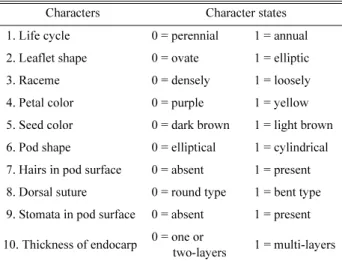
조사된 형태적 특징을 대상으로 형질 비교가 가능한 생 활환, 소엽형태, 화서밀도, 꽃색, 종자색, 과피 모양, 과피 표면 털 유무, 배봉선의 구부러짐, 과피 표면 기공 유무, 내 과피층 두께 등 10개의 형태형질을 선발하였다(Table 2).
3. 계통분석
형태학적인 정보를 이용할 수 없는 5개 분류군을 제외하 고 황기 속내 11개 분류군과 외군인 두메자운에 대하여 선 발된 10개의 형태학적 형질을 바탕으로 계통분석을 실시하 였다(Table 3). 분석결과 최절약 분지도(cladogram)를 얻었으
Fig. 6. Transverse section (TS) of seed coat of Astragalus L. A. Astragalus adsurgens. B. A. dahuricus. C. A. englerianus. D. A. floridus. E. A.inopinatus. F. A. koraiensis. G. A. membranaceus. H. A. membranaceus cv. “Longjing”. I. A. membranaceus cv. “Poongsung”. J. A.
adsurgens var. alpina. K. A. membranaceus var. mongholicus. L. A. schelichovii. M. A. sikokianus. N. A. sinicus. O. A. tephrosioides. P. A.
uliginosus. Q. Oxytropis anertii. Abbreviations: exts, exotesta; mts, mesotesta; ets, endotesta. Scale bars equal to 25
µ
m.며, 한 개의 분지도(Neighbor-Joining tree)는 Fig. 8과 같다.
분석 결과, 모두 세 개의 분지군으로 유집되었다. 첫 번 째 그룹은 황기(ASTME), 다화황기(ASTFL), 당곡이황기 (ASTTO), 제주황기(ASTMA), 몽골황기(ASTMM)가 유집
되었으며, 외군인 두메자운(OXYAN)에서 가장 먼저 분지 되어 형태 계통수의 기부에 위치하였다. 이 그룹에서 과 피는 타원형의 형태를 가지고 있으며, 배봉선은 평평한 형태를 취하는 공통적인 특징을 나타내었다. 그리고 제주
Fig. 7. Transverse section (TS) of pericarp in Astragalus L. A. Astragalus adsurgens. B. A. dahuricus. C. A. englerianus. D. A. floridus. E. A.inopinatus. F. A. koraiensis. G. A. membranaceus. H. A. membranaceus cv. ‘Poongsung’. I. A. adsurgens var. alpina. J. A. membranaceus var.
mongholicus. K. A. schelichovii. L. A. sikokianus. M. A. sinicus. N. A. tephrosioides. O. A. tongolenesis. P. A. uliginosus. Q. Oxytropis anertii.
Abbreviations: Ex, exocarp; Ms, mesocarp; En, endocarp; Scl, sclerenchyma. Scale bars equal to 25
µ
m.황기와 몽골황기는 꽃차례에 의해 다화황기, 당곡이황기, 황기와 분지되었으며, 소엽의 형태에 의해 다화황기는 황 기와 당곡이황기로 나누어졌다. 두 번째 그룹은 자주황기 (ASTDA), 자주개황기(ASTAD), 자운영(ASSIN)이 유집되 었다. 세 번째 그룹은 정선황기(ASTKO), 갯황기(ASTSI), 개황기(ASTUL)가 유집되었다. 또한 두 번째 그룹에서 자 주황기, 자주개황기, 자운영은 개황기, 갯황기, 정선황기 와 자매군을 형성하였다. 이 두 그룹은 과피가 원추형의 형태를 하고 있으며, 배봉선이 안으로 말려있는 형태(bent type)를 취한다는 공통점을 가지고 있었다. 그리고 자주색 의 꽃을 가지며, 과피 표면에 털이 존재함으로써 자주개 황기, 자주황기. 자운영은 정선황기, 갯황기, 개황기와 구 분되어 졌다. 특히, 자주개황기는 다년생 초본이며, 내과 피의 두께가 다층구조를 나타냄에 따라 자주황기 및 자운
영과 확연히 구별되었다. 그리고 정선황기와 갯황기는 종 자의 색에 의해 개황기와 차이를 나타내었다.
고 찰
해부학적 형질 및 형태학적 형질을 이용하여 동아시아 산 황기속의 종간 유연관계를 파악하였으며, 이를 통하여 형태형질이 종간 식별 형질로 유용하게 활용될 수 있는 가 능성을 확인하였다. 연구 결과, 동아시아산 황기속의 종피 해부구조는 종간 뚜렷한 차이점을 발견할 수 없었다. 따라 서, 황기속은 꽃의 색깔, 협과의 모양, 협과 표면의 털 유무, 소엽의 모양, 생활환, 종피 색, 배봉선 모양, 꽃차례 등이 종을 나누는 식별형질로 사용될 수 있음을 확인하였다 (Table 2).
Table 2. Morphological characters and character state selected for cladistic analysis of East-Asia Astragalus L.
Characters Character states
1. Life cycle 0 = perennial 1 = annual 2. Leaflet shape 0 = ovate 1 = elliptic
3. Raceme 0 = densely 1 = loosely
4. Petal color 0 = purple 1 = yellow 5. Seed color 0 = dark brown 1 = light brown 6. Pod shape 0 = elliptical 1 = cylindrical 7. Hairs in pod surface 0 = absent 1 = present 8. Dorsal suture 0 = round type 1 = bent type 9. Stomata in pod surface 0 = absent 1 = present 10. Thickness of endocarp 0 = one or
two-layers 1 = multi-layers
Table 3. Data matrix used for cladistic analysis of East-Asia Astragalus L. based on morphological characters.
Taxa Acronym 1 2 3 4 5 6 7 8 9 10
Astragalus adsurgens ASTAD 0 0 0 0 0 1 1 1 1 1
A. dahuricus ASTDA 1 1 0 0 0 1 1 1 1 0
A. floridus ASTFL 0 1 0 1 0 0 1 0 1 0
A. koraiensis ASTKO 0 1 0 1 1 1 0 1 1 1
A. membranaceus ASTME 0 0 0 1 0 0 1 0 1 0
A. adsurgens
var. alpina ASTMA 0 1 1 1 0 0 1 0 1 1
A. membranaceus
var. mongholicus ASTMM 0 1 1 1 0 0 1 0 1 0
A. sikokianus ASTSI 0 1 0 1 1 1 0 1 1 1
A. sinicus ASSIN 1 0 1 0 0 1 1 1 1 0
A. tongolensis ASTTO 0 0 0 1 0 0 1 0 1 1
A. uliginosus ASTUL 0 1 0 1 0 1 0 1 1 1
Oxytropis anertii OXYAN 0 0 0 0 0 0 0 0 0 0
Fig. 8. Cladogram based on morphological characters in East-Asia Astragalus L. Acronym refer to Table 1 and Characters refer to Table 3. ● similar two species; ◆ using species same medicinal source in China.
중국에서 황기라는 약재로 통용되고 있는 것 중 본 연구 에서는 황기(A. membranaceus), 당곡이황기(A. tongolensis), 다화황기(A. floridus), 몽골황기(A. membranaceus var.
mongholicus) 를 관찰한 결과, 종자는 신장형을 나타냈으며, 과피의 모양은 타원형을 하고 있었다. 더불어 과피 표면 에 모두 털이 존재하는 것을 확인하였고, 다화황기와 당 곡이황기는 털이 좀 더 많이 밀생하는 것을 확인하였다.
황기, 몽골황기, 다화황기는 과피 표면에 털이 존재하며 털에 ff미세돌기가 존재하였지만, 당곡이황기의 털은 미 세돌기가 존재하지 않는 매끄러운 표면을 가지는 것으로 확인되었다. 과피의 구조는 내과피에서 차이를 보였다.
황기와 몽골황기, 다화황기는 단층구조임을 보였으며, 당 곡이황기는 다층구조로 나타나는 것을 확인하였다. 이전 의 연구에서 Dong et al. (2003)은 황기와 몽골황기가 가장 가까운 염기서열 유사성을 보인다고 보고하였는데, 형태 및 해부학적인 특징 또한 황기는 몽골황기와 많은 공통점 을 가지고 있는 것으로 나타났다.
한편, 정선황기는 갯황기의 이명으로 처리되어야 한다 는 주장이 제기되고 있는데(Kim, 2004). 그 이유는 형태적 인 특징과 ITS 및 RAPD분석에 있어서 차이점을 보이지 않는다는 것이다. 이번 연구에서도 정선황기와 갯황기는 종자크기, 종자모양, 종자의 색, 종피의 구조, 과피의 크기, 과피 모양, 과피색, 배봉선의 형태, 과피의 구조에 있어서 차이점을 발견할 수 없었다. 이러한 결과는 Kim (2004)의 견해와 일치하였다. 따라서 형태학적인 형질을 기초로 하 여 정선황기(A. koraiensis)는 갯황기(A. sikokianus)의 이명 으로 처리되어야 한다고 생각한다. 황기속에서 아속 (subgenus)을 나눌 때 털의 형질이 중요하게 다뤄지는데 정선황기와 갯황기는 중착형 털을 갖는 subgenus Cercidothrix Bunge 에 속하며 형태형질도 이를 잘 뒷받침하 고 있다. 본 연구에서도 A. englerianus, 정선황기, 갯황기, 개황기 그룹은 subgenus Cercidothrix Bunge에 속하고, 황기, 제주황기, 몽골황기 황기, 다화황기, 당곡이황기가 저착 형 털을 갖는 subgenus Phaca Bunge에 유집되었다. 한편 Kim (2004) 이 정선황기와 A. bhotanensis가 매우 유사한 분 류군이라고 언급하였는데 이번 연구에서는 제시되지 못 하였으나 저자가 미주리 표본관을 통하여 A. bhotan- ensis(No. 04537371, MO) 의 협과를 확인한 결과 협과 형태, 크기, 털의 존재유무 등에서 상당히 유사한 특징을 가지 고 있었지만 소엽의 수에서 약간의 차이가 있음을 확인하 였다(pers. comm.). 또한 A. bhotanensis의 분포지역이 대부 분 중국 남부 간수, 귀주, 산시, 사천, 운남성 그리고 부탄 인 반면, 유독 동아시아의 남한에 A. bhotanensis이 자생한 다고 되어 있는 점은 재확인할 필요가 있다. 따라서 향후 정선황기(A. koraiensis), 갯황기(A. sikokianus) 및 A.
bhotanensis의 재료를 확보하여 DNA 염기서열은 물론 molecular cytology 연구를 통하여 이들 종의 동정을 명확 히 해결할 필요가 있다.
사 사
본 연구를 위해 귀중한 표본을 대여해 주신 뉴욕식물원 (NY)과 미주리 식물원(MO)의 표본관 관계자께 감사합니 다. 아울러 논문 심사과정중 아낌없는 조언과 교정을 해 주 신 익명의 심사자들께 감사합니다. 본 연구는 강원대학교 기성회 연구비지원에 의해 수행되었습니다(No. 120131307).
인용문헌
Al-gohary, I. H. and A. H. Mohamed. 2007. Seed morphology of Acacia in Egypt and its taxonomic significance. International Journal of Agriculture and Biology 9(3): 435-438.
Choi, I. S., S. Y. Kim and B. H. Choi. 2013. Taxonomic position and genetic differentiation of Korean Astragalus mongholicus Bunge. Korean Journal of Plant Taxonomy 43(1): 12-21.
Chung, T. H. 1957. Korean Flora. Sinjisa, Seoul. pp. 336-339. (in Korean)
Dong, T. T. X., X. Q. Ma, C. Clarke, Z. H. Song, Z. N. Ji, K. L.
Chun and K. W. K. Tsim. 2003. Phylogeny of Astragalus in China: molecular evidence from the DNA sequences of 5S rRNA spacer, ITS, and 18S rRNA. Journal of Agriculture Food Chemistry 51: 6709-6741.
Hong, L. W. 2005. Structure and development of Medicago trun- catula pod wall and seed coat. Annals of Botany 95: 737-747.
Huh, M. K., K. H. Bang and J. H. Cho. 2004. Genetic diversity and discrimination of Astragalus membranaceus Bunge and A.
membranaceus var. mongholicus using RAPD makers. Korean Journal of Oriental Physiology and Pathology 18(3): 825-829.
(in Korean)
Im, R. J. 1975. Flora of Coreana 4. Science and Technology Pub- lishing House Pyongyang, Korea. Pp. 115-120. (in Korean) Kim, S. Y. 2004. Taxonomic study on the genus Astragalus (Legu-
minosae) in Korea. Submitted to the faculty of Inha Univ. in partial fulfillment of the requirements for the degree of master of biology. (in Korean)
Lee, C. B. 1980. Illustrated Flora of Korea. Hyangmunsa Press, Seoul. pp. 491-492. (in Korean)
Lee, C. B., Y. S. Kim, J. S. Kim and J. S. Lee. 1985. Plant Tax- onomy. Hyangmunsa Press, Seoul. (in Korean).
Lee, W. T. 1996. Coloured Standard Illustrations of Korean Plants.
Academy Press, Seoul. Pp. 555-558. (in Korean)
Lee, Y. N. 1981. New taxa of Korean flora. Korean Journal of Bot- any 24: 27-30. (in Korean)
Lim, J. H., D. C. Kim, J. S. Sung, K. H. Bang, O. T. Kim, S. W.
Cha and H. W. Park. 2007. Discrimination of Astragalus mem- branaceus (Fisch) Bunge from A. membranaceus (Fisch) Bunge var. mongholicus (Bunge) with SCAR marker. Korean
Journal of Medicinal Crop Science 15: 51-55. (in Korean) Liston, A. and J. A. Wheeler. 1994. The phylogenetic position of
the genus Astragalus (Fabaceae): evidence from the chloro- plast genes rpoC1 and rpoC2. Journal of Biochemical System- atics and Ecology 22: 377-388.
Lock, J. M. and K. Simpson. 1991. Legumes of West Asia, a check list. Royal Botanical Gerdens, Kew, England.
Ma, X. Q., J. A. Duan, D. Y. Zhu, T. T. X. Dong and K. W. K.
Tsim. 2000. Species identification of radix Astragali (Hua- ngqi) by DNA sequence of its 5S-rRNA spacer domain. Phy- tochemistry 54: 363-368.
Mabberley, D. J. 2008. Mabberley's plant book. 3rd edition. Cam- bridge. Pp. 77, 474.
Moise, J. A., S. Han, L. Gudynaite-Savitch, D. A. Johnson and B.
I. A. Miki. 2005. Seed coats: structure, development, compo- sition, and biotechnology. In Vitro Cell and Development Biology-Plant 41: 620-644.
Osaloo, S. K., A. A. Maassoumi and N. Murakami. 2003. Molec- ular systematics of the genus Astragalus L. (Fabaceae): Phy- logenetic analyses of nuclear ribosomal DNA internal transcribed spacers and chloroplast gene ndhF sequence. Plant Systematics and Evolution 242: 1-32.
Park, J. W. 2007. The Genera of Vascular Plant of Korea. Flora of Korea Editorial Committee.
Riahi, M. and S. Zarre. 2009. Seed development in Astragalus cemerinus and A. ruxcifolius (Fabaceae), and ITS systematic implications. Acta biologica cracoviensia series Botany 51:
111-117.
Sanderson, M. J. and M. F. Wojciechowski. 1996. Diversification rates in a template legume clade: are there so many species of Astragalus (Fabaceae). American Journal of Botany 83: 1488- 1502.
Tiwari, S. P. and V. S. Bhatia. 1995. Characters of pod anatomy associated with resistance to pod-shattering in soybean.
Annals of Botany 76: 483-485.
Toh, C. A. 1959. Histological comparison of Astragalus membran- aceus vs. Astragalus membranaceus var. alpinus. A master's thesis of Ehwa Womans University. Pp. 1-17. (in Korean) Toh, C. A. 1971. A cytotaxonomic study on the Astragalus mem-
branaceus and Astragalus membranaceus var. alpinus. Korean Journal of Plant Taxonomy 3: 57-61. (in Korean)
Yaklich, R. W., E. L. Vigil, E. F. Erbe and W. P. Wergin. 1992. The fine structure of aleurone cells in the soybean seed coat. Pro- toplasma 167: 108-119.