• 검색 결과가 없습니다.

Taxonomic Re-evaluation of Korean Gyromitra Species Based on Morphological and Phylogenetical Studies

N/A
N/A
Protected

Academic year: 2021

Share "Taxonomic Re-evaluation of Korean Gyromitra Species Based on Morphological and Phylogenetical Studies"

Copied!
9
0
0

로드 중.... (전체 텍스트 보기)

전체 글

(1)

This is an Open Access ar ticle distributed under the terms of the Creative Commons Attribution Non-Commercial License (http:

//creativecommons.org/licenses/by-nc/4.0/) which permits unrestricted non-commercial use, distribution, and reproduction in any medium, provided the original work is properly cited.

© 2021 THE KOREAN SOCIETY OF MYCOLOGY.

Accepted: September 27, 2021 Revised: September 16, 2021 Received: July 26, 2021

https://doi.org/10.4489/KJM.20210032 Kor. J. Mycol. 2021 September, 49(3): 363-371

OPEN ACCESS pISSN : 0253-651X eISSN : 2383-5249

RESEARCH ARTICLE

Taxonomic Re-evaluation of Korean

Gyromitra Species Based on Morphological and Phylogenetical Studies

Sung-Eun Cho, Young-Nam Kwag, Sang-Kuk Han and Chang Sun Kim*

Forest Biodiversity Division, Korea National Arboretum, Pocheon 11186, Korea.

*Corresponding author: [email protected]

ABSTRACT

Several species of Gyromitra are highly poisonous when consumed raw the presence of gyromitrin. In this study, Gyromitra specimens deposited in the Korea National Arboretum were re-examined and subjected to molecular sequence analysis. G. gigas, G. aff. perlata, and G. tianshanensis were identified based on their morphological features and molecular phylogenetic analysis for the first time in Korea. Furthermore, internal transcribed spacer and 28S rRNA sequences of G. esculenta and G. infula were analyzed to confirm their phylogeny.

Keywords: Discinaceae, false morels, Gyromitra, Pezizales, phylogeny

INTRODUCTION

Gyromitra is a genus of Ascomycota, and its species commonly referred to false morels, exhibit a mycorrhizal association. Some Gyromitra species, including G. esculenta, G. fastigiata, G. gigas, and G.

infula, cause severe poisoning and even death humans the presence of toxic gyromitrins [1]. Gyromitra has a taxonomic history of transfers among various genera, including Discina, Helvella, and Maublancomyces.

Traditional characters have been used to segregate species, including their ecological features and macro- and micro-scopic characteristics. [2]. Five subgenera have been recognized in Gyromitra: Caroliniana, Discina, Gyromitra, Melaleucoides, and Pseudorhizina [3]. Recently, the subgenus Pseudoverpa was described based on its unique morphoecological profile of the Cypriot collections [4]. In addition, internal transcribed spacer (ITS) and Large subunit (LSU) phylogenetic analyses showed that collections from Cyprus in a well-supported clade within Gyromitra distant from their closest neighbor by 26 positions at the LSU locus.

To date, two species of Gyromitra (G. esculenta and G. infula) have been recorded in Korea [5]. In this

study, we analyzed the morphological characteristics and sequence data of three unrecorded Gyromitra

species to confirm their taxonomic position.

(2)

MATERIALS AND METHODS

Fungal materials and morphological observation

Twelve specimens of Gyromitra have been collected during mushroom field foray since 2009. Macro- morphological characteristics were examined using a dissecting microscope. For characterization, the paraphyses, asci, and ascospores were mounted in distilled water and 5% KOH, examined using an Olympus BX53 compound microscope (Olympus, MA, United States), and photographed with a Jenoptik ProgRes C14 Plus camera (Jenoptik Corporation, Jena, Germany). Microscopic parameters were measured and calculated using ProgRes Capture Pro v. 2.8.8 software (Jenoptik Corporation). The dried specimens were deposited in the Korea National Arboretum (KH).

DNA isolation, ITS sequencing, and phylogenetic analysis

Genomic DNA was extracted from 12 specimens using the DNeasy Plant Mini DNA Extraction Kit (Qiagen Inc., Valencia, CA, USA), following the manufacturer’s instructions, and used for PCR amplification. ITS 1 and 2, along with 5.8S rDNA were amplified using the primers ITS1 and ITS4 [6]. The 28S nuclear ribosomal LSU was amplified using the primers LR0R and LR6 [2]. The sequences generated in this study were assembled using Chromas v. 2.6.6, and then edited using BioEdit v. 7.2.5 [7] and MEGA v. 7.0.26 [8]. equences were assembled and deposited in GenBank. The ITS and LSU accession numbers are in Table 1. For phylogenetic analyses, the were aligned using MAFFT v. 7.475 [9] using the auto-option mode. Phylogenetic trees were constructed using RAxML in the CIPRES Science Gateway v.3.3 portal [10].

The relative robustness of the individual branches was estimated by bootstrapping with 1,000 replicates.

Table 1. Gyromitra specimens used in this study including locality, ITS and LSU GenBank accession numbers.

Species Specimen no. Coll. Date Locality ITS 28S

G. esculenta KA19-0028 3-May-2019 Pyeongchang-gun, Korea MZ567191 MZ573190

KA21-0149 4-May-2021 Pyeongchang-gun, Korea MZ567194 MZ573193 KA21-0150 4-May-2021 Pyeongchang-gun, Korea MZ567195 MZ573194 KA21-0151 4-May-2021 Pyeongchang-gun, Korea MZ567196 MZ573195

G. gigas KA19-0027 3-May-2019 Pyeongchang-gun, Korea MZ567190 MZ573189

KA21-0152 4-May-2021 Pyeongchang-gun, Korea MZ567197 MZ573196 KA21-0153 4-May-2021 Pyeongchang-gun, Korea MZ567198 MZ573197

G. infula KM09-0298 20-Jul-2009 Hongcheon-gun, Korea MZ567199 –

G. aff. perlata KA15-0013 7-May2015 Pocheon-si, Korea MZ567189 –

KA20-0002 9-Mar-2020 Pocheon-si, Korea MZ567192 MZ573191

KA20-0006 30-Mar-2020 Pocheon-si, Korea MZ567193 MZ573192

G. tianshanensis KA13-1244 26-Sep-2013 Ulleung-gun, Korea MZ567188 MZ573188

ITS, internal transcribed spacer region; 28s: 28s nuclear ribosomal LSU

(3)

RESULTS

Phylogenetic analysis

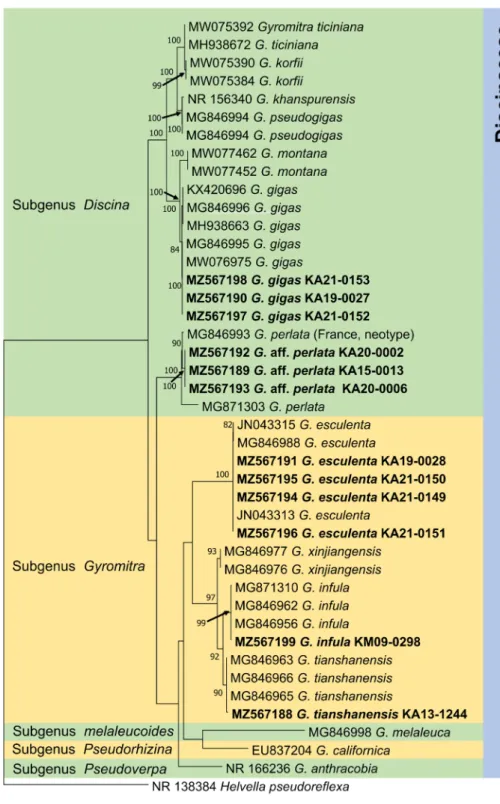
The RAxML tree showed that specimens of G. gigas, G. aff. perlata, and G. tianshanensis formed well- resolved monophyletic clades with high bootstrap values (100, 100, and 90, respectively). In addition, the phylogenetic positions of G. infula and G. esculenta collected from Korea were confirmed. In a previous report [2], G. gigas was considered a species complex comprising six different species. In this study, G. tianshanensis clustered with G. xinjiangensis and G. infula, but differed from the sister group. A search showed that three specimens of G. perlata from Korea were 100% identical to those from France (MG846993) and China (MG871303). In the ITS and LSU phylogenetic trees constructed, sequences from the Korean specimens clustered with G. perlata.

Taxonomy

Gyromitra gigas (Krombh.) Cooke, Mycogr., Vol. 1. Discom. London (No. 5): 191. 1878. (Figs. 1-3) Korean name: Keunmagwigombo-beoseot ( 큰마귀곰보버섯); derived from the species epithet ‘gigas’

that means “giant” in Latin.

Description: Apothecia stipitate, irregularly lobed, inflated, 5–12 cm when fresh, 1.5–3.5 cm dia and 2–3 cm high when dry; hymenium dull yellowish brown, cinnamon, reddish brown, dark brown to blackish when dry, undulate-rugose, receptacle surface white, cream, grayish white, light brown to black, glabrous;

stipe subcylindrical, enlarged at the base, typically fluted with broadly rounded ribs, white, light brown to black, glabrous to subpubescent, internally hollow, 2–3 × 0.3–1.3 cm. Excipulum of textura intricate, 40–55 μm thick, hyphae hyaline, 35 μm dia. Asci (n = 20) cylindrical, tapering at the base, 8-spored, 270–

330 × 17–21 μm, ave. 290–320 × 18.5–20 μm. Paraphyses cylindrical, septate, hyaline, 7–11 μm long.

Ascospores (n = 20) ellipsoidal to subfusoid, hyaline, smooth, biguttulate, non-apiculate, irregularly biseriate when young, uniseriate at maturity, 26–32 × 11.5–14 μm, ave. 28–30 × 12–13.5 μm.

Material examined: Korea, Pyeongchang-gun, 2021, leg. C. S. Kim, KA21-0153.

Notes: Gyromitra gigas regarded as a species complex morphologically similar taxa. Recently, this species was separated into six taxa G. gigas (Krombh.) Cooke, G. montana Harmaja, G. korfii (Raitv.) Harmaja, G. ticiniana Littini, G. pseudogigas X.C. Wang & W.Y. Zhuang, and G. khanspurensis Jabeen

& Khalid, on phylogenetic analysis [2]. Species within the G. gigas species complex are characterized by stipitate ascomata are saddle-shaped to irregularly lobed or cerebriform and wrinkled, and yellow-brown to brown reddish brown, ribbed to sulcate, white to yellow-brown stipe, ellipsoid to fusiform ascospores that are roughened to finely reticulate and uniguttulate or triguttulate with an inconspicuous to distinctive apiculus that is up to 4 μm long [2]. In addition, G. gigas has been reported only Europe and Asia [2].

In 2020, the G. gigas species complex was divided into six species (G. gigas, G. montana, G. korfii, G.

ticiniana, G. pseudogigas, G. khanspurensis) based on phylogenetic analyses and morphology [2]. In

this study, the Korean specimens formerly identified as G. gigas formed a monophyletic clade with other

sequences of G. gigas sensu stricto.

(4)

Gyromitra aff. perlata (Fr.) Harmaja, Karstenia 9: 11. 1969. (Figs. 1, 2, and 4)

Korean name: Neolbeunmagwigombo-beoseot ( 넓은마귀곰보버섯); derived from the species epithet

‘perlata’. Latin meaning perlatus (wide)

Fig. 1. Phylogenetic tree resulting from the RAxML analysis of ITS regions of the

genus Gyromitra. Bootstrap values higher than 60% are shown in the branches. Bar, 0.2

Substitutions per nucleotide position.

(5)

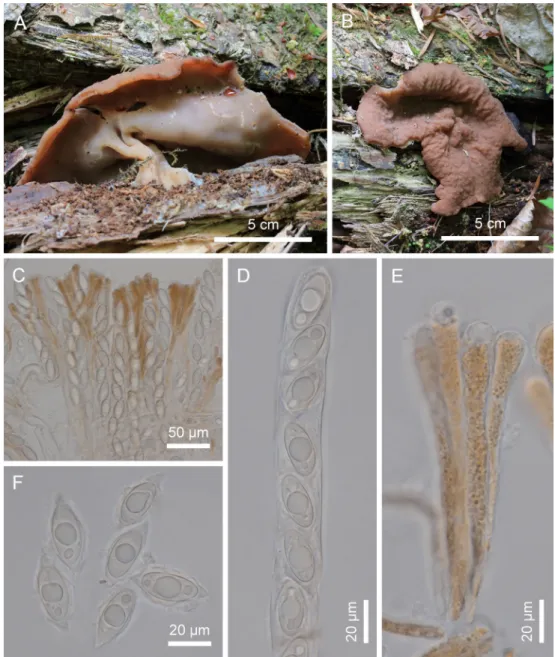
Description: Apothecia cup-shaped, up to 7 cm high when fresh, smooth, wavy to wrinkled, or bumpy.

Upper surface brown to reddish brown, darkening to dark brown or blackish. Under surface whitish to pale grayish brown or yellowish. Asci ( n = 20) subcylindrical, tapering at the base, 8-spored, 160–210 × 12.5–15 μm, ave. 180–200 × 13–14.5 μm. Paraphyses filiform, septate, orangish to orange-brown, 6–9 μ

m wide at apex. Ascospores (n = 20) fusoid, hyaline, smooth, apiculi pointed, 28–45 × 11–16 μm, ave.

32–42 × 13–15 μm.

Material examined: Korea, Pocheon-si, 2015, leg. S. K. Han, KA15-0013.

Notes: Based on the neotype specimen of G. perlata from France (MG846993), ascospores of this

species were 40–46 × 13–17 μm. However, the ascospores of Korean G. perlata were 22.5–27 × 11–13

μm. Therefore, the size range of ascospores are quite different between French and Korean specimens . In a

Fig. 2. Phylogenetic tree resulting from the RAxML analysis of LSU regions of the

genus Gyromitra. Bootstrap values higher than 60% are shown in the branches. Bar, 0.2

Substitutions per nucleotide position.

(6)

previous report [11], G. perlata was classified as a species complex. However, the Korean specimens of G.

perlata cluster with the neotype of G. perlata from France (MG846993) with strong support. Therefore, this species identified as G. aff. perlata.

Gyromitra tianshanensis X.C. Wang & W.Y. Zhuang, Mycologia 111(1): 72. 2018. (Figs. 1, 2 and 5) Korean name: Cheonsanmagwigombo-beoseot ( 천산마귀곰보버섯); derived from the species epithet

‘tianshanensis’. Mandarin tianshan (celestial mountains).

Description: Apothecia stipitate, cerebriform, irregularly lobed, convex, margin appressed and fused

Fig. 3. Macro- and micro-scopic characteristics of Gyromitra gigas (KA19-0027). A, B:

Mature apothecia; C: Immature asci; D: Paraphyses. Scal bars: A, B = 5 cm; C, D = 10 μm.

(7)

to the stipe, up to 4–6 cm high when fresh, 1.5–3.5 cm diameter and 2–3 cm high when dry; hymenium dull yellowish brown, cinnamon, reddish brown, dark brown to blackish when dry, undulate-rugose, receptacle surface white, cream, grayish white, light brown to black, glabrous; stipe subcylindrical, enlarged at base, typically fluted with broadly rounded ribs, white, light brown to black, glabrous to subpubescent, internally hollow, 2–3 × 0.3–1.3 cm. Excipulum of textura intricate, 100–220 μm thick, hyphae hyaline, 2–4 μm diameter. Asci (n = 20) subcylindrical, tapering at the base, 8-spored, 160–210 × 12–15 μm, ave.

170–200 × 13–14.5 μm. Paraphyses filiform, septate, hyaline, 7–9 μm wide at apex and 4.5–6 μm below.

Ascospores (n = 20) narrowly ellipsoidal to fusoid, hyaline, smooth, biguttulate, non-apiculate, irregularly

Fig. 4. Macro- and micro-scopic characteristics of Gyromitra aff. perlata (KA15-0013).

A, B: Mature apothecia; C: Asci and paraphyses; D: Ascus; E: Tips of paraphyses; F:

Ascospores.

(8)

biseriate when young, uniseriate at maturity, 17–21.5 × 6–9.5 μm, ave. 18–21 × 7–9 μm.

Material examined: Korea, Ulleung-gun, 26 Sep. 2013, leg. S. K. Han, KA13-1244.

Notes: Gyromitra tianshanensis clusters with G. infula and G. xinjiangensis but in morphological and molecular sequence. G. tianshanensis was introduced as a new species in Xinjiang, China and was collected rotten wood at 1700 m [3]. This species was collected from the rotten wood of Picea species

Fig. 5. Macro- and micro-scopic characteristics of Gyromitra tianshanensis (KA13-1244).

A, B: Mature apothecia; C: Paraphyses; D, E: Asci; F: Ascospores.

(9)

at 1,900 m Ulleungdo Island, Korea. In China, Gyromitra species are usually associated with coniferous trees or grow in coniferous-deciduous mixed forests with Picea, Pinus, and Betula at altitudes of 800-4000 m [3]. Therefore, Gyromitra species can be related to altitude and geographical position, especially G.

tianshanensis. The Korean collection was the first record outside its type locality.

ACKNOWLEDGEMENTS

We appreciate the efforts of Ho-Pil Choi providing collections for this study. This research was supported by the research fund of the Korea National Arboretum (Project No.: KNA 1-3-3, 20-3).

REFERENCES

1. Michelot D, Toth B. Poisoning by Gyromitra esculenta – a review. J Appl Toxicol 1991;11:235-43.

2. Miller AN, Yoon A, Gulden G, Stensholt Ø, Vooren NV, Ohenoja E, Methven AS. Studies in Gyromitra I: the Gyromitra gigas species complex. Mycol Prog 2020;19:1459-1473.

3. Wang X-C, Zhuang W-Y. A three-locus phylogeny of Gyromitra (Discinaceae, Pezizales) and discovery of two cryptic species. Mycologia 2018;111:69-77.

4. Crous PW et al. Fungal planet description sheets: 716-784. Persoonia 2018;40:240-392.

5. Anonymous. 2013. List of mushrooms in Korea. The Korean Society of Mycology, Seoul, Korea.

6. White TJ, Bruns T, Lee S, et al. Amplification and direct sequencing of fungal ribosomal RNA genes for phylogenetics. In: PCR protocols: a guide to methods and applications (Innis MA, Gelfand DH, Sninsky JJ, White TJ, eds). Academic Press, San Diego: 1990;315-22.

7. Hall TA. BioEdit: a user-friendly biological sequence alignment editor and analysis program for Windows 95/98/NT. Nucl Acids Symp Ser 1999;41:95-8.

8. Kumar S, Stecher G, Tamura K. MEGA7: Molecular Evolutionary Genetics Analysis Version 7.0 for bigger datasets. Mol Biol Evol 2016;33:1870-4.

9. Katoh K, Standley DM. MAFFT multiple sequence alignment software version 7:

improvements in performance and usability. Mol Bol Evol 2013;30:772-80.

10. Miller MA, Pfeiffer W, Schwartz T. Creating the CIPRES Science Gateway for inference of large phylogenetic trees. In: Proceedings of the Gateway Computing Environments Workshop (GCE), 25 14 Nov 2010, New Orleans, Louisiana 2010;1-8.

11. Vooren NV. Typification of Gyromitra perlata, type-species of the subgenus Discina

(Discinaceae). Ascomycete.ogr. 2017;9:19-22.

수치

Table 1. Gyromitra specimens used in this study including locality, ITS and LSU GenBank accession numbers.
Fig. 1. Phylogenetic tree resulting from the RAxML analysis of ITS regions of the  genus Gyromitra
Fig. 3. Macro- and micro-scopic characteristics of Gyromitra gigas (KA19-0027). A, B:
Fig. 4. Macro- and micro-scopic characteristics of Gyromitra aff. perlata (KA15-0013)
+2

참조

관련 문서

As the basis of the study, concept behind information communication technology was formed, and based on theoretical fundamentals of current internet use, ICT

A Contrastive Study on the Proverbs of Family Relationship of Korean and Chinese..

Performance evaluation of Volume PTV based on Affine Performance evaluation of Volume PTV based on Affine Performance evaluation of Volume PTV based on Affine Performance

The purpose of this study is to determine customer satisfaction and repurchase intentions based on various characteristics when Korean Chinese consumers actually

In the present study, 10 study stations were established, and seasonal changes for various ecological aspects of the community such as species composition, number of

The method of research is as follows: First, in the music and education process, the ability of Korean traditional music education and haegeum is based

Based on this research, I hope that the direction of Korean classical music education, diversity of teaching materials and teaching method of contents area

Therefore, in this study, based on the media facade expression characteristics and expression techniques, evaluation factors through satisfaction analysis on