KOMPSAT2 TERMINAL POLAR STATION MASS PRODUCTION TEST
*
Jihoon Kang,
**Chol Lee,
***Tae-Hoon Kim, and
*Sang-Il Ahn
*Korea Aerospace Research Institute, **KAIST SaTReC, ***Soletop. Inc [email protected], [email protected], [email protected], [email protected]
ABSTRACT The KOMPSAT2 Terminal Polar Station was recently installed at near North Pole, Tromso, and Toulouse.
The K2PS consists of one receiving station and two processing sites. The receiving station has been installed at SvalSat (N78˚ , E15˚ ), and the two receiving sites have been installed at KSAT (Kongsberg Satellite Service AS), Tromso, Norway (N69˚ , E18˚ ) and SISA, Toulouse, France (N43˚ , E1˚ ). The products of K2PS system can be classified to two categories: Level 1R product and Level 1G product. The Level 1R product is radiometric corrected product with RPC (Rational Polynomial Coefficients) and the Level 1G product is geometric corrected product with POD (Precise Orbit Data) and PAD (Precise Attitude Data) data based on Level 1R product. To meet a SISA (Spot Image SA)’s requirement, K2PS system has high performance product producing capability. This paper describes overall K2PS systems’ production generation flow and the mass production test result of K2PS systems.
KEY WORDS: KOMPSAT2, Polar Station, Performance Test, Level 1R, Level 1G
1. INTRODUCTION
The KOMPSAT2 Terminal is newly developed by adopting the latest version of PC technologies for higher processing performance and cost-effectiveness, based on operational K2 image processing system installed at KARI. The KOMPSAT2 Terminal Polar Station, hereafter K2PS, was recently installed at Arctic Svalbard, Tromso (Norway), and Toulouse (France).
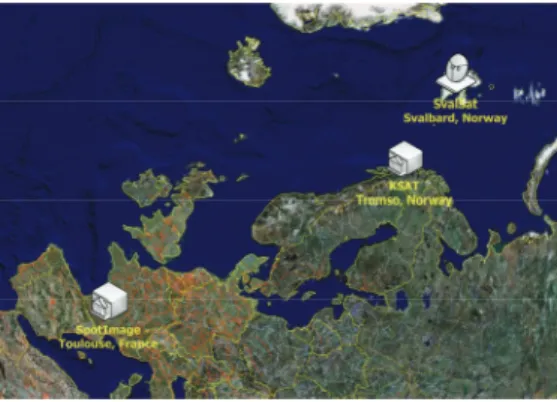
The K2PS system consists of the receiving station and the two processing sites. The receiving station receives the image data from a satellite and transmits the data to the processing sites through dedicated T3 network. The processing site receives the data from the receiving station and generates a Level 1A data, a Level 1R and a Level 1G product. Figure 1 shows deployed location of K2PS system. At Svalbard (N78, E15), the receiving station has been installed, and the processing sites are at Tromso (N69, E18) and Toulouse (N43, E1).
Figure 1. Location of K2PS system
By taking location advantage of the North Pole antenna station, the K2PS system can contact maximum 14 times per a day with KOMPSAT2, and among the contacts,
maximum available contacts are 10 times per a day base on contractual agreement. Therefore, over 70 minute imaging data, that is over 2000 catalogue, will be processed at the K2PS in a day. In consequence, SISA and KSAT can make lots number of product generation order to system. The K2PS system has been designed for generating over 250 products in a day to meet performance requirement.
In this paper, massive production test results are described for validating the K2PS system’s product generation performance. The rest of this paper is organized as follows. In the next section, we introduce the functionalities of the K2PS system. Then section 3 introduces Level 1R and Level 1G product of K2PS system. Section 4 shows performance test results and finally section 5 concludes our works.
2. K2PS FUNCTIONALITIES
The K2PS system can be categorized to 4 classes in functionality: Acquisition, Processing, Archiving, and Product Generation. The acquisition is a receiving data from the satellite, the processing means generating a Level 0/1A and catalogue, a backup procedure is called as a archiving procedure, and as the name implies, a production generation means generating a product of K2PS. Below subsections describe the functionalities in detail.
2.1 Acquisition
The K2PS system can receive 10 times of 7 minute imaging data in a day because its receiving station is located at near North Pole (Svalbard). The received data is pre-processed at the receiving station and transmitted to the processing station through dedicated T3 (45Mbps) network.
In order to cope with network bandwidth bottleneck (45Mbps) compared to K2 downlink data speed at 320 Mbps, the data is transmitted in a specially designed ILB (Image Line Block) data, un-decompressed version of Level 0 data, which is called Pre-Level 0 data.
2.2 Processing
The Pre-Level 0 data will be processed to the Level 0 and the Level 1A data in parallel at the processing sites.
The Pre-Level 0 data will be decompressed for generating the Level 0 data, and the Level 0 data will be processed to the Level 1A data in sequence.
During the Level 1A processing, NUC (Non Uniform Correction), Periodic Noise Removing, BSM (Binary Statistical Morphology), Scattergram, Butting Zone Smoothing, Absolute PAN LOD (Line of Distance), and Relative MS LOD (Line of Distance)/LOS (Line of Sight) will be processed. And, as the last procedure, catalogues of the Level 1A data is generated.
2.3 Archiving
The Level 0 and Level 1A data will be archived for future use. After the Level 0 and Level 1A processing is finished, the archiving procedure will be started automatically.
The Level 0 file will be removed right after the archiving procedure is completed. However, the Level 1A file will not be removed immediately because the Level 1A data will be used for the production generation. The Level 1A data will be stored at online RAID storage and only if the RAID storage’s remaining space is over the limit, the oldest Level 1A data will be removed from the storage.
2.4 Product Generation
In product generation step, the Level 1A is used for generating the Level 1R and the Level 1G product. If the required Level 1A data is existed in RAID Storage, the system automatically uses the data for generating the Level 1R or Level 1G product. If not, the system will request to an operator for restoring the Level 1A data.
A user can order products through web based ordering interface. The user can select several options which are MTF correction, Level of product, and output media. By selecting output media option, the user can select between FTP transfer and DVD media.
3. K2 TERMINAL: POLAR STATION PRODUCT The K2PS system has two product levels: Level 1R and Level 1G. Both level products are 15000 x 15500 pixels in size, and include product metadata, catalogue thumb image, and catalogue browse image. A GeoTiff format is used for a product.
3.1 Level 1R
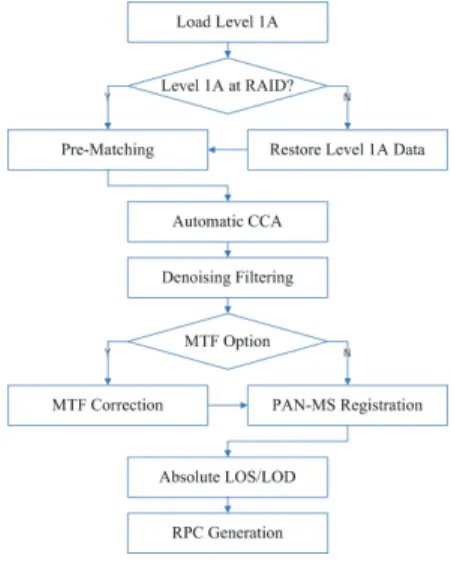
The Level 1R product is radiometrically corrected product. From the Level 1A data, the system reads only needed area among entire Level 1A dataset. If the Level 1A data is not available at online RAID storage, the system request operator to restore the Level 1A data.
Because KOMPSAT2 image data consists of PAN and MS image, the system load both PAN and MS image data.
To guarantee the geo-location accuracy between PAN and MS image, a registration procedure is required at the system.
At the K2PS system, to enhance the processing performance, a pre-matching procedure is adopted. The pre-matching procedure registers PAN to MS roughly. By this pre-matching procedure, fine registration search range can be reduced what can enhance overall product processing performance.
After the pre-matching procedure, a cloud cover assessment and filtering are proceed. Then, MTF correction is applied to a product. The MTF correction procedure is optional according to user’s request. After MTF correction fine PAN to MS registration is proceed.
Finally, LOS/LOD distortion correction procedure is applied to a product.
Figure 2. Level 1R Processing Procedure
Additionally, the K2PS system can generates 3D RPC coefficient for Level 1G orthorectified image by end user from a Level 1R product. A user can apply RPC coefficient for orthorectification.
3.2 Level 1G
The Level 1G product is geometrically corrected product of a level 1R product with POD/PAD data. All product procedure is same with the Level 1R product except the Level 1G product include geo-correction procedure at the last part.
4. PERFORMANCE TEST RESULT
In this section we present performance test results. The performance test was proceeded at the processing site of Toulouse, France. All the data was received at the receiving station on August 2008. 253 products were ordered through ordering interface. All the ordered products had little cloud. The hardware used for this performance test is HP-xw4400 series with Intel Core 2 Quad Q6700 and 4GB RAM on top of 32 bit MS Windows Server 2003.
4.1 Processing Time of Procedures
Table 1 shows the average processing time and standard deviation of each procedure’s processing time.
Table 1. Processing Time of Procedures
Procedure
Average Processing
Time
Standard Deviation
Pre-Matching 37 sec 39.90
CCA Less than 1 sec 0.37 Filtering (MTFC) 89 sec 1.35
PAN-MS Reg 50 sec 11.02
LOS/LOD 17 sec 1.05
RPC Generation 59 sec 6.77
Geo Correction 45 sec 3.32
As you can see at Table 1, the filtering procedure which includes MTF correction spends the longest time among the procedures. Remarkable result is the standard deviation of the Pre-Matching and PAN-MS Registration procedure. The standard deviations are larger than the others because the Pre-Matching and PAN-MS Registration procedure highly depends on a characteristic of image. The procedures extract features of image for matching or registering. If there are not enough features in the image, the procedure consumes more time to cover entire search range.
Figure 3. Pre-Matching Time Analysis
Figure 3 represents the Pre-Matching’s processing time and search range of that time. A dotted line is the search range and solid line is the processing time. It shows the
search range and required processing time has almost linear relationship.
4.2 Average Processing Time of Product
To evaluate the system’s overall performance, the level product’s processing time was measured in some conditions. The MTF correction is an optional part which can be select by user’s requirement, in other hands the RPC coefficient is not an option. However, the RPC generation is separated like an option because it is not actual image processing job.
Table 2. Average Processing Time
Condition
MTFC RPC
Level 1R Average Processing Time
Level 1G Average Processing Time ON ON 4 min 25 sec 5 min 12 sec OFF ON 2 min 56 sec 3 min 24 sec ON OFF 3 min 25 sec 4 min 12 sec OFF OFF 1 min 56 sec 2min 24 sec
Table 2 shows the average processing time of the Level 1R and the Level 1G product. The average processing time of Level 1R product with MTFC ON and RPC ON takes 4 min 25 sec, and in case of Level 1G product with same condition, it takes 5min 12 sec. If the system generate continuously during a day, the result will be almost same with Table 3.
Table 3. Product Generation Performance per a Day
Condition
MTFC RPC
Level 1R Product / Day
Level 1G Product / Day
ON ON 326 276
OFF ON 490 423
ON OFF 421 342
OFF OFF 744 600
5. CONCLUSION
The K2PS system consists of the receiving station and the two processing sites. By the location advantage of the receiving station, it receives 10 times of 7 minute imaging data from KOMSPAT2. Among the lots of received image data, the system can generate over 270 products with MTF correction and RPC generation in a day. It is powerful and very attractive to the user which has time requirement.
Even though the performance test verified that the K2PS system meets the SISA’s product generation requirement, we could check that the Pre-Matching and the Registration algorithm can be enhanced. In future, we hope the improved procedure can enhance the K2PS system performance more than 15%.