• 검색 결과가 없습니다.

Using Carboxylmethylated Cellulose as Water-Borne Binder to Enhance the Electrochemical Properties of Li<sub>4</sub>Ti<sub>5</sub>O<sub>12</sub>-Based Anodes

N/A
N/A
Protected

Academic year: 2021

Share "Using Carboxylmethylated Cellulose as Water-Borne Binder to Enhance the Electrochemical Properties of Li<sub>4</sub>Ti<sub>5</sub>O<sub>12</sub>-Based Anodes"

Copied!
6
0
0

로드 중.... (전체 텍스트 보기)

전체 글

(1)

Using Carboxylmethylated Cellulose as Water-Borne Binder to Enhance the Electrochemical Properties of Li 4 Ti 5 O 12 -Based Anodes

Lili Liu, Chongling Cheng

a

, Hongjiang Liu *, Liyi Shi**, and Dayang Wang

a

Department of Chemistry, College of Science, Shanghai University, Shanghai 200444, P.R. China

a

School of Civil, Environmental, and Chemical Engineering, RMIT University, VIC 3001, Australia (Received October 12, 2015; Revised October 20, 2015; Accepted October 20, 2015)

···

Abstract The present work reports a systematic study of using carboxymethylated cellulose (CMC) as water-borne binder to produce Li

4

Ti

5

O

12

-based anodes for manufacture of high rate performance lithium ion batteries. When the LTO-to-CB-to-CMC mass ratio is carefully optimized to be 8:1:0.57, the special capacity of the resulting electrodes is 144 mAh·g

−1

at 10 C and their capacity retention was 97.7% after 1000 cycles at 1 C and 98.5% after 500 cycles at 5 C, respectively. This rate performance is comparable or even better than that of the electrolytes produced using con- ventional, organic, polyvinylidene fluoride binder.

Keywords: Lithium titanate, CMC binder, Electrochemical properties, Long cycle life

···

1. Introduction

Exhaust gas emitted from vehicles is one of the big- gest contributions to the increasingly serious environmen- tal pollution nowadays. Over the years, a considerable number of efforts have been put in development of envi- ronmental-friendly, green fuels for automobiles instead of fossil fuels [1-3]. In this context, electric vehicles (EVs) and energy storage station (ESS) have been recently developed on the basis of use of high performance lith- ium ion batteries (LIBs) with long cycle life and high energy density [4-9]. However, the stability and safety of LIBs remain the big technical concerns, which limits the commercialization of LIB [10,11]. To address these issues, novel electrode materials with larger lithium ion storage at high rate have been developed [12].

Among currently developed anode materials, spinel Li

4

Ti

5

O

12

(LTO) has attracted increasing attention for its outstanding characteristics. Comparing to commercial graphite anodes, spinel LTO exhibits a very flat and rela- tively higher charge discharge platform at around 1.5 V (versus Li) [13,14]. Thus, it can avoid formation of solid electrolyte interface (SEI) film; otherwise, the latter

results in low coulombic efficiency especially in the first formation cycle due to a significant loss of lithium ion [15]. Spinel LTO has negligible volume change during the lithium intercalation/extraction processes(considered as zero-strain material), which results in excellent cycle stability [16,17].

Typically, LTO electrodes are consisted of active mate- rials (e.g. LTO particles), conductive agents, current col- lectors and binders. The active materials determine the capacity of the electrode. The conductive agents such as carbon black (CB) are used to improve the rate perfor- mance of the electrode owing to the enhanced electric conductivity. The binders are used to glue the active materials and conductive agents together with the cur- rent collectors. Thus, the electrons can flow from/to the outside circuit through the active material–conductive agent–current collector chain. Although the mass frac- tion of the binders are only in the range of 2-10% in a commercial electrode configuration, the binder materials are one of the most crucial electrode components for improvement of the cell performance, especially for cycle life. Without the aid of the binders, the active materials will not properly contact the current collectors, thus

*Corresponding Author: Hongjiang Liu, TEL: +61-3-9925-3232, E-mail: [email protected]

**Corresponding Author: Liyi Shi, TEL: +61-3-9925-3232, E-mail: [email protected]

<PM리뷰>
(2)

Nowadays polyvinylidene fluoride (PVDF) is widely used in commercial lithium ion batteries, which is an oily binder and needs to be dissolved in organic solvents such as N-methylpyrrolidone (NMP). Both PVDF and NMP are not environmentally friendly, toxic, and rather expen- sive. CMC is widely used water-borne binder in many applications [19-22]. Although the use of water for CMC dissolution is environment friendly, obviate strict process- ing control and allow fast drying. However, a small amount of water left behind in the cell is known to cause a noticeable adverse impact onto the battery perfor- mance, especially when LTO is used as anode. New evi- dences suggests that the use of CMC as binder can manufacture lithium ion batteries such as Si [23-25], Sn [26-28], LiCoO

2

[29], and LiFePO

4

[30,31], with compa- rable or better performance than those batteries, in which PVDF is used as binder. In this work, we manufactured LTO anodes, using CMC as binders and carefully stud- ied the impact of the CMC content in the cells on the performance of the resulting LTO anodes. We demon- strate that when the mass ratio of LTO to CMC to CB is 8:1:0.57, the resulting LTO anodes exhibit excellent high rate performance with high capacity. Their specific capacity can be 144 mAh·g

−1

at 10 C and the capacity retention is 97.7% after 1000 cycles at 1 C and 98.5%

after 500 cycles at 5 C, respectively.

2. Experimental Section

All the reagents were purchased from China National Medicines Corp., Ltd without any purification

2.1. Synthesis of LTO particles

LTO particles were synthesized according to the proto- col described in our previous report [32]. Typically, 1.010 g of TiO

2

(anatase) and 0.502 g of LiOH·H

2

O were added into 30 mL of deionized water, followed by mag- netic stirring for 30 min. The mixture dispersion was transferred into a Teflon-lined autoclave, followed by incubation at 180

o

C for 24 h. The precipitates were col- lected from the bottom of the autoclave by centrifuga- tion. After 3 times repetitions of the centrifugation/water washing cycle and 3 times repetition of the centrifuga- tion/absolute ethanol washing cycle, the precipitates were

for 2 h in a nitrogen atmosphere, yielding LTO particles.

2.2. Material characterization

The crystalline structure of the resulting LTO particles was characterized by powder X-ray diffraction (XRD) using D/max 2200 with Cu K (1.54Å) radiation in the 2 θ range of 10-70

o

. The morphology and crystalline struc- ture of the LTO particles were characterized by scanning electron microscopy (SEM) using JSM-6700F (Japan) and transmission electron microscope (TEM) using JEM- 2010F (Japan).

The electrochemical performance of the resulting LTO anodes was investigated by the assembled CR2016 coin- type cells in an argon-filled glove box (MBraun, Ger- many). The lithium plate was used as the counter elec- trode. To manufacture the working electrode, CB, and CMC were homogeneously mixed in deionized water with the aid of magnetic stirring for 24 h. Then the resulting slurry was uniformly cast on copper foil and dried at 120

o

C under vacuum for 12 h. LiPF

6

was dis- solved in the mixture of ethylene carbonate and dimethyl carbonate (1/1 in volume) at the concentration of 1 M, which was used as the lithium ion battery electrolyte.

Following the similar protocol, the PVDF was used as binder to produce LTO anodes, in which the mass ratio of LTO to CB to PVDF was 8:1:1.

The coin cells were cycled with different current densi- ties in the voltage window from 1.0 to 2.5 V (vs. Li/Li

+

) on a CT2001A cell test instrument (LAND Electronic Co. Ltd) at room temperature. The specific capacity of LTO electrode was calculated with respects to the mass of the active materials, i.e. LTO particles. Electrochemi- cal impedance spectroscopy (EIS) was carried out in the frequency range from 100 kHz to 0.01 Hz with an elec- trochemical workstation (CHI660d).

3. Results and Discussion

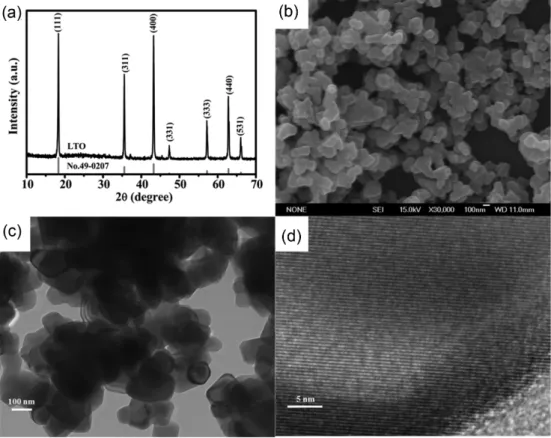
Fig. 1(a) shows the XRD pattern of the resulting LTO particles, in which all the diffraction peaks are in good agreement with the spinel LTO phase (JCPDS Card No.49-0207). SEM and TEM imaging indicate that the sizes of the resulting LTO particles are ca. 120 nm (Figs.

1(b) and 1(c). The HRTEM image of the LTO particles

(3)

also confirms the highly crystalline nature of the result- ing LTO particles.

The rate performance of LTO electrodes obtained by using water-borne CMC binder and organic PVDF binder, respectively, is compared in Fig. 2(a). The spe- cific capacity of the LTO electrodes obtained using the PVDF binder is 171, 168, 162, 160, 157, 152, and 140 mAh·g

−1

at 0.1 C, 0.2 C, 0.5 C, 1 C, 2 C, 5 C, and 10 C,

respectively. The LTO electrodes obtained using the CMC binder can exhibit specific capacity comparable or slightly larger than those of the LTO electrodes obtained using the PVDF binder, when the LTO-to-CB-to-CMC mass ratio is optimized to be 8:1:0.57. The specific capacity of the resulting electrode is 174, 173, 165, 162, 160, 155, and 144 mAh·g

−1

at 0.1 C, 0.2 C, 0.5 C, 1 C, 2 C, 5 C, and 10 C, respectively. As shown in Fig. 2(b), the use of CMC binder results in 10 times increased peel strength of the LTO electrodes.

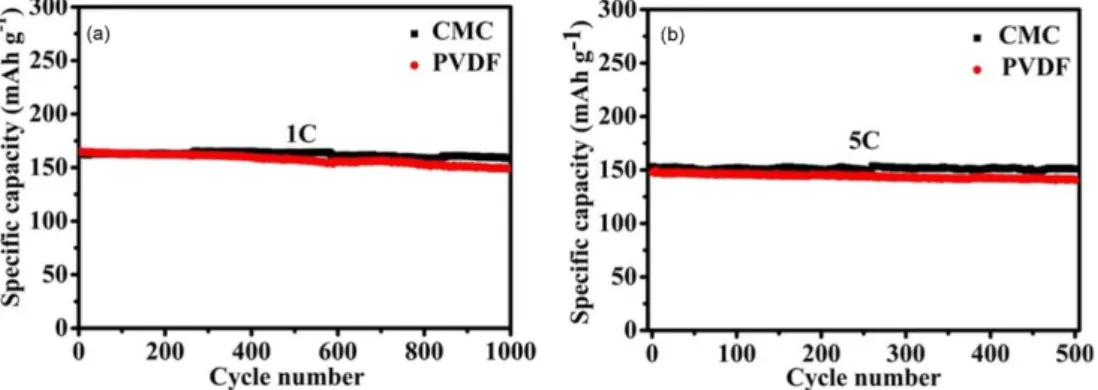
Fig. 3 shows the cycling stabilities of the resulting LTO electrodes at 1 C and 5 C. LTO electrodes obtained using the PVDF binder retain 90.3% of the specific capacity after 1000 cycles at 1 C (164.8 mAh·g

−1

for the 1

st

cycle and 148.8 mAh·g

−1

for the 1000

th

cycle) and 95% at 5 C (147.9 mAh·g

−1

for the 1

st

cycle and 140.5 mAh·g

−1

for the 500

th

cycle). In comparison, LTO electrodes obtained using the CMC binder exhibit a slight better cycling sta- bility, which retain >97.7% of their specific capacity retains after 1000 cycles at 1 C (162.4 mAh·g

−1

for the 1

st

cycle and 158.7 mAh·g

−1

for the 1000

th

cycle) and 98.5%

after 500 cycles at 5 C(153.3 mAh·g

−1

for the 1

st

cycle and 151 mAh·g

−1

for the 500

th

cycle). This small but non- Fig. 1. (a) XRD pattern and (b) SEM, (c) TEM, and (d) HRTEM images of the LTO particles obtained.

Fig. 2. (a) Plots of the rate performance of the LTO electrodes,

which are produced by using CMC (red solid dots) and

PVDF (black solid squares) binders, respectively, versus the

cycle number. The LTO-to-CB-to-CMC mass ratio is

optimized to be 8:1:0.57. The LTO-to CB-to-PVDF mass

ratio is 8:1:1 and (b) The peel strength of these electrodes.

(4)

negligible difference in the cycling stability should reflect the difference in the adhesion between the current collec- tor and activity materials between the LTO electrodes obtained using CMC and PVDF binders (indicated in Fig. 2(b)).

The rate performances of the LTO electrodes obtained

at different LTO-to-CB-to-CMC mass ratios are showed in Figs. 4(a) and 4(b). Note that the LTO-CB mass ratio is set as 8:1 for all the electrodes for easy comparison.

The results show that the rate performance is initially enhanced with the CMC content decreasing, while notice- ably deteriorates after the CMC content decreases below Fig. 3. Plots of the cycle performance of the LTO electrodes obtained using CMC (black solid squares) and PVDF (red solid circles) binder versus the cycle number at 1 C, (a) and 5 C and (b). The LTO-to-CB-to-CMC mass ratio is optimized to be 8:1:0.57. The LTO-to-CB-to-PVDF mass ratio is 8:1:1.

Fig. 4. (a) Plots of the rate performance of LTO electrodes with CMC binder versus LTO-to-CB-to-CMC mass ratios: 8:1:1

(black solid squares), 8:1:0.67 (green up triangles), 8:1:0.80 (red solid dots), 8:1:0.57 (blue down triangles), 8:1:0.50 (cyan solid

dots), (b) Plot of the specific capacity of the LTO electrodes, obtained at the LTO-to-CB-to-CMC mass ratio of 8:1:1 (black

curve), 8:1:0.8(red curve), 8:1:0.67 (green curve), 8:1: 0.57 (blue curve), and 8:1:0.5 (cyan curve), versus current rate, (c)

Charging/discharging flat curves of the LTO electrode, obtained at the LTO-to-CB-to-CMC mass ratio of 8:1:0.57, in different

current rate and (d) Electrochemical impedance spectra of the LTO electrodes, obtained using CMC(black solid squares) and

PVDF binders (red solid dots), at a voltage of 1.56 V. the LTO-to-CB-to-CMC mass ratio is 8:1:0.57, while the LTO-to-CB-to-

PVDF mass ratio is 8:1:1. The equivalent circuit is depicted in the inset, in which R

s

is the resistance of the electrolyte, R

ct

the

charge transfer resistance, Z

w

the Warburg impedance and CPE the constant phase element.

(5)

0.50. The optimal LTO-to-CB-to-CMC mass ratio is found to be 8:1: 0.57 to achieve the largest specific capacity.

In order to evaluate the effect of impedance on electro- chemical performance, The electrochemical impedance spectra (EIS) enables study of the effect of impedance on the electrochemical performance of LTO electrode, which comprise a semicircle in the high frequency range and a sloping line in the low frequency range, which can be ascribed to the charge transfer coupled with a capaci- tance at the interface of the LTO particles for the former and the lithium ion diffusion in the bulk of LTO material for the latter. Based on the EIS spectra, one can deduce the equivalent circuits can be deduced, where R

s

repre- sents the ohmic resistance including total resistance of the electrolyte, separator and electrical contacts, R

ct

the charge-transfer resistance, CPE the constant phase-angle element involving double layer capacitance, and W

s

(Warburg impedance) the solid-state diffusion of Li

+

in the bulk of the active material. Fig. 4(d) shows the elec- trochemical impedance spectra(EIS) of the LTO elec- trodes, obtained using CMC and PVDF binders, at a stable voltage of 1.56V. It reveal that R

ct

of the LTO elec- trodes obtained using CMC binder is approximately 18 Ω, slightly smaller than that of the LTO electrodes obtained using PVDF binder (24 Ω) .

4. Conclusions

In this study, we demonstrate that the use of water- borne CMC binder can produce LTO electrodes with rate performance comparable to or even better than those pro- duced by using PDVF binders, after careful optimization of the LTO-to-CB-to-CMC mass ratio. In our work, the optimal LTO-to-CB-to-CMC mass ratio is found to be 8:1:0.57. The resulting LTO electrodes show the specific capacity of 174 mAh·g

−1

at 0.1 C and 144 mAh·g

−1

at 10 C. The electrodes can remain 97.7% of the original spe- cific capacity up to 1000 cycles at 1 C and 98.5% up to 500 cycles at 5C, underlining a good cycling stability.

Thus, the present work demonstrates that by proper opti- mization, environmentally friendly water-borne binders such as CMC can be used as binder for lithium ion bat- teries instead of organic PVDF binder.

Acknowledgements

Pengfei Hu and Jianchao Peng are acknowledged for assistance with HRTEM characterization and Profes- sional and Technical Service Platform for Designing and Manufacturing of Advanced Composite Materials, Shanghai.

This work was financially supported by Shanghai Municipal Science and Technology Commission (13dz2292100) and Baoshan District Science and Technology Commission of Shanghai (bkw2013142).

Reference

[1] J.-M. Tarascon and M. Armand: Nature, 414 (2001) 359.

[2] J. Cabana, L. Monconduit, D. Larcher and M. R. Palacín:

Adv. Mater., 22 (2010) E170.

[3] P. G. Bruce, B. Scrosati and J.-M. Tarascon: Angew.

Chem. Int. Ed., 47 (2008) 2930.

[4] V. Etacheri, R. Marom, R. Elazari, G. Salitra and D. Aur- bach: Energy Environ. Sci., 4 (2011) 3243.

[5] J. B. Goodenough: Energy Environ. Sci., 7 (2014) 14.

[6] A. Nugroho, S. J. Kim, K. Y. Chung and J. Kim: Electrochim.

Acta, 78 (2012) 623.

[7] J. Huang and Z. Jiang: Electrochim. Acta, 53 (2008) 7756.

[8] Y. Wang and G. Cao: Adv. Mater., 20 (2008) 2251.

[9] J. Hassoun, S. Panero, P. Simon, P. L. Taberna and B. Scro- sati: Adv. Mater., 19 (2007) 1632.

[10] Z. Cui, F. Gao, Z. Cui and J. Qu: J. Power Sources, 207 (2012) 150.

[11] A. Ito, D. Li, Y. Ohsawa and Y. Sato: J. Power Sources, 183 (2008) 344.

[12] B. L. Ellis, W. R. M. Makahnouk, Y. Makimura, K. Toghill and L.F. Nazar: Nat. Mater., 6 (2007) 749.

[13] T.-F. Yi, L.-J. Jiang, J. Shu, C.-B. Yue, R.-S. Zhu and H.- B. Qiao: J. Phys. Chem. Solids, 71 (2010) 1236.

[14] M. Broussely and G. Archdale: J. Power Sources, 136 (2004) 386.

[15] L. Shen, C. Yuan, H. Luo, X. Zhang, K. Xu and F. Zhang:

J. Mater. Chem., 21 (2011) 761.

[16] J. Haetge, P. Hartmann, K. Brezesinski, J. Janek and T.

Brezesinski: Chem. Mater., 23 (2011) 4384.

[17] N. Li, G. Zhou, F. Li, L. Wen and H.-M. Cheng: Adv.

Funct. Mater., 23 (2013) 5429.

[18] S.-L. Chou, Y. Pan, J.-Z. Wang, H.-K. Liu and S.-X. Dou:

Phys. Chem. Chem. Phys., 16 (2014) 20347.

[19] C. Mangwandi, L. JiangTao, A. B. Albadarin, R. M. Dhenge and G. M. Walker: Powder Technol., 270 (2015) 424.

[20] A. A. Dangi and P. B. Zalodiya: Int. J. Pharm. Investig., 2 (2012) 183.

[21] C. Hüttl, C. Hettrich, R. Miller, B.-R. Paulke, P. Henklein,

H. Rawel and F. F. Bier: BMC Biotechnol., 13 (2013) 1.

(6)

and S. F. Lux: Langmuir, 30 (2014) 10299.

[23] B. Lestriez, S. Bahri, I. Sandu, L. Roué and D. Guyo- mard: Electrochem. Commun., 9 (2007) 2801.

[24] S.-L. Chou, J.-Z. Wang, M. Choucair, H.-K. Liu, J. A.

Stride and S.-X. Dou: Electrochem. Commun., 12 (2010) 303.

[25] Z.-J. Han, N. Yabuuchi, K. Shimomura, M. Murase, H.

Yui and S. Komaba: Energy Environ. Sci., 5 (2012) 9014.

[26] S.-L. Chou, J.-Z. Wang, C. Zhong, M.M. Rahman, H.-K.

Liu and S.-X. Dou: Electrochim. Acta, 54 (2009) 7519.

[27] J. Li, D.-B. Le, P.P. Ferguson and J.R. Dahn: Electrochim.

[28] S.-L. Chou, X.-W. Gao, J.-Z. Wang, D. Wexler, Z.-X. Wang, L.-Q. Chen and H.-K. Liu: Dalton trans., 40 (2011) 12801.

[29] C.-C. Li, J.-T. Lee, Y.-L. Tung and C.-R. Yang: J. Mater.

Sci., 42 (2007) 5773.

[30] A. Guerfi, M. Kaneko, M. Petitclerc, M. Mori and K. Zaghib:

J. Power Sources, 163 (2007) 1047.

[31] W. Porcher, P. Moreau, B. Lestriez, S. Jouanneau, F. Le Cras and D. Guyomard: Ionics, 14 (2008) 583.

[32] C. Cheng, H. Liu, J. Li, X. Xue, H. Cao, D. Wang and L.

Shi: J. Power Sources, 283 (2015) 237.

수치

Fig. 3 shows the cycling stabilities of the resulting LTO electrodes at 1 C and 5 C. LTO electrodes obtained using the PVDF binder retain 90.3% of the specific capacity after 1000 cycles at 1 C (164.8 mAh·g −1  for the 1 st  cycle and 148.8 mAh·g −1  for t
Fig. 4. (a) Plots of the rate performance of LTO electrodes with CMC binder versus LTO-to-CB-to-CMC mass ratios: 8:1:1 (black solid squares), 8:1:0.67 (green up triangles), 8:1:0.80 (red solid dots), 8:1:0.57 (blue down triangles), 8:1:0.50 (cyan solid dot

참조

관련 문서

Among the sub-factors of autonomy support coaching behavior, strategy recognition had the most direct influence on the grit of athletes, followed by

Second, as a result of the IPA analysis of the sub-factors of audience perception, the factors of entry route were located in the first quadrant, the

This study was conducted to recognize the importance of self - management of dance major students and to understand the relationship between the sub -

Third, looking at the sub-factors in terms of textbooks and software by priority, they were in the order of development of textbooks and learning tools

For the sub-factors of selection attributes and customer value according to screen golf course handicap, convenience, professionality, facilities, price,

The results of this study are as follows: ⑴ 4 basic directions, 16 themes, and 64 sub-themes of the vocational high school development are established, and

tricuspidata on the production of proinflammatory cytokines in TNFα+IFNγ-stimulated HaCaT cells ...15 Fig.5: The cell viability of sub-fractions from 70% EtOH

Second, the difference of satisfaction of appearance by marital status showed significant difference in body strength among sub - factors of