경기육괴 동부 오대산 지역의 구룡층군에 대한 SHRIMP U-Pb 저어콘 연대측정: 새로운 후기 고생대층의 인지와 지체구조적 의의
조등룡*
한국지질자원연구원 국토지질연구본부
SHRIMP U-Pb Zircon Geochronology of the Guryong Group in Odesan Area, East Gyeonggi Massif, Korea: A new identification of
Late Paleozoic Strata and Its Tectonic Implication
Deung-Lyong Cho*
Geological Research Division, Korea Institute of Geoscience and Mineral Resources, 124 Gwahang-no, Yuseong-gu, Daejeon 305-350, Korea
요 약: 경기육괴 동부 오대산 지역의 구룡층군 흑운모 편암에 대한 SHRIMP U-Pb 저어콘 연대를 측정하였 다. CL 영상에서 저어콘은 변성작용에 의해 원위치에서 성장한 가중평균연령 247±6 Ma의 저어콘 외연부를 갖는다. 쇄설성 저어콘 핵은 대부분 마그마기원을 지시하는 누대구조와 Th/U 비를 보이고, 53점의 분석치에 서 46점이 일치연령에 가까운 자료에 해당한다. 이들은 가중평균 378±10 Ma(n=9), 420±4 Ma(n=6)와 1845±9 Ma (n=18)의 집중군과 신원생대에서 시생대 최후기에 걸친 687±9 Ma에서 2519±20 Ma의 산발적인 연령을 보인 다. 이 연구의 연대자료는 지금까지 시대미상이었던 구룡층군이 경기육괴 동부에서 최초로 보고되는 고생대 후기 지층으로서 최고 퇴적시기가 옥천대 남서부의 퇴적층에 대비될 수 있음을 나타낸다. 또한 이 연구에서 제시하는 중국 중앙부 충돌대의 경우와 같은 구룡층군의 트라이아스기의 변성시기와 고생대 중기(361~425 Ma)의 쇄설성 저어콘 연대는 오대산 지역이 중국 충돌대의 영향을 받은 지역 혹은 그의 연장부에 해당할 가 능성을 시사한다.
핵심어: 구룡층군, 경기육괴, 충돌대, 저어콘, 고분해능이차이온질량분석
Abstract: Zircon separated from a biotite schist of the Guryong Group in Odesan area, eastern part of the Gyeonggi Massif in Korea were analysed for SHRIMP U-Pb ages. CL images display composite core-rim structures of the zircon, indicating an in-situ overgrowth of zircon through a high-grade metamorphism.
The metamorphic zircon rims give a weighted mean age of 247±6 Ma. While the detrital zircon cores have zoning patterns and Th/U ratios indicative of a magmatic origin. Among 53 analyses from the cores, 46 data yield near concordant ages which are concentrated at 378±10 Ma (n=9), 420±4 Ma (n=6) and 1845±9 Ma (n=18) with sporadic Neoproterozoic (687±9 Ma) to late Archean (2519±20 Ma) ages. The age data constraint sedimentation age of protolith of the Guryong Group, so far unknown, as late Paleozoic. The Guryong Group of this study is the first late Paleozoic strata reported from eastern Gyeonggi Massif, and its maximum depositional age (ca 378 Ma) is identical with those of the late Paleozoic strata in the southwestern Ogcheon Belt. The Triassic metamorphic age and abundant middle Paleozoic provenance (361~425 Ma) of the Guryong Group are similar with those reported from the Triassic collisional belt in central China. Thus this study indicates that the Odesan area would be an possible eastward extension of the Triassic collisional belt in central China.
Keywords: Guryong Group, Gyeonggi Massif, Collisional Belt, Zircon, SHRIMP
*Corresponding author Tel: +82-42-868-3040 E-mail: [email protected]
서 언
트라이아스기의 남중국판과 북중국판의 충돌대인 친링-다비-술루 충돌대가 동측으로 한반도에 연장되 는지에 대한 문제는 최근 20년 동안 한반도 지체구조 논의에 가장 큰 주제가 되고 있다(Yin and Nie, 1993; Ernst and Liou, 1995; Zhang, 1997; Chough et al., 2000; Oh and Kusky, 2007; Kwon et al., 2009). 이러한 논의는 트라이아스기의 변성대가 한반 도에 어디에 분포하는지, 충돌대에 합당한 변성작용 의 조건을 갖는지를 바탕으로 한다. 한반도 중앙부의 임진강대는 약 250 Ma 시기의 고압 각섬암상 변성작 용과 이에 수반되는 지구조적 특징을 근거로 1990년 대의 초반부터 가장 먼저 한반도에서 중국충돌대의 유력한 연장부로 여겨져 왔다(Yin and Nie, 1993;
Cho et al., 1996; Chang, 1996; Ree et al., 1996;
Chough et al., 2000; Ree et al., 2001; Cho et al., 2005; Cho et al., 2007). 2000년대 초반 경기육괴 서남부 홍성지역에서 트라이아스기 에클로자이트 (eclogite)가 보고된 이후로는 임진강대가 아닌 홍성 지역으로 중국의 충돌대가 연결되고, 경기육괴 북부 지역에 광범위하게 나타나는 230 Ma 충돌 후 화강암 을 근거로 충돌대가 홍천에서 경기육괴 동부 오대산 지역을 통해 한반도를 관통할 가능성이 있다는 주장 이 제기되고 있다(Oh et al., 2003, 2005, 2006b, 2006c; Oh and Kusky, 2007; Oh, 2012; Kim et al., 2011b). 한편 Kwon et al.(2009)과 Sajeev et al.(2010)는 최근에 임진강대에서 고압 백립암의 존재 를 보고하고, 비봉백립암, 백동백림암과 삼곳대 고압 백립암의 변성작용에 대한 해석을 근거로 “임진강 봉 합대”에서 옥천대 남쪽까지를 포함하는 알프스형 충 돌대인 “한국충돌대”(Korean Collision Belt) 모델을 제안하였다.
2000년대 초반부터 한국의 지체구조 연구에 SHRIMP U-Pb 연대측정이 활발하게 도입되면서 화 석을 포함하지 않아 시대를 규정하기 어려웠던 지층 들이 쇄설성 저어콘의 연대측정으로 속속 시대가 밝 혀지고 있으며, 특히 임진강대, 옥천대 중앙부, 경기 육괴 서남부인 홍성, 태안 지역 등의 트라이아스기 변성작용이 영향을 미친 지역에서 사일루리아기 혹은 데본기 이후의 고생대 지층이 규명되고 있다(Cho et al., 2001, 2005; Lim et al., 2005; Cho, 2007; Cho et al., 2010; Kim et al., 2011a; Na et al., 2012;
Cho et al., 2013; Kim et al., 2014). 중국의 친링 과 다비대의 경우 트라이아스기 충돌 이전에 대륙의 봉합과 관련된 고생대 퇴적암이 나타나기 때문에 (Hacker et al., 2004; Dong et al., 2011; Wu and Zheng, 2013), 고생대 후기에 퇴적된 지층의 분포 파 악은 한반도의 충돌대 규명에 중요한 의미를 갖는다.
이 연구는 경기육괴 오대산 지역의 구룡층군에 대 해 SHRIMP U-Pb 저어콘 연대측정을 실시하여 경기 육괴 서부와 옥천대 뿐만 아니라 경기육기 동부에도 트라이아스기의 변성작용을 받은 고생대 지층임이 존 재함을 최초로 보고하고 이에 대한 의미에 대해 토의 한다.
지질 배경
오대산 지역은 이질 기원인 고원생대 미그마타이트 질 편마암과 화강암류가 기저를 이루며, 시대 미상의 구룡층군, 트라이아스기의 맨거라이트(mangerite), 쥬 라기의 화강암류와 백악기의 퇴적층이 분포한다(Fig.
1) (Kim et al., 1975a; Kim et al., 1975b; Lee et al., 1975; Kee et al., 2010; Song et al., 2011).
고원생대 화강암류는 과거 반상변성질 편마암으로 알 려진 것이며(Kim et al., 1975a; Kim et al, 1975b), Kwon et al.(1997)는 반상변성질 편마암 및 미그마타 이트질 편마암과 이에 렌즈상으로 소규모 협재하는 규암, 각섬암, 결정질석회암과 우백질 편마암을 오대 산편마암복합체로 명명한 바 있다. 미그마타이트질 편 마암은 주로 석영, 사장석, 퍼다이트, 흑운모로 구성 되고, 변성도에 따라 석류석, 근청석, 규선석, 백운모, 스피넬 등을 포함한다(Kwon et al., 1997). 고원생대 화강암류의 일부는 최근 발간된 1:50,000 지질도에서 이질 기원의 편마암을 관입하는 엽리상의 반상 흑운 모 화강암, 대청봉화강암(거반정질 화강암), 곰배령화 강암(조립질 화강섬록암)으로 분류되고, SHRIMP U- Pb 저어콘 연대측정에 의한 정치시기가 1855-1839 Ma로 보고되었다(Kee et al., 2010; Song et al., 2011).
구룡층군은 1:50,000 지질도 현리 도폭에서 처음 명명되었다(Kim et al., 1975b). 이 지층은 미그마타 이트질 편마암 위에 부정합으로 놓이며, 규암층을 기 저부로 하여 흑운모 호상편마암, 흑운모 편암, 각섬석 -흑운모 편암, 각섬암, 대리암 등으로 구성된다. 이들 에서 흑운모 편암이 구룡층군의 주구성 암체이며, 규
암층은 연장성이 약하고, 흑운모 편마암은 평행한 엽 리로 얇게 존재하며, 각섬석-흑운모 편암은 각섬암과 의 경계부에 국지적으로 형성되어 있다(Kim et al., 1975b; Kwon et al., 1997). 맨거라이트는 미그마타 이트질 편마암을 관입하며, Kwon et al.(1997)에 의 해 최초로 사방휘석과 단사휘석을 함유하는 석영-몬 조나이트질의 “맨거라이트”로 규명되었다. Oh et al.
(2006c)은 맨거라이트 암체가 우백질 암상과 우흑질 암상으로 구성된다고 하였으나 Kim et al.(2011b)은 우백질 암상만이 진정한 맨거라이트에 속하며 우흑질 암상은 맨거라이트가 아닌 반려암임을 확인하였다. 맨 거라이트와 반려암의 SHRIMP U-Pb 저어콘 연대는 각각 234.2±1.2 Ma과 231.3±1.3 Ma이고 이들의 지화 학적 특징은 섭입작용을 경험한 대륙충돌 후 환경을 나타낸다고 한다(Oh et al., 2006c; Kim et al., 2011b).
Kwon et al.(1997)은 오대산 지역에 2회의 변성작 용이 있었고, 초기의 변성작용은 원생대 초기에 일어
났으며, 변성도는 동쪽에서 서쪽으로 증가하면서 5.4~7.4 kb와 776~789oC의 백립암상의 중압형 변성조 건에 이르렀다고 하였다. 두 번째 변성작용은 저압형 변성작용(6 kb 이하, 680~750oC)이며, 맨거라이트 주 변에 집중되고 최고의 변성조건은 상부 각섬암상에 도달했다고 한다. 반면 Oh et al.(2006b)은 맨거라이 트 주변의 미그마타이트질 편마암의 스피넬 백립암이 대륙충돌과 관련하여 페름기-트라이아스기(245±10 Ma~248±18 Ma) 시기에 914~1157oC의 초고온 변성 작용을 받은 후 저압형 상부 각섬암상의 후퇴변성작 용을 받았음을 보고하였다.
시료와 연구방법
SHRIMP 저어콘 연대측정을 위해 구룡층군의 흑운 모 편암에서 시료를 채취하였다(Fig. 1). 시료는 양호 한 편리를 보이며 등축습곡을 형성하는 중립질 암석 으로서 석영, 사장석, 견운모, 흑운모, 백운모로 구성
Fig. 1. Simplified geologic map of the Odaesan area (b) with simplified tectonic map of northeast Asia (a) (modified after Kim et al., 1975a; Kim et al., 1975b; Lee et al., 1975; Kim et al., 2011b). Abbreviations: KM, Kwanmo Massif; NM, Nangrim Massif; PB, Pyeongnam Basin; IB, Imjingang belt; GM, Gyeonggi Massif; OMB, Okcheon metamorphic belt; TB, Taebaeksan Basin; YM, Youngnam Massif; GB, Gyeongsang Basin.
되고(Fig. 2), 드물게 견운모화된 근청석과 규선석의 가상을 포함한다.
야외에서 채취한 약 1 kg의 시료를 조쇄기(jaw crusher)와 미분기(pulverizer)에서 분말로 만들었다.
이를 60 메쉬(지름 250 µm)의 체로 분리하여 중광물 을 분리하고, 최종적으로 실체현미경 하에서의 수선 택(hand-picking)으로 저어콘을 수집하였다. 중광물분 리에는 Cho(2004)에 제시된 물과 비이커를 이용한 패닝 방법을 적용하였다. 저어콘의 시료준비와 U-Pb 이차이온질량분석은 한국기초과학지원연구원 오창캠 퍼스에서 이루어졌다. 선별된 저어콘을 U-Th-Pb 비 보정을 위한 FC1(Paces and Miller, 1993), U 함량 보정을 위한 SL13(U=238 ppm) 표준 저어콘과 함께 1 인치 직경의 에폭시에 마운트하여 저어콘 입자의 중 심 부분이 드러날 때까지 단계별로 연마하였다. 모든
저어콘에 대해 편광현미경 및 반사현미경 영상과 전 자현미경(JEOL JSM-6610LV)의 음극발광(Cathodolu- minscence: CL) 및 후방산란전자(Back Scattered Electron: BSE) 영상으로 촬영하고, 이들이 나타내는 저어콘의 표면 상태, 포유물의 존재와 내부구조를 고 려하여 분석점의 위치를 결정하였다.
SHRIMP 분석의 절차와 자료 처리는 대부분 Willams(1998)의 방법을 따랐다. 연대측정에 필요한 원소 및 분자에 대해 5회를 스캔하여 측정하였으며, 이온빔의 직경은 약 25 µm이었다. 보정을 위해 미지 시료의 3~4점 분석마다 FC1 표준 저어콘을 측정하였 다. 초기자료의 보정, 연대계산과 다아아그램의 작성 은 SQUID 2.50과 Isoplot 3.71(Ludwig, 2008, 2009) 프로그램에 의하였으며, common Pb 보정은 204Pb 카운트 측정치를 이용하였다. 이 연구에서 논의하는 각 분석점의 연령은 1.0 Ga을 기준으로 이보다 젊을 경우는 207Pb 보정의 206Pb/238U 비, 고기인 경우는
204Pb 보정의 207Pb/206Pb 비에 각각 의한 것이다. 개 별 분석치에 딸린 오차는 1σ 수준이며, 가중평균연령 계산치의 오차는 95% 신뢰수준이다.
분석결과
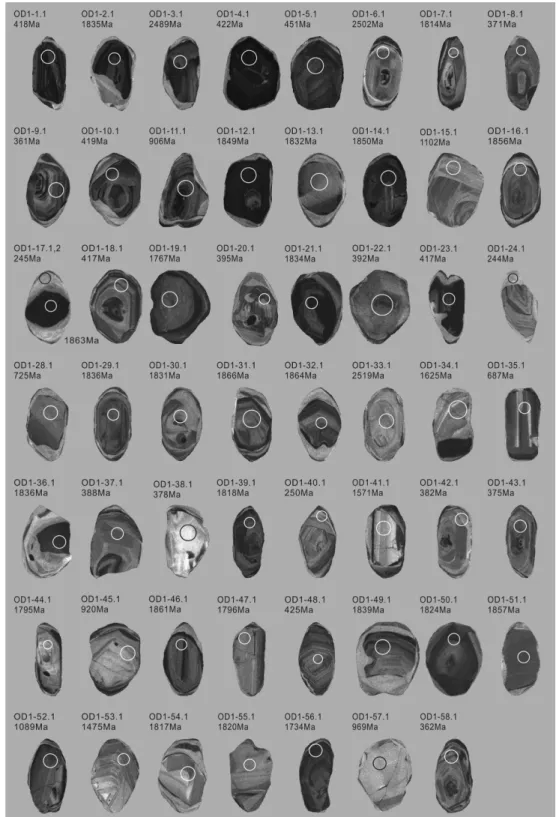
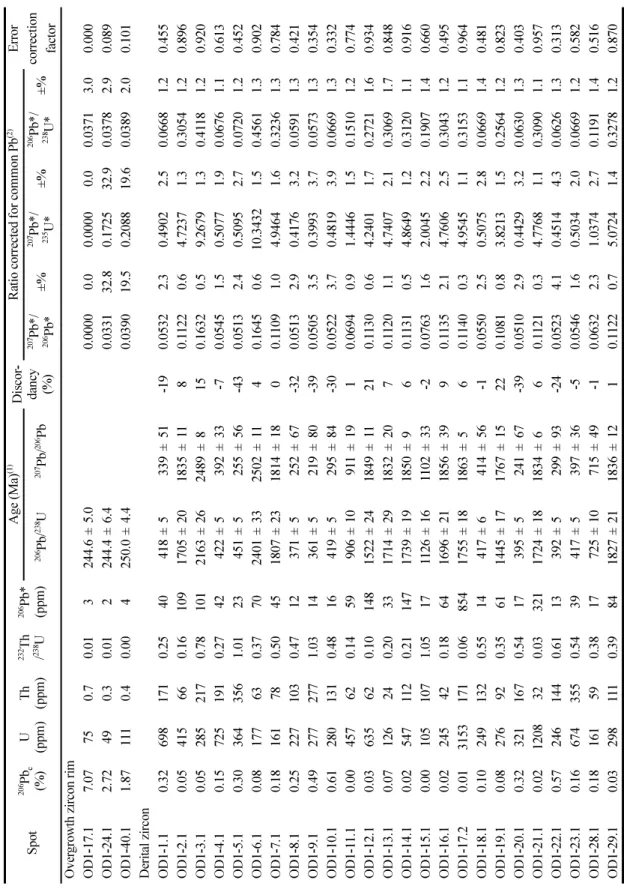
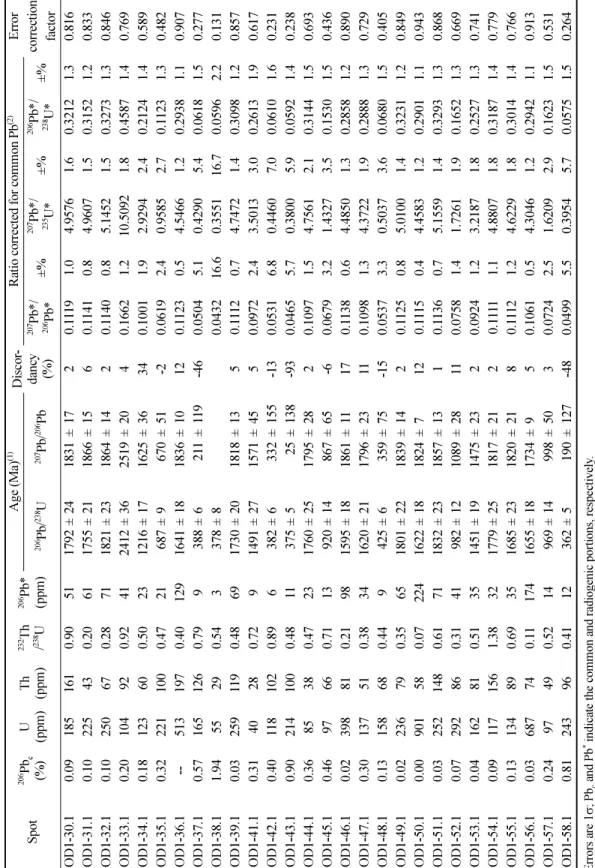
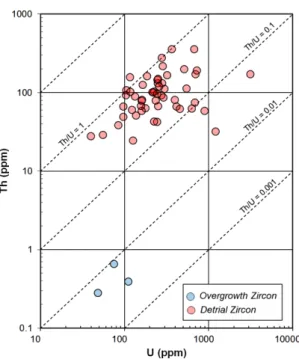
SHRIMP U-Pb 분석이 이루어진 저어콘의 CL영상 과 분석점의 위치는 Fig. 3에, 분석 결과의 요약은 Table 1에, 저어콘의 Th과 U 함량 관계도, 콘코디아 다이아그램과 빈도막대그래프/확률밀도그림은 각각 Figs. 4, 5와 6에 제시되었다. 연령의 신빙성을 고려 하여 빈도막대그래프/확률밀도그림의 작성에서 1.0 Ga 이상이면서 10% 이상의 불일치 비를 보이는 자료는 제외하였다.
저어콘 시료는 다양한 색을 띠고, 입자의 장축의 길이가 최대 250 µm에 달하며 축과 길이의 비가 1:1~1:3인 판상 내지 주상의 형태를 갖는다. CL 영상 에서 저어콘은 대부분 파동형(oscillatory), 띠형(band) 등 마그마 기원을 지시하는 누대구조를 보이지만(예:
Vavra, 1990; Hoskin and Schaltegger, 2003) 일부 는 기원을 유추하기 어려운 다양한 명도의 균질한 CL을 나타낸다(Fig. 3). 상당수의 입자는 원래 결정의 일부가 삭박된 양상이며, 특별한 누대구조를 보이지 않는 과성장한 저어콘 연변부가 핵을 둘러싸는 복합 적인 기원의 입자도 흔히 관찰된다. 이러한 내부구조 의 특징은 저어콘이 퇴적물로 운반과정을 거쳐 시료 Fig. 2. (a) Well foliated biotite schist from the Guryong
Group showing isoclinal folding which was collected for SHRIMP U-Pb zircon analyses. (b) photomicrograph of the biotite schist sample consisting of quartz (Qzt), plagioclase (Pl), biotite (Bt) and sericite (Ser) (crossed polar).
Fig. 3. Cathodoluminescence image of the analysed zircons. Circles (about 25 µm in diameter) and numbers are approximate locations and SHRIMP 207Pb-corrected 206Pb/238U (≤1000 Ma) or 204Pb corrected 206Pb/207Pb (>1000 Ma) ages of the analysed spots in Table 1.
Table 1. Summary of SHRIMP U-Pb zircon data for a biotite schist sample from the Guryong Group Spot206Pbc (%)U (ppm)Th (ppm)
232Th /238U
206Pb* (ppm) Age (Ma)(1) Discor- dancy (%)
Ratio corrected for common Pb(2)Error 206Pb/238U207Pb/206Pb207 Pb*/ 206 Pb*±%207 Pb*/ 235 U*±%206 Pb*/ 238 U*±%correction factor Overgrowth zircon rim OD1-17.17.07 75 0.7 0.01 3 244.6±5.0 0.0000 0.0 0.0000 0.0 0.03713.0 0.000 OD1-24.12.72 49 0.3 0.01 2 244.4±6.4 0.0331 32.8 0.1725 32.9 0.03782.9 0.089 OD1-40.11.87 111 0.4 0.00 4 250.0±4.4 0.0390 19.5 0.2088 19.6 0.03892.0 0.101 Derital zircon OD1-1.10.32 698 171 0.25 40 418±5339±51 -19 0.0532 2.3 0.4902 2.5 0.06681.2 0.455 OD1-2.10.05 415 66 0.16 109 1705±20 1835±11 8 0.1122 0.6 4.7237 1.3 0.30541.2 0.896 OD1-3.10.05 285 217 0.78 101 2163±26 2489±815 0.1632 0.5 9.2679 1.3 0.4118 1.2 0.920 OD1-4.10.15 725 191 0.27 42 422±5392±33 -70.0545 1.5 0.5077 1.9 0.06761.1 0.613 OD1-5.10.30 364 356 1.01 23 451±5255±56 -43 0.0513 2.4 0.5095 2.7 0.07201.2 0.452 OD1-6.10.08 177 63 0.37 70 2401±33 2502±11 4 0.1645 0.6 10.3432 1.5 0.45611.3 0.902 OD1-7.10.18 161 78 0.50 45 1807±23 1814±18 0 0.1109 1.0 4.9464 1.6 0.32361.3 0.784 OD1-8.10.25 227 103 0.47 12 371±5252±67 -32 0.0513 2.9 0.4176 3.2 0.05911.3 0.421 OD1-9.10.49 277 277 1.03 14 361±5219±80 -39 0.0505 3.5 0.3993 3.7 0.05731.3 0.354 OD1-10.10.61 280 131 0.48 16 419±5295±84 -30 0.0522 3.7 0.4819 3.9 0.06691.3 0.332 OD1-11.10.00 457 62 0.14 59 906±10 911±19 1 0.0694 0.9 1.4446 1.5 0.15101.2 0.774 OD1-12.10.03 635 62 0.10 148 1522±24 1849±11 21 0.1130 0.6 4.2401 1.7 0.27211.6 0.934 OD1-13.10.07 126 24 0.20 33 1714±29 1832±20 7 0.1120 1.1 4.7407 2.1 0.30691.7 0.848 OD1-14.10.02 547 112 0.21 147 1739±19 1850±96 0.1131 0.5 4.8649 1.2 0.31201.1 0.916 OD1-15.10.00 105 107 1.05 17 1126±16 1102±33 -20.0763 1.6 2.0045 2.2 0.19071.4 0.660 OD1-16.10.02 245 42 0.18 64 1696±21 1856±39 9 0.1135 2.1 4.7606 2.5 0.30431.2 0.495 OD1-17.20.01 3153 171 0.06 854 1755±18 1863±56 0.1140 0.3 4.9545 1.1 0.31531.1 0.964 OD1-18.10.10 249 132 0.55 14 417±6414±56 -10.0550 2.5 0.5075 2.8 0.06691.4 0.481 OD1-19.10.08 276 92 0.35 61 1445±17 1767±15 22 0.1081 0.8 3.8213 1.5 0.25641.2 0.823 OD1-20.10.32 321 167 0.54 17 395±5241±67 -39 0.0510 2.9 0.4429 3.2 0.06301.3 0.403 OD1-21.10.02 1208 32 0.03 321 1724±18 1834±66 0.1121 0.3 4.7768 1.1 0.30901.1 0.957 OD1-22.10.57 246 144 0.61 13 392±5299±93 -24 0.0523 4.1 0.4514 4.3 0.06261.3 0.313 OD1-23.10.16 674 355 0.54 39 417±5397±36 -50.0546 1.6 0.5034 2.0 0.06691.2 0.582 OD1-28.10.18 161 59 0.38 17 725±10 715±49 -10.0632 2.3 1.0374 2.7 0.1191 1.4 0.516 OD1-29.10.03 298 1110.39 84 1827±21 1836±12 1 0.1122 0.7 5.0724 1.4 0.32781.2 0.870
Table 1. Continued Spot206Pbc (%)U (ppm)Th (ppm)
232Th /238U
206Pb* (ppm) Age (Ma)(1) Discor- dancy (%)
Ratio corrected for common Pb(2) Error 206Pb/238U207Pb/206Pb207 Pb*/ 206 Pb*±%207 Pb*/ 235 U*±%206 Pb*/ 238 U*±%correction factor OD1-30.10.09 185 161 0.90 51 1792±24 1831±17 2 0.1119 1.0 4.9576 1.6 0.3212 1.3 0.816 OD1-31.10.10 225 43 0.20 61 1755±21 1866±15 6 0.1141 0.8 4.9607 1.5 0.3152 1.2 0.833 OD1-32.10.10 250 67 0.28 71 1821±23 1864±14 2 0.1140 0.8 5.1452 1.5 0.3273 1.3 0.846 OD1-33.10.20 104 92 0.92 41 2412±36 2519±20 4 0.1662 1.2 10.5092 1.8 0.4587 1.4 0.769 OD1-34.10.18 123 60 0.50 23 1216±17 1625±36 34 0.1001 1.9 2.9294 2.4 0.2124 1.4 0.589 OD1-35.10.32 221 100 0.47 21 687±9670±51 -2 0.0619 2.4 0.9585 2.7 0.11231.3 0.482 OD1-36.1--513 197 0.40 129 1641±18 1836±10 120.1123 0.5 4.5466 1.2 0.2938 1.1 0.907 OD1-37.10.57 165 126 0.79 9 388±6211±119 -46 0.0504 5.1 0.4290 5.4 0.0618 1.5 0.277 OD1-38.11.94 55 29 0.54 3 378±80.0432 16.6 0.3551 16.7 0.0596 2.2 0.131 OD1-39.10.03 259 119 0.48 69 1730±20 1818±13 5 0.1112 0.7 4.7472 1.4 0.3098 1.2 0.857 OD1-41.10.31 40 28 0.72 9 1491±27 1571±45 5 0.0972 2.4 3.5013 3.0 0.2613 1.9 0.617 OD1-42.10.40 118 102 0.89 6 382±6332±155 -13 0.0531 6.8 0.4460 7.0 0.0610 1.6 0.231 OD1-43.10.90 214 100 0.48 11375±525±138 -93 0.0465 5.7 0.3800 5.9 0.0592 1.4 0.238 OD1-44.10.36 85 38 0.47 23 1760±25 1795±28 2 0.1097 1.5 4.7561 2.1 0.3144 1.5 0.693 OD1-45.10.46 97 66 0.71 13 920±14 867±65 -6 0.0679 3.2 1.4327 3.5 0.1530 1.5 0.436 OD1-46.10.02 398 81 0.21 98 1595±18 1861±11 170.1138 0.6 4.4850 1.3 0.2858 1.2 0.890 OD1-47.10.30 137 51 0.38 34 1620±21 1796±23 110.1098 1.3 4.3722 1.9 0.2888 1.3 0.729 OD1-48.10.13 158 68 0.44 9 425±6359±75 -15 0.0537 3.3 0.5037 3.6 0.0680 1.5 0.405 OD1-49.10.02 236 79 0.35 65 1801±22 1839±14 2 0.1125 0.8 5.0100 1.4 0.3231 1.2 0.849 OD1-50.10.00 901 58 0.07 224 1622±18 1824±7120.1115 0.4 4.4583 1.2 0.2901 1.1 0.943 OD1-51.10.03 252 148 0.61 71 1832±23 1857±13 1 0.1136 0.7 5.1559 1.4 0.3293 1.3 0.868 OD1-52.10.07 292 86 0.31 41 982±12 1089±28 110.0758 1.4 1.7261 1.9 0.1652 1.3 0.669 OD1-53.10.04 162 81 0.51 35 1451±19 1475±23 2 0.0924 1.2 3.2187 1.8 0.2527 1.3 0.741 OD1-54.10.09 117 156 1.38 32 1779±25 1817±21 2 0.1111 1.14.8807 1.8 0.3187 1.4 0.779 OD1-55.10.13 134 89 0.69 35 1685±23 1820±21 8 0.1112 1.2 4.6229 1.8 0.3014 1.4 0.766 OD1-56.10.03 687 74 0.11 174 1655±18 1734±95 0.1061 0.5 4.3046 1.2 0.2942 1.1 0.913 OD1-57.10.24 97 49 0.52 14 969±14 998±50 3 0.0724 2.5 1.6209 2.9 0.1623 1.5 0.531 OD1-58.10.81 243 96 0.41 12 362±5190±127 -48 0.0499 5.5 0.3954 5.7 0.0575 1.5 0.264 Errors are 1σ; Pbc and Pb* indicate the common and radiogenic portions, respectively. (1) Calculated using207Pb-corrected 206Pb/238U and 204Pb-corrected207Pb/206Pb ratios, respectively (2) Common Pb corrected using measured 204Pb
의 모암에 유입된 후 변성작용에 의해 원위치의 성장 (in situ growth) 과정을 거쳤음을 의미한다.
55개 저어콘 입자로부터 연변부 3점과 쇄설성 핵 53점의 SHRIMP U-Pb 분석치를 얻었다. 연변부 저 어콘의 분석치에서 U과 Th 함량은 각각 49~111 ppm 과 1 ppm 미만이고, 결과적으로 Th/U 비는 0.01 미 만으로 매우 낮다(Table 1, Fig. 4). 이들의 겉보기연 령(appparent age)은 244.4~250.0 Ma의 범위이고, 가 중평균연령은 246.8±5.8 Ma이다(n=3, MSWD=0.38).
쇄설성 저어콘 핵의 분석치는 U 및 Th 함량과 Th/
U 비가 각각 40~3153 ppm, 24~356 ppm과 0.03~1.38 로 넓은 범위를 보여 이들 저어콘이 다양한 성분의 모암으로부터 유래하였음을 시사한다. 이들의 겉보기 연령은 데본기 후기에서 시생대 최후기에 이르는 360.8~2519 Ma에 걸쳐있다(Table 1, Fig. 5, 6). 이 들은 콘코디아 다이아그램과 빈도막대그래프/확률밀 도그림에서 가중평균연령 378±10 Ma(n=9, MSWD=
6.2), 420±4 Ma(n=6, MSWD=0.30), 940±61 Ma(n=4, MSWD=0.59), 1845±9 Ma(n=18, MSWD=2.3), 2506±
18 Ma(n=2, MSWD=0.59)인 집중군을 형성하며, 약 687 Ma와 725 Ma의 신원생대 후기 연령도 포함한다 (Table 1, Fig. 6).
토의 및 결론
구룡층군의 지질시대와 대비
이 연구의 쇄설성 저어콘 핵의 가장 젊은 연령군과 과성장한 변성작용 기원의 저어콘 연령은 구룡층군 흑운모 편암의 원암이 퇴적된 시기를 약 378 Ma과 247 Ma 사이, 즉 데본기 후기 이후의 고생대 후기로 제한한다. 지금까지의 연구에서 사일루리아기 내지 데 본기 이후의 고생대층의 분포는 임진강대, 경기육괴 Fig. 4. Th and U concentrations of the zircon domains
in Fig. 3 analyzed by SHRIMP (see Table 1 for the concentrations).
Fig. 5. Concordia plot of the SHRIMP U-Pb data in Table 1.
Fig. 6. Relative probability distribution-frequency histo- gram plot of the zircon ages. Red and blue bins indicate detrital and overgrowth zircons, respectively.
The age data refer to 207Pb/206Pb ages for zircons older than 1.0 Ga, and 206Pb/238U ages for younger zircons, respectively, and discordant ages older than 1.0 Ga were rejected for the plot (see Table 1 for the age data).
서부와 옥천대 중앙부 및 남서부에 국한되지만 이 연 구는 경기육괴 동부 오대산 지역에도 고생대 후기의 지층이 존재하는 것을 나타낸다. 퇴적암의 쇄설성 저 어콘이 형성하는 가장 젊은 연대 집중군은 그 퇴적암 의 최고 퇴적시기에 해당한다고 할 수 있다. 기존의 연구에서 사일루리아기 내지 데본기 이후 고생대층의 최고 퇴적시기는 임진강대의 연천층군 삼곳대가 397±6 Ma(Cho et al., 2005), 미산층이 431±4 Ma (Kim et al., 2014), 안면도에서 영종도에 걸쳐 산발 적으로 분포하는 태안층은 시료에 따라 420±4 Ma (Cho, 2007), 420-430 Ma(Cho et al., 2010; Na et al., 2012), 441±17 Ma, 449±3 Ma, 432±3 Ma과 446±7 Ma이다(Kim et al., 2014). 즉, 약 378 Ma 최고 퇴적시기의 구룡층군은 임진강대 연천층군과 경 기육괴 서부의 태안층에 비해 젊은 지층으로 생각할 수 있다. 옥천대 중앙부 옥천누층군의 최고 퇴적시기 는 피반령 단위(unit)의 하부와 상부가 각각 535±
6 Ma 및 544±4 Ma와 447±5 Ma이고, 보은 단위의 3 시료는 각각 758±7 Ma, 757±24 Ma와 746±32 Ma로 보고되어(Cho et al., 2013) 구룡층군에 비해 고기의 지층으로 보인다. 반면 옥천대 남서부의 화산리층, 비 봉층과 설옥리층은 최고 퇴적시기가 각각 371±11 Ma, 386±3 Ma과 약 355 Ma로서(Kim et al., 2014) 구룡 층군과 같아 구룡층군은 시대적으로 옥천대의 남서부 지층에 대비될 수 있다.
지체구조적 의의
구룡층군 흑운모 편암의 과성장한 저어콘이 제시하 는 246.8±5.8 Ma의 트라이아스기 광역변성 시기는 Oh et al. (2006c)이 보고한 맨거라이트 주변의 미그 마타이트질 편마암의 스피넬 백립암이 대륙충돌과 관 련하여 경험한 페름기-트라이아스기(245±10 Ma~
248±18 Ma) 시기의 광역변성작용과 잘 일치한다.
쇄설성 저어콘 핵의 연령구성은 구룡층군 흑운모 편암의 모암인 퇴적암이 대부분 약 1.8 Ga(40%)와 361~425 Ma(36%)의 고원생대 후기와 고생대 중기의 암석으로부터 유래하였으며, 소량의 시생대 말과 중 원생대-신원생대의 암석에서도 유래하였음을 보인다 (Fig. 6). 또한 저어콘의 CL 및 Th/U 비의 특징은 이들이 대부분 화성암에서 결정화된 저어콘이었음을 나타낸다(Figs. 3, 4). 경기육괴에는 18~19억년의 화 성활동과 광역변성작용에 의한 정편마암과 준편마암 이 광범위하게 분포하고, 준편마암의 저어콘 상속핵
은 대부분 약 20억년에서 25억년까지의 고원생대 연 령이며 드물게 시생대 연령도 존재하는 특징을 보인 다(Lee et al., 2000; Oh et al., 2006a; Kim et al., 2013b와 그에 포함된 참고문헌). 또한 경기육괴에는 소규모의 중원생대의 화성암과 로디니아 초대륙의 합 체 및 분열과 관련된 신원생대의 화성활동이 존재한 다(Kim et al., 2013a, 2013b와 그에 포함된 참고문 헌). 따라서 구룡층군 흑운모 편암의 가장 우세한 약 1.8 Ga와 소량의 시생대 말기, 중원생대-신원생대의 쇄 설성 저어콘의 근원은 경기육괴의 선캠브리아 기반암 에 대응된다고 할 수 있다.
중국 중앙의 충돌대(Central China Orogenic Belt) 에서는 트라이아스기 충돌 전인 고생대 초기-중기에 대륙의 봉합과 관련된 화성암과 변성암의 나타난다 (Harker et al., 2004; Dong et al., 2011; Wu and Zheng, 2013). 중국의 충돌대의 연장부로 여겨지는 경기육괴 남서부 홍성 지역에서도 한반도에서 고생대 에 지각의 섭입에 의한 지체구조의 증거로 고생대 중 기의 마그마 호의 화성활동과 변성작용이 발견되고 있다(예: Kim et al., 2011a; Park et al., 2014). 또 한 여러 지질학적 증거에 의해 중국의 충돌대에 대비 되는 조산대로 여겨지는 “홍성-임진강대”를 따라 단 속적으로 분포하는 고생대 퇴적층(태안층과 연천층 군)과 옥천대 서남부의 퇴적층(화산리층, 비봉층, 설 옥리층)에는 중국의 충돌대 인근의 고생대 지층의 경 우처럼 많은 중기 고생대의 화성기원 저어콘 쇄설성 입자가 포함된다(Kim et al., 2014와 그 안의 참고문 헌). 오대산 지역이 트라이아스기 조산대에 해당한다 는 기존의 암석학 및 변성작용의 증거(Oh et al., 2006b, c)와 이 연구의 트라이아스기 광역변성 시기 를 종합하면 구룡층군의 고생대 중기의 쇄설성 저어 콘은 임진강대, 경기육괴 서부와 옥천대 남서부의 경 우처럼 고생대 대륙의 봉합과 관련된 산물일 가능성 이 있다.
결론적으로 이 연구의 구룡층군 흑운모 편암의 저 어콘이 제시하는 트라이아스기 변성시기와 쇄설성 저 어콘의 연대구성은 경기육괴 오대산 지역이 중국 충 돌대의 영향을 받은 지역이거나 혹은 그의 연장부에 해당할 가능성을 시사한다.
사 사
이 연구는 한국지질자원연구원의 연구과제 “서부경
기지괴 지구조 진화 및 지질정보 구축”(과제번호: 14- 3311-1)의 일환으로 수행되었다. SHRIMP 분석을 위 한 시료준비, 기기분석과 자료처리에 도움을 준 한국 기초과학지원연구원 오창캠퍼스의 김정민박사, 이기 욱박사와 실험실 실무진, 그리고 시료의 현미경적 특 징에 대해 토의한 이승렬박사께 감사드린다. 또한 초 고를 심사하여 오류를 지적하고 건설적인 제안을 해 준 김성원박사와 익명의 심사자께 사의를 표한다.
References
Chang, E.Z., 1996, Collisional orogen between north and south China and its eastern extension in Korean Penin- sula. Journal of Southeast Asian Earth Science, 13, 267- 277.
Cho, D.-L., 2004, Mineral separation and sample prepara- tion methods efficient for subgrain zircon analyses. Jour- nal of the Petrological Society of Korea, 13, 126-132 (in Korean with English abstarct).
Cho, D.-L., 2007, SHRIMP zircon dating of a low-grade meta-sandstone from the Taean Formation: Provenance and its tectonic implications. KIGAM Bulletin, 11, 3-14 (in Korean with English abstract).
Cho, D.L., Kwon, S.T., Jeon, E.Y. and Armstrong, R., 2001, SHRIMP U-Pb zircon geochronology of an amphibolite and a paragneiss from the Samgot unit, Yeoncheon Com- plex in the Imjingang belt, Korea: tectonic implication.
Geological Society of Korea Annual Meeting Abstract 14-1, 89.
Cho, D.-L., Kwon, S.-T., Jeon, E.-Y. and Armstrong, R., 2005, SHRIMP U-Pb zircon ages of metamorphic rocks from the Samgot unit, Yeoncheon complex in the Imjin- gang belt, Korea: Implications for the Phanerozoic tecto- nics of East Asia (abstract). Annual Meeting of the Geo- logical Society of America, paper no. 171-6. doi: 0020- 6814/07/912/30-22.
Cho, D.-L., Suzuki, K., Adachi, M. and Chwae, U., 1996, A preliminary CHIME age determination of monazite from metamorphic and granitic rocks in the Gyeonggi massif, Korea. Journal of Earth and Planetary Science, Nagoya University, 43, 49-65.
Cho, M., Cheong, W., Ernst, W.G., Yi, K. and Kim, J., 2013, SHRIMP U-Pb ages of detrital zircons in metasedi- mentary rocks of the central Ogcheon fold-thrust belt, Korea: Evidence for tectonic assembly of Paleozoic sedi- mentary protoliths. Journal of Asian Earth Sciences, 63, 234-249.
Cho, M., Kim, Y. and Ahn, J., 2007, Metamorphic evolu- tion of the Imjingang belt, Korea: implications for Permo- Triassic collisional orogeny. International Geology Review, 49, 30-51.
Cho, M., Na, J. and Yi, K., 2010, SHRIMP U-Pb ages of detrital zircons in metasandstones of the Taean Forma- tion, western Gyeonggi massif, Korea: Tectonic implica- tions. Geosciences Journal, 14, 99-109.
Chough, S.K., Kwon, S.T., Ree, J.H. and Choi, D.K., 2000, Tectonic and sedimentary evolution of the Korean penin- sula: a review and new view. Earth Science Review, 52, 175-235.
Dong, Y., Zhang, G., Neubauer, F., Liu, X., Genser, J. and Hauzenberger, C., 2011, Tectonics evolution of the Qin- ling orogen, China: Review and synthesis. Journal of Asian Earth Sciences, 41, 23-237.
Ernst, W.G. and Liou, J.G., 1995, Contrasting plate-tectonic styles of the Qinling-Dabie-Sulu and Franciscan metamor- phic belt. Geology, 23, 353-356.
Hacker, B.R., Ratschbacher, L. and Liou, J.G., 2004, Sub- duction, collision and exhumation in the ultrahigh-pres- sure Qunling-Dabie orogen. In Aspects of the Tectonic Evolution of China, (eds. Malpas, J., Fletcher, C.J.N., Ali, J.R. and Aitchison, J.C.), The geological society pub- lishing house, Brassmill Lane, 157-175.
Hoskin, P.W.O. and Schaltegger, U., 2003, The composition of zircon and igneous and metamorphic petrogenesis. In Zircon (eds. Hanchar J.M. and Hoskin, P.O.W), Reviews in Mineralogy and Geochemistry, 53, 27-62.
Kee, W.-S., Kim, H., Kim, B.C., Choi, S.J., Park, S.-I. and Hwang S.K., 2010, Geological report of the Seoraksan sheet, scale 1:50,000. Korea Institute of Geoscience and Mineral Resorces, 94p (in Korean with English sum- mary).
Kim, B.K., Chi, J.M., Lee D.Y. and So, C.-S., 1975a, Explanatory text of the geological map of Hyeon Ri sheet, sheet 6827-I, scale 1:50,000. Geological and Mine- ral Institute of Korea, 1-7 (English summary).
Kim, S.W., Kee, W.-S., Lee, S.R., Santosh, M. and Kwon, S., 2013a, Neoproterozoic plutonic rocks from the west- ern Gyeonggi massif, South Korea: Implications for the amalgamation and break-up of the Rodinia superconti- nent. Precambrian Research, 227, 349-367.
Kim, S.W., Kwon, S., Santosh, M., Cho, D.-L. and Ryu, I- C., 2014, Detrital zircon U-Pb geochronology and tec- tonic implications of the Paleozoic sequences in western South Korea, Journal of Asian Earth Sciences, doi: http:/
/dx.doi.org/10.1016/j.jseaes.2014.05.022.
Kim, S.W., Kwon, S., Santosh, M., Williams, I.S. and Yi, K., 2011a, A Paleozoic subduction complex in Korea:
SHRIMP zircon U-Pb ages and tectonic implications.
Gondwana Research, 20, 890-903.
Kim, S.W., Kwon, S., Yi, K. and Santosh, M., 2013b, Arc magmatism in the Yeongnam Massif, Korean Peninsula:
Imprints of Columbia and Rodinia supercontinents. Gond- wana Research, doi: 10.1016/j.gr.2013.08.020.
Kim, S.W., Park, B.K., Kim, O.J., Yoo B.H. and Kim, K.H,
1975b, Explanatory text of the geological map of Bug- bunri sheet, sheet 6927-IV, scale 1:50,000. Geological and Mineral Institute of Korea, 1-5 (English summary).
Kim, T., Oh C.W. and Kim J., 2011b, The characteristic of mangerite and gabbro in the Odaesan area and its mean- ing to the Triassic tectonics of Korean peninsula Journal of the Petrological Society of Korea, 20, 77-98 (in Korean with English abstarct).
Kwon, S., Sajeev, K., Mitra, G., Park, Y., Kim, S.W. and Ryu, I.C., 2009, Evidence of Permo-Triassic collision in Far East Asia: the Korean collision orogen. Earth and Planetary Science Letter, 279, 340-349.
Kwon, Y.W., Kim H.S. and Oh C.W., 1997, Polymetamor- phism of the Odesan gneiss complex in the northeastern area of the Kyonggi massif, Korea. Journal of the Petro- logical Society of Korea, 6, 226-243 (in Korean with English abstract).
Lee, S.R., Cho, M., Yi, K. and Stern R.A., 2000, Early Pro- terozoic granulites in central Korea: Tectonic correlation with Chinese cratons. Journal of Geology, 108, 729-738.
Lee D.S., Yun, S. and Kim, J.J., 1975, Explanatory text of the geological map of Changchon sheet, sheet 6827 II, scale 1:50,000. Geological and Mineral Institute of Korea, 1-10 (English summary).
Lim, S.-B., Chun, H.-Y., Kim, Y.B., Kim, B.K. and Cho, D.-L., 2005. Geologic ages, stratigraphy and geological structures of the metasedimentary strata in Bibong-Yeon- mu area, NW Okcheon belt, Korea. Journal of the Geo- logical Society of Korea, 41, 335-368 (In Korean with English abstract).
Ludwig, K.R., 2008, Isoplot 3.6. A user's manual. Berkley Geochronology Center Special Publication 4, 2455 Ridge Road, Berkely, CA 94709, USA, 78p.
Ludwig, K.R., 2009, SQUID 2.50. A user's manual. Berkley Geochronology Center, 2455 Ridge Road, Berkely, CA 94709, USA, 102p.
Na, J., Kim, Y., Cho, M. and Yi, K., 2012, SHRIMP U-Pb ages of detrital zircons from metasedimentary rocks in the Yeongheung-Seonjae-Daebu Islands, Northwestern Gyeonggi Massif. Journal of the Petrological Society of Korea, 21, 31-45 (in Korean with English abstract).
Oh C.W., 2012, The tectonic evolution of South Korea and northeast asia from Paleoproterozoic to Triassic. Journal of the Petrological Society of Korea, 21, 59-87 (in Korean with English abstarct).
Oh, C.W, Choi, S.G., Zhai, M. and Guo, J., 2003, The first finding of eclogite relict in the Korean Peninsula and its tectonic meaning. Abstract volume of The West Norway Eclogite Field Symposium, 107.
Oh, C.W., Kim, C.B., Park, Y.S. and Kim, S.W., 2006a, SHRIMP U-Pb zircon ages of Paleoproterozpoc rocks from the Gyeonggi Massif and their implications. Journal of the Geological Society of Korea, 42, 587-606.
Oh, C.W., Kim, S.W., Choi, S.G., Zhai, M., Guo, J. and Sajeev, K., 2005, First finding of eclogite facies metamor- phic event in South Korea and its correlation with the Dabie-Sulu collision belt in China. Journal of Geology, 113, 226-232.
Oh, C.W., Kim, S.W. and Williams, I.S., 2006b, Spinel granulite in Odesan area, South Korea: Tectonic implica- tions for the collision between the North and South China blocks. Lithos, 92, 557-575.
Oh, C.W., Krishnan, S., Kim, S.W. and Kwon, Y.W., 2006c, Mangerite magmatism associated with a probable Late- Permian to Triassic Hongseong-Odesan collision belt in South Korea. Gondwana Research, 9, 95-105.
Oh, C.W. and Kusky, T.M., 2007, The Late Permian to Tri- assic Hongseong-Odesan collision belt in South Korea, and its tectonic correlation with China and Japan. Inter- national Geology Review, 49, 639-657.
Paces, J.B. and Miller Jr., J.D., 1993, Precise U-Pb ages of Duluth Complex and related mafic intrusions, northeast- ern Minnesota: geochronological insights to physical, petrogenic, paleomagnetic, and tectonomagmatic pro- cesses associated with the 1.1 Ga midcontinent rift sys- tem. Journal of Geophysical Research-Solid Earth, 98, 13997-14013.
Park, S.-I., Kim, S.W., Kwon, S., Thanh, N.X., Yi, K. and Santosh, M., 2014, Paleozoic tectonics of the southwest- ern Gyeonggi massif, South Korea: Insight from geochemistry, chromian-spinel chemistry and SHRIMP U- Pb geochronology. Gondwana Research, http://dx.doi.org/
10.1016/j.gr.2013.07.015.
Ree, J.H., Cho, M., Kwon, S.T. and Nakamura, E., 1996, Possible eastward extension of Chinese collision belt in South Korea: the Imjingang belt. Geology, 24, 1071- 1074.
Ree, J.H., Kwon, S.H., Park, Y., Kwon, S.T. and Park, S.H., 2001, Pre- and post-tectonic emplacements of the grani- toids in the central-southern Okchon belt, South Korea:
implications for the timing of the strike-slip shearing and thrusting. Tectonics, 20, 850-867.
Sajeev, K., Jeong, J., Kwon, S., Kee, W.S., Kim, S.W., Komiya, T., Itaya, T., Jung, H.S. and Park, Y., 2010, High P-T granulite relicts from the Imjingang belt, South Korea: Tectonic significance. Gondwana Research, 17, 75-86.
Song, K.-Y., Park S.-I. and Cho, D.-L., 2011, Geological report of the Sokcho-Yangyang sheet, scale 1:50,000.
Korea Institute of Geoscience and Mineral Resources, 81p (in Korean with English summary).
Vavra, G., 1990, On the kinematics of zircon growth and its petrogenetic significance: a cathodoluminescence study.
Contributions to Mineralogy and Petrology, 106, 90-99.
Williams, I.S., 1998, U-Th-Pb geochronology by ion micro- probe. In Application of Microanalytical Techniques to
Understanding Mineralizing Processes (eds. Mckibben, M.A., Shanks III, W.C. and Ridley W.I.), Reviews in Economic Geology, 1-35.
Wu, Y.B. and Zheng, Y.F., 2013, Tectonic evolution of a composite collision orogen: An overview on the Qinling- Tongbai-Hong'an-Dabie-Sulu orogenic belt in central China. Gondwana Research, 23, 1402-1428.
Yin, A. and Nie. S., 1993, An indentation model for the north and south China collision and the development of
the TanLu and Honam fault systems, eastern Asia. Tec- tonics, 12, 801-813.
Zhang, K.J., 1997, North and South China collision along the eastern and southern North China margins. Tectono- physics, 270, 145-156.
2014년 7월 4일 접수 2014년 7월 4일 심사개시 2014년 9월 4일 채택