• 검색 결과가 없습니다.

Cultivable Bacterial Community Analysis of Dairy Activated Sludge for Value Addition to Dairy Wastewater

N/A
N/A
Protected

Academic year: 2021

Share "Cultivable Bacterial Community Analysis of Dairy Activated Sludge for Value Addition to Dairy Wastewater"

Copied!
11
0
0

로드 중.... (전체 텍스트 보기)

전체 글

(1)

Cultivable Bacterial Community Analysis of Dairy Activated Sludge for Value Addition to Dairy

Wastewater

Tethi Biswas

1,2

, Debasmita Chatterjee

3

, Sinchini Barman

3

, Amrita Chakraborty

1

, Nabanita Halder

1

, Srimoyee Banerjee

1

, and Shaon Ray Chaudhuri

1

*

1

Department of Microbiology, Tripura University, Suryamaninagar, Tripura West, 799022, India

2

Centre of Excellence in Environmental Technology and Management,

3

Department of Biotechnology, Maulana Abul Kalam Azad University of Technology, Haringhata, Nadia, West Bengal-741249, India

Received: January 29, 2019 / Revised: April 18, 2019 / Accepted: April 29, 2019

Introduction

Operation Flood, the world's biggest dairy develop- ment program launched by National Dairy Development Board (NDDB), India in 1970 under the leadership of Mr.V. Kurien, started with an objective of creating a milk grid nationwide and has made India world’s largest producer of milk [1] from a milk-deficient nation. This production is associated with simultaneous release of copious amount of nutrient rich wastewater which could

support microbe as well as plant growth. For every litre of milk processed in India, about 1 to 10 L of water is utilized [2] depending on the end products such as butter, cheese, and yoghurt. This nutrient-rich [3] efflu- ent if discharged (untreated or partially treated) into the water bodies will cause eutrophication while increasing the salinity of the soil. The effluent needs to be treated using an energetically intensive, laborious and elaborate process (Fig. 1A) requiring about 105 to 120 h. The establishment cost of an effluent treatment plant (ETP) to process about 10 m

3

dairy wastewater (DWW) is approximately 15200 US Dollar with a running cost of about 1.2 to 2% of the revenue generated. For an aera- tion tank of 2.1 m

3

, six to seven propellers of 7.5 horse- Analysis of bacterial communities based on their 16S rDNA sequences revealed the predominance of Proteobacteria (Aeromonas sp., Acinetobacter sp. and Thaueraamino aromatica sp.) and uncultured bacte- rium in activated sludge from the effluent treatment plant (ETP) of Mother Dairy, Calcutta (India). Each isolate was used for bioremediation of dairy wastewater with simultaneous conversion of nitrogenous pol- lutants into ammonia. A consortium developed using seven of these isolates and three Bacillus strains from different environmental origins could reduce 93% nitrate with simultaneous production of ammonia (626 µg/100 ml) within 20 h in non-aerated, immobilized conditions as compared to 82% nitrate reduction producing 2.4 µg/100 ml ammonia in 96 h with extensive aeration in a conventional ETP. The treated ammo- nia-rich effluent could be used instead of freshwater and fertilizer during cultivation of mung bean with 1.6-fold increase in grain yield. The ETP with the surrounding agricultural land makes this process a zero liquid discharge technology for using the biofertilizer generated. In addition, the process requires minimal energy supporting sustained environmental health. This method is thus proposed as an alternative approach for small-scale dairy ETPs.

Keywords: Dairy wastewater, activated sludge, bioremediation, bacteria, biofertilizer

*Corresponding author

Tel: +919831034236, Fax: +913812374802 E-mail: [email protected]

© 2019, The Korean Society for Microbiology and Biotechnology

(2)

Fig. 1. (A) Pictorial representation of a conventional system of dairy effluent treatment plant. (B) Schematic diagram of the

1 L bioreactor. (C) Molecular identity of the isolated strains. (D) Field Emission Scanning Electron Microscopic image of MDS

7A showing the cell morphology. (E) Phylogenetic tree of partial 16S rDNA sequences of MDS 7A constructed using MEGA7,

(F) Scanning Electron Microscopic image of the consortium under environmental mode showing the cells in biofilm state.

(3)

power work round the clock for 24 h, making the process expensive and difficult for the medium and small-scale set-ups to adopt. This necessitates looking for alterna- tive options.

Numerous research groups are working on different aspects of DWW treatment to improve the existing sys- tem which consists of anaerobic and aerobic processes.

Existing anaerobic treatment methods [4, 5] are energet- ically balanced, with no oxygen requirement and reduced problem of sludge bulking [6]. However, there are a few drawbacks associated with the anaerobic treat- ment processes. The lipids present in dairy effluents pose severe problems by virtue of floc formation and floa- tation within reactors. The lipids also reduce nutrient availability to cells in case of biofilm reactors and often the products of lipid breakdown inhibit other microbial processes such as methane production [7]. Aerobic treat- ment of the DWW [8, 9] may utilize membrane bioreactor [10], sequencing batch reactors [11] and the activated sludge process for the treatment of this kind of wastewa- ter. However, the aerobic treatment process also has cer- tain drawbacks. It is much more time consuming; often taking around 96 h of retention time depending on the initial chemical oxygen demand (COD) load [12]. The activated sludge process requires high energy inputs [13] while leading to the formation of huge quantities of solid bulks [14]. The existing treatment process is not affordable for the small and middle segment of dairy ETP.

In order to ensure complete treatment of DWW by small and middle scale Dairy ETP with minimal envi- ronmental impact in an economically viable manner, appropriate treatment strategy needs to be developed. It should ensure minimum energy and time consumption with generation of value added product. In order to do so, well characterized bacterial isolates from appropriate environmental origin can be combined in different pro- portions to develop consortium with desired perfor- mance like conversion of nitrogenous pollutants into ammonia in this case. Once developed, the consortium could be used in biofilm reactors to ensure one time microbial charging, minimum maintenance and resis- tance to pollutant shock load with sustained perfor- mance over a long period of time and minimum dead mass generation.

In thist study, we attempted to develop the above

mentioned system at the laboratory scale. The first step would be to characterize the bacteria in the activated sludge involved in the biological treatment of the dairy effluent and the second step would be the development of an efficient consortium for DWW treatment and test the efficiency of the treated effluent as a plant growth nutrient.

Materials and Methods

Characterization of the wastewater

The influent as well as effluent from the Mother Dairy Calcutta ETP at West Bengal, India (22.6828

o

N, 88.3062

o

E) were collected in sterile glass containers and carried to the laboratory for further analysis. It was stored at 4 ℃ until further investigation. The physical parameters (colour, pH, odour), chemical parameters (calcium carbonate, ammonia, chloride, nitrate, nitrite, phosphate, residual chlorine, biological oxygen demand (BOD), total carbohydrate content, total protein content) and biological parameters (Escherichia coli, Enterobacter aerogenes, Shigella flexneri, Klebsiella pneumonia, Pseudomonas aeruginosa, Proteus mirabilis, Entero- bacter faecalis, Salmonella sp. and Staphylococcus aureus) were analysed according to the Guide manual:

Water and Wastewater analysis of Central Pollution Control Board (CPCB), India [15].

Screening and characterization of isolates

The activated sludge from the ETP was collected in sterile 50 ml centrifuge tubes (Tarson, Cat No. 546041), transported to the laboratory, and stored at 4 ℃ before being used.

The sludge samples were diluted (10

-3

to 10

-4

) asep- tically in Phosphate Buffered Saline (PBS) (8.01 gm sodium chloride, 0.2 gm potassium chloride, 1.78 gm di-sodium hydrogen phosphate and 0.27 gm potassium di-hydrogen phosphate with a final pH of 6.5), vortexed at highest speed for a minute and were spread on Luria Bertani (LB) agar (1% tryptone, 0.5% yeast extract, 0.5%

sodium chloride, 1.5% bacteriological agar; pH 7.5). The

plates were incubated for 12 h at 37 ℃ in an inverted

position. The different types of colonies were selected

and subsequently streaked consecutively for three

rounds on LB Agar plates to obtain pure cultures. The

pure isolates obtained were characterized in detail as

(4)

per standard procedure [16]. Under morphological char- acterization, the cell and colony morphology were noted.

For a better understanding of the morphology, the overnight grown cells were observed under Scanning electron microscope in environmental mode (Quanta 250, FEI). For isolates, MDS 1, MDS 5A and MCC 2139 further analysis was done using the Field Emis- sion scanning electron microscope {Supra 55 (Serial number 4132)}. The Gram nature and extracellular enzyme (lipase, protease, amylase, DNAse, lecithinase, oxidase, catalase, and phosphatase) producing ability were checked as part of the isolates’ biochemical charac- terization. Antibiotic susceptibility, substrate utilization profile, pH as well as temperature optimization for growth were carried out to understand the isolates’

physiological characteristics as per the standard proce- dure. The biofilm-forming ability is an important crite- rion for the characterization of bacteria and more important if it needs to be used for the development of a biofilm reactor which could be used for wastewater treatment in a continuous mode. The formation of bio- film by the isolates was tested using Martin’s method [17] with minor modification. The isolates were incu- bated for 24 h instead of 12 h at 37 ℃ in LB medium in 24 well microtiter plate (NEST, Cat No. 702001). This variation was due to the need to test them at the matu- ration stage of biofilm formation. The strains were char- acterized at the molecular level using partial 16S rDNA sequencing as per the standard procedure. The sequence of the forward and reverse primers was AGAGTTT- GATCMTGGCTCAG and TACGGYTACCTTGTTAC- GACTT respectively. The polymerase chain reaction (PCR) was run for 25 cycles with an initial denaturation at 96 ℃ for 5 min, denaturation at 96℃ for 30 s, hybrid- ization at 50 ℃ for 30 s and elongation at 60℃ for 1.30 min. The PCR products were subjected to TA cloning and the positive clones were used for sequencing the inserts. For sequencing, the sequencing mixture (10 µl) consists of Big Dye Terminator Ready Reaction Mix (4 µl); Template (100 ng); Primer (20 pmol). The sequenc- ing was carried out on a 3500 ABI Platform. The sequences were subjected to nucleotide BLAST analysis at National Center for Biotechnology Information (NCBI) and the closest neighbours were documented.

The novel sequences were submitted to GenBank and the corresponding accession numbers were obtained (Fig.

1C). The phylogenetic trees were constructed for the sub- mitted sequences using MEGA7 [18].

Since these isolates were indigenously present in the dairy activated sludge with high BOD load along with nitrate, phosphate and other contaminants acting as a selective pressure, it was expected that they would have an inherent ability for bioremediation. The different iso- lates were checked for their ability to reduce carbohy- drate, protein, nitrate, nitrite, chloride, calcium carbonate and phosphate according to standard protocols [15, 19 − 21] following 16 h of incubation at 37 ℃. The isolates were tested for their ability to produce ammonia in planktonic as well as biofilm state following 16 h of incu- bation at 37 ℃ under stationary condition. The selection of stationary condition for monitoring ammonia produc- tion was based on earlier studies [22] carried out in the laboratory for DWW treatment.

Development of consortium

Keeping in mind the complex nature of the dairy efflu- ent and the different pollutants to be treated, a consor- tium was prepared with the goal of bioremediation of the wastewater with enhanced ammonia production from the waste. The consortium with ten isolates (seven from dairy activated sludge, one from marine coastal waters [23], one from biomass of the low-level radioactive waste- water treating bioreactor [24, 25] and one from the rhi- zosphere of water lily [26]) combined in 1:1 proportion was developed to obtain simultaneous reduction of nitrate and phosphate from DWW with associated ammonia production. The 1:1 proportion was based on an earlier optimization study for the development of bac- terial consortium for selective conversion of nitrogenous pollutants to ammonia under ambient condition [22].

Earlier reports by our group have revealed the minimi-

zation of bacterial dead mass during wastewater treat-

ment using tailor-made consortium [27 −29]. The

selection of isolates was based on their ability to remove

nitrate and phosphate. Since biofilm-based systems are

known to perform better as compared to their suspended

counterparts [28 −31], the consortium was tested for its

performance under the immobilized condition and visu-

alized under a Scanning electron microscope in environ-

mental mode (ZEISS EVO-18). For forming the biofilm,

4% inoculum of the developed consortium (1.9 × 10

9

Colony Forming Unit/ml after 12 h of growth) was

(5)

added to LB broth in 1 L bioreactor with 100 Pall rings (diameter 0.022 m and height 0.016 m) used as immobi- lization matrix (Fig. 1B). The system was allowed to stand at 37 ℃ for 24 h for the microbes to grow and stick to the matrix. The culture was decanted, the system was left aseptically for six hours to facilitate further stabili- zation of the stuck bacteria on the matrix and finally, DWW was added for setting up the biofilm reactor. This was considered as the zero-day of the experiment. The consortium in the biofilm reactor at ambient tempera- ture (25 −28℃) operated under batch mode was tested for its sustained activity over a period of 20 days with sam- pling at the 20

th

hour for 14 days. Based on the results obtained, the sampling from the 15

th

to the 20

th

day was done at the 6

th

hour, 16

th

hour and 20

th

hour for monitor- ing nitrate reduction and ammonia production while at the 6

th

hour and 16

th

hour for the phosphate reduction.

As fat is an integral part of wastewater generated from dairy industries, the consortium has also been checked for its fat removal efficiency from the fat-rich DWW after 24 h of incubation at 37 ℃. After incubation was over, the fat content was measured and compared with that of control (initial fat content in the wastewa- ter). For the measurement, the oil-water separation method was adopted where n-hexane was used with the wastewater in a 1:20 ratio for the separation of fats from the wastewater. The oily layer after separation from the aqueous layer was collected, hexane was allowed to evaporate and, the remaining dried fat content was weighed. The same was checked for the wastewater churned for 90 s prior to treatment. This was done to suspend the fat as smaller particles/droplets thus ensur- ing better microbial interaction.

Each set of data was statistically validated using sin- gle-factor ANOVA at a significance level of 0.05 using Microsoft Excel 2007.

Results and Discussion

Characterization of the DWW and isolates

The influent and the effluent were characterized for a better understanding of the system (Supplementary Table 1). It is of utmost importance to understand the nature of the effluent for developing appropriate treat- ment strategy and accessing the efficiency of the adopted process. The treated effluent met the CPCB discharge

limit for most of the pollutants but involves utilization of large space in terms of ETP area; enormous energy con- sumption in terms of mixing in the aeration chamber as well as the discharge of copious amount of treated efflu- ent to the environment.

To understand the microbes involved in the bioremedi- ation, the activated sludge was analyzed for its microbial population. The cultivable microbial population of the activated sludge revealed the presence of eight different types of bacteria (Supplementary Table 2, 3, 4; Fig.

1C, Fig. 1D, Fig. 1E) which were closest to Aeromonas sp., Acinetobacter sp., Thaueraamino aromatica sp.

and uncultured bacterium at the molecular level using partial 16S rDNA sequence analysis (Fig. 1C, Fig. 1E).

The above data reflects that through this approach, microbes that were reported to be uncultivable could be cultivated under laboratory conditions. All the iso- lates were Gram-negative, DNase, and Lecithinase non- producers. Amongst all, MDS 7A (MCC2139) could only utilize Esculin (Supplementary Table 3) out of the 35 dif- ferent substrates tested. It was resistant to almost all antibiotics tested while showing intermediate sensitiv- ity to Doxycycline hydrochloride (DO) and Ciprofloxa- cin (CF) (Supplementary Table 4).

An absorbance of 0.2 to 0.35 at 620 nm reflects struc- tured biofilm while that above 0.65 indicates strong bio- film formation [17]. Out of these 8 isolates (Supplementary Table 2) only MDS7B was a weak biofilm former;

MDS7A was moderate biofilm former while the other 6 were strong biofilm formers. This result indicates them to be desirable candidates for biofilm reactor-based studies.

Bioremediation of DWW

Since the principle focus of this study was to know the

microbes involved in the process of bioremediation, the

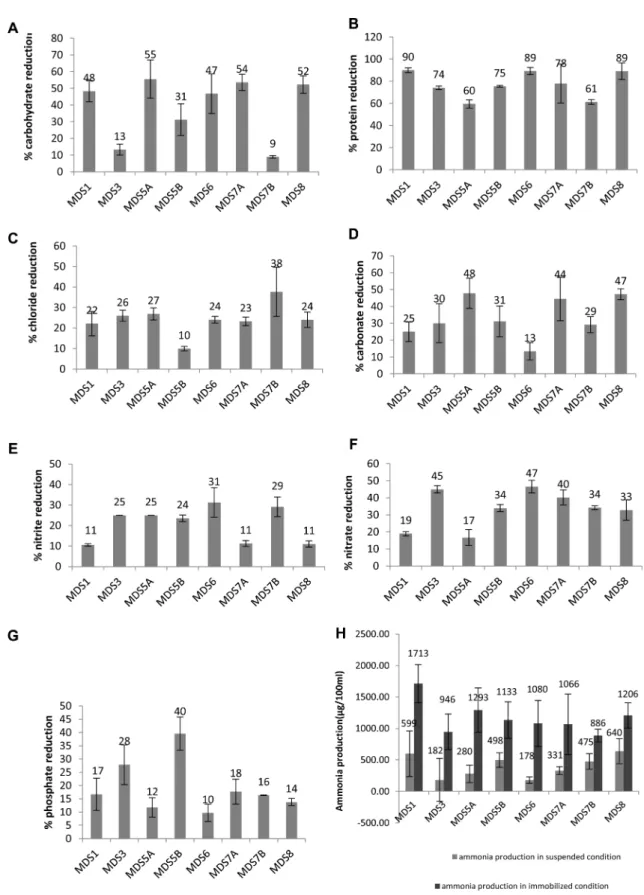
isolates were individually tested (Fig. 2) for their ability

to reduce carbohydrate (Fig. 2A), protein (Fig. 2B), chlo-

ride (Fig. 2C), carbonate (Fig. 2D), nitrite (Fig. 2E),

nitrate (Fig. 2F) and phosphate (Fig. 2G), while produc-

ing ammonia (Fig. 2H). Each isolate was found to reduce

protein, carbohydrate, nitrate, nitrite, and carbonate

indicating their direct involvement in the process of

bioremediation. The production of ammonia indicates

their ability to convert organic pollutants into ammonia

in a C/N rich condition as observed in DWW. Though

(6)

Fig. 2. (A-G) represents graphs showing pollutant removal ability of the pure isolates. H represents a graph showing ammonia

production by the isolates in suspended and immobilized condition. Ammonia production is significantly high in case of immobi-

lized condition under ambient pressure at 37 ℃ from the DWW.

(7)

ammonia is toxic to aquatic life forms; it acts as a plant growth nutrient in adequate concentration during soil application. Nitrogen (N) is an essential source of nutri- tion for growing plants. Ammonia has the highest N con- tent among the commercial fertilizers. Biological production of ammonia from wastewater and its reuse would reduce the use of chemical fertilizers simultane- ously converting the waste into a by-product. As nitrate is assimilated via conversion to nitrite, ammonia and then into amino acids, the supply of ammonia requires less energy input by the plant because the N here is already in a reduced form by-passing the initial steps in assimilation. These isolates were further able to reduce chloride and phosphate indicating their ability to handle the waste generated as an outcome of the Clean-in-place (CIP) practice followed in these industries. The extent of removal of carbohydrate, carbonate, nitrite, nitrate and phosphate by the pure isolates were much less than that of the conventional ETP indicating the physicochemical processes to be actively involved in reducing these com- ponents (Supplementary Table 1 and Fig. 2). Moreover, there might be other microbes actively involved in these reductions but could not be cultivated using the chosen medium. The protein content reduction in the ETP was comparable to that by the pure isolates. There was bet- ter removal of chloride leading to cell growth indicating less involvement of the physicochemical process in chlo- ride removal. Under a low C/N ratio, the nitrogenous pollutants get converted to nitrogen gas while during high C/N ratio (as in case of DWW) it moves towards the production of ammonia [32]. Ammonia is used for vari- ous purposes. When produced at 37 ℃ temperature and atmospheric pressure [33] in a substantial amount, it might be extracted. However, when produced in concen- trations that could not be extracted in an economically viable manner, it could be used as a biofertilizer [22]. The ability of these isolates to convert the nitrogenous com- ponent in DWW into ammonia was evaluated. The pro- duction ranges from 178 to 641 µg/100 ml (Fig. 2H) under a suspended condition. The possible pathway of nitrate reduction to ammonium could be dissimilatory nitrate reduction to ammonium (DNRA), under limited oxygen conditions. Unlike denitrification, it acts to con- serve nitrogen in the system, producing soluble ammo- nium rather than nitrogen gas. Another source of nitrogen in the DWW is the milk protein. Ammonium

ions are formed during the breakdown of amino acids. A major concern regarding the consistent performance of a biological system is maintaining the microbial popula- tion during the entire span of the operation. Biological systems are an integral part of DWW treatment which goes hand in hand with physico-chemical process. The microbial composition needs to be maintained during the course of their operation for sustained performance. This concern could be addressed by using biofilm-based sys- tem instead of suspended culture. The biofilm-based sys- tem in each case (Fig. 2H) produced significantly (p- value 7.16E-06) higher concentration of ammonia by these isolates (887 to 1713 µg/100 ml) (Fig. 2H) as com- pared to their suspended states revealing their ability to converting nitrogenous pollutants in DWW into ammonia (principle component of liquid biofertilizer).

This is an important criterion for selection of the bacte- rial isolates for consortium development. In this case, the microbes could produce an economically important by-product from wastewater instead of using enriched or selective media. Also, they could produce ammonia just in a range that is acceptable for the plant application which otherwise, in a higher concentration could become toxic [34] for soil and the receiving water bodies (after seepage). Fig. 2(A−G) clearly revealed bioremedial activity of each isolate. However, the discharge level for nitrate (10 mg/l as per CPCB) could not be reached either by the pure isolates or during conventional treat- ment that was studied.

Development of tailor-made consortium

An attempt was made to develop consortium with the objective of getting the nitrate from DWW to discharge level with the simultaneous production of ammonia.

Three different Bacillus sp. (MCC0008, MCC2059, MCC0120) isolated from the varied origin with nitrate and phosphate removing ability [23 −26] were added in 1:1 ratio to 7 of the isolates from dairy activated sludge {MDS1, MDS5A, MDS5B, MBS6, MDS 7A (MCC2139), MDS7B, MDS8 (MCC2167)} to evolve the consortium.

The strong biofilm-forming (O.D at 620 nm = 0.78) con-

sortium revealed uniform biofilm under scanning elec-

tron microscopy (Fig. 1F) with synergistic effect for

targeted end product generation with minimum sludge

production. However, this consortium could also reduce

phosphate to just above the discharge level.

(8)

The consortium in a 1 L biofilm reactor at ambient temperature (25 −28℃) operating under batch mode (Fig.

1B) was tested for its sustained activity at every 20

th

hour for 14 days through analysis of nitrate, phosphate and ammonia concentration (Fig. 3). The performance of the reactor stabilized from day one for phosphate reduc- tion; day 6 for ammonia production while day 11 for nitrate reduction. The nitrate reduction was 93% (from 115 ppm to 8 ppm) and the ammonia production was 626 µg/100 ml (38%) with phosphate reduction of 45%.

For 15

th

to the 20

th

day the major nitrate reduction was at 16

th

hour while reaching discharge level only at the 20

th

hour of incubation {35% ± 2.5 (6

th

hour), 80% ± 2.4 (16

th

hour), 95% ± 3.6 (20

th

hour); p-value 1.38E-15}.

Ammonia production increased significantly (p-value 5.16E-12) with time showing maximum production at 20

th

hour. The values were 7% ± 1.1, 26% ± 2.7, 34% ± 2.5 at the 6

th

, 16

th

and 20

th

hour of incubation; a pattern similar to that of nitrate reduction. In case of phosphate, the reduction was measured at 6

th

(60% ± 7.0) and 16

th

(41% ± 1.2) hour with higher reduction at the 6

th

hour (p value 5.37E-05). The reason behind this decreased reduction from 6

th

to 20

th

hour was due to the release of polyphosphate under the anoxic condition and its con- version to inorganic phosphate (Pi) by the phosphatase enzyme produced by the microbes (Supplementary Table 2). The immobilized biofilm system could reduce COD by 72% (from 16.5 g/l to 4.5 g/l) and the total nitrogen loss was recorded to be 26% (from 46.2 mg/l to 34.3 mg/l) within 20 h. The decrease in reduction percentage of total nitrogen compared to nitrate reduction is due to the production of ammonia in the system. Total nitrogen is

the sum of total Kjeldahl nitrogen (ammonia, organic and reduced nitrogen).

The reactor once charged with bacterial biofilm, could be used repeatedly with consistent performance. But for phosphate the discharge level (5 mg/l as per CPCB) was not reached. This phosphate could be picked up by soil (rhizosphere) to enable the plants to utilize the same.

The nitrate reduction led to a final concentration of 5 mg/l which was below the CPCB discharge level (10 mg/l) with associated ammonia production (626 µg/

100 ml) at room temperature under ambient pressure.

The production could be further increased by operating the reaction at 37 ℃. Thus the consortium was involved in conversion of nitrogenous compounds in DWW to ammonia, an easily utilizable form of nitrogen by plants.

The C/N ratio of the growth medium determines the specific metabolic pathway functional in a microbe [32, 33] under a given condition. Since the C/N ratio of DWW is high owing to the high organic load, the preferred met- abolic pathway for conversion of the nitrogenous sub- stances would be nitrification followed by ammonification.

Dissimilatory nitrate reduction processes, including

denitrification, anaerobic ammonium oxidation

(ANAMMOX), and dissimilatory nitrate reduction to

ammonium (DNRA), are important pathways of nitrate

transformation in aquatic environments. While denitrifi-

cation and ANAMMOX removes nitrate through nitrate

reduction and ammonium oxidation respectively to

nitrogen gas, DNRA does not remove nitrate but instead

reduces it to ammonium. Therefore, DNRA still retains

the transformed nitrogen as a biologically available

form. Organic matter contents are considered as a cru-

Fig. 3. Graph showing percentage nitrate and phosphate reduction and simultaneous ammonia production in a one litre

biofilm reactor after 20 h of incubation at ambient conditions.

(9)

cial variable for ammonium production via DNRA [35].

The DNRA rates correlates with organic matter content acting as substrate to supply electron for the nitrate reduction during the DNRA reaction [36]. Some of these isolates have been shown to have the requisite genes for ammonification [33, 37].

The consortium upon incubation for 24 h at 37 ℃, could also remove fat by 37% from the fat-rich wastewater. The same consortium upon incubation with the 90 s churned out wastewater prior to treatment, could reduce the fat content by 54%. Churning could emulsify the fats in the wastewater and break them into smaller droplets which in turn could assist the microbes for better reaction and thus removal. This consortium could be preserved as glycerol stock like the pure isolates.

Reusing treated DWW as liquid biofertilizer

The reuse of the treated effluent was undertaken through pot trials for Mung bean (var. Meha) cultivation from February to May 2017 at Maulana Abul Kalam Azad University of Technology, West Bengal, India (22.5965

o

N, 88.4173

o

E). The experiment was conducted in triplicate with control set being irrigated with tap water, set 1 being irrigated with untreated DWW while set 2 being irrigated with microbially treated DWW. The irrigation was done once a day with 50 ml water, untreated DWW and treated DWW (whichever is appli- cable) per 8 kg of soil. Preliminary results show a 1.6- fold increase (p-value 3.043E-03) in yield following treated DWW application compared to control. No signif- icant change (p-value 0.15941) in yield was observed using untreated DWW when compared to control. Meer presence of high C/N ration is not sufficient to enhance plant growth but conversion of the nutrients into a plant utilizable form is essential to promote plant growth and yield enhancement [38]. Further optimization is required for developing a regimen for plant growth promotion with a combination of treated effluent with chemical fertilizer to ensure maximum yield enhancement. It would obviate the necessity for purchase of fresh water for irrigation in the farms in the vicinity of the dairies.

The associated sustenance of agriculture in these farms would involve very little chemical fertilizer use along with this biofertilizer application for optimum yield enhancement with minimum damage to the environ-

ment due to leaching of unutilized chemical fertilizer from the fields into the agricultural runoff. This would help generate revenue in terms of profit from sale of bio- fertilizer, savings in terms of energy and reduced land requirement for ETP setup.

The single unit operation would enhance the capacity of effluent processing of a conventional 7 unit setup (Fig.

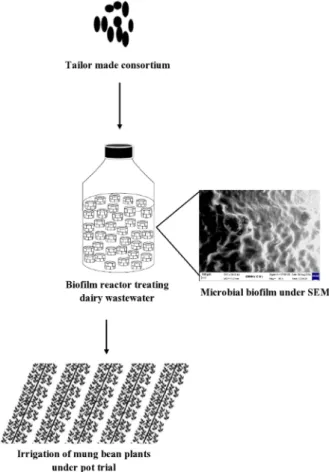
1A) while cutting down the energy consumption to mild aeration for the last 6 h of a 26 h treatment process as compared to 105 to 120 h in a conventional system. In addition, this process will generate an economically important by-product which would minimize use of chemical fertilizer while replace use of fresh water for agriculture as compared to dischargeable water in case of a conventional system. This would make the process of dairy effluent treatment self-sustaining while protect- ing the environment through zero liquid discharge (Fig.

4) along with minimal chemical fertilizer leaching.

Fig. 4. A schematic diagram summarizing the author’s

strategy for bioremediation and zero liquid discharge.

(10)

Acknowledgments

The authors would like to thank Mother Dairy, Dankuni for provid- ing the effluent (specially Dr S K Bhowmik and Mr Anisur Rahaman);

Institute of Physics, Bhubhaneswar, India for ESEM and Indian Institute of Science Education and Research, Kolkata, India for FESEM facility;

Carl Zeiss facility at Center for Research in Nanoscience and Nanotech- nology, Kolkata for ESEM of the consortium; Ministry of Human Resource Development, Government of India under the Frontier Area of Science and Technology scheme for the fellowship to TB; Maulana Abul Kalam Azad University of Technology West Bengal as well as Tri- pura University for providing the laboratory and Computation facility;

Prof A R Thakur for helping during sample collection and during the entire course of the study.

Conflict of Interest

The authors have no financial conflicts of interest to declare.

References

1. Banerjee A. 2001. Dairying systems in India. Available from http:

//www.fao.org/docrep/T3080T/t3080T07.htm. Accessed April 17, 2019.

2. Wojdalski J, Drozdz B, Piechocki J, Gaworski M, Zander Z, Mar- janowski J. 2013. Determinants of water consumption in the dairy industry. Pol. J. Chem. Tech. 15: 61-72.

3. Punnagaiarasi A, Elango A, Rajarajan G, Prakash S. 2017. Bioreme- diation-An Ecosafe Approach for Dairy effluent treatment.

pp. 45-50. In Prashanthi M, Sundaram R, Jeyaseelan A, Kaliannan T (eds.), Bioremediation and Sustainable Technologies for Cleaner Environment, Springer, Cham.

4. Bezerra Jr. RA, Rodrigues JAD, Ratusznei SM, Zaiat M, Foresti E.

2009. Effects of feed time, organic loading and shock loads in anaerobic whey treatment by an AnSBBR with circulation. Appl.

Biochem. Biotechnol. 157: 140-158.

5. Dague RR, Habben CE, Pidaparti SR. 1992. Initial studies on the anaerobic sequencing batch reactor. Water Sci. Technol. 26: 2429- 2432.

6. Belancon D, Fuzzato MC, Gomes DRS, Cichello GCV, Pinho SCD, Ribeiro R, et al. 2010. A comparison of two bench-scale anaerobic systems used for the treatment of dairy effluents. Int. J. Dairy Tech. 63: 290-296.

7. Petruy R, Lettinga G. 1997. Digestion of a milk – fat emulsion.

Biores. Technol. 61: 141-149.

8. Tocchi C, Federici E, Fidati L, Manzi R, Vincigurerra V, Petruccioli M. 2012. Aerobic treatment of dairy wastewater in an industrial three-reactor plant: Effect of aeration regime on performances and on protozoan and bacterial communities. Water Res. 46:

3334-3344.

9. Schwarzenbeck N, Borges JM, Wilderer PA. 2005. Treatment of dairy effluents in an aerobic granular sludge sequencing batch

reactor. Appl. Microbiol. Biotechnol. 66: 711-718.

10. Fraga FA, García HA, Hooijmans CM, Miguez D, Brdjanovic D.

2017. Evaluation of a membrane bioreactor on dairy wastewater treatment and reuse in Uruguay. Int. Biodeterior. Biodegrad. 119:

552-564.

11. Li X, Zhang R. 2002. Aerobic treatment of dairy wastewater with sequencing batch reactor systems. Bioprocess Biosyst. Eng. 25:

103-109.

12. Porges N, Jasewicz L, Hoover SR. 1953. Aerobic treatment of dairy wastes. Appl. Microbiol. 1: 262-270.

13. Charpentier J, Florentz M, David G. 1987. Oxidation-reduction potential (ORP) regulation: a way to optimize pollution removal and energy savings in the low load activated sludge process.

Wat. Sci. Tech. 19: 645-655.

14. Liu Y, Tay JH. 2001. Strategy for minimization of excess sludge production from the activated sludge process. Biotechnol. Adv.

19: 97-107.

15. Gautam SP. 2015. Guide manual: water and wastewater_analysis.

Central Pollution Control Board, Ministry of Environment &

Forests, Government of India. Available from http://www.indi- aenvironmentportal.org.in/files/file/guidemanualw&wwanalysis.

pdf. Accessed April 17, 2019.

16. Nandy P, Thakur AR, RayChaudhuri S. 2007. Characterisation of microbial strains obtained through microbial profiling of urine.

OnLine J. Biol. Sci. 7: 44-51.

17. Martin R, Soberon N, Vaneechoutte M, Florez AB, Vazquez F, Suarez JE. 2008. Characterization of indigenous vaginal lactoba- cilli from healthy women as probiotic candidates. Int. Microbiol.

11: 261-266.

18. Kumar S, Stecher G, Tamura K. 2016. MEGA7: Molecular evolu- tionary genetics analysis version 7.0 for bigger datasets. Mol. Biol.

Evol. 33: 1870-1874.

19. Jiao Y, Cody GD, Harding AK, Wilmes P, Schrenk M, Wheeler KE, et al. 2010. Characterization of extracellular polymeric substances from acidophilic microbial biofilms. Appl. Environ. Microbiol. 76:

2916-2922.

20. Lowry OH, Rosebrough NJ, Farr AL, Randall RJ. 1951. Protein measurement with the Folin phenol reagent. J. Biol. Chem. 193:

265-275.

21. Cataldo DA, Maroon M, Schrader LE, Youngs VL. 1975. Rapid col- orimetric determination of nitrate in plant tissue by nitration of salicylic acid. Commun. Soil Sci. Plant Anal. 6: 71-80.

22. RayChaudhuri S, Thakur AR, Gantayet LM. 27. 01. 2017. Patent no.

201731003023. Bio-fertilizer production from bacterial consor- tium.

23. Das S, Mukherjee I, Sudarshan M, Sinha TP, Thakur AR, RayChaud- huri S. 2012. Bacterial isolates of marine coast as commercial pro- ducer of protease. OnLine J. Biol. Sci. 12: 96-107.

24. DebRoy S, Bhattacharjee A, Thakur AR, RayChaudhuri S. 2013.

Draft Genome of a nitrate and phosphate accumulating Bacillus sp MCC0008. Genome A. 1: e00189-12.

25. Mishra M, Jain S, Thakur AR, RayChaudhuri S. 2014. Microbial

community in packed bed bioreactor involved in nitrate remedi-

(11)

ation from low level radioactive waste. J. Basic Microbiol. 54: 198- 203.

26. DebRoy S, Mukherjee P, Roy S, Thakur AR, RayChaudhuri S. 2013.

Draft Genome of a phosphate accumulating Bacillus sp WBUNB004. Genome A. 1: e00251-12.

27. RayChaudhuri S, Sharmin J, Banerjee S, Jayakrishnan U, Saha A, Mishra M, et al. 2016. Novel microbial system developed from low level radioactive waste treatment plant for environmental sustenance. pp. 121-154. In Saleh HEDM, Rahman ROA (eds.), Management of Hazardous Wastes, Intech, Croatia.

28. Saha A, Bhushan S, Mukherjee P, Chanda C, Bhaumik M, Ghosh M, et al. 2017. Simultaneous sequestration of nitrate and phos- phate from wastewater using a tailor made bacterial consortium in biofilm bioreactor. J. Chem. Technol. Biotechnol. 93: 1279-1289.

29. RayChaudhuri S, Mukherjee I, Datta D, Chanda C, Krishnan GP, Bhatt S, et al. 2016. Developing tailor-made microbial consortium for effluent remediation. pp. 17-35. In Rahman ROA, SalehHEDM (eds.), Nuclear Material Performance, Intech.

30. Oh HM, Ku YH, Ahn KH, Jang KY, Kho YH, Kwon GS, et al. 1995.

Biological treatment of phenolic Industrial wastewater by a mixed culture immobilized on ceramic beads. Korean J. Microbiol.

Biotechnol. 23: 755-762.

31. Park AR, Koo BS, Kim JS, Kim EJ, Lee HC. 2016. Lactulose produc-

tion using Immobilized cells including thermostable Cellobiose 2-epimerase. Miocrobiol. Biotechnol. Lett. 44: 504-511.

32. Goldman JC, Caron DA, Dennett MR. 1987. Regulation of gross growth efficiency and ammonium regeneration in bacteria by substrate C: N ratio. Limnol. Oceanogr. 32: 1239-1252.

33. Ghoshal T, Ghosh S, Saha A, Halder N, Thakur AR, RayChaudhuri S. 2014. Combination of conventional and in-silico approach for identifying an industrially important isolate of Aeromonas. Online J. Biol. Sci. 14: 70-83.

34. Mroczkowski W, Stuczynski T. 2006. Toxic effects of ammonia volatilizing from sandy soil fertilized with ammonium salts and urea on barley crop decreases. Polish J. Environ. Stud. 15: 827-832.

35. Buresh RJ, Patrick WH.1978. Nitrate reduction to ammonium in anaerobic soil. Soil Sci. Soc. Am. J. 42: 913-918.

36. Burgin AJ, Hamilton SK. 2007. Have we overemphasized the role of denitrification in aquatic ecosystems? A review of nitrate removal pathways. Front. Ecol. Environ. 5: 89-96.

37. Chatterjee D, Thakur AR, Raychaudhuri S. 2013. Draft genome sequence of ammonia-Producing Acinetobacter sp. Strain MCC2139 from Dairy Effluent. Genome Annouc. 1: 410-413.

38. Sharma NK, Goswami B, Gajjar B, Jain C, Soni D, Patel K. 2011.

Utilization of Amul Dairy effluent for agriculture practices. Int. J.

Environ. Sci. 2: 22-32.

수치

Fig. 1. (A) Pictorial representation of a conventional system of dairy effluent treatment plant
Fig. 2. (A-G) represents graphs showing pollutant removal ability of the pure isolates
Fig. 4. A schematic diagram summarizing the author’s strategy for bioremediation and zero liquid discharge

참조

관련 문서

• Controlled decomposition of organic materials such as plant materials, animal waste, food.. waste, and wastewater sludge

In this study, the RESRAD-RECYCLE 3.10 computer code was used to evaluate individual and collective doses due to the recycling of radioactive metal waste

Waste lubricating oil, which is radioactive waste generated from nuclear power plants, is a lubricant for major equipment of nuclear power plants, and is incinerated

In addition, using the properties of water shown in diverse shapes, Ki Hyung-do's recognition on the reality and future consciousness from regression of

– Treat wastewater before it is discharged to maintain the water quality of the natural waters for the benefit of humans and aquatic ecosystem. • Wastewater management goal

Protecting the aquatic ecosystem in the water body Recover water and resources from wastewater and. produce renewable energy using wastewater constituents.. • So, the goal

In order to remove phosphorus contained in domestic sewage, an experimental investigation is performed using intermittently aerated activated sludge process

This result also correspond with the one studying children using the community children center such as 'study on children from low-income family of single parent