K. H. Bae ・ K. H. Oh ・ S.-Y. Kim ( )
National Institute of Biological Resources, 42 Hwangyeong-ro, Seo-gu, Incheon, 404-708, Republic of Korea
e-mail: [email protected]
Sodium hypochlorite treatment and light-emitting diode (LED) irradiation effect on in vitro germination of Oreorchis patens (Lindl.) Lindl
Kee Hwa Bae ・ Kyoung Hee Oh ・ Soo-Young Kim
Received: 4 March 2014 / Revised: 11 March 2014 / Accepted: 27 March 2014
ⓒKorean Society for Plant Biotechnology
Abstract In this study, we investigated the effects of sodium hypochlorite (NaOCl) and red or blue light-emitting diode (LED) light on embryo swelling and germination of Oreorchis patens (Lindl.) Lindl. A method for determining the swelling and protocorm formation in O. patens seeds through in vitro examination of immature seeds was established.
NaOCl treatment of immature seeds was found to significantly enhance the extent of embryo swelling and protocorm formation in immature zygote embryos compared to those in the untreated controls. Additionally, the effects of white fluorescent light, and red and blue LED lights on embryo swelling and protocorm formation in in vitro cultured seeds were examined and compared to the conditions with or without NaOCl treatment. The most suitable light for embryo swelling and protocorm formation was the red LED light.
Keywords Germination, Medium, Orchid, Oreorchis patens
Introduction
Oreorchis patens (Lindl.) Lindl. belongs to the Orchidaceae and is distributed across East Russia (Amur, Kamchatka, Sakhalin, and Ussuri), China, Japan, and Korea (Lee and Choi 2006). It commonly grows in temperate deciduous forest margins, thickets, grassy places, shaded places, and along valleys in the main ranges of Baek-du-dae-gan (Lee and Choi 2006). This plant produces scapes (30-50 cm tall) from May to July, each bearing 20-35 whitish-yellow flowers (7-15 mm long; 1.5-3 mm diameter) (Lee 2006).
In vitro seed culture techniques of various orchid species have been widely used for its conservation and propagation
(Stewart and Kane 2006a; Stewart and Kane 2006b; Stewart and Kane 2007; Bae et al. 2009; Dutra et al. 2009; Suzuki et al. 2009; Bae et al. 2010; Bae and Choi 2013). Although this approach has been used for a long time, reports on in vitro germination of orchid species are limited, despite its large number of species.
It has been previously reported that sodium hypochlorite (NaOCl) treatment, a common method for disinfecting plant materials, is highly effective in stimulating in vitro germination of Oreochis coreana seeds (Bae et al. 2013).
The effectiveness of seed disinfection using NaOCl and calcium hypochlorite (Ca(ClO)2) solution to stimulate orchid seed germination has also been reported in other species (Malmgren 1996; Miyoshi and Mii 1998; Bae et al. 2009;
Bae et al. 2010; Bae and Choi 2013). The mechanism underlying this stimulatory effect on orchid seed germination is not well understood (Harvais and Hadley 1967).
Light-emitting diodes (LEDs) have recently developed as an alternative light source for plant culture systems. They have several advantages compared to conventional light sources, including their wavelength specificity and narrow bandwidth (Bula et al. 1991; Hoenecke et al. 1992). LEDs have been used for studies on chlorophyll biosynthesis in wheat (Tripathy and Brown 1995), stem elongation and leaf expansion in lettuce (Hoenecke et al. 1992), disease development in pepper and cucumber (Schuerger and Brown 1994), and photosynthesis in kudzu (Tennessen et al. 1994).
However, to date, no effort has been made to develop a protocol for in vitro propagation or conservation of O.
patens. This study aimed to describe seed germination and embryo development in O. patens and evaluate and establish a method for in vitro culture of immature seeds of O. patens.
DOI:http://dx.doi.org/10.5010/JPB.2014.41.1.44 Research Article
ISSN 1598-6365
Materials and methods
Plant materials and culture conditions
The fruits of Oreochis patens were collected immediately before dehiscence from a single population near the Hambaek Mountain (Kangwon Province) in late September 2013 (voucher specimen, VP0000288327 and seed number, GR0000255167).
Following collection, the seeds were immersed in deionized sterile water and agitated for 30 min. The seeds were then treated with 30 ml of 1% NaOCl in deionized water (v/v) for 30 min, followed by three 30s rinses in deionized sterile water. All media were supplemented with 20 g/L sucrose and the pH was adjusted to 5.5 with 0.1 M KOH before the addition of 3.0 g/L gelrite. The media were autoclaved at 117.7 kPa at 121 °C for 15 min. The cultures were maintained in a growth room at 20 ± 2°C.
Effects of NaOCl and culture medium on embryo swelling and seed germination
Mature capsules were sterilized in 1% NaOCl for 30 min and then rinsed three times with sterile water. The seed capsules were then cleaved using a scalpel blade and the seeds were scraped. The seeds were treated with 1%
NaOCl for 30 min. The seeds were then left in the final rinse water until their transferred to Phytomax Orchid Maintenance (POM) medium (P6668, Sigma Co. Ltd., USA) and Seed Germination Maintenance (SGM) medium (P6543, Sigma Co. Ltd., USA). Two basal media were used in this study: POM and SGM media without plant growth regulators. Embryo swelling was defined as an increase in size of at least twice the original size and the formation of a protocorm. The number of swollen embryos and the diameters of the embryos were recorded at 2 week intervals by examining under a microscope.
Effects of NaOCl and light emitting diodes (LEDs) on embryo swelling and seed germination
The seeds were treated with 1% NaOCl for 30 min. and were then left in the final rinse water until these were transferred to the POM medium. Cultures were incubated in growth chambers (Sejong Scientific, Korea) at 25°C and 60% relative humidity. The seeds were subjected to three different cultures treatments by using the following sources of illumination : (1) fluorescent light, (2) red LED (peak wavelength: 660 nm), (3) blue LED (peak wavelength:
450 mm). The duration of lighting for all treatments was
16 h per day. Embryo swelling was defined as an increase in size of at least twice its original size and the formation of a protocorm. The numbers of swollen embryos and the diameters of the embryos were recorded at 4-week intervals by examining under a microscope.
Statistical analysis
All data were expressed as means ± standard error (SE) and subjected to analysis of variance (ANOVA). Each experiment was conducted in triplicate, with at least 200 seeds per replicate. Significant differences among the treatments were determined using Duncan’s multiple range test at P
< 0.05 (SAS, 2003).
Results and discussions
NaOCl treatment and culture medium condition for seed germination
The effect of NaOCl pre-treatment on seed germination was examined. After 30 min of 1% NaOCl treatment, the seed coat was completely bleached and the zygotic embryos inside of seed coats could be clearly seen (Fig. 1A).
Swollen embryos were first scored 4 weeks after sowing (Fig. 1B). After NaOCl pretreatment, the frequency of embryo swelling was observed after 8 weeks of culture.
The highest rate of swelling of zygotic embryos was observed in 30 min with 1% NaOCl in POM medium (Table 1). The rate of embryo swelling in POM medium (90.7%) was significantly greater than that in SGM medium (60.4%). When untreated (without 1% NaOCl) immature seeds of O. patens, were cultured in SGM and POM medium, the rate of swelling was 38% and 29%, respectively, after 4 weeks of culture (Table 1). After 8 weeks of culture of the mature seeds in POM medium without NaOCl treatment, the rate of protocorm formation was very low compared to the seeds treated with NaOCl (Table 1). In contrast, immature seeds subjected to NaOCl pre-treatment showed signs of swelling within 8 weeks of culture (Fig.
1C). NaOCl pretreatment of seeds in POM medium showed a significantly higher rate of protocorm formation compared to that of the immature seeds. The rate of protocorm formation in immature seeds was 58.8% after 8 weeks of culture (Table 1). The maximum rate of protocorm formation with a pretreatment of 1% NaOCl for 30 min and culturing in POM medium was 87.5%. The morphological development from seed to protocorm in O. patents was documented
Fig. 2 Effects of culture media and NaOCl pre-treatment on frequency of embryos diameter after 0, 2, 4, 6 and 8 weeks in vitro culture. A: Non treated NaOCl for seeds on SGM, B: Non treated NaOCl for seeds on POM, C: NaOCl treated for 30 min on SGM, D: NaOCl treated for 30 min on POM. Vertical bars indicate standard errors (n=3)
Fig. 1 Developmental stages of seed culture for O. patens. A: Hyaline embryo, testa intact (scale bar, 0.1 mm), B: Embryos swollen (scale bar, 0.1 mm), C: Swelled embryos present rhizoids (scale bar, 0.1 mm), D: Closed view appearance of protomeristem and rhizoids elongation (scale bar, 1.0 mm), E: Appearance of protomeristem and rhizoids elongation (scale bar, 1.0 mm)
Table 1 Effect of NaOCl treatment time for embryo swelling and protocorm formation of O. patens seeds after 8 weeks culture on medium supplemented with sucrose (20 g/L) and gerlite (3.0 g/L)
NaOCl treatment (min)
Swelled embryos formation (%) Protocorm formation (%)
SGM POM SGM POM
0 38.6 ± 8.1*b 29.1 ± 5.3*b 26.2 ± 4.4b 10.8 ± 3.5*b
30 60.4 ± 6.1a 90.7 ± 3.4a 35.3 ± 4.3a 58.8 ± 2.2a
*Data are the means ± SD, of three experiments. Different alphabetical letters are significantly different according to Duncun's multiple range test at P < 0.05. SGM and POM means Seed Germination Medium and Phytomax Orchid Mainterence Medium.
(Figs. 1D-E). The biggest embryo diameters were observed in seeds treated with 1% NaOCl for 30 min and cultured in POM medium (Fig. 2D); these were followed by seeds cultured in SGM (Fig. 2C), and those not treated with NaOCl and cultured in SGM (Fig. 2A). On the other hand, seeds not treated with NaOCl and cultured in POM (Fig. 2B) showed the smallest embryo diameters. Seed germination of orchid species is typically very low or nonexistent in ex vitro and in vitro conditions (Ault and Blackmon 1987;
Anderson 1996). Terrestrial orchids have more stringent requirements for germination, and information on the specific requirements for each species is limited (Fast 1982). NaOCl is a disinfecting agent that has been widely used for seed surface sterilization (Bewley and Black 1994; Miyoshi and Mii 1998). This reagent is also known to induce seed germination or overcome seed dormancy in some species (Vujanovic et al. 2000). In Cypripedium macranthos, the frequency of germination was 67% after sterilization with NaOCl (Miyoshi and Mii 1998). Yildiz and Celal (2002)
Table 2 Effect of NaOCl treatment time and light source (LED) for embryo swelling and protocorm formation of O. patens seed after 10 weeks culture on medium supplemented with sucrose (20 g/L) and gerlite (3.0 g/L)
NaOCl treatment (min)
Swelled embryos formation (%) Protocorm formation (%)
White LED Red LED blue White LED Red LED Blue
0 8.1 ± 1.6*b 11.9 ± 2.4*b 4.1 ± 2.1*b 14.6 ± 2.1b 12.8 ± 2.8*b 6.4 ± 1.1*b
30 88.4 ± 8.9a 90.9 ± 4.8a 54.2 ± 7.1a 91.8 ± 4.9a 94.1 ± 4.4a 61.7 ± 3.5a
*Data are the means ± SD, of three experiments. Different alphabetical letters are significantly different according to Duncun's multiple range test at P < 0.05.
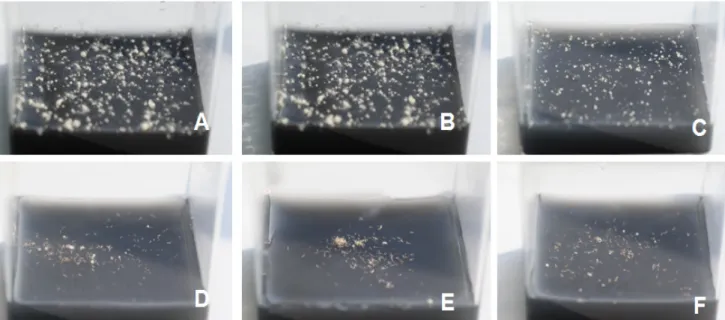
Fig. 3 Effects of light-LEDs for protocorms formation of O. patens seeds. A: White light on seed treated by 1% NaOCl 30 min, B: LED Red light on seed treated by 1% NaOCl 30 min, C: LED Blue light on seed treated by 1% NaOCl 30 min, D: White light on seed non-treated by NaOCl, E: LED Red light on seed non-treated by NaOCl, F: LED Blue light on seed non-treated by NaOCl previously reported that the pre-treatment of Linum
usitatissimum seeds with NaOCl for 20 min enhanced its germination. The induction of germination through NaOCl treatment is thought to be due to scarification of the seed coat, which facilitates water and oxygen absorption or enhances oxidative respiration by producing more oxygen through the decomposition of NaOCl (Vujanovic et al. 2000). The effectiveness of disinfection solutions such as NaOCl and Ca(ClO)2 in stimulating the germination for orchid seeds has been reported in other species (Miyoshi and Mii 1998;
St-Arnaud et al. 1992; Malmgren 1996), however, its mechanism has not yet been established. Possible mechanisms of action underlying the induction of seed germination or cessation of dormancy by NaOCl might include partial degradation of the seed coat and/or the solubilization and oxidation of certain growth inhibitors. Harvais (1982) interpreted the stimulatory effect of surface sterilization with NaOCl as a physiological effect of washing away the endogenous inhibitor, abscisic acid (ABA), from the seeds.
NaOCl and light source condition for embryo swelling and seed germination
The rate of embryo swelling after 4 weeks of sowing was 88.4, 90.6, and 54.2% under white, red, and blue LED -lights, respectively, in POM medium (Table 2). The 625 nm wavelength (red LED-light) was associated with the highest rate of embryo swelling, although this also strongly inhibited protocorm formation (Table 2, Fig. 3B) after 8 weeks of culture. The highest rate of protocorm formation was observed in seeds treated with 1% NaOCl for 30 min and cultured under red LED -light, followed by white -light (91.8%, Fig. 3A), and blue LED -light (61.7%, Fig.
3C). On the other hand, the treatment without NaOCl in POM medium under white, red, and blue LED -lights was the least effective for protocorm formation (Table 2, Figs.
3D-F). The induction of embryo swelling, seed germination, and protocorm growth by using LEDs has also been previously reported in Calanthe satsuma (Fukai et al. 1997).
The inhibition of seed germination by lighting has been
reported for many terrestrial orchid species, such as Calanthe tricarinata (Godo et al. 2010) and Habenaria macroceratitis (Stewart and Kane 2006a). LED lighting systems also regulate in vitro seed germination and seedling growth. In Bletilla ochracea, a maximum seed germination of 74%
was obtained using LEDs (Godo et al. 2011).
In conclusion, we demonstrate that embryo swelling occurs after immature seeds are subjected to NaOCl pre-treatment, thus resulting in a higher frequency of seed germination in O. patens. This protocol could be very useful for commercial nurseries that conduct large-scale propagation and ex situ conservation of O. patens.
Acknowledgement
This works was supported by Grant no. NIBR 2013-01-020 from the National Institute of Biological Resources in Korea.
References
Anderson AB (1996) The re-introduction of Platanthera ciliaris in Canada. In: Allen C. (Ed.). Proceedings of the North American Native Terrestrial Orchids: Propagation and Production. North American Native Terrestrial Orchid Conference, Maryland:
73-76
Ault JR, Blackmon WJ (1987) In vitro propagation of Ferocactus acanthodes (Cactaceae). Hort Sci 22:126-127
Bae KH, Choi YE (2013) Factors affecting fruit baring in natural habitat and in vitro culture of zygotic embryos of Cypripedium japonicum. Prog Ornamet Plant 11:146-152
Bae KH, Kim CH, Sun BY, Choi YE (2010) Structural changes of seed coats and stimulation of in vitro germination of fully mature seeds of Cypripedium macranthos Swartz by NaOCl pretreatment. Prog Ornament Plant 10:107-113
Bae KH, Ko MS, Lee MH, Kim NY, Song JM, Song G (2013) Effects of NaOCl treatment on in vitro germination of seeds of a rare endemic plant, Oreorchis coreana Finet. J Plant Biotech 40:43-48
Bae KH, Kwon HK, Choi YE (2009) In vitro germination and plantlet conversion from the culture of fully mature seeds of Cypripedium guttatum Swartz. Prog Ornament Plant 9:
160-165
Bewley JD, Black M (1994) Seeds: Physiology of development and germination. Second Edition. New York, Prenum Press Bula RJ, Morrow RC, Tibbitts TW, Barta DJ, Ingnatius RW,
Martin TS (1991) Light-emitting diodes as a radiation source for plants. Hort Sci 26:203-205
Dutra D, Kane ME, Richardson L (2009) Asymbiotic seed germination and in vitro seedling development of Cyrtopodium punctatum: a propagation protocol for an endangered Florida
native orchid. Plant Cell Tiss Org Cult 96:235-243
Fast G (1982) European terrestrial orchids. Symbiotic and asymbiotic methods. In: Arditti J, ed. Orchid biology-reviews and perspectives II. Ithaca, NY: Comstock Publishing Associates, 326-329
Fukai S, Fujikawa K, Okamoto K, Hasegawa A, Goi M. (1997) Effects of red and blue light on germination and protocorm growth of Calanthe satsuma. Lindleyana 12:169-171 Godo T, Fujiwara K, Guan K, Miyoshi K (2011) Effect of
wavelength of LED-light on in vitro asymbiotic germination and seedling growth of Bletilla ochracea (Orchidaceae), Plant Biotechnol 28:397-400
Godo T, Komori M, Nakaoki E, Yukawa T, Miyoshi K (2010) Germination of mature seeds of Calanthe tricarinata Lindl., an endangered terrestrial orchid, by asymbiotic culture in vitro. In Vitro Cell Dev Biol Plant 46:323-332
Harvais G (1982) An improved culture medium for growing the orchid Cypripedium reginae axienically. Can J Bot 51:
327-332
Harvais G, Hadley G (1967) The relation between host and endophyte in orchid mychorriza. New Phytol. 66:205-215 Hoenecke ME, Bula RJ, Tibbitts TW (1992) Importance of blue
photon levels for lettuce seedlings grown under red-light emitting diodes. Hort Sci 27:427-430
Lee JS, Choi BH (2006) Distribution and red data of wild orchids in the Korean Peninsula. Kor J Plant Taxon 36:335-360 LeeYN (2006) Flora of Korea. Gyohaksa, Seoul
Malmgren S (1996) Orchid propagation: theory and practice. In:
Allen, C. (Ed.), Proceedings of the North American Native Terrestrial Orchids: Propagation and Production. North American Native Terrestrial Orchid Conference, Maryland, pp63-71
Miyoshi K, Mii M (1998) Stimulatory effects of sodium and calcium hypochlorite, pre-chilling and cytokinins on the germination of Cypripedium macranthos seed in vitro.
Physiol Plant 102:481-486
SAS Institute Inc (2003) SAS version 9.0. SAS Institute, North Carolina
Schuerger AC, Brown CS (1994) Spectral quality may be used to alter plant disease development in CELSS. Adv Space Res 14:
395-398
Stewart SL, Kane ME. (2006a) Asymbiotic germination and in vitro seedling development of Habenaria macroceratitis (Orchidaceae), a rare Florida terrestrial orchid. Plant Cell Tiss Org Cult 86:147-158
Stewart SL, Kane ME (2006b) Symbiotic germination of Habenaria macroceratitis (Orchidaceae), a rare Florida terrestrial orchid.
Plant Cell Tiss Org Cult 86:159-167
Stewart SL, Kane ME (2007) Symbiotic seed germination and evidence for in vitro mycobionts specificity in Spiranthes brevilabris (Orchidaceae), and its implications for species-level conservation. In Vitro Cell Dev Biol Plant 43:178-186 St-Arnaud MD, Lauzer D, Barabe D (1992) In vitro germination
and early growth of seedlings of Cypripedium acaule (Orchidaceae). Lindleyana 7:22-27
Suzuki RM, Moreira VC, Nakabashi M, Ferreira VM (2009) Estudo da germinação e crescimento in vitro de Hadrolaelia tenebrosa (Rolfe) Chiron & V.P. Castro (Orchidaceae), uma espécie da flora brasileira ameaçada de extinção. Hoehnea 36:
657-666
Tennessen DJ, Singsaas EL, Sharkey TD (1994) Light-emitting diodes as a light source for photosynthetic research. Photosynt Res 39:85-92
Tripathy BC, Brown CS (1995) Root-shoot interaction in the
greening of wheat seedlings grown under red light. Plant Physiol 107:407-411
Vujanovic, V, St-Arnaud M, Barabe D, Thibeault G (2000) Viability testing of orchid seed and the promotion of colouration and germination. Ann Bot 86:79-86
Yildiz M, Celal ER (2002) The effect of sodium hypochlorite solution on in vitro seedling growth and shoot regeneration of flax (Linum usitatissimun). Natul wissen Schffen 89:259-261