Korean J Environ Agric (2012) Online ISSN: 2233-4173 Vol. 31, No. 1, pp. 52-59 http://dx.doi.org/10.5338/KJEA.2012.31.1.52 Print ISSN: 1225-3537
Soil Microbial Community Assessment for the Rhizosphere Soil of Herbicide Resistant Genetically Modified Chinese Cabbage
Soo-In Sohn,
1*Young-Ju Oh,
2*Byung-Ohg Ahn,
1Tae-Hoon Ryu,
1Hyun-Suk Cho,
1Jong-Sug Park,
1Ki-Jong Lee,
1Sung-Dug Oh
1and Jang-Yong Lee
11National Academy of Agricultural Science, Suwon, 441-707, Korea,
2Korea Biodiversity Research Center, Phochon, 487-711, Korea
Received: 9 March 2012 / Accepted: 26 March 2012
ⓒ 2012 The Korean Society of Environmental Agriculture
*교신저자(Corresponding author),
Phone: +82-31-299-1144; Fax: +82-31-299-1122;
E-mail: [email protected]
†The first two authors contributed equally to this work
52
Abstract
BACKGROUND: Cultivation of genetically modified(GM) crops rapidly has increased in the global agricultural area.
Among those, herbicide resistant GM crops are reported to have occupied 89.3 million hectares in 2010. However, cultivation of GM crops in the field evoked the concern of the possibility of gene transfer from transgenic plant into soil microorganisms.
In our present study, we have assessed the effects of herbicide-resistant GM Chinese cabbage on the surrounding soil microbial community.
METHODS AND RESULTS: The effects of a herbicide- resistant genetically modified (GM) Chinese cabbage on the soil microbial community in its field of growth were assessed using a conventional culture technique and also culture-independent molecular methods. Three replicate field plots were planted with a single GM and four non-GM Chinese cabbages (these included a non-GM counterpart).
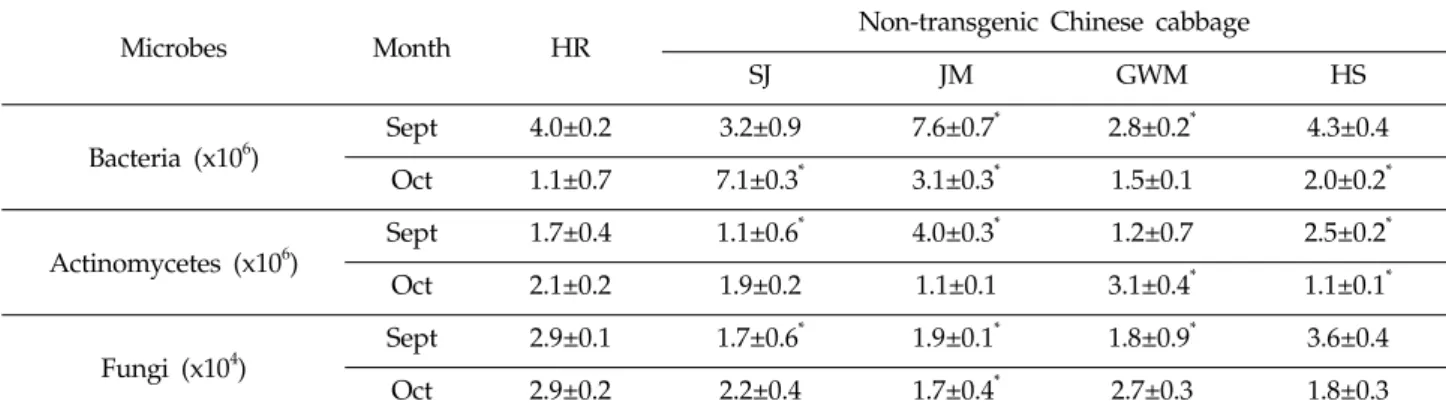
The soils around these plants were compared using colony counting, denaturing gradient gel electrophoresis and a species diversity index assessment during the growing periods. The bacterial, fungal and actinomycetes population densities of the GM Chinese cabbage soils were found to be within the range of those of the non-GM Chinese cabbage soils. The DGGE banding patterns of the
GM and non-GM soils were also similar, suggesting that the bacterial community structures were stable within a given month and were unaffected by the presence of a GM plant.
The similarities of the bacterial species diversity indices were consistent with this finding.
CONCLUSION: These results indicate that soil microbial communities are unaffected by the cultivation of herbicide-resistant GM Chinese cabbage within the experimental time frame.
Key Words: Chinese cabbage, DGGE, GM, herbicide- resistant, soil microbial community
Introduction
Chinese cabbage ( Brassica campestris L. ssp.
Pekinensis ) is a commercially important vegetable in Korea, Japan, China and many other countries of South Asia (Cho et al ., 2001). The phosphinothricin acetyltransferase ( pat ) gene has been isolated from Streptomyces viridochromogenes and transgenic plants expressing this gene are resistant to the herbicide glufosinate (Wohlleben et al ., 1992).
Glufosinate and glyphosate are relatively environmentally benign, non-residual, post-emergence herbicides that target both monocotyledonous and dicotyledonous weedy species (Duke, 2005; Espinoza-Ésquivel and Arrieta-Espinoza, 2007; Olofsdotter et al ., 2000).
Through the use of these herbicides, the productivity
Open Access
Research Article
Fig. 1. Herbicide-resistant transgenic and conventional non-GM Chinese cabbages photographed after four weeks of culture in the field. HR, herbicide-resistant; SJ, Samjin;
GWM, Gawulmat; HS, Hwangseong; JM, Jangmi.
of GM crops can be increased and labor costs can be reduced. Hence, herbicide-resistant GM crops offer a valuable and environmentally friendly alternative for effective weed control. In 2010, herbicide resistant GM crops are reported to have occupied 89.3 million hectares (Peng, 2011). Although the total global cultivation area of GM crops is increasing markedly, legislation to regulate their cultivation is being introduced in a number of countries.
There are a number of well established concerns regarding the commercial cultivation of GM crops including plant invasiveness, dispersal of the plant into the native ecosystem, gene flow through pollen transfer, development of resistance in target organisms and non-target effects on native flora and fauna including effects on the biodiversity of beneficial and antagonistic microorganisms. However, the potential for interaction between transgenic plants and plant residues and the soil microbial community is not well understood (Eastham and Sweet, 2002;
Nielsen et al ., 2001; Wolfenbarger and Phifer, 2000;
Riba et al ., 2000). Novel proteins have been shown to be released from transgenic plants into the soil ecosystem, and their presence can influence the biodiversity of the microbial community by selectively stimulating the growth of organisms that can use these factors (Dunfield and Germida, 2004). It is therefore important to identify the transgene- associated pertinent target population and investigate the possible effects of GM plants on the microbial community as part of a soil environmental risk assessment. Despite the controversy surrounding the environmental impact of GM crops, the global transgenic crop hectarage and number of countries utilizing these transgenic varieties is growing yearly.
According to the International Service for the Acquisition of Agrobiotech Applications (ISAAA), the estimated global area of genetically modified crops was 160 million ha in 2010, and has increased 94-fold increase since 1996 (James, 2011; Peng, 2011). It is therefore essential to perform pre-commercialization tests of these plants for environmental safety and ensure that every GM crop undergoes post approval monitoring to guarantee that crops engineered using biotechnology continue to be safe for both consumers and the environment.
In our present study, we have assessed the effects of herbicide-resistant GM Chinese cabbage on the surrounding soil microbial community. Using
culture-dependent and -independent molecular methods, soil microbial community density, soil bacterial community changes and the composition of the soil bacterial communities during growing periods were compared for GM and non-GM Chinese cabbages.
Materials and Methods
Plant materials and field design
GM Chinese cabbage seeds, cultivar Samjin, into
which the bar gene had been introduced to produce
herbicide resistance (Cho et al ., 2001) were provided
by Dr. Hyun-Suk Cho from RDA, Korea. Field testing
was performed at the National Academy of
Agricultural Science (NAAS), Korea beginning in July
2008. GM and non-GM Chinese cabbage (cv. Samjin,
Jangmi, Gawulmat and Hwangseong) seeds were
sown in a nursery box and transplanted into a field
two weeks later (Fig. 1). Three subplots were
assigned per plant type (3 x 3 meters). Soil samples
were taken from each subplot in the middle of
September and October, 2008. The roots were shaken
vigorously to separate loosely adherent soil. These rhizosphere soil samples were then sieved through a 2-mm mesh and stored at 4°C until needed.
Growth media and culture conditions
Culture media used for bacterial growth were prepared with 20 g of R2A agar (BD Diagnostic Systems, Sparks, MD) and 0.05 g of cycloheximide per liter of distilled water. Media used for the growth of actinomycetes contained 0.2 g/L sodium caseinate, 0.5 g/L KH
2PO
4, 0.2 g/L MgSO
4⋅7H
2O, and 0.5 g/L FeCl
3⋅6H
2O. Fungi were cultured in broth containing 20 g of R2A agar supplemented with 0.2 g/L chloramphenicol. To prepare solid medium, agar (BD Diagnostic Systems, Sparks, MD) was added to this liquid broth at a concentration of 1.5%. One gram of each sieved soil sample was suspended in 100 mL of 0.85% NaCl solution. This diluted soil suspension was then serially diluted tenfold (up to 10
-7), and 200 μl of each of the last three dilutions was used to inoculate 3 or 5 Petri plates at each dilution level to generate a counting set of 9 or 15 plates. Inocula were then spread over the surface of the agar-containing medium using sterile glass spreading rods. Plates containing bacteria, actinomycetes and fungi were incubated at 28°C for 48 h, 120 h, and 96 h, respectively. Microbial community density results were analyzed by one-way ANOVA using SPSS 15.00 (SPSS Inc., Chicago, USA). The significance level was set at P < 0.05.
DGGE(denaturing gradient gel electrophoresis) analysis Soil DNA was extracted using a FastDNA Spin Kit (Qbiogene, Carlsbad, CA). PCR amplification of the 16S rRNA genes was performed with the primer pairs 1070f: 5’-ATGGCTGTCGTCAGCT-3’ and 1392r:
5’ - CGCCCGCCGCGCCCCGCGCCCGGCCCGC CGCCCCCGCCCCACGGGCGGTGT-3’ ( E. coli 16S rRNA gene sequence numbering). The 1392r primer contains a GC clamp of 40 bases with a highly variable V9 region. PCR amplification was performed in a 50 μL reaction mixture containing 10X PCR buffer [160 mM(NH
4)
2SO
4, 670 mM Tris/HCl, pH 8.8, 25 mM MgCl
2, 0.1% Tween 20], 1 μL template DNA, 25 pmol of each primer, 200 μM of each dNTP (GeneCraft, Munster, Germany), and 2.5 U of Taq polymerase (GeneCraft, Munster, Germany). PCR cycles consisted of an initial denaturation step at 95°C for 5 min, followed by 30 cycles of 95°C for 1 min,
55°C for 1 min, 72°C for 1 min, and a final extension at 72°C for 7 min. PCR products were subjected to DGGE analysis with the Dcode Universal Mutation Detection System (Bio-Rad, Hercules, CA). A linear gradient of 40 to 70% (vol/vol) formamide plus 7M urea was used for DGGE, which was performed in 1X Tris-acetate-EDTA buffer at 60°C and a constant voltage of 60 V for 18 h. After electrophoresis, the gels were stained with SYBR Green I (Cambrex BioScience, Rockland, ME) for 15 min, rinsed for 25 min, and photographed under UV transillumination (302 nm).
PCR amplification of soil bacterial 16S rRNA gene Soil microbial community DNA was extracted using a FastDNA Spin Kit (Qbiogen, Carlsbad, CA).
PCR was carried out using the primers, 27f:
5’-AGAGTTTGATCM TGGCTCAG-3’ and 1492r:
5’-GGYTACCTTGTTACGACTT-3’, which target the 16S rRNA genes of a wide number of domain bacteria at positions 28 through 1492 ( E. coli 16S rRNA gene sequence numbering). The PCR protocols used were as described for DGGE and 2 μL aliquots of the PCR products were evaluated by electrophoresis on horizontal 1.5% agarose gels.
Cloning and Sequencing
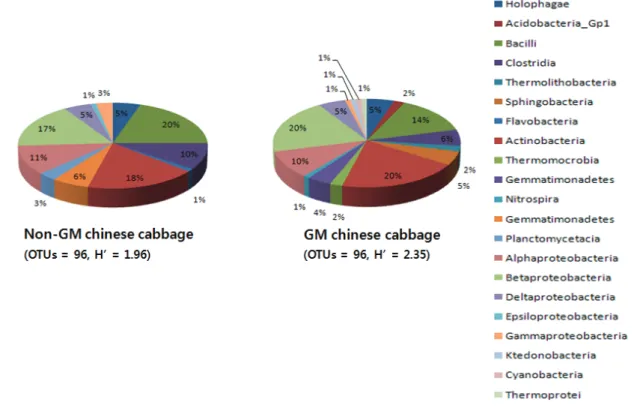
The 16S rDNA PCR products obtained from the soil bacterial community DNA samples were cloned into the pGEM-T Easy vector (Promega, Madison, WI) and a clone library was then constructed from pooled PCR products of the soil DNA sampled in September.
For bacteria, 96 clones were chosen randomly from each clone library. Plasmids were prepared using a Bioneer miniprep kit (Bioneer, Daejeon, Korea) in accordance with the manufacturer’s instructions.
Sequencing was performed using an ABI Prism BigDye Terminator Cycle Sequencing Ready Kit (Applied Biosystems, Foster City, CA) with the sequencing primers 27f: 5’-AGAGTTTGATCMTGG CTCAG-3’ and 519r: 5’-ACCGCGGCTGCTGGCAC-3’.
Analysis of 16S rRNA gene sequence and bacterial species diversity indices
16S rDNA sequences were checked for chimeras
using the Mallard program. Sequences were then
compared with those in the GenBank, Bioinformatics
Bacteria Identification and Ribosomal Database Project
databases. Bacterial diversity was measured using the
Shannon-Wiener’s index, which determines the soil
Microbes Month HR Non-transgenic Chinese cabbage
SJ JM GWM HS
Bacteria (x106)
Sept 4.0±0.2 3.2±0.9 7.6±0.7* 2.8±0.2* 4.3±0.4
Oct 1.1±0.7 7.1±0.3* 3.1±0.3* 1.5±0.1 2.0±0.2*
Actinomycetes (x106)
Sept 1.7±0.4 1.1±0.6* 4.0±0.3* 1.2±0.7 2.5±0.2*
Oct 2.1±0.2 1.9±0.2 1.1±0.1 3.1±0.4* 1.1±0.1*
Fungi (x104)
Sept 2.9±0.1 1.7±0.6* 1.9±0.1* 1.8±0.9* 3.6±0.4
Oct 2.9±0.2 2.2±0.4 1.7±0.4* 2.7±0.3 1.8±0.3
Values indicate the colony forming unit (CFU)/g fresh weight ± standard deviation from three replicates. The asterisk denotes a significant difference (
P
<0.05). SJ, Samjin; JM, Jangmi; GWM, Gawulmat; HS, Hwangseong.Table 1. Number of microbes detected in the rhizosphere soils of herbicide resistant (HR) and conventional Chinese cabbages
Fig. 2. DGGE analysis of the 16S rDNA V9 region obtained after PCR amplification with the eubacterial primers 1070f and 1392r. Shown are DGGE profiles of field soil samples taken in September (A&B) and October (C&D) of herbicide-resistant Chinese cabbage (HR1, 2 & 3), and non-GM Samjin (SJ1, 2 & 3), Jangmi (JM1, 2 &3) Gawulmat (GWM1, 2 & 3) and Hwangseong (HS1, 2, & 3) Chinese cabbage cultivars.
M, DGGE molecular markers.
Fig. 3. Bacterial community analysis of soil samples from field-grown Chinese cabbages. Rhizospheric soils were sampled in September 2008 from the following cultivars: A, Samjin non-GM. B, Herbicide-resistant GM Chinese cabbage (Samjin background). OTU, operational taxonomic unit; H’, Shannon-Weiner’s diversity index.