Effects of Cover Crops on Soil Chemical Properties and Biota in a Pear Orchard
Jinu Eo, Jin-Myeon Park1*, and Kee-Choon Park1
Climate Change and Agroecology Division, National Academy of Agricultural Science
1National Institute of Horticultural & Herbal Science, Rural Development Administration
(Received: October 6 2014, Revised: February 15 2015, Accepted: February 20 2015)
The use of cover crops has a beneficial effect on sustainable soil management in pear orchards. We aimed to compare changes in soil chemical properties and biota with the use of different cover crops. We tested the effects of five cover plants, including hairy vetch, orchard grass, rattail fescue, rye, and perennial ryegrass. Use of different cover crops had a minimal impact on soil chemical properties through three year experiments. The aboveground biomass was greatest with the use of rye. The potential amounts of returnable N and P were highest when leguminous hairy vetch was used as a cover plant. Changes in the composition of the microbial community were investigated by phospholipid fatty acid (PLFA) analysis. Microbial PLFAs were highest with the use of rattail fescue and lowest with the use of hairy vetch. Minimal changes in the abundances of nematodes and microarthropods suggested that there was no bottom-up control in the soil ecosystem. The results also show that increases in aboveground biomass and nutrient content with the use of cover crops may not promote the abundance of soil organisms.
Key words: Hairy vetch, Nematode, Nutrient, PLFA, Rattail fescue
Principal component analysis based on soil microbial PLFAs under different cover plants.
1)
*Corresponding author : Phone: +82312906220, E-mail: [email protected]
§Acknowledgement: This study was conducted with the financial support of “Research Program (Project No. PJ006426)” by Rural Development Administration.
Introduction
배 과원의 토양관리에서 친환경적 방법으로 비옥도를 높 이고 작물의 생육을 촉진하는 것은 지속적 농업의 중요한 목표이다. 피복작물은 근계발달을 통해 토양의 고착력을 높 이며, 배수성이나 보수력을 증가시키는 등의 물리성 개선에 효과적이다 (Lucas et al., 2014; Manns et al., 2007). 또 한, 토양 표면을 피복하여 잡초 발생이나 토양침식을 억제 한다 (De Baets et al., 2011). 두과작물은 질소고정균과의 상호작용에 의한 질소 축적을 통해 양분을 증가시키고, 비 두과작물은 토양의 입단, 미생물 밀도, 탄소고정 등을 증가 시킨다 (Sainju et al., 2003).
식물은 종류에 따라 토양의 탄소나 질소의 순환, 양분이 나 물의 저장과 같은 기능적 측면에 영향을 주며 (De Deyn et al., 2009), 토양생태계에서 미생물 군집의 크기, 구성 및 밀도에 영향을 미친다 (Li et al., 2012; Xavier et al., 2013).
식물 뿌리분비액의 조성은 근권미생물 군락에 영향을 미치 며 (Landi et al., 2006), 근권과 비근권에서 미생물상 차이 의 원인이 된다 (Mouhamadou et al., 2013). 또한, 양분의 무기화과정이나 식물생장 촉진 미생물을 증진시키는 등의 피드백 작용을 통해 식물의 양분 흡수를 증가시켜 결과적으 로 식물의 군집에 영향을 미치기도 한다 (Van der Heijden et al., 2008).
토양미생물은 양분의 순환, 병원균 억제, 토양의 입단화 등에 기여하여 식물의 생육을 촉진하는 효과가 있다. 토양 미생물의 바이오매스, 활성 및 군집구조의 변화는 토양관리 방법과 밀접한 관계가 있다. 미생물 분석을 위해서 다양한 방법들이 이용되고 있으며, 그 중 인지질지방산 (PLFA) 분 석법은 미생물의 밀도와 군집구조뿐만 아니라 환경변화를 반영하는 지표로 이용될 수 있다 (Kourtev et al., 2002). 그 외에도 식물의 종이 근권부의 미생물에 대해 미치는 영향에 대해 다양한 분자생물적인 연구가 이루지고 있다 (Marschner et al., 2003).
본 연구는 다양한 피복작물이 토양이화학성과 양분순환 에 미치는 영향을 조사하고, 이에 대한 생물적 요소와의 상 호작용을 알아보는 것을 목적으로 하였다. 이와 함께 토양 내 미생물상과 미소동물상 변화와의 상관관계 분석을 통해 토양피복작물이 토양생태계 먹이망에 미치는 영향에 대해 고찰하였다.
Materials and Methods
실험장소 및 처리방법 본 실험은 전남 나주시에 위치 한 배 (Pyrus pyrifolia Nakai) 재배 농가에서 2011~2013년 에 수행되었다. 배나무는 12년생으로 재식간격은 6 m × 5.5 m이었고, 과원의 표토는 농가의 관행적인 초생재배방
법에 준하여 관리하였다. 피복작물로는 두과작물인 헤어리 베치 (Hairy vetch, Vicia villosa Roth)와 볏과인 오처드그 래스 (Orchardgrass, Dactylis glomerata L.), 호밀 (Rye, Secale cereale L.), 퍼레니얼 라이그래스 (Perennial ryegrass, Lolium perenne L.), 들묵새 (Rattail Fescue, Vulpia myuros L.)를 처리하였고, 대조구는 자연초생으로 관리하였다. 각 초종별 파종량은 오처드그래스, 퍼레니얼 라이그래스, 들묵 새는 30 kg ha-1, 호밀은 160 kg ha-1, 헤어리베치는 60 kg ha-1이었으며, 매년 9월 하순에 산파하였다. 녹비작물은 매 년 4월에 예취하여 환원하였다. 각 처리구의 면적은 36 m
× 5.5 m이었고, 난괴법 3반복으로 배치하였다.
토양 및 피복작물 시료채취 토양 화학성은 2013년 7~8월에 표토 5~20 cm 부위에서 토양을 채취하여 음건한 후 토양 화학성 분석에 이용하였다. 피복작물의 조사는 2013년 4월에 수행하였으며, 각 처리구별로 30 cm x 30 cm 의 면적에서 3반복으로 시료를 채취한 후 건조하여 건물중 과 무기성분 분석에 이용하였다.
토양 화학성 분석 토양 pH는 토양과 물의 비율을 1:5 로 교반한 후 초자전극법으로 측정하였고, 토양 유기물은 Tyurin법, 유효인산은 Lancaster법, 치환성 칼륨 (K), 칼슘 (Ca), 마그네슘 (Mg)은 1 N CH3COONH4 (pH 7.0) 완충용액 으로 침출하여 ICP-OES (SDS-720, GBC, Australia)를 사 용하여 측정하였다 (RDA, 1988). 식물체 무기성분 중 질소 측 정은 식물체 시료 0.5 g을 황산염 혼합분말 (K2SO4와 CuSO4
= 9:1)과 농황산을 넣고 분해한 후 켈달장치 (Kjeltec 8400, Foss, Sweden)를 이용하여 증류한 후 적정법으로 분석하였다.
인은 ammonium vanadate법으로 비색계 (UV/VIS spectro- photometer, Cintra 6 GBC, Australia)를 사용하여 정량하 였고, K와 Ca 및 Mg은 ICP-OES (MX2, GBC, Australia)로 측정하였다.
토양 미생물 분석 2013년 6월 17일에 각 처리구별로 과수와 1 m 이상 떨어진 3지점에서 0~20 cm 깊이의 토양 을 채취하여 혼합한 시료를 분석에 이용하였다. 토양 미생 물의 인지질지방산 (PLFA, phospholipid fatty acid)의 분석 은 Li et al. (2006)의 방법을 따랐다. 냉동건조한 토양시료 5 g에 chloroform (4 mL), methanol (8 mL), 0.15 M citrate buffer (3.2 mL, pH 7.4)을 혼합하여 지질을 추출한 후 silicic acid column으로 neutral-, glyco- 및 phospho-lipid로 분 리하였다. MIDI Sherlock Microbial Identification System (MIDI Inc., Newark, DE)을 이용하여 지방산을 정성 · 정량 하였다. 각 지방산의 값은 표준으로 넣은 19:00 지방산을 이용하여 그 양을 환산하였다. 불포화 지방산은 16:1 ω5c, 17:1 ω8c, 18:1 ω7c, 포화지방산은 14:00, 15:00, 16:00,
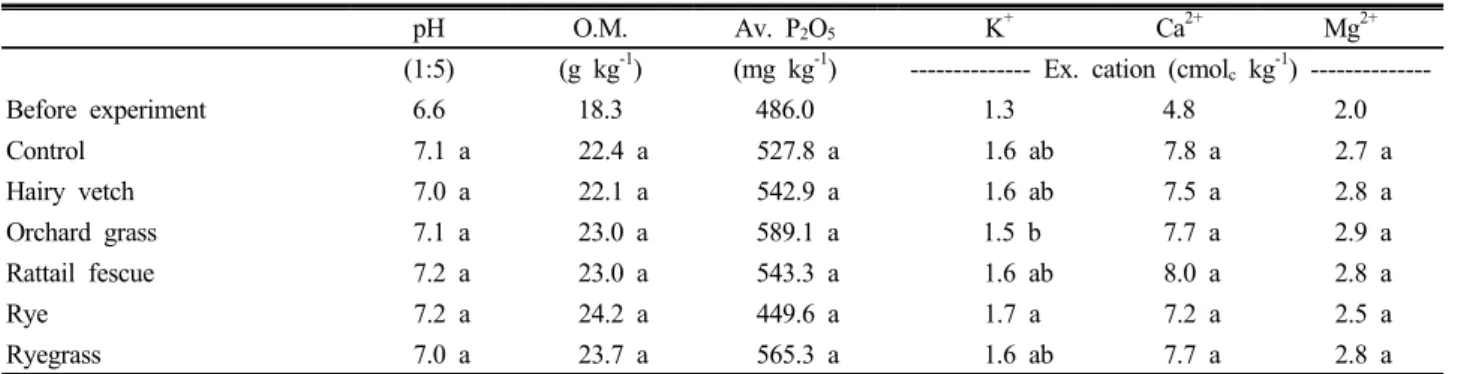
Table 1. The effect of cover crops on the chemical properties of soils.
pH O.M. Av. P2O5 K+ Ca2+ Mg2+
(1:5) (g kg-1) (mg kg-1) --- Ex. cation (cmolc kg-1) ---
Before experiment 6.6 18.3 486.0 1.3 4.8 2.0
Control 7.1 a 22.4 a 527.8 a 1.6 ab 7.8 a 2.7 a
Hairy vetch 7.0 a 22.1 a 542.9 a 1.6 ab 7.5 a 2.8 a
Orchard grass 7.1 a 23.0 a 589.1 a 1.5 b 7.7 a 2.9 a
Rattail fescue 7.2 a 23.0 a 543.3 a 1.6 ab 8.0 a 2.8 a
Rye 7.2 a 24.2 a 449.6 a 1.7 a 7.2 a 2.5 a
Ryegrass 7.0 a 23.7 a 565.3 a 1.6 ab 7.7 a 2.8 a
Means followed by the same letter within a column are not significantly different at P > 0.05.
17:00, 18:00, 20:00을 지표로 사용하였다. 호기성균은 16:1 ω 7t, 혐기성균은cy19:0을 사용하였다. 그램 음성균의 지표 지방산은 18:1 ω7c, 19:0cy ω8c, 17:1 ω8c, 그램양성균은 i14:0, i15:0, a15:0, i16:0, i17:0, a17:0, 세균은 그램 음성 균과 양성균을 모두 이용하였다. 곰팡이는 18:2 ω6,9c, 방 선균은 10Me16:0, 10Me17:0, TBSA10Me18:0, 균근균은 16:1 ω5c을 지표로 이용하였다.
배양 가능한 미생물의 밀도를 측정하기 위해 100 g의 토 양을 200 mL의 증류수에 혼합한 후 희석배수를 달리하여 세균과 곰팡이를 측정하기 위하여 각각 TSA (Tryptic soy agar) 배지와 PDA (Potato dextrose agar) 배지를 이용하였 다. 현탁액을 배지에 도말하여 20°C에서 1주일간 배양한 후 CFU (colony forming unit)를 측정하였다.
미소동물 조사 토양 미소동물의 밀도는 토양미생물을 조사한 동일 시료를 대상으로 조사하였다. 토양 자활성 선 충의 밀도를 조사하기 위해 20 g의 토양을 이용하여 베르만 깔대기법 (Baermann funnel)에 의해 48시간 동안 추출 후 TAF (2% triethanolamine, 2.8% formaldehyde) 용액에 시 료를 보관하였다. 보관하였던 선충을 광학현미경에서 관찰 하면서 식성에 따라 세균섭식성과 곰팡이섭식성으로 분류 하였다. 미소절지동물은 300 mL의 토양으로 툴그렌 장치를 이용하여 72시간 동안 추출하였다. 추출된 시료는 광학현미 경으로 관찰하면서 응애류, 톡토기류 등으로 분류하였다.
통계분석 피복작물이 토양 화학성, 미생물 PLFA 및 미 소동물 밀도에 미치는 영향은 Fisher’s LSD 검정법으로 분 석하였다. 각 PLFA 지방산을 이용하여 주요인 분석 (PCA) 를 실시하여 처리간 미생물 군집의 특성을 비교하였다. 모 든 통계과정은 XLSTAT (Addinsoft, NY)를 이용하여 수행 하였다.
Results and Discussion
토양 화학성 배 과원에서 피복작물을 재배했을 때 토
양 화학성은 대조구인 자연초생지와 비교하여 전반적으로 차이가 적었다 (Table 1). 토양 pH와 유기물함량, 유효인산, 치환성 Ca과 Mg함량은 처리간에 차이가 없었고, 치환성 K 만 오처드그래스 처리구에서보다 호밀 처리구에서 유의성 있게 높았다. 처리간 차이가 적었던 것은 녹비작물이 등숙 되기 전에 예취되어 유기물로 환원되는 양이 적었고, 당년 예취된 것은 혼입이 안된 상태로 토양 위에 놓여 있었기 때 문으로 생각된다.
녹비작물 식물의 지상부 건물중은 호밀 재배구가 가장 많았고 오처드그래스와 퍼레니얼 라이그래스가 적었다 (Table 2). 오처드그래스는 다른 잡초와의 경쟁으로 생육이 불량하 였는데, Creamer et al. (1997)도 이 식물이 초장이 크거나 세력이 강한 식물과의 경쟁에 약하다고 보고하였다. 호밀은 건물중이 많았지만 토양에 혼입될 때 잔사는 분해가 늦어 단 기간의 양분공급에는 효과적이지 못 할 수 있다 (Brunetto et al., 2014). 또한, 피복 작물은 토양과 기상환경에 따라 건물중 생산에 차이가 클 수 있으므로, 작물별 생육특성에 대한 고려가 필요하다 (Biederbeck et al., 1996).
피복작물의 양분환원 가능량 피복작물을 재배했을 때 피복작물의 양분환원 가능량은 처리간 차이가 나타났다 (Table 2). Choi et al. (2011)의 보고에 의하면 동계 피복작 물 재배는 자연방임 초생보다 양분 환원 가능량은 많으나 유기물함량을 제외하고 유효인산, 치환성 양이온 함량 등은 차이가 없다고 하였으며 본 연구 결과와 같았다. 특히, 헤어 리베치는 질소환원 가능량이 높았는데 이 식물이 토양의 유 기탄소와 질산태질소를 증가시킨다는 선행보고와 일치한다 (Kuo et al., 1997; Sarrantonio, 2003). 두과작물인 헤어리 베치를 볏과작물인 퍼레니얼 라이그래스와 비교하였을 때 지상부 건물중은 비슷하였으나, 질소환원 가능량은 1.7배 많았다. 두과작물은 비두과작물에 비해 일반적으로 질소함 량이 높으므로, 작물의 질소 공급과 토양의 질소함량 증진 에 효과적이다 (Ashraf et al., 2004). P와 K의 환원량은 피 복작물 중 오처드그래스에서 비교적 낮았으며 이는 낮은 지
Table 2. Aboveground biomass and potential amount of returnable nutrient in cover crops.
D.W. N P2O5 K2O CaO MgO
(kg 10a-1) --- (kg 10a-1) ---
Control 370.4 c 9.2 c 4.6 ab 25.8 ab 3.9 ab 2.0 a
Hairy vetch 559.3 bc 20.7 a 5.7 ab 35.5 a 5.6 a 2.3 a
Orchard grass 363.0 c 9.4 c 4.5 b 18.9 b 3.8 ab 1.8 a
Rattail fescue 663.0 b 17.8 ab 6.9 a 29.3 ab 3.6 ab 2.2 a
Rye 1,074.1 a 14.7 abc 7.1 a 30.4 ab 3.4 b 2.0 a
Ryegrass 488.9 bc 12.1 bc 5.7 ab 23.7 ab 3.4 b 1.8 a
Means followed by the same letter within a column are not significantly different at P > 0.05.
Fig. 1. Principal component analysis based on microbial PLFAs extracted from soils under different cover plants.
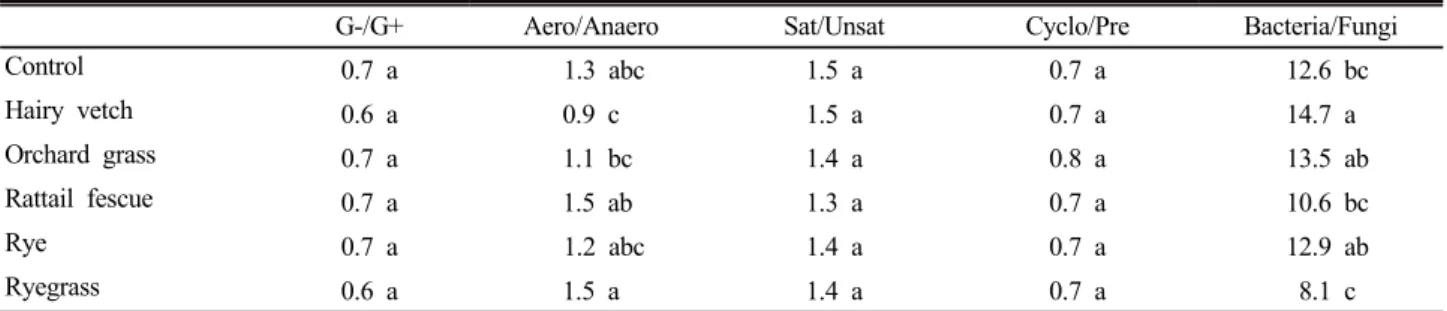
Table 3. PLFA indicators with the use of different cover crops.
G-/G+ Aero/Anaero Sat/Unsat Cyclo/Pre Bacteria/Fungi
Control 0.7 a 1.3 abc 1.5 a 0.7 a 12.6 bc
Hairy vetch 0.6 a 0.9 c 1.5 a 0.7 a 14.7 a
Orchard grass 0.7 a 1.1 bc 1.4 a 0.8 a 13.5 ab
Rattail fescue 0.7 a 1.5 ab 1.3 a 0.7 a 10.6 bc
Rye 0.7 a 1.2 abc 1.4 a 0.7 a 12.9 ab
Ryegrass 0.6 a 1.5 a 1.4 a 0.7 a 8.1 c
†Values indicated by the same letter within a column are not significantly different at P > 0.05. G-, gram negative bacteria; G+, gram positive bacteria; Aero, aerobic microbes; Anaero, anaerobic microbes; Sat, saturated fatty acid; Unsat, unsaturated fatty acid;
Cyclo, cyclo fatty acid; Pre, precursor.
상부 생산량에서 기인한 것으로 보인다. Ca의 환원 가능량 은 지상부 건물중과 다른 경향이 나타났다. 헤어리베치는 호밀과 비교할 경우 건물중은 52% 수준인데 반해 Ca 환원 가능량은 1.6배 높았다. 이것은 Hoyt (1989)의 연구에서도 유사한 결과가 나타났으며, 작물별 양분흡수 특성이 다른 것으로 판단된다.
토양 미생물상 및 생리적 지표 PLFA분석에서 나온
32 종류의 지방산에 근거한 주성분분석에서 PC1과 PC2에 의해 각 처리들이 분리되었다 (Fig. 1). 이를 통해 피복작물 에 따라 미생물PLFA 구성이 영향을 받는 것이 확인되었으 며, 작물의 근권에서 분비되는 물질과 환원된 유기물이 토 양미생물의 구성과 밀도에 영향을 미치는 것으로 추측된다 (Batten et al., 2006; Li et al., 2012). 미생물 PLFA의 호 기성/혐기성 비율은 처리간 차이가 있었으나, 환경스트레스 를 나타내는 포화/불포화 및 Cyclo/precursors지방산 비율 에 대한 피복작물의 영향은 미미하였다 (Table 3). 호기성/
혐기성 비율은 헤어리베치 처리구에서 둘묵새나 퍼레니얼 라이그래스 처리구보다 낮았다. 헤어리베치는 얕은 근계체 계를 갖고 있고 (Ingels et al., 1998), 과다한 잔사에 의해 습도가 높아지고 온도가 낮아지면 혐기적 환경이 조성될 수 있다 (Matthew et al., 2011).
토양 미생물 밀도 토양 미생물 PLFA지표 중 세균, 곰 팡이 및 방선균은 피복작물 처리별로 서로 다른 반응이 나 타났으며 (Table 4). 세균과 곰팡이에 대한 PLFA 분석과 배 양법에 의한 결과에서 유사한 경향이 나타났다 (Table 4, 5).
피복작물의 구성성분은 유기물분해에 관여하는 미생물의 활 동에 영향을 미치며, 그 중C/N율은 낮을수록 분해되는 속도 가 증가하고 분해시 세균을 조장한다 (Gusewell and Gessner 2009; Rousk and Baath, 2007). 헤어리베치는 두과작물로
Table 4. The effect of cover crops on microbial PLFA.
Fungi Bacteria Actino VAM Total
--- (nmol PLFA g soil-1) ---
Control 1.3 bc 10.4 b 3.7 b 1.5 b 35.3 b
Hairy vetch 0.8 c 12.3 b 4.1 b 1.5 b 34.1 b
Orchard grass 1.1 c 14.7 b 4.4 ab 1.7 b 39.6 b
Rattail fescue 2.0 ab 20.7 a 5.8 a 2.6 a 57.8 a
Rye 1.4 abc 16.8 ab 4.8 ab 2.2 ab 45.7 ab
Ryegrass 2.1 a 16.4 ab 4.6 ab 2.0 ab 46.3 ab
Means followed by the same letter within a column are not significantly different at P > 0.05. Actino, actinomycetes; VAM, vesicular-arbuscular mycorrhizal fungi.
Table 5. Culturable microorganism and mesofauna abundance.
Microorganisms Nematodes Microarthropods
Bacteria Fungi Bacterivores Fungivores Collembolans Mites
(cfu ×107) (cfu ×104) --- (ind g-1) --- --- (ind 100 mL-1) ---
Control 1.5 b 2.7 ab 9.8 ab 0.0 a 0.3 a 0.4 a
Hairy vetch 0.8 b 2.9 b 12.2 a 0.0 a 0.0 a 0.0 a
Orchard grass 0.8 b 1.8 b 5.0 b 0.1 a 0.0 a 0.1 a
Rattail fascue 1.7 a 4.5 a 7.8 ab 0.0 a 0.0 a 0.7 a
Rye 1.6 ab 2.0 b 9.7 ab 0.1 a 0.1 a 0.1 a
Ryegrass 1.4 ab 4.6 ab 7.2 ab 0.0 a 0.1 a 0.2 a
Means followed by the same letter within a column are not significantly different at P > 0.05.
C/N율이 10-15로 낮으며 (Anugroho et al. 2010), 토양에 투입시 세균이 증가한다는 보고가 있다 (Zhou and Everts, 2007). 본 연구에서도 헤어리베치에 의해 세균/곰팡이 비율 이 대조구보다 높았기 때문에 이로 인해 세균 중심의 구조 가 형성되는 요인이 될 수 있다.
오처드그래스가 토양 미생물에 미치는 영향에 대한 보고 는 적으며, Drury et al. (1991)는 토양생물의 밀도 증가에 효과적이지 않았다고 하였다. 본 연구에서도 곰팡이, 세균, 근균균, 총 미생물 밀도가 낮았기 때문에 토양미생물을 촉 진하는 효과는 크지 않은 것으로 보인다 (Table 4, 5). 호밀 은 토양생물의 밀도와 기능적 다양성을 증가시킬 수 있다 (Nair et al., 2012). Zhaorigetu et al. (2008)은 호밀이 곰 팡이 밀도는 증가시켰으나, 세균 밀도에는 영향이 없었다고 보고하였다. 근균균의 접종밀도가 청경구에 비해 높거나 (White and Weil, 2010), 응애류의 밀도가 증가하였다는 보 고가 있으나 (Reeleder, 2006), 본 연구에서는 대조구와 비 교하여 유의적인 차이가 없었다 (Table 4). 라이그래스는 토 양미생물의 밀도를 증가시키며 (Zablotowicz et al., 2007).
호밀과의 비교에서도 퍼레니얼 라이그래스는 지상부 건물 중이 작지만 토양미생물의 밀도는 크게 차이가 나지 않았기 때문에 토양미생물 증진에 유용하다. 들묵새에 의한 미생물 PLFA변화는 적었다는 보고가 있지만 (Eo et al., 2010), 본
연구에서는 세균, 방선균 및 균근의 밀도가 증가하는 효과 가 있었다 (Table 4, 5). 이처럼 들묵새는 토양미생물의 밀 도를 증가시킬 수 있고, 타감작용을 하는 물질을 생산하여 다른 식물의 생장을 억제하는 효과도 기대할 수 있다 (Kato- Noguchi et al., 2010).
토양 동물상 토양미소동물 중 세균섭식성 선충과 미소 절지동물의 밀도는 유의적 차이가 없었고, 자활성 선충의 밀도만 처리간 차이가 있었다 (Table 5). 토양 생태계에서는 세균과 곰팡이를 중심으로 하는 먹이망 구조가 일반적으로 형성된다. 하지만 오처드그래스 처리구와 비교했을 때, 들 묵새 처리구에서 세균의 밀도가 높았는데 자활성 선충의 밀 도는 증가하지 않았고, 헤어리베치 처리구에서는 세균 밀도 의 차이는 없었지만 세균섭식성 선충의 밀도는 높았다. 이 러한 결과들을 고려할 때 피복작물 재배에서 미생물 밀도변 화에 의해 이를 섭식하는 미소동물의 밀도가 영향을 받는 이차적인 효과는 적었던 것으로 보인다.
Conclusion
배과원의 토양을 다양한 피복작물로 재배하였을 경우 식 물에 따른 토양 화학성 변화는 적었었다. 헤어리베치 처리
구에서 질소환원 가능량이 가장 높았고, 호기성균/혐기성균 의 비율과 토양 미생물 밀도는 낮았다. 오처드그래스의 건 물생산량 및 양분 환원 가능량이 낮았으며, 호밀은 토양 유 기물 공급력이 높았다. 피복작물재배 초기에 토양의 치환성 K함량 감소를 유발하는 오처드그래스의 경우 칼륨의 인위 적인 공급이 필요하다. 각 양분성분별 토양환원 가능량이 피복작물마다 다르고 토양에 혼입할 경우 이들이 분해되어 배나무가 이용할 수 있게 되기 까지 분해되는 기간도 다를 것으로 예상되므로 시기별 양분 공급 계획이 필요하다. 들 묵새의 경우처럼 미생물 밀도는 증가시키지만 유기물과 무 기양분 공급력이 낮은 것으로 나타나는 등 토양 화학성과 미생물상에 미치는 효과는 피복작물의 종류마다 다르므로 이들 피복작물의 혼파나 연도별 피복작물의 종류 변경 등의 방법도 고려해야 한다.
References
Anugroho, F., M. Kitou, F. Nagumo, K. Kinjo, and G.Y.
Jayasinghe. 2010. Potential growth of hairy vetch as a winter legume cover crops in subtropical soil conditions. Soil Sci.
Plant Nutr. 56:254-262.
Ashraf, M., T. Mahmood, F. Azam, and R.M. Qureshi. 2004.
Comparative effects of applying leguminous and non-leguminous green manures and inorganic N on biomass yield and nitrogen uptake in flooded rice (Oryza sativa L.). Biol. Fertil. Soils 40:147-152.
Batten, K.M., K.M. Scow, K.F. Davies, and S.P. Harrison. 2006.
Two invasive plants alter soil microbial community composition in serpentine grasslands. Biol. Invasions 8:217-230.
Biederbeck, V.O., O.T. Bouman, C.A. Campbell, L.D. Bailey, and G.E. Winkleman. 1995. Nitrogen benefits from four green- manure legumes in dryland cropping systems. Can. J. Plant Sci.
76:307-315.
Brunetto, G., C.A. Ceretta, G.W.B. de Melo, J. Kaminski, G.
Trentin, E. Girotto, P.A.A. Ferreira, A. Miotto, and P.C.O.
Trivelin. 2014. Contribution of nitrogen from agricultural residues of rye to ‘Niagara Rosada’ grape nutrition. Sci. Hortic.
169:66-70.
Choi, H.S., K.H. Im, Y. Lee, H.J. Ji, J.R. Cho. 2011. Nutrient contribution as affected by ground cover treatments in a pear orchard. Kor. Soc. Weed Sci. Conf. 31(1):65-66.
Creamer, N.G., M.A. Bennett, and B.R. Stinner. 1997. Evaluation of cover crop mixtures for use in vegetable production systems.
Hortscience 32:886-870.
De Baets, S., J. Poesen, J. Meersmans, and L. Serlet. 2011. Cover crops and their erosion-reducing effects during concentrated flow erosion. Catena 85:237-244.
De Deyn, G.B., H. Quirk, Y. Zou, S. Oakley, N.J. Ostle, and R.D.
Bardgett. 2009. Vegetation composition promotes carbon and nitrogen storage in model grassland communities of contrasting
soil fertility. J. Ecol. 97:864-875.
Drury, C.F., J.A. Stone, and W.I. Findlay. 1991. Microbial biomass and soil structure associated with corn, grasses, and legumes. Soil Sci. Soc. Am. J. 55:805-811.
Eo, J., S.B. Kang, K.C. Park, K.S. Han, and Y.K. Yi. 2010.
Effects of cover plants on soil biota: A study in a apple orchard.
Korean J. Environ. Agric. 29:287-292.
Gusewell, S., and M.O. Gessner. 2009. N : P ratios influence litter decomposition and colonization by fungi and bacteria in microcosms. Func. Ecol. 23:211-219.
Hoyt, G.D. 1989. Predicting nutrients from winter cover crops for no-till management. Proc. 1989 Southern Conservation Tillage Conf. Spec. Bul. 89-1. p 70-72.
Ingels, C.A., R.L. Bugg, G.T. McGourty, and L.P. Christensen.
1998. Cover cropping in vineyards: a grower's handbook.
University of California, Division of Agriculture and Natural Resources. Publication 3338.
Kato-Noguchi, H., M. Yamamoto, K. Tamura, T. Teruya, S.
Kuenaga, and Y. Fuji. 2010. Isolation and identification of potent allelopathic substances in rattail fescue. Plant Growth Regul. 60:127-131.
Kourtev, P.S., J.G. Ehrenfeld, and M. Haggblom. 2002. Exotic plant species alter the microbial community structure and function in the soil. Ecology 83:3152-3166.
Kuo, S., U.M. Sainju, and E.J. Jellum. 1997. Winter cover crop effects on soil organic carbon and carbohydrate in soil. Soil Sci. Soc. Am. J. 61:145-152.
Landi, L., F. Valori., J. Ascher, G. Renella, L. Falchini, and P.
Nannipieri. 2006. Root exudates effects on the bacterial communities, CO2 evolution nitrogen transformations and ATP content of the rhizosphere and bulk soil. Soil Biol.
Biochem. 38:509-516.
Li, J.H., S.M. Jiao, R.Q. Gao, and R.D. Bardgett. 2012.
Differential effects of legume species on the recovery of soil microbial communities, and carbon and nitrogen contents, in abandoned fields of the loess plateau, China. Environ. Manage.
50:1193-1203.
Li, W.H., C.B. Zhang, H.B. Jiang, G.R. Xin, and Z.Y. Yang.
2006. Changes in soil microbial community associated with invasion of the exotic weed, Mikania micrantha HBK. Plant Soil 281:309324.
Lucas, S.T., E.M. D’Angelo, and M.A. Williams. 2014. Improving soil structure by promoting fungal abundance with organic soil amendments. Appl. Soil Ecol. 75:13-23.
Manns, H.R., C.K. Maxwell, and R.J.N. Emery. 2007. Soil biochemical response to long-term conservation tillage under semi-arid Mediterranean conditions. Soil Till. Res. 96:83-94.
Marschner, P., E. Kandeler, and B. Marschner. 2003. Structure and function of the soil microbial community in a long-term fertilizer experiment. Soil Biol. Biochem. 35:453-461.
Matthew, J.L., C.C. Sheaffer, and L.W. Donald. 2011. Rolled winter rye and hairy vetch cover crops lower weed density but
reduce vegetable yields in no-tillage organic production.
Hortscience 46:387-395.
Mouhamadou, B., J. Puissant, E. Personeni, M. Desclos- Theveniau, E.M. Kastl, M. Schloter, L. Zinger, J. Roy, R.A.
Geremia, and S. Lavorel. 2013. Effects of two grass species on the composition of soil fungal communities. Biol. Fert. Soils 49:1131-1139.
Nair, A., and M. Ngouajio. 2012. Soil microbial biomass, functional microbial diversity, and nematode community structure as affected by cover crops and compost in an organic vegetable production system. Appl. Soil Ecol. 58:45-55.
Reeleder, R.D., J.J. Miller, B.R.B Coelho, and R.C. Roy. 2006.
Impacts of tillage, cover crop, and nitrogen on populations of earthworms, microarthropods, and soil fungi in a cultivated fragile soil. Appl. Soil Ecol. 33:243-257.
Rousk, J., and E. Baath. 2007. Fugnal and bacterial growth in soil with plant materials of different C/N ratios. FEMS Microbiol.
Ecol. 62:258-267.
Rural Development Administration (RDA). 1988. Method of soil chemical properties. RDA. Korea.
Sainju, U.M., W.F. Whitehead, and B.R. Singh. 2003. Cover crops and nitrogen fertilization effects on soil aggregation and carbon and nitrogen pools. Can. J. Soil Sci. 83:155-165.
Sarrantonio, M. 2003. Soil response to surface-applied residues
of varying carbon-nitrogen ratios. Biol. Ferty. Soils 37:175- 183.
Van der Heijden, M.G.A., R.D. Bardgett, and N.M. van Straalen.
2008. The unseen majority: soil microbes as drivers of plant diversity and productivity in terrestrial ecosystems. Ecol. Lett.
11:296-310.
White, C. M., and R.R. Weil. 2010. Forage radish and cereal rye cover crop effects on mycorrhizal fungus colonization of maize root. Plant Soil 328:507-521.
Xavier, F.A.D., S.M.F. Maia, K.A. Ribeiro, E.D. Mendonca, and T.S. de Oliveira. 2013. Effect of cover plants on soil C and N dynamics in different soil management systems in dwarf cashew culture. Agric. Ecosyst. Environ. 165:173-183.
Zablotowicz, R.M., M.A. Locke, and L.A. Gaston. 2007. Tillage and cover effects on soil microbial properties and fluometuron degradation. Biol. Fert. Soils 44:27-35.
Zhaorigetu, M. Komatsuzaki, Y. Sato, and H. Ohta. 2008.
Relationships between fungal biomass and nitrous oxide emission in upland rice soils under no tillage and cover cropping systems.
Microbes Environ. 23:201-208.
Zhou, X. G., and K. L. Everts. 2007. Effects of host resistance and inoculum density on the suppression of Fusarium wilt of watermelon induced by hairy vetch. Plant Dis. 91:92-96.