Vol. 21, No. 3 (2011)
161
†Corresponding author
E-Mail : [email protected] (S. I. Hong)
Mechanical and Oxidation Properties of Cold-Rolled Zr-Nb-O-S Alloys
Jong-Min Lee, A. J. Nathanael, Pyung-Woo Shin*, Sun Ig Hong
†and Yong Hwan Jeong**
Department of Nanomaterials Engineering Chungnam National University, Daejon
*Department of Metallurgy and Materials Engineering, Changwon National University, Changwon
**Department of Applied Nuclear Technology Development, Korea Atomic Energy Research Institute, Daejon (Received December 27, 2010 : Received in revised form January 27, 2011 : Accepted January 28, 2011)
Abstract
The stress-strain responses and oxidation properties of cold-rolled Zr-1.5Nb-O and Zr-1.5Nb-O-S alloys were studied. The U.T.S. (ultimate tensile strength) of cold-rolled Zr-1.5Nb-O-S alloy with 160 ppm sulfur (765 MPa) were greater than that of Zr-1Nb-1Sn-0.1Fe alloy (750 MPa), achieving an excellent mechanical strength even after the elimination of Sn, an effective solution strengthening element. The addition of sulfur increased the strength at the expense of ductility. However, the ductile fracture behavior was observed both in Zr-Nb-O and Zr-Nb-O-S alloys. The beneficial effect of sulphur on the strengthening was observed in the cold rolled Zr-1.5Nb-O-S alloys. The activation volume of cold-rolled Zr-1.5Nb decreased with sulfur content in the temperature region of dynamic strain aging associated with oxygen atoms. Insensitivity of the activation volume to the dislocation density and the decrease of the activation volume at a higher temperature where the dynamic strain aging occurs support the suggestion linking the activation volume with the activated bulge of dislocations limited by segregation of oxygen and sulfur atoms. The addition of sulfur was also found to improve the oxidation resistance of Zr- Nb-O alloys.Key words
strength, ductility, oxidation, weight gain, fracture.1. Introduction
Zr alloys have been used as nuclear cladding materials since it has shown high temperature strength, corrosion resistance, good mechanical properties, and low neutron absorption.
1)Zr alloys’ in-reactor behaviors such as cor- rosion, mechanical strength, creep and irradiation- induced growth are mainly controlled by its alloying elements and thermo-mechanical processing during pilgering.
2-4)The first generation zirconium alloys such as Zircaloy-2 and Zircaloy-4 contain alloying elements such as Sn, Fe and Cr and have been used for several decades in the nuclear reactors without any significant performance problems.
The efforts to enhance the safety and economy of nuclear power plants, however, have led to the development of the second generation Zr alloys such as Zirlo™ (trademark of Westinghouse Electric Co.), M5™ (trademark of AREVANP), and other Zr alloys.
The important alloying elements in Zirlo™ (Zr-Nb-Sn-Fe base alloy) and M5™ (Zr-Nb base alloy) tubes are Nb and Sn. Based on in-reactor experience of various Zr alloys, it is generally found that Sn increases the mechanical strength and creep resistance but decrease the corrosion resistance,
4,5)while Nb increases the corrosion and irradiation-induced
growth resistance.
4)It was also found that the higher heat treatment temperature after the final pilgering step lowered the mechanical strength but enhanced the corrosion and growth resistance.
5)Therefore, stress relieved claddings may be favored if relatively higher mechanical strength is required, while fully recrystallized cladding is favored if better corrosion and growth resistance are needed.
4,5)One interesting and surprising observation in Zr base alloys is that the addition of sulphur as little as 25 ppm enhanced the mechanical strength, creep resistance and corrosion resistance.
6,7)Sulfur and phosphorus have been known to cause the embrittlement in many alloys by reducing the boundary cohesive strength.
8-10)A surprising result that the thermal creep resistance can be improved drastically by the addition of sulfur
9)has almost been unnoticed outside the nuclear industry and the nuclear-related academic community. The addition of 25 wt% ppm sulfur is known to be enough to reduce the creep rate of zirconium alloys by a factor of three at 400
oC.
9,10)Charquet
11)also reported that sulfur has an extremely beneficial effect on the steam corrosion resistance in zirconium alloys at 400
oC.
Sulfur containing zirconium alloys have been patented
10,12)and commercialized.
Zr-Nb base alloys are known to have a better corrosion
resistance, but a lower creep resistance than Zr-Nb-Sn-Fe
alloys. Recent observation that the creep resistance and
the tensile strength enhanced with the addition of small
O-S alloys can best be explained by the dislocation interaction mechanism in which the segregation of alloying elements which affects the activation length of dislocations.
9)In this study, cold-rolled Zr-1.5Nb-O-S alloys for better mechanical strength and corrosion resistance were designed and their properties were characterized. Since Zr-1 Nb-O alloys have the lower creep resistance than Zr-1 Nb-0.8 Sn- 0.1 Fe alloys, Zr-1.5Nb alloys alloyed with higher Nb and oxygen contents and a small amount of sulfur content (Zr- 1.5Nb-O-S alloys) were used for enhanced mechanical performance. The increase of Nb content to 1.5 wt. %, which is higher than that of the typical Zr-1 Nb-O cladding tube alloys and the oxygen content to 1570~1610 ppm, which is close to the higher end of the typical oxygen content in commercial Zr alloys, are expected to enhance the creep resistance and the mechanical strength. The higher oxygen content is also thought to induce more significant amplified effect of sulfur on the oxygen strengthening. The primary objective of this study is to investigate the deformation and fracture behaviors of Zr-1.5Nb-O-S alloys and compare them to those of commercially available Zr alloys for nuclear fuel claddings such as Zr-1Nb-1Sn-0.1Fe alloy.
2. Experimental Procedure
Zr-1.5 wt. % Nb-O alloys without and with various sulfur contents (25 ppm, 160 ppm) were cast by vacuum arc melting. The addition of sulfur was made by adding iron sulfide in the melt. The chemical compositions of Zr- 1.5Nb-O and Zr-1.5Nb-O-S alloys are summarized in Table 1. The disk-shaped ingots (15 mm thick) were β-quenched (maintained at 1020
oC for 0.5 hr and quenched to water at room temperature), hot-rolled at 580
oC, annealed at 580
oC for 3 hrs. and cold-rolled into 0.9 mm thick plates with 3 intermediate heat treatments at 570
oC for 2 hrs. During the final cold rolling process, the thickness of plates was reduced from 1.76 mm to 0.90 mm.
Oxidation tests were performed at 300
oC in air.
3. Results and Discussion
Fig. 1 displayed the TEM micrograph of cold rolled Zr- 1.0Nb-O. The cold rolled Zr-1.5 Nb-O has the featureless high dislocation density with the bending contours con- tours, which resulted from the locally accumulated strain fields of dislocations in the cold rolled alloys. The cold rolled Zr-1.5 Nb-O with the addition of sulfur also has the featureless high dislocation density with the bending con- tours. which is similar to that of Zr-1.5 Nb and will not be shown in this paper. As shown in Fig. 2, X-ray diffraction pattern analysis on Zr-1.5Nb-O and Zr-1.5Nb-O-S did not
Fig. 1. TEM micrograph of cold rolled Zr-1.5Nb-O.
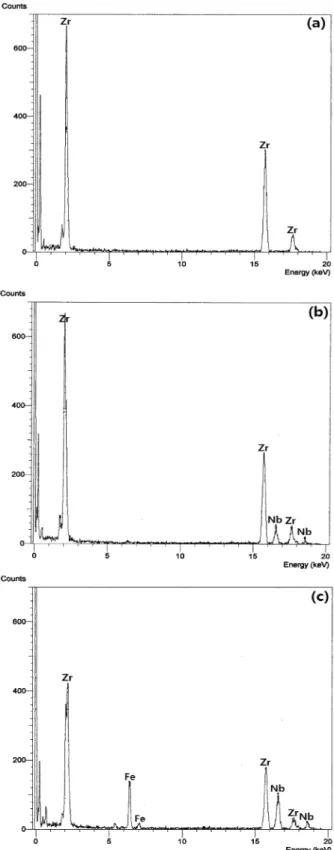
display any peak from sulfur containing compounds such as iron sulfide, zirconium sulfide and niobium sulfide, which is likely due to the low sulfur. Fig. 3(a), 3(b) and 3(c) show the EDS spectra from Zr matrix (a) rod-shaped particle (b) and round particles (c). EDS analysis revealed that small round particles in Fig. 1 are Fe containing intermetallics and rod-shaped particles are β-Nb.
13)The increase of strength with sulfur addition may be linked to the increase of the solution strengthening of sulfur and dislocation density. The increase of dislocation density can be caused by either the increase of statistically stored dislocation due to a lower recovery rate or that of geometrically necessary dislocation due to the presence of large particles. Since the population of intermetallic par- ticles is not much influenced by the addition of sulfur, the increase of dislocation density with a higher sulfurcontent can be associated with the increase of statistically stored dislocation due to a lower recovery rate. The recovery rate is dependent on the alloying content since the alloying content influence the stacking fault energy and cross slip and climb of dislocations are influenced by the stacking fault energy.
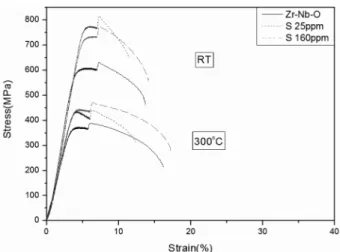
The stress strain responses of cold-rolled Zr-1.5Nb-O without and with sulfur contents (25 ppm and 160 ppm) at room temperature and 300
oC are shown in Fig. 4. The flow stress of cold-rolled Zr-1.5Nb-O increased by ~135 MPa at room temperature with the addition of 25 ppm sulfur. With further increase of sulfur content up to 160 ppm, a slight increase of the flow stress was observed. In the cold rolled Zr-1.5Nb-O and Zr-1.5Nb-O-S alloys, flow softening is dominant after the peak stress. The high strength and the dominant flow softening after initial brief strengthening reflect the higher stored cold work during
the thermo-mechanical processing. No yield drops were observed in the cold rolled alloys because the substructure strengthening due to the high dislocation density is far
Fig. 2. X-ray diffraction pattern analysis on Zr-1.5Nb-O and Zr-1.5Nb-O-S did not display any peak from sulfur containing compounds such as iron sulfide, zirconium sulfide and niobium sulfide.
Fig. 3. EDS spectra from Zr matrix (a), rod-shaped particle (b) and round particles (c). EDS analysis revealed that small round particles are Fe containing intermetallics and rod-shaped particles are β-Nb.
greater than the dynamic strain aging effect. The room temperature yield strength of Zr-1.5Nb-O (570 MPa) was observed to be lower than that of Zr-1Nb-1Sn-0.1Fe (710 MPa), a commercially available nuclear cladding alloy, but the yield strengths of Zr-1.5Nb-O-S alloy with 160 ppm sulfur (740 MPa) were higher than that of Zr-1Nb- 1Sn-0.1Fe alloy (730 MPa), achieving higher strength than Zr-1Nb-1Sn-0.1Fe alloy even after the elimination of Sn, an effective solution hardening alloying element. The duc- tility of Zr-1.5Nb-O-S was found to be higher compared to that of commercially available Zr-1Nb-1Sn-0.1Fe. At 300
oC, the flow stress also increased, but by a smaller amount
~90 MPa with the addition of 25 ppm sulphur and no appreciable change of the flow stress was observed with further increase of sulphur. The ductility did not increase appreciably up to 300
oC because of the dynamic strain aging at 200~400
oC and began to increase rapidly above 400
oC.
Strain rate jump tests were performed to investigate the effect of strain rate in the cold rolled Zr-1.5Nb-O and Zr- 1.5Nb-O-S alloys and stress-strain behaviors in strain jump tests are exhibited in Fig. 5. In the cold rolled Zr-1.5Nb-O- S, stress jumps were observed during the strain rate jump from 10
−4/sec to 10
−2/sec. The activation volume for plastic
flow was measured by analyzing the transient behaviors during the jump tests and the effect of sulfur on the activation volume for deformation of Zr-1.5Nb-O alloys was examined. The activation volume V* associated with the deformation process has been obtained from the following equation:
14)(1) where k is the Boltzmann constant, is the shear strain rate, σ
1and σ
2are the applied shear stresses at the normal strain rates and and T is the absolute temperature.
The shear stress τ was calculated from the normal flow stress σ, using the relation τ = σ/m, where m is the Taylor factor. According to Luton and Jonas, m is assumed to be equal to 4.
15)The activation volume and the strain rate sensitivity for the cold rolled Zr-Nb-O and Zr-Nb-O-S alloys are summarized in Table 2. The activation volume, V*, decreased slightly with the increase of sulfur content at room temperature and 300
oC.
The sulphur strengthening may arise from the disturbing effects on dislocation motion. The most important factors affecting dislocation motion in solution are the size factor,
V∗ = kT ∂ γln *⁄∂τ nk = ln(ε*1⁄ε*2) σ⁄( 1–σ2) γ*
ε*1 ε*2 Fig. 4. Stress strain responses of cold rolled Zr-1.5Nb-O, Zr-1.5Nb-
O-25 ppm S, Zr-1.5Nb-O-160 ppm S and Zr-1.0Nb-O at the strain rate of 1× 10⁻⁴/sec at room temperature and 300oC.
Fig. 5. Stress strain responses during the strain rate jump from 1× 10⁻⁴/sec to 1× 10⁻²/sec in the cold rolled Zr-1.5Nb-O and Zr- 1.5Nb-O-S alloys at the strain rate of 1× 10⁻⁴/sec at room temperature and 300oC.
Table 2. Activation volume and strain rate sensitivity of Zr-1.5Nb-O and Zr-1.5Nb-O-P alloys at room temperature and 300oC.
Heat treatment Alloy Composition RT 300oC
m V* m V*
Annealed
Zr-1.5Nb-O 0.0204 65 b3 0.0185 266b3
Zr-1.5Nb-O-25ppm S 0.0204 60 b3 0.0187 252b3
Zr-1.5Nb-O-160ppm S 0.0214 47 b3 0.0254 156b3
Cold-Rolled
Zr-1.5Nb-O 0.0106 78 b3 0.0145 182b3
Zr-1.5Nb-O-20ppm S 0.0109 58 b3 0.0168 141b3
Zr-1.5Nb-O-160ppm S 0.0106 52 b3 0.0149 147b3
the modulus factor and the electronic factor.
16,17)Morinaga and Kamado
18)found that both solution hardening and precipitation hardening can best be predicted by the size difference and the electronegativity difference between the matrix and solute atoms. One interesting observation is that the strengthening effect of sulphur and oxygen are interdependent and sulphur amplified the strengthening effect of oxygen
Some solute atoms such as Si and Al are known to
amplify the dynamic strain aging effect due to interstitial atoms including oxygen in Ti alloys by enhancing the lattice distortion although they cannot cause the dynamic strain aging directly at intermediate temperatures.
19,20)Ferrer et al.
6)observed that sulphur amplified many dynamic strain aging effects reputed to be due to oxygen, the yield stress plateau, the strain rate sensitivity and ductility minimum, and the static aging peak. Despite the observations in- dicative of the amplication effect of sulfur on the dynamic
Fig. 6. Fracture surfaces of Zr-1.5Nb-O (a, d), Zr-1.5Nb-O-25 ppm S (b. e) and Zr-1.5Nb-O-160 ppm S (c. f) after tensile testing at room temperature (a, b, c) and 300oC (d, e, f) are displayed in Fig. 6 (a-f).
The segregation of sulphur atoms in addition to oxygen atoms
21,22)could decrease the activation volume by limiting the length of the activated bulge and enhance the strengthening effect. Insensitivity of the activation volume to the dislocation density and the decrease of the activa- tion volume at a higher temperature where the dynamic strain aging occurs support the suggestion linking the activation volume with the activated bulge of dislocations limited by segregation of oxygen and sulphur atoms.
Dislocations can collect a significant number of solute atoms from its surroundings after being stopped by forest dislocations
9,21)even at low temperatures.
Ferrer et al.
6)suggested that sulphur segregation at dislocation core could modify the core structure of dis- locations, which would affect most of the dislocation properties including Peierls friction, cross slip, pipe diffu- sion and interaction with other impurities. However, for the modification of dislocation cores by sulphur to be an operative strengthening mechanism, the dislocation cores should be modified over a reasonable length of dislocations with the modified core structure maintained while they are in motion during deformation. It is questionable if the mobility of sulphur atoms is high enough to keep up with moving dislocations to maintain the modified dislocation core structure during deformation. In Ferrer’s model, if the dislocations are liberated from the segregated sulphur atoms, the modified core structure would return to its original structure and the Peierls friction may not be appreciable. Chang and Hong
7)suggested that the rate- controlling mechanism for the deformation of Zr-1.5Nb-O and Zr-1.5Nb-O-S alloys can best be explained by the dislocation interaction mechanism in which the segregation of alloying elements which affects the activation length of dislocations.
9)The strengthening due to sulfur may arise from the disturbing effects of solute atoms on dislocation motion.
The most important factors affecting dislocation motion in solution solution are the size factor, the modulus factor and the electronic factor.
16,17)Morinaga and Kamado
18)25 ppm S (b. e) and Zr-1.5Nb-O-160 ppm S (c. f) after tensile testing at room temperature (a, b, c) and 300
oC are displayed in Fig. 6 (a-f). All alloys exhibited ductile frac- ture surfaces and no groove- or cleavage-like features
11)were observed, suggesting no significant detrimental effect of sulfur in fracture of Zr-Nb-O alloys. Fig. 4(d) shows the fracture surface of Zr-Nb-O-160 ppm S at 300
oC and no secondary cracks were observed. The similar ductile fracture surfaces were observed at 300
oC for Zr-Nb and Zr- Nb-20 ppm S. The absence of groove- or cleavage-like features on the fracture surface is compatible with the observation that Zr-Nb alloys with 20 ppm phosphorous addition have no sulfide particles which may act as fracture paths as in Ti alloys.
24)In Fig. 7, the oxidation behavior of Zr-1.5Nb-O, Zr- 1.5Nb-O-25 ppm S and Zr-1.5Nb-O-160 ppm S at 300
oC in air are shown. The weight gain due to oxide formation was observed to decrease with the addition of sulfur.
Charquet
11)found that the addition of even small amount of sulfur markedly improve the steam corrosion resistance, particularly in the range between 2 and 200 ppm. The
Fig. 7. The oxidation behavior of (a) Zr-1.5Nb-O, (b) Zr-1.5Nb-O- 25 ppm S and (c) Zr-1.5Nb-O-160 ppm S in air at 300oC.
beneficial influence of the sulfur content was observed whatever its metallurgical state: in solid solution and mainly as sulfides. When there were sulfides the key factor is probably the volume fraction of precipitates. However, the reason for the beneficial influence of sulfur was not understood, yet. The sulfur may influence the phase and structural stability of oxide, which remains to be solved in the future work.
25)4. Conclusion
On the basis of the investigation of mechanical and oxidation properties of Zr-1.5Nb-O-S alloys, the follow- ing conclusions can be drawn:
1. The yield strengths of Zr-1.5Nb-O-S alloy with 160 ppm sulfur (740 MPa) were higher than that of Zr- 1Nb-1Sn-0.1Fe alloy (730 MPa), achieving higher strength than Zr-1Nb-1Sn-0.1Fe alloy even after the elimination of Sn, an effective solution hardening alloying element. The ductility of Zr-1.5Nb-O-S was found to be higher compared to that of commercially available Zr-1Nb-1Sn-0.1Fe.
2. The beneficial effect of sulfur on the strengthening was observed in the cold rolled Zr-1.5Nb-O-S alloys over the wide temperature range from room temperature up to 300
oC in the cold rolled Zr-1.5Nb-O-S.
3. The dynamic strain aging effect in the cold rolled Zr-1.5Nb-O-S is less clear because the strengthening due to the dynamic interaction between oxygen/sulphur atoms and dislocation is relatively small compared to the substructure strengthening due to the high dislocation density stored during cold rolling. The detrimental effect of phosphorous on the ductility in the cold rolled Zr- 1.5Nb-O-S is less pronounced.
4. The activation volumes, V*, for the cold rolled Zr- 1.5Nb decreased slightly with the increase of sulphur content at room temperature and 300
oC. The rate-con- trolling mechanism of the deformation can be explained by the dislocation interaction mechanism in which the seg- regation of oxygen and sulphur atoms affects the activation length of dislocations.
5. Fracture surfaces of Zr-1.5Nb-O and Zr-1.5Nb-O-S alloys exhibited ductile fracture and no groove- or cleavage-like features were observed, suggesting no significant detrimental effect of sulfur in fracture of Zr- 1.5Nb-O alloys.
6. The weight gain due to oxide formation was observed to decrease with the addition of sulfur. In compatible with the observation of Charquet that the addition of even small amount of sulfur markedly improve the steam corrosion re- sistance, particularly in the range between 2 and 200 ppm.
Acknowledgements
This research was supported by Basic Atomic Energy Research Institute Program through the National Research Foundation of Korea (NRF) funded by the Ministry of Education, Science and Technology (2009-0075917).
References
1. J. A. L. Robertson, J. Nucl. Mater., 100, 108 (1981).
2. E. Tenckhoff and P. L. Rittenhouse, J. Nucl. Mater., 35, 14 (1970).
3. E. F Ibrahim, R. Choubey and J. J. Jonas, J. Nucl. Mater., 126, 44 (1984).
4. R. A. Holt, J. Nucl. Mater., 159, 310 (1988).
5. W. Liu, Q. Li, B. Zhou, Q. Yan and M. Yao, J. Nucl.
Mater., 341, 97 (2005).
6. D. Charquet, J. Senevat and J. P. Marcon, J. Nucl. Mater., 255, 78 (1998).
7. K. I. Chang and S. I. Hong, J. Nucl. Mater., 373, 16 (2008).
8. A. J. Stewart and M.W. Schmidt, Geophys. Res. Lett., 34, L13201 (2007).
9. D. Bika and C. J. McMahon Jr., Acta Metall. Mater., 43, 1909 (1995).
10. R. Wu, A. J. Freeman and G. B. Olson, Science, 265, 376 (1994).
11. D. Charquet, J. Nucl. Mater., 304, 246 (2002).
12. F. Ferrer, A. Barbu, T. Bretheau, J. Crepin, F. Willaime and D. Charquet, p. 863, Thirteenth International Symposium on Zirconium in the Nuclear Industry, ASTM STP 1423, ASTM International, West Conshohocken, USA (2002).
13. S. Ko, S. I. Hong and K. T. Kim, J. Nucl. Mater., 404, 154 (2010)
14. H. Conrad, J. Met., 16, 582 (1964).
15. M. J. Luton and J. J. Jonas, Can. Metall. Q., 11, 79 (1972).
16. R. L. Fleisgher, Acta Metall., 11, 203 (1963).
17. R. L. Fleisgher, Acta Metall., 9, 996 (1961).
18. M. Morinaga and S. Kamado, Model. Simulat. Mater. Sci.
Eng., 1, 151 (1993).
19. S. I. Hong, W. S. Ryu and C. S. Rim, J. Nucl. Mater., 116, 314 (1983).
20. S. I. Hong, Mater. Sci. Eng., 64, L19 (1984).
21. Z. S. Basinski, R. A. Foxall and R. Pascual, Scripta Metall., 6, 807 (1972).
22. S. I. Hong and C. Laird, Acta Metall. Mater., 38, 1581 (1990).
23. S. Ege, Organic Chemistry, 5th ed., p.27, Houghton Miffin Harcourt, Boston, USA (2003).
24. D. Hu, A. J. Huang, X. P. Song and X. Wu, J. Alloy Comp., 413, 77 (2006).
25. S. M. Seo, K. S. Lee and K. A. Lee, Kor. J. Mater. Res., 14(3), 163 (2004) (in Korean).