Optimal Current Control Method of BLDC Motor Utilizing Maximum Torque Point
Chang-Seok Park1, Jung-Hoon Jang2, Tae-Uk Jung3*
<Abstract>
This paper proposes an optimal current control method for improving efficiency of Brushless Direct Current (BLDC) motor. The proposed optimal current control method is based on the maximum torque point analysis of Finite Element Analysis (FEA). The proposed method can increase the effective voltage at the maximum torque point of BLDC motor and increase the output torque per unit current to increase the efficiency.
In order to verify the proposed optimal current control method, have developed the prototype of a 50 [W] class motor drive and experimented by 20 [W] motor using the dynamometer set. This was verified.
Keywords : Brushless direct current (BLDC) motor, optimal current control, maximum torque point
1 Dept. of advanced engineering, Phd. Course, Graduate school Kyungnam University.
2 Dept. of advanced engineering, M.S. Course, Graduate school Kyungnam University.
3* Corresponding author, Professor Dept. of Electrical engineering of Kyungnam University.
(E-mail: [email protected])
1. Introduction
Brushless direct current (BLDC) motors have a higher efficiency than the DC motors and induction motors because of the high torque and high power density.
BLDC motors are also easy to control speed and variable speed. Since there is no brush and it can be used semi-permanently, DC motors and induction motors are being replaced.
Generally, the BLDC motor control methods can be divided into PMSM (Permanent Magnet Synchronous Motor) and BLDCM (Brushless Direct Current Motor) by the Back Electromotive Force (Back-EMF) waveform.
PMSM are sinusoidal with back-EMF and 3-phase 3-excitation operation to control current with sinusoidal waveforms. There are required to detect the position of the continuous rotor in order to drive the motor in a stable manner. BLDCM are square waveform with back-EMF. The 3-phase 2-excitation operation is performed to control the current with a square waveform, and the rotor position is detected and controlled every 60 degrees of the electrical angle.
BLDCM have 3-phase 2-excitation operation, and the motor utilization ratio is 66.7 [%], which is smaller than that of PMSM.
Therefore, the 3-phase 2-excitation operation at the same torque output requires more phase current than the 3-phase 3-excitation operation. As a result, the maximum output becomes smaller. However, BLDC motors are
widely used because they have simpler drive structure than PMSM and are relatively easy to control, making it suitable for small BLDC motors [1-3].
In this paper, the optimal current control method is proposed based on maximum torque point analysis. In order to improve efficiency of BLDC motors, it is necessary for improved efficiency of BLDC motor control methods have been studied for improved efficiency of BLDC motors [4-10]. As compared to the conventional methods, the advantage of the proposed method is to increase the effective voltage applied to the maximum torque point based on the Finite Element Analysis (FEA). Therefore, it can improve the efficiency by increasing the output torque per unit current.
To verify of the proposed optimal current control method, developed the prototype of a 50 [W] class drive and experimented it by motor dynamometer set.
2. Maximum torque of BLDC motor
The proposed optimal current control method increases the effective voltage applied to utilize the maximum torque per ampere (MTPA) when the rotor of the motor is located at the maximum torque point. The current can rise quickly and the output torque can be increased.
Generally, the force generated when a rotor is placed in a magnetic field through
which an arbitrary stator flux flows can be expressed by the following (1).
× (1)
Where, is the magnetic flux density of the rotor, is the magnetic flux density of the stator, is the stacking length of the rotor.
Therefore, the generated torque is calculated as shown in (2).
(2)
Where, is radius of the rotor, is the angle between and .
The point where the maximum torque is generated by (2) is where the rotor flux and composite magnetic flux form sin90[°]. At this time, The rotor position angle is derived
from flux vector and Finite Element Analysis (FEA).
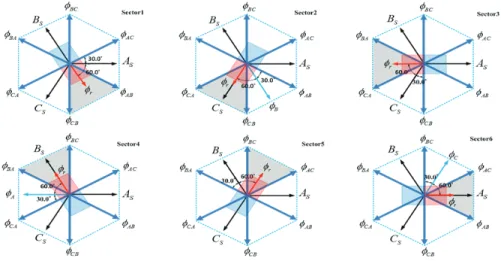
Figure 1 shows a vector diagram of rotor flux and stator flux. As shown figure 1, The maximum torque point is the point at which the rotor flux vector and , the composite flux vector of and , form 90 degrees. Atthistime, the position angle of the rotor flux vector is 60 degrees.
Figure 2 shows the maximum torque vector of the rotor flux and the stator flux of each BLDC motor. The maximum torque
C
r
AC
r
BS
CS
AS AS
BS
CS
r
r
AC
C
AS
CS
BS
r
C
AC
r
Fig. 1 Vector diagram of rotor flux and stator flux
Fig. 2 Maximum torque vector for each section of BLDC motor
point is the point at which the rotor flux vector and , the composite flux vector of and , form 90 degrees. At this time, the position angle of the rotor flux vector is 60 degrees, and the maximum torque point of each section occurs at intervals of 60 degrees.
3. Maximum torque analysis
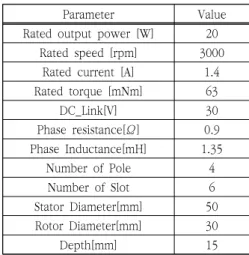
FEA is performed by 2D modeling of BLDC motor based on analysis using a flux vector diagram. Figure 3 shows a BLDC motor FEA model. And The parameters of the motor are shown in TABLE 1. The maximum torque point of each section is derived through FEA of BLDC motor. In order to analyze the torque characteristics of each section, divided into 6 sections by a flux vector diagram of the BLDC motor.
Fig. 3 BLDC motor FEA model (4 pole 6 slot)
Parameter Value
Rated output power [W] 20 Rated speed [rpm] 3000
Rated current [A] 1.4 Rated torque [mNm] 63
DC_Link[V] 30
Phase resistance[Ω] 0.9 Phase Inductance[mH] 1.35
Number of Pole 4
Number of Slot 6
Stator Diameter[mm] 50 Rotor Diameter[mm] 30
Depth[mm] 15
Table 1 Parameters of BLDC motor
As a result, it was found that the maximum torque was generated at about 30 degrees at the machine angle and about 60 degrees at the electrical angle. Also, it can be seen that the maximum torque is generated at equal intervals in each of the section according to rotor position. Figure 4 shows the torque generation ratio according to rotor position.
Fig. 4 Torque generation ratio according to rotor position (4 pole 6 slot)
4. Proposed optimal current control method
The optimal current control method increases the effective voltage applied to the maximum torque point. Through this optimal current method, increasing the effective voltage when the rotor of the motor is located at the maximum torque point, the current can rise quickly and the output torque can be increased.
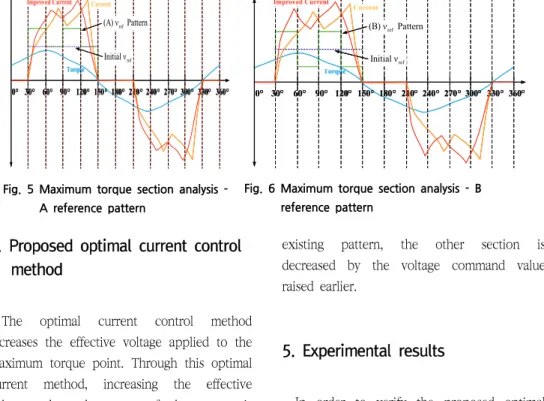
Figure 5 and 6 shows the analysis of the maximum torque operating range. The control methods are divided into A and B patterns.
The A reference pattern in Figure 5 indicates that the voltage command value rises only at the maximum torque points and the other points keep the voltage command value. The B reference pattern in Figure 6 raises the voltage command value at the maximum torque point in the same way as the A reference pattern. However, in order to keep the average voltage equal to the
existing pattern, the other section is decreased by the voltage command value raised earlier.
5. Experimental results
In order to verify the proposed optimal current control method, 20 [W] BLDC motor and motor drive were experimented extensively with dynamometer load. Figure 7 shows the experimental system configuration of the BLDC motor drive.
Fig. 7 Experimental system configuration of BLDC motor drive
(A) ν Patternref
Initial νref
(A) ν Patternref
Initial νref
Fig. 5 Maximum torque section analysis - A reference pattern
Initial νref
(B) νrefPattern
Fig. 6 Maximum torque section analysis - B reference pattern
Figure 8 to 12 below show characteristic waveform when operating under rated load.
Figure 8 shows the waveform of conventional BLDC control. As shown current waveform, the peak current value is 1.057 [A].
Figure 9 shows that the variable duty is increased by 5 [%] only at the maximum torque point. As shown current waveform, the peak current value is 1.05 [A].
Figure 10 shows the waveform when the variable duty is increased 10 [%] only at the maximum torque point. As shown current waveform, the peak current value is 1.049 [A].
Figure 11 shows the shows the waveform when the variable duty is increased by 5 [%]
at the maximum torque point and by 5 [%]
decrease at the other section. As shown current waveform, the peak current value is 1.042 [A].
Figure 12 shows the waveform when the variable duty is increased by 10 [%] at the maximum torque point and by 10 [%]
decrease at the other section. As shown current waveform, the peak current value is 1.04 [A].
Therefore, under the same output power condition, it is the highest efficiency when Fig. 8 Characteristic waveforms at rated load
operation when conventional BLDC control
Fig. 9 Characteristic waveforms at rated load operation when variable duty is increased by 5 [%]
Fig. 10 Characteristic waveforms at rated load operation when variable duty is increased by 10 [%]
Fig. 11 Characteristic waveforms at rated load operation when variable duty is increased by 5 [%] and by 5 [%]
decrease
the variable duty is increased by 10 [%] at the maximum torque point and 10 [%]
decrease at the other section. Because the input power is reduced due to the input current value is the smallest.
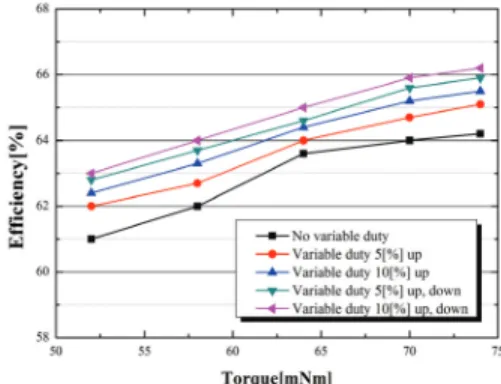
Figure 13 shows the efficiency curve according to the variable duty. The results of the experiment are shown in TABLE 2.
Under the same output power condition, Experimental results show that the efficiency is improved by 1.3 [%] when the variable duty is increased by 10 [%] at the maximum torque point and decrease by 10 [%] decrease at the other section.
6. Conclusions
This paper proposed an optimal current control method for improving the efficiency of BLDC motors. The maximum torque points were derived by using the FEA and flux vector analysis of the BLDC motor. And
maximum torque point per ampere was increased by varying the applied effective voltage reference value using the proposed method.
The feasibility of the proposed method was verified through experiments of 50 [W] class motor drive and 20 [W] BLDC motor. The proposed optimal current control method is expected to be applied to small size BLDC motor drive which have economical and similar capacity that do not require additional hardware.
References
[1] Mei Ying, Pan Zaiping, “A Novel Starting Method of Sensorless BLDC Motor for Electric Vehicles,” International Conference on Electrical and Control Engineering, pp. 3212-3215, Jul.
2010.
[2] Pillai, N.S, Vipin, A.M, Radhakrishnan, R,
“Analysis and simulation studies for position sensorless BLDC motor drive with initial rotor positionestimation,” International Conference on Fig. 12 Characteristic waveforms at rated
load operation when variable duty is increased by 10 [%] and by 10 [%]
decrease Fig. 13 Efficiency curve
Nascent Technologies in the Engineering Field (ICNTE), pp. 1-6, Jan. 2015.
[3] Jianwen Shao, Nolan, D, Hopkins, T, “Improved direct back EMF detection for sensorless brushless DC (BLDC) motor drives,” Applied Power Electronics Conference and Exposition, vol. 1, pp. 300-305, Feb. 2003.
[4] S. K. Safi, P. P. Acarnley and A. G. Jack,
“Analysis and simulation of the high-speed torque performance of brushless DC motor drives”, IEE Proc.-Electr. Power Appl., Vol.
142, No. 3, May 1995.
[5] C. C. Chan, J. Z. Jiang, W. Xia and K. T.
Chau, “Novel Wide Range Speed Control of Permanent Magnet Brushless Motor Drives”, PEDS’95, Feb. 1995.
[6] J. H. Choi, J. S. Park, J. H. Kim and I. S.
Jung, “Conrol Scheme for Efficiency Improvement of slim type BLDC Motor”, ISLPED ‘14, pp.
820-824 Aug. 2014.
[7] W. S. Im, J. P. Kim, J. M. Kim and K. R.
Baek, “Torque Maximization Control of 3-Phase BLDC Motors in the High Speed Region”, JPE, Vol. 10, No. 6, pp. 717-723, Oct. 2009.
[8] B. G. Gu, J. H. Choi and I. S. Jung, “Simple Lead Angle Adjustment Method for Brushless DC Motors”, JPE, Vol 14, No. 3, pp. 541-548, Dec. 2013.
[9] C. G. Kim, J. H. Lee, H. W. Kim and M. J.
Youn, “Study on maximum torque generation for sensorless controlled brushless DC motor with trapezoidal back EMF” IEE Proc.-Electr.
Power Appl., Vol. 152, No. 2, March 2005.
[10] J. J. Moon, W. S. Im and J. M. Kim, “Novel Phase Advance Method of BLDC motors for wide range speed operations”, APEC’13, pp.
2343-2348, May. 2013.
(Manuscript received May 16, 2017; revised June 5, 2017;
accepted June 12, 2017.)