• 검색 결과가 없습니다.

Combustion characteristics of diesel engine with bio-ethanol blend fuel

N/A
N/A
Protected

Academic year: 2021

Share "Combustion characteristics of diesel engine with bio-ethanol blend fuel"

Copied!
8
0
0

로드 중.... (전체 텍스트 보기)

전체 글

(1)

(CO

2

)

, .

(carbon neutral) .

,

. J. Kor. Soc. Fish. Tech., 45(2), 114 121, 2009

DOI:10.3796/KSFT.2009.45.2.114

Combustion characteristics of diesel engine with bio-ethanol blend fuel

Suk-Ho J UNG *

Department of research and development, DAIHATSU DIESEL MFG. CO. LTD, Shiga-Pref., 524-0044, Japan

There are increased in using the bio-ethanol, as the carbon neutral attracts many researchers due to a reduction in carbon dioxide spotted as the global warming gas. A gasoline engine with 100% of the bio- ethanol was developed and used in Brazil already, but researches of using the bio-ethanol in diesel engines are lack. In this study, combustion tests with blend fuel of the gas oil and bio ethanol by 50% maximally due to a low cetane number of bio-ethanol were accomplished as a basic study of introduction of using the bio- ethanol in diesel engines. The result was that smoke emission was decreased with increase in proportion of the bio-ethanol, due to the increase of a amount of pre-mixed combustion with ignition delay. Although the amount of CO

2

is reduced according as the bio-ethanol is used(carbon neutral), the emission of CO

2

with increase in the proportion of the bio-ethanol was more increased due to lower a heat value of bio-ethanol than gas oil.

Key words : Bio-Ethanol, Ignition delay, Smoke reduction, Amount of premixed combustion

* Corresponding author: [email protected], Tel: 81-70-5502-2315, Fax: 81-77-583-6417

(2)

, 2005 .

, ,

. ,

. ,

5200(l/ha), 3900(l/ha),

2900(l/ha), 2100(l/ha) ,

, , ,

, 340(l/t) 300(l/t)

OSEI (2008) .

2006 1838( kl), 158( kl),

1800( kl) ,

375( kl), 220( kl) .

.

3 10%

.

10%

.

85% ,

, 100%

FFV (Flexible Fuel Vehicle) .

,

,

.

. ,

.

Ahmed (2001), Hahn-Hägerdal et al.(2006), Hansen et al.(2005), Kwanchareon et al.(2007), Mohammadi et al.(2005), Yamada et al.(2005)

20%

.

.

50%

, . ,

.

10% .

. Miwa et al.(1988)

.

(

99.9%) . ,

JIS 2 ,

99.5% .

10, 20, 25, 30, 50 60%

,

, 1

. EtOH

.

EtOH60

(3)

.

99.0%

99.5% (4%)

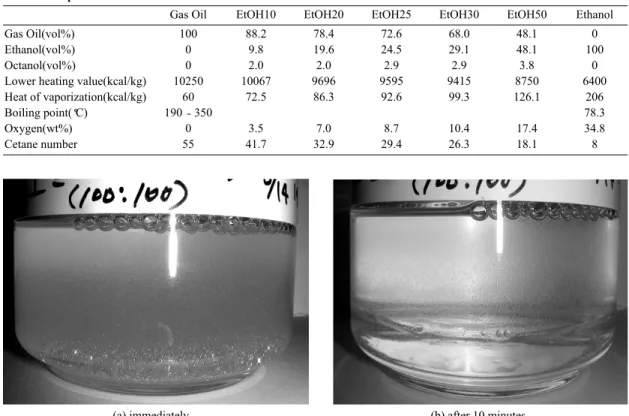
Fig. 1

. Fig. 1 (a)

Fig.

1 (b) Table 1. Properties of tested fuels.

Gas Oil EtOH10 EtOH20 EtOH25 EtOH30 EtOH50 Ethanol

100 0 0 10250

60 190 350

0 55

88.2 9.8 2.0 10067

72.5

3.5 41.7

78.4 19.6 2.0 9696

86.3

7.0 32.9

72.6 24.5 2.9 9595

92.6

8.7 29.4

68.0 29.1 2.9 9415 99.3

10.4 26.3

48.1 48.1 3.8 8750 126.1

17.4 18.1

0 100

0 6400

206 78.3 34.8 8 Gas Oil(vol%)

Ethanol(vol%) Octanol(vol%)

Lower heating value(kcal/kg) Heat of vaporization(kcal/kg) Boiling point( C)

Oxygen(wt%) Cetane number

(a) immediately. (b) after 10 minutes.

Fig. 1. Failing forms of gas oil-ethanol blend fuels due to small amount of octanol (EtOH50).

(a) EtOH30. (b) EtOH50.

Fig. 2. Forms of gas oil-ethanol blend fuels.

(4)

. Fig. 2

30% 50%

.

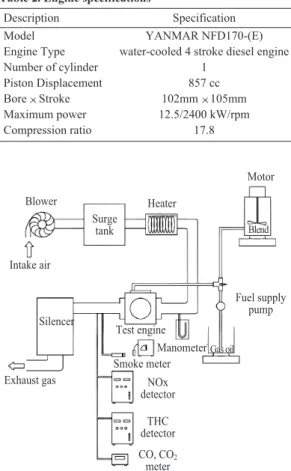
, YANMAR NFD170 (E)

. 2

. 102(mm)

105(mm) 857(cc) ,

2400(rpm) 12.5 (kW), 17.8 .

Fig. 3 .

1,200 5(rpm) ,

,

60 0.5( C) .

, . ,

10 .

, 4 CA BTDC .

0.25 , 350 ,

. NOx

(CLD) NOx (

ECL 77 ) , THC

(FID) THC (

EHF 710H ) 10

. .

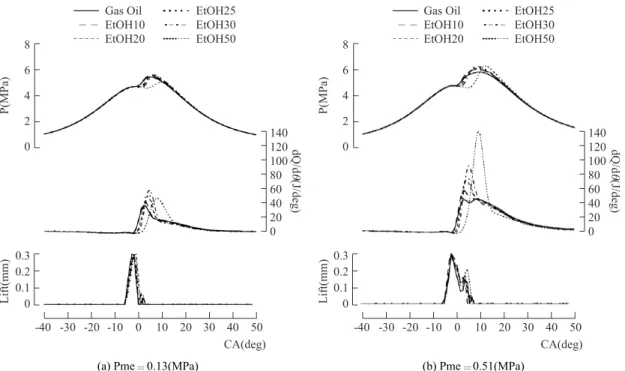
Fig. 4

. Fig. 4 (a)

Pme=0.13(MPa) ,

Fig. 4 (b) Pme 0.51

(MPa) .

CA , P, dQ/d θ, Lift

, ,

.

,

. ,

.

.

. , 50%

Fig. 3. Schematic diagram of system for experiment.

Motor Heater

Test engine

Gas oil Blend

Manometer Smoke meter

detector NOx

detector THC

CO, CO

2

meter Blower

Intake air

Exhaust gas

Fuel supply pump Surge

tank

Silencer

Table 2. Engine specifications

Description Specification

Model YANMAR NFD170-(E)

Engine Type water-cooled 4 stroke diesel engine

Number of cylinder 1

Piston Displacement 857 cc

Bore Stroke 102mm 105mm

Maximum power 12.5/2400 kW/rpm

Compression ratio 17.8

(5)

, 60%

.

140(J/deg

CA)

. Fig. 5

. ,

1 CA ,

4 CA .

,

.

. , 1

75% 4 CA

.

.

(a) Pme 0.13(MPa) (b) Pme 0.51(MPa)

Fig. 4. Change in combustion history due to blend ratio of ethanol/gas-oil (T

IN

60( C), θ

inj

4 BTDC).

Gas Oil EtOH10 EtOH20

EtOH25 EtOH30 EtOH50

Gas Oil EtOH10 EtOH20

CA(deg) CA(deg)

EtOH25 EtOH30 EtOH50

P(MPa) dQ/d θ(J/deg)

Lift(mm) P(MPa) Lift(mm)

8 6 4 2 0

140 120 100 80 60 40 20 0

dQ/d θ(J/deg)

140 120 100 80 60 40 20 0

-40 -30 -20 -10 0 10 20 30 40 50 -40 -30 -20 -10 0 10 20 30 40 50 0.3

0.2 0.1 0

8 6 4 2 0

0.3 0.2 0.1 0

Fig. 5. Change in ignition delay due to blend ratio of ethanol/gas-oil.

10

8

6

4

2

0 0 10 20 30 40 50 60

lgnition delay(deg CA)

EtOH blend ratio(vol.%)

Pme 0.13(MPa)

Pme 0.26(MPa)

Pme 0.39(MPa)

Pme 0.51(MPa)

(6)

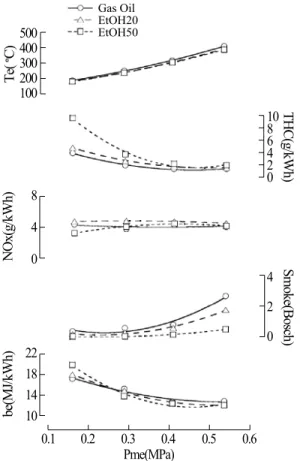
Fig. 6 0, 20, 50%

. Te, THC, NOx, Smoke be

, ,

, .

. THC

. THC

. , NOx

.

90% .

Fig. 7

.

,

50% 80% .

Fig. 6. Change in exhaust emissions and fuel consumption ratio due to blend ratio of ethanol/gas-oil.

500 400 300 200 100

10 8 6 4 2 0

0.1 0.2 0.3 0.4 0.5 0.6 Pme(MPa)

Gas Oil EtOH20 EtOH50

Te( C)

8 4 NOx(g/kWh) 0

22 18 14

be(MJ/kWh) 10 THC(g/kWh)

4 2 0

Smoke(Bosch)

Fig. 8. Relationship between decrement of smoke emission and amount of premixed combustion.

10 8 6 4 2

0 0 20 40 60 80 100

Smoke decrement(%)

Amount of premixed combustion(vol.%) Pme 0.13(MPa)

Pme 0.26(MPa) Pme 0.39(MPa) Pme 0.51(MPa)

Fig. 7. Relationship between decrement of smoke emission and blend ratio of ethanol/gas-oil.

10 8 6 4 2

0 0 20 40 60 80 100

Smoke decrement(%)

EtOH blend ratio(vol.%)

Pme 0.13(MPa)

Pme 0.26(MPa)

Pme 0.39(MPa)

Pme 0.51(MPa)

(7)

. . Fig. 8

.

,

.

.

,

. Fig. 9

. .

. 170

H/C 1.8 C

11

H

19.8

,

C

2

H

6

O, . C be [(1 W

EtOH

) C

GO

W

EtOH

C

EtOH

]

(g/kWh) (1)

, C , be

(g/kWh), C

GO

1g ,

C

EtOH

1g , W

EtOH

.

. OSEI et al.(2008)

0 ,

.

.

50% ,

,

50%

.

.

90%

.

.

,

.

. Fig. 9. Total carbon weight estimated with fuel con-

sumption.

300

250

200

150

100

0 0.1 0.2 0.3 0.4 0.5 0.6

Carbon weight(g/kWh)

Pme(MPa)

EtOH0

EtOH20

EtOH50

(8)

Ahmed, I., 2001, Oxygenated diesel: Emission and performance characteristics of ethanol-eiesel blends in CI engine. SAE 2001-01- 2475. pp. 6.

Hahn-Hägerdal, B., M. Galbe, M.F. Gorwa-Grauslund, G. Lidén and G. Zacchi, 2006. Review : Bio- ethanol-the fuel of tomorrow from the resicues of today. TRENDS in Biotechnology, 24(12), 549 556.

Hansen, A.C., Q. Zhang and P.W.L. Lyne, 2005. Ethanol- diesel fuel blends-a review. Bioresource Technology. Vol. 96, 277 285.

Kwanchareon, P., A. Luengnaruemitchai and S. Jai-In, 2007. Solubility of a diesel-biodiesel-ethanol blend, its fuel properties, and its emission characteristics from diesel engine. Fuel, Vol. 86, 1053 1061.

Miwa, K., T. Wakabayashi, T. Ohsawa and M. Ikegami,

1988. Combustion and performance of a diesel engine with ethanol-gas oil blends. International Symposium on Alcohol Fuels, Vol. 8. 595 600.

Mohammadi, A., T. Ishiyama, S.S. Kee, N. Horibe and T.

Kakuta, 2005. Improvement in exhaust emissions from a diesel engine utilizing ethanol blended fuel.

JSME Series B, Vol. 71, No. 706, 1715 1722.

OSEI, S., 2008. The spearhead of bio ethanol-revised edition. Kogyo Chosakai Publishing Inc. of Japan.

pp. 4 37.

Yamada, T., J. Kawashima, N. Miyamoto and T.

Murayama, 2005. A Study on diesel engines with alcohol fuels(Solubility and combustion characteristic with ethanol-Heavy oil fuel blends). JSME Series B, Vol. 49, No. 441, 1087 1094.

2009 5 8

2009 5 15 1

2009 5 15

수치

Fig. 1. Failing forms of gas oil-ethanol blend fuels due to small amount of octanol (EtOH50).
Fig. 3. Schematic diagram of system for experiment.
Fig. 4. Change in combustion history due to blend ratio of ethanol/gas-oil (T IN 60( C), θ inj 4 BTDC).
Fig. 6. Change in exhaust emissions and fuel consumption ratio due to blend ratio of ethanol/gas-oil.

참조

관련 문서

In this study, sequential solvent fractions of hot water extract and 70% ethanol extract were prepared from domestic (Imsil region) and foreign (Chile

In this study, we fabricated the three-dimentional (3D) polycaprolactone (PCL) scaffolds via bio-extruder equipment and then treated surface modification of

¡ 작동 범위 내에서의 어떠한 점도 MCR이 될 수 있으나, MCR을 선정할 때는 마력과 회전수의 Derating 값(MCR, NMCR에서 마력과 회전수의 차이), 프로펠러 회전수,

The construction of Electric motor propulsion system are presumed arrangement of boat and compared The engine fuel of cost with battery charge of cost .The Model

To create a smooth path with continuous position and velocity, we start with the linear function but add a parabolic blend region at each path point.. During the blend portion

It was found that the NO emission decreased significantly at various condition of operation with the 2-stage combustion type diesel engine, but CO and

In this study, we developed a non-toxic titanium alloy with low elastic modulus in order to improve biocompatibility, and the surface characteristics of

The comparison of final gas composition between TSM of Steam-air-blown gasification and Steam gasification (fixed Steam to fuel ratio = 0.5 and Oxygen to Fuel ratio = 0.23)